Bring yourself suddenly to notice your own physique when you are very much interested in writing. See how you are clasping the pen, as if some mysterious force were pulling hard to get it away from you, your fingers pressed hard against it, and moving with ten—a hundred times the amount of force needed to write the words in your mind. Notice how your tongue is cleaving to the roof of your mouth, as if you were forced to hold it there in order to keep it at all; how firmly the throat muscles are held, and finally how all parts of your body are officiously contracted, instead of minding their own business and resting, while the head and hand do their work. (Call Reference Call1885, 8)
In her 1885 work Motion for Health and Grace, Annie Payson Call (1853–1940), during her lifetime a prolific and widely read writer and teacher of bodily education and relaxation, urges the reader to become aware of the unnecessary physical effort in the act of writing. Over a century later, amidst an increasing interest in movement, meditation, somatic and mind-body practices, Call's work merits careful attention: this forgotten early somatic educator taught her students how to release bodily tensions, concentrate their minds, increase their vitality, and move with greater ease. Her work also sheds light on what it is like to imagine movement via the written word.
This article aims to fill three existing gaps: (1) to introduce readers to the work and thought of Annie Payson Call, a figure neglected in the scholarship of movement-based disciplines, and place her in a new context; (2) to bring together somatics and reading theory; and (3) to discuss how a written, word-based medium may evoke in a reader an understanding of movement. The field of somatics has yet to develop a precise methodology due to the relatively recent attention to somatics in academia, the different foci of various somatic practices, and the experiential nature of somatic work that necessitates the study of the practitioner's own experience rather than an external object or phenomenon. Many scholars have overlooked the important connection between physical awareness and linguistic awareness.Footnote 1 Just as movement teachers must use language to guide students toward understanding somatic concepts, such as alignment, centeredness, balance, and tension, likewise, writers who describe somatic movement must rely on language to express and evoke sensation in the reader/practitioner.
As I will demonstrate, Call developed a sophisticated somatic practice, as is evident in her approach to bodily and mental relaxation. In analyzing her work, I also explain how her writing effectively conveys movement experiences. Through carefully crafted instructions that employ visualizations and figurative language, Call helps her reader imagine releasing physical tension and mental stress. I argue that her writing engages the reader not only cognitively but also imaginatively as the reader wonders how a particular movement might feel.
Following a brief overview of key concepts in somatics and of literary scholarship that explores the role of imagination in the reading process, I will examine Call's connection to Delsartism and, through her writings, will reconstruct her sequence of somatic exercises. I will analyze how Call's writing style helps a reader imagine the physical experience of the exercises and envision states of mental calm.
Somatics, Somatic Imagination, and Reading Sensation
The umbrella term somatics refers to a number of bodily practices that emphasize subjective experience and inner awareness of movement, such as the Alexander Technique, the Feldenkrais Method, Body-Mind Centering, Continuum Movement, and ideokinesis, among others. As Sylvie Fortin has pointed out, somatics can indicate both a way of sensing and perceiving one's body and a field of knowledge or philosophy emphasized by a particular method (Fortin Reference Fortin2002, 128). The coinage of the term “somatics” is attributed to philosopher and Feldenkrais practitioner Thomas Hanna. In his 1986 article “What is Somatics?” Hanna explains that the soma is the body perceived not from the third-person point of view, outwardly, but from within from first-person perspective: “The soma, being internally perceived, is categorically distinct from a body, not because the subject is different but because the mode of viewpoint is different: it is immediate proprioception—a sensory mode that provides unique data” (Hanna Reference Hanna1986, 4). While somatically oriented disciplines differ in their foci and methods, they all emphasize learning through perception; each facilitates postural and muscular awareness and gaining movement experience. One fundamental tenet is to rely on physical sensations. For example, Body-Mind Centering emphasizes the body's cellular intelligence and feeling the organs; the Feldenkrais Method focuses on the bones and facilitating effortless movement, and various sensory-based dance modalities such as 5Rhythms, Nia, JourneyDance™, and Soul Motion™ encourage participants to move from the “inside out” and explore bodily sensations during free dance. Somatic dance practices may help an individual experience deeper understanding of both the inner world and outer environment, by guiding participants to sense how the indoor or outdoor dance space influences movement and by incorporating movement explorations in pairs or groups, aiming to foster feelings of community and belonging.
To probe into the dynamics between sensation, writing, and imagination, I distinguish between kinesthetic sympathy, kinesthetic imagination, and somatic imagination. Educational philosopher Kieran Egan refers to “somatic understanding” as “a general embodied kind of understanding” that differs from linguistic and conceptual knowledge (Egan Reference Egan1997, 162). Egan discusses this term in the context of physical and sensory experiences in the first couple of years of life, but does suggest that “somatic understanding” does not cease to develop. Mark Fettes extends Egan's theories by examining how “somatic understanding” can be deliberately developed, focusing on “how our direct sensory engagement with the world might be guided by imaginative teachers” (Fettes Reference Fettes2011, 116). In this framework, “somatic imagination” refers to learning through real-life experiences as an embodied and imaginative being. Caryn McHose has referred to “somatic imagination” as a form of imagination that “reveals body plasticity through persuasive dialogue with the sensorimotor brain—the movement brain—the part of us that regulates posture and movement” (McHose Reference McHose2015). Here, somatic imagination is tied to orienting oneself in relation to gravity and a particular location; imagination is employed to “catch the body's attention around weight and space” (McHose Reference McHose2015).
Unlike McHose, Kieran, and Fettes, I move the term “somatic imagination” into the realm of reading and language. I use “somatic imagination” as a term to explore how a reader may imagine inward movement and subtle body sensations through reading texts that describe movement. In 1936, dance scholar and critic John Martin wrote,
When we see a human body moving, we see movement which is potentially producible by a human body and therefore by our own; through kinesthetic sympathy we actually reproduce it vicariously in our present muscular experience and awaken such associational connotations as might have been ours if the original movement had been of our own making. (Quoted in Batson and Wilson Reference Batson and Wilson2014, 100)Footnote 2
Martin thus defines kinesthetic sympathy as the spectator's capacity to feel observed movements in his/her own body. Could this idea be extended into the realm of the written word? Contrary to a painting, a movie, or a performance, a written text is limited in its capacity to visually, aurally, and kinesthetically stimulate the audience. Can a written text that describes movement help readers visualize, imagine, and sense movement in their own bodies? I suggest that with somatic imagination one does not merely imagine a movement—such as balancing on one foot—but also imagines, inwardly, what it feels like to do this movement. As I will argue, somatic imagination allows readers to feel the body internally; kinesthetic imagination is the ability to imagine physical movement before or without performing it, but it lacks the emphasis on inward sensation of somatic imagination.
Elaine Scarry, in her Dreaming by the Book (2001), offers a thought-provoking account of how readers compose mental pictures while reading. Looking at the arts more broadly, she distinguishes between immediate sensory content (such as the sounds of a song), delayed sensory content or instructions for the production of actual sensory content (such as a musical score), and mimetic content with no actual sensory content, whether immediate or delayed: “the figural rooms and faces and weather that we mimetically see, touch, and hear, though in no case do we actually do so” (Scarry Reference Scarry2001, 6). The verbal arts, she argues, take place almost exclusively in the realm of mimetic content, since they are limited in their visual, acoustical, or tactile features. She theorizes how novels and poems, despite their absence of actual sensory input, succeed in producing vivacious mental images and explores why mental images do not remain static snapshots of still lives but start to move in the reader's mind (see Scarry Reference Scarry2001, 244).
Scarry's account sheds light on the use of implicit and explicit instructions in written texts. She argues that literary works are at the heart a series of erased imperatives for mental composition: a reader has to reconstruct images internally that the author has seen in his/her head. Even single words contain instructions: “they are there to prompt a thought or an image” (Scarry Reference Scarry2001, 152). The abundance of these erased imperatives exceeds the reader's ability to mentally compose all the images evoked. Rereading books thus feels like a new experience. When instructions are overtly presented as commands to a reader—such as “imagine,” “picture,” “look closely”—the implication is that these instructions cannot be ignored (see Scarry Reference Scarry2001, 37). Scarry looks at how words operate as commands for certain images to be manifested while reading literary texts. But how does a nonliterary, somatic text that aims at evoking sensory experiences handle instructions and readers’ mental compositions of movement?Footnote 3
Call, Delsartism, and Health Movements
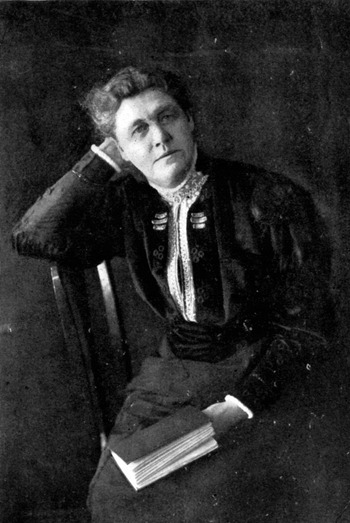
Call came from a prominent New England family. Born in Arlington, Massachusetts, she was the daughter of Henry Edwin and Emily Payson Call; her brother, Edward Payson Call, was publisher of The New York Evening Mail and The New York Commercial. After the death of Call's father, her mother married Edward Anden Whiston, a former port physician in Boston and business manager of the Swedenborgian Massachusetts New-Church Union and editor of New-Church Review. Call taught her technique of bodily education at Lasell Seminary for Young Women in Auburndale, Massachusetts, and saw clients at her office on Arlington Street in Boston.Footnote 4 She was also the principal of the Mount Prospect School for boys in Waltham. Call died at her home in Waltham on February 3, 1940, at the age of 86 (Photo 1).Footnote 5
Annie Payson Call. In The Critic, April 1905, Vol. XLVI, No. 4, p. 298.

Call penned many health manuals, among them The Regeneration of the Body (Reference Call1888), As a Matter of Course (Reference Call1899a), Power Through Repose (Reference Call1900), Every Day Living (Reference Call1905), Nerves and Common Sense (Reference Call1910a), The Freedom of Life (Reference Call1910b), Brain Power for Business Men (Reference Call1911), How to Live Quietly (Reference Call1915a), and Nerves and the War (Reference Call1918).Footnote 6 Composer, singer, and music educator Clara Rogers (1844–1931) in her memoir The Story of Two Lives (1932) notes, “Miss Call's work was attracting much attention, and was regarded daily more and more as a thing of importance. People of intellectual distinction both here and abroad gave heed to it and became her pupils” (Rogers Reference Rogers1932, 42). Most famously, William James realized the psychological value of Call's ideas. James endorsed her works in “The Gospel of Relaxation,” where he states that Call's Power Through Repose “ought to be in the hands of every teacher and student in America of either sex” (James Reference James1911, 66). He adds that Call's As a Matter of Course, “the gospel of moral relaxation, of dropping things from the mind, and not ‘caring,’ is preached with equal success” (James Reference James1911, 73).
Call has been overlooked by most scholars except those who associate her with New Thought or American Delsartism.Footnote 7 Delsartism originated with François Delsarte (1811–1871), a French music and drama teacher who developed a system of dramatic expression based on his studies of people's movements, gestures, and facial expressions. Nancy Lee Chalfa Ruyter notes that American Delsartists focused less on actor training and more on applying Delsartism to everyday life—relaxation, breathing, controlled energy use, and “postural balance, and graceful comportment of the body” (Ruyter Reference Ruyter1999, 71). Delsartism became popular among middle-class women because it was “a pleasing performative program which centered upon the development of ‘repose, vitality, and pose,’ and [it] figured prominently in constructing a public identity for women” (Andrick Reference Andrick2012, 126). Delsartism also impacted the development of modern dance in America: Isadora Duncan learned from Delsarte's movement systems and Ruth St. Denis took Delsarte lessons and also attended an inspiring talk by Genevieve Stebbins, one of the most renowned Delsartism teachers in the United States (see Siegel Reference Siegel1993; Daly Reference Daly2002; Simonson Reference Simonson2013).
Call's response to Delsartism was complex; to regard her work solely in the context of Delsartism is to limit her achievements. While Call's work shared Delsartism's concern with relaxation and repose, she did not present herself as a Delsartean teacher. Call's writing explicitly refers to Delsarte only in a few instances. In a chapter called “Training for Motion” in Power Through Repose (1900), Call notes how “the average ballet girl is not adequately trained, from the natural and artistic standpoint” (Call Reference Call1900, 115). She believes that ballet training relies on “a series of pirouettes and gymnastic contortions, with the theatrical smile of a pretty woman” (Call Reference Call1900, 115). In the same context, she mentions Delsarte:
Many exercises which lead to the freedom of the body are well known in the letter—not in the spirit—through the so-called “Delsarte system.” If they had been followed with a broad appreciation of what they were meant for and what they could lead to, before now students would have realized to a far greater extent what power is possible to the human body. But so much that is good and helpful in the “Delsarte system” has been misused, and so much of what is thoroughly artificial and unhealthy has been mixed with the useful, that one hesitates now to mention Delsarte. Either he was a wonderful genius whose thoughts and discoveries have been sadly perverted, or the inconsistencies of his teachings were great enough to limit the true power which certainly can be found in much that he has left us. (Call Reference Call1900, 116)
Like the Delsartists, Call was engaged in a cultural conversation about relaxation, “natural” or “authentic” expression in dancing, and ease in movement.Footnote 8 Most important, Call diverged from Delsartism's focus on gesture and voice and instead developed a method for sensing the body from within.
Call's ideas participated in a much larger set of health movements of the time. While some of Call's ideas about mental concentration, vitality, and renewed energy echo Delsarte's, many other writers also shared these concerns. The end of the nineteenth century and the beginning of the twentieth witnessed an emergence of health movements, an establishment of health centers, sanatoria, spas, and the spread of vegetarianism and health-promoting diets and medicines. Physical exercise regimes, formal physical education, and modern sports grew in popularity. Leaders of physical culture movements like Bernarr Macfadden and Eugen Sandow founded popular magazines and journals devoted to physical well-being and training, lectured widely, established institutes and communities, and proposed prescriptions on diet, sleep, and clothing (see Wilk Reference Wilk2008). A rich variety of pragmatic methodologies aimed at improving and guaranteeing a well-balanced functioning of the mind and the body. Alternative healing methods, influenced by or adopted from Eastern medical practices, gained in popularity.Footnote 9
A more widespread attention to self-integration, repose, serenity, concentration, and meditation resulted from the overlapping and crossing of ideas stemming from New Thought, Vedanta, mind-cure, and South Asian Buddhism at the end of the nineteenth century. For example, Swami Vivekananda (1863–1902), a follower in India of the reformer Ramakrishna (1836–1886), gave lectures at Harvard as well as in San Francisco and Los Angeles, among other places: his teachings in the United States came in contact with the wider crosscurrents of Theosophy, mind-cure, and New Thought metaphysics. Among his audience members were William James, Gertrude Stein, the philosopher Josiah Royce, the Sanskrit scholar Charles Rockwell Lanman, George Santayana, and the Nobel Peace Prize winner James Addams (see Goldberg Reference Goldberg2013). Vivekananda had a number of successors as teachers of meditation and Yoga at the end of the nineteenth century, among them Swami Paramandanda, who gave talks at Theosophical societies and New Thought meetings.
The popularity of methods that emphasized physical, mental, and spiritual health was possibly a response to industrialization, urbanization, and the horrors of the First World War. Such upheavals were assumed to cause strain on the nervous system, leading to increased reports of nervous disorders in men and especially women (see Blom Reference Blom2008). George Thomas White Patrick, in his Psychology of Relaxation (1916), suggests that the calamity of the First World War calls attention to a more careful study of the psychological conditions of modern life and the effect of the modern metropolis on the mind and the nerves: the rapid progress in science, industry, and invention corresponded with an increase in the rapidity and tension of people's lives (see Patrick Reference Patrick1916). William James laments that that Americans’ faces are “contracted” with “the habitual American over-intensity and anxiety of expression” (James Reference James1939, 74). James sees a “national harm” being done by “ceaseless over-tension, over-motion, and over-expression”—these have a “reflex influence on the inner mental states” (James Reference James1939, 75). He points out that Americans have habits of “jerkiness and bad co-ordination” (James Reference James1911, 64) and concludes, “Our dear American character is weakened by all this over-tension” (James Reference James1911, 64).
Delsartism, among other health methods, aimed at remedying neurasthenia—nerve depletion and exhaustion, “resistance to work or activity in all its forms” (Rabinbach Reference Rabinbach1990, 167)—by attending to the mind, body, and soul. Indeed, by 1888, Delsartean relaxation training principles were formally known as “nerve training” (Andrick Reference Andrick2012, 126). In discussing mental health practices of the period, the popularity and influence of Sigmund Freud cannot be overlooked. Freudian psychoanalysis, however, has a different focus than the psychophysical and meditative practices of the era. Freudian psychoanalysis includes the figure of the psychoanalyst or therapist whose role is integral in the healing process of the self. Contemplative and somatic techniques, in contrast, foreground self-practice and immediate experience: the emphasis is placed on the individual's direct engagement with the practice and the capacity to self-heal and train the mind and body to adopt new habits.
Call's interest in how we perceive our own bodies and learn to relax the mind and the body is particularly relevant for scholars and practitioners of somatics. Although the term “somatics” was not coined until the late twentieth century, the ideas and practices have been developing since the late nineteenth century (see Johnson Reference Johnson1995; Fraleigh Reference Fraleigh2015). Michele Mangione distinguishes different phases in the development of somatics:
(1) The turn of the century to the 1930s: early pioneers developed their methods;
(2) 1930–1970: establishing individual lineages by students of the pioneers;
(3) 1970–1990: integrating different approaches into therapeutic, educational, psychological, and artistic domains. (Mangione Reference Mangione1993, 20–53)
Call is a forerunner of contemporary choreographic practices and movement forms in which sensory awareness, rather than movement technique, structures movement exploration and innovation (see Banes Reference Banes1987; Albright and Gere Reference Albright and Gere2009). As I will show below, Call's techniques clearly position her work in the history of somatic thought and practice.
Call's Somatic Technique
Call begins by asking the same questions common in today's somatic practices: “How to relax?”, “How to ‘drop unnecessary tension’ from the body and the mind?”, “How to use rest to gain vitality?”, and “How to develop ease in motion?” (see Call Reference Call1888, Reference Call1900, Reference Call1905, Reference Call1907). Call is concerned that people are often in states of bodily and mental “contraction.” She laments: “We are so far from the true sense of refreshment and renewal that we have no idea of the possible growth from rest” (Call Reference Call1907, 6). Even in sleep we seldom allow the body to rest completely: “The spine does not give to the bed, leg or arm muscles are tense, fingers are clinched, the throat contracted, or the face is drawn up in some way or another” (Call Reference Call1907, 10). Call urges the reader to release any unnecessary tension from the body on a daily basis, a goal that demands both mental and physical attention. Relaxed breathing and letting go of muscular strain for thirty minutes per day should “save at least a part of the waste of human energy” and “help us to a better and more economical management of our human engine” (Call Reference Call1907, 11).
Both the mind and the body need to be trained to release extra strain in Call's technique. In her vision, physical states of bodily tension tend to be accompanied by mental states of distraction and worrying. She develops techniques that teach how to “do nothing but keep quiet, body and brain” (Call Reference Call1900, 25). In Call's view, worrying or letting the mind jump from one thought to another diffuses rather than concentrates energy. Call writes that the mind's “rapid and misdirected working” has a detrimental effect on “free nerves,” “relaxed muscles,” and “natural sleep” (Call Reference Call1900, 18). Releasing habitual holding patterns in the muscles will “enable us more easily to drop disturbing thoughts” (Call Reference Call1900, 20). Unlike Freud, Call is not interested in healing traumas or moving back to childhood to understand present concerns: she focuses on the need to observe day-to-day mental and physical habits and adopt new ones that provide energy rather than consuming it. She applies the idea of letting go of superfluous effort to how one stands, sits, sleeps, cooks, writes, reads, runs to catch a bus, and leads business ventures: using the body with awareness in daily activities connects Call's ideas to later somatic practices such as the Feldenkrais Method and the Alexander Technique.
Throughout her works, Call includes instructions for physical and mental exercises to bring about states of relaxation. Comparing exercises in different texts reveals her technique. I focus on The Heart of Good Health, The Freedom of Life, and Nerves and Common Sense, and her most famous work, Power Through Repose. Call teaches the practitioner to move his/her attention from one body part to the next, starting with the muscles of the neck and the back of the head, inviting these areas of the body to rest. “It is surprising to find how much force we use to hold our own heads on, as we may prove by our inability to let them drop down,” Call observes in The Heart of Good Health (Call Reference Call1907, 12). This focus on the importance of the alignment of the head for the well-being of the body foreshadows later ideas developed by F. M. Alexander. After the head has partially or fully “regained its freedom,” Call encourages the reader to feel in what part of body “the largest portion of wasted energy appears to be consumed” (Call Reference Call1907, 12). However, if such part cannot be found, the practitioner should attend to the hands, arms, and fingers as they are likely to be tense from constant use (Call Reference Call1907, 12). Then the feet and legs are “trained to be relaxed and quiet when not in use, and the effect of this is to bring a natural rhythmic gait in walking” (Call Reference Call1907, 13). One then releases the muscles in the chest and around the waist area, which in Call's view are “especially hard to relax, and the unnecessary pressure brought to bear on them in walking, almost without exception, very striking” (Call Reference Call1907, 13).
In Power Through Repose, Call proposes two methods for learning to recognize muscular tension and feel the difference between muscles and bones: working with a partner and adopting a self-practice routine. The exercises with a partner are designed to help a practitioner become aware of the tendency to hold on with muscles instead of surrendering weight to gravity. Lying on the back and giving his/her whole weight to the floor, the practitioner lets the partner lift one arm, bend it at the joints, and then lay it down: the arm's entire weight should be given to the partner “so that it seems to be no part of you, but as separate as if it were three bags of sand, fastened loosely at the wrist, the elbow, and the shoulder; it will then be full of life without tension” (Call Reference Call1900, 98). The partner then lifts and catches the arm or the leg: “Unnecessary tension is proved when the limb, instead of dropping by the pure force of gravity, sticks fast wherever it was left” (Call Reference Call1900, 98). The partner then moves the practitioner's head slowly up and down, side to side, “gently and until its owner can let go so completely that it seems like a big ball in the hands that move it” (Call Reference Call1900, 100). The practitioner is then lifted into a sitting position and helped to lie down again, with the aim of increasing awareness of the back and chest muscles: “in lowering the body it must ‘give’ like a bag of bones fastened loosely together and well padded” (Call Reference Call1900, 102). To finish, the partner helps the practitioner to roll “over and over, carefully” without the latter trying to assist the partner (Call Reference Call1900, 102). Call believes that remaining passive while letting another guide one's movement leads to “a steadily increasing ability to relax at all times when the body should be given to perfect rest” (Call Reference Call1900, 103).
During times when a partner's aid is not available or needed, Call proposes establishing a self-practice routine. The sequence of the exercises remains the same as in the partner work. First, the practitioner performs exercises for relaxing the neck muscles. In The Freedom of Life, Call tells the sedentary reader to “drop the head forward very loosely, slowly and heavily, and raise it very slowly, then take a long, quiet breath. Repeat this several times until you begin to feel a sense of weight in your head” (Call Reference Call1910b, 7). In Nerves and Common Sense, she advises dropping the head slowly forward and then lifting it up slowly “as if you pushed it all the way up from the lower part of your spine, or, better still, as if it grew up, so that you feel the slow, creeping, soothing motion all the way up your spine while your head is coming up” (Call Reference Call1910a, 104). These exercises are followed by freeing the spine: the practitioner sits up on the floor, with heavy arms and legs, the head dropped forward, and then lets the spine “go back slowly and easily, as if the vertebrae were beads on a string, and first one bead lay flat, then another and another, until the whole string rests on the floor” (Call Reference Call1900, 106). Next are the rolling exercises. Interspersed throughout the descriptions of the exercises are comments on breathing: “The muscles, being now relaxed into freedom, are held in place, so to speak, by the pressure from the breath—we blow in the fingers of a glove to put them in shape” (Call Reference Call1900, 107). Call's detailed, expressive writing about her techniques, as evidenced here in phrases such as “beads on a string” and “fingers of a glove,” demonstrates her relevance to somatic educators and practitioners of today.
Writing, Reading, and Imagining
As I will show, Call's writings shed light on some of the dynamics of writing and reading about physical sensation and mental calm. She comments on the limitations of the written word to express movement and bodily sensation. In Power Through Repose, she notes that “the set of motions mentioned can only be very inadequately described in print” (Call Reference Call1900, 126) and contends: “So far as I can, I will give directions for gaining true relaxation. But because written directions are apt to be misunderstood, and so bring discouragement and failure, I will purposely omit all but the most simple means of help” (Call Reference Call1900, 97). Indeed, the method she describes is first and foremost experiential, and to write about these bodily-mental exercises is a demanding task: “It is not within the province of this essay to describe the exercises, even if they could be written so clearly that they might be followed and practiced, which unfortunately cannot be done” (Call Reference Call1907, 12).
The inadequacy of words, however, is what incites Call to invent creative ways to evoke imagination for somatic purposes. One way she engages imagination is by peppering her exercises with images that guide the reader into physical sensation. Call employs memorable figurative language such as “take a breath in as gently as a fog creeps in from the sea” (Call Reference Call1907, 16) and “let the breath go out … as the air goes out of little children's balloons when it is allowed to escape” (Call Reference Call1907, 16). Her images come from everyday life, as in “try to let your body rest back on the floor more heavily, as a rubber bag would if the air were allowed to escape from it” (Call Reference Call1900, 104) and “[feel as if] we were lying in the snow, and every time we let the breath out we settled back … and make a deeper impression in the snowbank on which we were lying” (Call Reference Call1907, 16). The reader is likely to have had a similar experience—the memory of it could reside in the body—or can picture the image with ease. These vivid images show a poetic approach to working with the body and mind.
Call evokes somatic imagination by explicitly asking the reader to imagine what it might feel like to be doing an exercise. Instead of emphasizing the need to put the book aside and actually do the exercise, Call seems to be suggesting that it is possible to feel the exercise while reading and imagining. In “train[ing] for rest,” Call asks the reader to imagine lying on the floor and giving up every part of the body to the force of gravity:
Then stop and imagine yourself heavy. First think one leg heavy, then the other, then each arm, and both arms, being sure to keep the same weight in the legs; then your body and head. Use your imagination to the full extent of its power, and think the whole machine heavy; wonder how the floor can hold such a weight. Begin then to take a deep breath. Inhale through the nose quietly and easily. Let it seem as if the lungs expanded themselves without voluntary effort on your part. … Let go and exhale the air with a sense of relief. As the air leaves your lungs, try to let your body rest back on the floor more heavily, as a rubber bag would if the air were allowed to escape from it…. It helps to relax if you imagine your arm holds to the shoulder by a single hair, and that if you move it with a force beyond the minimum needed to raise it, it will drop off entirely. To those who have little or no imagination this will seem ridiculous; to others who have more, and can direct it usefully, this and similar ways will be very helpful. (Call Reference Call1900, 103–105)
Here, Call instructs the practitioner to drop physical tension in the muscles by guiding him/her to feel the weight of the body. Call directs attention to particular body parts, one by one, as in a body scan. Being able to see inwardly and feel one leg heavy, then the other, then each of the arms is in Call's view important for releasing unnecessary muscular contraction.
Call's images are not overly detailed and grant readers space to pursue their own imaginative paths. For example, Call encourages readers to “realize the quiet power of all natural growth and movement”:
No words can bring so full a realization of the quiet power in the progress of Nature as will the simple process of following the growth of a tree in imagination from the workings of its sap in the root up to the tips of the leaves, the blossoms, and the fruit. Or beginning lower, follow the growth of a blade of grass or a flower, then a tree, and so on to the movement of the earth, and then of all the planets in the universe. Let your imagination picture so vividly all natural movements, little by little, that you seem to be really at one with each and all. Study the orderly working of your own bodily functions; and having this clearly in mind, notice where you, in all movements that are or might be under the control of your will, are disobeying Nature's laws. Nature shows us constantly that at the back of every action there should be a great repose. (Call Reference Call1900, 75–76)
Here Call presents an outline for what in fact are three exercises. One version asks the reader to “follow the growth of a tree in imagination” from sap in the root to leaves, blossoms, and fruit. Another version starts the imaginative sequence from a blade of grass or a flower, then moves to imagining the growth of a tree, and the movement of the earth and the planets in the universe. A third version asks the reader to imagine the movement of the planets and the entire universe and study bodily functions and movements under one's control. Although all versions take up a short space on the page, imaginatively they are actually asking for a lengthy engagement: attempting to imagine the movement of all the planets in the universe by itself can take a long time. Call is not asking one to actually explore the natural world over a period of time but rather to conjure up one's own mental picture of what these processes could look and feel like.
Mental compositions of images are orderly, sequential, and gradual in Call's exercises. The images move from smaller to bigger objects, from lower to higher, from outer to inner or inner to outer. In the previous example, the instructions rely on linear progression helping the reader gradually imagine himself/herself as a part of the larger imagined natural environment. Rather than concentrating on an immobile or static image and asking the mind to be still, Call encourages the reader to move the mind, in a systematic fashion: one image is a logical, organic outgrowth of the next. Indeed, Call herself evokes the very word “orderly”: “study the orderly working of your own bodily functions” and proceed to noticing misalignments with “natural forces” in the body only after studying the “orderly working” is “clearly in mind.”
What are the particular linguistic commands that Call uses to move the mind and evoke inward sensation? Her commands in the two long passages quoted above display a variety of cognitive tasks. The instructions in these passages ask the reader to “imagine,” “think,” and “feel.” “Let it seem,” “wonder,” “try,” and “it helps if you imagine” allow for the desired phenomena to arise rather than rigidly prescribe them: the language is inviting. Call highlights that the images need to come vividly alive for the reader. Perhaps with this intent in mind, she chooses images that emanate from the natural world. “Study” an image or “wonder” or “think” ask the reader to get curious about the image and explore its effect. “Let your imagination picture so vividly all natural movements, little by little, that you seem to be really at one with each and all” emphasizes that the reader should not see the images as outside of his/her body but rather become one with them and feel them inwardly. “Use your imagination to the full extent of its power” urges the mind to be fully engaged. The images are not meant to be thought about or seen in the mind's eye only but also to be felt. For example, “in letting our breath out we should feel ourselves relax inside with a sense of rest” (Call Reference Call1907, 16). Even in the realm of feeling, Call's language leaves room for the reader's own response, as seen in the repetitions of “should feel” rather than the imperative “feel.” Through all these commands, Call involves a range of mental functions to bring about a sense of release and calmness.
Call performs on the page a mental relaxation meditation. Reading these exercises and conjuring up the scenes in the mind's eye while reading, rather than putting the book aside and trying the exercise out, may, in Call's view, bring about a calmed state. For example, Call explains how to keep the mind concentrated on one imaginative scenario. She advocates the need to “drop all our effort of our minds if we want to know how to rest; and that is difficult. We can do it best by keeping our minds concentrated on something simple and quiet and wholesome” (Call Reference Call1910a, 37). She notes:
For instance, you can feel tired and rushed and you can have half an hour in which to rest and get rid of the rush. Suppose you lie down on the bed and imagine yourself a turbulent lake after a storm. The storm is dying down, dying down, until by and by there is no wind, only little dashing waves that the wind has left. Then the waves quiet down steadily, more and more, until finally they are only ripples on the water, then no ripples, but the water is as still as glass. The sun goes down. The sky glows. Twilight comes. One star appears, and green banks and trees and sky and stars are all reflected in the quiet mirror of the lake, and you are the lake, and you are quiet and refreshed and rested and ready to get up and go on with your work—to go on with it, too, better and more quietly than when you left it. (Call Reference Call1910a, 37)
Call starts out by asking the reader to imagine herself/himself as a lake after a storm. She later reminds the reader of the initial request: “you are the lake, and you are quiet and refreshed and rested and ready to get up and go on with your work.” Rather than seeing an image outside of ourselves as spectators, Call wants us to be in the image or feel like we are a particular image.
Coordination rather than subordination on the level of sentence structure is what Call uses to write about mental relaxation. “The sun goes down. The sky glows. Twilight comes” in the passage above is a sequence of short sentences, each presenting one clear image or thought. “One star appears, and green banks and trees and sky and stars are all reflected in the quiet mirror of the lake, and you are the lake” is a sentence that moves by coordination of phrases, words, or clauses joined by “and.” These structures focus on linear accumulation of information, a forward progression of one element at a time rather than subordinating information, which sets individual elements in hierarchical and causal relationships with one another. Call seems to be suggesting that for the mind to stay in a state of calm, the preferred linguistic means is sequential coordination.
We can use our imaginations to stir up the mind, for example, by following an exciting adventure story. Call's writing, however, suggests that we can use imaginative powers also for a very different purpose—to rest the mind. She writes:
Or, another way to quiet your mind and let your imagination help you to a better rest is to float on the top of a turbulent sea and then to sink down, down, down until you get into the still water at the bottom of the sea. … No matter how furious the sea is on the surface, not far below the surface it is absolutely still. It is very restful to go down there in imagination. (Call Reference Call1910a, 38)
The passage is characterized by repetitive, almost lulling language (“sink down, down, down,” “and you are the lake and you are quiet”). Call uses language to create an experience of slowed movement of thoughts. This passage explicitly reveals the overall intent of her exercises: “let your imagination help you to a better rest.”
Story-like progression and narrative elements characterize these relaxation exercises. As the examples above show, Call offers lengthy scenarios that are meant to help the reader conjure up certain scenes in the mind's eye. These scenes are by necessity rather static in that they are not full mini-stories with characters and plot development. But they do depict some movement and change, as in “the storm is dying,” “the sun goes down,” “twilight comes” (Call Reference Call1910a, 37). As was the case with the orderly sequence of images discussed above, narrative also promotes movement, rather than stillness, in the mind. Call's reliance on these narrative sequences suggests a belief in narrative's power to help a practitioner cognitively process the ideas in contrast to exercises that detail specific movements. Delsarte teacher Genevieve Stebbins offers an exercise: “(a) stand before a chair, attitude legs con-con [palm in, fingers turned to earth]; right leg strong; (b) bend right knee as far down and out as is possible; (c) bend torso forward in opposition. The thigh now meets the chair and you are seated” (Stebbins Reference Stebbins1886, 84). These instructions exemplify the difficulty of following detailed or seemingly technical descriptions for physical exercises in one's mind's eye, possibly preventing the reader from engaging in a deeper imaginative process.
Conclusion
Reasons as to why Call has been neglected in the history of somatics can be manifold. First, Call did not write manuals devoted solely to movement. Her writings explore how her ideas of mental and physical relaxation could play out in family settings, business endeavors, and understanding peace. While this seemingly wide perspective makes the somatic intent of her work merge with other concerns, it simultaneously demonstrates how somatic principles could be applied to different life scenarios. As I have shown, her exercises for self-practice and partner work have a clear structure and sequence and reveal the somatic nature of her work. However, due to the dispersal of the exercises throughout many texts, their coherence becomes less noticeable unless studied. Second, Call did not attach her name to well-known movement theorists and dance practitioners of the time. She was an educator, not a dance performer. As Nancy Ruyter has argued, educators have tended to gain less attention compared to dance performers in the history of dance and movement (see Ruyter Reference Ruyter1999). Call's writings were popular and her ideas did travel—for example, Clara Rogers notes that Frances E. Archer, wife of the Scottish dramatic critic William Archer (1856–1924) was a proponent of Call's ideas in Britain (see Rogers Reference Rogers1932). However, Call did not establish a training program to educate other teachers of her method, which prevented her ideas from spreading.Footnote 10
Call's ideas participated in the cultural conversation on “natural” movement. Elizabeth Selden, in her Elements of the Free Dance (1930), defines “natural dance” as “a method used in educational work, placing less emphasis on form than on expression. The objective is to develop a vigorous, controlled and expressive body through the most efficient use of natural movements” (1930, 158). Isadora Duncan in her performances and Margaret H'Doubler and Gertrude Colby in their dance teaching explored and promoted their versions of “natural” movement, calling attention to inborn impulses for expression, the use of “natural” movements, such as skipping, galloping, running, and leaping in dance, and finding inspiration for movement in the natural environment (see Colby Reference Colby1922; H'Doubler Reference H'Doubler1940; Ross Reference Ross2000). In Call's approach, “natural” refers to states of being where the individual is uninhibited by tension that causes strained or artificial movement; “natural” in her writings also refers to the ability to follow the dynamics of effort and rest in the natural world. Call's inquiry into “natural” movement adds another layer to the explorations of “free” and “expressive” dance forms at the beginning of the twentieth century: she highlighted the questions of what mental and physical adjustments, what kind of release work in the muscles and alignment in the skeleton allow a dancer to move with more freedom and enable him/her to express emotions through movement more readily in the first place.
Call's constant attention to both the mind and the body in acts of relaxation makes her technique somatic. In her physical exercises, different cognitive capacities are engaged in tracing sensations in the body, imagining inner perception, and paying attention to how the movement is being executed. In her exercises for relaxing the mind, the starting point is the body: the physicality of the self is not neglected in the work on the mental realm. Call's technique is thus both a physical education and a training in mental attention and awareness. Language plays an important role in both the physical and the mental exercises. The physical exercises rely heavily on poetic imagery, indicating that imaginative capacities are crucial in working with bodily sensation. The mental relaxation exercises employ imagery and narrative structures that highlight sequential movement from one image to the next: to calm the mind, Call sets the mind to follow and imagine orderly movement. While Elaine Scarry's framework emphasizes the visual—how readers compose one image in the mind's eye, set the image in motion and move to the next—Call is preoccupied with how images make us feel or capture physical sensations.
The reading practice is important in experiencing Call's technique via writing. Call's use of expressive language, her explicit instructions to “imagine,” as well as the integration of the exercises directly into the body of the text are crucial for helping readers use their imagination for somatic purposes. In Genevieve Stebbins’ Delsartist texts, the exercises are clearly listed, titled, and grouped, thereby signaling the texts’ status as health manuals (see Stebbins Reference Stebbins1886, Reference Stebbins1898). In contrast, philosophical reflections, theorizations, and somatic exercises are not textually separated from one another in Call's health manuals: the exercises do not occur as appendixes, footnotes, or italicized parts of the text, and so encourage a deeper reading experience. Call makes no distinctions between somatic exercises and philosophical reflections and so the registers of the text are not separated visually. The reader can seamlessly move from an account of the body posture of contemporary women, the brain power of businessmen, and the peacefulness of familial settings, to a section in which Call makes a direct address to the reader. Since it would be difficult to perform and read the exercise at the same time, readers may imagine these states of physical and mental relaxation, within the body, as they are reading her instructions—or they may stop reading in order to imagine. Although there is no direct textual evidence of Eastern meditation practices in Call's work, her vivid instructions and her direct address to readers are evidence that her exercises are or depict a form of meditation. The sections where the author asks the reader to imagine a particular effect in the mind or the body can also set readers themselves into a meditative framework: readers may be able experience the exercise as they read it.
Call's work thus demonstrates the historical significance of somatics and provides insight into the processes of reading, writing, and imagining. Her work offers an important dimension to somatics—attention to language, imagination, and the way the reader is treated. Her works manifest the desire on the part of the author not only to describe the processes of the calm or meditative mind and the relaxed body but also to evoke a response in readers. Call's writing technique is not simply to provide information but to also help activate her reader's somatic imagination through her poetical, evocative language and narrative structures. Reading Call's work and engaging in an imaginative process without visual or auditory aids is, at bottom, a form of somatic training itself.