Ree, Carretta, and Teachout (Reference Ree, Carretta and Teachout2015) outlined a compelling argument for the pervasiveness of dominant general factors (DGFs) in psychological measurement. We agree that DGFs are important and that they are found for various constructs (e.g., cognitive abilities, work withdrawal), especially when an “unrotated principal components” analysis is conducted (Ree et al., p. 8). When studying hierarchical constructs, however, a narrow emphasis on uncovering DGFs would be incomplete at best and detrimental at worst. This commentary largely echoes the arguments made by Wee, Newman, and Joseph (Reference Wee, Newman and Joseph2014), and Schneider and Newman (Reference Schneider and Newman2015), who provided reasons for considering second-stratum cognitive abilities. We believe these same arguments in favor of second-stratum factors in the ability domain can be applied to hierarchical constructs more generally.
Hierarchical Constructs: Modern Psychometric Analyses Reveal the Second Stratum
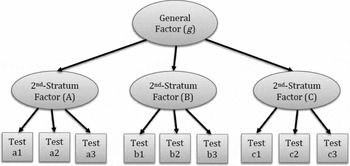
Hierarchical constructs are everywhere. Even in the domain of cognitive ability, where positive manifold and empirical evidence for DGF is perhaps the strongest of any content domain, Carroll's (Reference Carroll1993) empirical review of over 400 datasets led him to conclude that cognitive ability was best described not by a unidimensional model but by a hierarchical three-stratum model (also see McGrew, Reference McGrew2009). According to the hierarchical factor modelFootnote 1 (see, e.g., Figure 1), a set of cognitive tests (e.g., tests of reading comprehension, vocabulary, and grammar) reflects a more-specific intellectual ability—that is, second-stratum ability (e.g., reading–writing ability). In turn, a set of second-stratum ability factors (e.g., reading-writing, quantitative reasoning, visual-spatial processing) reflects Spearman's higher order g factor. Hierarchical factor models of cognitive ability typically fit the data better than do unidimensional models (e.g., MacCann, Joseph, Newman, & Roberts, Reference MacCann, Joseph, Newman and Roberts2014; Outtz & Newman, Reference Outtz, Newman and Outtz2010). The emerging consensus is thus that cognitive abilities are a set of hierarchically organized constructs: A higher order factor (i.e., g, the cognitive DGF) may be extracted from the positively correlated lower order factors (Schneider & Newman, Reference Schneider and Newman2015). We speculate that hierarchical factor models would also fare well in content domains such as job attitudes (Newman, Joseph, & Hulin, Reference Newman, Joseph, Hulin and Albrecht2010) and work withdrawal (Hanisch, Hulin, & Roznowski, Reference Hanisch, Hulin and Roznowski1998), as well as in the many domains where Ree et al. identified DGFs; we assert that in all of these domains, psychometric models that include the second-stratum factors will tend to provide better fit to the data than do unidimensional models that include only a DGF.
Figure 1.Hierarchical model with three strata (example). Examples of second-stratum cognitive abilities might include numerical ability, verbal ability, spatial ability, and clerical ability. Examples of tests that reflect numerical ability might include both arithmetic reasoning (word problems) and math knowledge (algebra-geometry-fractions-exponents). Examples of tests that reflect clerical ability/cognitive speed might include both numerical operations (a speeded test of simple math problems) and coding speed (a speeded test of recognizing arbitrary number strings; see Outtz & Newman, Reference Outtz, Newman and Outtz2010).
As Ree et al. highlighted, the DGF often accounts for the majority of the test variance in a given psychological construct. When hierarchical factor analyses are conducted, each second-stratum ability factor accounts for less test variance than the DGF does. But focusing on the DGF while ignoring second-stratum ability factors may indicate a construct-deficient measurement model. In the cognitive ability domain for example, in addition to loading on the DGF, tests often also load substantially onto second-stratum ability factors. Mean loadings on the second-stratum factors were .42 for the Woodcock-Johnson Psycho-Educational Test Battery Manual sample (vs. .59 on g; Carroll, Reference Carroll and Nyborg2003) and also .42 for the 1960 Project TALENT sample (vs. .55 on g; Reeve, Reference Reeve2004). Although we concur with Ree et al. that DGFs are very important, we disagree with giving short shrift to second-stratum factors.
Some esteemed scholars have decried second-stratum factors as artifactual because it is plausible to attribute the appearance of second-stratum factors to factor fractionation or swollen specifics (Humphreys, Reference Humphreys1962; Kelley, Reference Kelley1939). That is, any factor solution can be conditioned by adding tests from the same narrow domain until a lower order factor emerges. This argument is logically valid. By the same logic, however, any DGF (including g itself) might likewise be considered a swollen specific, which emerges because researchers have measured a given domain using relatively homogeneous instrumentation (Outtz & Newman, Reference Outtz, Newman and Outtz2010). More specifically, the application of the cornerstone principle of convergent validity—in which a test is considered to measure cognitive ability only if it correlates highly with other cognitive ability tests—leads to homometric reproduction of constructs and instruments (Outtz & Newman, Reference Outtz, Newman and Outtz2010). It is thus potentially inconsistent to claim that second-stratum factors emerge due to swollen specifics while simultaneously ignoring the possibility that DGFs are themselves swollen specifics, arising through the same process of specifying factor models on arbitrarily homogeneous indicators.
Specific Validity Depends on the Criterion Variable
Diversity outcomes. The use of cognitive tests in high-stakes selection typically results in adverse impact (i.e., the selection of disproportionately fewer minority applicants as compared with majority applicants), harming the diversity outcomes of a selection system. This is because the mean Black–White subgroup difference on a cognitive test composite (measuring g) is approximately 1 standard deviation in magnitude (Roth, Bevier, Bobko, Switzer, & Tyler, Reference Roth, Bevier, Bobko, Switzer and Tyler2001). By contrast, second-stratum cognitive abilities can vary substantially in terms of the magnitude of their Black–White subgroup differences (Hough, Oswald, & Ployhart, Reference Hough, Oswald and Ployhart2001; Wee et al., Reference Wee, Newman and Joseph2014). By considering second-stratum cognitive abilities, rather than g alone, it is possible for specific cognitive ability factors to be differentially weighted so as to attenuate the trade-off between selection quality and organizational diversity. This is achieved by differentially weighting second-stratum abilities to achieve Pareto-optimal selection quality–diversity tradeoffs (De Corte, Lievens, & Sackett, Reference De Corte, Lievens and Sackett2007). For example, across two large samples comprising a total of 15 job families, Wee et al. (Reference Wee, Newman and Joseph2014) showed it was possible to improve the proportion of hires from the minority group across all job families studied, with little to no decrement in selection quality compared with a unit-weighted cognitive test composite (essentially, compared with g). At least 8% diversity improvement was possible in all job families, and in four of the 15 job families, the adverse impact ratio more than doubled, greatly improving the proportion of job offers extended to minority candidates. Diversity improvement was typically achieved by assigning more weight in the selection system to second-stratum numerical ability and clerical ability and less weight to second-stratum verbal ability (Wee et al., Reference Wee, Newman and Joseph2014).
As is the case with other types of estimation, it is difficult to robustly estimate the weights assigned to second-stratum abilities at small sample sizes (e.g., N < 50), and more work examining the cross-validity of the technique remains to be conducted. Nonetheless, Wee et al. (Reference Wee, Newman and Joseph2014) offer a “proof of concept” that organizational diversity may be improved without loss of selection quality, when compared with a unit-weighted g composite. For those interested in organizational diversity outcomes, Wee et al.’s results may augur a renewed interest in second-stratum abilities.
The compatibility principle. Beyond diversity outcomes, we acknowledge there has been only modest evidence for specific validity (i.e., incremental prediction of work performance criteria by second-stratum abilities, beyond g), especially for the criteria of training grades and work samples (see review by Ree & Carretta, Reference Ree and Carretta2002). Some scholars have noted that the meager results for the incremental validity of specific abilities might be due to how the performance criterion is measured (Reeve & Hakel, Reference Reeve and Hakel2002; Viswesvaran & Ones, Reference Viswesvaran and Ones2002). Echoing these authors and Ajzen and Fishbein (Reference Ajzen and Fishbein1977; also Fishbein & Ajzen, Reference Fishbein and Ajzen1974), Schneider and Newman (Reference Schneider and Newman2015) proposed an ability–performance compatibility principle: “General abilities predict general job performance, whereas specific abilities predict specific job performance.” Schneider and Newman also note, “To our knowledge, only the first half of the ability–job performance compatibility principle (i.e., general ability predicts general job performance) has been rigorously evaluated to date” (p. 15). These authors then reviewed some suggestive results that are potentially relevant to the claim that specific abilities predict specific job performance criteria (Hogan & Holland, Reference Hogan and Holland2003; Joseph & Newman, Reference Joseph and Newman2010). However, research efforts are still hampered by a failure to evaluate specific job performance criteria (e.g., verbal job performance, spatial job performance). Until the job performance criterion is measured with compatible bandwidth to the cognitive ability construct, it will be difficult to draw unequivocal conclusions about the incremental validity of second-stratum abilities beyond g.
We expect the compatibility principle to generalize across relationships other than the cognitive ability–job performance relationship. That is, we should not expect second-stratum factors to predict general criteria. Instead, second-stratum factors should predict second-stratum criteria. Keeping this in mind should aid future researchers in designing potentially clearer tests of the specific validity hypothesis.
Positive Manifold Without g: Cascading Models
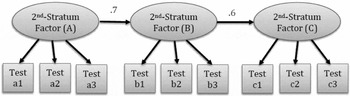
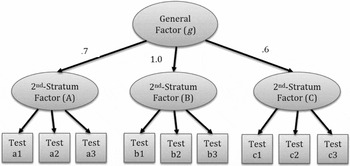
Ree and colleagues acknowledge that van der Maas et al.’s (Reference van der Maas, Dolan, Grasman, Wicherts, Huizenga and Raijmakers2006) mutualism model could produce positive manifold in the absence of g, and we agree. Another, much simpler model—a cascading or mediation model—is also able to produce positive manifold in the absence of g. A cascading model is a type of mediation model that implies the sequential development of a set of related constructs over time, where development of one construct or skill enables the development of another construct or skill. For example, in Joseph and Newman's (Reference Joseph and Newman2010) cascading model, emotional intelligence facets are connected in a developmental sequence: Emotion perception gives rise to emotion understanding, which in turn gives rise to emotion regulation. Yet, emotion perception, emotion understanding, and emotion regulation can also be treated as second-stratum factors of a higher order emotional intelligence construct (MacCann et al., Reference MacCann, Joseph, Newman and Roberts2014). It turns out that this is not uncommon: A cascading model (see Figure 2A) and a model containing a DGF (see Figure 2B) can often be fit equally well to the same data. So the data can often be equivocal as to whether a cascading model versus a DGF model is a more accurate theoretical specification. Whether the positive manifold is due to cascading/mediation versus a general higher order factor will likely require longitudinal data to resolve (see Cole & Maxwell, Reference Cole and Maxwell2003, for a description of how longitudinal data might be useful in establishing mediation or cascading effects).
Figure 2A.Cascading model (example).
Figure 2B.Model with general factor (supported by same data as Figure 2A).
Summary
Empirically, we agree with Ree et al. that a positive manifold exists in many psychological constructs and that disregarding this positive manifold muddies the theoretical waters. Methodologically, as compared with an unrotated principal components analysis, more effective analytic strategies such as hierarchical and bifactor analyses exist to disentangle DGFs from second-stratum factors. We believe an emphasis on DGFs—at the expense of second-stratum factors—would prevent us from developing a deeper theoretical understanding of the nomological networks of psychological constructs. Both DGFs and second-stratum factors should be considered. We concur that ignoring DGFs is a chronic and widespread problem in many domains of organizational research, but overemphasizing DGFs to the disregard of second-stratum factors (as exemplified in the domain of cognitive ability research; Schneider & Newman, Reference Schneider and Newman2015; Wee et al., Reference Wee, Newman and Joseph2014) can also be a problem. The predictive value of second-stratum factors should be audited while keeping in mind multiple criteria (e.g., diversity outcomes), the compatibility principle (i.e., specific predictors lead to specific criteria), and the possibility that positive manifold can emerge from cascading models (i.e., mediation models).





Ree, Carretta, and Teachout (Reference Ree, Carretta and Teachout2015) outlined a compelling argument for the pervasiveness of dominant general factors (DGFs) in psychological measurement. We agree that DGFs are important and that they are found for various constructs (e.g., cognitive abilities, work withdrawal), especially when an “unrotated principal components” analysis is conducted (Ree et al., p. 8). When studying hierarchical constructs, however, a narrow emphasis on uncovering DGFs would be incomplete at best and detrimental at worst. This commentary largely echoes the arguments made by Wee, Newman, and Joseph (Reference Wee, Newman and Joseph2014), and Schneider and Newman (Reference Schneider and Newman2015), who provided reasons for considering second-stratum cognitive abilities. We believe these same arguments in favor of second-stratum factors in the ability domain can be applied to hierarchical constructs more generally.
Hierarchical Constructs: Modern Psychometric Analyses Reveal the Second Stratum
Hierarchical constructs are everywhere. Even in the domain of cognitive ability, where positive manifold and empirical evidence for DGF is perhaps the strongest of any content domain, Carroll's (Reference Carroll1993) empirical review of over 400 datasets led him to conclude that cognitive ability was best described not by a unidimensional model but by a hierarchical three-stratum model (also see McGrew, Reference McGrew2009). According to the hierarchical factor modelFootnote 1 (see, e.g., Figure 1), a set of cognitive tests (e.g., tests of reading comprehension, vocabulary, and grammar) reflects a more-specific intellectual ability—that is, second-stratum ability (e.g., reading–writing ability). In turn, a set of second-stratum ability factors (e.g., reading-writing, quantitative reasoning, visual-spatial processing) reflects Spearman's higher order g factor. Hierarchical factor models of cognitive ability typically fit the data better than do unidimensional models (e.g., MacCann, Joseph, Newman, & Roberts, Reference MacCann, Joseph, Newman and Roberts2014; Outtz & Newman, Reference Outtz, Newman and Outtz2010). The emerging consensus is thus that cognitive abilities are a set of hierarchically organized constructs: A higher order factor (i.e., g, the cognitive DGF) may be extracted from the positively correlated lower order factors (Schneider & Newman, Reference Schneider and Newman2015). We speculate that hierarchical factor models would also fare well in content domains such as job attitudes (Newman, Joseph, & Hulin, Reference Newman, Joseph, Hulin and Albrecht2010) and work withdrawal (Hanisch, Hulin, & Roznowski, Reference Hanisch, Hulin and Roznowski1998), as well as in the many domains where Ree et al. identified DGFs; we assert that in all of these domains, psychometric models that include the second-stratum factors will tend to provide better fit to the data than do unidimensional models that include only a DGF.
Hierarchical model with three strata (example). Examples of second-stratum cognitive abilities might include numerical ability, verbal ability, spatial ability, and clerical ability. Examples of tests that reflect numerical ability might include both arithmetic reasoning (word problems) and math knowledge (algebra-geometry-fractions-exponents). Examples of tests that reflect clerical ability/cognitive speed might include both numerical operations (a speeded test of simple math problems) and coding speed (a speeded test of recognizing arbitrary number strings; see Outtz & Newman, Reference Outtz, Newman and Outtz2010).
As Ree et al. highlighted, the DGF often accounts for the majority of the test variance in a given psychological construct. When hierarchical factor analyses are conducted, each second-stratum ability factor accounts for less test variance than the DGF does. But focusing on the DGF while ignoring second-stratum ability factors may indicate a construct-deficient measurement model. In the cognitive ability domain for example, in addition to loading on the DGF, tests often also load substantially onto second-stratum ability factors. Mean loadings on the second-stratum factors were .42 for the Woodcock-Johnson Psycho-Educational Test Battery Manual sample (vs. .59 on g; Carroll, Reference Carroll and Nyborg2003) and also .42 for the 1960 Project TALENT sample (vs. .55 on g; Reeve, Reference Reeve2004). Although we concur with Ree et al. that DGFs are very important, we disagree with giving short shrift to second-stratum factors.
Some esteemed scholars have decried second-stratum factors as artifactual because it is plausible to attribute the appearance of second-stratum factors to factor fractionation or swollen specifics (Humphreys, Reference Humphreys1962; Kelley, Reference Kelley1939). That is, any factor solution can be conditioned by adding tests from the same narrow domain until a lower order factor emerges. This argument is logically valid. By the same logic, however, any DGF (including g itself) might likewise be considered a swollen specific, which emerges because researchers have measured a given domain using relatively homogeneous instrumentation (Outtz & Newman, Reference Outtz, Newman and Outtz2010). More specifically, the application of the cornerstone principle of convergent validity—in which a test is considered to measure cognitive ability only if it correlates highly with other cognitive ability tests—leads to homometric reproduction of constructs and instruments (Outtz & Newman, Reference Outtz, Newman and Outtz2010). It is thus potentially inconsistent to claim that second-stratum factors emerge due to swollen specifics while simultaneously ignoring the possibility that DGFs are themselves swollen specifics, arising through the same process of specifying factor models on arbitrarily homogeneous indicators.
Specific Validity Depends on the Criterion Variable
Diversity outcomes. The use of cognitive tests in high-stakes selection typically results in adverse impact (i.e., the selection of disproportionately fewer minority applicants as compared with majority applicants), harming the diversity outcomes of a selection system. This is because the mean Black–White subgroup difference on a cognitive test composite (measuring g) is approximately 1 standard deviation in magnitude (Roth, Bevier, Bobko, Switzer, & Tyler, Reference Roth, Bevier, Bobko, Switzer and Tyler2001). By contrast, second-stratum cognitive abilities can vary substantially in terms of the magnitude of their Black–White subgroup differences (Hough, Oswald, & Ployhart, Reference Hough, Oswald and Ployhart2001; Wee et al., Reference Wee, Newman and Joseph2014). By considering second-stratum cognitive abilities, rather than g alone, it is possible for specific cognitive ability factors to be differentially weighted so as to attenuate the trade-off between selection quality and organizational diversity. This is achieved by differentially weighting second-stratum abilities to achieve Pareto-optimal selection quality–diversity tradeoffs (De Corte, Lievens, & Sackett, Reference De Corte, Lievens and Sackett2007). For example, across two large samples comprising a total of 15 job families, Wee et al. (Reference Wee, Newman and Joseph2014) showed it was possible to improve the proportion of hires from the minority group across all job families studied, with little to no decrement in selection quality compared with a unit-weighted cognitive test composite (essentially, compared with g). At least 8% diversity improvement was possible in all job families, and in four of the 15 job families, the adverse impact ratio more than doubled, greatly improving the proportion of job offers extended to minority candidates. Diversity improvement was typically achieved by assigning more weight in the selection system to second-stratum numerical ability and clerical ability and less weight to second-stratum verbal ability (Wee et al., Reference Wee, Newman and Joseph2014).
As is the case with other types of estimation, it is difficult to robustly estimate the weights assigned to second-stratum abilities at small sample sizes (e.g., N < 50), and more work examining the cross-validity of the technique remains to be conducted. Nonetheless, Wee et al. (Reference Wee, Newman and Joseph2014) offer a “proof of concept” that organizational diversity may be improved without loss of selection quality, when compared with a unit-weighted g composite. For those interested in organizational diversity outcomes, Wee et al.’s results may augur a renewed interest in second-stratum abilities.
The compatibility principle. Beyond diversity outcomes, we acknowledge there has been only modest evidence for specific validity (i.e., incremental prediction of work performance criteria by second-stratum abilities, beyond g), especially for the criteria of training grades and work samples (see review by Ree & Carretta, Reference Ree and Carretta2002). Some scholars have noted that the meager results for the incremental validity of specific abilities might be due to how the performance criterion is measured (Reeve & Hakel, Reference Reeve and Hakel2002; Viswesvaran & Ones, Reference Viswesvaran and Ones2002). Echoing these authors and Ajzen and Fishbein (Reference Ajzen and Fishbein1977; also Fishbein & Ajzen, Reference Fishbein and Ajzen1974), Schneider and Newman (Reference Schneider and Newman2015) proposed an ability–performance compatibility principle: “General abilities predict general job performance, whereas specific abilities predict specific job performance.” Schneider and Newman also note, “To our knowledge, only the first half of the ability–job performance compatibility principle (i.e., general ability predicts general job performance) has been rigorously evaluated to date” (p. 15). These authors then reviewed some suggestive results that are potentially relevant to the claim that specific abilities predict specific job performance criteria (Hogan & Holland, Reference Hogan and Holland2003; Joseph & Newman, Reference Joseph and Newman2010). However, research efforts are still hampered by a failure to evaluate specific job performance criteria (e.g., verbal job performance, spatial job performance). Until the job performance criterion is measured with compatible bandwidth to the cognitive ability construct, it will be difficult to draw unequivocal conclusions about the incremental validity of second-stratum abilities beyond g.
We expect the compatibility principle to generalize across relationships other than the cognitive ability–job performance relationship. That is, we should not expect second-stratum factors to predict general criteria. Instead, second-stratum factors should predict second-stratum criteria. Keeping this in mind should aid future researchers in designing potentially clearer tests of the specific validity hypothesis.
Positive Manifold Without g: Cascading Models
Ree and colleagues acknowledge that van der Maas et al.’s (Reference van der Maas, Dolan, Grasman, Wicherts, Huizenga and Raijmakers2006) mutualism model could produce positive manifold in the absence of g, and we agree. Another, much simpler model—a cascading or mediation model—is also able to produce positive manifold in the absence of g. A cascading model is a type of mediation model that implies the sequential development of a set of related constructs over time, where development of one construct or skill enables the development of another construct or skill. For example, in Joseph and Newman's (Reference Joseph and Newman2010) cascading model, emotional intelligence facets are connected in a developmental sequence: Emotion perception gives rise to emotion understanding, which in turn gives rise to emotion regulation. Yet, emotion perception, emotion understanding, and emotion regulation can also be treated as second-stratum factors of a higher order emotional intelligence construct (MacCann et al., Reference MacCann, Joseph, Newman and Roberts2014). It turns out that this is not uncommon: A cascading model (see Figure 2A) and a model containing a DGF (see Figure 2B) can often be fit equally well to the same data. So the data can often be equivocal as to whether a cascading model versus a DGF model is a more accurate theoretical specification. Whether the positive manifold is due to cascading/mediation versus a general higher order factor will likely require longitudinal data to resolve (see Cole & Maxwell, Reference Cole and Maxwell2003, for a description of how longitudinal data might be useful in establishing mediation or cascading effects).
Cascading model (example).
Model with general factor (supported by same data as Figure 2A).
Summary
Empirically, we agree with Ree et al. that a positive manifold exists in many psychological constructs and that disregarding this positive manifold muddies the theoretical waters. Methodologically, as compared with an unrotated principal components analysis, more effective analytic strategies such as hierarchical and bifactor analyses exist to disentangle DGFs from second-stratum factors. We believe an emphasis on DGFs—at the expense of second-stratum factors—would prevent us from developing a deeper theoretical understanding of the nomological networks of psychological constructs. Both DGFs and second-stratum factors should be considered. We concur that ignoring DGFs is a chronic and widespread problem in many domains of organizational research, but overemphasizing DGFs to the disregard of second-stratum factors (as exemplified in the domain of cognitive ability research; Schneider & Newman, Reference Schneider and Newman2015; Wee et al., Reference Wee, Newman and Joseph2014) can also be a problem. The predictive value of second-stratum factors should be audited while keeping in mind multiple criteria (e.g., diversity outcomes), the compatibility principle (i.e., specific predictors lead to specific criteria), and the possibility that positive manifold can emerge from cascading models (i.e., mediation models).