1. Introduction
Every artwork is to some extent ‘open’: it leaves gaps for the audience to engage with via active interpretation, or actual engagement and co-creation. The idea of participatory creation is already evident in Umberto Eco's article ‘The Poetics of the Open Work’ from 1959, in which the author suggests, in the light of open-ended musical works created by his contemporaries, that even though some works clearly invite co-authorship there is an ‘open’ aspect common to all artworks (1959: 173):
(i) ‘open’ works … are characterized by the invitation to make the work together with the author … (ii) on a wider level … there exist works which, though organically completed, are ‘open’ to continuous generation of internal relations which the addressee must uncover and select in his act of perceiving the totality of incoming stimuli. (iii) Every work of art … is effectively open to a virtually unlimited range of possible readings, each of which causes the work to acquire new vitality in terms of one particular taste, or perspective, or personal performance.
Eco points to different types of artworks that invite various forms of engagement. Such engagement can vary, from a personal subjective reading of a work to the possibility of actively influencing it through participatory frameworks. Even the most seemingly fixed and predetermined work of art is in some way participatory, as it requires the audience to take on an active interpretative role in the creation of a message. In more participatory works, the audience is invited to co-create the work. It is therefore useful to speak of a continuum of active interpretation to co-creation.
The open musical work challenges conventions that have become part of the performance tradition, the most obvious of which are: the separation between audience and performers both in the spaces they occupy (stage vs. seating area) and the roles they play, and the importance of the centralised ‘author’ who creates the piece and prescribes the performative acts. These conventions have been questioned in particular since the mid-twentieth-century in happenings, experimental theatre and installations. The increasing availability of technologies of dissemination and interactivity further enabled the reshaping of the performative, turning us all into performers via social networks and content-sharing websites. Increasingly we see works, such as interactive installations and gaming systems, in which performative action is delegated to the audience/player. Roles of authorship, performance and spectatorship are blurred and they can be shared, transferred and superimposed. The ‘work’ here is emergent, occurring as a result of a given ‘ecology’ that includes the totality of the environment in which the audience and the work meet. Elements of this ecology include considerations such as space, time structure, instructions, interactive design and the social context.
2. Ecologies of engagement
The creation of an open work is in effect the design of an ecology of engagement. Rather than a scripted structure, the creator here focuses on the possible interactions between the audience and the work. Several issues need to be considered in the design of such an ecology:
-
• The user: Is the user a casual visitor or someone who came along specifically to see the work? Does the user have previous knowledge of the work? Is the user a trained musician or a novice? How do the interfaces in the work's ecology relate to this level of competence?
-
• The role of the user: Is the user supposed to actively contribute to the work? If so, how is this encouraged? What are the limits to this role? How are they indicated?
-
• Creator's control/guidance: How open is the piece, and how much of it is directed/controlled? Does the creator need to provide instructions or are they implied by the environment or the social context? Is the user aware of the ‘controlled’ aspects of the piece? How is the user made to feel he or she can trust the environment?
-
• Time: Is the time structure of the piece fixed? What is the optimal duration for experiencing the work? Do the logisitics of the work require a limitation of the time the user spends within the work's ecology?
-
• Space: Is the space centralised in one location or spread out? How does the structure of the space ‘guide’ the user (e.g. corridors, lighting of certain areas, visibility)?
-
• Social context: How many people can enter the environment at any one time? Is interaction between users encouraged? If so, how? Is it possible that the users know each other in advance (e.g. class trip, social club, community-specific event)? Does the work rely on a familiar social context (e.g. concert, party, religious ritual)? If not, how is the social context of the environment presented to the users? If a connection between users is encouraged, are they co-present in the ecology of the work or do they communicate via non-simultaneous media (e.g. writing, drawing, online social media such as Twitter, sound recordings)?
These considerations place the point of view of the user as central. The work is in many cases an unfamiliar situation, and there is a risk of the user feeling threatened or frustrated. The creator needs to create an atmosphere of trust and provide guidance via instructions. These instructions can be indicated explicitly or be embedded within the environment, and while being somewhat prescriptive they must still leave room for the users to explore and engage in a truly open dialogue with the work.
Participatory works can enable interaction between users of the environment. This can occur between users that are co-present or via traces left in the space (such as writing and recording). The design of space and interfaces can encourage this interaction.
The following discussion will focus on the ecologies of engagement in participatory electroacoustic sound works, as well as the use of current technologies for designing such ecologies.
3. Technologies
Though we should avoid the stance of complete technological determinism, it is evident that certain technological developments have been integrated, readapted and subverted to form part of participatory artworks. Two fields are of particular significance in this context: dissemination via broadcast, mobile technology and the Internet, and interactivity that enables increased response and creative contribution from an audience.
3.1. Dissemination
The use of content-distribution technologies affects communication, stretching or compressing it in time and space, and transforming the world into what McLuhan famously called a ‘global village’ (1964: 3). Dissemination technologies have resulted in the emergence of certain types of audiences – reflected in numbers of ‘auditors’, the diffusion of performance over time and space, as well as changes in modes of reception and interaction. Audiences are becoming increasingly diversified, communication now including more multi-directional and participatory forms.
Abercrombie and Longhurst (Reference Abercrombie and Longhurst1998: 41–76) distinguished between three audience types with their own particular ‘rules’ of interaction – simple, mass and ‘diffused’, to which I will add a fourth that is becoming increasingly relevant – the mediated-reciprocal audience:
-
• The simple audience, such as the ‘live’ co-present type of theatre performance or a concert, is characterised by a sense of immediacy and directness between sender and receiver. There is high attention and involvement, and the event is usually ceremonious in some sense.
-
• Mass audiences of TV, radio and recorded media are not localised in the same place. The communication is less direct and usually more casual.
-
• The term ‘diffused audience’ indicates the idea that in contemporary society everyone is an audience all the time. People consume mass media to a degree that it has become constitutive of present everyday life. Another aspect of the diffused audience is the idea that human interaction in society is essentially performative and ‘life is a constant performance: we are audience and performer at the same time’ (Abercrombie and Longhurst Reference Abercrombie and Longhurst1998: 73).
-
• The mediated-reciprocal audience is becoming increasingly relevant in contemporary Internet-based communication. Though the use of this medium is often quite casual, the possibility of interaction presents the potential for increased engagement and, in some cases, a degree of co-presence of users in time and cyberspace. This mode is a multi-directional network-shaped relationship of many-to-many.
These four audience types imply significantly different types of social interaction, and have a crucial impact in the design of an ecology of engagement. The members of the simple audience are co-present in time and space, sharing an experience and possibly interacting with each other. The ecology of the ‘simple’ event can allow for various degrees of engagement amongst audience members, depending on the accepted ‘rules’ of the event (compare the relatively interactive village fair or rock concert with the more restricted symphony concert). The mass audience occurs in a more casual context, and therefore implies a less concentrated context for audience engagement with the work or each other. Still, there is a scope of possible interaction here, with the TV screen providing a ‘fireplace’ in many households, bringing family members together to share the viewing but also engage in conversation. A more recent incarnation of the sociability of mass media is the habit of friends gathering to watch each other's favourite YouTube video clips, actively ‘curating’ and responding verbally or via choices of related clips. In the mediated-reciprocal context, all members of a network can potentially be both creators and receivers. Though this presents the opportunity for increased creative participation, the nature of the medium (predominantly, the Internet) entails individual access that in most cases is not co-present in space and time with other members of the audience, and therefore less directly ‘sociable’.
3.2. Interactivity
Increasingly, interactive technologies are used in order to encourage an audience's active engagement with an artwork. Two areas of interactive technology are of particular significance:
-
1. Interfaces and responsive environments designed specially to enable audience participation as part of a work.
-
2. Existing ubiquitous platforms and interfaces adapted and used in the context of an artwork. These include both devices (smartphones, tablets, gaming systems) and networks (e.g. social networks such as Facebook, or gaming environments that enable realtime online connection).
In the first category are works such as installations in which the audience can ‘play’ a responsive environment using interfaces that trigger and influence sound or produce sounds that are then integrated in the work (for instance, real-time processing of sounds produced by the audience, such as Achim Wollscheid's 8 lights, 8 speakers from 2009Footnote 1 ). This category also includes performances that offer ‘open’ situations that allow the audience to make decisions or influence the proceedings on stage. Web-based works can extend this type of engagement to completely virtual environments and instruments or to hybrid situations in which an online user can influence a ‘real’ situation (e.g. Jeff Lieberman and Dan Paluska's Absolut Quartet Footnote 2 from 2008, in which a physical automated system is operated by remote online users).
The second category includes both online platforms and interfaces that are in widespread use and which can be used or manipulated as a means for artistic engagement. Internet social networks (Facebook, Twitter) as well as content-sharing sites (YouTube, SoundCloud) have possibly intensified a desire not only to watch but to ‘perform’ via the creation of content. The amount of personal videos, photos and blogs published online demonstrates how we have become a ‘diffused’ audience with the potential of always performing or watching as part of everyday life. Sometimes the performative ‘frame’ might include creations that are less mundane, including music created independently, or curatorial platforms such as iPod DJing or shared playlists. Many recording artists make separate stems of their musical pieces available, and encourage their fans to create and upload remixes (e.g. Caribou's competition to create a remix for his track Sun Footnote 3 ). Another widespread shared cultural phenomenon is the online meme, when a particular video becomes highly popular and is manipulated and recontextualised via editing or dubbing.
As well as social networks, ubiquitous interactive devices, such as the smartphone, can encourage an audience to become ‘performative’. Virtual instruments are widely available as apps for mobile devices. Björk recently released an interactive version of her album Biophilia (2011) as a series of apps for the iPhone or iPad, offering the listener the option of interacting with her musical compositions through virtual interfaces. Gaming systems and the controllers used for playing them (such as the Wii and Kinect) as well as mobile devices have also been also absorbed into performance.Footnote 4 Ubiquitous interfaces and networks have also led to fascinating new performative modes in which the mediatised and the ‘real’ world complement each other, as can be seen in the works of London-based group Blast Theory.
Interactivity is not always equally participatory. Dixon (Dixon with Smith Reference Dixon and Smith2007: 563–98) distinguishes between four categories of interaction with increasing levels of engagement:
-
1. navigation – simple multiple-choice;
-
2. participation – more engaged interaction that also encourages social interaction between audience members;
-
3. conversation – reciprocal connection with the work; and
-
4. collaboration – altering the performance or artwork significantly, co-authorship.
These categories indicate both an ascending order of complexity of the user's input and an increasingly significant influence on the content of the work.
New technologies have been used to design the possibilities of human interaction with a work. However, as Lev Manovich (Reference Manovich2001: 57) suggests, the physical objects and interfaces are not what we need to focus on:
When we use the concept of ‘interactive media’ exclusively in relation to computer-based media, there is the danger that we will interpret ‘interaction’ literally, equating it with physical interaction between a user and a media object (pressing a button, choosing a link, moving the body), at the expense of psychological interaction. The psychological processes of filling-in, hypothesis formation, recall, and identification, which are required for us to comprehend any text or image at all, are mistakenly identified with an objectively existing structure of interactive links.
Indeed, rather than focusing on the actual objects and interfaces, the design of a work's ecology must take into consideration the role that an interface plays within a wider social and psychological perspective. The choice of interface needs to go beyond mere novelty if it is to serve a dramaturgy that is not only about the technology. Questions that could guide this process of design could be:
-
• How does the interface relate to the narrative or dramaturgy of the work?
-
• What sort of creative input does the interface enable an audience to add, and is it relevant to the nature of the work?
-
• Does interactive design allow for social interaction among the audience members?
In the next sections I will focus on electroacoustic works in which an audience actively interprets a work, influencing and participating in its creation, or engages in a more multidirectional mode where participants can all create, send and perceive in a network-shaped performance. Two main aspects are central to this overview: the continuum of interpretation to co-creation, and the sense of community in participatory work. I will then discuss the role these aspects played in the creation of my project Shadowgraphs (2009–11).
4. From interpretation to participation
All forms of performance are to some extent participatory, but the degree of engagement can vary. Even in less participatory types of performance, such as the symphony orchestra concert, the audience is engaged in active interpretation. The relationship between audience and performance is a bilateral, or even multilateral, one, and there is a constant exchange where all of those present are, in a sense, performing. Eskelinen and Tronstad (Reference Eskelinen and Tronstad2003: 200) indicate two feedback loops in performance: ‘a transactional one between the audience and the actors and an interactive one between the actors’. Bearing in mind that performance is essentially a social event, we could add the interaction between the spectators as another ‘feedback loop’.
According to the tripartite model of communication proposed by Nattiez (Reference Nattiez1990: 10–28), a Trace – such as a poem, symphony or painting – does not serve merely as a medium conveying a message from a ‘Producer’ to the Receiver, but is an intersection for a poietic process of creation, as well as an esthesic process of reception, both of which create a ‘message’. Both of these processes influence the way a Trace plays out its part in communication. This model can apply to both traditional performance models and participatory forms. In more participatory works, Nattiez's Trace is open-ended, and allows the Receiver to engage both in esthesic processes of interpretation and in poietic ones – by creating new situations and Traces. In these works, the ‘Producer’ creates the situation for interaction rather than a fixed, ‘closed’ work.
Participation of the audience (or community) in musical performance is not a recent development. It was a crucial part of music's original social context of ritual such as celebration, sacrifice and prayer. Mass media such as TV and radio, or certain music performance modes such as the symphony concert, gave rise to a widespread model in which the listener is a consumer whose participation is highly limited and prescribed. The field of performing art since the mid-twentieth century has challenged this via experimentation with more participatory forms, such as the happenings of the 1950s. Allan Kaprow defined the idea of the happening as an event in which variegated space and non-prescribed time structures leave to the audience many creative and performative decisions, ultimately doing away with professional performers or with the concept of ‘audience’ altogether (Eskelinen and Tronstad Reference Eskelinen and Tronstad2003: 201–2).
Two main elements are of particular importance in the design of such participatory works: the interactivity of the work and the social context in which it is presented.
4.1. Interactive environments
Any live performance is an interactive environment. Different seating or location in the space will lead to a different way of perceiving the performance, but even from one fixed position the spectator can choose which aspects and actions on stage to observe at any given moment. Active engagement can be enhanced when more freedom is given to the audience in space – by legitimising or encouraging the audience to move – and in time – by giving the audience the choice of switching between attention and inattention to certain aspects of performance or constructing the work by choosing from elements and materials offered by the creator.
Janet Cardiff's installation The Forty Part Motet (2001) is an installation which, though presented within a fixed medium rather than live context, allows the audience to interact with it in a performative way. Thomas Tallis's composition Spem in alium (c. 1570) is played through forty individual speakers placed in the space with one voice assigned to each speaker. Cardiff designed the installation to provide the viewer/listener with the chance to experience the music via different vantage points, leading to a dynamic mix in which one can hear the individual voices as well as a varying combination of them all.Footnote 5
In other works, the audience is actually invited to determine the time structure of a piece by selecting the sound materials experienced at any moment. In Christina Kubisch's sound installations Electrical Walks the viewer/listener can wear wireless headphones that respond to electric induction, and, by walking through the space, ‘compose’ the piece.Footnote 6 The experience is an individual one, in which the performer is also the sole listener.
The degree of participation in these two examples is confined to individual choices from a predetermined set of materials. Other works enable more direct performative engagement. In David Rokeby's installation series Very Nervous System (1986–90) computer vision techniques were used to detect movement of visitors/participants and this data was then converted into musical compositions (see Salter Reference Salter2010: 328–9). More recently, Achim Wollscheid created environments of interaction in public space. In his outdoor installation Possible Polyson (2006), six circular light projections are connected to six respective speakers with a typical sound.Footnote 7 Once a person enters one of the circles, the respective loudspeaker's sound changes and responds to movement. This responsive environment also allows for the interaction of several users simultaneously, leading to a more social, shared ‘performance’.
In some works, this idea is taken even further and the audience is invited to become the performer. In the performance-installation work TGarden, the result of a collaboration between the art research groups Sponge and FoAM, small groups of participants from the general public were invited to wear sensor-embedded theatrical costumes and move in a dedicated space. Their movement was tracked and analysed in real time, resulting in musical and visual equivalents based on physical models (Salter Reference Salter2010: 331–2).
In all of these examples, performance and reception are integrated. There are various degrees of co-authorship with differences in the amount, significance, frequency and complexity of the visitors/participants’ contributions and the control that the creator of such a work has over the result. The ecology of a piece – the space in which it is presented, the number of people that can engage with the piece simultaneously, the amount of attention required – shapes the social context created around it. Though we speak of an ecology of participation, it is always a constructed environment that is controlled by a set of limitations to participation and co-authorship. In this sense, these works are not entirely emergent, but rather created through a guided process indicated to the audience via explicit instructions, available interfaces/interactivity and sound materials. In all of these works, the main experience of the work is the discovery of possibilities. The audience gradually familiarises itself with the ecology of the work including its affordances and limitations. The creator of a work is therefore the designer not only of the ecology itself, but also of all the potential processes that the audience can experience.
4.2. Social context
The social context of a work also defines the degree of participation and the communal behaviour that emerges. Parties, demonstrations and religious rituals all have a framework of interaction with a structure and code of behaviour that encourage active participation as well as the possibility of connection between the participants. Ulyate and Bianciardi (Reference Ulyate and Bianciardi2002) used the model of the dance party as the premise for their Interactive Dance Club.Footnote 8 The design of the interactive environment set out to enhance a social context by using playful intuitive interfaces influencing video and audio. The interfaces that were spread throughout the space included the Beam Breaker (which allowed the triggering of a musical phrase by ‘breaking’ a light beam), Stomp (consisting of floor-mounted pads triggering musical phrases and computer-generated projections when stepped on) and Meld Orbs (spheres with proximity sensors via which the audience influenced computer graphics and notes of musical chords). Interaction was kept simple and rewarding, and enhanced participation and communality within the familiar social context of a party.
Social interaction and a degree of freedom for the audience to engage with a performance were also used in the Decamerone project (2006) devised by artists/performers Marije Nie and Karl Gillick, in which I took part. OT310, a large alternative performance space in Amsterdam, was transformed for three nights to serve as the backdrop to an imaginary scenario in which a bird flu pandemic had taken over the world. In this scenario, the space was a ‘safe’ sheltered zone for a group of artists. Just as in Boccaccio's original Decameron, members of a group entertained themselves and the audience every night with ‘storytelling’ in the form of short acts and performances. The spectators were ‘initiated’ before entering the space by undergoing a (rather comical) ‘sanitation’ process. Entering and leaving the space was not encouraged, and re-entry entailed a repeat of the sanitation process. A ‘host’ was appointed for each night, making the atmosphere personal and informal.
The event was successful partly because of the distribution of the acts in the space and the freedom the audience had to move between the various corners of performance and socialisation. The sense of isolation from the outer world created a sense of intimacy; the audience members were part of a temporary ‘community’ within the prescribed scenario. A sense of community among the performers was created through: preparatory emails and newsletters, ‘pooling’ of performers and pre-event gatherings on the night, as well as the fact that some performers already knew each other previously. There was quite a clear division of roles between performers and audience, yet the mix of performance and socialisation modes (in which the acts were sometimes discussed and responded to) and the shared imaginary scenario created a strong sense of communality for all involved.
Both Ulyate and Bianciardi's dance club and the Decamerone project attempted to integrate musical performativity into a social context. Rather than the focus being solely the musical ‘work’, social interaction and sound performance here were interdependent. However, we could say that every sound performance has its own social context that is embedded within its ecology. Even within a work that is perceived in a more individual way, such as Kubisch's Electrical Walks, a social context is still at work and is manifest in the implications of the space in which it takes place (public/private, indoors/outdoors), the presence of other listeners in the space, and the cultural connotations of the sights and sounds encountered.
5. Communities, networks and diffused performance
By designing the performance ecology to include more communal components, we can regard music-making as a network with a many-to-many distribution form, where all participants are potentially both audience and performer, and the experience is shared by all participants. This could be manifested either in a situation where all the participants are physically co-present (e.g. Ulyate and Bianciardi's dance club mentioned) or in a diffused online network such as the Internet.
The Internet is increasingly becoming a central part of our social lives. It provides a platform for social networks and potential ‘online communities’. But could the term ‘community’ actually apply here? Shaun Moores (Reference Moores2005: 164–5) suggests that any community, even the most localised, is imagined as a common identity – a created conceptual construct. Manuel Castells (see Moores Reference Moores2005: 168–9) adopts a slightly different approach, suggesting that ‘rather than conceiving of social groupings primarily as communities, it is better to begin by thinking of them as being formed within networks’. He calls this emergent social model ‘networked individualism’ – a social pattern in which the individual chooses the time, place and partners of the interaction.
Online music communities can form around the appreciation of certain music types or, more interestingly, around musical creation. Lysloff (Reference Lysloff2003) provides an ‘Internet ethnography’ of an online musical community: the mod scene. The members of this community created their own compositions via a specific online module, and shared the results with other users via a personalised user page. Certain interactions here were typical of performance-based communities (hit charts, fans) and of ‘offline’ (‘real life’) communities with a hierarchy of experts/elders, exchange of information and self-regulation in case of ownership infringement. In this online community, there was considerable potential for multi-vocal authorship and sharing of the creative process. A more recent example is the smartphone app Leaf Trombone (Wang, Oh, Salazar and Hamilton Reference Wang, Oh, Salazar and Hamilton2011) which, as well as being a quirky virtual instrument, also includes a social crowdsourcing platform with users taking on roles such as ‘composer’, ‘performer’, ‘judge’ and ‘observer’.
Online platforms can potentially provide the opportunity for the creation of an online electroacoustic music community. An example of this is Visitors Studio, which sets out to provide a platform for collaboration between artists from various backgrounds and locations.Footnote 9 Participants can upload sounds or still images, and respond to each other's input by mixing and remixing in real time.
Since the early 2000s there has been a surge of interest in network-based telematic music performance, evident in the work of various artists such as Atau Tanaka (e.g. Global String), Pedro Rebelo (Netrooms) and The Telematic Circle (see Braasch Reference Braasch2009). Network performance entails a certain social interaction in the act of music-making. As in the case of the participatory sound works discussed previously, the interfaces, modes of distribution, and definition of roles such as creator, performer and listener, all influence the way in which a work is produced and experienced. Rebelo's Netrooms: The Long Feedback is a series of network-based performances in which anyone can potentially participate.Footnote 10 It consists of ‘an extended feedback loop and delay line across the internet’. Using a PureData patch, participants can listen to the loop, add sound to it via a microphone, or communicate with other players. Though the environment for the piece is pre-determined, it is open enough to encourage co-authorship from all participants. Authorship is shared, yet there is a centralising instance, as a live mix of the different sound streams is presented to a live audience in one venue. Such networked performance points to a deeper shift from works that are centralised, to more distributed configurations, where there is a more diffuse manifestation of the elements of performance: author, performer, stage and audience.
Online communities and networked performance both make use of the Internet to form platforms of shared musical performativity. Though both are ‘mediated-reciprocal’, they are significantly different in the social context they create. Online communities rely on ‘networked individualism’ in which members access the conceived community in their own time and space, while networked performance creates a concentrated experience that is shared synchronously, lending the event a more ceremonious and unique nature. In this sense, the latter combines the participatory potential of the ‘mediated-reciprocal’ type with the direct, live aspect of the ‘simple’ audience type.
6. SHADOWGRAPHS (2009–11)
The piece Shadowgraphs (2009–11) consists of three related ‘ecologies’: an installation, a blog and a live performance (Sound example 1; Movie example 1). Throughout this project I explored the main themes discussed in this paper: the continuum of ‘active interpretation’ to ‘co-creation’ and the sense of community. I was interested in exploring the way an audience could actively engage with a work by creating connections between the various ecologies and sharing the subjective experience with other audience members. The piece is based on an open narrative scenario: sounds and images indicate a (possibly traumatic) past event that happened to a female protagonist in a forest. Within this scenario, the listener needs to create his or her own interpretation of ‘what really happened’. It seemed most suitable to create the project as an ‘open work’, maintaining the feeling of a mystery and inviting the audience to ‘fill in the gaps’. The project is presented here in chronological order of creation, demonstrating how each stage informed the following one while focusing on participatory aspects of the work.
6.1. Installation: participation via drawing
The first stage of Shadowgraphs was an installation presented at the exhibition The Eagle Document: The New Collection of Enumerate Things.Footnote 11 The exhibition set out to address the relationship between the artist and the spectator, as stated in its press release (Oeschler Reference Oeschler2009):
[It] considers the spectator as a social agent, embedded in the wider cultural network, and as an active participant in the creation of new ideas, thoughts and associations. Thus, ‘The New Collection’ exhibition creates a performative and dialogic situation between the viewer and art works, which does away with passive spectatorship.
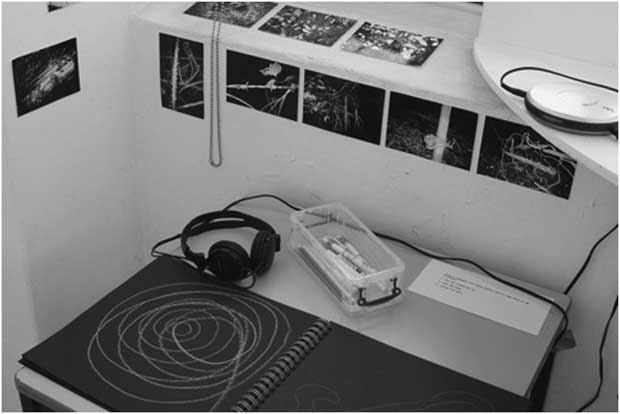
With this ethos in mind, I created an installation that placed the ‘spectator’ as an active participant in a process of collective authorship. The gallery visitor is invited to enter a small, secluded room with a CD player on a small table and, hanging on the walls, an array of enigmatic snapshots taken in the woods (Figure 1). The visitor is instructed to sit down, listen to the soundtrack and draw in a black sketchbook. Though the situation allows a degree of freedom, the actual environment does direct the process of co-authorship to some extent. The secluded room and the use of headphones for listening evoke a feeling of intimacy and isolation, while dim lighting, the use of black paper and the manipulation of the snapshot images imply dark surroundings and a nocturnal scenario.
The installation Shadowgraphs at The Stephen Lawrence Gallery, 2009. Photo courtesy of Monika Oeschler.

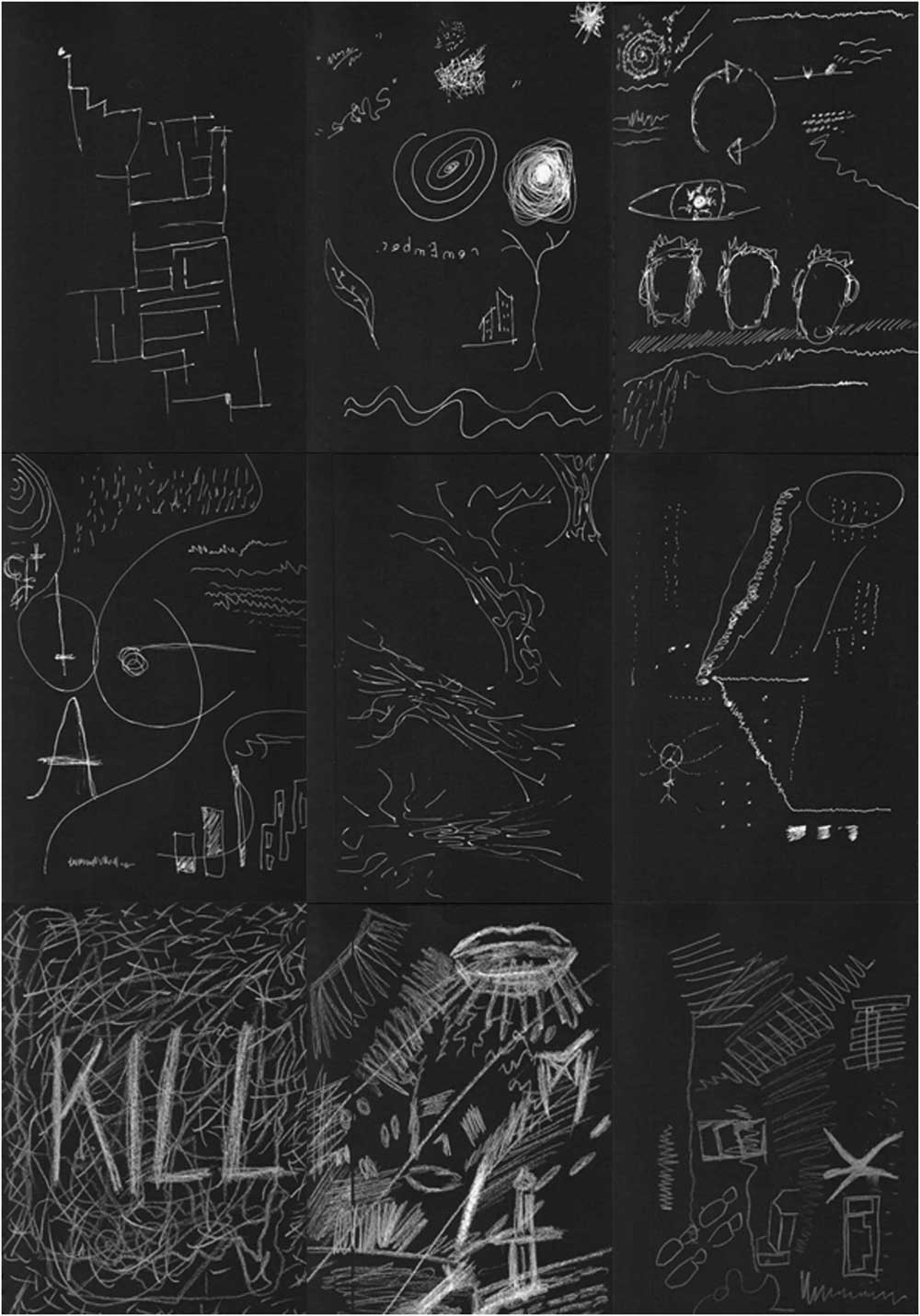
I wanted to create a collective non-verbal narrative in the installation's book and felt that enforcing the notion of a narrative scenario would lead to coherence between the various visitors’ drawings (Figure 2). The installation resulted in a considerable number of drawings, which then became part of the work for subsequent visitors. The instruction provided, to draw rather than write, helped to maintain the open nature of the work, as it avoided the more explicit indication of narrative in words. The act of drawing or writing within one book enhanced the sensation of co-authorship of a shared narrative; some visitors even added details or comments to previous visitors’ contributions (‘You will never know how much I needed this’ was responded to with ‘Why not?). The work took on a life of its own, with the accumulation of drawings encouraging repeat visits to the installation space. Though individual visitors tended to create their own personal style of interpretation, many said that they were curious to see how other visitors responded.
Visitors’ drawings from the installation Shadowgraphs at the NoiseFloor Festival, Stafford 2011.
Over a period of two years, the installation travelled and was presented at several other spaces. Feedback from visitors tended to be similar across the various audience cohorts: the act of drawing enhanced the immersion in the sound, and many chose to spend longer in the installation space, listening repeatedly to the soundtrack. Some visitors said they found the visual elements distracting and would rather just engage with the sounds, while others tended to respond more strongly to the photographs on the walls.
6.2. Blog
During the period preceding the premiere of the live piece Shadowgraphs, I created a blog, with the aim of documenting the influences and sources of the live piece's composition, as well as providing another platform of collective authorship.Footnote 12 Participation via comments was solicited using various networks, including email lists, Facebook and the promotional materials announcing upcoming performances of the live piece. The site's visitors were asked to participate by responding to various ‘challenges’, thus actively experiencing the network of cultural influences informing the piece and sharing their thoughts with me and other readers. I have included examples of two such participatory challenges.
6.2.1. Example 1
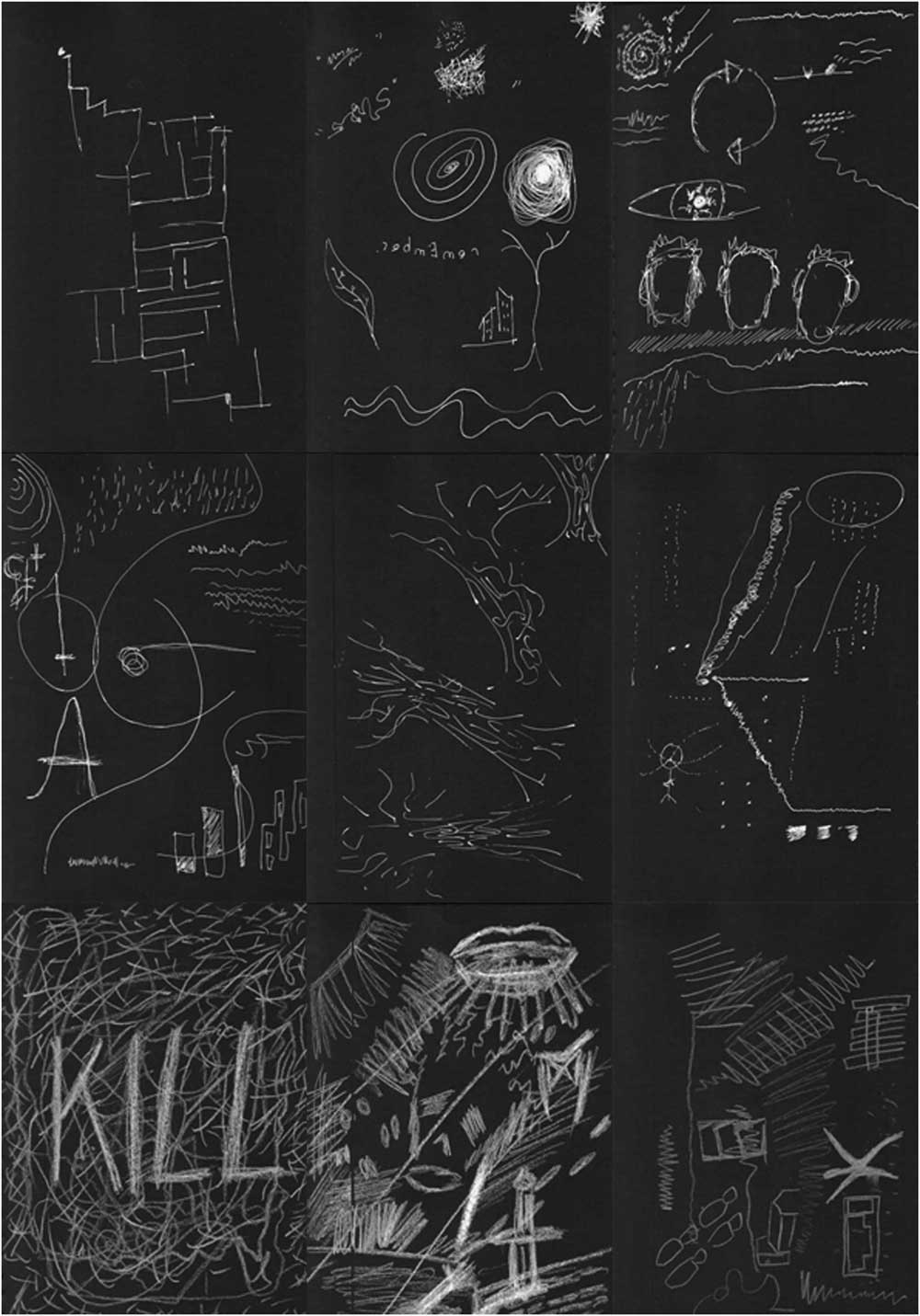
I provided a slide show of drawings the audience drew in the installation, and asked the blog readers to imagine what kind of soundtrack led to these drawings. Of all the responses, this is the most detailed and reflective:
Connecting…
I am tiny, in pain, and I'm lost in a labyrinth. I feel the pressure, the stress; I'm confused – I need to escape and I choose death. After death comes rebirth – or so some people want us to believe. After birth I see shapes, I'm confused, full of questions that need answers. Everything around me seems alien – get me back to the tunnel I need to die again. Blimey, I'm a moth…
Listening…
Bzzzz… Crack. ( – echoes – ). Physical force, slow crushing sounds. Sine tones, thin sounds intertwined. Wheezing. {{.}}…
Too much to describe, no time and no sense.
The writer of this text is referring directly to the drawings created by the visitors of the installation. At this point, the initial ‘fixed’ part of the work that I created (the installation's soundtrack and photos) is removed from the work's ecology and I only provide a platform for engagement between co-authoring audience members. The writer attempts to empathise with the subjective experience expressed in the drawings, and creates his own subjective impression in writing.
6.2.2. Example 2
In a subsequent blog post I reveal the installation soundtrack, and invite the readers to respond to it using only three words. Here are the results as they were posted on the blog:
[Granules; unhurried; textures] [suspense, fear, psychopath] [dark moist jungle] [blackbirds, high and spacious] [darkness, frost, trepidation] [electric crickets. shakers. desert] [mycelium birds churches] [cave-winter-war zone] [creation and communication] [stillness slither Rapture] [dusk sleepy unknown] [Asia, insects, everywhere] [opaque slither submerge]
Though the responses are different, there is a general emergence of themes such as: darkness and night time, threat, emotions, physical sensation and a sense of place, mainly a natural non-urban setting. Through compiling and juxtaposing the various words, I encourage the readers to create their subjective interpretations from the collection of contributions.
The blog was created with the intention of creating a temporary online community, actively and creatively responding to the themes of the piece. I kept my input here to a minimum, taking on the role of ‘mediator’ and providing starting points and suggestions for co-authorship. The blog relied on a sense of curiosity on the side of the contributors regarding other users’ responses and the part their own contribution played within the combined results. Interaction within this context relied on ‘networked individualism’ in which each user accessed the work in a ‘mediated-reciprocal’ way.
6.3. Live performance
The live piece Shadowgraphs extends the idea of the active spectator into the concert hall.Footnote 13 As it is not a participatory piece, I will only discuss it briefly in the context of its connection with the other two ‘ecologies’. As this is a staged live piece, the audience here is encouraged to engage in ‘active interpretation’ rather than participation. The piece has a nonlinear, fragmented structure. Though it is a narrative drama, it does not develop in a chronological fashion but is structured as a series of ‘states’, each of which provides another angle to the story, another space, another piece of ‘evidence’. The listener is encouraged to put the various pieces together and create his or her individual version. The live piece was connected to the installation and the blog via its theme and sound materials. I encouraged the audience of the live piece to engage with all the ecologies of Shadowgraphs by including the installation in a space adjacent to the performance space on the evening of the performance, and by mentioning the blog in all the promotional materials and the programme notes for the piece.
7. Conclusion: sharing of subjectivities
Participatory sound works open the possibility for the audience to engage with a work and co-create it. Works such as Cardiff's Forty Part Motet, Kubisch's Electrical Walks and Björk's interactive Biophilia apps enable the user to actively explore a work. Rather than being truly participatory, these pieces are an extension of ‘active interpretation’, as they provide a fixed environment, the possibilities of which are gradually discovered. Other works, such as TGarden invite the user to actively perform and possibly interact with other users, thereby subverting the traditional live performance model by allowing the audience to ‘go on stage’.
A participatory work may be experienced subjectively by an individual, or it could be embedded in a more social context. This can be occur in a shared time and space, as we have seen in Ulyate and Bianciardi's Interactive Dance Club, or within an online virtual environment in the case of network performance such as Rebelo's Netrooms. Online technology has facilitated the creation of collaborative performance networks consisting of nodes of reception and creation. Beyond the technology itself, this work implies the possibility of de-centralised collaboration. However, even though such work is collaborative, it is conceived by an initial creator who designs the ecology along with its rules of engagement, possibilities and limitations.
Shadowgraphs could be seen as a network-shaped piece. This network is manifest not only in the diffusion of a theme across various media and modalities, but also in the way it has expanded via participation of the individual ‘audience’ members (if indeed ‘audience’ is the right word in this case). Through a process of individual creation of meaning that is embedded in a shared communal cultural point of reference, the piece has expanded and travelled, both online and in the real world. It is a type of rhizome, in which authorship is shared in a non-hierarchical way, and the work can continue to expand in unexpected ways, with new nodes of meaning and interpretation emerging in the process.
A participatory network piece with multiple participants is an ecology of intersubjectivity, consisting of the relationship between the individual experience and the way it is shared with others. In the case of the Shadowgraphs installation, the knowledge that the same soundtrack and space inspired the drawing process created a situation in which both the common source and the diverse interpretations of it were an essential part of the work. A similar process took place via writing in the blog through shared comments. Though the interpretations were individual and personal, we could also say that subjective construction of meaning is inextricably a communal process of sharing, as Jean-Luc Nancy (Reference Nancy2000: 2) states: ‘There is no meaning if meaning is not shared, and not because there would be an ultimate or first signification that all beings have in common, but because meaning is itself the sharing of Being.’ In this sense, individual subjectivity is not prior to a process of ‘intersubjectivity’ but is actually, from the very start, part of a community.