Special need children have serious physical, mental, and emotional disabilities compared with others. Reference Hockenberry and Wilson1 According to the Convention on the Rights of Persons with Disabilities (CRPD) and the fourth goal of Sustainable Development Goals, education is the right of all children worldwide, despite their condition, which must be delivered in a safe environment. Reference Bebbington and Unerman2,3 Thus, disabled children require more specific and equipped educational environments. Based on Universal Design for Learning (UDL) guidelines, curriculum and educational setting must be designed to serve all learners, irrespective of ability, age, gender, or cultural and linguistic backgrounds. 4 Disasters are one of the most crucial threats for places, especially schools. In addition, it is considered as a serious disruption of functioning a community causing widespread human, economic, or environmental losses that exceed the ability of the affected community or society to cope using its own resources. 5–Reference Bethel, Foreman and Burke7 Following disasters, people are affected to different extents, and vulnerable populations, such as those with poor health, disabilities, and chronic diseases, are at an increased risk of adverse health outcomes. Reference Hoffman8,Reference Dyregrov, Yule and Olff9
Among vulnerable groups, children are more at the risk of disaster consequences. It is estimated that approximately 175 million children per year will be affected by disasters. Reference Ranghieri and Ishiwatari10 Students who are present in class at the time of disaster are exposed to serious adverse health outcomes. Thus, the setting should be safe, and its capacity and resilience should be confirmed in advance. 11-Reference Haulle14 Disasters, along with environmental disruptions, mental and economical adverse effects, lead to serious injuries and death of teachers and students. Furthermore, the disruption of the educational process is considered as another effect of these events. On the other hand, standard and safe schools play a significant role in response and recovery phase in the affected society. Reference Tuswadi15,Reference Mirzaei, Mohammadinia and Nasiriani16
Based on the experiences from previous disasters, people with physical disabilities are at higher risk of injuries, death, and mental disorders. Reference Jàmbá17-19 Furthermore, special needs children will be severely injured physically and mentally during disasters due to their special limitations. Reference Peek and Stough20,Reference Boon, Brown and Tsey21 Hence, the schools of special needs children are required to have the necessary safety protocols against disasters with respect to their needs and abilities. Safety and disaster preparedness should be prioritized at schools. Reference Mirzaei, Dehghani-Tafti and Mohammadinia13 Additionally, building collapse, furniture falls, and fire is among the most prevalent school hazards and threats in the schools. Retrofitting structural and nonstructural measures are considered as necessary interventions to maintain building safety against disaster, although most of these measures are not taken because of costs. In addition, only nonstructural measures are often considered to reduce costs. Reference Tormala and Petty22,Reference Coppola23 However, few studies have considered the safety of exceptional schools against disasters in Iran.
Iran is located in Asia and exposed to different natural and manmade disasters annually. According to the INFORM report in 2020, Iran has a score of 5.2, ranking 43 for risk. Additionally, Iran is still a country with high vulnerability and a lack of suitable coping strategies. 24 The present report shows the need for special attention to disaster management and taking specialized measures to reduce vulnerability and increase capacity and resilience against disasters in this country. Therefore, taking serious measures is essential in this area in Tehran, the capital of Iran. Thus, the present study aimed to evaluate the safety and disaster risk assessment of exceptional schools in Tehran, Iran.
Methods
In the present cross-sectional study, 66 exceptional schools in Tehran were selected based on census sampling method, among which 55 in all grades were considered and evaluated by the documents related to school hazard. Those public schools operating for 4 h/d were considered. The exclusion criteria included mixed schools (educating special needs children with other children in the same place and time), use change, school closing, and school use for consultation.
This checklist was designed by Tehran Disaster Mitigation and Management Organization (TDMMO), and Ministry of Education in 2015, 25 which consisted of module 1, including the general information about the schools, and module 2, encompassing 125 items for assessing the structural and nonstructural safety of schools. These items included location, availability and view (9 items), yard (4 items), classes and offices (13 items), kitchen (3 items), library and conference hall (4 items), laboratory and studio (10 items), powerhouse (8 questions), storage room (3 items), corridors and emergency exits (15 items), elevator (6 items), electrical facilities (17 items), heating facilities (14 items), and fire extinguishing systems (10 items). The questions were designed based on a 4-item scale (yes, no, to some extent, does not apply here). The safety of each school was calculated based on the weight of the related modules. The safety of 797 schools in Tehran during 2015-2016 were assessed by using the above-mentioned checklist. The data were analyzed using statistical descriptive tests and Excel software, and the safety of schools was categorized as low-risk (0-33.33%), medium-risk (33.34-66.66%), and high-risk (66.67-100%) based on the results.
Results
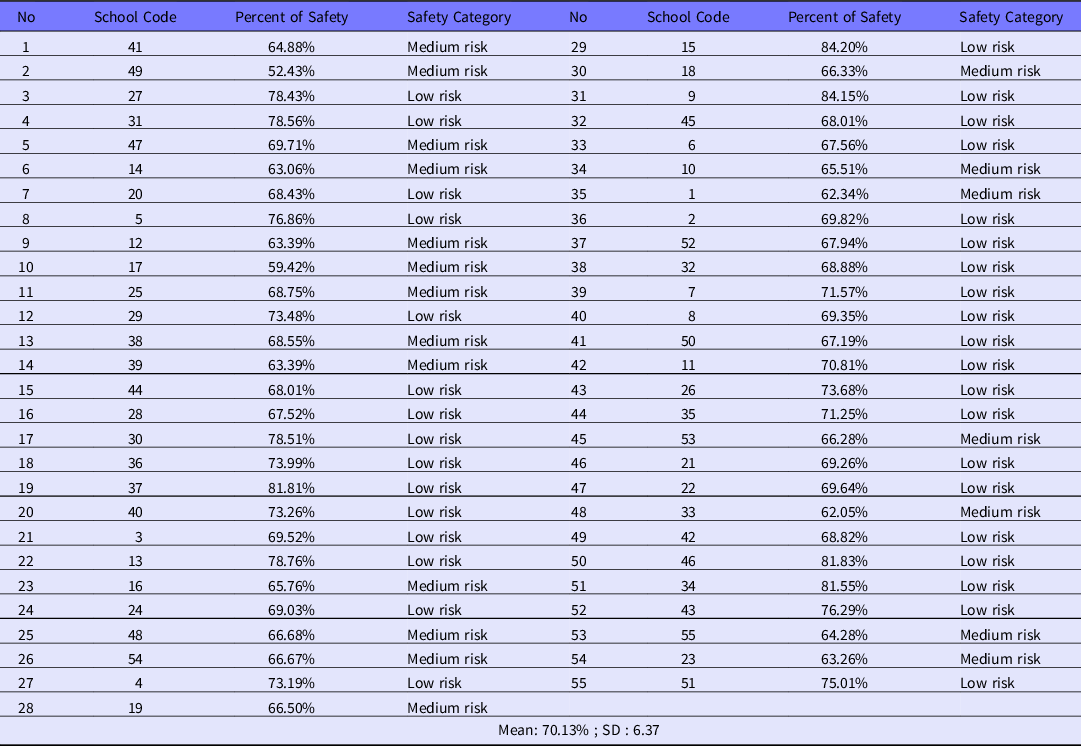
In total, the safety of exceptional schools in this study was 70.13% (Table 1), which suggests medium-risk level. The oldest building aged 69 y and the newest school is 2 y old. The average age of school buildings is 23 y, which represents hazardously old structure of the schools. Furthermore, 61.88% of schools have 2 floors. The most unsafe places at some schools were elevators (least safety: 7.69%), yards (least safety: 9.52%), laboratories (least safety: 16.67%), libraries (least safety: 24.24%), fire extinguishing systems (least safety: 28.99%) and storage room and kitchen (least safety: 33.33%) (Table 2).
Safety of exceptional schools in Tehran, one by one school

Safety of exceptional schools

The mean safety of libraries and conference halls suggest medium-risk level (mean: 44.13 and standard deviation [SD]: 20.55). In addition, mean safety of elevators is 46.85% and SD is 26.01. In most of the schools, elevators were inaccessible due to technical issues. Insurance, regular supervision, and obeying the standards for elevator doors were neglected by the schools. Assessment results indicated an overall mean safety of 51.42% and standard deviation of 10.99, which indicates medium-risk and requires immediate planning and implementations. Furthermore, the mean safety of yards regarding playing area, separation of parking from playing area, and use of warning signs is 57.83. Furthermore, most of the schools parking and playing area were not separated properly and warning signs were not installed at dangerous zones. Moreover, fire extinguishing systems were limited to fire extinguisher capsules and only 2 schools (among 55) had active automated smoke detectors. The rest of the schools failed to have automated smoke detectors and were deactivated. As a result, the mean safety for fire extinguishing systems in schools is medium-risk (mean: 59.84; SD: 11.77). Concurrently, the safety of corridors and staircases is medium, and most of the schools have only 1 entrance and exit route. Based on the results, special schools in Tehran have relatively safe corridors and entrance and exit routes (mean: 65.08%; SD: 11.30).
Discussion
Based on the results, buildings in a majority of exceptional schools are very old and require immediate reconstructions. Some of the schools were placed in dangerous locations, such as main roads, next to railways, and areas having old aqueducts. Due to the limitations of disabled children in most of the exceptional schools, yards are not being used for playing and physical activities. The safety of libraries, corridors, elevators, laboratories, and fire extinguishing systems requires immediate considerations in exceptional schools in Tehran. The United Nations Educational, Scientific and Cultural Organziation (UNESCO) in its guidelines has emphasized the significance of a safe location for building a school, indicating that schools should be designed and constructed with the least number of floors, ideally 2 floors. 26 Additionally, according to International Strategy for Disaster Reduction (ISDR)Footnote 1 guidelines, fewer number of floors and proper location of schools are crucial determinants of higher resistance and safety in schools. Reference Petal27
Furthermore, organizing a disaster management team as incidence command system (ICS) is considered as one of the most important elements in school preparedness for hazards and disasters. At the time of disaster, the situation can be controlled and causalities may be minimized by means of this system. Every member of this system according to the apportion responsibilities should implement some measures, such as identifying hazards, vulnerabilities, capacities, planning, as well as developing educational courses and exercises to empower schools and improve their preparedness for disasters. 28-Reference Nickerson, Brock and Reeves30 The tools used in the present study failed to assess ICS in schools.
An assessment in 355 schools of New Zealand in 2017 shows the acceptable level of disaster preparedness. Necessary disaster management measures in New Zealand schools are carried out by educational officials and students’ families. However, researchers have suggested that there is a need to develop operational guidelines to increase the safety and disaster preparedness of schools in the country. Reference Hosseini and Izadkhah31 On the other hand, another study evaluated the safety of Arkansas schools and indicated no safety, despite all the preventive measures for common hazards, such as shootings among the schools in United States. Although 95% of the schools have an emergency exit, only 40% have performed emergency evacuation drills, without evaluating the level of preparedness among teachers and students. Reference Tipler, Tarrant and Johnston32 Indonesia is susceptible for earthquakes, tsunamis, and tornadoes. Therefore, attempts have been made to increase disaster risk understanding of primary school children in fifth and sixth grades by providing appropriate education, because an understanding of disaster risk among students plays a significant effect on self-care measures during disaster. Based on the results in this study, children’s education about disasters can increase safety and disaster resilience in schools. Reference Graham, Shirm and Liggin33 Although Pakistan is highly exposed to climate-change disasters, especially floods, the schools do not have enough vigilance and preparedness for natural disasters. Reference Fathoni34 In another study conducted on the preparedness among 20 schools in Pakistan, the results indicated that they lack safety guidelines, physical and mental rehabilitation programs, and emergency exit routes, requiring authorities to take immediate actions to make schools safe. Reference Shah, Ye and Pan35
The present study used the standard tool established by the Tehran Disaster Mitigation and Management Organization. However, more precise assessment of safety in schools necessitates a more accurate tool because only nonstructural safety measures are evaluated by using the present tool without considering the details about safety against disasters. For example, all of the details about hazards, capacities, and vulnerabilities of that place should be measured to determine a place’s safety. Thus, the present study focused on evaluating only nonstructural safety of schools and failed to assess other dimensions regarding the safety in school. Therefore, the lack of access to a standard and valid instrument has been a limitation of the research team.
Conclusions
Based on the results, exceptional schools demonstrated inappropriate safety level and disaster preparedness following the recent hazards in Iran, such as flooding, earthquake, fire, and building collapses. Therefore, the Special Education Organization accompanied by the Ministry of Education, Disaster Mitigation and Management Organization, Tehran Disaster Mitigation and Management Organization, and non-gevernmental orgazizations (NGOs) must plan and implement measures to reduce disaster risk and increase preparedness among exceptional schools. Furthermore, educational programs should be assigned for teachers, families, and students to increase willingness for performing the preventive standards. Likewise, this study highlighted the need for designing an accurate, effective, and more precise tools for evaluating the schools so that authorities can access the results more easily and take appropriate actions immediately.
Due to the limited studies about disaster mitigation and preparedness in schools, especially schools for exceptional children, attention to disaster preparedness in this schools is obligatory.
The results show necessary attention is needed to vulnerable populations in disasters, especially for exceptional children, increasing safety and preparedness of their daily activities, and improving empowerment of their caregivers before, during, and after disasters.
Further research is recommended to: (1) design a pattern of disaster preparedness in schools of exceptional children, (2) design a standard instrument for disaster risk assessment in these schools, (3) explore the standard operating procedures of disaster response in these schools, (4) explore the first psycho-social-emotional support protocol in exceptional children and their caregivers, (5) explore the process of reestablishment and continued operation plans of these centers, and (6) determine appropriate and efficient educational methods for disaster risk reduction in exceptional children and their families and caregivers.
Funding Statement
The present study was conducted under the order of Tehran University of Medical Sciences Nursing and Midwifery Care Research Center (TUMS NMCRC) with the approval number of 97-01-99-38066 and ethics code of IR.TUMS.FNM.REC.1397.051 in 2018.