The prognosis of CHD has improved dramatically because of therapeutic advances in congenital cardiology and surgery; therefore, the number of patients with adult CHD successfully reaching adulthood has increased. Although numerous previous reports have mentioned the association of sleep apnoea with heart failure, hypertension, and arrhythmia in the general population,Reference Shamsuzzaman, Gersh and Somers 1 – Reference Oldenburg, Lamp and Faber 3 few studies have examined sleep apnoea in patients with adult CHD. Studies have shown a high prevalence of sleep apnoea in the children with tetralogy of Fallot,Reference Herold, Young, Ge, Snieder and Lovrekovic 4 as well as in patients with transposition of the great arteries after a atrial switch procedure.Reference Cotts, Smith, Lu, Dorfman and Norris 5 The prevalence, risk factors, and effects on prognosis of sleep apnoea in adult CHD have not been studied well.
The aim of this study was to investigate the prevalence and characteristics and to identify the risk factors associated with the development of sleep apnoea in a population of hospitalised patients with adult CHD.
Materials and methods
Study design and patients
This was a single-centre retrospective study of sleep apnoea consisting of 104 consecutive patients, above 15 years with median age of 36 years, interquartile range of 28–48 years, who had various adult CHDs with or without a medical history of cardiac surgery. The medical records of patients that attended Tokyo Women’s Medical University Hospital between May 2010 and June 2016 were reviewed. All patients underwent a sleep study in the hospital. Indications for admission were classified as heart failure, diagnostic catheterisation, interventional catheterisation, or arrhythmia. We excluded patients with unstable status, such as those with NYHA class IV; those receiving any intravenous drip infusions, oxygen supplementation, or positive airway pressure treatment; and those with cyanosis or arterial oxygen saturation <90%.
First, we studied the prevalence of sleep apnoea in patients with adult CHD. Second, we compared the characteristics based on the severity of sleep apnoea. Third, we analysed the risk factors associated with respiratory disturbance index. Finally, we reviewed the outcome of patients with sleep apnoea treated by continuous positive airway pressure or adaptive servo-ventilation.
Sleep study
All patients underwent type 3 portable overnight polygraphy: Pulsleep LS-120S; Fukuda Denshi, Tokyo, JapanReference Uesugi, Kobayashi and Hasebe 6 was used in 57 patients and Morpheus R; Compumedics, Vic., AustraliaReference Satake, Sugimura and Fukumoto 7 in 47 patients. Episodes of apnoea and hypopnea, the mean and lowest percutaneous arterial oxygen saturation levels, and the number of desaturation from baseline saturation episodes were assessed based on previously described methods.Reference Chesson, Berry and Pack 8 Pulsleep LS-120S has a pressure sensor for nasal airflow and snoring, a pressure-sensitive sensor on the suprasternal notch to estimate oesophageal pressure, and a body position sensor. Heart rate and percutaneous arterial oxygen saturation were continuously monitored using a pulse oximeter. Morpheus R has a pressure sensor for nasal airflow and snoring, two stress-sensitive belts – one each for the rib cage and abdomen – a body position sensor, continuous pulse oximetry, and three-channel electrocardiograms.
Sleep duration, the estimated length of time between the time the patient went to bed and the time one got out of bed, was estimated from a sleep diary. Estimated sleep duration was used for portable monitor analyses.
Apnoea was defined as a continuous cessation of breathing airflow for 10 seconds or more; hypopnea was defined as a reduction of 50% or greater in breathing airflow with percutaneous arterial oxygen desaturation ≥3%. 9 Respiratory disturbance index, the number of apnoeas and hypopneas per hour of the estimated sleep duration, was calculated from the portable monitor data. 10 Apnoea was classified as obstructive sleep apnoea or central sleep apnoea based on the presence or absence of laboured breathing estimated using an oesophageal pressure sensor in Pulsleep LS-120S and by thoracoabdominal motion in Morpheus R during apnoea. We also calculated the 3% oxygen desaturation index, which was the total number of 3% desaturation from baseline saturation episodes per hour of estimated sleep duration. 9 The portable monitor records were manually analysed by an expert technician and medical doctor specialised in respiratory medicine.
Severity and type of sleep apnoea
We defined a respiratory disturbance index ≥5 as sleep apnoea. The severity of sleep apnoea was classified into four categories as no sleep apnoea, patients with a respiratory disturbance index <5; mild sleep disordered breathing, patients with a 5≤ respiratory disturbance index<15; moderate sleep apnoea, patients with a 15≤ respiratory disturbance index <30; and severe sleep apnoea, patients with a respiratory disturbance index ≥30.
We divided the patients into three groups: those without sleep apnoea (respiratory disturbance index <5), those with mild sleep apnoea (5≤ respiratory disturbance index <15), and those with moderate/severe sleep apnoea (respiratory disturbance index ≥15). We also stratified the types of sleep apnoea into two categories as described above: obstructive sleep apnoea and central sleep apnoea.
Demographic data collection
We obtained demographic data within 1 week before or after the sleep study from the patients’ medical records, such as NYHA functional class, history of cardiac surgery – particularly the performance of the Fontan procedure – blood test results for brain natriuretic peptide with normal value <20 pg/ml measured using a chemiluminescence enzyme immunoassay, Lumipulse Presto BNP; Fujirebio, Tokyo, Japan, and noraddrenaline with normal value <450 pg/ml measured using high-performance liquid chromatography, CA test; TOSHO, Tokyo, Japan, echocardiographic parameters of the shortening fraction of the systemic ventricle, catheterisation parameters, drug use, and treatment using pacemaker and implantable cardioverter defibrillators. Arrhythmia was defined as sinus rhythm, atrial tachyarrhythmia, atrial fibrillation, ventricular tachyarrhythmia, and ventricular fibrillation detected by 12-lead and Holter electrocardiogram. Hypertension was determined when patients had systolic and diastolic blood pressures of >140 mmHg or >90 mmHg, respectively. Dyslipidaemia was defined as low-density lipoprotein cholesterol ≥140 mg/dl, high-density lipoprotein cholesterol <40 mg/dl, or triglycerides ≥150 mg/dl. Patients with fasting blood glucose level ≥126 mg/ml or random blood glucose level ≥200 mg/ml or HbA1c ≥6.5% were defined as having diabetes mellitus. Chronic kidney disease was defined as an estimated glomerular filtration rate <60 ml/minute/1.73 m2. Thyroid dysfunction, including hyperthyroidism and hypothyroidism, was defined as a previous diagnosis of thyroid dysfunction by endocrinologists. Protein-losing enteropathy was diagnosed by documenting enteric protein loss using nuclear scintigraphy. We obtained central venous pressure, mean pulmonary artery pressure, pulmonary capillary wedge pressure, systemic end-diastolic pressure, ascending aortic pressure, pulmonary vascular resistance, and cardiac index from cardiac catheterisation (n = 78). From 78 patients, 60 (77%) underwent cardiac catheterisation within 1 month after the sleep study, whereas 3 (4%), 6 (7%), and 9 (12%) patients underwent the procedure after 4–6, 7–11, and 12 months, respectively.
Complexity of CHD
According to the complexity of CHD, based on the International Classification of Diseases-9 codes,Reference Warnes, Williams and Bashore 11 – Reference Khairy, Van Hare and Balaji 13 we divided the patients with CHD into simple or complex CHD, including moderate/severe CHD. Simple CHD included atrial septal defects, ventricular septal defects, mitral valve regurgitation, and patent ductus arteriosus. Other CHDs such as tetralogy of Fallot, congenitally corrected transposition of the great arteries, single ventricle, and double-outlet right ventricle were considered complex CHDs.
Statistical analysis
Data regarding patient characteristics and various biomarker levels were expressed as number (%), or median, represented in interquartile range of 25–75th percentile.
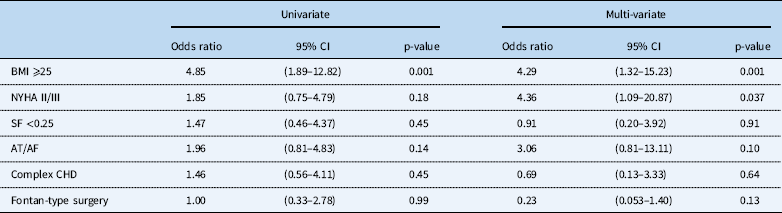
We used the non-parametric tests, such as Mann–Whitney U-test or Kruskal–Wallis one-way analysis, to compare continuous variables, for example various biomarker levels, and the χ2-test to compare the proportion of categorical variables, for example atrial arrhythmia, among our study groups. We used multi-variate logistic regression analysis to analyse risk factors associated with a respiratory disturbance index ≥15. This model included body mass index, NYHA ≥II, shortening fraction <0.25, atrial tachycardia/atrial fibrillation, complex CHD, and Fontan-type surgery. Body mass index and atrial tachycardia/atrial fibrillation were previously reported as factors associated with sleep apnoea in patients with congestive heart failure.Reference Sin, Fitzgerald and Parker 14 Relationships were summarised as an odds ratio with 95% confidence interval. JMP Pro version 12; SAS Institute, Cary, NC, United States of America was used for all analyses. A p-value of <0.05 was considered statistically significant.
Results
Patients’ characteristics
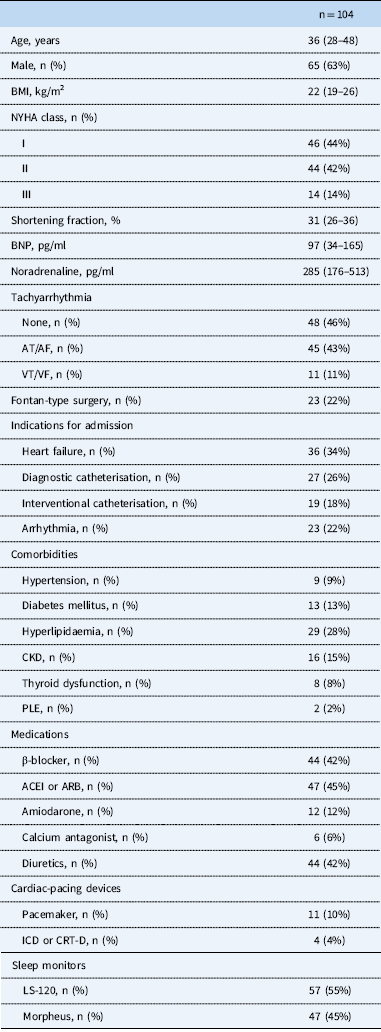
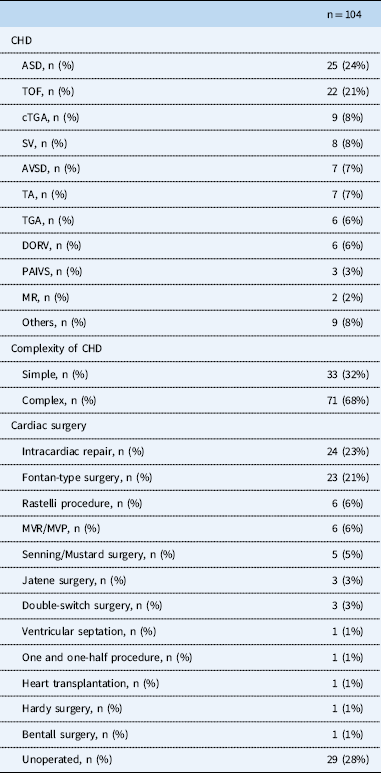
The baseline characteristics of these patients are summarised in Tables 1 and 2. The median age of the patients was 36 (28–48) years, the body mass index was 22 (19–26) kg/m2, and the indications for admission were heart failure 34% (n = 36), diagnostic catheterisation 26% (n = 27), interventional catheterisation 18% (n = 19), or arrhythmia 22% (n = 23).
Patient characteristics.

The values presented are in median represented by interquartile range 25–75th percentile or n (%)
ACEI = angiotensin-converting enzyme inhibitor; AF = atrial fibrillation; ARB = angiotensin receptor blocker; AT = atrial tachyarrhythmia; BMI = body mass index; CKD = chronic kidney disease; CRT-D = cardiac resynchronisation therapy defibrillator; ICD = implantable cardioverter defibrillators; NYHA = New York Heart Association; PLE = protein-losing gastrointestinal disease; VF = ventricular fibrillation; VT = ventricular tachyarrhythmia
Cardiac diagnosis and previous cardiac surgeries.
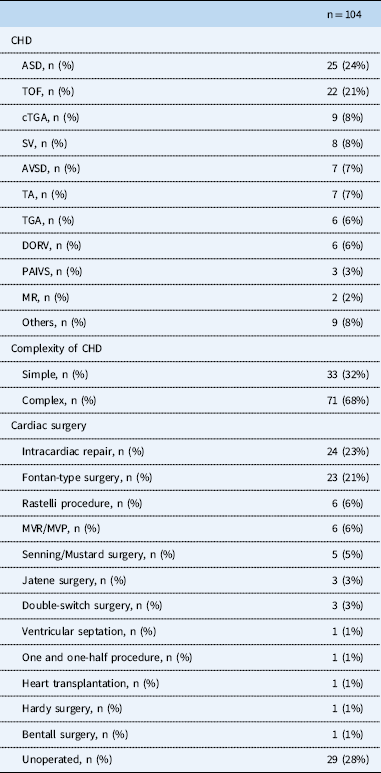
The values presented are in n (%)
ASD = atrial septal defect; AVSD = atrioventricular septal defect; cTGA = corrected transposition of the great arteries; DORV = double-outlet right ventricle; MR = mitral valve regurgitation; MVR = mitral valve replacement; MVP = mitral valve plasty; PAIVS = pulmonary atresia with intact ventricular septum; SV = single ventricle; TA = tricuspid atresia; TOF = tetralogy of Fallot; TGA = transposition of the great arteries
The number of previous Fontan-type surgeries was 23 (22%). The number of patients with simple and complex CHDs was 33 (32%) and 71 (68%), respectively.
The numbers of patients with NYHA classes I and II + III were 46 (44%) and 58 (56%), respectively, and the shortening fraction and brain natriuretic peptide concentrations were 31% (26–36%) and 97 pg/ml (34–165 pg/ml), respectively.
The type of atrial tachyarrhythmia/atrial fibrillation included 37 paroxysmal that stopped within a week of onset and eight permanent types in which normal heart rhythm could not be restored with treatment.
Prevalence of sleep apnoea in adult CHD
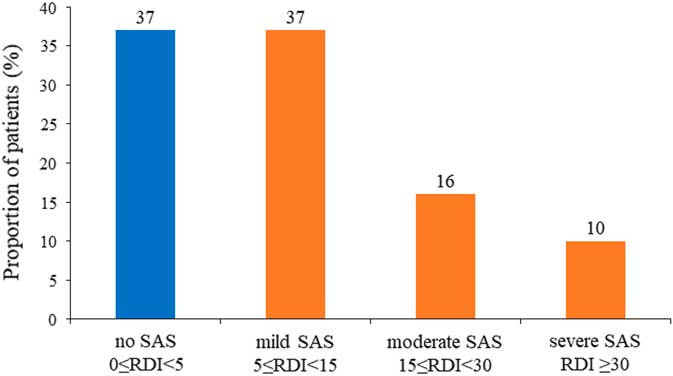
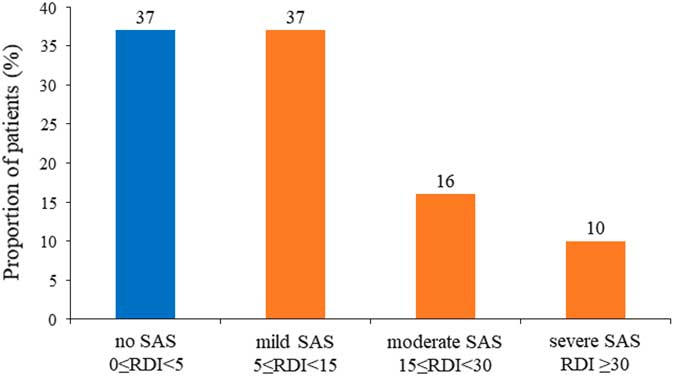
The prevalence of sleep apnoea is shown in Figure 1. The prevalence of sleep apnoea, defined as respiratory disturbance index ≥5, was 63% (n = 66). The distribution of mild, moderate, and severe sleep apnoea was 37, 16, and 10%, respectively. Moderate/severe sleep apnoea was found in 26% of patients. The type of sleep apnoea was 92% (n = 58) for obstructive sleep apnoea, and 8% (n = 5) for central sleep apnoea.
Prevalence of sleep apnoea based on the degree of RDI. RDI = respiratory disturbance index; SAS = sleep apnoea syndrome.
Comparison of characteristics based on the degree of sleep apnoea
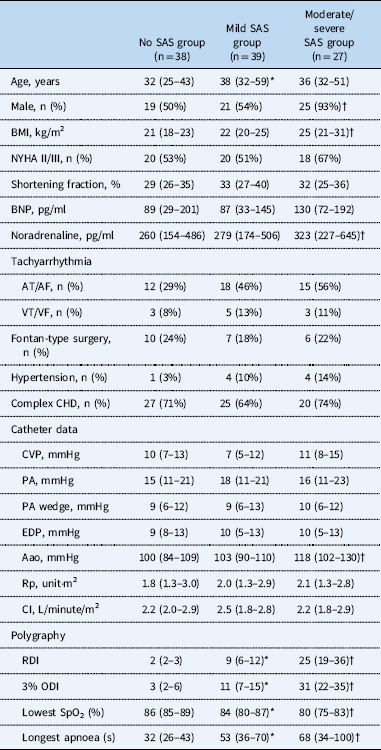
Comparison of the characteristics between patients without sleep apnoea and those with mild or moderate/severe sleep apnoea is shown in Table 3. In brief, the group with moderate/severe sleep apnoea had a significantly higher proportion of male patients and higher body mass index, noradrenaline level, and ascending aortic pressure than the group without sleep apnoea. In contrast, the group with mild sleep apnoea showed no significant difference in various parameters, except age, compared with the group without sleep apnoea. All patients with suspected central sleep apnoea had a high NYHA class (NYHA class III).
Characteristics of patients based on the degree of sleep apnoea.
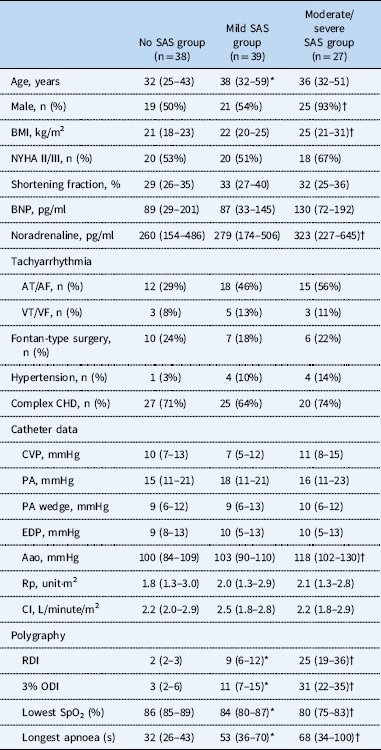
The values presented are in median (interquartile range: 25th–75th percentile) or n (%)
Aao = ascending aorta; CI = cardiac index; CVP = central venous pressure; EDP = end-diastolic pressure; ODI = oxygen desaturation index; PA = pulmonary artery; Rp = resistance of pulmonary; RDI = respiratory disturbance index; SAS = sleep apnoea syndrome
* p < 0.05, no SAS versus mild SAS
† p < 0.05, no SAS versus moderate–severe SAS
Risk factors associated with respiratory disturbance index ≥15
Multi-variable analysis showed that NYHA ≥II with odds ratio, 4.36; 95% confidence interval, 1.09–20.87, and body mass index ≥25 with odds ratio, 4.29; 95% confidence interval, 1.32–15.23, were independent risk factors for respiratory disturbance index ≥15 in patients with adult CHD (Table 4).
Multi-variable odds ratios for respiratory disturbance index.

AF = atrial fibrillation; AT = atrial tachyarrhythmia; BMI = body mass index; CI = confidence intervals; NYHA = New York Heart Association; RDI = respiratory disturbance index; SF, shortening fraction
Treatment of sleep apnoea
We treated eight patients with severe sleep apnoea using continuous positive airway pressure in five patients and adaptive servo-ventilation in three patients. After continuous positive airway pressure or adaptive servo-ventilator therapy, symptoms associated with sleep apnoea, such as sleepiness, arousal during sleep, and headache, improved in 88% of patients (7/8 patients). Although the respiratory disturbance index after respiratory therapy showed a significant decrease compared with the respiratory disturbance index before respiratory therapy (3.7 ± 1.9 versus 55.4 ± 19.7, p = 0.002) in six patients who underwent sleep study before and after respiratory therapy, heart failure worsened in one patient with repaired tetralogy of Fallot who experienced severe right ventricle dysfunction after automatically adjusted continuous positive airway pressure with the pressure level ranging from 4 to 16 mmH2O.
Discussion
This study showed a high prevalence of sleep apnoea in adult CHD, with most cases being obstructive sleep apnoea, and that NYHA ≥II and higher body mass index were risk factors for developing respiratory disturbance index ≥15 in patients with adult CHD.
A high prevalence of sleep apnoea in patients with adult CHD was observed in this study compared with a previously reported prevalence of sleep apnoea in a healthy community sample; that is 16.5 and 6.5% for apnoea–hypopnea index ≥5 and apnoea–hypopnea index ≥15, respectively.Reference Young, Palta and Dempsey 15 In a previous study that screened sleep apnoea using the Pediatric Sleep Questionnaire, which defined sleep apnoea as having Pediatric Sleep Questionnaire scores ≥8, the reported prevalence of sleep apnoea in the children with tetralogy of Fallot was 38% higher than that in the healthy general population (5%)Reference Herold, Young, Ge, Snieder and Lovrekovic 4 , and screening of sleep apnoea in CHD using type 3 polysomnography has not been reported yet. Several factors may contribute to this high prevalence of sleep apnoea in adult CHD. In this study, the median central venous pressure of all patients and even in the group without sleep apnoea was high at 10 mmHg. The underlying adult CHD itself may be associated with abnormal haemodynamics and congestive state even without clinical heart failure. The high venous pressure and venous blood flow congestion in pharyngeal and neck tissues may decrease upper airway size,Reference Shepard, Pevernagie, Stanson, Daniels and Sheedy 16 and fluid displacement from the oedematous leg to the peri-pharyngeal soft tissues when lying supine may narrow the pharynx during sleep.Reference Yumino, Redolfi and Ruttanaumpawan 17 There was a high rate of complex CHD, heart failure that required hospitalisation, cardiac conditions that required catheter intervention, and arrhythmia in the present study. Such findings may reflect a more unhealthy patient population within our institute. Together, these mechanisms and factors may be associated with the high prevalence of sleep apnoea in adult CHD.
Although adult patients with CHD have unique haemodynamics such as complex CHD with chronic right or left heart failure and repaired Fontan-type surgery with single-ventricle physiology, these conditions involved in the congestive state with high central venous pressure may contribute to the high prevalence of sleep apnoea in adult CHD; however, the presence of complex CHD and history of Fontan-type surgery were not independent risk factors of respiratory disturbance index ≥15 after multi-variate analysis. Because this study included various heterogenous CHDs and haemodynamics, the risk of sleep apnoea in each specific condition should be studied in the future.
The findings of heart failure by high NYHA class and obesity as risk factors for sleep apnoea were compatible with previous reports in patients without CHD.Reference Yumino, Redolfi and Ruttanaumpawan 17 – Reference Tkacova, Niroumand, Lorenzi-Filho and Bradley 21 Obstructive sleep apnoea and central sleep apnoea are common in patients with heart failure, and the predominant type of sleep apnoea can shift from obstructive to central based on the severity of heart failure.Reference Vazir, Hastings and Dayer 20 , Reference Tkacova, Niroumand, Lorenzi-Filho and Bradley 21 The incidence of central sleep apnoea was higher in patients with low cardiac index and increased pulmonary wedge pressure.Reference Mortara, Sleight and Pinna 22 In patients with heart failure, fluid displacement from the leg to the neck narrows the pharynx, contributes to obstructive sleep apnoea, and increases venous blood flow; consequently, pulmonary congestion with increasing pulmonary wedge pressure leads to central sleep apnoea.Reference Yumino, Redolfi and Ruttanaumpawan 17 Obesity is also a risk factor for sleep apnoea because of airway size affected by fat deposition.Reference Horner, Mohiaddin and Lowell 18 , Reference Mortimore, Marshall, Wraith, Sellar and Douglas 19 Although congestive heart failure and obesity were already known as risk factors of sleep apnoea, this was the first study to document these findings in adult CHD. Recently, there has been a focus on the management of cardiovascular risk factors such as obesity, hypertension, diabetes, and hyperlipidaemia in adult CHD.Reference Lui, Fernandes and McElhinney 23 First, the management of obesity and lifestyle in adult CHD patients may be important to reduce sleep apnoea and improve long-term outcomes similar to what is seen in the general population.Reference Nishihata, Takata and Usui 24
This study showed high noradrenaline level and ascending aortic pressure in the group with moderate/severe sleep apnoea compared with the group without sleep apnoea and with mild sleep apnoea. Sleep apnoea contributed to the autonomic and haemodynamic changes by hypoxia, hypercapnia, negative intrathoracic pressure, and arousal to increase sympathetic activity and noradrenaline level.Reference Kapa, Sert Kuniyoshi and Somers 25 – Reference Somers, Dyken, Clary and Abboud 27
Most of the sleep apnoea types were obstructive sleep apnoea (92%). A small percentage of central sleep apnoea may be associated with a relatively young age and low percentage of severe heart failure (NYHA class III in 14%) of the patients in this study. The Japanese Circulation Society recommended using portable sleep monitoring for screening of sleep apnoea. 10 More detailed tests for sleep apnoea using detailed polysomnography are needed to show the exact sleep apnoea type and apnoea hypopnea index in patients with adult CHD whose symptoms are highly suggestive of sleep apnoea.
The effectiveness of sleep apnoea treatments, such as continuous positive airway pressure and use of an adaptive servo-ventilator, in the CHD population is still unknown. In our limited experience, although continuous positive airway pressure or an adaptive servo-ventilator seemed to be effective to improve sleep apnoea-associated symptoms for most patients treated, right heart failure worsened in one patient with tetralogy of Fallot and severe right ventricular dysfunction after starting continuous positive airway pressure. High positive airway pressure was suggested to increase intrathoracic pressure, resulting in disturbed venous return into the right ventricle in this case. Some CHD patients have unique haemodynamics with chronic right heart failure, such as the Fontan circulation. Because high positive air pressure may exacerbate haemodynamics in patients with predominant right heart failure, appropriate identification of positive air pressure level for those patients with sleep apnoea and right heart failure may be necessary to start continuous positive airway pressure therapy. Positive pressure should be used with caution in patients with Fontan physiology, as well as in those with biventricular circulation and right ventricular dysfunction.
Limitations of the study
Our study has several limitations. Because the number of study patients was small, the patients in this study included heterogeneous CHD, and each haemodynamic condition was different such as single or biventricular ventricle physiology. The role of haemodynamics in sleep apnoea and the risk factors for developing sleep apnoea may be different among various conditions. Because the patients in this study had a high rate of complex CHD (68%) and heart failure (34%) requiring hospitalisation as mentioned earlier, we cannot exclude the possibility that the results (particularly with regard to the prevalence of sleep apnoea) may not be as applicable to an outpatient population of adults with simple forms of CHD.
We used type 3 sleep monitoring for screening sleep apnoea and did not use detailed polysomnography. Type 3 portable monitoring may somewhat over- or underestimate the actual prevalence of sleep apnoea in the adult CHD population. Identifying the accurate sleep apnoea type using type 3 portable sleep monitoring may be difficult. Although type 1 monitoring polysomnography remains the gold standard for the diagnosis of sleep apnoea, a recent report showed the usefulness of portable device compared to home-based polysomnography for screening the presence of sleep apnoea in patients with heart failure.Reference El Shayeb, Topfer, Stafinski, Pawluk and Menon 28 , Reference de Vries, van der Wal and Kerstjens 29 Because more than 90% of sleep apnoea was obstructive sleep apnoea in this study, we believe using type 3 monitoring in our study did not affect our results largely.
Conclusion
Our results indicated a high prevalence of sleep apnoea in patients with adult CHD, and that congestive heart failure where NYHA ≥II and obesity where body mass index ≥25 were risk factors for sleep apnoea in adult CHD, which were also recognised as risk factors for sleep disordered breathing in the non-adult CHD population. These results indicate that the unique haemodynamics and congestive state of CHD may be associated with the high prevalence of sleep apnoea, and lifestyle improvement and heart failure control in adult CHD patients is critical. The role of screening, prevention, and treatment for sleep apnoea in adult CHD should be clarified in future studies.
Acknowledgements
The authors thank all medical staffs for their cooperation.
Financial Support
This research received no specific grant from any funding agency or from commercial or not-for-profit sectors.
Conflicts of Interest
The authors declare that they have no conflicts of interest.
Ethical Standards
All procedures performed in studies involving human participants were conducted in accordance with the ethical standards of the institutional and/or national research committee and with the Declaration of Helsinki, 1975, as revised in 2008, or comparable ethical standards. This study was approved by the Institutional Review Board of Tokyo Women’s Medical University Hospital. Informed consent was obtained from patients in accordance with the university hospital policies.