INTRODUCTION
Lymphatic filariasis is one of the major causes of chronic disability in the developing countries and, as such, produces a considerable economic burden. About 44 million people suffer from elephantiasis, lymphoedema, and genital pathology, the major manifestations of the parasitic disease, and another 76 million have parasites in their blood and hidden internal damage to their lymphatic and renal system (Ottesen et al. 1997). Currently, diethylcarbamazine (DEC) and ivermectin (IVM) are the 2 anti-filarial drugs used for treating human filariasis. DEC rapidly eliminates mf from the circulation, but adult parasites (particularly W. bancrofti) are less susceptible to it (Noroes et al. 1997; El Setouhy et al. 2004). Ivermectin, like DEC, is a microfilaricide and does not exert any appreciable effect on adult parasites (Kumaraswami et al. 1988; Dreyer et al. 1995; Ottesen et al. 1999). In recent years another drug, albendazole (ALB), has been added to our armamentarium of anti-filarials. ALB is a benzimidazole derivative and has been primarily used for the treatment of intestinal helminthiasis (Bartoloni et al. 1993; Beach et al. 1999; Horton, 2000). It has also been found to be useful as an anti-filarial agent, especially because of its macrofilaricidal activity (Ottesen and Ramachandran, 1995; Addiss et al. 1997; Ottesen et al. 1999; Beach et al. 1999 and Dunyo et al. 1999, 2000). These authors reported that treating children with a combination of IVM and ALB seemed to be more effective than IVM alone in clearing mf, but as these studies did not employ highly sensitive techniques to assess macrofilaricidal activity (e.g. ultrasound assessment or very long-term follow-up of microfilaraemia), they were not able to gauge whether or not ALB had such activity. Nevertheless, the current recommendations for treatment and control of lymphatic filariasis thus consists of DEC or IVM along with ALB. However, the main drawback of ALB is its poor or erratic absorption from the gastrointestinal tract (Marriner et al. 1986; Tracy and Webster, 2001) and this was considered to be responsible for the variable results seen in filarial subjects. Therefore, the present study was aimed at developing better orally active ALB formulations that can overcome this deficiency. For this purpose, emulsion, suspension and suppository formulations of ALB were prepared. A solid dispersion technique using water-soluble carrier such as polyethylene glycol (PEG) and polyvinyl pyrrolidone (PVP) was employed (Chiou and Riegelman, 1969, 1971) to improve the aqueous solubility and for ultimate increase in anti-filarial efficacy of ALB. The formulations were tested for anti-filarial efficacy against mf, adult worms and uterine contents of female adult worms using experimental infection of Brugia malayi in Mastomys coucha and jird (Meriones unguiculatus).
MATERIALS AND METHODS
Chemicals
Albendazole (ALB) was obtained from Sigma Chemicals. ALB tablet IP, manufactured by Emcure Pharmaceuticals Ltd and marketed by GlaxoSmithKline Pharmaceuticals Ltd under the brand name ‘Zentel’, was purchased from the local market. Polyethyleneglycol (PEG)-6000, stearic acid (SA) and citric acid (CA) were from s.d. Fine Chemicals; Polyvinyl pyrrolidone (PVP-44,000) and hydroxy propyl methyl cellulose (HPMC)-4000cp were from Aldrich Chemicals; methyl cellulose (MC-High substitution) was from BDH; sodium lauryl sulphate (SLS) was from Sisco Research Laboratories. Groundnut oil (GNO) was purchased from the local market as Premio refined oil whose acid value was calculated as 0·22. All chemicals used were of highest grade available and used as such without further purification.
Experimental models
M. coucha and M. unguiculatus infected with B. malayi were used in the study. All the experiments were conducted in compliance with the Institutional Animal Ethics Committee guidelines for use and handling of animals. Throughout the study, the animals were housed in a climate (23±2 °C; RH 60%) and photoperiod (12 h light-dark cycles) controlled animal house. They were fed standard rodent chow supplemented with dried shrimps and had free access to drinking water.
B. malayi infection in male M. coucha (6–8 weeks old) was produced by inoculating 100 L3 obtained from experimentally infected laboratory-bred black eyed susceptible strain of Aedes aegypti mosquitoes which were fed 9/10 days before on microfilaraemic M. coucha (Murthy et al. 1983).
For establishment of adult parasite transplantation-induced infection in jirds the method of Sadanaga et al. (1984) was adopted. Briefly, 8 to 10-week-old male jirds were transplanted intraperitoneally (i.p.) with adult worms isolated from the peritoneal cavity of jirds harbouring a 4 to 5-month-old infection (Murthy et al. 1997). Each male normal healthy animal (55–60 g body weight) received 10 female and 5 male worms. On day 2 or 3 of adult worm transplantation, the peritoneal fluid was aspirated and checked for the presence of mf. The treatment with the test formulation was started on day 7 or 8 post-transplantation (p.tpl.) according to the method of Sadanaga et al. (1984).
Selection of animals
Animals (70–80 g body weight) harbouring an approximately 5-month-old infection and showing a progressive increase in microfilarial counts was selected for the study.
In the first set of experiments we used 3 animals per group. Based upon the results obtained in this experiment, and observing the trend especially in the ALB-1 group we then set up repeat experiments with 4 animals in the ALB-1 group and 2–3 animals in the rest of the groups. These experiments were conducted in consultation with biostatistician and in compliance with the requirement of Institutional Animal Ethics Committee.
The animals were sacrificed under deep anaesthesia.
Preparation of albendazole formulations
The composition of ALB formulations prepared in the laboratory is given in Table 1.
Table 1. Composition of the albendazole formulations prepared in the laboratory (PEG, polyethyleneglycol; PVP, polyvinyl pyrrolidone; HPMC, hydroxy propyl methyl cellulose; MC, methyl cellulose; SLS, sodium lauryl sulphate; CA, citric acid; SA, stearic acid; TDW, triple distilled water; GNO, groundnut oil.)

ALB-1
ALB was suspended in GNO. Aqueous solutions of MC and SLS (both 1% w/v) were added to it. The mixture was vortex-mixed and sonicated for 30 min at 10% amplitude with pulse of 5 sec followed by pause of 1 sec under ice-cold conditions to obtain a milky white emulsion.
ALB-2
ALB was mixed with PEG-6000 (1[ratio ]2 ratio) previously melted at 70–80 °C. Aqueous solutions of MC and SLS (both 0·5% w/v) were added to this, followed by thorough vortex mixing and sonication for 30 min, as above, to obtain a uniform suspension.
ALB-3
This is a suppository formulation. The suppository base consisted of PEG-6000, PEG-400 and GNO were mixed at a ratio of 6[ratio ]2[ratio ]2 (w/w) and melted at 70–80 °C. ALB was then mixed with 6 ml of melted suppository base and mixed thoroughly under molten conditions at 70–80 °C.
ALB-4
ALB was mixed with melted PEG-6000 (1[ratio ]2 ratio). The mixture was immediately congealed in ice followed by repeated freezing and thawing to obtain an homogenous mixture. SLS, HPMC and SA were added to this and mixed thoroughly at 70–80 °C and then cooled to 0 °C to produce a solid mass. The solid mass was powdered using a pestle and mortar, and was then mixed with TDW and sonicated for 30 min as above to obtain a uniform suspension.
ALB-5
SA and SLS were added to a mixture of ALB, PVP and CA (1[ratio ]1[ratio ]1) and ground to a powder using a pestle-mortar. The powder so obtained was pulverized (Fritsch, model: Pulverisette, Germany) using impaction at 4000 rpm for 3 h with break and scraping after every 30 min. The pulverized powder was sieved through 100 mesh and the sieved particles after weighing were suspended in TDW and vortex mixed for uniform suspension. Particle size of the suspension was measured using a Malvern particle size analyser (Scirocco master sizer). The average particle size was found to be 31·889 μm (range 2–200 μm). However, some particles were of 1000 μm size.
ALB-6
ALB, PVP and CA (1[ratio ]1[ratio ]1) were mixed with SA and SLS and ground to a powder in a pestle and mortar as described for ALB-5. The powdered mass was weighed and suspended in the required volume of TDW, vortex-mixed and sonicated as described above. The uniform milky suspension so obtained was analysed for particle size. The average particle size was: 4·317 μm (range 0·5–20 μm). Some particles were of 90 μm size.
All the formulations were made 1 day before the start of administration to animals and were stored at 4–8 °C during the period of administration (5 days).
Administration of the drug
Pure-ALB and Zentel were ground to a fine powder and suspended in TDW containing 0·1% Tween-80. ALB-1, ALB-2, ALB-4, ALB-5, ALB-6 and suspensions of pure ALB and Zentel were administered orally at a dose of 200 mg ALB/kg body wt. The volume of formulations (except ALB-3) administered to M. coucha of 70–80 g body weight was 0·35–0·4 ml and contained the required dose of 14–16 mg of ALB/70–80 g body weight. ALB-3 was administered rectally at a dose of 200 mg ALB/kg. The dose volume was 0·2 ml/70–80 g animal. Jirds received 0·275–0·3 ml of the formulations containing the required dose of 11–12 mg of ALB/55–60 g body weight. All administrations were given once daily for 5 consecutive days.
DEC was administered at 25 and 50 mg base/kg in jirds and M. coucha, respectively, intraperitoneally once daily for 5 consecutive days.
Assessment of anti-filarial activity
Micro- and macrofilaricidal activities were evaluated according to the methods of Lammler and Wolf (1977) and Chatterjee et al. (1992). Microfilarial counts were made in 10 μl of blood before the start of treatment (day 0), on day 7/8 of post-initiation of treatment (p.i.t.) and thereafter at weekly intervals until day 91 in the case of M. coucha (Chatterjee et al. 1992) and on days 7/8 and 30 p.i.t. in the case of jird (Sadanaga et al. 1984; Tripathi et al. 2003). The effect of treatment on mf count was assessed in relation to pre-treatment (day 0) level. All the animals were sacrificed on day 91 or day 30 p.i.t. and adult worms were recovered from the heart, lungs, testes, lymph nodes and their vessels in the case of M. coucha and the peritoneal cavity in the case of jird. The worms were examined under a microscope for motility and mortality as described elsewhere (Chatterjee et al. 1992; Murthy et al. 1997). The percentage mortality was calculated by comparing the number of live worms recovered from the experimental animals with that recovered from matched untreated infected controls. The uterine contents of all the live female worms recovered from the animals were examined under a microscope. Worms with empty uteri or uteri containing dead or degenerated developmental stages including mf, were considered as sterilized worms. The percentage sterilization of female worms was calculated from the number of worms sterilized out of the total live female worms recovered.
Statistical analysis
Results were presented as mean±S.E.M. of 2 experiments and the data were analysed statistically using Dunnett's and Newman-Keuls Multiple Comparison Test after one-way analysis of variance (ANOVA). Differences with P<0·05 were considered significant.
RESULTS
All the formulations, suspension of pure-ALB and Zentel were well tolerated by the animals and there were no abnormalities in the behaviour, food/water consumption and general activity of the animals throughout the treatment and post-treatment period (data not shown).
Efficacy in the B. malayi – M. coucha model
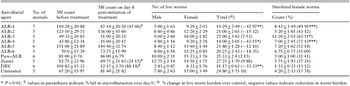
Table 2 shows the results of the effect of pure ALB, Zentel and the test formulations of ALB on parasitological parameters. A significant female worm sterilization effect was shown by ALB-1, ALB-3 and ALB-4 to an extent of 90% (P<0·001), 63% (P<0·05) and 77% (P<0·001), respectively.
Table 2. Anti-filarial activity of albendazole formulations (200 mg/kg, p.o. ×5 days) and DEC against Brugia malayi in Mastomys coucha (Values are mean±S.E.M. ALB, albendazole; DEC, diethylcarbamazine (50 mg base/kg, i.p. ×5 days); Zentel, marketed tablet of ALB.)
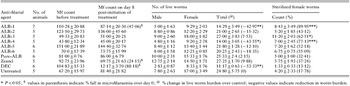
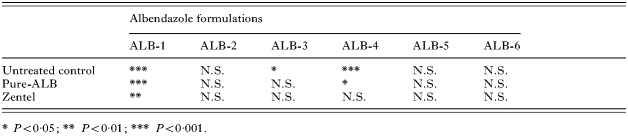
Further, we compared the sterilizing efficacy of the test formulations with that of the pure ALB-suspension and Zentel (Table 3). The efficacy of ALB-1 was found to be better than that of pure-ALB (P<0·001) and Zentel (P<0·01). ALB-4 was not as effective as ALB-1 (pure-ALB vs ALB-4: P<0·05; Zentel vs ALB-4: N.S.) while the activity of ALB-3 was no better than pure-ALB and Zentel. No significant sterilizing activity could be detected with the rest of the ALB-formulations. A moderate macrofilaricidal activity was also shown by both ALB-1 and ALB-4 (around 44%).
Table 3. Statistical significance of sterilization efficacy of albendazole formulations in the Brugia malayi – Mastomys coucha model (Newman-Keuls multiple comparison after one-way analysis of variance) (ALB, albendazole; Zentel, marketed tablet of ALB; N.S., not significant.)

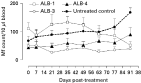
Untreated control animals showed a progressive rise in microfilaraemia until termination of the experiment (Fig. 1). About 18% of female worms recovered from these animals were sterile.

Fig. 1. Microfilaraemia in Mastomys coucha infected with Brugia malayi and treated with different formulations (ALB-1, ALB-3 and ALB-4) of albendazole. Data points are mean±S.E.M.
ALB-1 treatment produced no significant effect on microfilaraemia until day 70 p.i.t. However, microfilaraemia steadily decreased thereafter (day 70: P<0·05; day 84: P<0·01; day 91: P<0·01) till the day of sacrifice. ALB-4 treated animals showed no change in mf count throughout the observation period (Fig. 1).
Neither pure-ALB nor Zentel showed any significant effect on the mf, adult parasites or female reproductive potential as compared to untreated control (Table 2; Fig. 1).
DEC at a dose of 50 mg /kg (i.p.) caused more than 80% reduction in microfilaraemia and around 50% adulticidal action (Table 2).
Efficacy in the B. malayi – jird (M. unguiculatus) model
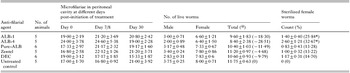
Both ALB-1 and ALB-4 showed marginal sterilization (26–33%; P<0·05) effect on female parasites, whereas pure ALB and Zentel did not exhibit any anti-filarial activity (Table 4).
Table 4. Anti-filarial activity of albendazole formulations (200 mg/kg, p.o. ×5 days) and DEC against transplanted adult worms of Brugia malayi in Meriones unguiculatus (Values are mean±S.E.M. ALB, albendazole; Zentel, marketed tablet of ALB; DEC, diethylcarbamazine (25 mg base /kg, i.p. for 5 days); @ % reduction in worm burden over control.)

In this system, DEC (25 mg/kg) also did not show any anti-filarial activity (Table 4).
DISCUSSION
Filariasis needs a chemotherapeutic agent capable of eliminating both infection and disease manifestations (Ottesen, 1992; Evans et al. 1993). Since no single agent is known to possess such an activity, a combination therapy is being currently tried for this purpose. Towards this end, co-administration of ALB/DEC or ALB/IVM was reported to be advantageous but the effect was not uniform (Evans et al. 1993; Ottesen et al. 1999; Beach et al. 1999). DEC is a highly effective microfilaricidal drug. In contrast, there is insufficient evidence on the microfilaricidal and macrofilaricidal efficacy of ALB (Ottesen et al. 1999; International Filariasis Review Group, 2004; Critchley et al. 2005; Tisch et al. 2005; Gyapong et al. 2005). Further, ALB suffers from some limitations, particularly poor absorption by oral route (Tracy and Webster, 2001), and perhaps this was the reason for the inconsistent results produced by ALB either alone or in combination with other anti-filarials. It is well known that benzimidazole derivatives are poorly absorbed through gastrointestinal tract (Denham et al. 1978; Vanden Bossche, 1981; Murthy et al. 1992) and ALB belongs to this class of compounds. With a view to overcoming this problem, 6 new formulations of ALB were prepared in the present study and tested for anti-filarial efficacy against B. malayi in experimental rodent models. Of these, 3 formulations: ALB-1, ALB-3 and ALB-4 produced sterilization of female reproductive potential, the best being ALB-1. ALB-1 also showed moderate adulticidal activity and a late reduction in microfilaraemia. While the untreated infected animals showed a steady rise in microfilaraemia over the observation period, ALB-4 treated animals showed no rise in microfilaraemia till day 91 of treatment. Taken together, these observations indicate that the adulticidal and sterilizing action of ALB-1 and ALB-4 is evidently responsible for the observed effect on microfilaraemia. In contrast, pure-ALB and Zentel showed no prominent anti-filarial activity. Thus, the improved sterilization effect of ALB-1 over pure ALB or Zentel suggests that ALB-1 might be useful in the control of transmission of the infection.
The superior anti-filarial activity of ALB-1 observed in the present study could be due to its lipid content, since Welling (1977) and Lange et al. (1988) showed that the bioavailability of ALB could be increased when given together with a fatty meal. In fact, when the activity of ALB-1 (emulsion) and ALB-4 (suspension) was compared with pure-ALB and Zentel it was found that the improved activity of ALB-1 was due to emulsion formulation, suggesting better gastrointestinal absorption of the drug in presence of oil. Similarly, the significant activity shown by the suppository formulation ALB-3, could be due to the presence of oil in the base. Both pure-ALB and Zentel showed poor anti-filarial activity by the oral route perhaps because of the absence of a lipid component in these preparations. In the present study, some anti-filarial activity in terms of sterilizing potential was also observed with other formulations and this could be due to solid dispersion in a water-soluble polymeric carrier (Chiou and Riegelman, 1969, 1971; Kohri et al. 1998; Malllick et al. 2003), surfactant content (in ALB-2 and 4) (Estal et al. 1994) and small particle size (in ALB-5 and 6). Mallick (2004) reported that grinding of poorly water-soluble crystalline drugs induces an amorphous formation, which can lead to increased dissolution and a consequent improvement in bioavailability. We are currently studying the bioavailability of the effective formulations.
In the B. malayi-jird system, both ALB-1 and ALB-4 showed only marginal macrofilaricidal and sterilization effect, suggesting that bioavailability of the drug in this species might be different. It is known that metabolism and/or bioavailability of many drugs may differ in different host species, and for this reason, efficacy and safety of potential compounds are usually investigated in more than one species. Among the anti-filarials, for example, DEC was found to be effective against B. malayi in M. coucha (Tyagi et al. 1986; Tripathi et al. 2003), cats (Edeson and Laing, 1959) and man (Wilson, 1950; Turner, 1959; Chen, 1964), but poorly effective in the B. malayi-jird system (Tanaka et al. 1981).
In conclusion, the findings of the present study show that the anti-filarial efficacy of ALB-1 (emulsion) formulation was superior to pure-ALB or Zentel. It provides a valuable lead for developing a better form of orally active ALB with adulticidal and female sterilizing potential to meet today's need under the Global Programme to Eliminate Lymphatic Filariasis.
The authors thank the Director, CDRI, Lucknow, for his encouragement during the study. The award of a Senior Research Fellowship by ICMR, New Delhi, to R. L. Gaur and S. Dixit is gratefully acknowledged. Thanks are due to Mr V. K. Bose, for his skillful technical assistance. This paper is CDRI communication No. 6875.