Introduction
Mounting experimental evidence point to a significant complexity of crystallization processes. Often crystal do not grow via monomer addition but undergo multiple transformation and assembly processes. One class of such alternative pathways involves crystallization by attachment of oriented crystals, known as oriented attachment (OA) [Reference Li, Nielsen, Lee, Frandsen, Banfield and De Yoreo1, Reference Nielsen, Li, Zhang, Aloni, Han, Frandsen, Seto, Banfield, Colfen and De Yoreo2, Reference De Yoreo, Gilbert, Sommerdijk, Penn, Whitelam, Joester, Zhang, Rimer, Navrotsky, Banfield, Wallace, Michel, Meldrum, Colfen and Dove3]. The idea of crystal growth through the attachment of aligned small crystals was first suggested more than a 100 years ago based on observations of the assembly of pre-existing crystals in saturated solution into single or twinned crystals [Reference Ivanov, Fedorov, Baranchikov and Osiko4]. In these early experiments, crystallization of lead nitrate under slow evaporation of the solvent produced single crystals of octahedral habit. By contrast, stirring the solution of pre-existing crystals yielded the formation of spinel twins [Reference Gaubert5].
A more direct evidence of OA was obtained using transmission electron microscopy (TEM), which revealed a persistent crystallographic alignment of nanocrystals. The nanocrystals formed single crystal chains through the attachment along a specific crystal face [Reference Penn and Banfield6, Reference Meng, Chen, Chen, Zhou, Peng and Li7]. Subsequently many materials were shown to exhibit similar crystallization behavior in a geological environment, under controlled synthesis conditions and in biological systems [Reference De Yoreo, Gilbert, Sommerdijk, Penn, Whitelam, Joester, Zhang, Rimer, Navrotsky, Banfield, Wallace, Michel, Meldrum, Colfen and Dove3, Reference Zhang and Banfield8]. Most of the conclusions about the OA pathway were made, however, based on the ex situ TEM analysis of the final crystals, which left the question of the underlying particle nucleation, growth, and dynamics unexplored. A definitive proof of the OA pathway was obtained only recently by direct in situ observation of particle attachment through a liquid cell transmission electron microscope [Reference Li, Nielsen, Lee, Frandsen, Banfield and De Yoreo1]. These experiments revealed complex dynamic processes preceding the attachment that involve a smaller particle approach a larger one from a distance of several nanometers followed by its exploration of the larger particle surface while in a solvent-separated state. This dynamic process encompasses small particle translation along the surface of the bigger particle, rotation, and, finally, alignment along the matching crystallographic faces followed by a rapid jump-to-contact from about 1 nm distance [Reference Li, Nielsen, Lee, Frandsen, Banfield and De Yoreo1]. This sampling of relative orientation of nanocrystals while in a long-lived solvent-separated state at nanometer distances points to a critical role of interfacial chemical dynamics at particle–solution interfaces that produce the forces that attract, align, and attach specific crystal faces to each other. Herein, the relative contribution of several interparticle forces conceptually within the range that favors crystallographic alignment is reviewed.
Based on experimental observations, the OA process can be roughly divided into three stages: approach, alignment, and attachment. During the first stage, particles approach from distances of 4–6 nm. The second stage involves particles residing in a long-lived solvent-separated state and sample face alignment. Finally, during the attachment stage, the solvent between the aligned particles is eliminated and jump-to-contact takes place. The complexity of the OA process implies that several types of forces working in tandem are likely to drive particle and interfacial solvent dynamics at each stage, which poses a unique challenge for theoretical modeling.
Theoretical approaches used to study the origin of the anisotropy of interactions between nanocrystals consider various aspects of interparticle interactions, but the relevant length and time scales are difficult to fully encompass. Nevertheless, significant progress has been made in identifying the strength and range of the driving forces for OA using well-established and novel modeling techniques. The progress was significantly aided by the development of new experimental methods for measuring orientation-specific interactions between nanocrystals and interfacial structure and dynamics [Reference Zhang, He, Sushko, Liu, Luo, De Yoreo, Mao, Wang and Rosso9, Reference Zhang, Shen, Liu, Kerisit, Bowden, Sushko, De Yoreo and Rosso10, Reference Li, Chun, Xiao, Zhou, Cai, Zhang, Rosso, Mundy, Schenter and De Yoreo11, Reference Higgins, Polcik, Fukuma, Sader, Nakayama and Jarvis12].
Macroscopic interparticle interactions
Early theoretical models of the mechanism of OA followed the traditional approaches of colloidal science, which consider macroscopic interactions between charged particles across a mean-field medium [Reference Lv, He, Wang, Niu, Cao, Dickerson and Wang13]. The possible sources of face specificity of interparticle forces at this level of theory include the anisotropy of bulk material properties of the nanocrystals such as the anisotropy in their static and dynamic dispersion responses, dipolar polarization of the crystals, and the face specificity of the distribution of surface charge.
Face-specific Van der Waals forces
The anisotropy of van der Waals interactions between nanocrystals may originate (i) from the intrinsic anisotropy of the dielectric response of the corresponding bulk material, (ii) from the shape anisotropy of the particles, or (iii) from the combination of these two effects.
Lifshitz theory of van der Waals interactions between dielectrically anisotropic planar surfaces
Lifshitz quantum electrodynamic theory of dispersion interactions predicts face-specific and orientation-specific interactions between dielectrically anisotropic solids. Van der Waals free energy for two anisotropic media (e.g., graphite of rutile TiO2) interacting across isotropic media (e.g., water or vacuum) can be calculated as
 $$\eqalign{G\left( {l,\theta } \right) = {{ - kT} \over {16{\pi ^2}{l^2}}}\sum\limits_{n = 0}^\infty {R\left( {i{\xi _n}} \right)} \cr\sum\limits_{j = 1}^\infty {{1 \over {{j^3}}}} \int_0^{2\pi } {{{\left[ {\Delta \left( {{\xi _n},0,\psi } \right)\Delta \left( {{\xi _n},\theta ,\psi } \right)} \right]}^j}{\rm{d}}\psi } = {{ - {\cal H}\left( {l,\theta } \right)} \over {12\pi {l^2}}}\quad ,$$
 $$\Delta \left( {{\xi _n},\theta ,\psi } \right) = \left[ {{{{\varepsilon _c}\left( {i{\xi _n}} \right)g\left( {\theta - \psi } \right) - {\varepsilon _m}\left( {i{\xi _n}} \right)} \over {{\varepsilon _c}\left( {i{\xi _n}} \right)g\left( {\theta - \psi } \right) + {\varepsilon _m}\left( {i{\xi _n}} \right)}}} \right]\quad ,$$
 $${g^2}\left( {\theta - \psi } \right) \equiv {{\varepsilon _a^{\parallel} } \over {{\varepsilon _c}}} + {{\left( {\varepsilon _a^ \bot - \varepsilon _a^{\parallel} } \right)} \over {{\varepsilon _c}}}{\sin ^2}\left( {\theta - \psi } \right)\quad .$$
Summation over n is over the imaginary Matsubara frequencies  $i{\xi _n} = {{2\pi kT} \over h}n,\;n = 0,\;1,\;2 \ldots$, and the n = 0 term has a prefactor of 1/2. In the afore-mentioned equations, kT is the thermal energy, l is the separation between particle surfaces, and θ is the azimuthal angle for rotation of one surface with respect to the other. εm(iξn) is the dielectric function of the intervening media, which is isotropic for most common solvents.
 ${\cal H}\left( {l,\theta } \right)$ is the Hamaker coefficient.
Retardation effects can be included through a relativistic screening factor R(ξ):
 $$R\left( \xi \right) = \left( {1 + r\left( \xi \right)} \right){{\rm{e}}^{ - r\left( \xi \right)}}\quad ,$$
 $$r\left( \xi \right) = {{2l\xi } \over {{c / {{\varepsilon _c}}}{{\left( \xi \right)}^{{1 / 2}}}}}\quad .$$
Then the force per unit area, F(l, θ), and the torque per unit area, τ(l, θ), acting on the nanocrystals can be calculated as
 $$F\left( {l,\theta } \right) = - {{\partial G\left( {l,\theta } \right)} \over {\partial l}}\quad ,$$
 $$\tau \left( {l,\theta } \right) = - {{\partial G\left( {l,\theta } \right)} \over {\partial \theta }}\quad .$$
For weak anisotropic solids, the expression for van der Waals energy and torque can be simplified by giving the scaling of the torque as sin(2θ)1.4.
The dielectric tensor of an anisotropic material can be written as
 $$\varepsilon = \left[ {\matrix{ {{\varepsilon _a}} & 0 & 0 \cr 0 & {{\varepsilon _b}} & 0 \cr 0 & 0 & {{\varepsilon _c}} \cr} } \right]\quad .$$
Often, the dielectric anisotropy is semi-uniaxial. For example, rutile TiO2 is anisotropic in all three crystallographic directions with strong anisotropy between the c-direction and a-plane and weak anisotropy in the a-plane. Then, an anisotropic factor δ‖(⊥), small compared with εa, can be introduced, and the dielectric tensor becomes
 $$\varepsilon = \left[ {\matrix{ {{\varepsilon _a}\left( {1 + {\delta _{\parallel} }} \right)} & 0 & 0 \cr 0 & {{\varepsilon _a}\left( {1 + {\delta _ \bot }} \right)} & 0 \cr 0 & 0 & {{\varepsilon _c}} \cr} } \right]\quad .$$
The frequency-dependent dielectric response of the material can be calculated based on spectroscopic data and anharmonic quantum theory for multiple phonon mode crystals [Reference Schoche, Hofmann, Korlacki, Tiwald and Schubert15, Reference Gervais and Piriou16, Reference Gervais and Piriou17]. The formalism decouples the damping parameters for each longitudinal (LO) and transverse (TO) phonon mode, giving the following expression for the dielectric function:
 $$\varepsilon \left( \omega \right) = {\varepsilon _\infty }\prod\limits_i {{{{\omega ^2} + i{\gamma _{{\rm{LO}}i}}\omega - \omega _{{\rm{LO}}i}^2} \over {{\omega ^2} + i{\gamma _{{\rm{TO}}i}}\omega - \omega _{{\rm{TO}}i}^2}}} \quad ,$$
or
 $$\varepsilon \left( {i\xi } \right) = {\varepsilon _\infty }\prod\limits_i {{{{\xi ^2} + {\gamma _{{\rm{LO}}i}}\xi + \omega _{{\rm{LO}}i}^2} \over {{\xi ^2} + {\gamma _{{\rm{TO}}i}}\xi + \omega _{{\rm{TO}}i}^2}}\quad ,}$$
where γLO(TO)i are the dumping factors and ωLO(TO)i are the optical phonon mode frequencies.
The Lorentzian formula [Reference Bergstrom18] can be used in the UV range as follows:
 $${\varepsilon _{{\rm{UV}}}}\left( {i\xi } \right) = 1 + {{{c_{{\rm{UV}}}}} \over {1 + {{\left( {{\xi / {{\omega _{{\rm{UV}}}}}}} \right)}^2}}}\quad .$$
The dielectric function of water can be calculated using the combined Debye oscillator and damped oscillator model [Reference Parsegian19]:
 $${\varepsilon _{\rm{w}}}\left( {i\xi } \right) = 1 + \sum\limits_i {{{{d_i}} \over {1 + {\tau _i}\xi }}} + \sum\limits_i {{{{f_i}} \over {{\xi ^2} + {\gamma _i}\xi + \omega _i^2}}} \quad .$$
Similar models are used for other common solvents.
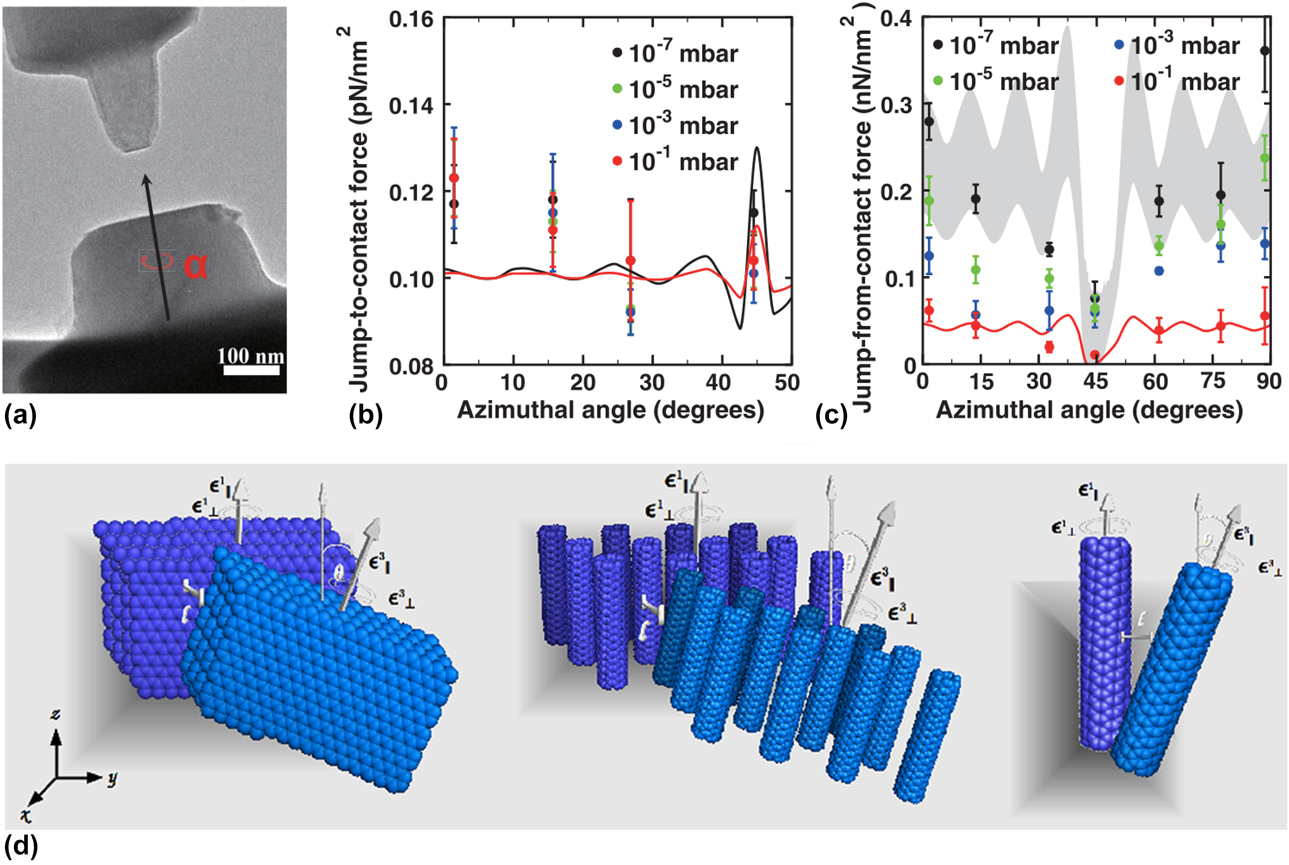
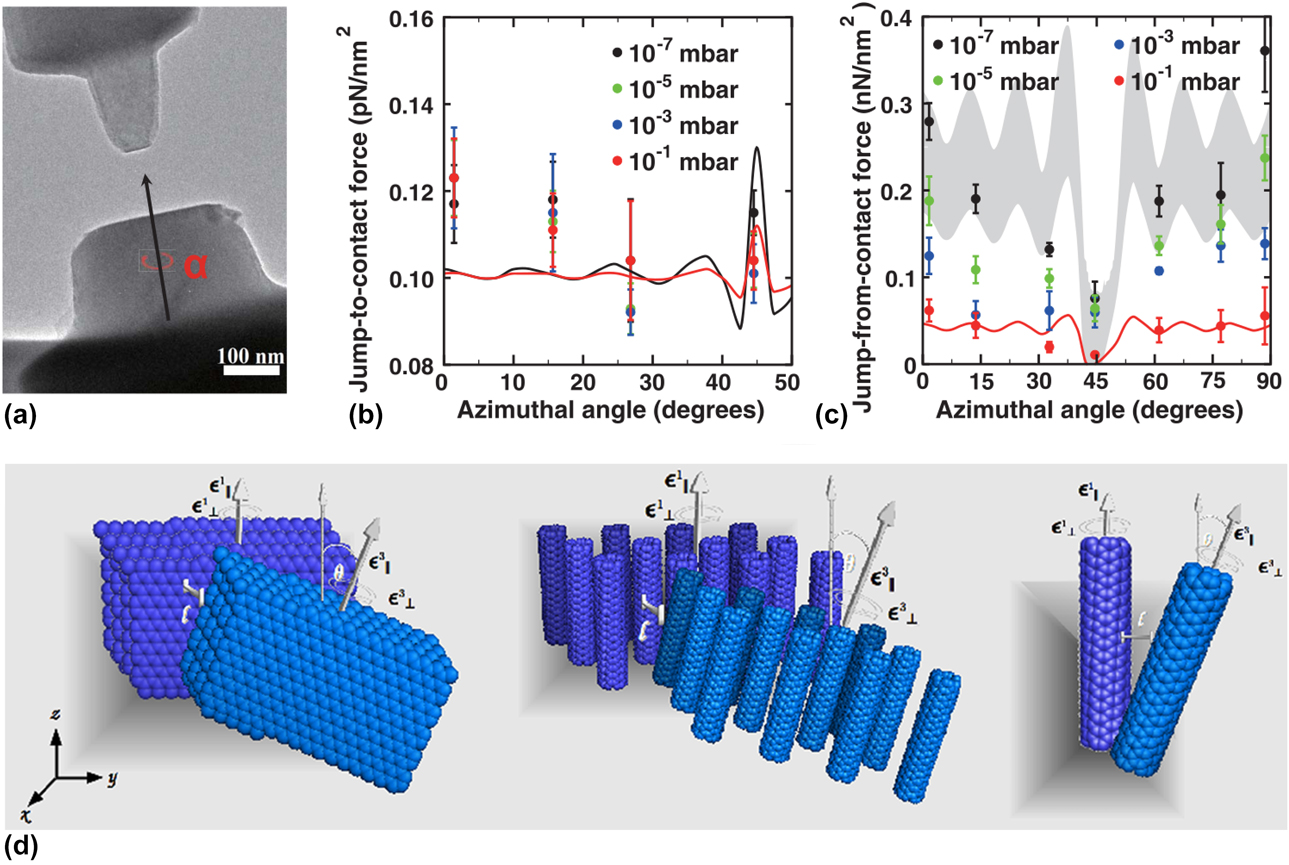
Lifshitz theory prediction of the face and angular dependence of van der Waals interactions of dielectrically anisotropic solids was put to test only recently [Reference Zhang, He, Sushko, Liu, Luo, De Yoreo, Mao, Wang and Rosso9]. The new experimental method integrated atomic force microscopy (AFM) probe technology with environmental TEM (ETEM) [Reference Erts, Lohmus, Lohmus, Olin, Pokropivny, Ryen and Svensson20] to measure force–distance relationships between two single crystals while directly imaging the interparticle gap. The experiments were designed to isolate interparticle van der Waals interactions as the only significant attractive force acting between rutile TiO2 nanocrystals and were performed under high vacuum conditions and in the presence of water vapor. These measurements demonstrated the quantitative agreement of the angular dependence of interparticle forces and the predictions of Lifshitz theory [Figs. 1(a)–1(c)]. Two other takeaways from this study include the short-range nature of the van der Waals forces on the azimuthal alignment of nanocrystals, which becomes insignificant at separations of 1.0–1.5 nm. By contrast, at separations of approximately one hydration layer, the attraction is strongly dependent on azimuthal alignment and systematically decreases as intervening water density increases. These results suggest that van der Waals interactions between dielectrically anisotropic nanocrystals will contribute to particle alignment at the final stages of the OA process.
Direction-specific particle–particle van der Waals forces. (a) The TEM image of two rutile TiO2 crystals during the ETEM–AFM force measurements. (b) Measured forces (symbols) and vdW forces calculated using Lifshitz theory for rutile (001) crystals interacting across vacuum (∼10−7 mbar) and a thin isotropic water layer (∼10−1 mbar) are shown with black and red lines, respectively. (c) Measured forces (symbols) and calculated vdW forces across vacuum at 0.4- to 0.5-nm separation (gray region) and with an intervening isotropic water film at 0.4-nm separation (red line) (Ref. Reference Zhang, He, Sushko, Liu, Luo, De Yoreo, Mao, Wang and Rosso9). (d) Schematics of the interacting optically anisotropic uniform plates, morphologically anisotropic plates, and cylinders experiencing van der Waals torque (Ref. Reference Hopkins, Podgornik, Ching, French and Parsegian14).
The dynamics of nanocrystals in isotropic solution were further investigated by coupling van der Waals interactions and hydrodynamic effects [Reference Yasui and Kato21]. Simulations of the dynamics of cubic and spherical optically anisotropic crystals predicted the alignment of nanocrystals along their optical axes.
Shape anisotropy
Van der Waals interactions between nanocrystals with elongated morphology may exhibit orientational anisotropy even when the dielectric response of the corresponding bulk material is isotropic. The effect of shape anisotropy on interparticle van der Waals torque is typically longer range, with the range commensurating with the size of the particles. Analytic closures for orientation-dependent van der Waals forces were derived for plates, the arrays of cylinders, and two isolated cylinders using Lifshitz theory [Fig. 1(d)]. The formalism separates the effects of morphological and material anisotropy and gives the following expression for the torque [Reference Hopkins, Podgornik, Ching, French and Parsegian14] between two plates:
 $$\tau \left( {l,\theta } \right) = - {{\partial G\left( {l,\theta } \right)} \over {\partial \theta }} = - {{{A^{\left( 2 \right)}}\left( l \right)\sin \left( {2\theta } \right)} \over {6\pi {l^2}}}\quad ,$$
and two cylinders:
 $$\tau \left( {l,\theta } \right) = - {{{{\left( {\pi {a^2}} \right)}^2}\left( {{A^{\left( 0 \right)}}\left( l \right) + {A^{\left( 2 \right)}}\left( l \right)\left( {2 - \cos \left( {2\theta } \right)} \right)} \right)\cos \left( \theta \right)} \over {2\pi {l^4}\;{{\sin }^2}\left( \theta \right)}}\quad ,$$
where the approximation of  ${\cal H}\left( {l,\theta } \right) = {A^{\left( 0 \right)}}\left( l \right) + {A^{\left( 2 \right)}}\left( l \right)\sin \left( {2\theta } \right)$, valid for weak optical anisotropy, was used.
Calculations for cylindrical nanoparticles, such as carbon nanotube, predicted that they experience torques that drive cylindrical particles to undergo parallel alignment of their LO axes [Reference Hopkins, Podgornik, Ching, French and Parsegian14]. The same qualitative result was obtained for cylinders made of either anisotropic or isotropic materials. The values of the torque and its angular dependence for the cylinders separated by 6 nm were found to be largely independent of the anisotropy of the materials’ optical response, pointing to a dominating role of shape anisotropy at long range. An interesting result was obtained for a composite material comprising parallel arrays of cylinders [Reference Hopkins, Podgornik, Ching, French and Parsegian14]. The calculated torque between the arrays of cylinders was stronger than that between plates at large separations. This effect of morphological anisotropy may be used in the synthesis of hierarchical materials.
Dielectric anisotropy versus shape anisotropy
These results demonstrate that van der Waals interactions can play an important role in aligning elongated nanocrystals during the OA approach stage, whereas van der Waals torque due of materials’ optical anisotropy can contribute to particle azimuthal alignment during the second stage of OA, when particles are separated by several layers of solvent.
Electrostatic interactions
Electrostatic dipolar interactions were proposed as a driving force for nanorod growth through the OA pathway [Reference Liao, Cui, Whitelam and Zheng22]. This model considered classical point dipole interactions as the only interparticle force and predicts head-to-tail assembly of dipoles in a chain structure to interpret the experimentally observed nanorod growth through particle attachment. A different conclusion was obtained in a model that apart from dipolar interactions also encompasses van der Waals torque and Brownian dynamics of the particles [Reference Yasui and Kato21]. This study predicts that cubic or spherical particles with dipole moment along their optical axis attach in the side-by-side parallel dipole orientation when the particles are smaller than 5 nm. The dominating driving force for OA for these small crystals is van der Waals attraction. By contrast, the model predicts that dipolar interactions dominate when crystals are larger than 20 nm. Then, crystals orient in a side-by-side antiparallel dipole configuration.
We note that a distinction should be made between dipolar interactions arising from anisotropic dipolar polarizability of the material, i.e., the material’s frequency-dependent dielectric response spectrum, and those between permanent surface dipoles of polar surfaces. For example, ideal ZnO(0001) surfaces are polar and the corresponding ideal ZnO(0001)-terminated nanorods would have a considerable macroscopic dipole. However, in equilibrium conditions, these macroscopic dipoles are compensated through the formation of surface defects and partial hydroxylation/protonation of the (0001) faces [Reference Kresse, Dulub and Diebold23, Reference Martins, Moliner, Andres, Longo and Taft24, Reference Onsten, Stoltz, Palmgren, Yu, Gothelid and Karlsson25, Reference Rodriguez and Campbell26, Reference Schiek, Al-Shamery, Kunat, Traeger and Woll27, Reference Wahl, Lauritsen, Besenbacher and Kresse28, Reference Xu, Dong, Shi, Van Hove, Ho, Lin, Wu and Tong29, Reference Ye, Chen, Niu, Zhu, Shao and Qiao30, Reference Mora-Fonz, Lazauskas, Farrow, Catlow, Woodley and Sokol31]. In nonequilibrium conditions, however, when nanorod growth takes place at an elevated temperature [Reference Pacholski, Kornowski and Weller32], total compensation of the macroscopic dipole may not be achieved [Reference Fan, Zhang, Yan and Fan33]. Then, residual spontaneous dipolar polarization would also contribute to interparticle orientation-dependent interactions [Reference Fan, Zhang, Yan and Fan33].
Further developments of electrostatic models for the interactions between nanocrystals addressed surface charging either due to native surface chemistry of various crystal faces or due to decoration of the crystals with charged ligands [Reference Zhang and Banfield34]. The systematic study of the relative strength of Coulomb interactions between charged crystal faces, macroscopic dipole–dipole interactions, and van der Waals interactions between nanocrystals concluded that dipolar interactions fail to reproduce face-specific interactions driving OA for several materials. Instead, the interatomic Coulomb interactions were proposed as a driving force for OA at short-range and van der Waals interactions as dominating interparticle forces at larger separations [Reference Li, Chun, Xiao, Zhou, Cai, Zhang, Rosso, Mundy, Schenter and De Yoreo11]. These conclusions point to the similarity between this model and the Derjaguin–Landau–Verwey–Overbeek [Reference Derjaguin and Landau35, Reference Verwey36, Reference Verwey37] (DLVO) theory of colloidal interactions, which treats colloidal stability in terms of a balance of attractive van der Waals forces and repulsive electrical double-layer forces. Although recent theoretical models [Reference Li, Chun, Xiao, Zhou, Cai, Zhang, Rosso, Mundy, Schenter and De Yoreo11, Reference Zhang and Banfield34] are more advanced than the original DLVO approach in the treatment of interatomic Coulomb interactions and surface charge density, conceptually they are similar in that these models consider electrolyte solution as a mean-field medium that screens interparticle Coulomb interactions. By making this approximation, DLVO-type theories effectively exclude any specificity of solvent- and electrolyte-mediated interparticle forces. Thereby, even with five adjustable parameters, the DLVO theory often disagrees with the experiment at distances smaller than 1 nm [Reference Shubin and Kekicheff38], which is of particular importance in the OA process. Moreover, above electrolyte concentrations of 0.1 M, the theory loses any predictability [Reference Kim, Tuite, Norden and Ninham39].
The non–mean-field nature of the solvent manifests itself in solvent structuring at particle surface, specific hydration structure at crystal faces, specific hydration of mobile ions in the electrolyte solution, and specific interactions of hydrated ions with crystal faces, which can have dispersion and an electrostatic nature. The combination of all these effects leads to a high electrolyte specificity of interparticle forces driving the OA process [Reference Bostrom, Williams and Ninham40]. For example, forces can vary by more than an order of magnitude by changing the counter ion from bromide to acetate [Reference Dubois, Zemb, Fuller, Rand and Parsegian41, Reference Dubois, Zemb, Fuller, Rand and Parsegian42, Reference Pashley, Mcguiggan, Ninham, Brady and Evans43]. Experimental studies demonstrated that the probability of OA is highly sensitive to solution pH, concentration, and nature of the electrolyte [Reference Penn and Banfield6, Reference Burrows, Hale and Penn44, Reference Penn and Banfield45, Reference Burrows, Hale and Penn46]. Theoretical studies on the role of interfacial solution-mediated forces in the OA are scarce; however, several attempts to systematically address this issue were made.
Role of interfacial solvent structure and dynamics
Face-specific hydration forces
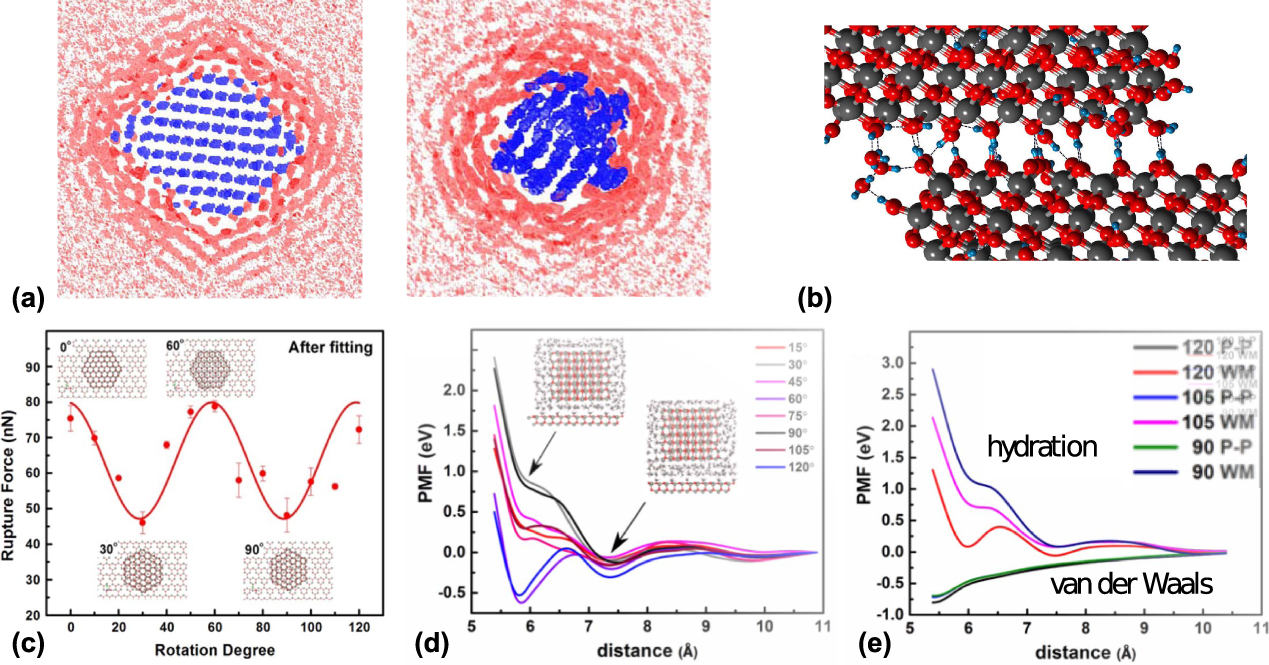
Interfacial water structuring, which extends over several water layers, is well documented experimentally [Reference Pashley and Israelachvili47, Reference Spagnoli, Gilbert, Waychunas and Banfield48]. The general feature of interfacial water structure is the periodic variation of its density, with the period equal to the size of a water molecule [Fig. 2(a)]. When two surfaces approach each other close enough for these structured water layers to overlap, they start experiencing entropic repulsion. These entropic hydration forces oscillate, with interparticle separations depending on the number of full water layers that can be accommodated between them. The specificity of the interactions between water molecules in direct contact with the crystal surface leads to the specificity of the position and height of the first density peak at the interface, and, by extension, to the specificity of entropic hydration interactions. Similarly, these forces may be sensitive to mutual orientation of the crystal faces. Molecular simulations predict the dependence of the structure of the hydration layer around nanoparticles on their size and morphology, providing an indirect evidence for the role of hydration forces in OA [Reference Spagnoli, Gilbert, Waychunas and Banfield48, Reference Zhang, De Yoreo and Banfield49]. A more direct correlation between the interfacial solvent properties and mutual crystallographic orientation between nanocrystals was obtained using a combination of AFM force measurements, orientation-dependent interactions between two ZnO nanocrystals in aqueous solution, and molecular dynamics simulations [Reference Zhang, Shen, Liu, Kerisit, Bowden, Sushko, De Yoreo and Rosso10]. The study revealed a 60° periodicity in the measured and calculated forces [Figs. 2(c)–2(e)]. Partitioning the total potential of mean force into solvent-mediated and solvent-independent contributions showed that the observed periodicity of the total force originates in entropic hydration interactions. Repulsive hydration energy curves have a characteristic oscillatory behavior, and at all azimuthal angles, there is a shallow minimum corresponding to 3 layers of intervening water. Deeper minima appear on the hydration free energy curves at two–water layer separation only when the azimuthal angle between nanocrystals is 0°, 60°, or 120°. This result points mainly to the entropic origin of specific hydration interactions. The conclusion is further supported by the analysis of hydrogen bonds in-between the two ZnO surfaces, which shows no obvious angular dependence of the number of hydrogen bonds and the hydrogen bond length. The role of enthalpic hydration interaction with the surfaces is more subtle; however, the number of Zn–Owater bonds in the space between the two ZnO surfaces was found to change cyclically with a period of 60°.
Water structuring at interfaces and interparticle hydration interactions. (a) Water density maps around 2.7 nm [0 nm (left) and 1.6 nm (right) hematite nanoparticles (Ref. Reference Spagnoli, Gilbert, Waychunas and Banfield48)]. (b) Network of hydrogen bonds between aligned anatase TiO2 nanocrystals (Ref. Reference Raju, van Duin and Fichthorn50). (c, d) Azimuthal angular dependence of measured and calculated forces between ZnO nanocrystals in pure water: (c) measured forces, (d) total calculated potential of mean force (PMF), and (e) hydration (WM) and van der Waals (P–P) contributions of the PMF (Ref. Reference Zhang, Shen, Liu, Kerisit, Bowden, Sushko, De Yoreo and Rosso10).

A detailed analysis of the role of face-specific enthalpic hydration interactions was performed using the reactive molecular dynamics approach [Reference Raju, van Duin and Fichthorn50]. These simulations revealed that in the absence of water, the interactions between anatase TiO2 nanocrystals are not face specific and particles attach along the direction of their approach, which is consistent with a nonspecific nature of van der Waals–driven aggregation of optically isotropic particles. The presence of water vapor changes the nature of interparticle short-range interactions. The adsorbed and partially dissociated water molecules create a dynamic network of hydrogen bonds between the aggregating nanocrystals, which promotes their alignment [Fig. 2(b)]. These simulations also suggest that face selectivity is related to the propensity of various crystal faces to dissociate water because electrostatic interactions between adsorbed hydroxyl groups and surface oxygens become the main driving force for particle alignment at separations below 0.3 nm.
These studies highlight the importance of interfacial water reactivity, structure, and dynamics in face selectivity and alignment of nanocrystals.
Face-specific forces in electrolyte solutions
Systematic experimental studies have shown that OA is highly sensitive to the properties of aqueous electrolyte solutions, in that even small changes in solution ionic strength or pH may disrupt the mode of nanoparticle assembly from OA to random aggregation [Reference Penn and Banfield6, Reference Burrows, Hale and Penn44, Reference Penn and Banfield45, Reference Burrows, Hale and Penn46]. Surface force apparatus measurements of the angular dependence of adhesion forces between two atomically flat mica surfaces revealed a 60° periodicity of sharp adhesion energy peaks in pure water and in electrolyte solutions [Reference Mcguiggan and Israelachvili51, Reference Mcguiggan and Israelachvili52]. This study also demonstrated the “quantization” of the attraction between two surfaces. That is, if in pure water the surfaces jump straight into the primary energy minimum, in 0.7 mM KCl the surfaces initially come to rest in the second, metastable, adhesive minimum, where the adhesive force is about 25% of that in the primary minimum. After dwelling in this solvent-separated state for several seconds, a jump-to-contact was observed. This adhesion dynamics in electrolyte solutions is characteristic to particle dynamics during the OA, in which the onset of a metastable solvent-separated state is essential for particle alignment in a lattice matching orientation. The observed appearance of a metastable state in electrolyte solutions cannot be driven by oscillatory entropic hydration forces alone, and points to a unique role of ion distributions in the electrical double layer (EDL) at nanocrystal–solution interfaces, which underlie both the osmotic pressure and azimuthal torque between lattice mismatched crystal surfaces [Reference Alcantar, Israelachvili and Boles53, Reference Tan, Zhao, Qiu, Kan, Ni and Chen54].
On the nanometer scale, the forces governing face-selective assembly may involve a delicate balance of solvent- and ion-mediated interactions. These forces arise from correlated density fluctuations of the solvent and solvated species in the interparticle region. At this length scale, forces no longer depend on the position of the individual atoms in solution, but are defined by the density distributions of solution species, their many-body interactions and dynamics. Such a shift from interatomic interactions defining interfacial properties at the 0.5-nm scale to collective many-body forces determining interfacial solvent structure and dynamics at the nanometer scale is the hallmark of the mesoscopic behavior. In pure solvent, these mesoscale forces manifest themselves in dynamic solvent structuring at interfaces and give rise to entropic solvation repulsion discussed in the previous section. In electrolyte solutions, ion density fluctuations in the EDL are also not random. Dispersion and electrostatic solvated ion–ion and ion–surface interactions in the EDLs of the interacting particles impose correlations onto ion dynamics. Correlated fluctuations in the EDL at one particle surface interact with fluctuations in ionic densities in the EDL of the other particles, inducing a long-range interaction, known as ion correlation forces. These interactions are the mesoscopic analog to the microscopic interactions between fluctuation-induced dipoles, or atom–atom van der Waals forces. On the nanometer scale, the fluctuating electric field is created by the fluctuations in ion densities in the interacting diffuse layers of two solvent-separated surfaces. In many cases, these interactions lead to the overall attractive interactions between like-charged surfaces [Reference Tan, Zhao, Qiu, Kan, Ni and Chen54, Reference Pincus and Safran55] or polyelectrolytes even in low salt conditions [Reference Manning56].
Ion correlation forces are sensitive to the details of the distribution of charged groups on the nanoparticle surfaces, which, in turn, depend on crystallographic face, solution pH, and electrolyte properties, e.g., bulk concentration and nature of the electrolyte. This intimate connection between mesoscopic forces and atomistic details of interfacial chemistry of various crystal faces of the nanoparticles provides a direct link between face specificity of the interparticle forces and experimental solution composition. Therefore, a computational framework encompassing short-range interfacial forces and mesoscale collective interactions should have a predictive power for synthesis conditions that favor the OA pathway.
Among available theoretical approaches, continuum representation of the solutions is fundamentally deficient because it lacks essential details of solution structure and dynamics by design. In theory, complete atomistic details of solution dynamics can be obtained using molecular dynamics simulations. However, in practice, molecular dynamics fails to capture large-scale fluctuations because such ensemble-averaged correlations can be only identified over a long time and length scales, not practical for molecular dynamics simulations [Reference Giberti, Salvalaglio and Parrinello57, Reference Raiteri and Gale58, Reference Demichelis, Raiteri, Gale, Quigley and Gebauer59, Reference Wallace, Hedges, Fernandez-Martinez, Raiteri, Gale, Waychunas, Whitelam, Banfield and De Yoreo60, Reference Raiteri, Gale, Quigley and Rodger61, Reference Lifanov, Vorselaars and Quigley62, Reference Zimmermann, Vorselaars, Quigley and Peters63, Reference Slater and Quigley64, Reference Smeets, Finney, Habraken, Nudelman, Friedrich, Laven, De Yoreo, Rodger and Sommerdijk65, Reference Quigley, Freeman, Harding and Rodger66, Reference Kawska, Brickmann, Kniep, Hochrein and Zahn67, Reference Sear68, Reference Gebauer, Kellermeier, Gale, Bergstrom and Colfen69]. For example, molecular dynamics fails to reproduce such fundamental solution property central to the understanding of crystallization processes as ion activity even in the arguably most simple electrolyte [Reference Mester and Panagiotopoulos70].
An alternative approach would be to calculate these ensemble-averaged correlations from first principles, bypassing the statistical averaging over the length and time scales characteristic to atomic motion. Such approach is adopted by the classical density functional theory (cDFT) of complex fluids, in which density correlation function is calculated directly through the solution of the Ornstein–Zernike equation [Reference Rosenfeld71, Reference Kahl and Lowen72, Reference Wu and Li73]. The cDFT theory is deeply rooted in quantum mechanics and was successful in describing phase diagrams of multicomponent systems and modeling homogeneous nucleation [Reference Oxtoby74]. Coupling the theory of inhomogeneous complex fluids to quantum mechanical descriptions of short-range forces can potentially provide a first-principles framework for studying complex nonequilibrium processes, including heterogeneous nucleation and particle-based crystallization. Although significant progress has been made, the lack of a computational approach that can predict ensemble pathways and outcomes, while maintaining molecular fidelity, is still a hindrance to building a predictive capability. Nonetheless, given that the OA process can be approximated as a three-stage process, in which the approach and fine particle reorientation, while in a metastable solvent-separated state, are not expected to be affected by dynamic reactivity at the crystal–solution interface, certain conclusions on the driving forces for OA can be made without invoking interfacial reactivity in a self-consistent fashion. Instead, face-specific surface distribution of charged groups due to water dissociation or ligand adsorption can be considered constant for particle separations greater than 0.5 nm. Using this approximation, the origin of electrolyte-mediated interactions leading to the “quantization” of the interparticle attractive forces was revealed through cDFT simulations [Reference Sushko and Rosso75].
Simulations of face-specific interactions in two classic systems, anatase TiO2 and ZnO, revealed that ion correlation interactions are giving rise to face-specific attractive interactions at a relatively long range. Simulations for TiO2, predict that crystal face-specific attractive interactions between nanoparticles dominate the interactions in the solvent-separated state only in a very narrow pH range, from pH 2.5 to 3.5, in agreement with experimental observation that OA between anatase crystals is most probable at pH 3, whereas random aggregation is more probable at pH 1.2–2.1 and pH 8–11 [Reference Penn and Banfield45]. This clear pH dependence of the competing isotropic particle–particle van der Waals forces and face-specific ion correlation forces at 2–6 nm separations reflects the role of diffuse ionic layers in mediating the OA.
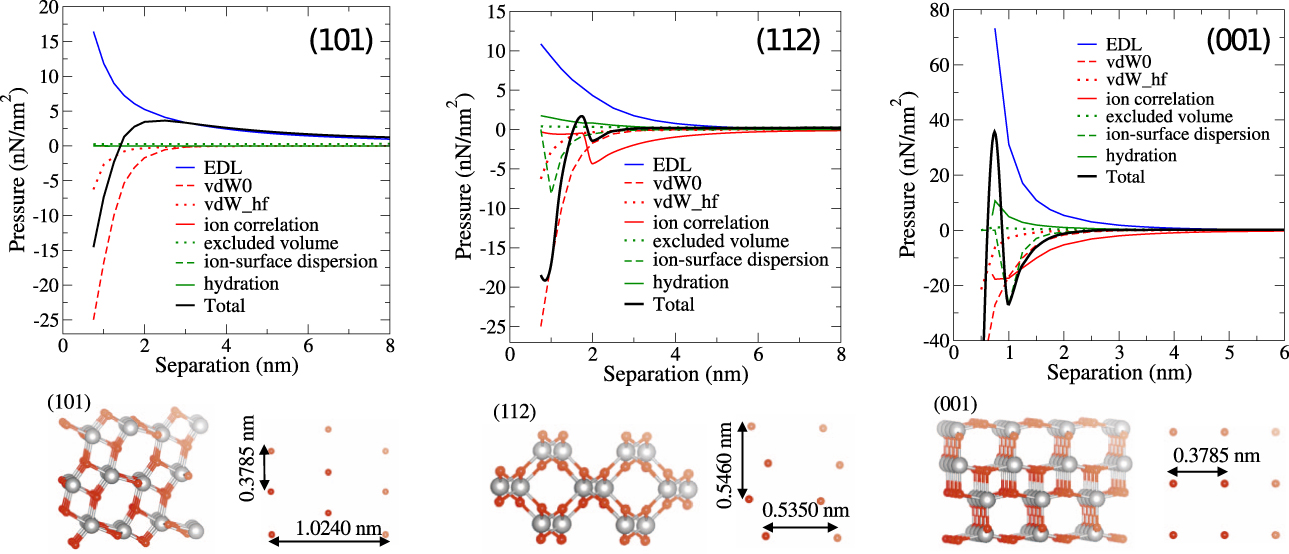
At pH 3, simulations predict a strong face specificity of the interparticle forces. In particular, the interaction forces between (101) surfaces are monotonic and repulsive at the long range, while a secondary minimum appears in a solvent-separated state for the interactions between two (001) and two (112) anatase faces (Fig. 3). However, the high barrier separating the metastable state, also called a capture minimum, and primary minimum suggests that attachment between (001) faces is a low-probability event. By contrast, for (112) faces, the barrier can be easily surmounted, and particles can undergo OA.
Face-specific interactions between anatase TiO2 particles in electrolyte solution. Distance dependence of the components of the total disjoining pressure between two anatase (101) facets (left), two (112) facets (middle), and two (001) facets (right). The structure of the corresponding surfaces and the arrangement of surface oxygens are shown (Ref. Reference Sushko and Rosso75).

Several opposing factors underlie the overall pH dependence of ion correlation forces in the capture minimum region of the pressure–distance curve. At 2-nm separation between nanoparticles, the EDLs are separated by a layer of “bulk solution.” In this regime, the strength of ion correlation forces is defined by the thickness of the EDL; the effective 2D ion density in the EDL, which increases with ion concentration or surface charge density; and the effective distance between the EDLs. The EDL thickness, characterized by the Debye length, decreases with increasing electrolyte concentration. By contrast, the effective distance between the EDLs at a fixed separation between the interacting surfaces and the 2D ion density in the EDL increases with increasing electrolyte concentration. Overall, the combination of these opposing effects results in a non-monotonic dependence of ion correlation forces on electrolyte concentration or pH.
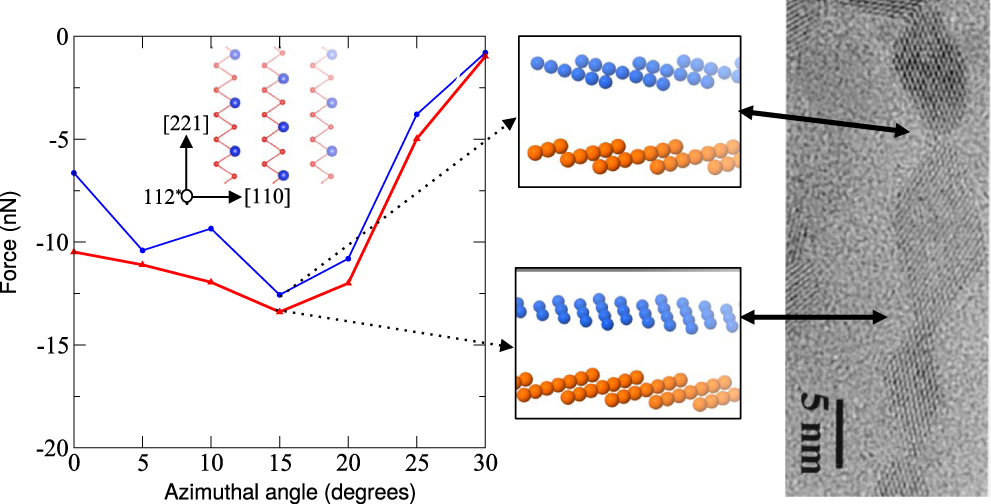
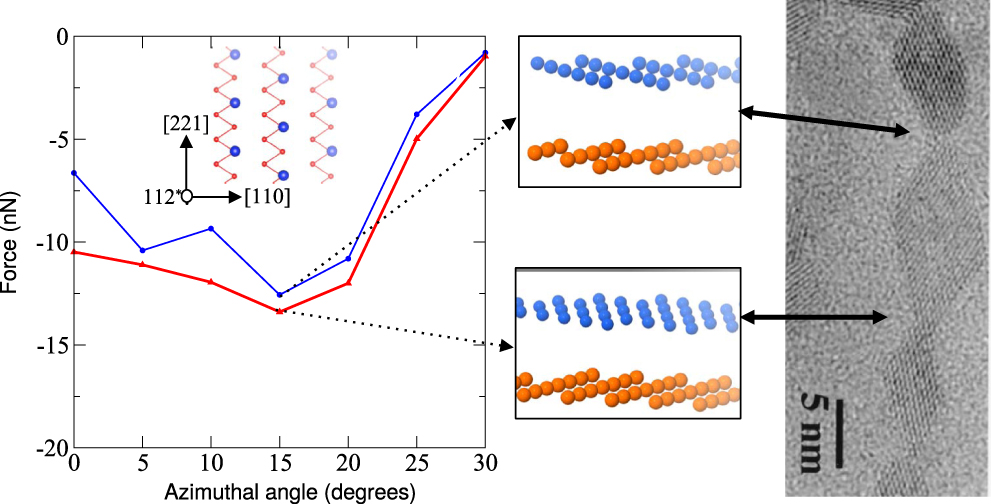
Ion correlation forces not only play a central role in face selectivity during nanoparticle approach, but are also strong enough at long range to influence the mutual orientation of the interacting nanoparticles in the vicinity of the capture minimum (Fig. 4). Ion correlation torque drives (112) faces either to alignment to form defect-free crystals or a twin boundary, in agreement with experimental observations [Reference Penn and Banfield45].
Angular dependence of the ion correlation forces at the midplane between (112) anatase TiO2 facets at 3-nm interparticle separation and the corresponding arrangement of surface oxygens on the interacting facets (Ref. Reference Sushko and Rosso75). The TEM image of the chain of anatase nanoparticles forming a single crystal (Ref. Reference Penn and Banfield45). The arrows highlight an ideal and a twin boundary along (112) faces.
Role of surface chemistry
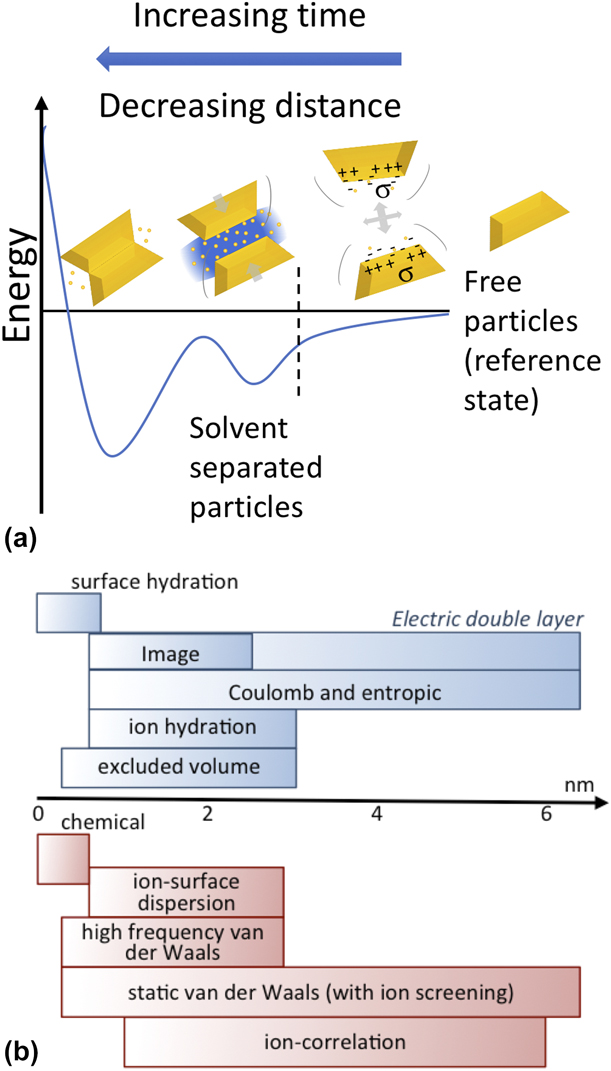
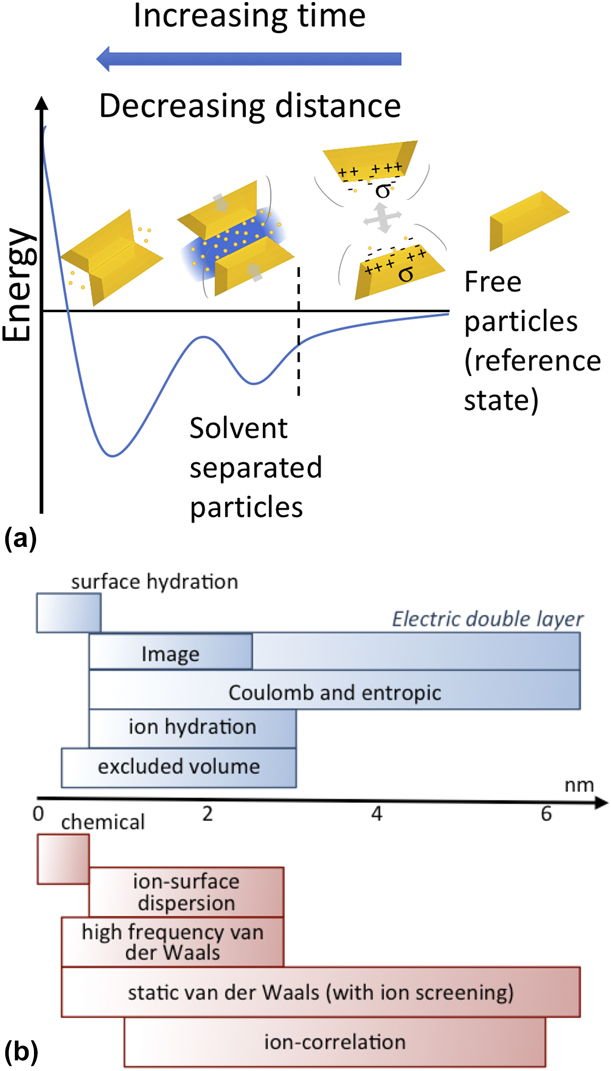
Simulations predict that particles align and attach along the faces with a close packed arrangement of charged species [Reference Raju, van Duin and Fichthorn50, Reference Sushko and Rosso75]. The intimate link between the arrangement of charged groups on the crystal face and the strength and range of ion correlation interactions observed for anatase TiO2 and ZnO suggests that the arrangement of charged groups on various crystal faces can serve as a predictor of the most likely mode of OA. For oxides in water-containing solutions, such charged species are usually acquired through partial protonation/hydroxylation of the surfaces. Then, the distribution of discrete charges on the surface is dictated by surface atomic ordering and by the pH and electrolyte concentration. Alternatively, a desired distribution of charged species on specific crystal faces can be engineered through targeted surface functionalization with ligands. This approach, which is often used successfully in material synthesis, includes assembly of ordered nanostructures through OA of functionalized nanocrystals [Reference De Yoreo, Gilbert, Sommerdijk, Penn, Whitelam, Joester, Zhang, Rimer, Navrotsky, Banfield, Wallace, Michel, Meldrum, Colfen and Dove3, Reference Cho, Talapin, Gaschler and Murray76, Reference Boneschanscher, Evers, Geuchies, Altantzis, Goris, Rabouw, van Rossum, van der Zant, Siebbeles, Van Tendeloo, Swart, Hilhorst, Petukhov, Bals and Vanmaekelbergh77]. Once the desired surface chemistry is achieved, the interparticle forces can be further tuned by adjusting the properties of the electrolyte, including the nature of ions, their size, charge, and solvation properties. All these system variables affect the strength of the dominating forces, ion correlation, and solvation, and can be finely adjusted through the choice of electrolyte. Temperature is also an important factor defining the strength of entropic ion correlation and hydration forces between nanoparticles and is instrumental in shifting the balance of interactions from enthalpic solvation repulsion to entropic ion correlation attraction (Fig. 5).
Schematics of the OA process (a) and the repulsive (blue) and attractive (red) forces acting between nanocrystals in electrolyte solutions and their range (b) (Ref. Reference Sushko and Rosso75).
Summary of the current status of OA theory
Although a comprehensive theoretical model for OA, including chemical reactive processes at short range such as bond-breaking and interparticle attachment [Reference Raju, van Duin and Fichthorn50, Reference Fichthorn78], has yet to be developed, a general physical picture can now be proposed. Based on simulations and extensive experimental work [Reference Alcantar, Israelachvili and Boles53] on the forces between two flat surfaces in pure water and in aqueous electrolyte solutions, interactions acting between two particles and driving their alignment can be divided according to their range and the stages of the OA process.
Approach
In situ experiments demonstrated that certain directionality and face specificity of particle motion can be observed at separations as high as 6–8 nm [Reference Li, Nielsen, Lee, Frandsen, Banfield and De Yoreo1, Reference Liao, Cui, Whitelam and Zheng22]. At these separations, interactions between nanocrystals are dominated by particle–particle van der Waals, spontaneous dipolar polarization, and ion correlation forces. The most likely source of anisotropy of van der Waals interactions is morphological anisotropy. At these separations, stochastic hydrodynamic forces compete with directional face-specific interactions affecting the velocity of the directional motion of the particles. The relative impact of hydrodynamic drag decreases when particles move closer together, and the strength of attractive van der Waals and ion correlation forces increases. Thereby, the increase in drift velocity of the particles with the decrease in distance is observed.
Capture minimum
At closer approach, attractive ion correlation forces and particle–particle van der Waals interactions dominate over repulsive electrostatic forces and give rise to a net minimum on the force curve for specific faces and conditions. This attraction increases with surface charge density and valency of the counterions [Reference Israelachvili79], which explains the experimentally observed sensitivity of the OA process to bulk solvent properties, such as pH or electrolyte concentration and chemistry [Reference Li, Nielsen, Lee, Frandsen, Banfield and De Yoreo1, Reference Burrows, Hale and Penn44, Reference Burrows, Hale and Penn46, Reference Penn and Soltis80, Reference Xue, Penn, Leite, Huang and Lin81]. In this regime, based on experimental observation [Reference Li, Nielsen, Lee, Frandsen, Banfield and De Yoreo1] the net forces already display a dependence on face-specific interfacial structure and are capable of rotating misaligned particles into lattice matching orientation. Weaker hydration and ion–surface interactions, which encompass repulsive image forces and attractive ion–particle dispersion interactions, give rise to specific ion effects by influencing fine details of ion distribution and, therefore, affecting the ion correlation force.
Adhesion barrier
In the regime when particles are separated by 3–6 solvent layers, repulsive forces are dominated by steric hydration, and monotonically repulsive forces by adsorbed protruding counterions, causing a shift in the outer Helmholtz plane of the EDL [Reference Alcantar, Israelachvili and Boles53]. At 0.5- to 1.5-nm separations, while such ions are concentrated into the gap between nanoparticles, the energy gain to hydrate these ions drives water into this region. Water structuring and associated depolarization provide a mechanism for accommodating high concentration of water molecules in the gap between nanoparticles as dictated by ion and surface hydration. However, the resulting loss in water entropy creates in effect an osmotic repulsive force between the interacting faces [Reference Leikin, Parsegian, Rau and Rand82, Reference Schneck, Sedlmeier and Netz83]. These forces, predominantly arising from the structure and properties of the confined solvent, collectively create an energy barrier that maintains particle separation at distances beyond the range of chemical forces responsible for adhesion.
Adhesion
At physical contact between aligned or nearly aligned lattices, or equivalently in the vicinity of the primary minimum of the particle–particle interaction force curve, the adhesion process occurs driven by forces that have a chemical nature, e.g., hydrogen bonding and interatomic van der Waals forces. It has been proposed that the reduction of the total surface energy by the removal of a certain crystal facet with a high surface energy may be the driving force for OA [Reference Lv, He, Wang, Niu, Cao, Dickerson and Wang13]. It is noteworthy that crystal faces with higher vacuum surface energy tend to be more reactive toward the solution species, which, in turn, affects interparticle forces and modifies their surface energy. Therefore, in the absence of macroscopic material anisotropy, there may be certain correlation between the surface energy of crystal faces in vacuum and the probability of OA along these faces, but this correlation is not absolute.
When the particles are aligned, the exclusion of any remaining solvent, elimination of defects, and the fusing of the two lattices take place [Reference Li, Nielsen, Lee, Frandsen, Banfield and De Yoreo1]. The mechanism of solvent exclusion is still poorly understood. However, molecular studies suggest that at particle separations of about 0.7 nm, ions and surfaces start competing for hydration water and it becomes more energetically favorable for the nonadsorbed ions to be expelled from the gap between nanoparticles into bulk solution, where they retain their hydration shell. Molecular dynamics and cDFT simulations predict that there are no free ions left in the gap at separations of 0.5 nm [Reference Sushko and Rosso75, Reference Leng84]. Experimental observations indirectly point to the expulsion of ions from the gap between surfaces at separations of 0.4 nm, manifested in the onset of exponential repulsive surface–surface hydration interactions, independent of ionic concentration or the nature of electrolytes [Reference Leikin, Parsegian, Rau and Rand82]. Further process involves the elimination of the dissociated water adsorbed on the particle surfaces. Reactive molecular dynamics predict that hydroxyls of dissociated water recombine with protons in the interparticle spacing and leave the gap in a zipper-like fashion [Reference Raju, van Duin and Fichthorn50, Reference Fichthorn78]. Finally, a slow process of defect elimination takes place.
Conclusions and outlook
Crystallization by OA of nanocrystals can potentially become a powerful method for the synthesis of hierarchical architectures [Reference Wen and He85, Reference Lu and Tang86]. These well-defined nanostructures combine the unique properties of their nanocrystal building blocks and the emergent properties of the hierarchical single crystal. The predictive theory for the self-assembly of these architectures by OA would provide a much-needed guide for the synthesis. As evidenced by numerous experimental observations, the traditional mean-field DLVO-type approaches cannot fill this gap as they lack any specificity in interfacial solvent structure and dynamics. Moreover, Coulomb electrostatics and particle–particle van der Waals interactions are very rarely the driving forces for particle alignment. Instead, combined experimental and theoretical studies of direction-specific forces between crystal faces revealed the central role of repulsive entropic hydration interactions and attractive ion correlation forces in directing particle-based crystallization through OA. In retrospect, this conclusion is not surprising because nucleation starts as a metastable density fluctuation in precursor solution that forms, evolves into a precursor of solid phase, and subsequently gets stabilized upon reaching a critical size. Therefore, interactions arising from correlated density and charge density fluctuations in solution can be expected to play central role in directing crystallization pathways.
Understanding the mechanism for crystallization pathway selection remains a significant challenge as none of the existing models is able to capture the full complexity of interatomic and many-body collective interactions driving nucleation and assembly processes, such as crystallization by OA. Although all these types of interactions are always acting between the particles in electrolyte solutions, at certain solvent compositions one or another type of forces will dominate, which explains why models based on a limited subset of interparticle forces sometimes predict correct face-specific interparticle interaction but fail in other cases, which emphasizes the need for self-consistent theoretical approaches that encompass all relevant length scales from Angstroms to several nanometers.
The prediction that interfacial solvent structure and dynamics often define face specificity of interparticle interactions suggests that detailed understanding of the properties of solid–electrolyte interfaces is the key to advancing our understanding of particle-based crystallization. The development of new high-resolution scanning probe microscopy, nonlinear spectroscopy, and X-ray scattering experimental methods can potentially provide much-needed insights into the structure of interfacial solvent and ionic atmosphere at charged interfaces beyond spatially averaged properties. Even less is known about the dynamics of the solvent confined between two nanoparticles on the time scales characteristic to nanoparticle approach, alignment in the solvent-separated state, and, finally, during jump-to-contact. Advancing spatial and temporal resolution of experimental techniques for probing interfacial solution properties would greatly assist the development of predictive theoretical models of particle-based crystallization and self-assembly.
Acknowledgments
This material is based upon work supported by the U.S. Department of Energy (DOE) Office of Science, Office of Basic Energy Sciences, Chemical Sciences, Geosciences, and Biosciences Division, through its Geosciences Program at Pacific Northwest National Laboratory (PNNL). PNNL is a multiprogram national laboratory operated by Battelle for the DOE.