How economic policies affect preferences is an important question, both in theoretical and policy terms. For example, some actors benefit from a fixed exchange rate, whereas others are hurt by such an exchange-rate regime. Some actors benefit from an appreciating exchange rate, while for others a depreciating currency is more advantageous. In combination with domestic and international institutions, such societal pressures are widely understood to affect actual policy outcomes as well as the global exchange-rate system.Footnote 1 Gaining a good understanding of who will endorse and who will oppose certain exchange-rate policies is therefore central to understanding how actual exchange-rate policies are made and how the system changes over time. An essential concern in this endeavor is to identify the policy preferences of key actors correctly.
Interest in this topic has surged in recent years. Many studies have underscored the impact of interest group preferences on exchange-rate policymaking.Footnote 2 Much of this work has been based on Frieden's influential classification of interest group preferences regarding the flexibility and the level of the exchange rate.Footnote 3 However, while most evidence supports his classification's predictions on exchange-rate flexibility, the model fares less well with regard to exchange rate-level preferences. Recent survey research shows that respondents frequently report other preferences than those predicted.Footnote 4 Similar to these surveys, Leblang does not find a significant effect of export-sector strength on the probability of a depreciation in periods of speculative exchange-market pressure.Footnote 5 This suggests that a more nuanced understanding of exchange-rate level preferences is needed.
The current classification of short-term preferences for exchange-rate levels distinguishes mostly between producers of tradable and nontradable goods. Unfortunately, this distinction neglects three crucial aspects of exchange-rate policy. First, in today's world of mobile capital, choices regarding the level of the exchange rate are intricately linked to monetary policy. For example, maintaining an appreciated exchange rate quite often requires tight monetary policy to attract sufficient international capital. Choosing an exchange-rate level therefore involves not only a trade-off between international competitiveness and national purchasing power but also between the effects of a change in the exchange rate and the effects of a change in the interest rate. Second, firms and individuals worry about both their international competitiveness and their balance sheets. Recent studies have emphasized this concern by arguing that domestic groups tend to advocate those exchange-rate policies that reduce their particular financial vulnerabilities. Hall and Woodruff show that severe currency mismatches in interest groups' balance sheets—a relatively common phenomenon in developing countries and emerging markets—lead to a strong preference against depreciation.Footnote 6 Shambaugh finds that reliance on different types of capital generate distinct capital-specific exchange-rate regime preferences.Footnote 7 Taken with studies that have highlighted the importance of competitiveness concerns,Footnote 8 these findings indicate that both balance-sheet and competitiveness considerations affect preferences regarding the level of exchange rates. Because changes in exchange and interest rates can have different effects on actors' competitiveness and balance sheets, exchange-rate level preferences are likely to be influenced by the interaction of these effects, rather than by any single effect. Finally, existing studies' static predictions of short-run preferences fail to explain why short-run preferences about exchange-rate policy outcomes sometimes change quite suddenly from maintaining exchange-rate stability to depreciating and vice versa.Footnote 9
This article offers a dynamic explanation of exchange-rate level preferences that builds on previous work but addresses these three shortcomings. It focuses on the choice between exchange-rate stability and depreciationFootnote 10 and argues that individuals and firms advocate or oppose depreciating the currency depending on their vulnerability to such an adjustment, relative to their vulnerability to policies that maintain exchange-rate stability, in particular monetary tightening. Actors' overall vulnerability consists of three different components: their vulnerability to changes in real prices, and their balance sheets' vulnerability to both depreciation and interest-rate increases. (Changes in the price of imported and exported goods and services affect actors' competitiveness and purchasing power. Balance sheets, on the other hand, are affected when exchange-rate and interest-rate movements change the value of liabilities and assets.) By assessing these components and accounting for mutually offsetting effects, each actor's overall vulnerability to depreciation and to maintaining (or “defending”) currency stability can be determined. Based on the assumption that actors always prefer those policy outcomes to which they are least vulnerable, each actor's preferred policy choice can then be deduced on the basis of this overall vulnerability. The dynamics of changing policy preferences arise when discounting mechanisms and the uncertainty surrounding the probability of a full-blown crisis cause actors to selectively focus on their vulnerability to depreciation only, rather than considering the trade-off between their vulnerabilities to depreciation and monetary tightening. As these perceptions of vulnerability are adjusted, exchange-rate level preferences can be expected to change as well.
The predictions of this argument are empirically evaluated with four comparative case studies of speculative attacks on the currencies of Hong Kong, South Korea, Taiwan, and Thailand in 1997–98, for which I analyze actors' exchange-rate level preferences and their effect on policy outcomes. All four countries initially maintained exchange-rate stability but responded differently when strong speculative pressure emerged. The case studies suggest that perceived and actual vulnerabilities contribute to understanding the variation in actors' exchange-rate and monetary policy preferences. In tranquil periods, actors prefer exchange-rate stability when their perceived or actual vulnerability to depreciation is high. However, when strong pressure emerges, actors whose vulnerabilities to monetary tightening exceed their vulnerability to depreciation begin to favor depreciation instead. The case studies also indicate that societal preferences influenced policy outcomes in these countries. When the private sector's vulnerability to depreciation was high, the authorities typically defended the exchange rate. In countries where influential actors were also highly vulnerable to interest-rate increases, these defenses were later abandoned when pressure intensified.
The article's main contribution is threefold. First, by taking into account the impact of monetary policy, the joint effect of price and balance-sheet considerations, and the dynamics of preference formation, it proposes a more nuanced strategy for identifying exchange-rate level preferences. Second, it shows empirically that this approach can account for variation in these preferences across actors and across time. In particular, it offers an explanation for the puzzling cases of Korea and Thailand, where policymakers delayed devaluation until an orderly exit from the peg was no longer possible. Finally, it shows that time-inconsistent policymaking can be encouraged not just by institutions, but that policy preferences can have a strong short-term bias as well.
Private-Sector Vulnerabilities and Exchange-Rate Level Preferences
Vulnerability to changes in exchange-rate and monetary policy consist of three components: firms' and individuals' concern about competitiveness and real prices, the vulnerability of their balance sheets to depreciation, and their balance-sheet vulnerability to interest-rate increases. Of course, in the long run these exchange-rate and interest-rate vulnerabilities are endogenous to the exchange-rate regime type and other institutions such as central bank independence or the quality and extent of government regulation. The focus in this article is on short-term preferences, however, because these are likely to matter most in a policymaking context.Footnote 11 In the short term, these vulnerabilities act as exogenous constraints on the formation of preferences.
Competitiveness and Purchasing Power Concerns
Changes in the exchange rate strongly affect real prices, at least in the short to medium run. Because depreciation lowers the international price of exports, it promotes export growth by increasing their international competitiveness.Footnote 12 Consequently, export-oriented industries are usually believed to favor a more depreciated exchange rate.Footnote 13 When the depreciation contributes to a realignment of the currency, it can also stimulate the economy as a whole. However, depreciation also increases the price of imports and puts upward pressure on the inflation rate. Such price increases hurt consumers and firms that strongly rely on internationally tradable inputs and imported goods. If exchange-rate stability and the resulting stability of the investment environment is one of the main comparative advantages of a country's financial sector, depreciations can also damage financial firms' competitiveness.
Of course, these positive and negative effects can partially offset each other.Footnote 14 Most export-oriented firms also use imported intermediate goods and inputs such as machinery, technology, or commodities. Everybody is affected by depreciation-induced inflation. The effect of depreciations can therefore be ambiguous overall when it comes to competitiveness and profitability, a finding that several firm-level empirical studies confirm.Footnote 15 Gauging the overall effect of exchange-rate policy on an actor's competitiveness thus requires taking both the positive and negative effects of depreciation into account. The more actors rely on exported rather than imported goods, the more they will profit from depreciation. Similarly, the purchasing power of actors with a high exposure to inflation or a high reliance on imported goods is vulnerable to depreciation. In contrast to depreciation, a monetary tightening does not directly affect competitiveness.Footnote 16
Balance-Sheet Vulnerability to Depreciation
Exchange-rate and monetary policy also profoundly affect balance sheets. Whether actors prefer exchange-rate stability or a depreciation thus not only depends on their competitiveness and purchasing power vulnerability but also on the composition of their assets and liabilities. Changes in the exchange rate affect foreign-currency-denominated balance-sheet positions, which are quite common. Any firm with cross-border transactions will typically exhibit items denominated in foreign currencies in its balance sheets. More importantly, and particularly common in emerging markets, market participants borrow abroad (or domestically but in a foreign currency), either because international interest rates are lower than domestic rates or because they are simply unable to borrow in their own currency.Footnote 17 Their balance sheets can consequently contain sizeable positions of foreign-currency-denominated liabilities. With such liabilities, a depreciation of the exchange rate considerably increases the debt burden (in terms of domestic currency), particularly when these liabilities are unhedged. This effect is especially detrimental when balance sheets are mismatched, that is, when assets—in contrast to liabilities—are predominantly denominated in domestic currency.Footnote 18 Those whose balance sheets contain sizeable and unmatched positions of foreign-currency-denominated liabilities can consequently be expected to favor exchange-rate stability.Footnote 19
Balance-Sheet Vulnerability to Monetary Tightening
Changes in the interest rate affect those balance-sheet positions denominated in domestic currencies. Higher interest rates increase the debt-servicing costs on domestic liabilities, making it more difficult and costly to repay these loans or to undertake new investments. This effect is particularly severe when the loans' interest rates are closely tied to short-term interest rates and when debtors have not hedged their liabilities.Footnote 20 Monetary tightening is most painful for those debtors who are either highly leveraged or already have difficulties servicing their debts. In such instances, even a small increase in interest rates can cause major difficulties for borrowers. The current problems of low-quality mortgage holders in the U.S. housing market provide a vivid example of a group with a high vulnerability to monetary tightening.
Most actors exhibit a mix of domestic-currency-denominated and foreign-currency-denominated assets and liabilities. Actors with mixed balance sheets weigh their vulnerability to depreciation relative to their vulnerability to interest-rate increases. The higher an actor's weighted overall vulnerability to depreciation, the more painful exchange-rate adjustments are likely to be. Similarly, debtors with a higher overall balance-sheet vulnerability to interest-rate increases will be harmed more by an interest-rate defense than a depreciation.Footnote 21
Deducing Preferences from Actors' Overall Vulnerability
It should be clear by now that vulnerabilities to exchange-rate and monetary policy are far from homogeneous. To capture the interaction of the three types of vulnerability, I have constructed a vulnerability space to illustrate how the three types of vulnerabilities interplay. For representational purposes, I collapse the three dimensions into a two-dimensional space by combining the two balance-sheet vulnerabilities.Footnote 22 This new dimension, the vertical axis of the vulnerability space in Figure 1, represents actors' overall balance-sheet vulnerability, that is, their balance-sheet vulnerability to depreciation less their balance-sheet vulnerability to interest-rate increases. Actors located in the upper half are highly vulnerable to depreciation. In contrast, the balance sheets of actors located in the lower half are more vulnerable to increases in domestic interest rates. The horizontal axis represents the competitiveness and purchasing power vulnerability to depreciation and hence the classic distinction between tradables and nontradables producers. The higher actors' competitiveness vulnerability, the less beneficial are the effects of a depreciation. Actors situated to the left—such as export and import-competing firms—are least vulnerable to (or may even benefit from) depreciation, while firms using high quantities of imported inputs can typically be found at the right-hand side of the continuum.
The vulnerability space

Figure 1 shows how actors' positions in this vulnerability space affect their preferences on exchange-rate stability versus depreciation. Because competitiveness and balance-sheet effects can either offset or reinforce each other, the combination of the two effects in one space here makes it possible to deduce each actor's preferred policy outcome. Actors located in the upper right-hand corner display a high overall balance-sheet vulnerability to depreciation while at the same time they are very exposed to price changes in imported goods. One can expect these actors to strongly prefer a defense to a depreciation. For actors located in the lower left-hand corner, by contrast, depreciations increase their competitiveness, while their balance-sheet vulnerability to interest-rate increases greatly exceeds their balance-sheet vulnerability to depreciation. These actors tend to strongly prefer depreciation to an interest-rate defense. Most actors are likely to be located in neither of these two corners but are more often found toward the middle of the vulnerability space. Since these actors have to offset balance-sheet and real-price effects, their preferences regarding exchange-rate stability or depreciation are less clear. All else equal, actors positioned around the diagonal connecting the upper left-hand and the lower right-hand corner can be expected to be indifferent or in favor of an intermediate response such as a combination of exchange-rate and interest-rate adjustment. The farther away an actor is located from the diagonal, the more pronounced is his preference for a defense or a depreciation, with actors in the upper-right triangle favoring an interest-rate defense and actors in the lower-left triangle favoring an adjustment through changes in the exchange rate.
Preference Dynamics
Certain actors sometimes switch from preferring exchange-rate stability to depreciation (and vice versa). The dynamics arise because maintaining exchange-rate stability in tranquil times is different from maintaining it in periods of severe exchange-market pressure. In tranquil times, when the exchange rate is properly valued and faces no upward or downward market pressure, maintaining a given exchange-rate level comes at relatively little cost in terms of monetary policy. Even mild speculative pressure can be countered by sterilized intervention in the foreign exchange market, which also has a limited effect on domestic interest rates. However, in periods of severe pressure, sterilized reserve sales are typically no longer sufficient to offset market forces. In the face of severe pressure, keeping exchange rates stable requires painful measures, most notably a significant tightening of monetary conditions. Higher interest rates make investments in domestic currency more attractive and hence stop, or at least slow down, the outflow of capital, while at the same time signaling the government's commitment to the exchange-rate peg.
While monetary tightening has a strong negative effect on actors with a high vulnerability to interest-rate increases, these actors are not negatively affected by sterilized sales of foreign reserves. In periods of tranquility or mild exchange-market pressure, they therefore tend to discount their interest-rate vulnerability and focus only on the effects of a potential depreciation on real prices and their foreign-currency-denominated balance-sheet positions. This biases their assessment of their vulnerability toward the effects of a depreciation and tends to discount the potential effects of a monetary tightening. Graphically, this emphasis on the effects of depreciation shifts their perceived position in the vulnerability space vertically upward.Footnote 23 With a high discount rate, this shift corresponds roughly to the amount of each actor's interest-rate vulnerability. In contrast, in periods of speculative pressure the full trade-off between exchange-rate and interest-rate stability becomes acute. Actors consequently base their policy preference on more accurate assessments of their actual overall vulnerability in these periods. The difference between their perceived and their actual vulnerability can cause certain actors with a high interest-rate vulnerability to prefer different policy responses in tranquil and mild-pressure periods than in severe-pressure periods, preferring exchange-rate stability in the former and a depreciation in the latter case.Footnote 24
Despite this change in strategies, actors are consistent in their preference structure and always prefer the policy outcome to which they are least vulnerable. It is the change in their perceived overall vulnerability that leads to a reassessment of their preferred policy outcome. Two factors cause rational actors to perceive their vulnerability differently in tranquil and in speculative pressure environments: discounting and uncertainty. Discounting means that individuals and firms place greater weight on short-term trade-offs than on possible long-term trade-offs.Footnote 25 Starting from a no-pressure environment, actors discount the possibility that interest rates may need to be raised in the future to keep exchange rates stable. Experimental research has shown that people tend to take more risks when choosing between negative prospects and to discard extremely unlikely outcomes in their decision calculus.Footnote 26 In the context of exchange-rate policy, this means that most actors will focus largely on the effects of a depreciation on their competitiveness and their balance sheets as long as pressure is mild. The uncertainty surrounding the probability and severity of a full-blown crisis and the costs of accurately assessing such probability reinforce this discounting mechanism. Since it is uncertain whether and when severe pressure will actually materialize in the future, actors further discount the potential effects of a monetary tightening. Moreover, because the complex interrelationship between the exchange rate and the interest rate is not commonly understood,Footnote 27 the perceived vulnerability against the inclusion of interest-rate concerns in tranquil periods faces further negative prejudice.
From Preferences to Policy Outcomes
Except for large, influential companies, firms and individuals do not usually lobby the authorities directly but engage in collective action to influence policy outcomes in their favor. How successful these actors are in having their preferences translated into policy depends on the homogeneity of their vulnerability profiles, group size, and on the institutional setting.Footnote 28
The degree of vulnerability-homogeneity depends on both broad sectoral and firm-level characteristics such as export-orientation or size. Both theoretical and empirical work in finance indicates that certain types of firms share similar vulnerability profiles, while other groups of firms tend to be more diverse.Footnote 29 One important distinction can be made between the financial sector (banks and other financial institutions) and the nonfinancial private-sector (corporations and households).Footnote 30 Firm-level evidence on nonfinancial firms in both Latin AmericaFootnote 31 and AsiaFootnote 32 shows that both size and export-orientation strongly affect nonfinancial firms' capital structure. Large firms and producers of tradables tend to hold much higher shares of foreign currency debt than small firms and producers of nontradables. Firm size also tends to affect firms' overall leverage and therefore the salience they attach to monetary and exchange-rate policy. Consequently, the vulnerability structure of large export-oriented firms is likely to differ from that of small nontradables firms. This suggests that despite the importance of firm-level variations, the average character and the homogeneity of firms' vulnerability structures will vary among different groups of firms.
Firms and individuals also differ in their ability to organize. Small groups of actors with similar vulnerability profiles (and hence preferences) are much easier to organize than large groups, especially when these larger groups have heterogenous preferences.Footnote 33 This organizational advantage is enhanced when actors sharing similar vulnerabilities concentrate along preexisting organizational lines. For example, when banks in a country share similar competitiveness and balance-sheet vulnerabilities to changes in the exchange and interest rate, they can easily mobilize based on the preexisting structure of a banking association. Larger, less organized, and more heterogenous groups of actors tend to be less influential politically.
The institutional setting can also affect groups' influence on policy outcomes in an indirect way.Footnote 34 Upcoming elections, for example, give voters—and hence, the large and heterogenous group of consumers and homeowners—much more voice than they would have in nonelection periods. The effect of their preferences on policy outcomes is indirect: although they are unlikely to lobby the authorities directly, when elections are approaching, the government is nevertheless likely to take their preferences into account.
Since the focus of this study is on preference formation, I assume a simple mechanism for how preferences translate into politics: the policy outcome depends on the distribution of politically influential depreciation proponents and opponents in favor and against depreciation. When influential actors favor exchange-rate stability regardless of the severity of speculative pressure, policymakers can be expected to defend the exchange rate at all cost. When most actors have a higher overall vulnerability to depreciation, a prompt depreciation is the likely outcome. In a third type of economy, a majority of influential actors perceives themselves more vulnerable to depreciation in tranquil periods even though their actual vulnerability is higher with regard to monetary tightening. In these countries one can expect a currency defense as long as it can be achieved through sterilized reserve sales, but a depreciation as soon as a significant monetary tightening becomes necessary to maintain exchange-rate stability.
Empirical Evaluation: Four Comparative Case Studies
To empirically evaluate the usefulness of the vulnerability argument for identifying preferences, I analyze exchange-rate level preferences in the context of emerging speculative pressure on exchange rates. Currency crisis episodes are particularly fit for an analysis of the vulnerability argument because exchange-rate preferences are very visible during such crises,Footnote 35 and because the monetary policy dimension becomes salient when speculative pressure turns severe. Exchange-rate policy outcomes during currency crisis periods can be classified into three ideal types: (1) prompt depreciation, in which policymakers depreciate as soon as mild speculative pressure emerges; (2) successful defense, in which the exchange-rate level is successfully maintained; and (3) the puzzling case of unsuccessful defense, in which policymakers defend the exchange rate until reserves are (almost) depleted and subsequently let the currency depreciate. If policymakers are susceptible to societal preferences, different constellations in favor or against depreciation should influence exchange-rate policy outcomes.
To evaluate the usefulness of the vulnerability argument, I compare the distribution of societal preferences in Hong Kong, South Korea, Taiwan, and Thailand during the Asian financial crisis of 1997–98.Footnote 36 The twofold research strategy focuses both on the question of whether actors' preferences can be correctly inferred from their vulnerability structures and on the question of the extent these preferences affected how policymakers responded to the currency crises in their countries. The analysis is based on information obtained in thirty semi-structured expert interviews with central bankers, government officials, International Monetary Fund (IMF) staff, and academics, who had detailed knowledge about the condition and preferences of firms and interest groups in these countries.Footnote 37 To obtain information about the vulnerability structure of influential actors, the interviewed experts were first asked to identify the relevant groups of actors and to rate their influence on the policy outcome. They were next asked to identify for each of these groups their preferred policy or policy mix, both during the buildup to the crisis and amidst full speculative pressure. Finally, experts had to specify groups' vulnerabilities with regard to both competitiveness/purchasing power concerns and balance-sheet considerations.Footnote 38 This information was augmented with information from secondary literature, newspaper sources, and official documents, and validated with confidential information from the archives of the German Bundesbank.Footnote 39
Several commonalities make the speculative attacks in these four countries particularly suitable cases for comparison. First, the attacks occurred during the same bearish global market conditions and with similar speculator sentiments. Second, the authorities in all four countries had been routinely intervening in the foreign exchange market for quite some time. Third, at the time of the crisis all four countries were export-oriented and had begun liberalizing their capital accounts, enabling domestic economic actors to accumulate foreign-currency-denominated positions in their balance sheets. Fourth, in 1997 these countries displayed comparable levels of civil liberties, which are an important prerequisite for domestic interest group politics.
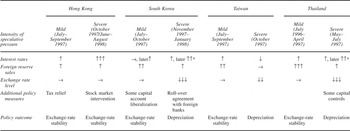
Table 1 summarizes how the authorities in the four countries responded to speculative pressure. It presents a series of puzzles: What explains the different degrees to which the authorities relied on interest-rate or exchange-rate adjustment and reserve sales? Why, despite a high level of foreign currency reserves in both countries, did Taiwan choose to let its currency depreciate while Hong Kong chose to defend? Why were the authorities in Thailand and Korea willing to spend almost all their reserves in a desperate attempt to stabilize their exchange rates while simultaneously shying away from a significant increase in interest rates?
Policy responses to speculative pressure in Hong Kong, Korea, Taiwan, and Thailand

Notes:
* Mostly because of IMF conditionality. ↑ = mild increase; ↑↑ = intermediate increase; ↑↑↑ = strong increase; → = no change; ↓ = mild decrease; ↓↓ = intermediate decrease; ↓↓↓ = strong decrease.
The four cases are particularly interesting because the most prominent alternative explanations for policy responses to speculative pressure can only partially account for the variation in policy outcomes. One set of alternative explanations points to the different quality of countries' economic fundamentals and foreign reserves. Countries experiencing fundamentals-based first-generation crises should be much more likely to depreciate than countries struck by expectations-based, second-generation-type crises. While the nature of the speculative attacks during the Asian financial crisis has been hotly debated,Footnote 40 it can be argued that Thailand was most vulnerable to attack, followed by Korea and, to a smaller extent, Hong Kong and Taiwan.Footnote 41 The crisis-type argument can thus explain Thailand's and Korea's decision to depreciate in response to severe exchange-market pressure as well as the variance among Taiwan's and Hong Kong's responses (their sound fundamentals and high level of reserves enabled them to choose either policy response), but it fails to answer why Thailand and Korea desperately tried to hold on to their exchange-rate pegs for so long and why Taiwan's approach to resolving the crisis was so different from Hong Kong's. The related argument that countries with more (potential) access to international funds (in particular Hong Kong and Korea that were more capable of defending than countries such as Taiwan, which lacked access to foreign funds),Footnote 42 can explain why Hong Kong defended while Taiwan depreciated fairly quickly and why Thailand and Korea initially tried to defend their currencies, but it fails to explain why Thailand lost even more reserves than Korea and why both countries asked the IMF for help only after they already had depreciated.
Various political economy explanations also fail to explain the observed variance in exchange-rate policy outcomes in the four cases. Frieden's well-known interest group argument,Footnote 43 for example, can explain the policy outcomes in Hong Kong and Taiwan, but it cannot account for Thailand's and Korea's determined but fruitless efforts to defend the exchange rate. Frieden argues that international traders and investors, a very influential group in the Hong Kong economy, have a preference for fixed (and potentially overvalued) exchange rates. In contrast, he expects exporters, especially of standardized products, to have a preference for a depreciated and more flexible exchange rate. While the prompt devaluation in Taiwan supports Frieden's argument, it cannot explain why Korea and Thailand, two equally export-oriented countries, were so reluctant to devalue. Thailand's unwillingness is striking, especially considering that the country exports highly standardized products. With regard to another political economy explanation focusing on the effect of the political regime type,Footnote 44 the only regularity seems to be that the more democratic countries (Thailand and Korea) chose the intermediate and painful path of first defending and then devaluing. A third argument, that defenses are more likely shortly before elections, while devaluations are more likely after elections,Footnote 45 has more traction. The defenses in Hong Kong in the autumn of 1997 and the initial exchange-rate defense in Korea can be attributed to upcoming elections, and Taiwan's prompt depreciation occurred shortly after elections had been held. However, the electoral-timing explanation has less leverage with regard to the Thai case or to Hong Kong's defenses in the summer of 1998, where the absence of close elections would lead one to expect a rapid devaluation. Electoral timing also has some difficulty in explaining why the Korean authorities abandoned their exchange rate just one month before election day.
Finally, it could be argued that the different policy outcomes can be explained by assuming an apolitical benevolent dictator who aims to maximize social welfare. The Taiwanese economy was much less vulnerable to a depreciation than Hong Kong's. The authorities' decision to devalue in the former and to defend in the latter case is consequently consistent with the benevolent-dictator explanation. However, the explanation is much less convincing with regard to the Thai and Korean cases. In both countries an early depreciation would have caused significantly less pain than the authorities' actual decision to tenaciously defend the exchange rate as long as possible and then to devalue nevertheless. This strategy caused the currencies to overshoot and required drastic and painful countermeasures, which could have been avoided had the authorities abandoned their currency defense earlier. It is interesting to note that the IMF had been recommending more exchange-rate flexibility for both countries for some time before the crises erupted.Footnote 46 The authorities in both countries were consequently aware of the risks involved in not depreciating, making this strategy an unlikely outcome for a social welfare-maximizing policymaker.
The very different policy outcomes in the four countries are indeed puzzling. As the discussion has shown, alternative explanations have particular difficulties with explaining the cases of failed defenses. For this reason, two of these cases, Thailand and Korea, are included in the analysis to show that the vulnerability argument offers an explanation for this variance.
Taiwan: Prompt Depreciation
Taiwan in 1997 is a case where most economic actors, notably the many small- and medium-sized enterprises (SMEs), stock market investors, large corporations, and the financial sector, were not very vulnerable to exchange-rate changes, but highly vulnerable to changes in the interest rate. A large proportion of firms in this export-oriented but financially domestic-oriented economy specializes in high-value-added and high-tech exports for which imported inputs are of relatively modest importance. This resulted, on average, in a low competitiveness/purchasing power vulnerability to depreciation of exporting firms.Footnote 47 More domestically oriented firms were more vulnerable to real price changes, especially to increases in the price of oil, but because Taiwan's fairly sound macroeconomic fundamentals made a currency collapse of the proportions seen in the other Southeast Asian countries unlikely, their vulnerability was only moderate. There was even less reason to worry about balance-sheet vulnerability to depreciation. Taiwanese companies had not borrowed substantial amounts in foreign currencyFootnote 48 and foreign assets greatly exceeded foreign liabilities in 1997.Footnote 49 Balance sheets would consequently gain rather than suffer from an exchange-rate depreciation, resulting in a low balance-sheet vulnerability to depreciation for a large majority of Taiwanese firms and individuals. In contrast, the balance sheets of most Taiwanese firms and individuals were vulnerable to interest-rate increases. A history of high savings had enabled Taiwanese companies to borrow predominantly in domestic currency, making the domestic interest rate the main determinant of the debt burden.Footnote 50 The main sources of financing were bank loans, the informal financial market, and Taiwan's dynamic capital market, in which one in three Taiwanese—both individuals and companies—had invested in 1997.Footnote 51 Since the performance of the Taiwanese stock market was highly sensitive to interest-rate increases, the interest-rate vulnerability for stock investors was on average quite high. The interest-rate vulnerability of SMEs varied a lot, but on average they were more leveraged than large corporations.
This Taiwanese vulnerability structure resulted in a low vulnerability to depreciation and a moderate to high vulnerability to monetary tightening for most Taiwanese firms and individuals. Since my argument suggests that the vulnerability to monetary tightening will be discounted as long as pressure is mild, it predicts that in the tranquil/mild-pressure period, which lasted until the early fall of 1997, most Taiwanese actors (except the export-oriented SMEs) should perceive themselves slightly more vulnerable to depreciation than to a defense, resulting in a weak preference for defense. The argument predicts that, in this specific setup, the authorities should also exhibit a weak preference for exchange-rate stability. This is precisely the Taiwanese experience: when market jitters caused by the floating of the Thai baht in July 1997 began to exert speculative pressure on Taiwan's currency, the New Taiwan (NT) dollar, early in the fall 1997, the Taiwanese authorities responded by selling several billion U.S. dollars of their sizeable foreign reserves. Taiwanese central bankers and politicians defined “maintaining financial stability” (defined as exchange-rate, interest-rate, and stock-market stability) as their policy priority.Footnote 52 As long as pressure remained mild, Taiwan's central bank, the Central Bank of China (CBC), was able to achieve all of these goals by sterilizing most of its foreign reserve sales. Convinced that the currency was appropriately valued, the authorities were initially even willing to temporarily accept modestly higher short-term interest rates in return for exchange-rate stability.Footnote 53
As speculative pressure grew more severe in October and monetary tightening became inevitable to maintain exchange-rate stability, the actual vulnerability became the salient determinant of policy preferences. The argument predicts that actors' low tolerance for pain inflicted by interest-rate increases and their low vulnerability to depreciation should lead to a change in policy preferences from exchange-rate stability toward depreciation. The available evidence points to such a shift in preferences and to a corresponding change in official policy. Since reserve sales were not fully sterilized, the resulting credit squeeze began to hurt the economy, in particular the stock market in September. As high interest rates and the continuous outflow of foreign funds began to take a heavy toll on the stock market in October, the public debate in Taiwan increasingly centered on the trade-off between stock-market performance and currency stability.Footnote 54 On 8 October 1997, the leaders of the nation's major industry and commerce associations publicly called for lower interest rates, a demand that was echoed by stock buyers.Footnote 55 At the same time, exporters increasingly and successfully lobbied the national parliament for a depreciation.Footnote 56 In such a situation, the vulnerability argument predicts that exchange-rate stability will promptly be abandoned in order to stabilize interest rates. In fact, the calls for a depreciation did not remain unheard. Faced with the choice to either further raise interest rates or to stop defending the NT dollar, the authorities chose the latter option on 17 October 1997 and let the currency depreciate “in order to minimize the adverse impact on the real sector and on financial markets.”Footnote 57 This decision was made even though the authorities still held very large funds of foreign currency reserves and although exchange-market pressure was not (yet) particularly severe.Footnote 58
The Taiwanese experience illustrates how a low tolerance for painful monetary tightening in combination with a strong export-orientation and a comparatively low balance-sheet vulnerability to depreciation can rapidly turn initial weak prodefense preferences into strong preferences for depreciation when the pressure on the exchange rate increases only slightly. Since most actors valued low interest rates and competitiveness gains higher than exchange-rate stability, they opted for monetary stability rather than exchange-rate stability. In accordance with the predictions generated by the vulnerability argument, the government was then unwilling to continue defending the currency and depreciated instead.
Thailand: Unsuccessful Defense (I)
The Thai experience was quite different. During the buildup to the currency crisis that culminated in a float on 2 July 1997, many Thai firms, in particular the influential groups of banks, finance companies, and industrial exporters, simultaneously exhibited a very high vulnerability to depreciation and to interest-rate increases—a situation that one IMF official referred to as a “double bind.”Footnote 59 Thailand's economy is fairly export-oriented, but the majority of exporters (67.5 percent of manufacturing exporters, according to a 1998 survey)Footnote 60 produce industrial goods that require imported inputs, thus decreasing the positive competitiveness effect of a depreciation. While the variance is quite high, a majority of Thai firms and individuals therefore exhibited a moderate to high degree of competitiveness vulnerability to depreciation. The balance-sheet vulnerability to depreciation also varied among Thailand's firms. The finance companies were the most vulnerable, followed by banks and big companies with high foreign currency exposure and only limited foreign currency earnings. Since the capital account liberalization in the early 1990s, considerable amounts of foreign capital had poured into Thailand. Relying on the long-standing stability of the baht, financial intermediaries had borrowed substantially in foreign currency and re-lent these—mostly unhedgedFootnote 61—funds at higher interest rates on the domestic market.Footnote 62 This practice resulted in severe currency mismatches, where liabilities denominated in foreign currency stood against assets denominated in domestic currency. Having matched their substantial foreign-currency borrowings with unprofitable investments in the faltering domestic property sector, the finance companies were most seriously affected. For this small, concentrated, and homogenous group of actors, the stability of the baht rapidly became a “life or death issue.”Footnote 63 Large exporters also borrowed substantially in foreign currency but were to some extent “naturally hedged” through their export earnings. In contrast, because most SMEs did not borrow abroad,Footnote 64 their balance sheets were not very vulnerable to depreciation. Other than banks and finance companies, the large majority of Thai firms still borrowed only in baht—but they did so extensively, resulting in a highly leveraged corporate sector.Footnote 65 Consequently, balance sheets were even more vulnerable to interest-rate increases than to depreciationFootnote 66 and “the corporate sector would have been much more hit by an interest-rate shock than an exchange-rate shock.”Footnote 67 Interest-rate vulnerability was highest for those who held large baht-denominated liabilities, most notably large corporations, SMEs, and exporters. Banks and finance companies were indirectly exposed because high interest rates increase the ratio of nonperforming loans.
In sum, a large part of the Thai private sector exhibited a high vulnerability to both depreciation and monetary tightening. The vulnerability argument suggests that until the eruption of severe speculative pressure in May 1997, most groups, including the two influential groups of finance companies and banks, should perceive themselves to be much more vulnerable to depreciation than to a defense. Except for the finance companies, however, their actual vulnerability was much higher when it came to a monetary tightening. With increasing pressure, actors' interest-rate and the actual vulnerability become salient, resulting in an increasing preference for devaluation over an interest-rate defense.
These predicted preferences correspond to those empirically observed: the export sector voiced concern about the exchange rate, but as pressure increased, balance-sheet considerations became increasingly important. While exporters did not demand depreciation, they clearly preferred depreciation to higher interest rates.Footnote 68 Businesses producing for the domestic market and consumers worried about the potential negative effects of a devaluation on the prices of imports.Footnote 69 Finance companies preferred higher interest rates and were strongly opposed to a devaluation.Footnote 70 As long as pressure remained mild, Thai banks were strongly opposed to a devaluation, as the repeated warnings against depreciation issued by the Thai Banking Association exemplify.Footnote 71 However, when pressure increased, they were also opposed to interest-rate hikes.Footnote 72
Statements from Bank of Thailand (BOT) and government officials indicate that the authorities gave much thought to the balance-sheet effects of a potential baht devaluation, while trade “was not an issue.”Footnote 73 Starting in summer 1996, Thailand had experienced a prolonged period of repeated mild speculative attacks on its long-standing peg, caused by a worsening current account deficit and the piecemeal policy measures implemented to address weaknesses in the Thai economy. The BOT initially fiercely resisted speculative pressure by selling almost all of Thailand's foreign reserves, modestly raising interest rates,Footnote 74 and even introducing some capital controls designed to deter foreign speculators. In February 1997, a BOT official said that “any policy to devalue the currency would cause more damage to the overall economy than could be offset by the gains expected from improved price competitiveness. Most importantly, devaluation would lead to inflationary pressure and more costly imports. At the same time, the private sector would find it more difficult to service overseas debts.”Footnote 75 This indicates that the BOT's preferred option against mild pressure was to stabilize the exchange rate by selling reserves and simultaneously maintaining interest-rate stability, especially since the central bank was highly concerned about the large foreign debt held by the private sector.Footnote 76 At the same time, the authorities were reluctant to further increase interest rates because they feared the consequences for the highly indebted financial sector and the real economy.Footnote 77 A stark example of such reluctance is the BOT's dangerous strategy of sterilizing its reserves sales through massive and secret swap transactions, which later strongly contributed to the crash of the currency. As the commission set up by the Thai parliament to investigate the causes of the crisis (the Nukul Commission) notes, the purpose of this strategy had been to prevent interest rates from skyrocketing.Footnote 78 In May 1997, the speculative attacks grew severe and the authorities discussed but nevertheless dismissed the option to stop sterilizing reserve sales, partly because this would have caused interest rates to rise substantially.Footnote 79 Instead the authorities imposed some capital controls for offshore market transactions, which led to an increase in offshore interest rates but allowed domestic interest rates to remain stable.Footnote 80 In fact, a significant increase in interest rates was never seriously considered. Interest rates were raised only later as a consequence of IMF conditionality and despite fierce resistance by Thai officials.Footnote 81 Even with these efforts to stabilize interest rates, monetary conditions were tight (by Thai standards, but low by crisis standards), which prompted several politicians, including Finance Minister Amnuay and the Parliaments' Fiscal Policy, Banking and Finance chairman, to call for lower interest rates.Footnote 82 When the pressure continued and the BOT had to inform the government that hardly any reserves were left, the authorities chose to float the baht on 2 July 1997.
The Thai crisis offers a classic case of initial, strong defense with a subsequent depreciation. The analysis of influential actors' vulnerability profiles suggests that changing domestic coalitions of proponents and opponents of depreciation contributed to the authorities' decision to switch from a fierce defense of the currency to a float. High foreign currency mismatches among influential groups and the economy's high dependence on imported goods initially led to widespread preferences for exchange-rate stability. When defending was no longer viable without significant interest-rate increases, the high leverage of the private sector and its high overall balance-sheet vulnerability to monetary tightening offer an explanation of why the Thai authorities abandoned the defense and chose to float instead.
South Korea: Unsuccessful Defense (II)
Similar to Thailand, the Korean experience in 1997 represents a case of a failed defense. Coincidentally, the distribution of perceived and actual vulnerabilities among Korean firms and households resembles that of Thailand. Korea's economy is highly export-oriented with a focus on technologically advanced, high-value-added products. Accordingly, many Korean firms are either exporters or indirectly linked to exporters as suppliers, making them not particularly vulnerable to the real price effects of depreciation. Nontradables producers, the majority of which are SMEs, have a higher average competitiveness vulnerability to depreciation, especially when they strongly rely on imported inputs.Footnote 83 In terms of their balance-sheet vulnerability to depreciation, SMEs were on average not very exposed, while the large, export-oriented, and politically influentialFootnote 84 industrial conglomerates (the so-called chaebol) and Korean banks had a high balance-sheet vulnerability to depreciation.Footnote 85 As in Thailand, Korea's financial-market liberalization in the 1990s had allowed Korean banks to take advantage of the lower interest rates abroad and borrow substantial amounts of foreign short-term money, which they then relent domestically as long-term loans.Footnote 86 The massive and mostly unhedged currency and term structure mismatches that resulted from this practice made Korean banks extremely vulnerable to exchange-rate fluctuations.Footnote 87 The chaebol also borrowed substantial amounts of money abroad and failed to hedge these debts. While they were highly vulnerable to depreciation, Korean companies were even more vulnerable to interest-rate increases. Debt ratios were extraordinarily high, on average exceeding a staggering 400 percent for the top thirty chaebol, with most of this debt short-term and in domestic currency.Footnote 88 The liabilities of SMEs, especially in the nontradables sector, were almost entirely denominated in won. SMEs were therefore also vulnerable to high interest rates, even though the interest exposure of these companies varied far more than that of the chaebol.Footnote 89 Overall, the corporate sector was much more vulnerable to an interest-rate shock than an exchange-rate shock.Footnote 90 Banks, who theoretically could pass on higher interest rates to their customers, were indirectly exposed through their borrowers' decreasing ability to repay their debts, especially since many loans to the chaebol were of low quality.Footnote 91 Since elections were scheduled in Korea for mid-December 1997, the vulnerabilities of a fifth group of actors, the group of voters/consumers, indirectly influenced the authorities' decision-making process. Vulnerabilities in this group varied widely. On average, however, consumers were vulnerable to price increases and held most of their debt in domestic, rather than foreign currency, creating a similar overall vulnerability structure to that of domestically oriented SMEs.
These facts imply that most Korean actors should have perceived themselves more vulnerable to depreciation than to a defense as long as speculative pressure could be contained without a tightening of monetary policy. In the absence of strong speculative pressure, banks should exhibit the strongest preference for a defense, closely followed by consumers, nontradables producers and the chaebol, while export-oriented SMEs should weakly favor depreciation. However, the actual vulnerabilities suggest that all groups except the banksFootnote 92 should prefer depreciation in the face of severe pressure. These predicted preferences largely correspond to the preferences observed empirically: the chaebol and many SMEs favored a defense against mild pressure but a depreciation when pressure became severe.Footnote 93 As soon as severe speculative pressure emerged, the Federation of Korean Industries, the chaebol-association, called for lower interest rates.Footnote 94 This is consistent with the expectation that the chaebol should exhibit the biggest aversion to an interest-rate defense. Banking institutions troubled with bad loans but facing painful consequences either way said that they saw “some need for depreciation” rather than a marked monetary tightening when pressure had increasedFootnote 95 and called for aid from the central bank.Footnote 96 Finally, middle-sized exporters initially did not articulate any strong preferences, even though some preferred a depreciation.Footnote 97
The actions taken by the Korean authorities when the won came under increasing speculative pressure in fall 1997 suggest that they were sympathetic to the private sector's vulnerabilities. Korean officials intervened extensively, but interest rates were raised only marginally.Footnote 98 “We were afraid of the bankruptcies in the corporate sector,” a Korean central bank official recalls.Footnote 99 As in Thailand, balance-sheet concerns outweighed potential competitiveness considerations.Footnote 100 Initially, the authorities were chiefly concerned with the impact of a depreciation on foreign liabilities. At the same time, “the Korean government would never have dreamed of raising interest rates” because of the corporate sector's high leverage.Footnote 101 In addition, the upcoming elections increased the weight the governments gave to voters' preferences, increasing their indirect influence on policymaking. Even after the speculative attacks intensified at the end of October, the authorities did not significantly tighten monetary policy and instead abandoned the defense of the won on 17 November 1997. Some weeks later, in the negotiations with the IMF and in the face of a dramatically deteriorating situation, Korean officials still tenaciously tried to avoid higher interest rates because they were deeply concerned about the potential effects on Korea's highly indebted corporations but, as in Thailand, Korean officials ultimately had to accept monetary tightening in return for an IMF rescue package.Footnote 102 The Korean case is thus in line with the vulnerability approach's indication that a high depreciation vulnerability of influential actors initially increases the incentives for the authorities to defend the exchange rate through sterilized intervention. When pressure intensifies and interest-rate increases become necessary, an even higher vulnerability to interest-rate increases subsequently changes the incentives to abandon the defense.
Hong Kong: Successful Defense
In Hong Kong, both the perceived and the actual vulnerability of influential actors was higher to depreciation than to a defense. As an extremely open economy that imports almost everything (including drinking water), export competitiveness and the price of imported goods are important issues. However, since the economy is highly service-oriented and relies on the city's function as a key trading port, Hong Kong's economic structure differs from those of the other three countries in this study. In 1997, manufacturing accounted for only 7.3 percent of the gross domestic product (GDP), while services, especially financial service industries (banks and nonbank financial services) made up 84.4 percent of GDP.Footnote 103 In contrast to export-oriented manufacturing firms, the competitiveness of service-oriented firms is generally not very sensitive to (real) exchange-rate movements.Footnote 104 As a regional financial center, Hong Kong's international competitiveness is determined by two alternative factors: financial stability and competitive domestic prices such as wages and property prices. In this context, the currency board plays a pivotal role, reducing volatility, uncertainty, and transaction costs. Abandoning the exchange-rate link would seriously threaten this stability and would thus result in a marked loss, rather than gain, in competitiveness for most of Hong Kong's service-oriented firms. It would also seriously undermine the attractiveness of Hong Kong stocks and property as international investment venues. A depreciation was also likely to fuel a further increase in the already high domestic asset prices.
In contrast, an interest-rate defense in the context of the region's highly flexible labor markets would lead to asset price and wage deflation and consequently a boost in Hong Kong's competitiveness.Footnote 105 In terms of competitiveness and real price considerations, giving up the currency board and devaluing the Hong Kong dollar was therefore likely to be advantageous for a few firms, most notably in manufacturing and tourism, but would have detrimental effects on the competitiveness of influential companies in the financial and trading services, as well as on the stock market and the property sector. Compared to this high level of competitiveness vulnerability, the balance sheet of the average Hong Kong firm was less vulnerable to depreciation. Even though both the financial and the real sector hold considerable foreign-currency assets and liabilities, these were largely matched in 1997, implying that most balance sheets were only modestly exposed to depreciation. Balance sheets were more vulnerable to interest-rate increases, especially because Hong Kong dollar-denominated liabilities mostly have variable interest rates.Footnote 106 Property and stock investors, a heterogenous group that made up a majority of Hong Kong's citizens and firms, making stock and property prices an important determinant of household spending,Footnote 107 were most vulnerable to higher interest rates. The high capitalization and prudent regulation of Hong Kong banks, by contrast, meant that high interest rates would mainly affect their profitability rather than their solvency. Moreover, since companies in Hong Kong were on average less leveraged than their counterparts in the region, these effects were unlikely to be as lethal.Footnote 108 Nevertheless, most actors exhibited at least some vulnerability to a monetary tightening.
Most actors therefore exhibited both a high perceived and actual vulnerability to depreciation. The best-organized groups, banks and financial-service firms in particular,Footnote 109 exhibited very homogenous and high vulnerabilities to depreciation. This suggests that all of these groups (except for the export sector) should have favored a defense regardless of the severity of speculative pressure. These predicted preferences coincide with the preferences voiced in the public debate. In October 1997, the chairman of the Hong Kong General Chamber of Commerce suggested that the authorities should “rethink the peg,” to ease the problems of the local tourism and manufacturing industries.Footnote 110 This comment prompted immediate rebuttals from the financial sector. The Chairman of HSBC Holdings said that the peg was a great force of stability and should therefore be defended.Footnote 111 A representative of Hong Kong Bank maintained that the crisis had been inspired by a loss of competitiveness, which indicated a need for domestic adjustment (including wage restraint and property price deflation), rather than for a devaluation.Footnote 112 Even though the losses inflicted by the sharp fall in property and stock prices hurt most residents of Hong Kong, support for the currency board remained high.Footnote 113 Given the stock market's high vulnerability to interest-rate increases, however, the stock-market intervention in August 1998 received widespread support as local and foreign investors were “grateful for the protection of their asset values.”Footnote 114
Policymakers were aware of the private sector's preferences when the speculative attacks on the Hong Kong (HK) dollar hit the currency between July 1997 and August 1998.Footnote 115 During that year, the authorities made it clear that exchange-rate stability was their top policy priority. They consistently stressed their commitment to the currency board and dismissed demands by exporters for devaluation. Financial Secretary Sir Donald Tsang emphasized very early that he had “no wish to meddle with [the] exchange rate to please the exporters.”Footnote 116 In a move that paralleled the preferences of firms in the financial services sector, the authorities allowed interest rates to rise sharply, with the overnight rates surging to a peak of 280 percent on 23 October 1997. Even though these high rates plunged the Hong Kong economy into recession, the authorities continued to rely on tight monetary policy as their main tool for defending the currency.Footnote 117 At the same time, policymakers were not immune to the plight of small-scale property owners, influential property developers, and industrialists.Footnote 118 When speculative pressure resurfaced in 1997, the authorities decided in a surprise move to heavily intervene in the stock market to keep stock prices from falling while simultaneously maintaining exchange-rate and interest-rate stability, providing another example of how societal preferences can indirectly affect policy outcomes.Footnote 119 This strategy allowed Hong Kong to successfully defend its currency board.
The vulnerability approach gives one a handle for explaining the authorities' willingness to bear the painful consequences of the currency defense: even though the balance sheets of most actors were more vulnerable to interest-rate increases than to depreciation, the negative long-term competitiveness effects associated with abandoning the currency board outweighed the balance-sheet considerations in Hong Kong. This resulted in an overall preference for exchange-rate stability. When the pain caused by interest-rate increases became too intense, the authorities found a way to relieve interest-rate pressures without compromising their commitment to the fixed exchange rate by intervening in the stock market. While this approach is unconventional and was possible only because of Hong Kong's extraordinarily high level of public funds, the stock-market intervention is consistent with the private-sector vulnerability approach.
Conclusion
The nuanced approach for identifying exchange-rate level preferences presented in this article has argued that actors' vulnerabilities to depreciation and monetary tightening shape these preferences, which in turn influence whether policymakers choose to maintain exchange-rate stability or to depreciate their currencies. Case studies of four Asian countries during the financial crisis of 1997–98 demonstrate that interest group preferences can be identified based on the interaction of competitiveness and purchasing power concerns, balance-sheet vulnerabilities, and the severity of exchange-market pressure.
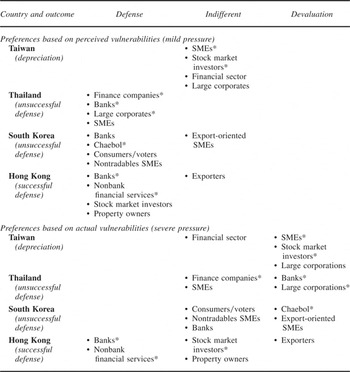
Table 2 summarizes the preferences based on groups' perceived and actual vulnerabilities in each of the four countries under study. Because most economic actors in Taiwan were not very vulnerable to a depreciation, they were mostly indifferent or had only weak preferences about exchange-rate policy. Since their balance sheets were much more vulnerable to interest-rate increases, however, they mostly developed a strong preference for depreciation over an interest-rate defense when pressure increased. While highly vulnerable to depreciation, many influential Thai and Korean firms were even more vulnerable to interest-rate increases. This made them unwilling to tolerate a significant monetary tightening, even though they had initially strongly supported a defense of the currency through reserve sales. In contrast, the paramount importance of exchange-rate stability for Hong Kong's financial-service firms can explain their strong prodefense preference during both mild and severe pressure periods, and their willingness to endure the painful consequences of very high interest rates in Hong Kong. Table 2 shows that the biggest change in preference coalitions occurred in the two countries that chose the costly middle way of first defending and then depreciating the exchange rate (Thailand and Korea). Table 2 also represents how the traditional approach of assuming that tradables producers prefer a depreciated currency, while nontradables producers prefer an appreciated exchange rate, does not capture important variations among the preferences of these groups.
Comparison of private-sector preferences in mild-pressure and severe-pressure periods

Notes:
* indicates the most influential groups (as identified by experts). Chaebol = large, export-oriented, and influential industrial conglomerates. SMEs = small- and medium-sized enterprises.
By mapping the changing pattern of coalitions in favor of defenses or depreciations to the actual policy outcomes, the case studies indicate that societal preferences directly or indirectly affect policy outcomes. When the private sector's vulnerability to depreciation was high, the authorities typically defended the exchange rate. In countries where vulnerabilities to interest-rate increases exceeded the vulnerability to depreciation, these defenses were later abandoned when pressure intensified. Vulnerability considerations thus contribute to the understanding of the tragic cases of the Thai and Korean crises, in which the authorities defended the currency for a prolonged period only to allow it subsequently to depreciate substantially—in the process causing people to experience the worst of both worlds. While the lack of accurate firm-level data on vulnerability structures, exchange-rate preferences, collective action, and the level of influence exerted on policymakers limit the explanatory power of these case studies, the results nevertheless suggest that the vulnerability approach is useful for understanding the variation in exchange-rate level preferences across different actors and across time in the four Asian countries during this financial crisis.
The framework's applicability is not limited to these cases. Because of its generic focus on actors' vulnerabilities, it can be applied to exchange-rate level preferences in very different socioeconomic contexts, such as in developing and developed countries where the actors' balance sheets are likely to exhibit quite different compositions of foreign and domestic positions. For example, the prompt 1992 devaluation in Britain occurred in a setting where a depreciated exchange rate promised large competitiveness gains and where homeowners, who almost exclusively held British pound-denominated mortgages, were extremely sensitive to interest increases. Another example is Argentina, where the government's defense of the peso-U.S. dollar link against speculative attacks in 1995 coincides with a large accumulation of U.S. dollar-denominated loans by local businesses, public agencies, and citizens and hence a high balance-sheet vulnerability to depreciation. In contrast, in 2002 when the authorities decided to abandon the currency board, real overvaluation had made Argentine products so uncompetitive that competitiveness concerns had surpassed the balance-sheet concerns.
The findings in this study have implications for some broader political economy research questions. First, they underscore the importance of understanding how societal preferences directly or indirectly influence policymakers' willingness to implement certain policies. A correct specification of the relevant preferences complements and improves explanations focusing on the macroeconomic and institutional decision-making context that delineate policymakers' ability to implement exchange-rate and monetary policy.Footnote 120 Second, by emphasizing how short-run concerns can outweigh the long-run benefits of exchange-rate adjustments, the findings draw attention to the importance of combining time asymmetries and distributional concerns in the study of exchange-rate politics. While time-inconsistent policymaking is usually analyzed in the context of institutions that encourage policymakers to discount the future, the vulnerability approach suggests that a short-term bias can exist in policy preferences as well. Political economy research consequently needs to investigate in more detail the interplay between distributional issues and time-inconsistent incentives created by institutions. Certain institutions such as elections can, for example, be expected to enhance the influence of societal actors' bias for their short-term vulnerabilities, while other institutions (such as central bank independence) are likely to counteract this tendency by promoting a more long-term view.Footnote 121 Third, this study raises several questions for future research. One of these concerns policymakers' preferences. Given the importance of balance-sheet considerations, how does a government's debt situation affect its policy preferences? Another question concerns speculators. To what extent is the fact that speculative pressure emerges endogenous to interest groups' vulnerability structures? Given that countries such as Thailand and Korea were easy targets for speculators because of their reluctance to raise interest rates, should one not see a particularly high risk of currency crisis in countries in which perceived and actual vulnerabilities widely diverge?
The results also have several policy implications. First, policymakers and policy advisors need to understand that societal preferences can provide powerful incentives to deviate from economically efficient outcomes, with potentially destructive effects not only for these countries but the entire global exchange-rate system. Ignoring these incentives makes the implementation of good economic policies difficult at best and impossible at worst. International policy advisors, such as IMF staff, have often been scolded for advocating one-size-fits-all policies in response to crises. The findings presented in this article suggest that a stronger consideration of the political constraints under which domestic policymakers operate is likely to improve the ease with which the recommended policies can be implemented politically. While the desirability of some of these constraints may be debatable, taking them into account will lead to more feasible policy advice. Second, while it is important to recognize these political constraints, some of them can be alleviated if addressed in good time. For example, the findings show that large unhedged foreign currency liabilities can lead to a policy bias against timely devaluations. To avoid such a bias, policymakers should introduce measures to prevent the accumulation of such liabilities in the first place. This could be achieved by implementing more carefully designed and well-sequenced capital account liberalization measures or by designing regulatory systems that encourage hedging and discourage the accumulation of large currency or maturity mismatches. The findings presented in this study suggest that prevention is the key to preserving policy autonomy in the face of speculative pressure. As an added benefit, such increased autonomy makes speculative attacks less likely in the first place.
Appendix: List of Interviewees
For the interviewees listed below, titles were those held during the crises (current titles are denoted by an asterisk). Interview numbers in the text do not correspond to the order of names in this list. Three additional interview partners asked for full anonymity and are therefore not personally identified in this list:
ʼn Caroline Atkinson, Senior Deputy Assistant Secretary for International Monetary and Financial Policy, U.S. Treasury.
ʼn Paul Blustein, Journalist, Washington Post.
ʼn Jack Boorman, Director, Policy Development and Review Department, IMF.
ʼn Michael S.F. Chang, Senior Specialist,* International Funding Division, Department of Foreign Exchange, Central Bank of China, Taiwan.
ʼn Robert Dekle, Economist, Asia and Pacific Department, IMF.
ʼn Kokwang Huh, Director, International Department, Bank of Korea.
ʼn Ho Lok Sang, Director of the Centre for Public Policy Studies,* Lingnan University, Hong Kong.
ʼn Kang Kyong Sik, Minister of Finance and the Economy, Korea.
ʼn Kim Jung-Sik, Professor of Economics,* Yonsei University, Korea.
ʼn Donald Kirk, Journalist, Korea.
ʼn Timothy Lane, Policy Development and Review Department, IMF.
ʼn Calvin Lin, Professor of Economics,* Taichung National Institute of Technology, Taiwan.
ʼn James Lister, Director, Office of International Monetary Policy, U.S. Treasury.
ʼn Min Sang Kee, Professor of Finance,* Seoul National University, Korea.
ʼn Ekniti Nitithanprapas, Fiscal Policy Office,* Ministry of Finance, Thailand.
ʼn Oh Jong-Nam, Executive Director,* IMF.
ʼn Oh Jung-Gun, Deputy Director General, Institute for Monetary and Economic Research, Bank of Korea.
ʼn Olarn Chaipravat, Chairman of the Thai Bankers' Association, Thailand.
ʼn David O'Rear, Chief Economist for the Economist Intelligence Unit Asia, Hong Kong.
ʼn David Robinson, Division Chief for Thailand, Asia and Pacific Department, IMF.
ʼn Anoop Sing, Deputy Director, Asia and Pacific Department, IMF.
ʼn Thitithep Sitthiyot, Ministry of Finance,* Thailand.
ʼn Frank Tsai, Department for Foreign Exchange,* Central Bank of China, Taipei, Taiwan.
ʼn Wanda Tseng, Deputy Director, Asia and Pacific Department, IMF.
ʼn Ya-Hwei Yang, Director,* Center for Economic and Financial Strategies, Chung-Hua Institution for Economic Research, Taiwan.
ʼn Eddie Yue, Executive Director,* Monetary Management and Infrastructure Department, HKMA, Hong Kong.