Introduction
Over the last decade, narrative gerontologists have highlighted the theoretical possibilities and limitations of understanding ageing as a biographical event (e.g. see Freeman Reference Freeman2010; Gubrium Reference Gubrium, Kenyon, Clark and Vries2001; Kenyon and Randall Reference Kenyon and Randall1997; Kenyon, Bohlmeijer and Randall Reference Kenyon, Bohlmeijer and Randall2011; Randall and McKim Reference Randall and McKim2008). In addition, in-depth analyses of individual life stories have provided in-depth empirical insight into different ways of ageing. As examples, this work has advanced our understanding of how older adults experience and make sense of widowhood (Bennett and Vidal-Hall Reference Bennett and Vidal-Hall2000), resilience (Tuohy and Stephens Reference Tuohy and Stephens2011), activism (Caissie Reference Caissie, Kenyon, Bohlmeijer and Randall2011), birthdays (Bytheway Reference Bytheway2009), dementia (Mills Reference Mills1997), and life in retirement communities (Biggs et al. Reference Biggs, Bernard, Kingston and Nettleton2000). However, to date, research focusing upon what stories can do has been largely missing from narrative studies within social gerontology.
A small number of exceptions do exist. For example, policy analysis often enables overarching narratives embedded within such documents to be scrutinised in relation to how they might work to confirm, contradict and/or constrain individual experiences of growing older (e.g. Biggs Reference Biggs2001). Also noteworthy are recent interests in how alternative storylines of ageing animate older adults' lives in ways that facilitate resistance to dominant and potentially disempowering narratives of ageing (Conway and Hockey Reference Conway and Hockey1998; Gimlin Reference Gimlin2007; Griffin Reference Griffin2010; Phoenix and Smith Reference Phoenix and Smith2011; Phoenix and Sparkes Reference Phoenix and Sparkes2009; Tulle Reference Tulle2008). These examples, and others like them, have demonstrated the power of narrative to potentially (re)shape the ways in which ageing is experienced and represented. That said, they have predominantly been confined to the perspective of the storytellers (i.e. the older adult and/or the researcher) rather than the story-listeners.
The absence of those who listen to and respond – or not – to the stories that they hear is an important omission when making claims for what stories can do (Smith and Sparkes Reference Smith and Sparkes2008, Reference Smith and Sparkes2011). As Mattingly (Reference Mattingly1998) notes, narratives do not merely refer to past experience, but may help create experiences for their audience and move them to respond in certain ways. More recently, Martin (Reference Martin2007: 54) has noted that, ‘Stories are performative: through them we initiate, suggest and call for responses’. As such, narration is a social activity involving other participants who may provide storied responses to a story heard. Knowing how audiences respond to certain stories is critical if we are to understand in more detail what it is, exactly, that stories can do beyond providing valuable insight into individual experiences.
With these points in mind, in this paper we draw upon Frank's (Reference Frank2010) theoretical framework of socio-narratology to examine the work that stories can do. We make a unique theoretical and empirical contribution to the literature by focusing upon an audience of young adults and the ways in which they respond to a story about a group of masters athletes. In doing so, we respond to the question ‘what impact do the stories of masters athletes (in this instance, mature natural bodybuilders) have on younger adults?’
A socio-narratology in action: the example of masters athletes
According to sociologist Arthur Frank (Reference Frank2010), the work of stories is to animate human life. Stories ‘work with people, for people, and always stories work on people, affecting what people are able to see as real, as possible, and as worth doing or best avoided’ (Frank Reference Frank2010: 3). Conceptualising stories as active social interactions, which are heard and responded to, calls for a new way to think about and study them. This approach, which Frank terms socio-narratology, aims to understand what the story does, rather than understand the story as a portal into the mind of the storyteller. For him, the scope of socio-narratology is the reciprocal work of stories and humans in creating the social world. In addition, viewing stories as actors (as opposed to passive accounts) enable researchers to consider what capacities enable stories to do the work that they do. After all, Frank (Reference Frank2010: 15) asserts, ‘Stories do not do everything. The question is, what do they have the capacity to do best?’
To examine the work that stories might do, we take as a working example the impact that stories of ageing told by masters athletes might have upon young adults, and specifically their perception of (self-)ageing. Choosing this example as a means of using empirical data to interrogate the concept outlined above represents a progressive step. It facilitates further theoretically informed unravelling of an area of social gerontology where notions of healthy ageing, anti-ageing, age-appropriate behaviour and stereotyping (to name but a few issues) can intersect. This example, in particular, draws together and extends a number of existing issues that have been discussed within the social gerontology, psychology, sport, exercise and health sciences literatures.
The first issue concerns the way in which young people currently story (self-)ageing. Previous research has demonstrated the prevalence of negative images that frame young people's expectations of the future (Adams-Price, Henley and Hale Reference Adams-Price, Henley and Hale1998; Phoenix and Sparkes Reference Phoenix and Sparkes2006a, Reference Phoenix and Sparkes2006b). This negativity is consistent with medicalised discourses that dominate current understandings of old age in Western society, whereby the body is first and foremost signified by its systemic and systematic decay (Gullette Reference Gullette1997; Tulle-Winton Reference Tulle-Winton, Hancock, Hughes, Jagger, Paterson, Russell, Tulle-Winton and Tyler2000). Harbouring negative stories about the ageing process in young adulthood can do things that are problematic for individual and social wellbeing. For example, such stories can work to perpetuate ageist attitudes towards others, which in turn can impinge upon the development of mutually beneficial intergenerational relationships (Levy Reference Levy2001). Stories of a tragic old age can operate to create the tragic old age that one worries over (Moody Reference Moody1988). Indeed, Frank (Reference Frank1995) warns that there is a danger that people can become the stories that they tell – for better, or for worse.
Living with negative stories about a fearful future that lies ahead can also lead to a sense of narrative foreclosure (Freeman Reference Freeman, Andrews, Sclatter, Squire and Treader2000; Phoenix and Sparkes Reference Phoenix and Sparkes2006a). According to Freeman (Reference Freeman, Andrews, Sclatter, Squire and Treader2000), narrative foreclosure relates to the degree to which the culture in which one lives fails to provide adequate narrative resources for living one's life meaningfully and productively. Speaking of ageing in Western cultures he notes how ‘with pre-scripted narratives of decline well in place, there often appears little choice among the aged but to reconcile themselves to their narrative fate’ (Freeman Reference Freeman, Andrews, Sclatter, Squire and Treader2000: 81). Narrative foreclosure is an eminently social phenomenon that connects to the reification of cultural storylines and the tendency, on the part of many, ‘to internalize the storylines in such a way as to severely constrict their own field of narrative expression: the story goes this way, not that’ (Freeman Reference Freeman, Andrews, Sclatter, Squire and Treader2000: 83). Therefore, Freeman argues, by accepting the prevailing endings to cultural stories one accepts a certain kind of narrative fate and this potentially reduces the possibility of self-renewal as one grows older.
The second relevant issue relates to the significance of older adults in shaping how young people view ageing. Previous research has demonstrated how young people turn to older adults in order to make sense of who and what they are likely to become as they age (Phoenix and Sparkes Reference Phoenix and Sparkes2006a, Reference Phoenix and Sparkes2006b). In this sense, the stories that older adults tell about their ageing bodies (both positive and negative accounts) can work to provide younger people with what Pollner and Stein (Reference Pollner and Stein1996) describe as a narrative map that may show the way through an unfamiliar world. Given these points, we might anticipate that purposefully projecting stories of older people that foreground notions of ‘ageing well’ in symbiosis of an ageing, changing body might go some way to loosening the stronghold of narrative foreclosure in younger populations.
To that end, one group of older adults often deemed to be ‘ageing well’ within the literature are masters athletes (Baker, Horton and Weir Reference Baker, Horton and Weir2010). Scholars adopting a psycho-social approach to sport and exercise participation in older age have shown that involvement in competitive sport and/or structured, regular exercise can optimise experiences of ageing, motivate other older adults to be active, and resist the medicalised narrative of decline (Dionigi Reference Dionigi2008; Grant Reference Grant2001; Horton Reference Horton, Baker, Horton and Weir2010; Ory et al. Reference Ory, Hoffman, Hawkins, Sanner and Mockenhaupt2003; Phoenix and Sparkes Reference Phoenix and Sparkes2009). For example, referring to veteran runners Tulle (Reference Tulle2008: 159) has argued that, ‘The field [of Veteran athletics] provides the site in which the relationship to bodily ageing is re-articulated and in which, in the process, the enfeebling tendency of the dominant discourse of ageing can be overturned’.
While we concur with the dangers of championing fit, older adults as models of ‘healthy ageing’ (see e.g. Cardona Reference Cardona2008; Holstein and Meredith Reference Holstein and Meredith2003; Moody Reference Moody, Winkle, Whitehouse and Morris2005), this is an area of growing attention and relevancy both on the political landscape and also the everyday life of people as they age. Exercise promotion in later life currently represents a priority within policy arenas (Help the Aged 2008; HM Government 2009) and participation in masters sport around the globe along with numbers of gym memberships within older segments are increasing (International Health, Racquet & Sportsclub Association 2011; Weir, Baker and Horton Reference Baker, Horton and Weir2010). In order to understand this phenomenon in a more complete and nuanced way, there is a need to ask novel research questions that will shed light not only on what stories of masters athletes show, but also what their stories can do. Here, we have used the experiences of mature natural bodybuilders (MNBB) as an example, as an apparent visual and physiological contrast to notions of frailty that pervade stereotypes of ageing. In this paper we show how their stories of an alternative way of ageing can work with, for and on a group of young adults.
Methods
This paper reports on the second phase of a two-phase funded project aimed at exploring the movement of stories of ageing between young and old bodies. Phase one of the research focused on the lived experiences of 13 (11 males, two females) natural (‘drug-tested’) bodybuildersFootnote 1 aged between 50 and 73 years.Footnote 2 The reasons for focusing upon a population of MNBB and the content of their stories are discussed elsewhere (see Phoenix Reference Phoenix2010a; Phoenix and Smith Reference Phoenix and Smith2011). Here, we focus upon how these stories were responded to by a group of young adults aged 20–24 years.
The data from phase one (life history interviews, auto-photography and researcher-produced visual data) were analysed and key themes represented in the form of a digital story (Meadows Reference Meadows2003). This involved a running slide show of still images including, for example, the acts of training, competing on stage, and being within a gym environment. They also depicted salient biographical objects (Dant Reference Dant2001) such as trophies, specific food, supplements, and so forth. With permission, original audio reflecting a number of key themes identified through the analyses was superimposed to accompany the changing images. This included explanations of their entry into natural bodybuilding, the subsequent lifestyle (training and diet), experiences of natural bodybuilding in older age, along with points of tension (e.g. family relationships, bodybuilder stereotyping). An extract from the digital story, entitled ‘Maturing Muscle’ can be found at http://web.me.com/c.phoenix/Moving_Stories.Footnote 3
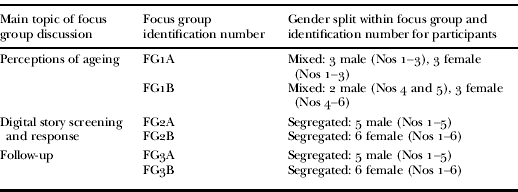
Phase two of the project (upon which this paper is based) consisted of a series of focus groups with undergraduate-level students. They were recruited to participate via an online student noticeboard and leaflets posted around the university campus. A total of 11 students (eight undergraduates and three postgraduates) took part, none of whom were acquaintances with either of the authors. Ten of the participants self-identified as white British, and one of the participants self-identified as Asian. All were able-bodied and described themselves as being middle class. The participants (six female and five male) were divided into two groups and asked to attend three focus groups each (see Table 1).
Breakdown of focus groups – participants and primary discussion topics
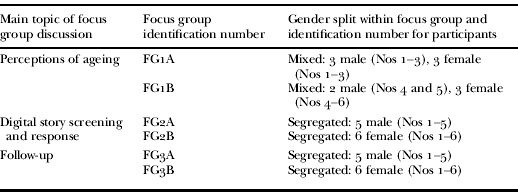
The purpose of the first focus group meeting was to gain insight into the participants' perceptions of (self-)ageing. This meeting took place in a mixed-gender setting (FG1A: three males, three females; FG1B: two males, three females). However, it became evident from this session that strong gender dynamics were at play. Accordingly, in line with the emergent nature of qualitative research, the focus groups were subsequently organised into separate male and female groups on the basis of facilitating further gendered responses (new FGA: five males; new FGB: six females).
The second focus group meeting involved viewing the digital story and gathering the participant's initial reactions to what they had seen. During the third meeting, lasting impressions of the digital story were explored and perceptions of (self-)ageing were revisited in light of the discussions that had taken place. The purpose of these subsequent focus group meetings were to project an alternative version of ageing and examine empirically how it was responded to. ‘Maturing Muscle’ provided ‘real life’ images and lived experiences that had the potential to contrast the descriptors of middle and older age cited by younger people in previous research (refer to previous section). In this sense, it was intended from the outset – and assumed (or ‘hypothesised’) theoretically – that this alternative way of ageing might, in some ways, work to challenge their currently foreclosed narratives.
During all of the focus group meetings, the first author assumed the role of moderator. The second author attended in the capacity of assistant moderator (Barbour Reference Barbour2007). Her role was to make additional notes regarding the order of speakers, simultaneous talk, body language, and so forth in preparation for transcription. The data were analysed using a categorical content analysis (Lieblich, Tuval-Mashiach and Zilber Reference Lieblich, Tuval-Mashiach and Zilber1998; Phoenix, Smith and Sparkes Reference Phoenix, Smith and Sparkes2010) to identify the key themes arising from the group discussions. This form of analysis is valuable in its focus on the whats of storytelling. In addition, analytical attention was given to the purpose and accomplishment of stories. This dialogical approach to analysing narrative data is sensitive to ‘the mirroring between what is told in the story – the story's content – and what happens as a result of telling that story – its effects’ (Frank Reference Frank2010: 71–2). Accordingly, the meaning of the story as a form of data shifts form from an abstract phenomenon to be coded to an active and artful companion that is examined for the work it does on, for and with people.
The transcripts were analysed separately by each author. The second author adopted the role of a ‘critical friend’, providing a theoretical sounding board to encourage reflection upon, and exploration of, alternative explanations and interpretations as they emerged in relation to the data (Wolcott Reference Wolcott1995). This process provided a useful forum to critically reflect on pre-existing assumptions, to challenge them if necessary, and to engage in more plausible alternative lines of inquiry that, as Tracy (Reference Tracy2010) also suggests, can increase the rigour and sincerity of qualitative research. Acting as a critical friend, the second author not only questioned the first author's analysis of the data, but also engaged in what Seale (Reference Seale1999) terms auditing and Tracy (Reference Tracy2010) describes as transparency. That is, she scrutinised a formal audit trail regarding matters like theoretical preferences, reading decisions and activities, accounts of the interactions among context, researcher, methods, setting, and participants, decisions about how much data to collect, and the process of sorting, choosing, organising, and analysing the data. This process was not used to remove bias in terms of producing knowledge independent of the researchers. This is because theory-free knowledge is not considered possible from an interpretivist standpoint. Indeed, like numerous others (e.g. Denzin and Giardina Reference Denzin and Giardina2008; Riessman Reference Riessman2008), Smith and Deemer (Reference Smith, Deemer, Denzin and Lincoln2000) argue that qualitative researchers working within this paradigm always have pre-existing assumptions that can permeate any analysis. Epistemologically, no matter how hard we try, we cannot achieve theory-free observation or knowledge as no one can be truly independent from their history, interests, pre-existing assumptions, and so on. This is not to suggest that ‘anything goes’. Rather, the procedures that we highlight above were employed to ensure rigour and sincerity throughout data collection, analysis and interpretation.
Findings and interpretations
A foreclosed future
Our analysis of the first focus group meeting supported previous research suggesting that groups of younger people generally view ageing as a negative process. For example, as an ‘ice-breaker’, participants were asked to write down five words depicting ‘middle age’. Common responses included: ‘depression’, ‘stressful’, ‘regrets’, ‘weight gain’, ‘less active’ and ‘midlife crisis’. The slightly more positive descriptor – ‘motivated’ – was used, though rapidly followed with the explanation, ‘because you're fearful that you won't be able to do certain things soon’. Participants were also asked to identify the age range which they felt constituted ‘middle age’, and responses were expressed in ranges between 40 and 55 years.
The age range that participants identified as constituting ‘older age’ was more variable, ranging from 60 to 90 years. Negative descriptors were also used when asked to perform the same task in relation to this period of one's life:
Author 1: Let's move on to the words you wrote down for old age …
Male 4: Oh, it's very bleak. Um, decrepit, restricted, slow, uncomfortable. Um, dependent. Just useless, basically. That's my vision of old age.
Female 4: Worried and dependent, yeah.
Female 5: I put cranky, grey hair, weight gain, and then fear.
Female 6: I kind of took it from the old people's home I was working in, which has really put me off being old. So um, I put haggard, wrinkly, slow, grey hair, bad health and bowel problems. There's probably a lot more I could have thought of too. (FG1B)
When asked to describe the notion of exercise throughout the lifecourse, the young adults involved in this study equated ageing with a slowing of the body, decreased intensity of exercise performed, and a shift in exercise type from that driven by notions of improvement (either via formal competition or general performance/skill acquisition) to that of lower intensity, lower impact, and with the purpose of ‘socialising’ and ‘keeping mobile’. These assumptions fit with Eichberg's (Reference Eichberg, Hansen and Nielsen2000) description of the life curve model in relation to movement culture and ageing. Depicted as an inverted U, Eichberg suggests that the life curve illustrates deep-rooted images and expectations of life in modern conscious, not least the place of sports. The achievement of the body is developed by training during the first half of life, whereas in the latter, sport and purposeful exercise generally exists under the title of ‘motion’ and ‘the preservation of health’. These sentiments were not absent from the experiences of the mature natural bodybuilders. However, their status as competitive athletes mirrored Stebbins' (Reference Stebbins1982) concept of serious leisure, which requires considerable personal effort, knowledge and training. Accordingly, it has been argued elsewhere that MNBB have the potential to offer an alternative storyline to the decline narrative depicted in the latter half of the life curve model (see Phoenix and Smith Reference Phoenix and Smith2011). In this paper, we advance knowledge by examining what these alternative stories – which might act to counter or redefine the narrative of decline – can do. We do this by analysing how a group of young adults respond to them.
What can (alternative) stories of ageing do?
Stories can stretch us
After watching the digital story, all of the participants declared their previously lacking awareness of older adults participating in sport or exercise as a form of serious leisure. Viewing the digital story alerted them to this new and for them, novel storyline, which challenged many of their existing assumptions about what an ageing body could and could not do.
Female 1: It offers more options to you, doesn't it. If you can see that there are people who are still doing bodybuilding it offers more options than just following the stereotype of, you know, just the older person who watches a lot of television and doesn't get out much. It offers a different option, something else. It shows that you can have much more decision over how you live your life even when you are limited in some ways. You can still have hobbies and find a way to enjoy life.
Female 5: Yeah, I think watching the bodybuilders made me, it opened my eyes to be like, oh, you know, there are possibilities. You can do things. (FG2B)
These comments demonstrate how the digital story worked on the young adults; educating them and expanding their frame of reference by presenting an additional route on their narrative map of ageing. This process resonates with elements of the ‘affirmation-expansion’ stage of story engagement described by Randall and McKim (Reference Randall and McKim2008). They propose that during this stage a story stretches us, and opens us up to ‘aspects of our lives that we are not normally, or at least not knowingly, aware of … acquaints us with people and situations that are by and large foreign’ (Randall and McKim Reference Randall and McKim2008: 137). During this preliminary encounter, Randall and McKim (Reference Randall and McKim2008: 137) suggest that the story confronts us with ‘complexities of emotion which, though technically within our capacity to imagine, surpass what we have actually experienced in the past’.
This latter point goes some way to explain why prior to watching ‘Maturing Muscle’ the participants appeared to overlook (sporting) activities akin to the development of third age identities that have become increasingly prevalent within Western society over the last decade (Gilleard and Higgs Reference Gilleard and Higgs2000). For example, in contrast to ageing bodies being viewed as problematic and failing, recent conceptualising emphasises a somewhat extended middle age, where older adults are dressing youthfully, having sex, dieting, actively travelling, running marathons, scaling mountains and so forth (Öberg Reference Öberg and Faircloth2003). While technically imaginable, it seemed that the young adults involved in this study required a mechanism such as the digital story in order to draw such images to the forefront of their imagination.
According to Frank (Reference Frank2010), it is this imaginative opening that makes stories attractive and can explain why people might be willing to listen to a story and at times use it to re-story their own. This is shown in the following extract taken from the second focus group meeting (male) where the participants shift from speaking about others to their own ageing bodies:
Male 3: I was thinking as I was watching [the digital story], that actually I'd quite like to look muscular and athletic even when I am that old. Because the two options that are sort of normally given to you as a normal old person are either ballooning or just being a bag of bones. And I had sort of thought, yeah, I'll go for the bag of bones option just because it's a bit more dignified (laughter). But actually you could have like a more athletic body. So, I don't know. Yeah, that's what I was thinking as I was watching it. So, yeah, maybe that's me in a few years time.
Male 2: Yeah … it's like he said, I wouldn't mind looking like they would on a day-to-day basis. I don't think I would ever go to compete at that age, because I wouldn't like to be a, kind of, greased up 70-year-old standing on a platform, sort of thing. It'd be a bit weird. But the actual, from day-to-day, you would look in shape. And I think that's not too bad. (FG2A)
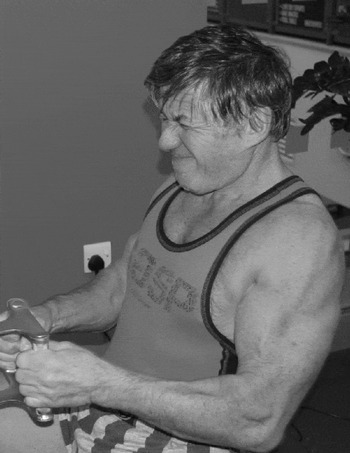
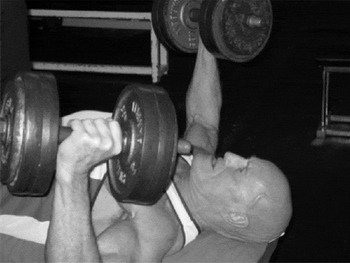
Our analysis illuminated how ‘Maturing Muscle’, had the capacity to arouse the participants’ imaginations and move them to consider ‘maybe that's me in a few years time’. Stories, suggests Frank (Reference Frank2010), can do this because they make the unseen both visible and compelling. Through the medium of a digital story, the young people were able to see older adults doing natural bodybuilding whilst also listening to their stories about this experience. Through exposure to the very performance both visually and orally, the young adults were able to witness the body of the storyteller (i.e. the MNBB) creating and embodying the story. This aspect was especially compelling and further enhanced the power of the story to do things to its audience. For example, Figures 1 and 2 are examples of the images featured in the digital story, and the comments below depict a common response:
Male 3: It's so strange seeing older people in this sort of, like, rugged environment, describing and talking about ‘grasping the iron.’ I can never imagine being late-fifties and saying, ‘I'm going to grasp some iron, and bang out some reps.’ (laughter)
Male 5: Yeah, same … and like seeing them lifting the weights and stuff. The one guys biceps were much bigger than mine – my dad's, and my granddad's! It was quite an eye opener really. (FG2A)
Using a digital story not only told younger people about the possibilities of engaging in a form of intense exercise in older age from the perspective of the MNBB themselves, it also showed them. Images of older bodies in the gym; sweating, grimacing, wearing gym attire and lifting (heavy) weights seemed to hold particular impact for challenging the notion of inevitable frailty and decline. In addition, the images projected a stark contrast to reported fixed impressions of older adults only being interested (or able to partake) in lower-intensity activities such as lawn bowls, walking, and/or recreational swimming. In this sense, the digital story worked as a visual narrative resource, stretching the participants' understanding of what doing exercise in older age could involve and could look like.
Still shot taken from the digital story (‘Maturing Muscle’). © 2009 Cassandra Phoenix.

Still shot taken from the digital story (‘Maturing Muscle’). © 2009 Cassandra Phoenix.

Stories can get under our skin
Counter-stories can arouse peoples' imaginations concerning how their lives might be different and the possibilities that still lie open to them (Nelson Reference Nelson2001). They can, as Frank (Reference Frank2010) puts it, get under people's skin. He notes how stories have the singular capacity to generate the most intense, focused engagement among listeners and readers. People do not simply listen to stories. Rather, they get caught up in them. Once stories are under people's skin, ‘they affect the terms in which people think, know, and perceive. Stories teach people what to look for and what can be ignored; what to value and what to hold in contempt’ (Frank Reference Frank2010: 48). In addition to challenging perceptions of ageing in general, our analysis illuminated the ways in which the story of ‘Maturing Muscle’ seemed to get under the skin of a number of the young participants. Specifically, the analysis demonstrated that during the month that followed the initial viewing of ‘Maturing Muscle’, the stories stayed with them. By this, we do not mean that the young adults could simply recall being shown the digital story, and recite some of its content. Rather, in the third and final group meeting they offered examples of episodes within their daily life when this story had accompanied their thinking:
Male 1: I have thought about it a bit more, my own ageing, which I just haven't really done very much at all before …
Male 4: I've been really attentive to other people, and watching older people, things like that. Certainly my parents, the next time I went home I was really looking at them … I've become very sensitive to watching people and thinking about how old they look and what they do, and whether I want to be doing what they're doing when I'm that age.
Male 5: … Yes, It's kind of similar to when you've learnt a new word that you've not really seen before, or whatever. But then once you've learnt it, then you see it everywhere. I think it's been a bit like that for me, where you've not really thought about the ageing process before. But then, walking around, you kind of relate it back to the talks we've had in here. You're looking at people and you're thinking, how old are they? They could be quite fit and agile, and you know, be 85, 90 [years of age]. So now I'm looking and thinking are they still mobile? How is their quality of life? (FG3A)
Likewise, female participants exclaimed:
Female 2: It's just talking about it [ageing], you're more aware of it. I think about my parents a lot more, and the physical condition they're in, how I want to be when I'm that age. Just looking at people around me, things like when old people are walking down the road, like I used to think ‘aww, poor them’. But now I'm more like, ‘Oh that's going to be me one day’, so I'm more aware of it and how I want to be.
Female 6: Yeah, I would say I'm less scared of ageing I think, because, I don't know. I think ageing is always this thing that people don't really want to talk about, but now I guess I see that it's not so bad. There are so many things that you can do, you shouldn't necessarily think of age as a restriction to say, doing exercise, doing activities that you want to do.
Female 4: … I think watching the bodybuilders, like that made me open my eyes and be like, oh, you know, there are possibilities. You can do things. I was telling my mum and dad about it. I told quite a few people about it actually. (FG3B)
In addition to being more aware of other older adults, and increasingly reflective about their own ageing process, these comments signal how being exposed to the experiences of the MNBB enabled some of the participants to begin rethinking their prejudices towards being old. Namely that being old is something to be scared about, and that older adults – ‘them’ (others) – are different from ‘us’ (younger people), and worthy of ‘our’ pity. The use of ‘us’ in relation to ‘them’ is a narrative device, which in this instance, contributes to the construction of older adults as ‘social others’, and can reinforce their marginalisation and stigmatisation (Holstein and Gubrium Reference Holstein and Gubrium2000). That noted, as illustrated in the extract above, seeing the MNBB and hearing about their experiences seemed to erode this sense of ‘otherness’ and connect some of the story-listeners with the storytellers.
The analysis showed how the digital story worked as an impetus for several of the participants to begin questioning the parameters of their socially situated beliefs concerning age-appropriate behaviour, especially in relation to physical activity in older age. It provides empirical support for Randall and McKim's (Reference Randall and McKim2008) conceptual discussion of the ‘contradiction-examination’ stage of story engagement. This stage requires that the story first disrupts what the audience thought was known. They note how, ‘We expect them to crack the shell of our habitual perceptions and to question our tried and true patterns for making sense of our lives, our selves’ (Randall and McKim Reference Randall and McKim2008: 138). In this instance, the habitual perceptions generally revolved around age being a restriction to doing exercise.
An indication that the story of ‘Maturing Muscle’ had got under the young adults' skin was when it travelled through them and was retold to others. By re-telling the stories of the MNBB to significant others in their lives, these young adults were beginning to examine and expand their own stories about ageing and the possibilities therein (Randall and McKim Reference Randall and McKim2008). As Frank (Reference Frank2010: 59) writes, ‘Vital, breathing stories can break between filters and grids’, and it is this movement that creates fissures in what were previously foreclosed narrative identities. By contributing to the circulation of the MNBB stories, these young adults were essentially ‘trying on’ a possible self (Bruner Reference Bruner, Neisser and Fivush1994).
This is shown in the extract above, and also below:
Male 3: There's a girl who I work with who has just got married, and I joked to her and said ‘it's about time you had kids isn't it?’ She just jumped on me and replied ‘I've got so much I want to do in my life before that!’ And I, feeling like the expert now, said ‘There's no need to worry about that. You can have kids and then you can …’ I was giving her the spiel. But I actually said to her how, you know, prime example, ‘If you were going to be a bodybuilder, you'd expect to do it in your late twenties, but there's this 70-year-old guy whose still lifting more weights than I can. So, these things are possible, you don't have to think it's ‘game over’ sort of thing just because you are old. (FG3A)
So far, in examining what stories of ageing told by MNBB can do we have illustrated how they can stretch and get under the skin of those who listen to them. These capacities of stories have the scope to work on re-opening foreclosed narratives by re-storying the ageing process. However, the dynamic and dialogical nature of the focus group meetings enabled different – and potentially less positive – responses to the digital story to be heard. These responses offer an additional layer of complexity into the work that stories can do.
Stories can connect … but also disconnect us
Earlier, we suggested that stories can reduce a sense of ‘otherness’ and in doing so, connect people (Frank Reference Frank2010). But, by the same means stories can also disconnect. Just as stories call upon individuals to assert common identities, so too can they emphasise difference. The story of MNBB disconnected the characters from a proportion of the audience by conflicting with existing storylines circulating within society about the sporting body. The nature of this conflict is exemplified in the following extract:
Female 1: I just think for men it's okay. The woman looked awful, but those men actually did look incredible. Sometimes it was a bit too much. Like, why do you want your body to be on show to everyone when you're that age, happily married, or you're married with kids? You should just grow old gracefully and live a happy life. But then, why not? Why can't they do that? But, I don't know, I just don't think I like bodybuilding.
Female 6: … I applaud them, because they're actually actively doing something with their lives. They're not just sitting, wasting away, like, sitting waiting for death. They are doing something. But then on the other hand, it is quite unusual to see. And I agree with [name – Female 1] in the respect that I think it's okay for men, but not for women. And that's just, obviously, because of society. You don't picture women as attractive if they're muscle-y, they're not meant to be like that. So I think it's really good that they're keeping fit. And, you know, that they are making something with their life rather than just sitting around. But I don't really like it if I'm honest. (FG3B)
While stereotyping exists in relation to what types of exercise older bodies should do, they also exist in relation to gender and sport, with muscularity being a particularly contentious issue for women (Heywood and Dworkin Reference Heywood and Dworkin2003). Accordingly, while the female participants generally applauded the MNBB ability to challenge dominant storylines about the ageing body, some remained disconnected from the alternative way of ageing that was portrayed. Indeed, the ongoing struggle to resolve competing storylines about gender, age and physicality are played out in the comments as the speakers work back and forth between their own sometimes conflicting responses.
The practice of bodybuilding (and the appearance of the body it resulted in) – the very embodiment of a counter-story to ageing – restricted the degree of engagement many of the female participants experienced. This lack of engagement is important as it impinges upon the likelihood of social change. Engaging with stories (or not) is required if social change is to occur. Randall and McKim (Reference Randall and McKim2008: 137) propose that, ‘the deeper our engagement with a story, the more the story changes us, slight though the change may be. We enter it as one sort of person and exit it another’. For stories to be taken fully on board and restorying to be optimised, they must engage the listener. In this instance, however, the plot-line of developing a physique with advanced muscularity in older age was a notion that females did not seem able to engage and identify with as readily as males.
Stories can be out of control
Stories always do different things to different people. They make a difference, yet exactly what that difference might be can never quite be known. This is because, as Smith and Sparkes (Reference Smith and Sparkes2011: 48) highlight, ‘what the narrative evokes and how an audience interprets it are unpredictable’. This characteristic speaks to Frank's (Reference Frank2010) assertion that stories are always out of control. The capacity of stories to be out of control was observed during the third focus group meetings where there were a small number of individual responses to the digital story that radically differed to those we have presented so far:
Female 2: It has definitely made me think more about ageing. For instance, I had an hour to kill the other day and I went into this beauty place and I was like ‘I need to prevent ageing’. I literally spent about 45 minutes talking to this lady who talked me through every single product, what I should use – because I was so worried about getting wrinkles on my face. I don't know why, it's just, I've just suddenly become really aware of it.
Author: So the focus group interviews made you more aware of your ageing body?
Female 2: Yeah, definitely. Not in a bad way, but it just highlighted it. And it's like now I've got the opportunity to do something about it, prevent it. (FG3B)
This response indicates how on occasions, (alternative) stories of ageing can reinforce existing fears about growing older. In the example presented above, the story of ‘Maturing Muscle’ evoked a specific behaviour (i.e. enquiring about anti-ageing products) aimed at warding off the visible signs of ageing. Seeking to prevent ageing by eradicating its visibility may contribute to anti-ageing ideologies and in doing so, reinforce the notion that growing older is something to fear and fight (see Vincent, Tulle and Bond Reference Vincent, Tulle and Bond2008). There were further examples where individual responses to ‘Maturing Muscle’ were atypical of their fellow focus group participants:
Male 3: When one of the guys said, ‘I'm not a burden on society’ and there's a picture of him doing this exercise in the gym, I'm just thinking, yeah but, if you have an accident, or you do something in the gym that injures yourself, you're going to be a nightmare on resources because you're not going to repair. You're too old to repair. (FG3A)
Stories can be out of control because what they do to people who listen and respond to them can be beyond the control of the storyteller. Responses such as these illustrate how stories can become out of control; acting upon listeners in ways that their tellers (and indeed re-tellers) did not anticipate (Frank Reference Frank2010). Randall and Phoenix (Reference Randall and Phoenix2009) note how the capacity of stories to be out of control is inherent to every interview and focus group context, for neither party can possibly know beforehand the direction that their interchange will take. This is not to suggest that people tell or respond to stories in ways that are entirely random. Rather, they resort to a mode of telling with which they feel familiar. This form of social practice involves individuals drawing from a multiplicity but ultimately limited repertoire of available social, public and cultural narratives which are then assembled into personal stories (Somers Reference Somers1994). As illustrated in the extracts above, at times when participants were unable or unwilling to move towards re-story ageing by drawing upon the alternative storyline that was projected via ‘Maturing Muscle’, their default position was to respond using existing narratives circulating within society. In this instance, these were the oppressive and damaging narratives of anti-ageing, and old age as a burden. In this study, the extent to which the stories of MNBB worked – without control – upon the young adults and evoked a sense of admiration, inspiration, fear or scepticism points to the degree of engagement that the young adults had with that particular storyline and the connection that they felt with the characters.
Reflective comments
Narrative research within gerontology over recent years has developed our conceptual understanding of ageing as a biographical event. It has also offered rich insight into the varied experiences of ageing. This work has been extremely valuable. However, we believe that if narrative research is to fulfil its potential within gerontology policy arenas, there is a need to also examine what stories of ageing can do. After all, successful interventions and policy initiatives are implicitly governed by the notion of stories doing things – and doing them well. As examples, this might involve moving people to take action over their health behaviours, connecting communities via storylines of common goals, or creating a fair and equal society through highlighting (and thereby normalising?) difference rather than sameness, which has the potential to destabilise entrenched and stereotypical storylines about others. The task of understanding what stories can do; how they can work with people, for people and on people affecting what they are able to see as real, possible, worth doing or best avoided (Frank Reference Frank2010) can be undertaken in a multitude of settings. On this occasion, we have utilised our on-going research with MNBB and young adults to demonstrate what such an approach might look like and the knowledge that can be generated as a result. We do not presume that these findings can be generalised (in the positivist sense) to all young adults, nor all physically active older adults. Rather, in keeping with the interpretivist standpoint our understanding of qualitative research generalisability is more aligned with the specific forms recently summarised by Chenail (Reference Chenail2010), including ‘translatability’ (LeCompte and Preissle Reference LeCompte and Preissle1993) and ‘naturalistic generalizability’ (see Tracy Reference Tracy2010).
By taking a relatively underused sociological concept and bringing it into the realm of social gerontology, psychology, sport, exercise and health sciences literatures, our paper contributes to conceptual, empirical and methodological knowledge in several ways. We have shown, for the first time within these literatures (to our knowledge), the value and potential of stories in changing peoples' lives. Previously, this has been speculated within the literatures, but empirical evidence has been lacking. Methodologically, there has been much support for using visual methods as a means to collect data (see Novec, Morris-Oswald and Menec Reference Novec, Morris-Oswald and Menec2011; Phoenix Reference Phoenix2010b). There has been very little – if any – work in these fields where visual methods have been used as a means of communicating data, followed by analysing how such data is responded to by a separate group of participants.
Our analysis pointed to a number specific capacities that stories of masters athletes might have, which can lead to the re-opening of young adults' sense of narrative foreclosure. Namely they can stretch and expand existing storylines – highlighting contradictions and evoking imagination. In doing so, they can connect people whose storied selves may previously have developed with a sense of oblivion to other lives, other ways of being. Our analysis also showed how these stories can get under the skin of those who listened to them – shifting from an abstract, distant account to becoming an embodied companion for life ahead.
Yet, our analysis also revealed the inherent complexities of narrating human life. Emphasising the reciprocal work of stories and humans in creating the social world, there were instances where (pre-)existing storylines competed in such a manner that they disconnected the story-listener from the storyteller. For example, social norms surrounding what constitutes appropriate muscularity for women hindered some of the female participants' ability to engage with the story of MNBB. In addition, for others, the notion of growing older as a burden and/or something which should be fought by concealing the appearance of an ageing body are dominant narratives within Western society. They are dominant because they are continuously told and retold over time by individuals and institutions through which Western society is comprised. Generally speaking, people will always have an affinity to (re)tell the most dominant storyline. Our findings indicated that this likelihood is somewhat inevitable when the alternative storyline on offer fails to engage. What acts as a counter-story for one, may do quite the opposite for another. To a certain extent, which outcome prevails is out of control, or at least, often beyond the control of the storyteller. That said, understanding what (alternative) stories people are more likely to engage with is a useful first step. Some insight into this may be gleaned by returning to/continuing with research which explores the narrative complexity of everyday life and identity. Likewise, being attentive to peoples' narrative habitus – their disposition to certain stories over others – is another. These challenges are important and return us to Frank's (Reference Frank2010: 15) overarching question imposed by socio-narratology; ‘Stories do not do everything. The question is, what do they have the capacity to do best?’ Further research is required if we are to address this question within gerontology and we hope that our paper acts as an impetus for this. It is our belief that policies and programmes will seldom produce the results that are wanted – a healthy, active and integrated society that values people of all ages and abilities – until we better understand these issues. This research demonstrates the impact of storytelling. Within that conceptual roadmap, it enables us to understand how we might use physical activity not just as a way to improve health but also as one vehicle by which to challenge (younger) people's negative stereotypes of ageing.
Acknowledgements
We are extremely grateful to all of the participants for taking the time to share their stories with us. Our thanks also go to the two anonymous reviewers for their constructive comments on an earlier draft of this paper. This project was funded by The Nuffield Foundation (SGS/36142). The funders did not have any involvement in the design, execution, analysis and interpretation of data, nor writing of the study. The views expressed are, however, those of the authors and not necessarily those of the Foundation. This project gained approval from the Sport & Health Sciences ethics committee, University of Exeter. The European Centre for the Environment and Human Health (part of the Peninsula College of Medicine and Dentistry which is a joint entity of the University of Exeter, the University of Plymouth and the NHS in the South West) is supported by investment from the ERDF (European Regional Development Fund) and ESF (European Social Fund) Convergence Programme for Cornwall and the Isles of Scilly. The Peninsula College of Medicine and Dentistry is a partner in the Combined Universities of Cornwall.