



Introduction
The national territory of the Union of the Republic of Myanmar (henceforth, Myanmar) constitutes the sub-Himalayan corridor for terrestrial human interactions from Initial Human Colonisation about 60 kya to the present-day. As such, Myanmar's archaeological record and chronology are of critical importance for understanding the interconnectedness of East and South Asian socio-cultural developments as well as those in the rest of Mainland Southeast Asia (MSEA) and Island Southeast Asia (ISEA) (e.g. Bellwood Reference Bellwood2005). In 2018 we published the first radiometric sequence for late prehistoric Myanmar, based on the 2014–2016 excavations of the Franco-Myanmar team of the Mission Archéologique Française au Myanmar (MAFM) at the Late Neolithic and Early-Mid Bronze Age sites of the Oakaie/Nyaung'gan complex on the eastern bank of the Chindwin River in north-central Myanmar's Sagaing Division (Figure 1; Pryce et al. Reference Pryce2018a). With this article, we consolidate and expand the Myanmar chronology with 94 new 14C dates spanning the Neolithic to Bagan periods (early third millennium BC to early second millennium AD). The dated samples are drawn from five locations, spanning eight trenches (of which three are exclusively settlement, and the remainder mixed funerary and settlement remains) excavated by the MAFM during the 2017–2020 seasons at Halin—the iconic and nominally Pyu culture (c. first to ninth centuries AD) site complex on the western flanks of the Irrawaddy River (Figure 2).
North-central Myanmar, showing the capital (Naypyidaw) and major extant cities and rivers, plus principal sites mentioned in the text (figure by the authors).

Satellite image showing Halin, with the city and citadel perimeters in white, as well as locations excavated by Myanmar Ministry of Religious Affairs and Culture (black dots, those with 14C dates labelled in italics) and MAFM (red dots with bold labels). Scale bottom right is 500m (figure by the authors).

Covering an area of approximately 540ha, Halin is the smallest of the three Pyu city-states that received UNESCO World Heritage Convention-listed status in 2014 (Myint Aung Reference Myint Aung1970, see also https://whc.unesco.org/en/list/1444/). Sriksetra, the largest (1857ha) and southern-most city-state, is 8km east of the Irrawaddy near Pyay (Figure 1). Long famous for its monumental brick architecture, concentric hydraulic and defence systems, and rich and heavily Indianised material culture (e.g. Stargardt Reference Stargardt1990), recent excavations at Sriksetra have revealed extensive domestic contexts and provided more radiometric dating for the Iron Age phase immediately preceding the Pyu (Stargardt Reference Stargardt2016). Beikthano is the next largest site (around 850ha) and is located 130km north-northeast of Sriksetra, at the confluence of the Sadon and Yanpe tributaries of the Irrawaddy (Figure 1). Beikthano was also studied extensively during the twentieth century (e.g. Stargardt Reference Stargardt2016) and the limited radiocarbon dates suggest a full first millennium AD Pyu occupation (Hudson Reference Hudson, Goh, Miksic and Aung-Thwin2012). Finally, Halin, a further 277km north-northeast from Beikthano, is the smallest of the Pyu city-states but is notable for also having extensive evidence for Neolithic, Bronze Age and Iron Age occupation (see online supplementary material (OSM) for details of previous excavations (OSM1)). Halin thus offers the chance to investigate the full duration of the Pyu civilisation as well as the transition to, and development of, that state, the sociopolitical and socioeconomic evolutions of the Iron and Bronze Ages and possibly the origins of agriculture at the dawn of the Myanmar Neolithic (Hudson & Lwin Reference Hudson and Lwin2012).
Halin is located on Upper Miocene–Pliocene sedimentary rocks of the Irrawaddy Formation (Soe Thura Tun et al. Reference Tun, Thein, Htay and Sein2014) at the northern boundary of Myanmar's ‘arid, steppe, hot’ (BSh) with the ‘tropical, savannah’ (Aw) Köppen–Geiger climate classification zones. As with most known major sites in Myanmar, including Bagan, Halin probably rose on the economic back of irrigated agriculture. The local soils are loamy, with occasional bands of clay, and a base of sand, clay and white calcareous gravel and boulders. Halin is not immediately adjacent to a natural water course: the Mu River runs north-south approximately 26km to the west and the Irrawaddy is similarly oriented roughly 15km to the east. Halin also shares with Sriksetra the particularity of being situated at a hot spring, locations that so often figure as special places in cultures around the world. At Halin these springs are a major source of common salt, which effloresces in the local soils. Establishing the antiquity of salt production and its relation to food preservation and Halin's location, away from a major axis of communication, is a major aim of the MAFM.
MAFM excavations
The MAFM's aims at Halin are wide: to provide the fullest possible reconstruction of life and industry, environment and economy, and death and health, for a large site complex with substantial time-depth. As such, many specialist studies are ongoing and the need for a reliable chronological framework underpins all of these. Prior to our work at Halin, 12 radiocarbon dates were available, three of which were obtained in the 1960s with large error margins. These were typically single determinations per site, for an archaeological landscape that covers 25km2 at a bare minimum, with a date range spanning a potentially precocious early/mid third millennium BC Neolithic (HL19*) to the early second millennium AD Bagan period (HL19). We do not claim to have perfected Halin's chronology but in multiplying the available dates 10-fold, we have certainly increased the resolution, particularly when combined with stratigraphic (especially funerary) and typological (especially pottery) data, for fruitful intra- and inter-site interpretation and for extrapolation to adjacent regions.
Digging and dating approaches
Excavations were conducted on the basis of 4 × 4m squares, the multiplication of which depended upon the anticipated depth of the deposit and the time available. Prehistoric archaeology in MSEA tends to be funerary focused and, since its inception in 2001, the MAFM has employed the anthropologie de terrain approach to understanding cemeteries (e.g. Duday et al. Reference Duday, Courtaud, Crubézy, Sellier and Tillier1990). This ‘field anthropology’, wherein a firm understanding of human anatomy and decomposition processes allows for a fine-grained reconstruction of the original burial, can identify whether individuals were buried ‘as is’, were wrapped in a shroud or enclosed in a coffin. In addition to grave-good analysis, such reconstructions can be used to detect granulated similarities and differences in burial practices that may relate to use of the burial location by different populations or sub-populations (ethnicities, migrants, ranking, etc.) or, critical to the chronological focus of this article, prolonged use (intra-site sub-phasing). All MAFM-excavated individuals were carefully exposed and recorded in situ and have, since 2015 when the lifting of skeletons was first permitted nationally, been subjected to thorough cleaning and multi-factor metric recording by the team anthropologists in the field laboratory. This has allowed for the comparison of metrics with standard and regionally focused databases to establish sex and age of death and assess pathology (cf. Pradier et al. Reference Pradier, Kyaw, Win, Willis, Favereau, Valentin and Pryce2019). Further laboratory analyses (diet, mobility, aDNA, etc.) were carried out on exported skeletal samples and all grave goods were studied according to the chaîne opératoire technique by team specialists, and will be published separately.
In terms of settlements, heavy vegetation cover and monsoonal erosion/deposition are often cited as factors preventing the detection and excavation of MSEA sites. However, judicious mattocking combined with attentive trowelling of monsoon-washed grey soils can and does reveal features to allow excavation by context, postholes, hearths, middens, etc. (e.g. Oxenham et al. Reference Oxenham, Matsumura and Dung2011; Pryce et al. Reference Pryce2018a). When layers could not be followed in plan at Halin, arbitrary spits of 100mm were removed until features were again revealed and context numbers harmonised to provide a full recording (see OSM2 for descriptions of MAFM excavations).
Regional cemeteries generally do not contain macro-charcoal, identifiable in the field during excavation; neither does our skeletal material tend to conserve sufficient collagen to allow for direct dating, and the apatite dating of human teeth and bone has not thus far provided satisfactory results (Pryce et al. Reference Pryce, Coupey, Kyaw, Dussubieux, Favereau, Lucas and Perrin2013, Reference Pryce2018a; and tested again at HL29-1 in 2017). We are, therefore, largely constrained to cross-dating the charcoal-bearing settlement sites with the charcoal-deficient cemeteries using pottery studies. So far this has proven effective and, crucially, allows us to build regional techno-typological chronologies for sites that have not had any successful radiometric dating (e.g. Favereau et al. Reference Favereau, Pryce, Win, Champion, Win, Hwte, Mar, Pradier and Willis2018). Other materials, such as copper-base metals (Pryce et al. Reference Pryce2018b) and glass (Dussubieux & Pryce Reference Dussubieux and Pryce2016) may offer insights on phase attribution, but pottery analysis remains the mainstay for chronology construction.
Routine recovery of organic material was carried out by wash-over bucket flotation, collecting light fractions with 0.25mm mesh. Minimum sampling of large contexts, identifiable features or arbitrary spits, was 40kg; whereas postholes, grave fill, grave good pottery contents and the abdominal volume of individuals were 100 per cent floated. Dried samples were exported to the UCL Institute of Archaeology for sorting of seeds and micro-charcoal, with eventual taxonomic identification for the former. This article concentrates on the dating benefits of flotation, with detailed archaeobotanical results forthcoming.
Phasing and ceramic techno-typology
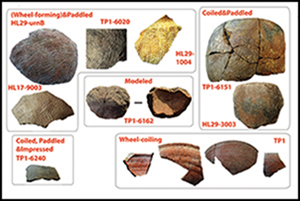
Critical to our dating efforts, the Halin ceramics were analysed using the French technological approach (Roux Reference Roux2019). In practice, this amounts to identifying the traces and features on surfaces and sections formed when the ceramic paste was manipulated during vessel manufacture. Every excavated sherd was studied in the field with the naked eye, a ×10 magnifying glass and a ×10–200 binocular microscope and classified traceologically. Thus, ceramic production methods can be interpreted, for spatially and/or chronologically contiguous populations, in terms of communities of practice. Finally, the ceramic forms and decorations were taken into account to assess whether the same forms corresponded with the same community (traces and forms are the same) or if stylistic transfer was apparent (traces are different but forms are the same) (Figure 3). A publication devoted to Halin pottery is forthcoming, as some of the assemblages were not fully studied prior to February 2021, but we provide a basic description in OSM3. In summary, there appear to be some marked technological continuities throughout the pottery assemblage, which suggests a certain stability of the local population over the time the area was occupied. The pottery of different periods can be usefully compared across different sites within Halin (Figure 4) and without—namely, the Oakaie/Nyaung'gan area for Neolithic and Bronze Age material, the Samon Valley for Iron Age material, Sriksetra and Beikthano for Pyu period material and Bagan for material of that period.
Preliminary techno-stylistic pottery sequence for Halin, showing examples of major technical groups and their context (figure by the authors).

Bayesian model for area HL-TP1. Modelled data post Markov Chain Monte Carlo is shown in dark outline, lighter shades indicate the radiocarbon likelihoods or single calibrated age ranges. Outlier values are shown in the form (Outlier [posterior]; Outlier [prior]) (figure by the authors).

Bayesian modelling of radiocarbon dates
To interpret our corpus of radiocarbon determinations we applied a Bayesian statistical approach, using OxCal 4.4 (Bronk Ramsey Reference Bronk Ramsey2009a) software and the INTCAL20 calibration curve (Reimer et al. Reference Reimer2020). The basis of the method is the integration of prior information, in the case of Halin principally via the excavated stratigraphic/cultural sequences, along with the radiocarbon likelihoods, or calibrated ages. We built a series of models reflecting the stratigraphic sequence in the various excavated areas that contained significant numbers of determinations and confident stratigraphic information (these include areas HL-TP1, HL29-1/2, HL30-1, HL19* and HL17-2). Several excavated areas have very few radiocarbon dates and were therefore not included in the modelling. We applied boundaries to account for the transition between one phase and another, and double boundaries which reflect an unknown span of the time elapsing between those various phases, for example in the form of a sterile layer. We applied an outlier-detection approach to explore the extent to which different likelihoods produced results at odds with their stratigraphic position (Bronk Ramsey Reference Bronk ramsey2009b). We used a modified Charcoal outlier model termed Charcoal Plus (after Dee & Bronk Ramsey Reference Dee and Ramsey2014) as well as a General outlier model, with the prior probability function set at 0.05. In some instances, for example when modelling dates of tooth enamel, we increased the outlier probability to 0.4 to reflect the greater risk of diagenesis and young determinations (Wood et al. Reference Wood, Fleury, Fallon, Nguyen and Nguyen2021). In the Charcoal Plus models the outlier probability was automatically set to 1.00 to reflect the possibility that all charcoal determinations contain a non-systematic inbuilt age bias (Dee & Bronk Ramsey Reference Dee and Ramsey2014). Outliers of significance were down-weighted in the model as a function of the extent of the posterior probabilities. Each excavation-based Bayesian model built is described in OSM4 along with the model codes and results (Figures 4–8).
Bayesian model for location HL17-2 (figure by the authors).

Bayesian model for area HL29-1/2 (figure by the authors).

Bayesian model for area HL30-1 (figure by the authors).

Bayesian model for the HL19* excavation (figure by the authors).

To consider all of the radiocarbon results together, we built a KDE_Model in OxCal 4.4 (Figure 9). This enables us to visualise the sum of the calibrated distributions (Bronk Ramsey Reference Bronk Ramsey2017; Higham et al. Reference Higham2020). The kernel function (usually Gaussian), with an associated bandwidth, is used to define the region over which a single observation contributes to the estimated frequency function. We also summarised the results of the individual site-based Bayesian models by selecting several key boundary priors from the most important models created at the site (Figure 10). This largely complements the KDE Model results, providing a reliable chronology for the Halin site and wider region for the first time.
KDE_Model for the Halin determinations (n = 104) (figure by the authors).

Priors from some of the key boundaries for the models built at Halin (see OSM). The boundaries come from, respectively the bottom, HL19*, HL30-1 (start and end BA, start IA) and HL29-1/2 (figure by the authors).

Halin synthesis and regional comparanda
Halin thus has a proven chronology spanning up to 4500 years, but how is the evidence distributed spatially and what can it tell us about the site complex over time? In reverse chronological order, the presence of Bagan phases at nominally Pyu Halin is not surprising. HL19 (not shown on the map) is a long-known Bagan temple and there is no reason for an abandonment of Halin at the end of the Pyu period. However, the scale of the Bagan phase at HL-TP1 is unexpected, in both the thick industrial/settlement deposits and the presence of major earthworks three kilometres from the city. The duration of Bagan period activity at HL-TP1 appears to be in the order of two or three centuries, which is not inconsiderable, but this produced 4m of domestic deposits composed of dozens of strata with interspersed hearths and probable salt production remains. This is likely indicative of an intense occupation. Halin's Bagan period radiocarbon sequence is consistent with historical records and the few determinations available at Bagan (Hudson Reference Hudson, Goh, Miksic and Aung-Thwin2012). However, it is not yet clear why the settlement and industry at HL-TP1 took place on a 3m-high constructed earthwork, nor whether the earthwork was built deliberately for this or if it was part of some general change in the focus of occupation at Halin. Such activity implies the whole area to the south-west of Halin's UNESCO-designated property zone needs evaluating in more detail, which is also suggested by the dense Bagan shell midden and cremation burials at HL29-1/2 .
Despite not targeting Pyu phases, it is surprising just how few such deposits the MAFM encountered at Halin. The only definite exposure is at HL-TP1, with 1.5m of deposits spanning the first millennium AD, suggesting a much lower-intensity occupation than that seen in the subsequent Bagan phase, or possibly a greater concentration within the city walls, where our only exposure was at HL17-1/2. The MAFM dates are consistent with historical records and radiocarbon dates from other Pyu sites (Hudson Reference Hudson, Goh, Miksic and Aung-Thwin2012; Stargardt Reference Stargardt2016).
The MAFM's coverage of the Halin Iron Age consists of the cemetery phase at HL30-1, which produced four dates spanning the mid–late first millennium BC, and our excavation at HL17-2, which exposed what appears to be mid–first millennium BC burials just next to the Pyu gatehouse. More data are required, especially from settlement sites, but there is no untoward gap in Halin's Iron Age phasing, which is consistent with the limited dates available from the Samon Valley cemeteries (Pautreau et al. Reference Pautreau, Coupey and Kyaw2010a) and other Iron Age deposits in central Myanmar at Taungthaman (Stargardt Reference Stargardt1990: 16), Sriksetra (Stargardt Reference Stargardt2016) and Kan Gyi Gon (Pryce et al. Reference Pryce, Coupey, Kyaw, Dussubieux, Favereau, Lucas and Perrin2013). Indeed, HL17-2 and Kan Gyi Gon suggest there may even be a tendency to a regionally early Iron Age transition in central and north-central Myanmar, perhaps sixth century BC rather than the typically stated fourth century BC for MSEA. At HL17-2, the presence of iron/steel but the absence of glass—the latter also a typical MSEA Iron Age type marker—may hint at a slight delay between ferrous and vitreous technologies reaching Southeast Asia from their, widely presumed, proximal source in India (Biggs et al. Reference Biggs, Martinon-Torres, Bellina and Pryce2013; Dussubieux & Pryce Reference Dussubieux and Pryce2016). That Myanmar's Iron Age may be slightly earlier than that for the rest of MSEA need not be surprising, given the relative proximity of South Asia but requires verification given the lack of Iron Age occupation in the Oakaie/Nyaung'gan area (Pryce et al. Reference Pryce2018a).
The Bronze Age period at Halin is comfortably accounted for by cemetery layers at HL29-1/2, settlement and burial contexts at HL30-1, and settlement contexts at basal HL-TP1, spanning the late second millennium and first half of the first millennium BC; all of which demonstrate shared ceramic traditions (Figure 3). So far uniquely at Halin, HL30-1 also captures the Neolithic transition, which we place during the eleventh century BC. All these dates are comparable to the Bronze Age phasing established at Oakaie/Nyaung'gan (Pryce et al. Reference Pryce2018a), and with Laos (Cadet et al. Reference Cadet2019), Thailand (Higham et al. Reference Higham, Douka and Higham2015, Reference Higham2020), Vietnam (Pryce et al. Reference Pryce, Cadet, Allard, Kim, Hiep, Dung, Lam and Foy2021) and Yunnan (Yao et al. Reference Yao, Darré, Zhilong, Lam and Wei2020; Higham Reference Higham2021). This close chronological patterning indicates that north-central Myanmar was tightly integrated within broader regional interaction networks of the late second millennium BC, as exemplified by early metal exchange networks (Pryce et al. Reference Pryce, Lam, Cadet, Jiang, Yang and Yao2022; Reference Pryce2023).
By far the most striking results of our dating programme concern the Neolithic deposits. Layer-4 in the cemetery at HL30-1, though limited in exposure and lacking direct dating, shows comparable ceramic traditions and funerary practices with the late second millennium BC Late Neolithic phases at Oakaie and Nyaung'gan (Favereau et al. Reference Favereau, Pryce, Win, Champion, Win, Hwte, Mar, Pradier and Willis2018; Pryce et al. Reference Pryce2018a; Pradier et al. Reference Pradier, Kyaw, Win, Willis, Favereau, Valentin and Pryce2019). HL19* is a different matter, with 12 radiocarbon dates starting 2896–2683 cal BC (68% probability) and ending by 2612–2510 cal BP (68% probability), making it among the earliest Neolithic contexts in MSEA. Recent fieldwork in Vietnam and Thailand has identified similarly early dates for the arrival of immigrant rice and millet farmers. The third occupation phase of Cái Bèo on Cát Bà island in Hạ Long Bay, which incorporated typical Neolithic incised pottery and rice phytoliths, dates to c. 2500 BC (Wang et al. Reference Wang, Nguyen, Le, Zhao, Carson, Yang and Hung2022a), while at Bài Bên, a late Hạ Long culture site on Cát Bà island, grinding stones from the third millennium BC include millet starch (Wang et al. Reference Wang, Nguyen, Le, Zhao, Carson, Yang and Hung2022b). The Bàu Tró phase of Thạch Lạc in central Vietnam also dates to c. 2480–2000 BC, making it provisionally Neolithic, as, similar to HL19*, full archaeobotanical and zooarchaeological analyses are not yet published (Piper et al. Reference Piper, Dung, Kiên, Thuy, Higham, Petchey, Grono, Bellwood, Higham and Kim2022).
The early dates for the Halin Neolithic thus corroborate and confirm the regional ‘two-layer’ model, which describes the movement of rice and millet-farming populations, ultimately from the Yangtze and Yellow rivers, from the southern Chinese provinces of Yunnan and Guangxi into northern Vietnam and Thailand in the mid third millennium BC. The two-layer model has been challenged in the ISEA and Pacific arena as the conflation of genetic and linguistic data with material culture (e.g. Lipson et al. Reference Lipson, Loh, Patterson, Moorjani, Ko, Stoneking, Berger and Reich2014; Denham Reference Denham, Cochrane and Hunt2018; Alam et al. Reference Alam2021; Larena et al. Reference Larena2021) but for MSEA the alternative model is that of the indigenous development of agriculture. This alternative was indeed prevalent during the 1960s and 1970s, when claims of seventh- and fifth-millennium BC Neolithic contexts at Spirit Cave and Non Nok Tha, respectively, in northern Thailand (Gorman Reference Gorman1970; Solheim Reference Solheim1972)—and even late Pleistocene Neolithic phases at Padah-Lin cave in eastern Myanmar (Aung Thaw Reference Aung Thaw1971)—led to speculation that MSEA had been a centre of plant domestication. However, MSEA research over the past 30 years strongly supports the two-layer model in the fields of material culture, linguistics, bioarchaeology, archaeobotany and aDNA studies (e.g. Rispoli Reference Rispoli2007; Higham et al. Reference Higham, Guangmao and Qiang2011; Oxenham et al. Reference Oxenham, Matsumura and Dung2011; Piper et al. Reference Piper2017; Lipson et al. Reference Lipson2018; McColl et al. Reference McColl2018; d'Alpoim Guedes et al. Reference d'Alpoim Guedes, Hanson, Lertcharnrit, Weiss, Pigott, Higham, Higham and Weber2020; Higham Reference Higham2021); though there is, of course, much room for refinement and chrono-spatial variations.
Thus we place the Halin sequence in a broader Southeast Asian context, seeing a continuum with those sites that have Neolithic phases commencing c. 2300 BC, like Ân Sơn in southern Vietnam (Bellwood et al. Reference Bellwood2011), the MP1 phase at Khok Phanom Di and the initial occupation of Nong Nor in north-east Thailand (Higham & Higham Reference Higham and Higham2022). These regional nuances, we suggest, are due to different waves of migrants from different areas, speaking different languages, at approximately the same time. Austroasiatic is the dominant reconstructed language family for Neolithic central MSEA, with Kra Dai in northern Vietnam, potentially derived from the Yangtze River basin and Tibeto-Burman hypothesised in western MSEA from the Yellow River basin (Bellwood Reference Bellwood, Sidwell and Mathias2021; Guo et al. Reference Guo2022). Therefore, we suggest that evidence from HL19* should be viewed in light of the geographic dislocation between north-central Myanmar and early Neolithic sites in Thailand and central-southern Vietnam, and their relative proximities to Chinese source cultures.
Halin lies approximately 1000 geodesic kilometres from northern Vietnam and north-east Thailand but less than 250km from the Chinese border. Furthermore, these 1000km are perpendicular to most of the mountain ranges and rivers, whereas Yunnan can be accessed via several river valleys (e.g. the Nanting) leading towards Dali (Figure 1) and then Kunming and the rest of Yunnan lies downstream on the Red River. Subject to verification, it seems conceivable that the Neolithic layers at Halin reflect a direct and relatively short extension of Yunnan's own Neolithicisation, c. 4800–3900 cal BP for rice cultivation (e.g. Li et al. Reference Li2016; Dal Martello et al. Reference Dal Martello, Min, Stevens, Higham, Higham, Qin and Fuller2018; Dal Martello Reference Dal Martello2022). This phenomenon could also represent a more westerly Tibeto-Burman migration, as suggested by the very limited aDNA data available for Myanmar, which indicate Tibeto-Burman individuals in the Oakaie area c. 3000 BP (Lipson et al. Reference Lipson2018). Current dating of HL19* is consistent with the only other radiometrically dated suspected Neolithic deposits in Myanmar: three determinations from Ywa Gon Gyi, south of Mandalay (Pautreau et al. Reference Pautreau, Maitay and Kyaw2010b). The combined data presented here do indicate, we argue, that Myanmar experienced interactions with East Asia during the Neolithic that differed from those of the rest of MSEA, seemingly dominated by the migration of Austroasiatic speaking populations into Vietnam and Thailand. This potential for variation in MSEA cultural transmission pathways and chronologies is also indicated for the Bronze Age transition, with metal provenance research showing the likelihood of direct contact with Yunnan as well as indirect contact with Thailand and Laos in the late second millennium BC (Pryce Reference Pryce, Choi and Park2018; Pryce et al. Reference Pryce2018b, Reference Pryce, Cadet, Allard, Kim, Hiep, Dung, Lam and Foy2021, Reference Pryce, Lam, Cadet, Jiang, Yang and Yao2022, Reference Pryce2023).
Conclusion
With this article we have improved 10-fold the radiometric chronology for Halin which, by virtue of the site's size, status and historical sequence, represents an archaeological advance at the national and regional scale. We confirm evidence for an early–mid third millennium BC, potentially Neolithic, phase, which is comparable to the wider MSEA and in line with expectations given the proximity to Yunnan. The c. 1100 BC Bronze Age transition is fully compatible with other Myanmar data as well as those from Yunnan, Vietnam and Thailand, and is likewise directly supported with archaeometallurgical data. Identification of an Iron Age phase in the sixth century BC at Halin is marginally earlier than the standard fourth-century BC dates for MSEA, which could be explained by the relative proximity of the site to South Asia, the likely source of ferrous and vitreous technologies (the latter possibly being transmitted after a slight delay). Our dates capture the full first millennium AD of Pyu occupation at Halin, as well as evidencing clear continuity into the second millennium AD Bagan phase, which might be expressed until the present-day on the basis of ceramic traditions. Nevertheless, we acknowledge several lacunae, needing to improve our resolution of Pyu and Iron Age sub-phasing, as well as to capture the late third and early–mid second millennium BC Neolithic. Furthermore, the timing and mechanism of Myanmar's transition from the Mesolithic/Hòabìnhian/Late Anyathian to the Neolithic has not been broached as we have not yet identified a suitable site. Given what we know of other such Southeast Asian sites, Halin lacks the cave locations normally presenting such evidence (e.g. Forestier et al. Reference Forestier, Zhou, Auetrakulvit, Khaokhiew, Li, Ji and Zeitoun2021). Myanmar still has much of its past to yield and will continue to be a major focus of Southeast Asian archaeological research when circumstances allow.
Acknowledgements
The Mission Archéologique Française au Myanmar was a bilateral scientific cooperation project between the Centre National de la Recherche Scientifique and the Department of Archaeology and National Museum and Library of the Myanmar Ministry of Religious Affairs and Culture, which was active between 2001 and 2020. We offer our gratitude to U Kyaw Oo Lwin, Director-General of the Department of Archaeology for his support of the Franco-Myanmar team, in the provision of permits and also the participation of his personnel during the quadrennial 2017–2020. In particular, we thank U Than Hitke, U Tun Aye, Daw Tin Win, Daw Aye Aye Mar, Daw Cherry Thin, Daw Han Myo Kyi Aung, Daw Khin Thidar Lin, and finally Daw Kalayar Myat Myat Htwe of the Department of Archaeology, University of Yangon (Myanmar Ministry of Education).
The French Embassy in Yangon and the French Institute in Yangon were both instrumental in providing us with in-country support, for which we thank the then Cultural Councillor M. Cyprien François, in particular, as well as His Excellency M. Christian Lechervy. Last but very far from least, we wish to thank our co-workers and friends from the village of Halin. Their welcome made a rewarding job a fun one too, and we miss them very much.
Finally, we give our thanks to helpful comments from Peter Bellwood and Phil Piper, as well as three anonymous reviewers who significantly strengthened the manuscript.
Funding statement
The fieldwork for the present study was financed by the Archaeological Consultative Commission of the French Ministry for Europe and Foreign Affairs for the 2017–2020 project cycle, with additional funds being contributed by the individual projects of a number of team members.
Supplementary material
To view supplementary material for this article, please visit https://doi.org/10.15184/aqy.2023.190.



