Introduction
Rice (Oryza sativa L.) is among the major grain crops, and half of the global population relies on it as a staple food (Matloob et al., Reference Matloob, Khaliq and Chauhan2015). The ever-rising global population and shrinking resource pool are changing the sowing and production methods for this crop. The traditional puddled transplanted rice is being rapidly replaced by direct-seeded rice worldwide but specifically in South Asia (Farooq et al., Reference Farooq, Siddique, Rehman, Aziz, Lee and Wahid2011). This system of rice cultivation saves precious resources including time, energy, water and labour (Moody, Reference Moody1993; Farooq et al., Reference Farooq, Siddique, Rehman, Aziz, Lee and Wahid2011). The adoption of this system has been rapid and widespread due to its economic feasibility, profitability and sustainability. However, weed infestations have become prevalent in this farming system due to the lack of a flooding phase (Matloob et al., Reference Matloob, Khaliq and Chauhan2015). Weed seeds germinate easily and continue to grow vigorously in direct-seeded aerobic rice fields as there is no standing water like traditional transplanting system that suppresses weed emergence and growth (Farooq et al., Reference Farooq, Siddique, Rehman, Aziz, Lee and Wahid2011).
Major weeds including several Echinochloa and Cyperus species dominate under aerobic conditions, but many newcomers are appearing in such innovative production system (Matloob et al., Reference Matloob, Khaliq and Chauhan2015). The alternate wet and dry periods in direct-seeded rice allow different weed species to emerge, establish and compete with the rice crop (Farooq et al., Reference Farooq, Siddique, Rehman, Aziz, Lee and Wahid2011; Matloob et al., Reference Matloob, Khaliq and Chauhan2015). One such new threat to direct-seeded rice is Parthenium weed (Parthenium hysterophorus L.; Asteraceae), which is becoming common in several field crops including sorghum [Sorghum bicolor L.; Moench], maize (Zea mays L.) and wheat (Triticum aestivum L.) (Bajwa et al., Reference Bajwa, Chauhan, Farooq, Shabbir and Adkins2016, Reference Bajwa, Ullah, Farooq, Chauhan and Adkins2019a, b; Oudhia, Reference Oudhia2000).
Parthenium weed is an immensely invasive plant species, originating from South and North America (Adkins et al., Reference Adkins, McClay, Bajwa, Adkins, Shabbir and Dhileepan2018). It has invaded 48 countries in the Asia-Pacific and African regions, where it has caused huge losses in crop and livestock production and in the health sector (Bajwa et al., Reference Bajwa, Chauhan, Farooq, Shabbir and Adkins2016). Parthenium weed is recognised as a highly competitive species owing to its seed germination ability under diverse conditions, biological plasticity, vigorous growth habit, quick resource use, allelopathic capacity and stress tolerance ability (Annapurna and Singh, Reference Annapurna and Singh2003; Bajwa et al., Reference Bajwa, Chauhan and Adkins2018, Reference Bajwa, Wang, Chauhan and Adkins2019c; Nguyen et al., Reference Nguyen, Bajwa, Navie, O’Donnell and Adkins2017). Strong interference ability makes this weed species very difficult to manage in agro-ecosystems. Parthenium weed has long been considered as an environmental weed and therefore, less attention has been paid towards preventive measures and its management in cropping systems. In a large-scale survey from Ethiopia, up to 90% farmers reported Parthenium as the most important weed in their region (Tamado and Milberg, Reference Tamado and Milberg2000). There is little information available on this weed in rice fields, but recent studies have highlighted that it is a potential threat to the productivity of rice especially under direct-seeded aerobic conditions (Bajwa et al., Reference Bajwa, Ullah, Farooq, Chauhan and Adkins2019a, Reference Bajwa, Ullah, Farooq, Chauhan and Adkins2019b). Earlier, Parthenium weed was reported to heavily infest upland direct-seeded rice field causing severe yield losses in India (Oudhia, Reference Oudhia2000; Paradkar et al., Reference Paradkar, Kurchania and Tiwari1997). In fact, it was one of the topmost frequent weeds in upland drilled rice (Oudhia, Reference Oudhia2000). Parthenium weed has been reported to cause up to 40% yield losses in several major grain and pulse crops with maize and sorghum being the most affected ones (Safdar et al., Reference Safdar, Tanveer, Khaliq and Riaz2015, Reference Safdar, Tanveer, Khaliq and Maqbool2016; Tamado et al., Reference Tamado, Ohlander and Milberg2002).
Deleterious impacts of Parthenium weed on crop growth and yield depend on its density and competition duration. Tamado et al. (Reference Tamado, Ohlander and Milberg2002) reported almost complete failure of a grain sorghum crop (97% yield loss) heavily infested by Parthenium weed, and even a very low density of Parthenium weed (3 plants m−2) caused 70% reduction in grain yield. In Pakistan, Parthenium weed also caused substantial yield losses in maize crop (Safdar et al., Reference Safdar, Tanveer, Khaliq and Riaz2015). According to a recent study on direct-seeded rice, Parthenium weed caused up to 35% loss in grain yield at the density of 20 plants m−2 (Bajwa et al., Reference Bajwa, Ullah, Farooq, Chauhan and Adkins2019a). Parthenium weed competition duration with crops determines the magnitude of growth and yield reductions (Safdar et al., Reference Safdar, Tanveer, Khaliq and Maqbool2016). Although limited information is available on this aspect, published studies showed that Parthenium weed competition begins at the early crop growth stages and prevails for significant periods of time. Tamado et al. (Reference Tamado, Ohlander and Milberg2002) determined that Parthenium weed–sorghum critical competition period was 19–69 days following the crop emergence. Such critical period of Parthenium weed competition in black gram was 30–45 days after crop emergence (Vivek et al., Reference Vivek, Rana, Singh and Tomar2008). Another study concluded that Parthenium weed should be managed within 17–23 days after crop emergence in maize to avoid grain yield losses (Safdar et al., Reference Safdar, Tanveer, Khaliq and Maqbool2016). However, there is no information available on this aspect for direct-seeded rice.
Therefore, this field study was carried out to estimate the impact of Parthenium weed on the performance of direct-seeded rice at different competition durations. Knowing the critical competition period between Parthenium weed and rice will aid in timely and effective management of this problematic weed.
Materials and Methods
Experimental site
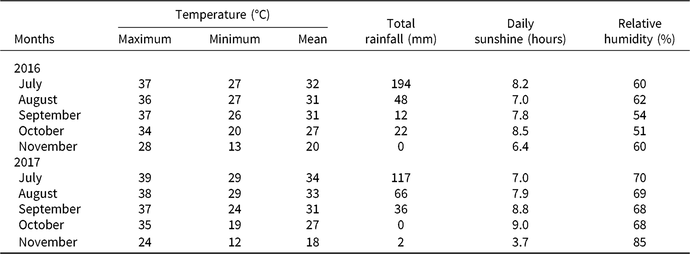
This study was carried out at the University of Agriculture Faisalabad (UAF), Pakistan, during 2016 and 2017. Total rainfall during the crop-growing season (July to October) was 276 and 221 mm in 2016 and 2017, respectively (Table 1; Meteorological Observatory, Department of Agronomy, UAF). The highest rainfall was received in July in both years, that is, 194 and 117 mm, respectively. The average maximum and minimum air temperatures during the growing season were 34 and 23 °C in 2016 and 2017, respectively (Table 1). The soil was a sandy clay loam with a pH of 8.1, an organic matter content of 0.8%, an electrical conductivity of 0.31 dS m−1 and a nitrogen (N) content of 530 ppm, phosphorus (P) 5 ppm and potassium (K) 195 ppm.
Weather data at the experimental site during the crop-growing seasons of the 2 years of study

Monthly average for all weather elements is presented except rainfall.
Experimental design and treatments
The study was laid down in a randomised complete block design with three replications and a plot size of 8.0 × 2.2 m. Parthenium weed seeds were collected from surroundings of the UAF where it grows in abundance. About 10 g weed seed was uniformly spread in each experimental plot except the season-long weed-free treatment just after sowing the crop. In this way, a dense population of Parthenium weed was achieved across all treatments. Six different treatments were created: a season-long weedy treatment, weed-free after 2, 4, 6 or 8 weeks of crop emergence and a season-long weed-free treatment. A uniform Parthenium weed density of 15 plants m−2 was maintained in all treatments, and excess Parthenium weed seedlings were removed just after their emergence (following the procedure of Safdar et al., Reference Safdar, Tanveer, Khaliq and Maqbool2016). The season-long weed-free treatment was kept free from Parthenium by manual weed control. All other weeds were eradicated manually as they emerged during the whole season in all treatments.
Crop husbandry
A field that was free from Parthenium weed infestations in previous seasons was cultivated four times followed by a double planking to prepare a uniform seed bed. Seeds of rice variety Super Basmati were obtained from Punjab Seed Corporation, Faisalabad, Pakistan. Crop seed (25 kg ha−1) was drilled with a manual drill in dry conditions at the row spacing of 22.5 cm. Irrigation was applied as required but without saturating the field, and there was no standing water afterwards. In total, 17 irrigations (typically, single irrigation is 3 acre inches) were provided throughout the crop-growing seasons in both years. In case of rainfall, irrigation was not applied to avoid flooding conditions. Fertilizers were soil-applied at 150–90–25 kg N–P–Zn ha−1 using urea (46% N), diammonium phosphate (46% P2O5) and zinc sulphate (35% Zn) as sources during both years, based on the soil analysis. Full dose of P and Zn, and half dose of N were applied at the time of sowing. The remaining half dose of N was top-dressed in two splits, that is, at tillering and panicle initiation stages of rice crop.
Observations
Height of 15 randomly selected Parthenium weed plants was measured before starting the weed-free period in all treatments and also at the time of crop maturity in the season-long weedy treatment. The weed plants were harvested from two randomly selected locations from each treatment plot (each 1 m2) and just before starting the Parthenium weed-free period in the respective treatments. Dry biomass was recorded after oven-drying at 70°C for 72 hours.
The number of rice panicles was counted from two randomly selected locations from each treatment plot (each 1 m2) at harvesting. From these, 10 panicles were randomly selected to record the number of branches per panicle, panicle length and number of grains per panicle. A sub-sample of 1000 grains was taken from each plot and then weighed on an electronic balance, and average 1000-grain weights were recorded. The crop was harvested, tied into bundles and sundried for 1 week in all plots. Grain yield was recorded from the whole plot using a spring balance and later expressed as Mg ha−1.
Statistical analyses
Data from both years were subjected to the analysis of variance, which revealed a significant effect of year (p ≤ 0.05); therefore, data for both years were analysed separately using Statistix-8.1 software. Means were separated using the least significant difference test at p ≤ 0.05. Graphs were prepared in Microsoft Excel where treatment means or percentage values were presented with ± standard errors of means. Grain yield losses were calculated by the following equation:
 $$percentage{\mkern 1mu} yield{\mkern 1mu} losses = {{{{\rm{Y}}_{{\rm{weed}}{\kern 1pt} {\rm{free}} - {{\rm{Y}}_{{\rm{weed}}}}}}} \over {{{\rm{Y}}_{{\rm{weed}}{\kern 1pt} {\rm{free}}}}}} \times 100$$
where Yweed-free is the grain yield in the season-long weed-free treatment and Yweed is the yield in the respective treatments where Parthenium weed was present.
Results
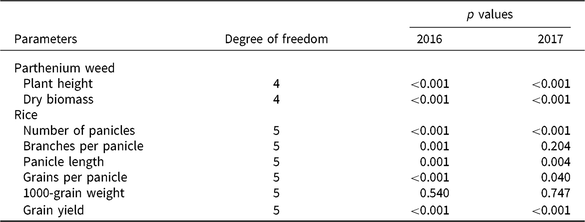
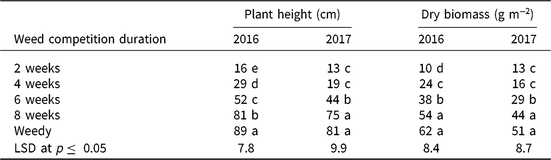
Plant height and dry biomass of Parthenium weeds raised significantly (p ≤ 0.05) as Parthenium weed–rice competition duration was increased (Table 2). The highest plant height (89 and 81 cm) and dry biomass (62 and 51 g m−2) of Parthenium weed were noted in the treatment kept weedy throughout the study period during 2016 and 2017, respectively (Table 3). However, Parthenium weed dry biomass was statistically similar between the treatments kept weedy for whole season or for 8 weeks after crop emergence (Table 3). This trend was observed during both years of the study.
Analysis of variance for Parthenium weed and rice parameters as affected by different weed competition durations during the 2 years of study

The only source of variation was weed–crop competition duration. p values ≤ 0.05 are significant.
Effect of Parthenium weed–rice competition duration on Parthenium weed plant height and dry biomass during the 2 years of study

LSD = least significant difference; Means were separated at the significance level of p ≤ 0.05.
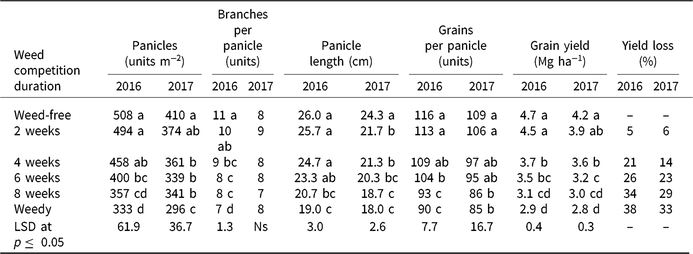
Different durations of Parthenium weed competition with the rice crop had significant effect on grain yield and most of the related traits during both years (Table 2). Rice panicles gradually decreased as the Parthenium weed control was delayed during both years (Table 4). The highest number of panicles (508 and 410) was observed in weed-free treatment during 2016 and 2017, respectively. The season-long competition of Parthenium weed caused 34 and 28% reductions in panicle number during both years, and the number of branches per panicle was affected by Parthenium weed competition duration only in 2016 (Table 4).
Effect of Parthenium weed competition duration on rice yield and yield-related attributes during the 2 years of study

LSD = least significant difference; Ns = non-significant; – = not applicable; Means were separated at the significance level of p ≤ 0.05.
The 1000-grain weight of rice was not significantly affected by the duration of weed competition (ranging from 16.1 to 17.3 g and 16.3 to 17.8 g during 2016 and 2017, respectively). Rice panicle length, grains per panicle and grain yield were also reduced by increasing Parthenium weed competition period during both years. The season-long competition of Parthenium weed caused the highest reductions in panicle length (27 and 26%), grains per panicle (23 and 22%) and grain yield (38 and 33%) of rice in the first and second year, respectively, as compared to the season-long weed-free treatment. However, these parameters were not significantly affected in plots kept free of Parthenium weed 2 weeks after crop emergence as compared to those kept weed-free for whole season (Table 4). The reduction in panicle length, grains per panicle and grain yield of rice was statistically similar between 8 weeks competition and full season weedy treatments. Overall, different competition durations reduced the rice grain yield by 5–38% and 6–33% during 2016 and 2017, respectively, as compared to the weed-free treatment (Table 4).
Discussion
The results of this study demonstrated that Parthenium weed was able to compete severely with the rice crop resulting in a substantial yield loss (5–38%). Increasing competition duration of this weed negatively affected the rice growth and grain yield. A rapid emergence of Parthenium weed at early crop stages has been reported to be a key factor benefiting this species in the competition encounter with crops (Bajwa et al., Reference Bajwa, Chauhan, Farooq, Shabbir and Adkins2016). Therefore, Parthenium weed caused a notable yield loss even when it only competed with the rice crop for a short period in its initial growth stages (Safdar et al., Reference Safdar, Tanveer, Khaliq and Maqbool2016).
Parthenium weed competition for longer durations affected crop growth more severely. One reason may be because Parthenium weed attains more height and dry biomass as it continues to grow for longer durations of time in the rice crop. In earlier studies, yield losses of 20–50% in maize (Safdar et al., Reference Safdar, Tanveer, Khaliq and Maqbool2016) and 40–95% in grain sorghum (Tamado et al., Reference Tamado, Ohlander and Milberg2002) have been reported due to Parthenium weed at different competition durations. Safdar et al. (Reference Safdar, Tanveer, Khaliq and Maqbool2016) reported that this weed gained a higher biomass when it was not controlled throughout the season or for 8 weeks after emergence as compared to its shorter competition durations in maize crop. Parthenium weed not only accumulated more biomass but also acquired more nutrients (NPK) from the soil (Safdar et al., Reference Safdar, Tanveer, Khaliq and Maqbool2016). In Ethiopia, Tamado et al. (Reference Tamado, Ohlander and Milberg2002) reported that Parthenium weed competed strongly with sorghum crop right after crop germination and the critical competition duration was found to be up to 60 days following crop emergence. Critical competition duration varies according to the crop or weed species and also geographic conditions. For instance, Mukherjee et al. (Reference Mukherjee, Sarkar and Maity2008) reported 15–60 days after crop emergence as a critical weed–crop competition period for direct-seeded rice. Another study reported this critical period to be between 21 and 43 days after emergence in the same system of rice cultivation (Anwar et al., Reference Anwar, Juraimi, Samedani, Puteh and Man2012). In the present study, grain yield losses due to Parthenium weed were similar (p ≤ 0.05) between 8 weeks competition and the season-long weedy treatments. This indicates that controlling Parthenium weed beyond 8 weeks after emergence will not improve the crop growth and yield substantially. However, preventing further seed set in this period will avoid the build-up of Parthenium weed seed bank.
Rice yield relies on a good seedling establishment, subsequent vigorous vegetative growth and the proper development at reproductive phase (Matloob et al., Reference Matloob, Khaliq and Chauhan2015). However, weed competition beyond the tillering stage often causes significant impairment of crop growth and yield losses. Especially, panicle initiation and grain-filling stages are more sensitive to biotic and abiotic stresses. Parthenium weed competition with rice crop for 6 weeks or more caused much higher yield losses, with Parthenium weed competition directly affecting key yield contributing traits such as panicle number, branches per panicle, panicle length and number of grains (Table 4). Similar negative effects have been reported on the number of grains per cob, 1000-grain weight and yield of maize enduring Parthenium weed competition for 5–8 weeks (Safdar et al., Reference Safdar, Tanveer, Khaliq and Maqbool2016). In a recent study, sorghum crop grown for fodder purpose suffered from severe losses in plant height, stem diameter, leaf area and yield by Parthenium weed competition at the weed density of 16 plants m−2 (Asif et al., Reference Asif, Ayub, Tanveer and Akhtar2017).
It is also important to note that Parthenium weed growth was significantly higher during 2016 as compared to 2017 and the same trend was observed in rice yield. This might be associated with higher rainfall and sunshine during growing season in 2016 than that in 2017 (Table 1). It means that Parthenium weed was equally benefited by extra moisture and the sunlight. The rapid growth, higher biomass accumulation and higher nutrient uptake contributed to high competitiveness of Parthenium weed (Bajwa et al., Reference Bajwa, Chauhan, Farooq, Shabbir and Adkins2016). It has been observed that it grows better and produces more seeds under relatively drier soil condition (2/3 of field capacity), but it can also tolerate drought conditions (Bajwa et al., Reference Bajwa, Chauhan and Adkins2017). This attribute might also have enabled Parthenium weed plants to grow vigorously under aerobic conditions, which prevailed in this study. In addition, Parthenium weed can acquire more nutrients, alter soil conditions in its favour (Bajwa et al., Reference Bajwa, Chauhan, Farooq, Shabbir and Adkins2016) and regulate its growth in different soil types (Annapurna and Singh, Reference Annapurna and Singh2003). It is also possible that Parthenium weed plants suppressed rice plant growth by releasing allelochemicals into the rhizosphere. In fact, Parthenium weed releases several secondary metabolites with toxic potential into its surroundings, especially in rhizosphere (Bajwa et al., Reference Bajwa, Chauhan, Farooq, Shabbir and Adkins2016). One such potent allelochemical is parthenin, which suppresses the growth of several plant species especially when deposited into the soil in higher amounts (Belz et al., Reference Belz, Reinhardt, Foxcroft and Hurle2007). Similarly, a range of phenolics have been linked to Parthenium weed root exudates and leachates with a substantial phytotoxic potential (Bajwa et al., Reference Bajwa, Chauhan, Farooq, Shabbir and Adkins2016). Such allelochemicals impair physiological processes in plants and therefore, hamper growth and development (Farooq et al., Reference Farooq, Bajwa, Cheema and Cheema2013). Parthenium weed residues were reported to suppress germination, growth and dry weight of rice seedlings (Oudhia and Tripathi, Reference Oudhia and Tripathi2000; Biswas et al., Reference Biswas, Paul, Ghosh and Karim2010). Therefore, competition and allelopathic capacity of this weed seems to have caused strong interference with rice growth and development at increasing competition durations in this study.
Conclusions
Rice yield was reduced substantially by Parthenium weed competition under direct-seeded aerobic conditions. Parthenium weed competition with rice for 2 weeks after crop emergence caused 5 and 6% yield losses during 2016 and 2017, respectively, which could be considered an acceptable yield loss level without control. However, allowing competition for 4 weeks and up to the end of crop cycle caused grain yield losses varying between 14 and 38%. As rice yield was not improved significantly when the weed was controlled after 8 weeks as compared to the season-long weedy treatment, Parthenium weed should be controlled during 4–8 weeks after rice emergence when sown under direct-seeded conditions to avoid substantial yield losses.
Acknowledgements
This study is part of the PhD project of Ali Ahsan Bajwa who is thankful to the University of Queensland, Australia, for the provision of Research Training Program and UQ Centennial Scholarships. Authors are also thankful to the technical staff at the Postgraduate Agricultural Research Station, University of Agriculture, Faisalabad, Pakistan for their support in conducting this study.