Introduction
Business ethics have become one of the most critical issues in human resource management and job performance in service sectors, including the tourism industry (De Cremer & Vandekerckhove, Reference De Cremer and Vandekerckhove2016). Unlike manufacturing, tourism requires interaction with the customer on a regular basis. Wong (Reference Wong1998) argues that because of such interaction within service industries, customer satisfaction relies in part on whether or not personnel achieve high-ethical norms and behave morally. Previous studies demonstrated that the tourism industry is particularly sensitive to employees' unethical behavior (Harris, Reference Harris2012; Stevens, Reference Stevens2001; Wong & Chan, Reference Wong and Chan2010; Yaman & Gurel, Reference Yaman and Gurel2006). Furthermore, tourism employees often face ethical issues (e.g., misleading information in restaurant menus, hotel brochures and on websites, overbooking, theft, mistreatment of other people involved in tourism industry, etc.) which affect their behavior toward customers and colleagues (Knani, Reference Knani2014). Thus, it is expected that having clear directions from supervisors and establishing a positive ethical climate in the organization would help employees eliminate uncertainties when handling ethical issues and dilemmas (Schwepker, Reference Schwepker2001).
According to Knani (Reference Knani2014), a positive ethical climate creates a healthy organization by increasing employees' job satisfaction, simultaneously motivating them to improve organizational performance (DeConnick, Reference DeConnick2010; Gokmen & Ozturk, Reference Gokmen and Ozturk2012). Kim and Miller (Reference Kim and Miller2008) recommended that companies focus on creating an appropriate ethical climate that reinforces the desired work behavior of their employees. Also, companies should avoid discrepancies between employees' and organization's ethical values since they could have detrimental effects on the employees' job satisfaction. This is due to the fact that employees experiencing such an inconsistency often feel that they need to compromise their own values in order to comply with the way the organization operates (Koh & Boo, Reference Koh and Boo2001).
In this regard, the influence of an ethical managers' behavior (as the main agent in organizational ethical culture), on individuals, groups and organizational performance has often explored in research (Brown & Trevino, Reference Brown and Trevino2006; Brown, Trevino, & Harrison, Reference Brown, Trevino and Harrison2005; Koh & Boo, Reference Koh and Boo2001). Managers' ethical beliefs and behavior are powerful motivators for subordinates to behave in accordance with the same standards (Deshpande, George, & Joseph, Reference Deshpande, George and Joseph2000). Any form of the manager's unethical behavior might be considered as a sign of approving such patterns of corporate behavior. Thus, the managerial role in creating ethical climate within the organization is crucial. It can shape employees' perception of ethical standards. In contrast, establishing a positive ethical climate within the organization can increase subordinates' job satisfaction and commitment to organizational goals (Toleikiene, Slaboaeviþinjte, & Sapiegiene, Reference Toleikiene, Slaboaeviþinjte and Sapiegiene2014; Fu, Deshpande, & Zhao, Reference Fu, Deshpande and Zhao2011). It is well known that business owners decisively influence work ethics and job satisfaction in the tourism industry (Harrison & Freeman, Reference Harrison and Freeman1999; Kim & Brymer, Reference Kim and Brymer2011) and that business ethics studies are usually conducted from tourists' perspective (e.g., Sather-Wagstaff, Reference Sather-Wagstaff2008; Walter, Reference Walter2016). This study, however, will focus on business ethics from the managers' and subordinates' points of view. Substantial efforts were made in researching the perception and effects of ethical management, separately for managers and their subordinates (e.g., Fu, Deshpande, & Zhao, Reference Fu, Deshpande and Zhao2011; Mulki, Jaramillo, & Locander, Reference Mulki, Jaramillo and Locander2006; Phatswane, Reference Phatswane2013). Researchers reported significant differences in business ethics attitudes between managers and their subordinates. For example, in the study of Phatswane (Reference Phatswane2013), employees, when compared with managers, perceive more favoritism by a supervisor but have lower perception of organizational resources misuse. Employees also state that ethical training is less important.
Due to deep structural changes in companies and a usually underdeveloped business philosophy, the research of the perception of ethical climate types (ECTs) is particularly important in transitioning economies. Despite the expansion of research about business ethics in the tourism industry over the past three decades, very few studies have focused on business ethics of those engaged in small and medium tourism organizations in non-Western, transitioning economies. Very little is known about the change in work ethics in circumstances of substantial reforms and a rapidly growing tourism industry as is the case now in Serbia (Dragin, Jovanović, Mijatov, Majstorović, & Dragin, Reference Dragin, Jovanović, Mijatov, Majstorović and Dragin2019). Tourism organizations in Serbia are mostly small and medium-sized, usually family-owned-managed enterprises (hotels, restaurants and travel agencies) (Statistical Office of Republic of Serbia, 2014).
Business ethics in Serbian tourism organizations are based on abiding the Law on Tourism and on the Code of Ethics prescribed for all business entities that are operating within the country. These organizations are also expected to provide working conditions that will not endanger employees' health and safety, which is all covered by the Law on safety and health at work (Official Gazette of Republic of Serbia, Code of business ethics, 2006). Beside these, tourism organizations in Serbia are also expected to provide specific ethical codes describing adequate working conditions that prevent deviant behavior at the workplace. However, the implementation of these standards is usually inconsistent and their sufficient understanding and acceptance is a time consuming process (Kim & Miller, Reference Kim and Miller2008). Organizational ethical culture and organizational behavior in general stems from an interplay between formal standards (such as State Law and Code of Ethics) and informal norms in the local community (Trevino & Brown, Reference Trevino and Brown2004).
The main goal of this research was to explore employee perception of the ethical climate within tourism organizations in the Republic of Serbia, and to analyze the effects of this perception on job satisfaction. More specifically, the purpose of this research can be defined as follows: (1) to assess how individual values, job department, and employee perspective (based on: (a) personal impressions and experience, (b) discussion with colleagues, (c) management behavior, and (d) according to the company manualFootnote 1) affect perception of ethical climate, and (2) to examine the relationship between the perception of different ECTs and the level of job satisfaction in managers and their subordinatesFootnote 2. This was accomplished by using a pen-and-paper questionnaire on a sample of 258 employees of different small and medium tourism organizations in the Republic of Serbia (for details, please see the ‘Methodology’ section).
Literature Review
Defining the main concepts: ethical climate and job satisfaction
Besides Trevino's definition, ethical climate can also be considered as ‘perceptual lens through which workers diagnose and assess situations’ (Parboteeah & Cullen, Reference Parboteeah, Cullen, Giacalone and Jurkiewicz2003: 138). It is a part of organizational culture that combines organizational values, policies, procedures and practices in order to resolve ethical problems within the organization (Denison, Reference Denison1996; Schneider & Reichers, Reference Schneider and Reichers1983; Trevino, Butterfield, & McCabe, Reference Trevino, Butterfield and McCabe1998). Most of the available studies related to organizational ethical climate were conducted on the basis of Victor and Cullen's theoretical model (Reference Victor, Cullen and Frederick1987, Reference Victor and Cullen1988). These authors define ethical climate as ‘the prevailing perceptions of typical organizational practices and procedures that have ethical content’ (Victor & Cullen, Reference Victor and Cullen1988: 101). Ethical climate is not related to the individual's level of morality. It actually represents the individual's perception related to work environment and expectations within the specific organization (Cullen, Parboteeah, & Victor, Reference Cullen, Parboteeah and Victor2003; Peterson, Reference Peterson2002). Also, ethical climate can be measured as a group variable which actually means that employees in the same milieu usually have similar perceptions of (un)ethical behavior (Luria & Yagil, Reference Luria and Yagil2008). Therefore, it could be said that ethical climate reflects employee perception of standards that define appropriate organizational behavior, as well as morally acceptable procedures within the workplace, which can affect the behavior of individuals and the organization as a whole (Kaplan, Reference Kaplan2010; Lopez, Babin, & Chung, Reference Lopez, Babin and Chung2009).
The most frequently used instrument for assessing ethical climate is the Ethical Climate Questionnaire (ECQ) (Victor & Cullen, Reference Victor, Cullen and Frederick1987, Reference Victor and Cullen1988; Cullen, Victor, & Bronson, Reference Cullen, Victor and Bronson1993), inspired by Kohlberg's theory of moral development (Reference Kohlberg1981). Combining the levels of moral assessment and locus of analysis, different ECTs can be established. Ethical criteria for moral assessment is represented in the form of egoism (domination of personal interest), altruism (focusing on the interest of a specific social group) or principle (adhering to the prescribed rules), while the locus of analysis can be individual (the referential group is the individual itself), local (the referential group is within the organization) or cosmopolitan (the referential group is outside the organization) (Victor & Cullen, Reference Victor, Cullen and Frederick1987, Reference Victor and Cullen1988). Their combination leads to nine theoretical ECTs: Self-interest, Company Profit, Efficiency, Friendship, Team Interest, Social Responsibility, Personal Morality, Company Rules and Procedures, Laws and Professional Codes (Victor & Cullen, Reference Victor, Cullen and Frederick1987, Reference Victor and Cullen1988). Specific theoretical ECT might dominate within an organization, and all theoretical ECTs are rarely confirmed within the same organization (Dragin et al., Reference Dragin, Jovanović, Mijatov, Majstorović and Dragin2019; Fritzsche, Reference Fritzsche2000; Kim & Miller, Reference Kim and Miller2008; Malloy & Agarwal, Reference Malloy and Agarwal2003; Martin & Cullen, Reference Martin and Cullen2006; Parboteeah & Kapp, Reference Parboteeah and Kapp2008; Parboteeah, Cullen, Victor, & Sakano, Reference Parboteeah, Cullen, Victor and Sakano2005; Trevino, Butterfield, & McCabe, Reference Trevino, Butterfield and McCabe1998; Zoghbi-Manrique-de-Lara & Guerra-Baez, Reference Zoghbi-Manrique-de-Lara and Guerra-Baez2015).
A widely cited definition states that ‘job satisfaction is a pleasurable or positive emotional state resulting from the appraisal of one's job or job experiences’ (Locke, Reference Locke and Dunnette1976: 1300). Job satisfaction is also defined as an affective orientation of individuals toward work roles they are currently engaged in (Kalleberg, Reference Kalleberg1977). Armstrong (Reference Armstrong2003) argues that job satisfaction represents people's favorable and positive feelings and attitudes toward their job. This means that job satisfaction could be considered the employee's evaluation of his/her working environment (Helliwell & Huang, Reference Helliwell and Huang2010). Job satisfaction can be influenced by various factors, such as individual values and attitudes, acquired through previous experiences and inherent to the individual's personality, but also by job environment itself and job characteristics (Spector, Reference Spector1997). Employees within the service sector have direct contact with consumers so their behavior and attitude can influence consumer opinion on the quality of service. Therefore, it is very important to promote employees' job satisfaction within the tourism industry (Peterson, Reference Peterson2002).
Proposed antecedents of ethical climate and job satisfaction
Ethical climate and job satisfaction are constructs which are affected by numerous factors. They differ based on leadership behavior, the socio-demographic characteristics of managers and subordinates, and individual values and employment characteristics, such as job department (front line or back office department) and job position (managerial or subordinate). However, these constructs also depend on the representation of the ethical code and factors that shape the employees' perspective, such as personal impressions and experience, discussion with colleagues, management behavior, and company manual.
Leadership behavior, the perception of ethical climate and job satisfaction
Wong (Reference Wong1998) argues that it is important for managers to encourage employees to act ethically directly, through managerial initiative and leadership. Subordinates trust managers who adhere to ethical principles and stimulate a positive ethical climate within the organization (Trevino & Brown, Reference Trevino and Brown2004). Studies also suggest the existence of a link between the perception of ECTs and job attitudes. For example, a trusting ethical climate within the organization might encourage employees to feel safer, which could also increase their job satisfaction and loyalty to the organization (Davis, Schoorman, Mayer, & Tan, Reference Davis, Schoorman, Mayer and Tan2000). On the other hand, in organizations where managers' behavior is perceived by subordinates as unethical and deviant, subordinates' commitment might decrease together with job satisfaction (Fu, Deshpande, & Zhao, Reference Fu, Deshpande and Zhao2011).
Socio-demographic variables and perception of ethical climate and job satisfaction
Various findings exist regarding the influence of socio-demographic characteristics of managers and their subordinates on ethical climate and job satisfaction (Al-Ajmi, Reference Al-Ajmi2006; Dragin et al., Reference Dragin, Jovanović, Mijatov, Majstorović and Dragin2019; Eskildsen, Kristensen, & Westlund, Reference Eskildsen, Kristensen and Westlund2004; Kaiser, Reference Kaiser2007; Kelly, Reference Kelly1989; and so on). Authors of this study have already tested the influence of socio-demographic variables on ethical climate, but significant results were not recorded (Dragin et al., Reference Dragin, Jovanović, Mijatov, Majstorović and Dragin2019). On the other hand, the authors did not examine the effects of socio-demographic characteristics on employees' job satisfaction, managers and subordinates included. Other studies, however, indicated that females expect less from their jobs, so they might attain job satisfaction easier than males (Kaiser, Reference Kaiser2007), even though female employees demonstrate a greater tendency toward social desirability in responding to the questionnaire (Kelly, Reference Kelly1989). Several studies did not identify differences in job satisfaction regarding age (Al-Ajmi, Reference Al-Ajmi2006; Eskildsen, Kristensen, & Westlund, Reference Eskildsen, Kristensen and Westlund2004), others reported an increase in job satisfaction with age (Carrell & Elbert, Reference Carrell and Elbert1974; Herzberg, Maunser, & Snyderman, Reference Herzberg, Maunser and Snyderman1957; Hulin & Smith, Reference Hulin and Smith1965; Mottaz, Reference Mottaz1987), while some indicate a decline in job satisfaction when retirement is near (Carrell & Elbert, Reference Carrell and Elbert1974). Job satisfaction can decrease in cases where an employee's education is too high or too low regarding job demands (Szivas, Riley, & Airey, Reference Szivas, Riley and Airey2003; Tsang, Rumberger, & Levin, Reference Tsang, Rumberger and Levin1991). However, Frye and Mount (Reference Frye and Mount2007) find that education level has a minimal or even insignificant impact on job satisfaction. Higher monthly income can increase job satisfaction, owing to the fact that income is the most common method to raise employee motivation (Bilgic, Reference Bilgic1998; Pan, Reference Pan2015). Ealias and George (Reference Ealias and George2012) argue that job satisfaction is slightly higher in unmarried respondents in comparison with those who are married, while Toker (Reference Toker2011) claims that marital status does not has a significant influence on job satisfaction. Saijo et al.’s (Reference Saijo, Chiba, Yoshioka, Kawanishi, Nakagi, Ito and Yoshida2013) study indicates that the place of residence affects job satisfaction. Employees working in large cities experience more stress than those employed in smaller cities or villages. On the other hand, Bodur's (Reference Bodur2002) study showed no significant influence of the place of residence on job satisfaction.
Individual values and the perception of ethical climate and job satisfaction
Ethical climate and job satisfaction in organizations might also be affected by individual values in managers and their subordinates (Malloy & Agarwal, Reference Malloy and Agarwal2003; Spector, Reference Spector1997). Individual values are criteria by which people shape and justify behavior and evaluate events, other people and themselves (Schwartz, Reference Schwartz and Zanna1992). In this paper we will focus on Kahle's (Reference Kahle1983) nine individual values, central in everyday life: security, self-respect, being well-respected, self-fulfillment, sense of belonging, excitement, fun and enjoyment, warm relationships and a sense of accomplishment. Individual values might affect moral reasoning in individuals and shape a sense of right and wrong behavior in the organization (Ambrose, Arnaud, & Schminke, Reference Ambrose, Arnaud and Schminke2008; Hemingway & Maclagan, Reference Hemingway and Maclagan2004). Fritzsche and Oz (Reference Fritzsche and Oz2007) state that altruistic values in employees can positively affect moral reasoning, unlike values focused on self-interest. We haven't found studies that directly examine the relationship between individual values and the perception of ECTs.
Lam, Baum, and Pine (Reference Lam, Baum and Pine2003) indicate that individual norms can also affect job satisfaction. If organizations do not share employees' values, employees can feel pressured to compromise their own values. Compromising individual values might enable employees to successfully fulfill job requirements in the organization, but their job satisfaction in that case most likely decreases. On the other hand, if employees' individual values are more liberal than the values of the organization, they might consider that the organization is limiting their business potential, which can also lower their job satisfaction (Ambrose, Arnaud, & Schminke, Reference Ambrose, Arnaud and Schminke2008; Arthaud-Day, Rode, & Turnley, Reference Arthaud-Day, Rode and Turnley2012; Lopez, Babin, & Chung, Reference Lopez, Babin and Chung2009). However, some research studies show that compatibility between individual and organizational values does not affect employees' job satisfaction (Bright, Reference Bright2008).
Employment characteristics and perception of ethical climate and job satisfaction
Ethical climate varies due to employment variables (e.g., job type, type of employment, working conditions, etc.) (Luria & Yagil, Reference Luria and Yagil2008; Weber, Reference Weber1995). It differs not only between industries but also between organizations within the same industry. In various organizations, especially those in the service sector, jobs are divided into components such as back- and front-office activities. This systematization is created regarding the spatial position of back and front offices within the organization, but also based on the level of employees' contact with customers. This division increases organizational productivity, improve service quality, but also decreases business costs (Metters & Vargas, Reference Metters and Vargas2000). Dragin et al. (Reference Dragin, Jovanović, Mijatov, Majstorović and Dragin2019) argue that employees from different sectors of a specific organization could also belong to different ECTs, as a result of different business operations, goals and aims within sectors. In a study of sub-climates within an organization, Weber (Reference Weber1995) also hypothesized that employees' responses to the ECQ (Victor & Cullen, Reference Victor, Cullen and Frederick1987, Reference Victor and Cullen1988) would differ by the type of department because of differences in departmental tasks and stakeholder accountability. In the context of tourism, business seasonality might influence the perception of ECTs. Dragin et al. (Reference Dragin, Jovanović, Mijatov, Majstorović and Dragin2019) advise that ethical climate should be measured every time working conditions change (i.e., new manager, team leader, colleagues, etc.). Employment variables also affect job satisfaction (Kilili & Bozdaglar, Reference Kilili and Bozdaglar2013). In the service industry, job satisfaction is sometimes difficult to achieve, due to employees' frequent exhaustion owing to extensive contact with people (Choi, Kim, Lee, & Lee, Reference Choi, Kim, Lee and Lee2014). However, organizations can stimulate job satisfaction by taking appropriate measures. Organizations that provide adequate reward systems and social support for their employees can increase job satisfaction (Mark & Smith, Reference Mark and Smith2012). Also, job satisfaction can be achieved by a greater autonomy allotted in performing working tasks (Lange, Reference Lange2012) and by providing conditions for adequate balance between the job and employees' other daily commitments (Szivas, Riley, & Airey, Reference Szivas, Riley and Airey2003).
Code of ethics and perception of ethical climate and job satisfaction
A variety of internal and external organizational factors can influence ethical climate (Schneider & Reichers, Reference Schneider and Reichers1983; Harris, Reference Harris1990; Maclagan, Reference Maclagan1992). Perhaps the most important factor is the code of ethics that could be used as a guideline for solving the ethical issues and dilemmas within the organization. The code's structure and transparency could influence organizational ECTs which could also be reflected in a sense of security among employees and a sense of belonging to the organization (Laezniak & Murphy, Reference Laezniak and Murphy1993; Mulki, Jaramillo, & Locander, Reference Mulki, Jaramillo and Locander2006). On the contrary, a lack of clarity about organizational ethical expectations could cause dilemmas related to ethical conflicts in interaction with customers (Chonko & Burnett, Reference Chonko and Burnett1983; Laezniak & Murphy, Reference Laezniak and Murphy1993; Schwepker, Reference Schwepker2003). Johnston and Marshall (Reference Johnston and Marshall2003) believe that ethical standards, often expressed through the ethical code, are crucial in obtaining a customer's loyalty, but also for creating better interpersonal relationships between employees and for providing the possibility of self-fulfillment and enjoyment, which can positively affect employees' performance and job satisfaction (Schwepker, Reference Schwepker2001). Managing business ethics and building its perception within an organization is a complex process. Creating an ethical code (as one part of company ethical program) is just the beginning of developing a desirable ethical climate (Trevino & Nelson, Reference Trevino and Nelson1999; Trevino & Brown, Reference Trevino and Brown2004). Different resources shape how employees perceive ethical behavior in the organization: management and organizational board, external consultants, educational programs about ethics, etc. (Trevino & Nelson, Reference Trevino and Nelson1999; Trevino & Brown, Reference Trevino and Brown2004). In Serbia, ethical programs are still developing especially in small and medium enterprises. For this reason, the authors of this paper have created several questions to determine which factors shape employees' perspective on ethics (i.e., personal impressions and experience, discussion with colleagues, management behavior, and company manual).
Based on previous findings, two hypotheses were formulated and tested in this research:
Hypothesis 1
Perception of ECTs is affected by job department, individual values, and factors such as personal impressions and experiences, discussions with colleagues, management behavior and the company manual for both managers and subordinates.
Hypothesis 2
Job satisfaction is affected by job department, socio-demographic characteristics, individual values and the existence of an ethical code for both managers and subordinates.
Relationship between ethical climate and job satisfaction
A variety of available research shows a relationship between ethical climate in an organization and job satisfaction (Deshpande, Reference Deshpande1996; Jaramillo, Mulki, & Solomon, Reference Jaramillo, Mulki and Solomon2006; Joseph & Deshpande, Reference Joseph and Deshpande1997; Koh & Boo, Reference Koh and Boo2001; Mulki, Jaramillo, & Locander, Reference Mulki, Jaramillo and Locander2006; Schwepker, Reference Schwepker2001; Vitell & Davis, Reference Vitell and Davis1990). Results of available studies show that a positive ethical climate within an organization can increase job satisfaction, which can also increase the intensity with which employees strive to meet the goals of the organization (Toleikiene, Slaboaeviþinjte, & Sapiegiene, Reference Toleikiene, Slaboaeviþinjte and Sapiegiene2014). More specifically, results showed that perception of certain ECTs, such as caring, independence, and a climate focused on abiding the rules might have a positive influence on job satisfaction (Elci & Alpkan, Reference Elci and Alpkan2009; Tsai & Huang, Reference Tsai and Huang2008; Wang & Hsieh, Reference Wang and Hsieh2012). Therefore, we propose an additional, third hypothesis in this research:
Hypothesis 3
Job satisfaction is affected by perception of ECTs for both managers and subordinates.
In the previous study, we used Victor and Cullen's (Reference Victor and Cullen1988) ECQ and isolated five ECTs in Serbia's tourism establishments: Instrumental, Efficiency, Individual Norms, Team Spirit and Abiding the Rules (Dragin et al., Reference Dragin, Jovanović, Mijatov, Majstorović and Dragin2019). The majority of respondents perceive two ECTs within their organizations: Abiding the Rules (41.5%) and Efficiency ECT (27.7%).
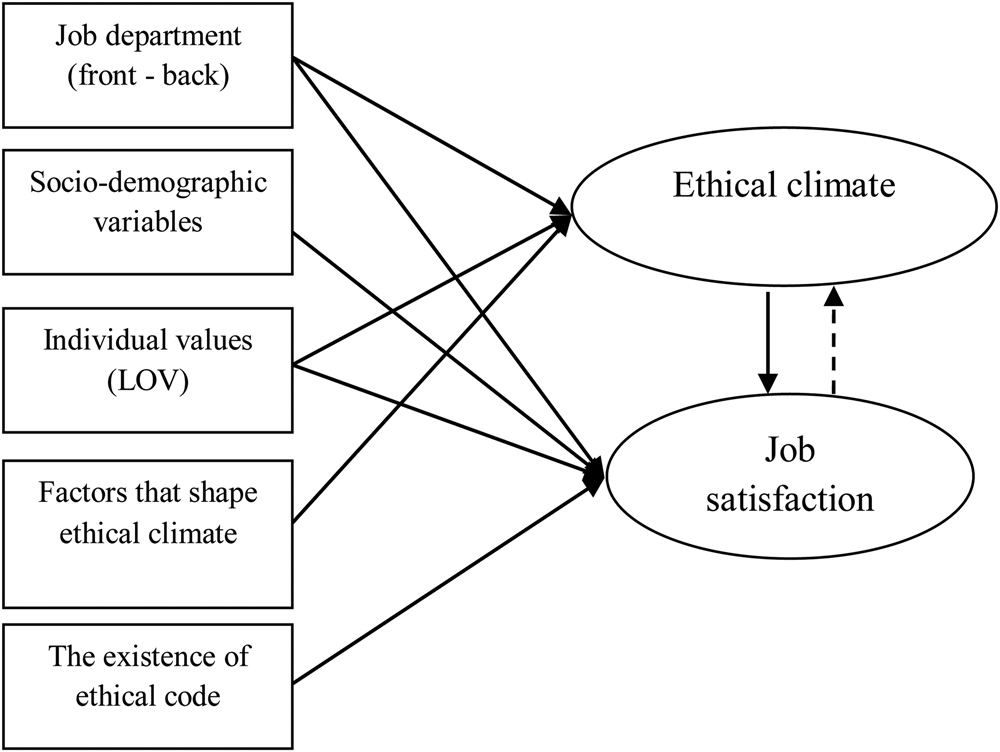
This research will further explore the determinants of identified ECTs within the Serbian tourism industry (Dragin et al., Reference Dragin, Jovanović, Mijatov, Majstorović and Dragin2019). This will be done by exploring the effects of job department (front–back office), individual values (sense of belonging, fun and enjoyment in life, warm relationships with others, self-fulfillment, being well respected, security) and factors that shape the employees' perception of ECT (personal impressions and experiences, discussions with colleagues, management behavior and the company manual for employees). Also, this research will examine whether job satisfaction is affected by ECT types, job department, individual values, socio-demographic variables and the existence of an ethical code. Finally, all this will be analyzed on two separate samples – managers and subordinates (see Figure 1).
Research model both for managers and subordinates.
Source: Authors.

Methodology
Sample
The convenience sample of 258Footnote 3 managers and subordinates in the Serbian tourism industry was recruited from travel agencies, hotels, restaurants and other types of tourism industry organizations, such as museums and tourism organizations. As part of their course requirements, master students of tourism management recruited all available and willing participants employed in tourism industry organizations.
Respondents are aged from 21 to more than 70 years (M = 34.69 in average). Most of the respondents belong to the 21–30 age group (43% of respondents). The sample consists of 59% of female respondents, while the most frequent level of education is a BA degreeFootnote 4 (41% of respondents). The majority of respondents have monthly incomes between 15,001 and 30,000 RSDFootnote 5 (45% of respondents) and 30,001 and 50,001 RSD (39% of respondents) which represents an average monthly income in Serbia.
Based on the job department of the respondents, it can be concluded that around 70% are from the front line job department (e.g., reception managers together with their subordinates, program organizers, sales agents, commercialists, tour guides, bartenders, waiters and hostesses), whereas the rest are in the back office department (owners, top managers, managers of sale, finance and marketing, administrators, secretaries, employees in the kitchen and cleaning persons). Most respondents are subordinates (73%) while others hold some type of managerial position (27%). Respondents were distributed into these two categories on the basis of their job position. Thus, owners, directors and managers of different sectors (such as finance, marketing, sales, reservation, reception and kitchen) are classified into groups related to managerial positions. On the other hand, sales agents, program organizers, administrators, secretaries, commercialists, tour guides, receptionists, bartenders, waiters, hostesses, chefs and cleaners are considered members of the subordinate group. However, the size of Serbian business units within the tourism industry predetermined the size of the managerial sub-sample. Since these business units are mostly quite small, the managerial sub-sample could not be larger.
Instrument
Data were collected through a questionnaire divided into five sections. The first section included questions related to respondents' socio-demographic characteristics (age, gender, education, place of residence, marital status, personal monthly income, job position) and a statement about the existence of an ethical code in their organization.
Beside questions about socio-demographic characteristics and representations of ethical codes in organizations, the questionnaire also consists of several other scales:
• The List of values (LOV, Kahle, Reference Kahle1983) which measured nine individual values on a scale from 1 (not important at all) to 5 (very important).
• The Job Satisfaction scale (JSS) that was used is a shortened and adapted Lytle's (Reference Lytle1994) JSS that consists of only five items (Kim, Leong, & Lee, Reference Kim, Leong and Lee2005). The respondents expressed their opinions on the five-point Likert scale (1 – completely agree to 5 – completely disagree).
• The ethical climate on a five-point Likert scale [1 (completely disagree) to 5 (completely agree)]. Dragin et al. (Reference Dragin, Jovanović, Mijatov, Majstorović and Dragin2019) used Victor and Cullen's (Reference Victor and Cullen1988) original 26-items ECQ and identified five ECTs in Serbian tourism industry organizations: Instrumental, Efficiency, Individual Norms, Team Spirit and Abiding the Rules. Instrumental ECT is focused on improving organizational interest. In organizations with Efficiency ECT, managers expect that subordinates work efficiently. Employees in organizations with dominant Individual Norms ECT are guided by their own sense of right and wrong, while those working in organizations with a Team Spirit ECT highlight care for colleagues. The main characteristic of Abiding the Rules ECT is managerial expectation from subordinates to follow prescribed rules (Dragin et al., Reference Dragin, Jovanović, Mijatov, Majstorović and Dragin2019). These identified ECTs were used as a basis for conducting further researchFootnote 6. The reliability of the whole scale is α = .85 while for separate subscales is as follows: Instrumental – α = .69, Efficiency – α = .42, Individual Norms – α = .70, Team Spirit – α = .83 and Abiding the Rules – α = .78.
• Factors that shape employees' perspective on ethical climate (through personal impressions and experience, discussion with colleagues, management behavior and according to the company manual for employees). These items were created by the authors.
All mentioned questionnaires (LOV, JSS and ECQ) were chosen because of their frequent use in tourism research, because they are reliable instruments and are not time-consuming for respondents. All scales in English were translated into Serbian and back – from Serbian to English (by different translators) in order to ensure that the meaning of the items remains the same.
Procedure
Master students of tourism management gathered the data used in this study as part of course requirements during the winter semester (from the 1st of November to the 15th of January) during the school year 2013/2014. Questionnaires were distributed in person, using standard pen-and-paper procedure, to employees who showed interest in participating. The respondents were those willing to be involved in further research on the topic and who participated on a voluntary basis (without incentives). No one refused to participate. They were all informed that research is anonymous and it was requested they answer the questionnaire honestly and truthfully. All gathered questionnaires were reviewed by the authors to eliminate any incorrectly completed questionnaires. None were excluded.
Analyses
Answers collected from 258 employees in the tourism industry were analyzed using SPSS 17.0. Descriptive statistics were used for the analysis of respondents' demographic characteristics. The total sample was divided into two groups – managers and subordinates. General linear modeling (GLM) with the analysis of variance procedure was used for the identification of predictor effects on dependent variables. Kim and Miller (Reference Kim and Miller2008), who inspired this research, also used this type of analysis; we adapted the same approach in order to provide the basis for comparing the results. Also, although the structural equation modeling has considerable advantages over regression analysis, it does not and should not replace it in tourism research (Nunkoo & Ramkissoon, Reference Nunkoo and Ramkissoon2012).
Variables
Dependent variables in this research are:
• Ethical climate defined as the employees' perception of organizational practices and procedures that have ethical content (Victor & Cullen, Reference Victor and Cullen1988: 101) among managers and subordinates (dimensions Instrumental, Efficiency, Individual Norms, Team Spirit and Abiding the Rules established in the research of Dragin et al., Reference Dragin, Jovanović, Mijatov, Majstorović and Dragin2019).
• Job Satisfaction defined as ‘a positive emotional state resulting from the appraisal of job experiences’ (Locke, Reference Locke and Dunnette1976: 1,300) among managers and subordinates.
Furthermore, independent variables are represented in the form of selected antecedents:
• Job department of managers and subordinates (employee positioned on the front line or in the back office department).
• Individual values of managers and subordinates defined based on the list of different issues and their importance for each individual in everyday life (Kahle, Reference Kahle1983) (security, self-respect, being well-respected, self-fulfillment, sense of belonging, excitement, fun and enjoyment, warm relationships and a sense of accomplishment).
• Factors that shape employees' perspective of organizational ethics: personal impressions and experience, discussion with colleagues, management behavior, and the company manual). The research tested the influence of these factors on ethical climate only.
There were two more independent variables that were researched within this study, but only in the context of their influence on job satisfaction:
• Socio-demographic characteristics of managers and subordinates (age, gender, education, place of residence, marital status, personal monthly income, job position). Their influence on ethical climate was already tested in the study conducted by Dragin et al. (Reference Dragin, Jovanović, Mijatov, Majstorović and Dragin2019).
• Ethical code (whether participants are aware of its presence in their organization or not).
Results
Results section obtained representation of the outcomes of testing the previously established hypotheses of research.
Testing Hypothesis 1
Subsample of managers
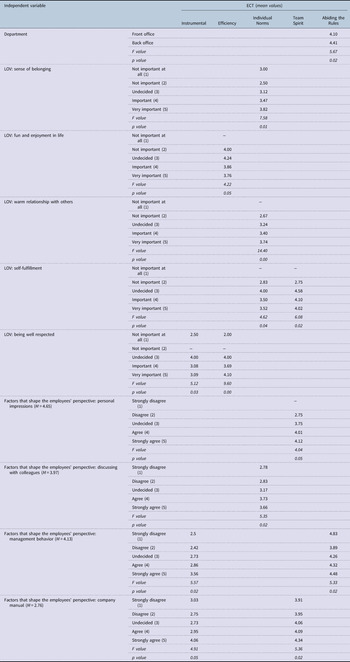
According to the results (see Table 1), job department affects managers' perception of Abiding the Rules ECT (F = 5.67, p = .02). Results show that managers, employed in back office sectors, are more likely to emphasize the following prescribed rules.
GLM results – managers

Source: Authors.
Five out of nine individual values from the LOV scale (Kahle, Reference Kahle1983) affect managers' perception of different ECT (see Table 1). First, managers' sense of belonging shapes their perception of Individual Norms ECT (F = 7.58, p = .01). Managers who consider a sense of belonging very important have the highest sense of Individual Norms ECT, while those managers who consider it unimportant, have the lowest level of perceiving the Individual Norms ECT. The second value that was a significant predictor of ECT is fun and enjoyment in life. Managers who consider this value as very important have the lowest level of perceiving the Efficiency ECT (F = 4.22, p = .05). On the other hand, those managers who are undecided when considering fun and enjoyment in life have the highest perception of Efficiency ECT. Interestingly, results show the highest perception of Individual Norms ECT within managers who consider warm relationships with others very important, while those who consider these relationships unimportant have the lowest perception of Individual Norms ECT (F = 14.40, p = .00). The importance of managers' self-fulfillment affects perception of two ECT: Individual Norms (F = 4.62, p = .04) and Team Spirit (F = 6.08, p = .02). The lowest perception of both ECTs is recorded in managers who consider self-fulfillment unimportant, while the highest perception of these ECT is noted in managers who are undecided. Being well respected is another value that affects the perception of two different ECT: Instrumental (F = 5.12, p = .03) and Efficiency (F = 9.60, p = .00). The lowest perception of these ECT is found in managers who consider that being well respected is not important at all. Instrumental ECT is highest in managers who are undecided on the importance of being well respected, while the perception of Efficiency ECT is higher for those who consider it very important.
Factors that shape employees' perspective also influence managers' perception of different ECTs (see Table 1). With the increase of the influence of personal impressions and experience on the employees' perspective, the perception of Team Spirit ECT rises (F = 4.04, p = .05). Also, a greater impact of discussions with colleagues leads to an increase in the recognition of Individual Norms ECT (F = 5.35, p = .02). According to the results (see Table 1), management behavior affects the perception of Instrumental (F = 5.57, p = .02) and Abiding the Rules ECT (F = 5.33, p = .02). Perception of Instrumental ECT is the highest for managers who strongly agree that perspective is shaped through management's behavior, unlike those who strongly disagree that this forms their perspective. On the other hand, there are two categories of those who perceive Abiding the Rules ECT as high, if the influence of management behavior is observed: those who strongly disagree and those who strongly agree that management behavior is a factor that shapes their perspective. Company manuals for employees also affect the perception of two ECT: Instrumental (F = 4.91, p = .05) and Team Spirit (F = 5.36, p = .02). Perception of both ECT is the highest in managers whose perspective is strongly influenced by organizational manuals. It is interesting that perception of Instrumental ECT is the lowest among the managers who evaluate this type of factor as undecided, while the perception of Team Spirit ECT is the lowest for those who strongly disagree that manuals shaped their perspective.
Subsample of subordinates
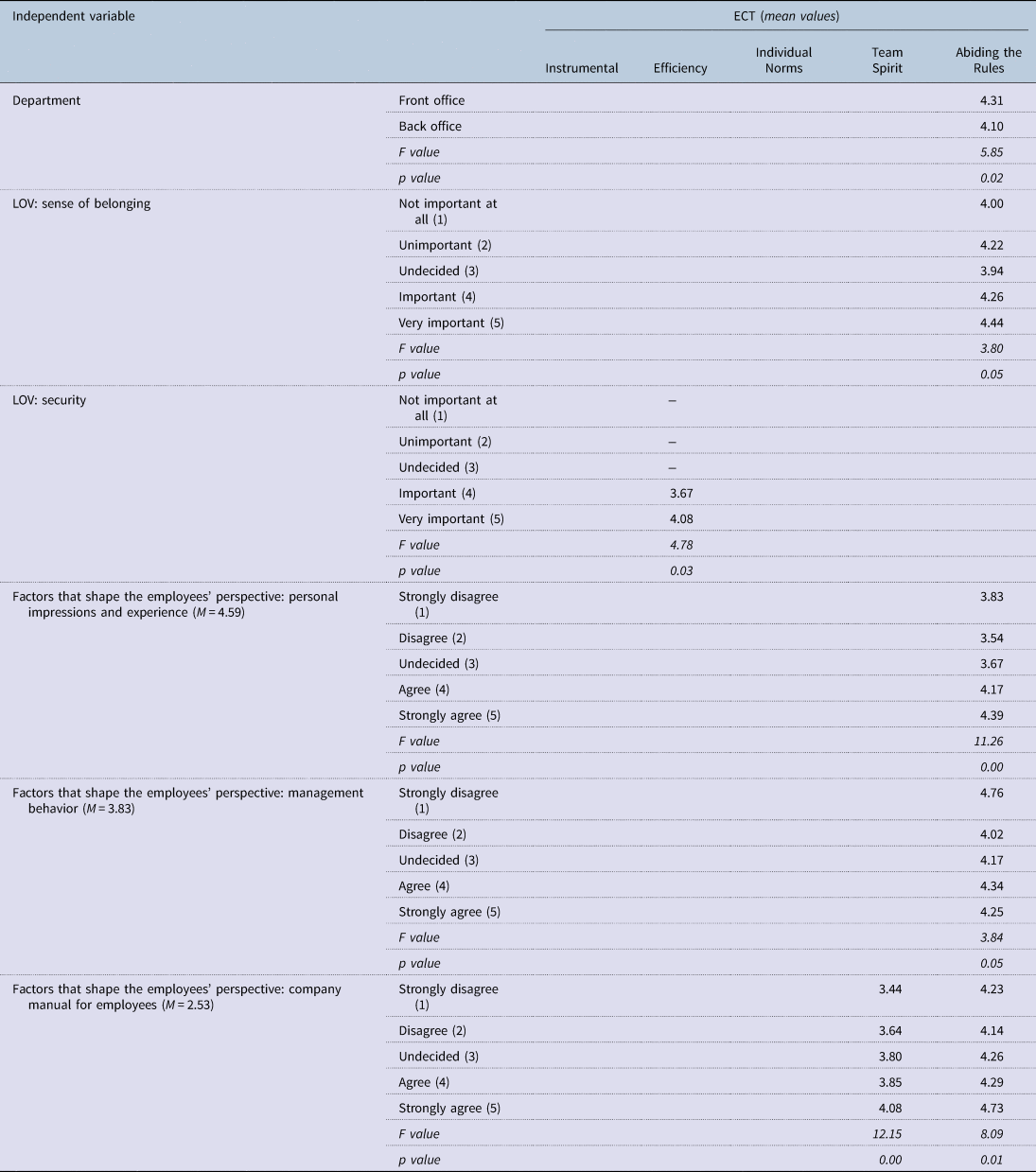
Job department affects not only managers', but also subordinates' perception of Abiding the Rules ECT (F = 5.85, p = .02) (see Table 2). However, subordinates' perception of this ECT is affected in a different way than the managers'. Perception of Abiding the Rules ECT is highest in subordinates who are employed in front office departments.
GLM results – subordinates

Source: Authors.
Beside the job department, only two out of nine individual values of LOV influence subordinates' perception of ECT. Abiding the Rules ECT is influenced by the sense of belonging individual value (F = 3.80, p = .05) (see Table 2). The highest perception of this ECT is recorded in subordinates who indicate that a sense of belonging is very important to them, unlike in those subordinates who are undecided when considering this value. Results also show that subordinates' perception of ECT is also influenced by their sense of security. Subordinates' feeling of security as an important and very important individual value affects their high perception of Efficiency ECT (F = 4.78, p = .03).
According to the results (see Table 2), factors that shape subordinates' perspective affect their perception of Abiding the Rules ECT. There is a general tendency to perceive Abiding the Rules as higher if personal impressions and experience is a factor that significantly shapes the employees' perspective (F = 11.26, p = .00). The same holds for the factor of company manual (F = 8.09, p = .01). However, in the case of management behavior, those who strongly disagree have the highest perception of Abiding the Rules. But, with the exception of this group, there is again a tendency to perceive Abiding the Rules as higher if management behavior has a stronger influence (F = 3.84, p = .05). Team Spirit is influenced by the company manual; the increase in significance of this factor leads to a higher awareness of Team Spirit ECT (F = 12.15, p = .00).
Testing Hypothesis 2
Subsample of managers
Before the main analysis, differences in job satisfaction between managers and subordinates were tested and the t-test shows that managers are significantly more satisfied than subordinates (t (253) = 3.38, p = .01). The degree of freedom in this t-test (df = 253) was in line with the observed data, given that incomplete answers regarding job satisfaction and job position were excluded from this analysis.
Using univariate GLM, authors examined whether job satisfaction is affected by ECT, job department, individual values, socio-demographic variables and the existence of an ethical code.
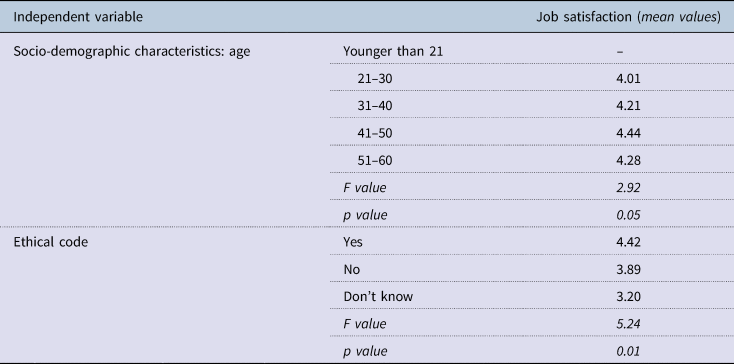
Results (see Table 3) show that managers' job satisfaction is only influenced by their age (F = 2.92, p = .05), out of six socio-demographic characteristics observed for the purpose of this study. Managers between 41 and 50 years of age are most satisfied with their job, while those aged between 21 and 30 years have the lowest job satisfaction. Job satisfaction is also influenced by the existence of an ethical code. Managers employed in organizations with a prescribed and transparent ethical code are more satisfied (F = 5.24, p = .01). Individual values, job department and ECT did not affect the job satisfaction of managers in this study.
GLM results – managers

Source: Authors.
Subsample of subordinates
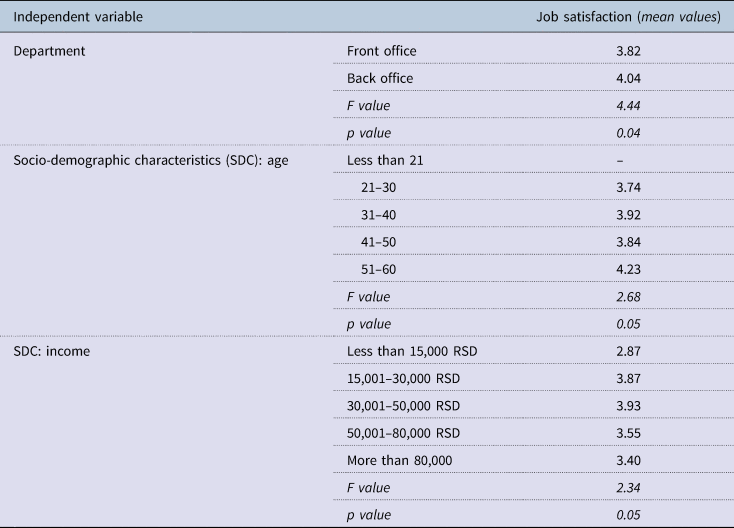
On the other hand, subordinates' job satisfaction is influenced by job department (F = 4.44, p = .04), age (F = 2.68, p = .05), monthly income (F = 2.34, p = .05) and some ECTs. Results (see Table 4) indicate that subordinates employed in back office departments are more satisfied with their jobs in comparison with those employed in front office ones. In regard to subordinates' age, the highest job satisfaction is recorded in those between 51 and 60 years of age. Results also show that the highest job satisfaction is recurrent in subordinates with monthly incomes between 30,001 and 50,000 RSD, and slightly less in the group of subordinates with incomes between 15,000 and 30,000 RSD. The lowest job satisfaction is recorded in subordinates whose income is less than 15,000 RSD.
GLM results – subordinates

Source: Authors.
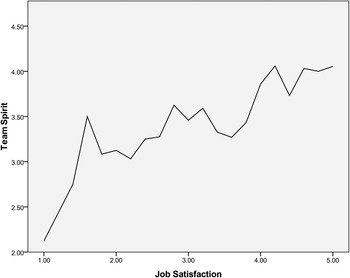
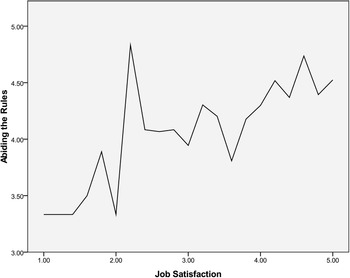
Finally, results related to subordinates' job satisfaction show that Team Spirit and Abiding the Rules are the only ECT that have significant influence on job satisfaction in the Serbian tourism industry. The effects of the ECT on job satisfaction are presented in Figures 2 and 3 since the values of both independent variables are average answers to several items that represent them.
The effect of Team Spirit on Job Satisfaction on a subsample of subordinates (univariate GLM, F = 24.67; p = .00).

The effect of Abiding the Rules on Job Satisfaction on a subsample of subordinates (univariate GLM, F = 3.93; p = .04).

Team Spirit positively affects job satisfaction, higher perception of Team Spirit leads to higher job satisfaction (F = 24.67, p = .00). However, those who have the highest perception of Abiding the Rules have below average job satisfaction (F = 3.93, p = .04). Still, there is a slight increase in job satisfaction for those who perceive Abiding the Rules as high.
Discussion
The research topic of this study is the ethical climate in tourism industries in the Republic of Serbia, a developing, non-western country. The findings of this study provide more specific and concrete information on both ethical climate and job satisfaction-related factors in small and medium tourism enterprises. As part of a larger study of ethical climate in the Serbian tourism industry, the main goal of this research was to determine the factors that influence the formation of the five previously identified ECTs (Instrumental, Efficiency, Individual Norms, Team Spirit and Abiding the Rules, see Dragin et al., Reference Dragin, Jovanović, Mijatov, Majstorović and Dragin2019). Factors tested here were job department (front–back office), individual values (sense of belonging, fun and enjoyment in life, warm relationships with others, self-fulfillment, being well respected, security) and factors that shape employees' perspective (personal impressions and experience, discussions with colleagues, management behavior and company manual for employees). Apart from the influence of these factors on employees' perception of ECT, this paper also examines factors that influence manager and employee job satisfaction (such as ECT, job department, individual values, type of organization, socio-demographic variables and the existence of an ethical code).
Although the relationship between ethical climate and job satisfaction has been previously examined (e.g., Jaramillo, Mulki, and Solomon, Reference Jaramillo, Mulki and Solomon2006; Koh & Boo, Reference Koh and Boo2001; Schwepker, Reference Schwepker2001), in this paper we analyze this relationship on two subsamples (managers and their subordinates) separately. Also, this research focused on the specific effects of ECT presence on employees' job satisfaction. Previous studies of the relationship between ethical climate and job satisfaction mostly examined how job satisfaction was affected by ethical climate in general (e.g., Luria & Yagil, Reference Luria and Yagil2008).
Predictors of ethical climate
Job department and ethical climate
According to results, the first proposed hypothesis regarding selected predictors on shaping ethical climate was confirmed. Thus, depending on the job department of managers, those employed in back office departments have a higher perception of Abiding the Rules ECT in comparison with those employed in the front office. This could be the result of the fact that back office managers are more exposed to frequent inspections related to their work which is particularly true for sectors such as finance, kitchen and house holding where not following the rules could lead to serious consequences. On the one hand, abiding to prescribed rules in the finance sector could protect organizations in the tourism industry from consequences of non-compliance with these rules, such as paying penalties or even closing the business (temporarily or permanently). Also, these managers' higher perception of abiding the rules could be a result of their awareness that prescribed rules can help them avoid consequences that could be harmful to the health of their customers. Such consequences could affect the company's image, consumers' loyalty, and financial performance as well. Abiding by prescribed rules is an important aspect of the tourism business in Serbia for both front and back-office sectors. Nevertheless, back-office managers seem to feel greater pressure because their business mistakes can lead to more serious business consequences.
Results related to the influence of job department on the perception of subordinates' ECT show that those employed in front office sectors have higher perception of Abiding the Rules ECT. Subordinates employed in front sectors, such as reception, sales and program organization often face extensive paperwork during their daily tasks. Even the smallest mistake in documentation can lead to serious problems. In addition, subordinates in front office departments are also faced with the requirements of their managers, so they need to balance between consumer satisfaction and benefits to their organization. Subordinates employed in back office sectors, despite lower perception of Abiding the Rules ECT, still highly evaluate the perception of this ECT. Thus, subordinates in Serbia's tourism industry are, generally, highly aware of Abiding the Rules ECT, as are the managers.
Individual values and ethical climate
The influence of managers' and subordinates' individual values on the perception of ECT was examined on the basis of Kahle's (Reference Kahle1983) LOV. Findings indicate that individual values shape the perception of ECT (Malloy & Agarwal, Reference Malloy and Agarwal2003). Managers who consider a sense of belonging to be very important have the highest perception of Individual Norms ECT, indicating that managers with a higher sense of belonging perceive that they are allowed to consult their individual sense of right and wrong while making business decisions. Managers, who consider sense of belonging to be a very important value, and experience it as well, could recognize organizational interest as their own. In this case, they personalize their business decisions in accordance with personal values. In contrast, perception of Individual Norms ECT is the lowest in managers who consider that a sense of belonging to the organization is not important.
Results show that, for managers, a higher emphasis on fun and enjoyment in life leads to a decrease in perception of the Efficiency ECT. This result confirmed previous findings that individual values affect the success of fulfilling job requirements within the organization (Lam, Baum, & Pine, Reference Lam, Baum and Pine2003). Efficiency is distinguished by moderation (e.g., cost control and control of the work environment) while valuing fun and enjoyment in life insinuates indulgence and hedonism. Therefore, it is not surprising that these constructs are disproportionate. Furthermore, if managers highly value fun and enjoyment, it can damage their commitment to organizational goals, which can in turn be reflected in lower business efficiency. These managers seem to be less aware of the Efficiency aspect of a work climate and perceive it as less present in their organizations. The majority of managers stated that they are indecisive whether fun and enjoyment in life are important or not. This might indicate a tendency toward dishonesty out of fear that the results of the study might be seen by their supervisors.
In the case of tourism managers, perception of Individual Norms ECT gradually increases along with the individual value of warm relationships with others. At first, this finding is a bit surprising considering that Individual Norms ECT describes an organization where employees are expected to make a business decision according to their personal values and beliefs without consulting others. However, this could mean that managers who care about relationships with their colleagues will also consult their personal sense of right and wrong when making business decisions whose aim it is to protect their colleagues' interest. Managers seem to have a greater tendency to perceive their organization as a flexible institution that allows employees to consider their own interest and ethics. Those who consider warm relationships with others an important value will regard their organization as a friendly institution. Individual Norms ECT implies this to a certain extent. Employees have the freedom to think for themselves and are guided by personal ethics. These managers might delegate more responsibility to their subordinates and allow them to participate in the decision making process by considering their opinions and values. This finding is in line with the study conducted by Fritzsche and Oz (Reference Fritzsche and Oz2007) who stated that altruistic values can positively affect the ethical climate of an organization.
The level of managers' self-fulfillment affects the perception of Individual Norms and Team Spirit ECT. The lowest perceptions of these ECTs have those who value self-fulfillment the least. Interestingly, the highest level of perceiving Individual Norms and Team Spirit ECT is recorded in managers who evaluate their consideration of self-fulfillment as undecided. This could mean that these managers highly value self-fulfillment, but also consider it is culturally unacceptable to admit it. Respondents are often aware that organizations require compromising individual values and adapting to the values accepted in organizational terms (Lam, Baum, and Pine, Reference Lam, Baum and Pine2003). Awareness of this might be the main reason respondents provide socially desirable answers. Since those managers who value self-fulfillment as important also perceive Individual Norms and Team Spirit ECT more, this could mean that working conditions of this kind lead to their greater sense of self-fulfillment.
According to results, managers who consider being well respected as not important at all have the lowest perception of Instrumental and Efficiency ECT. The answer not important at all was provided by only one respondent and will not be considered. Similarly to abovementioned findings, undecided managers have the highest perception of Instrumental ECT. The same goes for Efficiency ECT. Undecided managers are an interesting category, due to their unwillingness to state their real opinion, which might correspond to a desire to conform to social norms and organizational goals.
Results related to the significant influence of individual values on subordinates' ECT perceptions were obtained only for two values: sense of belonging and security. This is in accordance with Malloy and Agarwal's (Reference Malloy and Agarwal2003) claim that individual values influence the perception of ethical climate. Unlike the influence of managers' sense of belonging on Individual Norms ECT perception, subordinates' sense of belonging affects the perception of Abiding the Rules ECT. If subordinates have a stronger need to belong, they will also have an increased need to belong to the organization and to play by the rules. Another individual value that affects subordinates' perception of ECT is sense of security. All subordinates evaluate sense of security as important and very important. This value positively affects their perception of Efficiency ECT in the sense that the employee will perceive heightened responsibility to manage organizational costs and business efficiency. This, in turn, means that if he/she is efficient, he/she will feel more secure in the working environment. Successful business management encourages the survival of the organization, implying that people will keep their jobs (Schwepker, Reference Schwepker2001).
Employees' perspective and ethical climate
Factors that shape employees' perspective also affect managers' perception of ECT. Results indicate that managers' perception of Team Spirit ECT increases with the level of their dependence on personal impressions and experiences within their organization. Therefore, managers who are guided by personal impressions and experience seem to experience a higher level of team spirit. This finding is seemingly contradictory since those who rely more on their own opinions and experience could be seen as more selfish and self-absorbed and therefore would perceive caring for other employees as less important. However, authors believe that this might be managers' inclination (conscious or unconscious) toward embellishment of the real situation in the organization since Team Spirit ECT is often seen as the best indicator of a successful organization. This finding could be related to Knani's finding that managers are aware that positive ethical climate creates a healthy organization (Knani, Reference Knani2014). Managers might see themselves as responsible for creating organizational success and emphasizing team spirit could be an indicator of that attitude.
Another factor that shapes managers' perception of ECT is how much they rely on discussions with colleagues to determine their perspective. This factor has significant influence on the perception of Individual Norms ECT. Frequent discussions about general business issues increase managers' perspective that their colleagues (and subordinates) are often guided by personal ethics in the decision making process. This means that recurrent contact with employees could raise manager's awareness that employees are primarily guided by their own interest, instead of organizational ones. Authors of this study consider this to be a true reflection of the real state of affairs within organizations since discussions could offer more valid and detailed information about the existing work climate. According to Kim and Miller (Reference Kim and Miller2008), managers should encourage open discussions with employees in order to create an appropriate ethical climate and limit undesirable outcomes within the business environment.
Results also show that reliance on management behavior while determining employees' perspective is a factor that shapes managers' perception of Instrumental and Abiding the Rules ECT. Managers' perceptions of these ECT gradually increase with the increase of the influence of management behavior on employees' perspective. It's important to note that, in the case of managers, this factor might coincide with personal impressions and experience since this study's sample consists of small- or medium-sized tourist organizations where management usually only consists of one manager who, according to Harrison and Freeman (Reference Harrison and Freeman1999), determines the ethics within this type of organization. Therefore, the manager's behavior is often the standard according to which employees should behave so it is not surprising that Abiding the Rules and Instrumental ECT emerge as variables that managerial behavior shapes. Following the rules and organizational interest are two concepts that most managers promote and insist upon since they lead to a successful business.
Managers' perception of Instrumental and Team Spirit ECT are influenced by their reliance on company manuals for employees. As in most company manuals in Europe, company manuals in the Serbian tourism industry usually focus on establishing business rules that will benefit the organization, so they actually represent the precondition for the advancement of a specific business system. Therefore, managers whose perspectives are strongly shaped by company manuals for employees have the highest awareness related to the necessity of achieving organizational interest, often excluding subordinates' personal ethics, regardless of the consequences. Another important aspect of company manuals is instructions for employees on how to adapt their behavior to the business environment. They also provide general guidelines for solving ethical problems employees could be faced within a specific organization, as is stated in various studies (Johnston & Marshall, Reference Johnston and Marshall2003; Laezniak & Murphy, Reference Laezniak and Murphy1993; Schwepker, Reference Schwepker2001). Company manuals actually prohibit offensive behavior among employees, so it is not surprising that managers' perception of Team Spirit ECT, as important for colleagues' wellbeing, increases with the level of reliance on company manuals.
According to the results related to factors that shape subordinates' perspective, their perception of Abiding the Rules ECT is influenced by personal impressions and experiences. The more subordinates rely on personal impressions and experiences to determine their perspective, their perception of abiding by the prescribed rules will increase. Subordinates' perception of Abiding the Rules ECT is also influenced by the behavior of management and this finding is in accordance with previous studies that state that managerial behavior affects employees' attitudes and behaviors (Brown & Trevino, Reference Brown and Trevino2006; Brown, Trevino, & Harrison, Reference Brown, Trevino and Harrison2005; Koh & Boo, Reference Koh and Boo2001). Thus, subordinates' perception of the necessity to comply with prescribed rules, procedures and professional standards increases with the increase of their reliance on management behavior, which is equivalent to results obtained from their managers. Finally, perception of Abiding the Rules ECT increases with the increase of subordinates' reliance on company manuals, as documents that promote business standards and principles of employee behavior. Company manuals frequently provide important guidelines for resolving ethical dilemmas within organizations (Laezniak & Murphy, Reference Laezniak and Murphy1993; Mulki, Jaramillo, & Locander, Reference Mulki, Jaramillo and Locander2006). Since the factor of discussing with colleagues has not been shown to have a significant impact on subordinates' perception of ECT, this could mean that organizational rules are mostly rigid, formally established, and are not susceptible to change through discussion. Perception of Team Spirit ECT is influenced by company manuals for both managers and their subordinates. The perception of care for colleagues gradually increases for subordinates with the increase of the company manuals' influence, just like in managers' case.
It is interesting to notice that the factor that dominantly shapes managers' and subordinates' perspective is related to personal impressions and experiences, while the factor that shapes their perspective the least is related to company manuals for employees (mean values are represented in Tables 1 and 2). These findings are interesting, because perception of Abiding the Rules ECT is recorded as the most common ECT within respondents. Based on these results, it was expected that managers and subordinates were mainly guided by company manuals as written standards for ethical behavior. This could mean that company manuals are documents which are rarely consulted, probably due to their monotonous and incomprehensible content. They exist because it is mandatory that organizations have them, but it appears they are not practical and accessible to employees in general. Thus, for influencing the ECT within an organization, it is very important that an ethical code exists, but also that it is transparent and that all aspects of its ethical program are developed (Laezniak & Murphy, Reference Laezniak and Murphy1993; Mulki, Jaramillo, & Locander, Reference Mulki, Jaramillo and Locander2006).
Predictors of job satisfaction
On the basis of the presented research results, proposed hypothesis 2 regarding the influence of selected predictors on shaping job satisfaction is partly confirmed. Thus, besides researching the factors that influence managers' and subordinates' perception of ECT, this study also focused on researching factors that affect their job satisfaction. Analyses regarding managers' job satisfaction indicate that they are much more satisfied with their jobs than subordinates. This finding is not surprising since managers usually have higher incomes, greater job security, more freedom in completing tasks and better working conditions, which can all lead to greater job satisfaction (Cheng & Brown, Reference Cheng and Brown1998; Deery & Shaw, Reference Deery and Shaw1999; Pizam & Thornburg, Reference Pizam and Thornburg2000; Silva, Reference Silva2006; Tsai, Reference Tsai and Woodside2008). Results related to factors that influence managers' job satisfaction show that their job satisfaction significantly increases until the age of 50, after which a slight decrease in job satisfaction is detected. This is in accordance with previous research that shows this type of decline, seeing as a job becomes more difficult with age and the employee is often under pressure to retire so that a younger worker can take their place (Carrell & Elbert, Reference Carrell and Elbert1974). Managers' job satisfaction is also higher in organizations with a prescribed ethical code which could mean that clear organizational rules, in some respects, make their job easier. This finding is in line with previous research, which pointed to the notion that the establishment of ethical standards through an ethical code could affect employees' job satisfaction in a positive way (Chonko & Burnett, Reference Chonko and Burnett1983; Laezniak & Murphy, Reference Laezniak and Murphy1993; Johnston & Marshall, Reference Johnston and Marshall2003; Schwepker, Reference Schwepker2001; Schwepker, Reference Schwepker2003).
On the other hand, results related to subordinates' job satisfaction show that higher job satisfaction is attained by those employed in a back office department, which could be a consequence of the fact that direct contact with people during the entire workday might be exhausting and could imply more pressure (Babakus, Yavas, & Karatepe, Reference Babakus, Yavas and Karatepe2008; Cropanzano, Rupp, & Byrne, Reference Cropanzano, Rupp and Byrne2003; Karatepe & Aleshinloye, Reference Karatepe and Aleshinloye2009; Phillips, Tan, & Julian, Reference Phillips, Tan and Julian2007). This finding supports the observation that job satisfaction could be difficult to achieve within the service industry, due to extensive contact with people (Choi et al., Reference Choi, Kim, Lee and Lee2014). As in the case of managers, job satisfaction shows an incline depending on the age of respondents. Unlike managers, subordinates do not experience a decline in job satisfaction before retirement. This could be a result of greater pressure and more demanding responsibilities in managers than in subordinates. Monthly income also has a significant influence on subordinates' job satisfaction. Those with average monthly income are more satisfied than those with below and above average earnings. Our results do not confirm previous findings that an increase in monthly income leads to higher job satisfaction (Bilgic, Reference Bilgic1998; Pan, Reference Pan2015). The assumption is that subordinates with above average income are overloaded with work and under more pressure which leads to a lower job satisfaction. These subordinates might have the same work load and responsibility as managers but have less freedom and less job security than they do. Those with below average salaries are less satisfied since their earnings are usually insufficient to meet their basic needs.
Ethical climate and job satisfaction
Finally, the third proposed hypothesis, related to the influence of specific ECTs on employees' job satisfaction, was partly confirmed. The job satisfaction of subordinates is affected by two ECTs – Team Spirit and Abiding the Rules. These findings are in line with previous research regarding the relationship between ethical climate within the organization and job satisfaction (Deshpande, Reference Deshpande1996; Jaramillo, Mulki, & Solomon, Reference Jaramillo, Mulki and Solomon2006; Joseph & Deshpande, Reference Joseph and Deshpande1997; Koh & Boo, Reference Koh and Boo2001; Mulki, Jaramillo, & Locander, Reference Mulki, Jaramillo and Locander2006; Schwepker, Reference Schwepker2001; Vitell & Davis, Reference Vitell and Davis1990). If subordinates perceive that there is great care for others and that people in the organization look out for each other, their job satisfaction will rise. This additionally confirms the assumption that Team Spirit is the most positive ECT. Creating a positive ethical climate oriented toward warm relationships between employees affects employees' job satisfaction in a positive way (Schwepker, Reference Schwepker2001). The perception of Abiding the Rules ECT seems to affect subordinates' job satisfaction in two different ways. There are subordinates whose high perception of Abiding the Rules ECT leads to higher job satisfaction, but there are also subordinates whose job satisfaction decreases if they perceive Abiding the Rules ECT more. A possible explanation is that rules might not be perceived as beneficial by all subordinates in all circumstances. Some employees consider rules and procedures to be standards of behavior and performance; fairly and consistently applied rules and procedures in a company can establish a strong psychological contract, promoting employee commitment and having a positive impact on job satisfaction. On the contrary, the other group does not realize that rules are enforced for their own benefit but merely see them as punishment, as mere bureaucracy that restricts their right to decision-making (Wilton, Reference Wilton2011). Tsai and Huang (Reference Tsai and Huang2008) suggest that law and professional codes are sometimes treated as external and, not internalized by employees, become negatively associated with job satisfaction.
Conclusion
Strengths, weaknesses and practical implications of the study
Besides the contribution to better understanding the ethical climate concept in the Serbian tourism industry and its relationship with job satisfaction of employees in this sector, the results of this study also have certain practical implications. This study's findings provide useful information to top managers or policy-makers in the tourism industry, with which they can acquire a better understanding of the basic questions of ethical management in small- and medium-sized organizations. Personal value factors affect ethical climate perception more in managers than in subordinates which further substantiates the claim that managers have more freedom and more personal involvement in the ethical aspect of business and the decision making process. Subordinates are more concerned with their own general security and with belonging to the organization, as this further reinforces their position on the job. Those responsible for the selection of managers should have in mind that managers with specific value systems can nurture specific types of ethical climate.
Study limitations and directions for future research
As with many research studies, there are certain limitations. The tourism industry has specific characteristics that can influence the perception of ECT. For example, hotels might be a more stressful work environment than tourist agencies and further studies should explore these two types of organizations separately. Another limitation is related to respondents' general high evaluation of LOV. Nine values that are part of Kahle's (Reference Kahle1983) LOV seem to not be distinctive enough, since most of the respondents find them all very important. This might be due to respondents' fear that their answers might reach their supervisors. This could additionally affect their honesty in filling out the questionnaires. Therefore, employees might evaluate their own values in a manner they consider to be socially acceptable. The study could have benefited from the use of qualitative methods, such as interviews alongside questionnaires.
Ethical standards and perception may vary among cultures and thus, the cross-cultural generalization of the findings of this study may be limited. Future studies should examine to what extent our findings are applicable in other developing economies in the region, particularly in the republics of former Yugoslavia (e.g., North Macedonia, Montenegro, Bosnia and Herzegovina), countries that recently invested greatly in the tourism industry. For upcoming research, it would also be interesting to make a comparison with findings from developed European economies. Considering Serbia's intention toward the European Union and the integration and intensive cooperation between tourism companies in Serbia and those in developed European countries, exploring differences is important for effectively managing organizational ethical climates and better cross-cultural cooperation. It is also possible to extend the theoretical model by including additional dependent variables such as organizational commitment, turnover intention or organizational performance, and some control, moderating or mediating variables such as motivation.
Acknowledgements
This research is part of the project ‘Transformation of geospace in Serbia - past, current problems and solution proposals’, approved by the Ministry of Education, Science and Technological Development of Republic of Serbia (registration number: 176020 OI), as well as the project ‘Geotransformation of the area of Vojvodina in the function of regional development’, 114-451-2080/2016-01, approved by the Autonomous Province of Vojvodina, Provincial Secretariat for Higher Education and Scientific-Research Activity (Program 0201) (2016-2019). The research that is presented here is also a part of PhD research of the two co-authors: Maja Mijatov and Karolina Simat.
Author ORCIDs
Maja Mijatov, 0000-0002-4209-0791