Introduction
“Science is not a heartless pursuit of objective information. It is a creative human activity, its geniuses acting more as artists than as information processors.”
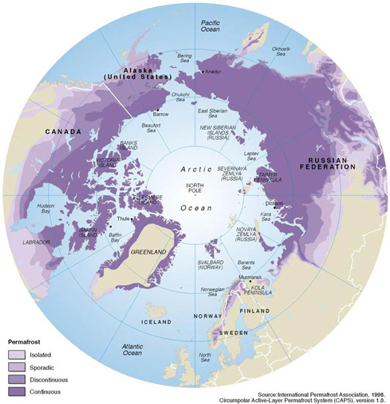
(Gould, Reference Gould1979, p. 201)Occupying more than 20 million square kilometres (Fig. 1), permafrost is a key landscape component of high-latitude and high-altitude regions (Brown, Ferrians, Heginbottom, & Melnikov, Reference Brown, Ferrians, Heginbottom and Melnikov1998). Ongoing climate warming, which is especially acute in the circumpolar North, results in a series of profound environmental impacts including permafrost thaw and erosion (AMAP, 2017; IPCC, 2013). This in turn can release organic carbon formerly trapped in frozen soils to the atmosphere, ultimately enhancing global warming (Schuur et al., Reference Schuur, Mcguire, Schadel, Grosse, Harden, Hayes and Natali2015). Considering that twice as much carbon is currently stored in permafrost compared to the atmosphere (Hugelius et al., Reference Hugelius, Strauss, Zubrzycki, Harden, Schuur, Ping and Kuhry2014), frozen-ground landscapes play a key role in global climate and large-scale biogeochemical cycles.
Permafrost distribution map in the Northern Hemisphere (Brown et al., Reference Brown, Ferrians, Heginbottom and Melnikov1998).

Across the Arctic, about four million people live in permafrost areas, particularly in Alaska, Canada, Russia, and Greenland. Frozen-ground landscapes have been used in the past by various indigenous peoples for settlement and hunting–fishing grounds, resulting in extensive ‘traditional environmental knowledge’ about these ecosystems. This knowledge provides valuable resources for science and community planning (Calmels, Laurent, Brown, Pivot, & Ireland, Reference Calmels, Laurent, Brown, Pivot and Ireland2015; Tondu et al., Reference Tondu, Balasubramaniam, Chavarie, Gantner, Knopp, Provencher and Simmons2014). Still, construction and maintenance of infrastructure in permafrost regions is difficult and is further exacerbated by climate change impacts and an urgent need for housing (Melvin et al., Reference Melvin, Larsen, Boehlert, Neumann, Chinowsky, Espinet and Nicolsky2016). Hence, permafrost dynamics and interactions with local infrastructure and communities are of key scientific interest (Fritz et al., Reference Fritz, Deshpande, Bouchard, Högström, Malenfant-Lepage, Morgenstern and Weege2015).
In this context, science communication to stakeholders and the general public is increasingly important. Several education and outreach initiatives stemming from the International Polar Year (IPY, 2007–2008) have been proposed in various formats, including field courses, exchanges with educators, and support for early career networks (e.g. Beck, Huffman, Xavier, & Walton, Reference Beck, Huffman, Xavier and Walton2014; Christiansen, Prick, & Lantuit, Reference Christiansen, Prick and Lantuit2007; Provencher et al., Reference Provencher, Baeseman, Carlson, Badhe, Bellman, Hik and Zicus2011). Among them, the Permafrost Young Researchers Network (PYRN) and the Association of Polar Early Career Scientists (APECS) foster innovative collaborations among the younger generations and within the whole polar research community (Tanski et al., this special issue). The IPY 10th anniversary invites reflection on past accomplishments and future perspectives on polar research education and outreach.
This Research Note reports on an innovative, multidisciplinary, and international education/outreach initiative called “Frozen-Ground Cartoons”. Firstly, we present the initial cartoons, which are a series of illustrated stories related to permafrost research with a focus on fieldwork activities and interactions with local communities. We then discuss ongoing and future outcomes stemming from the cartoons, as well as dissemination strategies.
A collaboration between artists and permafrost scientists
Science education and communication can take many forms, ranging from traditional classroom lectures, or images visible in Google Earth (Ballagh, Parsons, & Swick, Reference Ballagh, Parsons and Swick2007), to more unusual initiatives such as the use of poetry in chemistry classes (Araújo, Morais, & Paiva, Reference Araújo, Morais and Paiva2015), or analysis of ‘The Simpsons’ in a physics curriculum (Perales-Palacios & Vilchez-González, Reference Perales-Palacios and Vílchez-González2005). Comic strips or cartoons (the terms are often used interchangeably) can serve as powerful science communication tools: they are visual, generally funny, depict scientific concepts from a different perspective, and can be easily transferred between different language formats and shared via social media (e.g. Dominiczak, Reference Dominiczak2017; Mignone et al., Reference Mignone, Homfeld, Marcu, Baldwin, Bauer, Palazzari and McCaughrean2016; Shurkin, Reference Shurkin2015). Cartoons effectively connect art and science along visual, narrative and metaphoric axes, and more broadly, they help communicate science to the public and get the reader engaged, an important task of any scientific activity (Farinella, Reference Farinella2018; Tatalovic, Reference Tatalovic2009).
Background
The establishment of early-career researcher (ECR) networks was an important component of education, outreach and communication initiatives during IPY (Krupnik et al., Reference Krupnik, Allison, Bell, Cutler, Hik, López-Martínez and Summerhayes2011). This culminated in the establishment of APECS and PYRN in 2005 (Baeseman, Xavier, Lantuit, & Taylor, Reference Baeseman, Xavier, Lantuit, Taylor, Krupnik, Allison, Bell, Cutler, Hik, López-Martínez and Summerhayes2011; Tanski et al., this special issue), which now reach out to as many as 5000 and 1200 members, respectively. Also emerging from the IPY legacy were two major research programmes dedicated to permafrost research: the pan-Canadian programme, Arctic Development and Adaptation to Permafrost in Transition (ADAPT), and the pan-European programme, Changing Permafrost in the Arctic and its Global Effects in the 21st Century (PAGE21). These interdisciplinary research programmes provided organisational and financial support for a network of ECRs who actively engaged with APECS and PYRN. This collaboration resulted in a publication outlining the future directions of permafrost science from the perspective of ECRs (Fritz et al., Reference Fritz, Deshpande, Bouchard, Högström, Malenfant-Lepage, Morgenstern and Weege2015).
The “Frozen-Ground Cartoons” (FGC) project
The FGC project was initiated in 2015 by a core group stemming from the ECR collaboration (Fritz et al., Reference Fritz, Deshpande, Bouchard, Högström, Malenfant-Lepage, Morgenstern and Weege2015), and its aim was to develop a series of informative comics for schoolchildren and teachers. The comics address important concepts about permafrost (e.g. distribution and dynamics of frozen ground, including human impacts, fieldwork activities) and were intended to be used for education and outreach of permafrost science worldwide, thus contributing to the recruitment of the next generation of permafrost scientists.
Finding artists
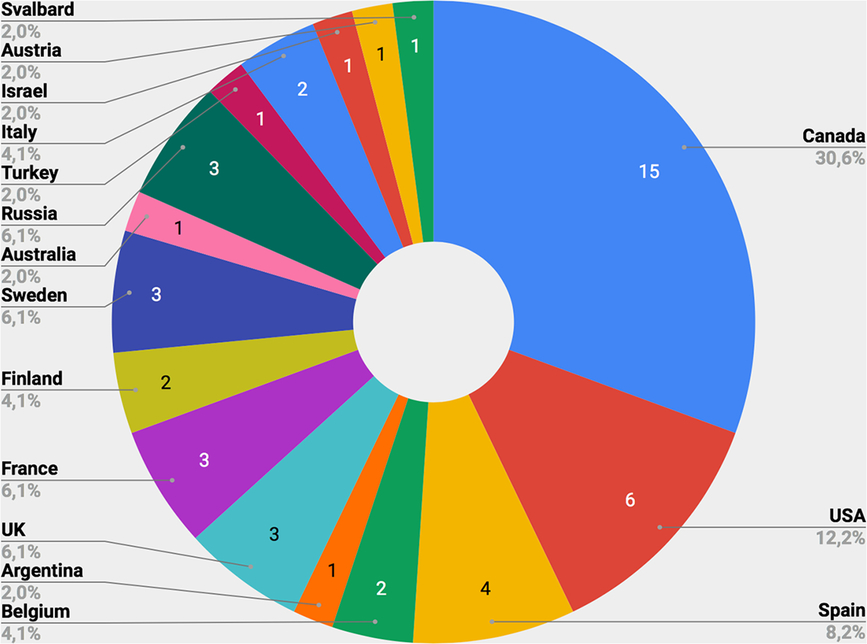
The project was officially launched as a two-year ‘Action Group’ funded by the International Permafrost Association (IPA). An application call for illustrators was sent through a number of national and international networks as well as through email lists related to art and science communication. A total of 49 applications were received from 16 countries (Fig. 2). Following an evaluation process (Fig. S1), 10 applicants were selected to submit a one-page cartoon ‘pitch’. Applicants were provided with material specific to permafrost research (e.g. fieldwork pictures, sketches, non-specialist texts). After a second round of evaluation, two artists were selected based on overall quality and potential to reach a large audience: Heta Nääs from Helsinki (Finland), and Noémie Ross from Montréal (Canada).
Provenance (country or territory of residence) of the applications received (n = 49) during winter 2016 (https://frozengroundcartoon.com/the-process/).

Developing stories
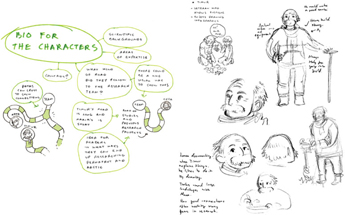
The following year was spent developing different scenarios and characters, an iterative process involving both the artists and the scientists via several online meetings and a one-day workshop. With topics suggested by the science group, the artists were ultimately given complete freedom to interpret the content and draft stories and characters (Fig. 3). After completion of the first drafts of the comics, the science group provided feedback to the artists, and edits were made until everybody agreed on final versions. A one-minute video trailer of the project, titled ‘FrostByte’, was released in late 2017 (https://frozengroundcartoon.com/2017/12/08/frozen-ground-cartoon-frost-byte/).
Preliminary sketches in 2016. Left: preliminary character biographies shown as a mind map. Right: preliminary ideas for one specific character. Drawing credit: Heta Nääs.

Translations and science outreach
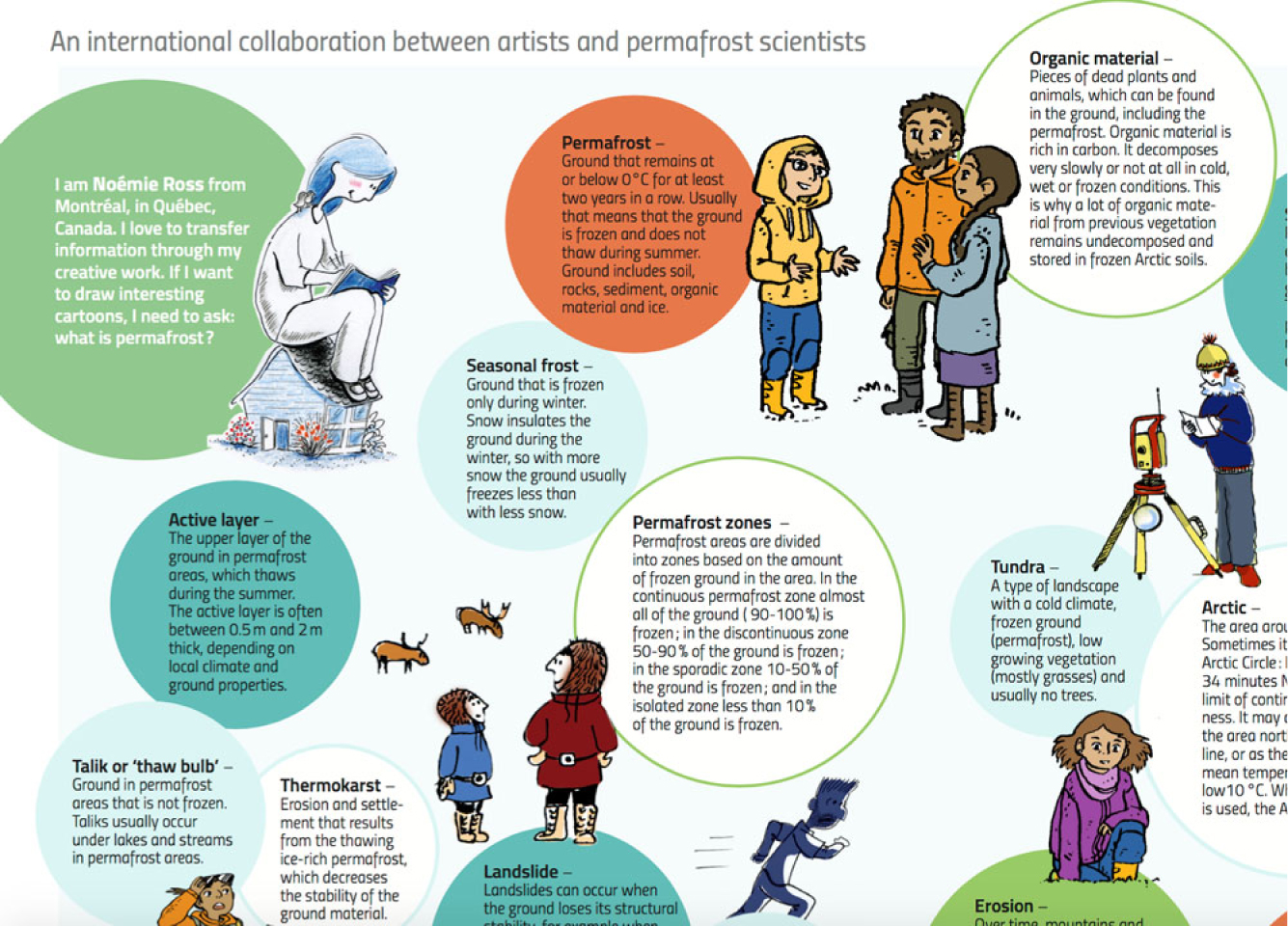
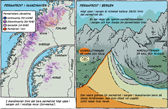
Final English versions of the FGC were completed in 2017 and culminated in a 28-page printed booklet containing all the cartoons, as well as a foreword and an illustrated permafrost glossary (Nääs et al., Reference Nääs, Ross, Bouchard, Deshpande, Fritz, Malenfant-Lepage and Habeck2017) (Fig. 4). The booklet has been published under a creative commons license (CC) including an ISBN number and a permanent doi. Meanwhile, a Swedish version was produced and printed for the Bolin Centre Climate Festival held in Stockholm in May 2017 (Fig. 5). The Swedish version included translations of the comics, as well as back covers that presented illustrations of permafrost distribution and reindeer herding in Scandinavia. The French version was released in October 2018 as a feature event of the ‘Fête de la Science’, held across France.
Sample of the illustrated permafrost glossary (Nääs et al., Reference Nääs, Ross, Bouchard, Deshpande, Fritz, Malenfant-Lepage and Habeck2017).

Sample of the Swedish version, produced for the Bolin Centre Climate Festival held in Stockholm in May 2017. Drawing credit: Heta Nääs.

Currently, cartoons are being translated into Russian and German, the focus in 2019 being on languages spoken in permafrost regions or by stakeholders in permafrost science (e.g. Inuktitut, Komi, Yakutian, Korean, Japanese, Chinese). Particular attention will be given to translation into indigenous languages, which are rarely represented in specialised and mainstream media. This will give native speaker groups access to the scientific narratives on permafrost and environmental research in their own language and further enable and empower them to take part in local, regional and global dialogues about permafrost degradation impacts across the Arctic.
Other ongoing and future outcomes
Augmented reality (AR) material
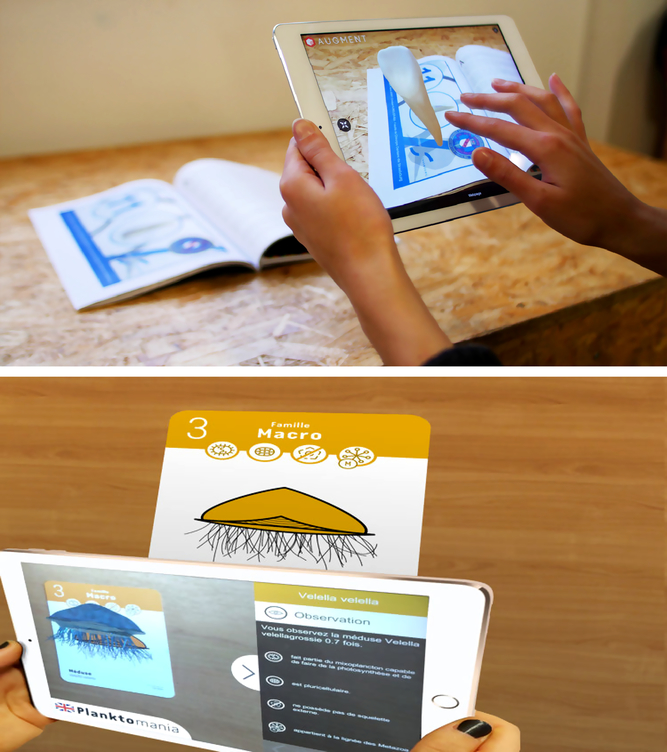
We are in the process of complementing our cartoons with AR material during the next years. We will produce maps, photos, videos, and 3D drawings that will be readily available via an application developed for smartphones and tablets (Fig. 6). Maps will allow the user to dynamically visualise in 3D and understand (1) permafrost distribution around the world, (2) climate warming amplification in the Arctic, and (3) erosion processes in permafrost areas and their consequences for the environment and the local population. Secondly, we will use numerous fieldwork photos gathered by scientists through the years, and 3D drawings developed from these photos, to highlight permafrost properties (Fig. 7). We will also present tools and equipment used for permafrost research, typical ecosystems or wildlife species, and how house construction is adapted to the Arctic. Finally, educational videos will provide information about (1) permafrost physical properties, (2) fieldwork campaigns, (3) sample collecting and analysing in the field and in the laboratory, (4) climate change impacts and mitigation strategies, and (5) inputs on how scientists collaborate with local communities to co-produce knowledge. This will provide an innovative way of presenting permafrost science to a wide range of diverse user groups.
Examples of augmented reality materials that can be developed based on different products. Above: from a science school book. Below: from a card game about phytoplankton. Images courtesy of J. Sansoulet.

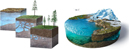
Examples of sketches that could be used to develop AR material. Left: permafrost distribution varying with latitude (source: @Science-Art.com). Right: permafrost and ground ice illustrated with 3ds Max and Photoshop (source: @Vladimir%20Andreev).

Board game
The objective of this initiative is to build a high-quality science-themed game, associated with the AR material, in which permafrost science itself drives the gameplay. We will use a multiplayer permafrost world map platform (Fig. 1) to engage the whole family or the whole classroom in educative travel. Questions will be divided into six categories: geography, physics, chemistry, biology, social sciences, and history. Players will test their knowledge, visualising AR tools at each step of the game. As young permafrost scientists, they will innovate, test hypotheses, publish articles, and collaborate with stakeholders or with other scientists.
Dissemination and plans for formal evaluation
Innovation of new technologies has led to the development of new approaches to encourage dialogue between scientists and the general public and students, while also inspiring people to take an active role in science. The goal of the FGC project was to develop an outreach tool to effectively engage with a number of audiences, such as targeted students, schools, discipline-specific networks, professional bodies, and educational communities. With this aim, the project combines traditional and innovative ways of communicating knowledge about permafrost.
First, the cartoons were presented in schools. The Swedish version of the comics was printed for distribution to school children in the Stockholm area. The cartoons were also presented and distributed to high-school students and teachers in a scientific activity in connection with the Arctic Frontiers Conference in Tromsø (Norway). With these school activities, we have initiated an informal evaluation of the comics, which focuses on the inspirational aspects (Are the comics liked? Are they fun and inspiring?), the learning outcomes (What do the children learn from reading the comics?), and the teaching aspects (Are the teachers helped in their work by the comics?). The evaluation is performed through a short quiz as well as by a drawing exercise named “Design the ultimate permafrost-meter!” (Fig. S2). The results will help in planning new comic-based outreach material, as well as how to best use the comics in outreach and education efforts as part of a formal evaluation process.
As a second step, we actively involved different target groups through the development of a website: https://frozengroundcartoon.com/. Since its launch in July 2017, we have recorded over 11,700 views from 3730 people from 87 countries (by 17 December 2018). The majority of the visitors were from countries with strong permafrost research programmes, such as Canada, the United States, Germany, Russia, and Scandinavian countries. However, there have also been visitors from less expected countries, such as Saudi Arabia, Malaysia, Cyprus, and Peru. Scientists interested in the project can get updates on the project via the project blog on ResearchGate (https://www.researchgate.net/project/A-Frozen-Ground-Cartoon-Explaining-international-permafrost-research-using-comic-strips) or on the main website.
To inform and encourage permafrost scientists to use these resources, the project was presented at scientific conferences. In late 2017, the first copies of the booklet were distributed at the American Geophysical Union Fall Meeting (Sjöberg et al., Reference Sjöberg, Bouchard, Deshpande, Fritz, Malenfant-Lepage, Nieuwendam and Harbor2017) and at the International Arctic Change 2017 Conference (Paquette et al., Reference Paquette, Bouchard, Deshpande, Fritz, Malenfant-Lepage, Nieuwendam and Harbor2017). During the IPA Action Group period, spanning two years between January 2016 and January 2018, a total of 10 presentations were made at a range of scientific and general public events (Table S1).
Conclusions
Teaching and communicating science to the public, especially to schoolchildren, can sometimes be a daunting task. Cartoons can be used to extract essential information on complex environmental and social issues and tell stories that capture readers’ interest, including groups that are underserved by other channels of science communication. Polar science, including permafrost science, lends itself well to this kind of outreach activity (e.g. fieldwork in remote areas, spectacular landscapes, fossilised mammoth bones, cultural heritage of Arctic communities).
From the very beginning, Frozen-Ground Cartoons were meant to provide permafrost science concepts and materials in a casual, popular, and efficient way. Based on the comments received so far from scientists, teachers, and the general public, including children, the project seems to be moving in the right direction. Yet, there are still a lot of opportunities to extend this work and we provide future ideas and directions to bring our science to new audiences. Augmented reality material is gaining popularity and relevance in the science curriculum as well as in education and public outreach activities, and we are adapting this new reality to permafrost science communication. Combined with the proposed board game for families and classrooms, there is truly an opportunity to take this outreach project to another level. Besides funding, the only limit for future developments seems to be our imagination.
Supplementary material
To view supplementary material for this article, please visit https://doi.org/10.1017/S0032247418000633.
Author ORCIDs
Frederic Bouchard, 0000-0001-9687-3356; Michael Fritz, 0000-0003-4591-7325; George Tanski, 0000-0002-2992-2071
Acknowledgments
We sincerely thank the artists Heta Nääs and Noémie Ross for creating engaging permafrost stories and characters. We are also grateful to Bethany Deshpande, Audrey Veillette and Stefanie Weege for participating in the production of the scientific material shown in the booklet, and to Warwick F. Vincent for reviewing early drafts of the cartoons. Financial support was provided for artist compensation and material printing by the International Permafrost Association (IPA), the International Arctic Science Committee (IASC), Climate and Cryosphere (CliC), Arctic Development and Adaptation to Permafrost in Transition (ADAPT), the Permafrost Young Researchers Network (PYRN), the Bolin Centre for Climate Research, the Alfred Wegener Institute Helmholtz Centre for Polar and Marine Research (AWI), the Association of Polar Early Career Scientists (APECS), and the IMPACT! Fund. Upcoming production of augmented reality material is funded by IASC and the H2020 project Nunataryuk under grant agreement No. 773421.