1 Introduction
In 1983, the US Medicare programme was the first federal programme to introduce an adjustment for workload complexity within an activity-based funding model for hospital services. The system used to control for workload complexity and relative performance was the Diagnosis-Related Group (DRG) case mix classification system that facilitated the grouping of patients on the basis of their treatment and resource requirements (Wiley, Reference Wiley2005a). Before this switch to a system of funding activity adjusted for complexity, the prevailing approach to reimbursement in the United States was a retrospective cost-based (fee-for-service) system, which was criticised for being inflationary and for providing perverse incentives for inappropriate care (US Congress Office of Technology Assessment, 1985; Kahn et al., Reference Kahn, Rubenstein, Draper, Kosecoff, Rogers, Keeler and Brook1990). Over the past decade, activity-based funding has become the predominant mechanism for reimbursing hospitals in Europe. The main rationale for moving to activity-based funding is the establishment of a transparent link between funding and activity. For many European healthcare systems, this link tended to be somewhat obscured where global budgets were the main mechanism for reimbursing hospitals.
Economic theory posits that by reimbursing hospitals on the basis of a fixed rate per unit of activity (adjusted for complexity), activity-based funding should provide a financial incentive to increase activity that is absent under global budgets. Compared with retrospective fee-for-service systems, improved efficiency (through minimising costs and input use) would also be encouraged (Aas, Reference Aas1995; Newhouse, Reference Newhouse1996; Ellis, Reference Ellis1998; Kutzin, Reference Kutzin2001; Jegers et al., Reference Jegers, Kesteloot, De Graeve and Gilles2002; Langenbrunner and Wiley, Reference Langenbrunner and Wiley2002; Langenbrunner et al., Reference Langenbrunner, Orosz, Kutzin and Wiley2005; Busse et al., Reference Busse, Geissler, Quentin and Wiley2011). Left unchecked, though, pure activity-based funding could lead to unintended adverse consequences, such as patient selection, inappropriate treatment and quality skimping (Aas, Reference Aas1995; Ellis, Reference Ellis1998; Jegers et al., Reference Jegers, Kesteloot, De Graeve and Gilles2002).
The main purpose of this paper is to examine the motivation for introducing activity-based funding systems, as well as their implementation, in five European countries – England, Finland, France, Germany and Ireland. The paper also attempts to discuss the impacts of this reimbursement mechanism, although empirical evaluations are still somewhat scarce. The five European countries were selected to illustrate how activity-based funding has been implemented in healthcare systems with differing organisational structures, financing systems and public/private sector involvement in the provision of hospital services. While there are some similarities across these countries in why activity-based funding was adopted, clear and significant differences are evident in how the funding system has been adapted and implemented. In England, France and Germany, the operation of activity-based funding appears to follow a more conventional model compared to either Finland or Ireland, in that prices are fixed ex ante. In Finland, the system is used to determine prices principally for the purposes of hospital billing, although these prices may be subject to change ex post to ensure the allocation of adequate funding to hospitals (Vuorenkoski et al., Reference Vuorenkoski, Mladovsky and Mossialos2008; Häkkinen, Reference Häkkinen2010). In Ireland, activity-based payment is used to adjust hospital budgets for workload complexity and relative performance (McDaid et al., Reference McDaid, Wiley, Maresso and Mossialos2009; Brick et al., Reference Brick, Nolan, O'Reilly and Smith2010).
2 Timing and motivation
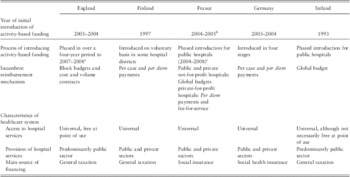
Table 1 summarises when and how activity-based funding was introduced in the selected European countries. For studies on the adoption and implementation of activity-based funding in other European countries and elsewhere, see, inter alia, Ettelt et al., Reference Ettelt, Thomson, Nolte and Mays2006; Street et al., Reference Street, Vitikainen, Bjorvatn and Hvenegaard2007; Moreno-Serra and Wagstaff, Reference Moreno-Serra and Wagstaff2010. In Ireland in 1993, following a recommendation of the Commission on Health Funding, an adjustment to hospital budgets based on relative performance and complexity-adjusted activity was introduced (Commission on Health Funding, 1989; Wiley, Reference Wiley2005b; McDaid et al., Reference McDaid, Wiley, Maresso and Mossialos2009). Since its introduction, the scope of activity-based funding has expanded in Ireland with almost a threefold increase in the number of participating hospitals (O'Reilly et al., Reference O'Reilly, McCarthy and Wiley2011). In Finland, the move away from the incumbent system of per diem prices towards case-based payments followed the 1993 reforms under which state subsidies for health care were paid to municipalities, which were charged with financing hospital care for their residents (Mikkola and Häkkinen, Reference Mikkola and Häkkinen2002; Mikkola, Reference Mikkola2003). In 1997, one of the 21 hospital districts in Finland adopted DRGs as a case-based payment method, with the subsequent adoption throughout the hospital system during the early part of the following decade (Mikkola and Häkkinen, Reference Mikkola and Häkkinen2002; Häkkinen, Reference Häkkinen2005; Häkkinen and Linna, Reference Häkkinen and Linna2005). Currently, 13 out of the 21 districts are using DRG-based pricing (Häkkinen, Reference Häkkinen2010; Kautianen et al., Reference Kautianen, Häkkinen and Lauharanta2011).
Timeline and process of introducing activity-based funding

aBut applied with immediate effect to foundation trusts.
bApplies to all hospitals since 2008.
cApplies to private hospitals since 2005. Prices are adjusted for all hospitals until 2012 (Or, Reference Or2009).
Sources: Commission on Health Funding (1989), Mikkola and Häkkinen (2002), Häkkinen (2005), Häkkinen and Linna (2005), Wiley (Reference Wiley2005b), Bellanger and Tardif (Reference Bellanger and Tardif2006), Epstein and Mason (Reference Epstein and Mason2006), Ettelt et al. (Reference Ettelt, Thomson, Nolte and Mays2006), Miraldo et al. (Reference Miraldo, Goddard and Smith2006) and Ettelt and Nolte (Reference Ettelt and Nolte2010).
In England, France and Germany, activity-based funding was introduced at a national level over a number of years during the 2000s. Even though block contracts had proved to be effective at containing costs in England, they were abandoned in favour of activity-based funding, which was consistent with the prevailing political commitment to reducing waiting lists, facilitating patient choice and encouraging competition between providers (Miraldo et al., Reference Miraldo, Goddard and Smith2006; Street, Reference Street2006; Street and Maynard, Reference Street and Maynard2007). Since the beginning of the 1990s, DRGs have been promoted in France for measuring hospital activity. Initially, to gain doctors’ acceptance, DRGs were presented as an epidemiological tool for monitoring patients (Michelot and Rodrigues, Reference Michelot and Rodrigues2008). Over time, the discourse has changed and activity-based payment using DRGs came to be seen as a good alternative to global budgets – the precursor to activity-based funding for public hospitals – which were considered deficient because they did not reflect the costs and volume of services provided (Bellanger and Tardif, Reference Bellanger and Tardif2006; Ettelt et al., Reference Ettelt, Thomson, Nolte and Mays2006). Moreover, private-for-profit hospitals, which provide more than half of all surgery in France, were paid by a mixture of per diem and fee-for-service. The introduction of a payment scheme based on activity was seen as a way of stimulating competition between public and private providers, thereby creating a level playing field (Or, Reference Or2009). In Germany, activity-based funding replaced a mixed system of per case and per diem payments, limited by hospital budgets, which potentially had contributed to prolonging hospitalisation beyond that medically necessary (Lungen and Lapsley, Reference Lungen and Lapsley2003; Busse and Riesberg, Reference Busse and Riesberg2004; Lungen et al., Reference Lungen, Dredge, Rose, Roebuck, Plamper and Lauterbach2004; Böcking et al., Reference Böcking, Ahrens, Kirch and Milakovic2005). Thus, despite different pre-existing reimbursement regimes, all five countries have chosen to implement reimbursement reform and to move to a form of activity-based funding within the space of a decade or so.
The introduction of activity-based funding was generally phased in over several years, allowing hospitals and funders time to adjust to the new reimbursement mechanism, thereby reducing the likelihood of any potential destabilisation. However, the length of time for implementation and the methods of adjustment varied between countries. Initially, the application of activity-based funding was restricted to particular hospitals (e.g. foundation trusts in England) and/or relatively small proportions of hospital activity (as in England and France), with initial losses (relative to previous reimbursement) limited (as in Germany). In addition, reimbursement rates were partially determined by hospitals’ own costs in all countries (see Busse et al., Reference Busse, Geissler, Quentin and Wiley2011 for country details). In Ireland, for example, the budgetary adjustment was initially calculated on the basis of 85% of a hospital's own costs and 15% of those of its peer group. By 2011, the share determined by a hospital's own cost profile had fallen to 20%. A similar approach was adopted in Germany where state-wide base rates were phased in over a five-year period (ending in 2009) during which there was gradual convergence of hospital-specific reimbursement rates. In France, national DRG prices will be adjusted for each provider's own historical costs up until 2012. Over time, then, countries are moving away from hospital-based reimbursement rates, which is consistent with Shleifer's theory of yardstick competition which posited that potential efficiency gains are maximised when reimbursement rates are entirely independent of a hospital's own costs (Shleifer, Reference Shleifer1985).
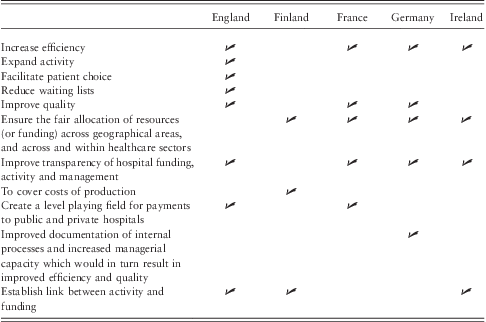
Despite variation across the five countries in implementing activity-based funding, Table 2 indicates that there were some common policy objectives, which these disparate systems were expected to achieve, although the emphasis on particular aims varied across countries. In England, for instance, improving efficiency had a high priority, while in France, where private hospitals have a major role in delivering surgery and there is no apparent problem with waiting times, relatively more emphasis was placed on improving transparency and fairness of funding between public and private providers, together with delivering better quality care. A number of objectives were mutually re-enforcing: expanding activity would be expected to help to reduce waiting lists ceteris paribus. Others, though, were diverse and potentially conflicting: enhancing efficiency could encourage hospitals to minimise costs to the possible detriment of the quality of care. Thus, activity-based funding alone cannot achieve all of these objectives and, therefore, other instruments are required. Indeed, attainment of these objectives is likely to be influenced by other policies, which also make it difficult to attribute changes to the implementation of activity-based funding.
Policy objectives for introducing activity-based funding
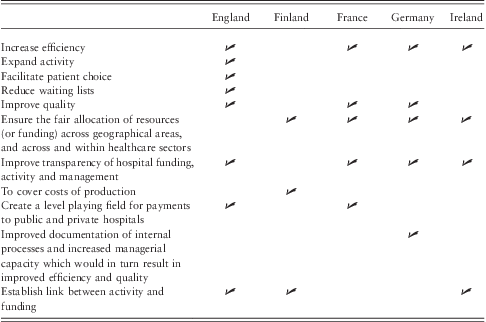
Sources: Commission on Health Funding (1989), Wiley (Reference Wiley2005b), Bellanger and Tardif (Reference Bellanger and Tardif2006), Epstein and Mason (Reference Epstein and Mason2006), Ettelt et al. (Reference Ettelt, Thomson, Nolte and Mays2006), Miraldo et al. (Reference Miraldo, Goddard and Smith2006) and Ettelt and Nolte (Reference Ettelt and Nolte2010).
3 Implementation
Although activity-based funding is common to the countries under consideration, there is substantial cross-country variation in how this mechanism has been implemented and developed. What follows compares the three main components (namely, activity covered and calculation of costs and prices) of activity-based funding in these five countries. This section concludes with an overview of the specific rules within which activity-based funding operates in each of the five countries.
3.1 Hospital activity
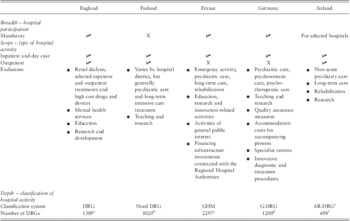
Table 3 outlines the breadth, depth and scope of hospital activity subject to activity-based funding in each of the five countries under study. On breadth, all relevant hospitals are mandated to participate in activity-based funding in England, France and Germany. In the latter, though, a small number of specialised hospitals providing highly complex care have been excluded from the scheme (Ettelt and Nolte, Reference Ettelt and Nolte2010). Full hospital participation minimises the potential for cost shifting to other institutions within the acute hospital sector, but hospitals may still try to minimise their own costs by transferring patients to other parts of the healthcare system that are not subject to this form of reimbursement.Footnote 1
Breadth, scope and depth of hospital activity subject to activity-based funding

AR-DRG, Australian Refined Diagnosis-Related Group; DRG, diagnosis-related group; HRG, Healthcare Resource Group; GHM, Groupe Homogène des Malades; G-DRG, German DRG.
aBased on HRG4.
bBased on 2008 version of the FullDRG, which includes DRGs for inpatient care, day surgery and scheduled and emergency visits.
cBased on version 11.
dBased on the 2010 grouper.
eApplies to day case and inpatient activity. Treatment Related Groups are used for outpatient activity.
fBased on Version 6.0.
Sources: Ettelt and Nolte (Reference Ettelt and Nolte2010), NHS Information Centre (2010), Department of Health (2011), Geissler et al. (Reference Geissler, Scheller-Kreinsen and Busse2011), Kautianen et al. (Reference Kautianen, Häkkinen and Lauharanta2011), Kobel et al. (Reference Kobel, Thuilliez, Bellanger and Pfeiffer2011), Mason et al. (Reference Mason, Ward and Street2011), Or and Bellanger (Reference Or and Bellanger2011) and O'Reilly et al. (Reference O'Reilly, McCarthy and Wiley2011).
Conversely, not all Irish public hospitals participate in the prevailing activity-based funding scheme, although there are plans to continue to extend the scheme to incorporate additional public hospitals (Brick et al., Reference Brick, Nolan, O'Reilly and Smith2010). The 2010 budgets of 39 acute public hospitals (accounting for 92% of activity) were adjusted for case mix (Health Service Executive, 2010a). These participating hospitals are typically larger than non-participants. In Finland, the adoption of DRG-based pricing is determined by hospital districts (Häkkinen, Reference Häkkinen2010). The decentralised nature of the Finnish healthcare system, together with the absence of national guidance on the operation of activity-based funding, means that there is considerable variation across hospital districts in the design and implementation of the scheme at the cost of reduced transparency and comparability (Häkkinen, Reference Häkkinen2005).
All five countries currently use activity-based funding to reimburse almost all day-case and acute inpatient activities. There are, however, some notable exceptions. For example, it has been recognised that it is particularly difficult to apply activity-based funding in mental health care due to issues concerning the classification of related diagnoses and the considerable variation in patient costs (Ettelt et al., Reference Ettelt, Thomson, Nolte and Mays2006). However, there are plans in England, France and Germany to extend activity-based funding to this area (Mason and Goddard, Reference Mason and Goddard2009; Geissler et al., Reference Geissler, Scheller-Kreinsen and Busse2011; Mason et al., Reference Mason, Ward and Street2011; Or and Bellanger, Reference Or and Bellanger2011). A combination of annual grants and fee-for-service is used to reimburse hospitals for emergency activity in France (Or, Reference Or2009). Most typically, hospitals receive separate funding for teaching and research activities, the costs of which may not be adequately reflected in prices under activity-based funding.
Three of the five countries apply activity-based funding to outpatient activity. In Germany, there is strict organisational division between the provision of inpatient and outpatient services: regional physicians’ associations have an effective monopoly over the provision of ambulatory care, while hospitals are permitted to only undertake inpatient care (Busse and Riesberg, Reference Busse and Riesberg2004; Schreyögg et al., Reference Schreyögg, Tiemann and Busse2005; Greß et al., Reference Greß, Focke, Hessel and Wasem2006). This separation has prohibited the extension of activity-based funding to outpatient activity. In France, outpatient services provided in hospital are paid by a fee-for-service schedule, as in the ambulatory sector.
The scheme used for classifying activity into groups with similar resource use and clinical characteristics is a crucial component of activity-based funding. In this, too, significant cross-country differences are apparent (Table 3). Interestingly, each country has adopted a different classification scheme for inpatient activity, although these are all closely related to the first classification system adopted by the US Health Care Financing Administration (Schreyögg et al., Reference Schreyögg, Stargardt, Tiemann and Busse2006a). The successful export of DRGs from the United States to Europe has been influenced by several factors, including their use in the former for prospective payment, their flexibility and the availability of technology and support at relatively low cost (Kimberly et al., Reference Kimberly and de Pouvourville1993, Reference Kimberly, de Pouvourville and D'Aunno2008). The Australian scheme, Australian Refined DRGs, was adopted in Germany (with modifications) and in Ireland. The utility of employing such diverse classification systems, even for describing relatively homogenous hospital services, could be questioned, but local adaptations reflect a desire to secure clinical ownership and acceptance of the classification system.
There is considerable variation in the number of groups each country's scheme uses: the number of DRGs in France, for example, is more than three times that in Ireland (see Table 3). This arises from the introduction of a new version of DRGs in France where the number of groups has been expanded to allow for case severity and short-stay DRGs (Or and Bellanger, Reference Or and Bellanger2011). There is no consensus in the literature on the optimum number of groups and there are advantages and disadvantages associated with schemes that have more or fewer groups. From a theoretical perspective, the benefits of fewer groups (and, consequently, more broadly defined categories) in terms of promoting efficiency and reducing the scope for data manipulation must be offset against the potential disadvantages of cherry picking lower-cost patients and skimping on quality (Busse et al., Reference Busse, Schreyögg and Smith2006). Such concerns over quality and access may be negated by expanding the number of groups, although in addition to potentially increasing the complexity of data coding, the prospective power of the system may be greatly diminished if the number of patients per group is too small. At the extreme, a very fine DRG classification could be similar to fee-for-service reimbursement (Busse et al., Reference Busse, Schreyögg and Smith2006). In France, there currently is an absence of evidence on whether doubling the number of groups in 2009 helped to reduce unintended consequences such as data manipulation and gaming.
3.2 Hospital cost
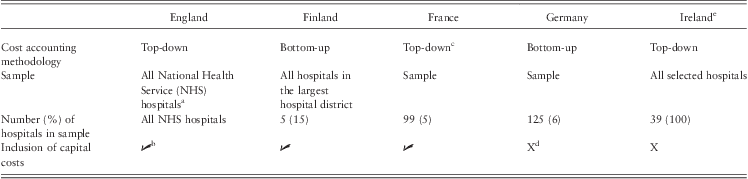
As with the activity data, the five countries have adopted different approaches to collating cost data (Table 4). The bottom-up approach, as used in Germany and Finland, is essentially based on patient-level data on resource utilisation to which unit cost data are applied (Street et al., Reference Street, Vitikainen, Bjorvatn and Hvenegaard2007). Patient-level costing is considered more accurate because it is based on actual, rather than average, resource utilisation (Leister and Stausberg, Reference Leister and Stausberg2005; Street et al., Reference Street, Vitikainen, Bjorvatn and Hvenegaard2007). In the absence of patient-level data, a top-down approach, as currently implemented in England, France and Ireland, involves the allocation of relevant hospital expenditure to particular services or specialties (Street et al., Reference Street, Vitikainen, Bjorvatn and Hvenegaard2007). Patient-level information and costing systems are being implemented in England; however, as of yet, these are not mandatory (Department of Health, 2009). In Ireland, a pilot project to collate patient-level costs is underway (Health Service Executive, 2010c).
Approaches to collation of cost data
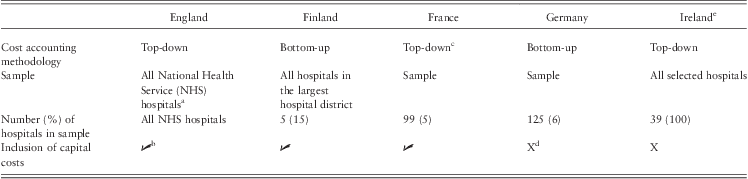
aCost data are from NHS hospitals only. Private providers, to which activity-based funding is now being extended when they care for NHS patients, do not provide cost data (Mason et al., Reference Mason, Street, Miraldo and Siciliani2009).
bCovered through activity-based funding and separate grants.
cA small proportion of costs are determined at patient level (Bellanger and Tardif, Reference Bellanger and Tardif2006).
dFinanced by the state governments.
eA pilot project was initiated in 2009 to assess potential approaches to patient-level costing (Health Service Executive, 2010c).
Sources: Häkkinen and Linna (Reference Häkkinen and Linna2005), Leister and Stausberg (Reference Leister and Stausberg2005), Schreyögg et al. (Reference Schreyögg, Stargardt, Tiemann and Busse2006a, Reference Schreyögg, Tiemann and Busse2006b), Ettelt and Nolte (Reference Ettelt and Nolte2010), Geissler et al. (Reference Geissler, Scheller-Kreinsen and Busse2011), Kautianen et al. (Reference Kautianen, Häkkinen and Lauharanta2011), Mason et al. (Reference Mason, Ward and Street2011), Or and Bellanger (Reference Or and Bellanger2011), O'Reilly et al. (Reference O'Reilly, McCarthy and Wiley2011) and Tan et al. (Reference Tan, Serdén, Geissler, van Ineveld, Redekop, Heurgren and Hakkaart-van Roijen2011).
Cost data can be supplied by a sample of hospitals (as in Finland, France and Germany), or, alternatively, by the full hospital population participating in activity-based funding (as in Ireland). There are advantages and disadvantages associated with both approaches (Schreyögg et al., Reference Schreyögg, Stargardt, Tiemann and Busse2006a). A sample-based approach should ensure good data quality at a relatively low administrative cost by ensuring that participating hospitals provide data in a consistent format. However, financial payments for hospitals had to be introduced in France and Germany to incentivise the provision of high-quality data in the required format (Schreyögg et al., Reference Schreyögg, Stargardt, Tiemann and Busse2006a). The payment to German hospitals participating in the voluntary data-sharing programme comprised a fixed component and a variable fee dependent on the quality of the data submitted (Schreyögg et al., Reference Schreyögg, Tiemann and Busse2005). One important potential disadvantage of using a sample is that it may not be representative, a charge that has been levied against the French and German samples (Bellanger and Tardif, Reference Bellanger and Tardif2006; Schreyögg et al., Reference Schreyögg, Tiemann and Busse2006b). The latter has been criticised for being biased towards medium and large hospitals and for a low participation rate among public and private hospitals (Schreyögg et al., Reference Schreyögg, Tiemann and Busse2006b). Convincing French private hospitals to provide their cost data has proved to be particularly difficult. Schreyögg et al. (Reference Schreyögg, Stargardt, Tiemann and Busse2006a) argue that achieving full participation is dependent on hospital ownership and the ability of the price-setting agency to gain access to the requisite data. Thus, obtaining data on all participating hospitals is relatively easier in Ireland, where public hospitals are owned and/or funded by the agency responsible for determining the reimbursement rate (Schreyögg et al., Reference Schreyögg, Stargardt, Tiemann and Busse2006a). In England, cost data are from National Health Service (NHS) hospitals only; private providers do not provide cost data, even though activity-based funding applies to them when they provide care for NHS patients (Mason and Goddard, Reference Mason and Goddard2009).
The reliability of costing methods, as well as the accuracy and transparency of cost data, are essential for the functioning of activity-based funding. In France, for example, the lack of transparent cost data to identify efficient providers and to facilitate an understanding of differences in clinical practice are issues to be addressed in the ongoing development of the activity-based funding system (Or and Bellanger, Reference Or and Bellanger2011).
The mechanisms for financing capital costs vary across the five countries (Table 4). By excluding capital costs from activity-based funding (as in Germany and Ireland), local, regional or national governments have retained control over decisions regarding, in particular, the planning of new hospital buildings and equipment. That hospitals should be able to control their costs subject to activity-based funding, at least in the short term, is a further argument for omitting capital costs from this funding system (Schreyögg et al., Reference Schreyögg, Stargardt, Tiemann and Busse2006a). In France and England, capital costs are (at least in principle) included in DRG prices. However, an unmeasured part of capital costs is funded through specific payments to French public hospitals to help them finance costly investment plans imposed by the recent healthcare reforms (Or and Bellanger, Reference Or and Bellanger2011).
3.3 Determining the price/tariff
Prices are set at a national level in three of the five countries considered (England, France and Ireland). In Germany, it has been agreed that the 16 base rates at state level will gradually converge to a narrow range at federal level between 2010 and 2014. At the end of this period, the acceptable regional variation will be between +2.5% and −1.25%. After 2015, a decision, informed by research on the reasons for variation in the state base rates, will be made about the possibility of having a single federal rate (Ettelt and Nolte, Reference Ettelt and Nolte2010). Under the decentralised healthcare system in Finland, prices vary across hospital districts, reflecting payment systems decided at local levels. However, nationally determined prices may also incorporate local factors. For instance, in England, the Market Forces Factor allows prices to be adjusted for local variation in input prices (Street and Maynard, Reference Street and Maynard2007; Mason et al., Reference Mason, Street, Miraldo and Siciliani2009).
Although all providers – public and private – treating publicly funded patients are subject to activity-based funding in England, France and Germany, they may not necessarily face the same price. In France, the tariff applied to public and private not-for-profit hospitals includes all costs associated with a hospital stay, while the equivalent for private-for-profit hospitals excludes doctors’ fees. It was intended that the prices in the two sectors would converge by 2012, but this deadline was recently extended to 2018 (Or, Reference Or2009). Whether the public and private sectors should face the same tariffs is an issue of some debate. A uniform tariff may be expected to increase competition between the public and private sectors ceteris paribus. However, if hospitals’ costs are not entirely within their control, such competition may be deleterious to quality of care. Moreover, ignoring structural differences between hospitals in setting prices may endanger the system's capacity to provide necessary (complex) care as well as equity of access. Therefore, differentiated tariffs can be used to adjust for exogenous cost differences and, thereby, create a ‘fair playing field’ between the public and private sectors (Mason et al., Reference Mason, Street, Miraldo and Siciliani2009: 385).
In all five countries, average costs are used as the basis for determining the tariff. This has been criticised on a number of grounds. First, rewarding hospitals at full average cost for activity provides an incentive to increase activity as long as marginal cost is less than or equal to price/average cost; this could result in the provision of care that is financially unsustainable and/or medically inappropriate (Mannion et al., Reference Mannion, Marini and Street2008). Second, the association between prices and average cost encourages convergence to the mean, rather than incentivising improvement in performance (Street and Maynard, Reference Street and Maynard2007). To secure performance improvements in 2010–2011, the English Department of Health imposed a 3.5% reduction in tariffs (somewhat akin to price-cap regulation), applied across all hospitals irrespective of their current level of performance (Department of Health, 2010). Similarly, the 2011–2012 tariffs have been set at ‘1% below the mean average of reported costs’ (Department of Health, 2011: 12). Third, cost-based prices may not reflect the value of outputs and, therefore, may result in the production of a sub-optimal mix of outputs from a societal perspective (Smith and Street, Reference Smith and Street2005; Street et al., Reference Street, Scheller-Kreinsen, Geissler and Busse2010). Recent initiatives have moved away from average cost pricing in an attempt to encourage quality improvements and to reduce unexplained variation in clinical practice. The introduction of best practice tariffs in England establishes a link between payment and the efficient provision of high-quality care (such as day-case treatment where appropriate, or following evidence-based clinical guidelines or protocols for complex treatments, etc.) (Department of Health, 2010). In Germany, adjustments are made to hospital payments under some ‘integrated care’ contracts to take account of certain quality indicators (Or and Häkkinen, 2011).
Almost all countries have introduced price adjustments and/or supplementary payment mechanisms in recognition of the inherent limitations of activity-based funding for certain types of activity or cases. Thus, while prices may be determined in advance, adjustments for extreme outlier cases (typically using per diem payments based on length of stay) mean that the system is not truly prospective and that some of the financial risk is shared between funders and providers. In England, a top-up is added to the prices paid to hospitals that undertake specialised services to offset the potentially higher costs they might incur from treating more complex patients (Department of Health, 2010, 2011; Daidone and Street, Reference Daidone and Street2011).
Certain expensive drugs and devices are not subject to activity-based funding in four of the five countries (the exception being Finland), but paid on top of the DRG price (see, e.g. Henschke et al., Reference Henschke, Bäumler, Weid, Gaskins and Busse2010). In France, expenditure growth in this area greatly outstripped that for activity subject to activity-based funding between 2005 and 2007 (37% vs 4%, respectively; Or, Reference Or2009). Interestingly, in Germany, the number of supplementary fees available increased from 26 in 2004 when they were introduced to 143 in 2010 (Schreyögg et al., Reference Schreyögg, Tiemann and Busse2005; Geissler et al., Reference Geissler, Scheller-Kreinsen and Busse2011). This increase may reflect the inadequacies of activity-based funding to reimburse hospitals for certain complex or cost-intensive services, but may also reveal hospitals’ attempts to shift costs to areas not covered by activity-based funding. In England, there is an annually updated list of high cost drugs and devices for which prices are negotiated locally rather than set nationally (Department of Health, 2011).
3.4 Control mechanisms
Under a pure form of activity-based funding, hospitals’ financial incentive to increase activity could result in unsustainable expenditure and might potentially be associated with adverse health outcomes. All five countries under consideration have adopted different approaches to attempt to tackle this issue. In England, Germany and Ireland, the volume of services is agreed at a local level and specified in contracts between hospitals and funders. In England, the extent to which these contracts translate into binding budget constraints is dependent on the size of the budget allocated to the commissioning agency (primary care trust) and its ability to manage demand for hospital services (Mannion and Street, Reference Mannion and Street2005; Oliver, Reference Oliver2005). While evidence suggests that commissioning agencies have been successful in transferring certain services from hospitals to the community, there are concerns that their ability to exercise control over hospital activity and expenditure may be somewhat weakened in the absence of an explicit threshold limit on hospital activity and due to other policies such as patient choice (Street and Maynard, Reference Street and Maynard2007; Mannion et al., Reference Mannion, Marini and Street2008).
In Germany, DRG prices are adjusted if services are provided in excess of (below) the volume agreed under the annual contract negotiated between sickness funds and hospitals (Busse and Riesberg, Reference Busse and Riesberg2004; Geissler et al., Reference Geissler, Scheller-Kreinsen and Busse2011). Therefore, the hospital's incentive to increase activity over the agreed level is diminished. In France, too, this strategy is also used, although its practical application differs: if hospital expenditure exceeds a national target level, then all hospitals (regardless of their individual performance) face reduced prices. This has been criticised for creating uncertainty over the prices faced by hospitals (Or, Reference Or2009). A more targeted policy of marginal pricing applies to emergency activity in England whereby emergency activity above a threshold based on historic activity levels is reimbursed at a rate of just 30% of the tariff (Department of Health, 2010).
In Finland, municipalities and hospital districts negotiate the volume and cost of services. The budget of each hospital district is based on these negotiations and is formally decided by a Council (with members appointed by each municipality), which is also responsible for determining the pricing method and the level of prices. If the hospital district budget is exceeded, the municipalities must cover the deficit from their own revenues, usually by paying hospitals higher prices for services. In the case of budgetary surplus, the prices paid by municipalities can be lowered (Häkkinen and Linna, Reference Häkkinen and Linna2005; Häkkinen, Reference Häkkinen2010). Thus, hospitals have no incentive to keep within budget since any deficit is covered ex post. In contrast, Finnish municipalities must balance annually their resource allocation to hospital care with that to other public services sectors. Increases in hospital costs must be financed either by increasing the local tax rate or by reducing resources allocated to social services (including day care for children), cultural services or sports halls, etc. Hence, municipalities have incentives for efficient cost sharing. There is now increasing evidence that Finnish hospitals are more efficient than hospitals in other Nordic countries (Linna et al., Reference Linna, Häkkinen and Magnussen2006, Reference Linna, Häkkinen, Peltola, Magnussen, Anthun, Kittelsen, Roed, Olsen, Medin and Rehnberg2010; Kittelsen et al., Reference Kittelsen, Anthun, Kalseth, Kalseth, Halsteinli and Magnussen2009). Although there has been no formal research to explain this finding, one possible explanation that has been proposed is that Finnish municipalities are more effective at controlling costs than the counties/regions in Sweden and Denmark, or the central government in Norway (Häkkinen, Reference Häkkinen2010).
4 Impact
Formal evaluation of the impact of activity-based funding in the selected countries is largely lacking (Scheller-Kreinsen et al., Reference Scheller-Kreinsen, Geissler and Busse2009). Several possible explanations can be advanced for this. First, the relatively recent introduction of activity-based funding in some of these countries means that it may be too soon to assess its impact (especially if there is a lag in the availability of the requisite data). Second, activity-based funding is not implemented in controlled environments and, therefore, it can be difficult to isolate its effect from that of other policies introduced concomitantly. Thus, changes in the parameters of interest may not easily be attributed to the introduction of activity-based funding. Furthermore, the potential for activity-based funding to achieve the objectives of increased activity and improved efficiency may depend on each country's starting point in terms of the previous reimbursement mechanism, as well as the specific design and governance of the new system (Street et al., Reference Street, O'Reilly, Ward and Mason2011). In France, for instance, a lack of transparency in price setting and additional payments appear to have contributed to uncertainty within the hospital sector that may ultimately undermine the expected outcomes of activity-based funding.
From a methodological perspective, short study periods may be unlikely to detect changes arising from the introduction of activity-based funding if the reforms have been phased in over a number of years (as has been the case for some of the countries considered in this paper). Conversely, results identified in studies with longer timeframes may be subject to potential confounding factors due to the introduction of other policies during the interim period. Few studies have attempted to control explicitly for the effects of such confounders.
Cognisant of these problems, this section reviews what evidence does exist on the impact of activity-based funding on hospital efficiency, as well as on the quality of care and of clinical data.
A common objective for moving to activity-based funding was to improve hospital efficiency by some combination of increasing activity, reducing costs and introducing an element of competition between hospitals (Table 2). However, no studies of the explicit impact on efficiency per se have been undertaken for the countries under consideration. Nevertheless, some studies have reported changes in indicators of efficiency – in particular, activity, length of stay, costs and quality.
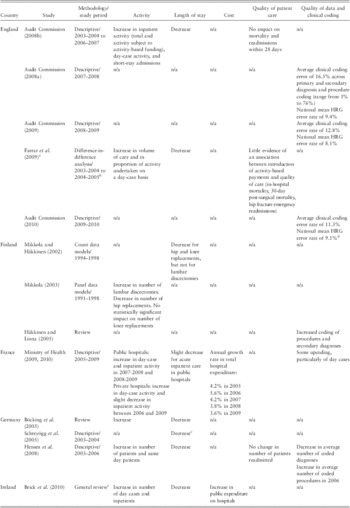
The link between funding and activity under activity-based funding provides hospitals with incentives to increase patient throughput. Indeed, this hypothesis is supported by the empirical evidence in Table 5, which shows that the volume of activity did increase following the introduction of activity-based funding in England (Farrar et al., Reference Farrar, Sussex, Yi, Sutton, Chalkley, Scott and Ma2007, Reference Farrar, Yi, Sutton, Chalkley, Sussex and Scott2009; Audit Commission, 2008b), France (Ministry of Health, 2009, 2010) and Germany (Böcking et al., Reference Böcking, Ahrens, Kirch and Milakovic2005; Hensen et al., Reference Hensen, Beissert, Bruckner-Tuderman, Luger, Roeder and Muller2008). As noted above, though, factors other than the introduction of activity-based funding may have affected this outcome. For example, in England, the introduction of activity-based funding was contemporaneous with large funding increases to the NHS and the use of other policy instruments, such as waiting time targets, so isolating its specific impact is virtually impossible (Propper et al., Reference Propper, Sutton, Whitnall and Windmeijer2007; Audit Commission, 2008b; Farrar et al., Reference Farrar, Yi, Sutton, Chalkley, Sussex and Scott2009; see also Sussex and Farrar, Reference Sussex and Farrar2009).
Summary of studies of changes in activity, length of stay, cost and quality following introduction of activity-based funding

n/a, not available.
aResults also reported in Farrar et al. (Reference Farrar, Sussex, Yi, Sutton, Chalkley, Scott and Ma2007).
bSome results are reported for the period 2003–2004 to 2005–2006.
cThe scale of this reduction was consistent with the longer run trend in length of stay (Schreyögg et al., Reference Schreyögg, Tiemann and Busse2005).
dThis error rate was calculated on the basis of HRG4, which was introduced in 2009–2010. According to the Audit Commission, this version of HRG4 is more sensitive to coding errors due (principally) to its larger number of HRGs. If HRG4 was used to classify patients in 2008-2009, then there would have been a 1.8% improvement in the HRG error rate (Audit Commission, 2010).
eGeneral review of trends in public hospital activity, length of stay and expenditure; not specifically focused on assessing changes following the introduction of activity-based funding.
See also O'Reilly et al. (2011).
Not only has hospital activity increased in absolute terms but there has also been a change in its composition. In an attempt to increase patient throughput while minimising costs, hospitals have increased the proportion of activity undertaken on a day-case basis (Farrar et al., Reference Farrar, Sussex, Yi, Sutton, Chalkley, Scott and Ma2007; Or, Reference Or2009). In England, while attempts to encourage hospitals to shift towards day-case activity date from the 1970s, activity-based funding coupled encouragement with financial incentives: the national elective tariff was set equal to the weighted average costs for inpatients and day cases (Boyle, Reference Boyle2005; Ettelt et al., Reference Ettelt, Thomson, Nolte and Mays2006; Street, Reference Street2006; Department of Health, 2007; Ellis and Vidal-Fernández, Reference Ellis and Vidal-Fernández2007; Street and Maynard, Reference Street and Maynard2007). With such a tariff, the incentive for hospitals to minimise costs encouraged a more rapid change from (relatively more expensive) inpatient to (relatively less expensive) day-case treatment than had been observed previously (Street and Miraldo, Reference Street and Miraldo2007; Farrar et al., Reference Farrar, Yi, Sutton, Chalkley, Sussex and Scott2009). The resulting increase in day-case treatment meant that the national tariff would over time converge towards the average day-case cost, thereby reducing the proportion of inpatient costs covered (Street and Maynard, Reference Street and Maynard2007) and incentivising a further shift to day-case activity.
In France, private for-profit and not-for-profit hospitals have been quick to respond to the new system by increasing their activity, as well as their market share in day cases (Ministry of Health, 2009). There were concerns, however, that some of the increase in day-case activity may be a consequence of deliberate ‘up-coding’ of activity and/or inappropriate treatment, rather than more efficient service delivery. To avoid potential abuse of the system, the health insurance fund introduced a definition of day-case activity with the result that there was a decline in such activity between 2006 and 2007 (Or and Bellanger, Reference Or and Bellanger2011).
Of course, changes in the recording of clinical data following the introduction of activity-based funding may not always serve to misrepresent patient data for the purposes of receiving higher reimbursement. Steinbusch et al. (Reference Steinbusch, Oostenbrink, Zuurbier and Schaepkens2007) argue that the risk of upcoding is dependent on the specific design and operation of the DRG systems, as well as broader issues, such as the market characteristics (including the presence of for-profit hospitals) and the instruments employed to prevent upcoding. Thus, the risk of upcoding would be expected to be lower in systems where there are no for-profit providers; coders’ remuneration is independent of the outcome of the coding process; the DRG assignment does not take place after discharge; and classification criteria are aligned with clinical practice. In Finland, coding of procedures and secondary diagnoses improved following the reimbursement reform, although it could be argued that the Finnish operation of activity-based funding does not provide strong incentives for upcoding (Häkkinen and Linna, Reference Häkkinen and Linna2005). Even in England, though, where there is a more explicit link between coding and payment, the Audit Commission, in its first national audit of clinical data in 2007–2008, concluded that there was little evidence of deliberate upcoding since errors were random, resulting in both positive and negative financial outcomes (Audit Commission, 2008a). The error rate fell in subsequent financial years (Audit Commission, 2009, 2010).
Consistent with increased day-case activity, length of stay has declined in England, Germany and Ireland, although some argue that this was merely consistent with a general trend towards shorter hospital stays (Böcking et al., Reference Böcking, Ahrens, Kirch and Milakovic2005; Schreyögg et al., Reference Schreyögg, Tiemann and Busse2005; Audit Commission, 2008b; Brick et al., 2010).
The consequences of these changes on costs and quality of care are not straightforward. Increased patient throughput may be expected to result in increased aggregate expenditure on hospital services (as in France; Or, Reference Or2009), yet the costs per case may be lower (as in England, proxied by changes in length of stay and share of day-case activity; Farrar et al., Reference Farrar, Yi, Sutton, Chalkley, Sussex and Scott2009). Quality of care might be adversely affected if patients are discharged from hospital ‘quicker and sicker’; but shorter hospital stays are associated with a lower probability of acquiring hospital infections ceteris paribus (Kosecoff et al., Reference Kosecoff, Kahn, Rogers, Reinisch, Sherwood, Rubenstein, Draper, Roth, Chew and Brook1990; Clarke, Reference Clarke1996). Evidence on the effects on the quality of care from the countries under consideration is very limited, but two evaluations found that the quality of English hospital care was not, in fact, adversely affected by the introduction of activity-based funding (Farrar et al., Reference Farrar, Sussex, Yi, Sutton, Chalkley, Scott and Ma2007, Reference Farrar, Yi, Sutton, Chalkley, Sussex and Scott2009; Audit Commission, 2008b). However, despite advances in the measurement of patient outcomes and quality of care, on the whole deficiencies remain in most of the countries under study (Or and Häkkinen, Reference Or and Häkkinen2011). For example, in France, Germany and Ireland, indicators such as readmission rates and complication rates are not routinely available.
5 Discussion
In the past decade, activity-based funding has become the most common mechanism for reimbursing hospitals in Europe. In the five countries under consideration here, this reform was aimed at achieving a long and varied list of policy objectives, some of which were common across these countries (e.g. increase efficiency, improve quality, enhance transparency), albeit with differing emphasis. At a cursory glance, there are some broad similarities across countries – for example, almost all systems incorporate a form of risk sharing between providers and funders for high cost, complex cases. However, at a more detailed level, it is clear that the schemes have been tailored for the country-specific contexts in which they operate. Thus, the practical implementation of activity-based funding depends on, inter alia, the relationships between providers and funders, the degree of (de)centralisation in the healthcare system, the separation between purchasing and provision and the structure of the hospital market (share of private hospitals, level of competition between public and private hospitals, etc.). Alongside these contextual factors, practical considerations are also important: success appears to be contingent on the availability of a robust information system together with flexible and transparent management and governance structures, which can support continuous fine-tuning of the system. The heterogeneity across countries is most evident from the fact that the five countries differ with regard to the DRG scheme adopted or locally developed, together with the approaches pursued for system implementation, costing and pricing. These differences make cross-country comparisons difficult and may limit the extent to which country-specific models of activity-based funding may be transplanted to other countries. Notwithstanding these constraints, what is encouraging is that the sharing of experience, techniques and tools in the international context can greatly assist those working on the development of local models and addressing local implementation issues.
Assessing the success of activity-based funding in achieving the stated policy objectives is complicated by the shortage of formal evaluations, together with their relatively recent adoption. Preliminary indications, though, suggest that following the introduction of activity-based funding, activity increased, length of stay declined and total hospital expenditure grew (albeit at a slower rate). Even so, it is difficult to attribute these changes exclusively to the funding reform due to the presence of confounding factors. Further empirical evaluation is required so that the strengths of this reimbursement model may be exploited and any weaknesses addressed.
Since its adoption by the five countries under consideration, the use of activity-based funding in reimbursing hospitals has evolved and will continue to do so. In England, the tariff has been used as an instrument to encourage a shift from inpatient to day-case treatment, to improve efficiency and, with recent moves away from cost-based to best-practice-based pricing, to ensure evidence-based clinical practice in line with national guidance (Department of Health, 2011). The Irish Health Service Executive has committed to moving to a prospective model of activity-based funding (Health Service Executive, 2010d). In addition, activity-based funding (and the associated information systems) can be used to incentivise improved quality of care (Or and Häkkinen, Reference Or and Häkkinen2011), as is currently underway in the United States (see, e.g. Pronovost et al., Reference Pronovost, Goeschel and Wachter2008; McNair et al., Reference McNair, Luft and Bindman2009; Goldfield, Reference Goldfield2010). In Germany, for instance, hospitals have an incentive to avoid readmissions because they will not receive additional reimbursement for cases readmitted for the same cause within 30 days of the initial admission (Geissler et al., Reference Geissler, Scheller-Kreinsen and Busse2011). A similar rule has been introduced in England (Department of Health, 2011).
The application of activity-based funding is also extending beyond hospital reimbursement. In Ireland, for example, consultants’ complexity-adjusted workload is estimated using data derived from the funding model and is the basis for monitoring compliance with the ratio of public to private practice specified in their employment contract (Health Service Executive, 2008). Alongside activity-based funding systems, patient classification systems provide a means of quantifying comparative hospital performance. In Finland, the Hospital Benchmarking project provides hospitals with information on efficiency and productivity (Linna and Häkkinen, Reference Linna and Häkkinen2008; Häkkinen, Reference Häkkinen2010). Similarly, HealthStat in Ireland produces comparative information on hospital performance (Health Service Executive, 2010b).
In the relatively short time period since activity-based funding was adopted in the five European healthcare systems under study, it has already evolved quite rapidly, contributing to efficiency improvements in their acute hospital sectors. The future direction for activity-based funding is clear: further adaptations will be necessary to address fully the increasing emphasis on quality of care and value-based purchasing, as well as to deliver integrated care through episode-based payment (as currently advocated in the United States, see Goldfield, 2010). Extending the reimbursement mechanism beyond the hospital sector will be required if these objectives are to be addressed. The recent developments discussed above indicate that progress is underway on adapting activity-based funding to meet these future challenges.
Acknowledgements
This paper draws on research undertaken as part of the EuroDRG project ‘Diagnosis related groups in Europe: Towards Efficiency and Quality’, funded under the 7th EU Framework Programme (Contract number: 223300). The authors are grateful for helpful comments received from Jonathan Sussex, Anna Dixon, Emmi Poteliakhoff, an anonymous reviewer and participants at the Autumn 2010 meeting of the European Health Policy Group.