Introduction
The goal of many therapeutic approaches is not only to dampen symptom severity, but also to ‘un-link’ or de-couple functional relationships between cognitive, emotional, and behavioral variables that contribute to psychopathology. For example, emotion-focused interventions aim to decrease the momentary association between negative affect and eating disorder (ED) behaviors by helping individuals to utilize more adaptive emotion regulation skills, which is thought to disrupt key maintaining mechanisms. However, analytic approaches that have been previously applied to examine mechanisms of change in EDs have insufficiently captured the nuanced dynamics of these processes, which could enhance our understanding of treatments and refine targets of intervention.
Affect regulation models of EDs
Negative affectivity and emotion dysregulation are central factors in the onset and maintenance of EDs (Lavender et al., Reference Lavender, Wonderlich, Engel, Gordon, Kaye and Mitchell2015; Stice, Reference Stice2002). Extensive research shows EDs characterized by binge eating are associated with heightened negative affect intensity and difficulties tolerating and regulating aversive emotions. This is consistent with theoretical and empirical work suggesting that binge-eating functions escape from or regulate negative affective states (Haedt-Matt & Keel, Reference Haedt-Matt and Keel2011; Heatherton & Baumeister, Reference Heatherton and Baumeister1991). Thus, the momentary coupling of negative affect and symptoms forms the basis of affect regulation models of EDs.
Binge eating disorder (BED) is one ED characterized by recurrent binge eating (i.e. consumption of an objectively large amount food with a sense of loss of control over eating) in the absence of regular compensatory behaviors (American Psychiatric Association, 2013). Similar to other EDs, BED is associated with emotion regulation difficulties and range of psychiatric and medical morbidities (Leehr et al., Reference Leehr, Krohmer, Schag, Dresler, Zipfel and Giel2015; Mitchell, Reference Mitchell2016). Despite the significance of this disorder, treatment outcomes remain less than optimal (Grilo, Reference Grilo2017; Linardon, Reference Linardon2018). Identifying interventions that disrupt momentary affect-binge-eating associations is therefore of utmost importance.
Emotion-focused interventions
Across psychopathology and treatment frameworks, converging research indicates that improvement in emotion regulation is a key mechanism of change (Gratz & Tull, Reference Gratz and Tull2010; Gratz, Bardeen, Levy, Dixon-Gordon, & Tull, Reference Gratz, Bardeen, Levy, Dixon-Gordon and Tull2015; Mennin & Fresco, Reference Mennin, Fresco, Kring and Sloan2010; Slee, Spinhoven, Garnefski, & Arensman, Reference Slee, Spinhoven, Garnefski and Arensman2008). In brief, emotion-focused treatments, which are included in the broader category of ‘third-wave’ behavioral and cognitive therapies, are based on the tenet that symptom reduction occurs through changing the context and function of internal events and behavior, rather than changing their form and frequency (Hayes, Villatte, Levin, & Hildebrandt, Reference Hayes, Villatte, Levin and Hildebrandt2011; Kahl, Winter, & Schweiger, Reference Kahl, Winter and Schweiger2012). In other words, emotion-focused treatments help individuals adaptively cope with negative affect and distress via emotion regulation strategies, rather than attempting to eliminate or suppress aversive emotional states. As a result, the momentary associations between negative affect and maladaptive symptoms should weaken as a result of increases in adaptive coping; however, this has yet to be empirically examined.
Notably, several ED treatments have been developed that specifically address emotion regulation, which shows promise in reducing symptoms (Berg & Wonderlich, Reference Berg and Wonderlich2013; Linardon, Gleeson, Yap, Murphy, & Brennan, Reference Linardon, Gleeson, Yap, Murphy and Brennan2019). One such treatment is Integrative Cognitive Affective Therapy (ICAT), which targets momentary affective processes that trigger binge eating (Wonderlich et al., Reference Wonderlich, Peterson, Crosby, Smith, Klein, Mitchell and Crow2014, Reference Wonderlich, Peterson and Smith2015). While ICAT for bulimia nervosa (BN) demonstrated comparable efficacy to cognitive behavior therapy enhanced (CBT-E; Fairburn, Reference Fairburn2008; Wonderlich et al. Reference Wonderlich, Peterson, Crosby, Smith, Klein, Mitchell and Crow2014), ICAT-BN was shown to be more effective than CBT-E for individuals who experienced high levels of affective lability, which is thought to be indicative of emotion dysregulation (Accurso et al., Reference Accurso, Wonderlich, Crosby, Smith, Klein, Mitchell and Peterson2016). Such findings are consistent with the tenets of this framework and suggest ICAT could be particularly effective in enhancing emotion regulation by de-coupling previously learned associations between high negative affect states and binge eating. Recently, ICAT has also been applied to the treatment of BED (Peterson et al., Reference Peterson, Engel, Crosby, Strauman, Smith, Klein and Wonderlichin press), which showed treatment outcomes for ICAT-BED were comparable to Cognitive Behavioral Therapy Guided Self-Help (CBTgsh; Fairburn, Reference Fairburn2013). However, no studies have examined the extent to which momentary associations between affect and behavior change during ICAT.
Despite evidence indicating improved emotion regulation is an important mechanism of symptom change, methodological approaches have largely precluded nuanced examination of how temporal associations between affect and symptoms change over the course of treatment and whether individual differences in these micro-level changes relate to macro-level outcomes. Investigating these temporal dynamics using person-specific analytic approaches would allow for a more precise assessment of these momentary processes and individual differences underlying behavior change. Although most ecological momentary assessment (EMA) studies apply multilevel modeling approaches that aggregate data across individuals to describe average dynamic patterns at the group level (e.g. the extent to which momentary negative affect generally predicts binge eating in a sample), person-specific approaches capture each individual's temporal dynamics based on his/her own time-series data (e.g. the extent to which momentary negative affect predicts binge eating for a particular person). In the context of BED, such an approach would shed light on how the strength of association between momentary negative affect and subsequent binge-eating symptoms decreases or de-couples during treatment, and whether individuals who evidence greater momentary de-coupling fare better over the course of treatment and at follow-up, perhaps as a result of increased capacity to employ adaptive emotion regulation skills.
The present study
To better understand hypothesized processes driving symptom change within ICAT-BED (i.e. de-coupling of negative affect and ED symptoms), we aimed to utilize multi-wave EMA data to assess (1) decrease in the association between momentary negative affect and subsequent binge-eating symptoms (i.e. de-coupling) over treatment, (2) differences in this de-coupling between treatment groups (i.e. ICAT-BED, which emphasizes emotion regulation skills, v. CBTgsh, which does not explicitly target emotion), and (3) the extent to which the magnitude of de-coupling is related to treatment outcomes. It was hypothesized that (1) the strength of the momentary association between negative affect and subsequent binge-eating symptoms would decrease during and after treatment; (2) there would be a stronger de-coupling effect in ICAT-BED compared to CBTgsh; and (3) lesser de-coupling would be associated with lesser improvement in treatment outcomes at end-of-treatment and follow-up. As an exploratory aim, we examined the potential that the association between de-coupling and treatment outcomes may differ across treatment groups.
Methods
Participants
Participants were drawn from an initial sample of 112 adults who met full criteria for DSM-5 BED (American Psychiatric Association, 2013). A priori exclusion criteria were: unable to read English; body mass index (BMI) < 21; lifetime history of psychotic symptoms or bipolar disorder; substance use disorder within 6 months of enrollment; medically or psychiatrically unstable (e.g. acute suicidality); purging behavior more than once per month for the previous 3 months; current diagnosis of BN; medical condition impacting eating or weight; the history of gastric bypass surgery; currently pregnant or lactating; currently receiving weight loss or ED treatment; use of medication impacting eating or weight; or psychotropic medication changes in the 6 weeks prior to enrollment.
The present study was limited to participants who completed the end-of-treatment EMA protocol given that analyses depended on the calculation of change in momentary associations between baseline and end-of-treatment (see Statistical analyses). Due to attrition, this resulted in a final analytic sample of 78, the majority of whom identified as female (86.4%). The mean age of the sample was 40.01 ± 13.21 years (range: 18–64), and the mean BMI was 34.14 ± 8.69 kg/m2 (range: 21.41–61.12). Most participants were non-Hispanic Caucasian (92.6%), with the remaining identifying as Hispanic (1.2%), Asian American (1.2%), or ‘Other’ (4.9%). The majority had completed at least a bachelor's degree (54.3%), and the median household income was $ 50 000–74 999.
Procedure
Participants were recruited from ED clinics, community advertisements, and social media postings at two sites in the Midwest United States. Following an eligibility screening, participants completed a baseline assessment comprised of semi-structured clinical interviews and a 7-day EMA.
After the baseline assessment, participants were randomized to ICAT-BED or CBTgsh. ICAT-BED (Wonderlich, Peterson, & Smith, Reference Wonderlich, Peterson and Smith2015) consisted of 21, 50-min individual sessions occurring over 17 weeks. Treatment included four phases, which emphasized motivational enhancement, psychoeducation, and self-monitoring (Phase 1); meal planning and emotional awareness (Phase 2); identifying precipitants of negative affect, possible functionality of binge-eating behavior, and implementation of skills (Phase 3); and relapse prevention and healthy lifestyle planning (Phase 4). CBTgsh utilized ‘Overcoming Binge Eating’ (Fairburn, Reference Fairburn2013), an empirically supported self-help intervention emphasizing consistent self-monitoring, the development of regular eating patterns, identification of alternative activities to avoid binge eating, problem-solving, and relapse prevention. Consistent with previous studies of CBTgsh (Wilson, Wilfley, Agras, & Bryson, Reference Wilson, Wilfley, Agras and Bryson2010), participants attended ten individual sessions (one initial 60-min session and nine 30-min sessions) occurring over the course of 17 weeks. During these sessions, participants met with a non-ED specialist who provided support and encouraged participants to progress through the self-help book at their own pace. ICAT-BED was delivered by doctoral-level psychologists and graduate students who received an initial all-day didactic training along with weekly group clinical supervision. CBTgsh was delivered by master's level clinicians who received a 2-h didactic training and weekly to biweekly group phone supervision. Supervision was provided by two authors with extensive experience delivering psychotherapy for EDs (authors S.A.W. and C.B.P.) to ensure treatment fidelity. At end-of-treatment and 6-month follow-up, participants again completed 7-day periods of EMA and outcome assessments. Institutional review board approval was obtained at each site.
Measures
The eating disorder examination 16.0 (EDE)
The EDE (Fairburn, Reference Fairburn2008; Fairburn & Cooper, Reference Fairburn, Cooper, Fairburn and Wilson1993) is a semi-structured interview that was administered at pre-treatment, end-of-treatment, and follow-up by trained assessors to evaluate BED diagnoses and ED symptoms. In the present study, cognitive symptoms were assessed as the EDE Global score, which comprised four symptom domains (i.e. restraint, eating concern, shape concern, and weight concern), while behavioral symptoms were operationalized as the frequency of objective binge episodes (OBEs) over the past 28 days. Reliability across assessors was excellent for diagnoses (κ coefficient = 1.0); intraclass correlation coefficients (ICCs) for the EDE scales were also excellent (ICC = 0.84-0.98).
EMA measures
Each EMA protocol utilized both signal and interval contingent recordings (Wheeler & Reis, Reference Wheeler and Reis1991). Specifically, participants were prompted to complete assessments throughout the day in response to five semi-random signals, which were distributed around five anchor points between 8 am and 10 pm. In addition, participants completed a final assessment at the end of the day (i.e. bedtime). For each recording, participants were asked to rate their current mood and to report any eating behaviors that had not yet been recorded.
Binge-eating behavior. Participants indicated the extent to which each recorded eating episode was characterized by overeating and loss of control over eating using a Likert-type scale ranging from 1 (not at all) to 5 (extremely). To assess overeating, participants rated the items: (a) ‘To what extent to do you feel that you overate?’, and (b) ‘To what extent do you feel that you ate an excessive amount of food?’. To assess the loss of control, participants rated the following questions: (a) ‘While you were eating, to what extent did you feel a sense of loss of control?’, (b) ‘While you were eating, to what extent did you feel that you could not resist eating?’, (c) ‘While you were eating, to what extent did you feel that you could not stop eating once you had started?’, and (d) ‘While you were eating, to what extent did you feel driven or compelled to eat?’. The overeating and loss of control items were averaged (α = 0.83 and 0.93, respectively) and summed together to provide an index of binge-eating symptoms at each eating episode.
Negative affect. The five-item Negative Affect subscale of the International Positive and Negative Affect Schedule Short Form (I-PANAS-SF; Thompson, Reference Thompson2007) was used to measure momentary negative affect. At each recording, participants rated the degree to which they were currently experiencing each of the five affective states (afraid, nervous, upset, ashamed, and hostile) on a scale ranging from 1 (not at all) to 5 (extremely). The internal consistency for the negative affect subscale was 0.80.
Statistical analyses
Person-specific changes in momentary negative affect – binge-eating associations
Analyses were based on available data without imputation. To derive person-specific estimates of the momentary association between negative affect and subsequent binge-eating symptoms, momentary negative affect scores were first grand-mean and person-mean centered within each EMA wave (pre-treatment, end-of-treatment, follow-up). That is, grand-mean centered variables reflect the degree to which an individual's average level of a variable differs from the sample mean (i.e. between-person effect), whereas person-mean centered variables reflect the degree to which an individual's momentary level of a variable differs from his/her own average level of that variable (i.e. within-person effect). To establish temporal relationships between momentary negative affect and binge eating, the within-person negative affect ratings were utilized, which were lagged from the prior EMA signal but not lagged across persons or days. That is, the lagged negative affect ratings (time t-1) reflect the intensity of momentary negative affect (relative to an individual's own average) that occurred before eating episodes (time t) reported on the same day. Then, separate random coefficients models were conducted at each EMA wave using PROC MIXED (SAS 9.4) to extract person-specific regression coefficients, which reflected the within-person association between lagged negative affect ratings (person-mean centered) and subsequent binge-eating symptoms. Each model included a single fixed effect of negative affect and random effects on the intercept and negative affect slope, which indicated the deviation from the overall intercept and slope for each participant. The person-specific deviations were then used to calculate each participant's intercept and slope values at each EMA wave, and the negative affect slope values were saved for subsequent analyses (i.e. higher individual slope values reflected stronger associations between momentary negative affect and subsequent binge-eating symptoms).
Aims 1–2
A repeated measures general linear model was conducted to assess changes in the association between momentary negative affect and binge-eating symptoms (i.e. changes in negative affect slope values; Aim 1) and differences in these changes across ICAT-BED and CBTgsh (Aim 2). The model included time (pre-treatment, end-of-treatment, follow-up) as a within-subjects factor, group (ICAT-BED v. CBTgsh) as a between-subjects factor and their interaction.
Aim 3
To assess the degree to which the magnitude of de-coupling of momentary negative affect and binge-eating symptoms predicted treatment outcomes, the residual change in negative affect slope indices from pre-treatment to end-of-treatment was calculated, with higher values indicating lesser declines (i.e. less de-coupling) between pre-treatment and end-of-treatment. Residual change was calculated rather than a raw change score given that pre-post change scores are highly correlated with baseline levels. Next, generalized linear models were conducted to examine each participant's residual change as a predictor of EDE Global scores and OBE frequency at end-of-treatment and follow-up, controlling for pre-treatment EDE Global score and OBE frequency, respectively. Models examining EDE Global scores used a gamma link function, and models examining OBE frequency employed a negative binomial function in order to account for skewed distributions of these continuous and count variables, respectively. Models also adjusted for age, BMI and treatment group. Last, to examine the exploratory aim, we added the interaction between the treatment group and residual change scores to models. Analyses were conducted using SPSS 25 and SAS 9.4.
Results
EMA data and compliance
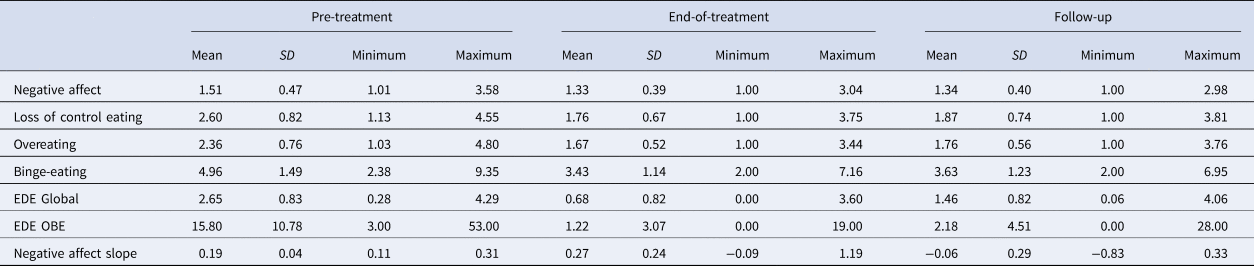
The average number of signals completed per person during each EMA period demonstrated adequate compliance to the protocol [pre-treatment: M = 30.28 ± 8.77 signals/person (68.9% including eating episode reports); end of treatment: M = 25.99 ± 8.39 signals/person (68.4% including eating episode reports); follow-up: M = 27.52 ± 8.48 signals/person (66.0% including eating episode reports)]. Descriptive statistics for variables across assessments are shown in Table 1.
Descriptive statistics

EDE, Eating Disorder Examination.
Note. Binge-eating reflects the sum of the loss of control eating and overeating composites.
Aims 1–2
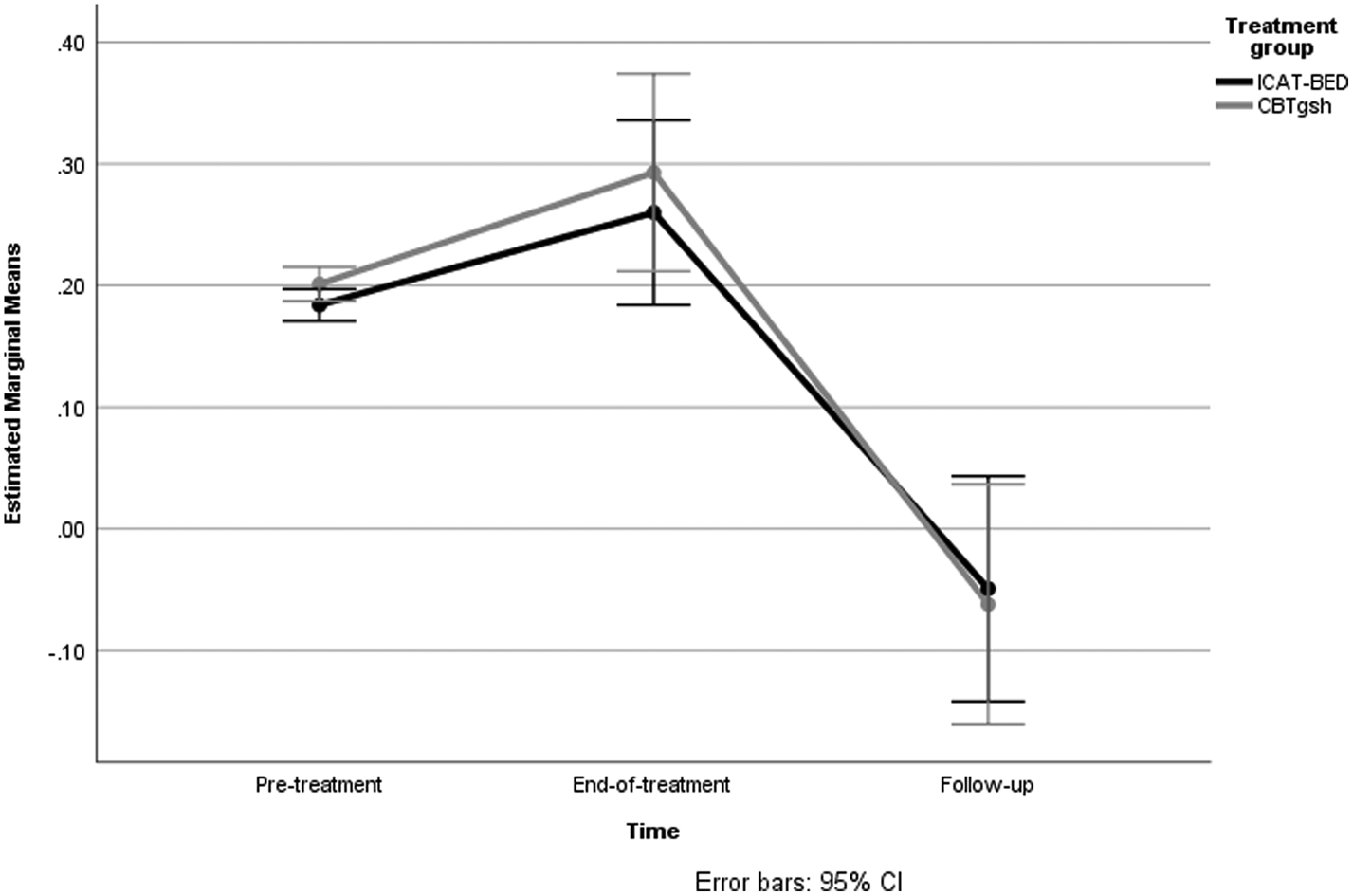
Results of the repeated measures general linear model indicated a significant effect of time, F (2) = 38.69, p < 0.001, but no significant effect of group, F (1) = .28, p = 0.598, or time × group interaction, F (2) = 0.18, p = 0.830. As depicted in Fig. 1, pairwise comparisons showed that across groups, there were significant increases in the negative affect slope from pre-treatment to end-of-treatment (p = 0.003), followed by significant decreases at follow-up, such that the slope at follow-up was lower compared to pre-treatment and end-of-treatment levels (ps<0.001). Thus, while there were initial increases in the strength of association between momentary negative affect and binge-eating symptoms, the magnitude of this association dropped below pre-treatment levels by the 6-month follow-up, in partial support of the Aim 1 hypothesis. In contrast, the lack of interaction with the group did not support the Aim 2 hypothesis, in that the magnitude of de-coupling did not significantly differ by treatment type.
Estimated marginal means of individuals' slope of negative affect at pre-treatment, end-of-treatment, and follow-up.

Exploratory analyses
As exploratory analyses, we also examined the degree to which starting slope values may have impacted the degree of de-coupling within each treatment. To do so, we categorized participants into groups based on treatment condition and quartiles of pre-treatment slope values (ICAT-BED quartile 1-4; CBTgsh quartile 1-4). We then re-ran the repeated measures ANOVA described in Aim 2 using this revised grouping (see details in online supplementary material). Results revealed those with the highest pre-treatment slope values (4th quartile subgroups, reflecting stronger negative-affect binge-eating associations) appeared to experience increases in the coupling of negative affect and binge eating at the end of treatment, yet steeper declines by follow-up. However, the differences between the ICAT-BED and CBT 4th quartile subgroups were minimal across timepoints. Thus, it does not appear that those with higher starting slopes who received ICAT-BED necessarily experienced greater de-coupling compared to those with higher starting slopes who received CBTgsh.
Aim 3
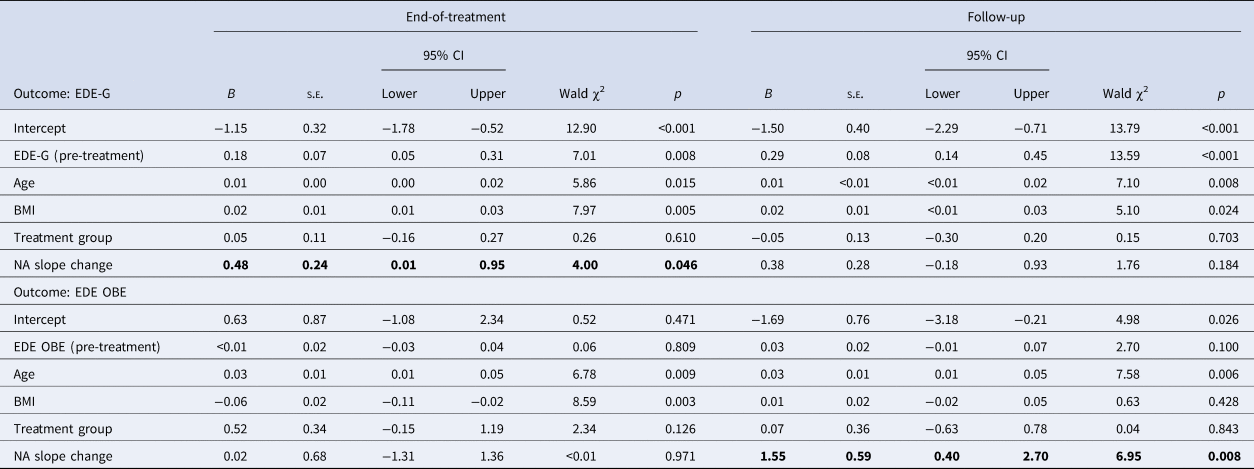
As shown in Table 2, generalized linear model results indicated that less de-coupling (i.e. more positive residual change values) was associated with higher EDE Global scores at end-of-treatment (B = 0.48, s.e. = 0.24, p = 0.046) and higher OBE frequencies at follow-up (B = 1.55, s.e. = 0.59, p = 0.008), controlling for age, BMI, treatment group, and pre-treatment levels of outcome variables. There were no significant effects of residual change scores for EDE Global at follow-up or OBE frequency at end-of-treatment. When the interactions between the treatment group and residual change scores were added to the models, no significant effects emerged for EDE Global scores or OBE frequency at end-of-treatment or follow-up (ps = 0.303–0.877); therefore, the more parsimonious models without these terms are presented in Table 2.
Generalized linear models examining the de-coupling of associations between negative affect and binge-eating as predictors of treatment outcomes

EDE, Eating Disorder Examination; EDE-G, Global score; OBE, objective binge-eating frequency over the past 28 days; BMI, body mass index; NA slope change, residual change in the slope of momentary negative affect predicting binge eating from pre-treatment to end-of-treatment (higher score = less decline in slope).
Bold values indicate p < 0.05.
Note: Treatment group was coded such that ICAT-BED was the reference category.
Discussion
The current study used a person-specific modeling approach to investigate whether this association was de-coupled, or weakened, following two specific BED treatments. Specifically, the magnitude of changes in the micro-level (momentary) association between negative affect and subsequent binge-eating symptoms was calculated for each individual and then used as a predictor of macro-level treatment outcomes. Consistent with expectations, there was a significant decrease or ‘de-coupling’ effect at follow-up across the sample, such that the momentary association between negative affect and binge-eating symptoms was significantly weaker compared to pre-treatment and end-of-treatment; however, contrary to hypotheses, the magnitude of this change did not significantly differ between ICAT-BED and CBTgsh. Furthermore, across treatment groups, individuals who experienced less de-coupling between pre-treatment and end-of-treatment evidenced lesser improvement in cognitive ED symptoms (as indexed by the EDE Global score) at end-of-treatment and lesser improvement in binge-eating frequency at follow-up. Together, these findings illustrate how changes in micro-temporal dynamics are linked to macro-level symptom change and further highlight the need to account for individual variability in momentary processes.
While the overall de-coupling effect was consistent with hypotheses, it was notable that this effect emerged only at follow-up, and that the momentary association between negative affect and binge-eating symptoms strengthened somewhat between pre-treatment and end-of-treatment. These findings are nevertheless consistent with prior EMA research in EDs (Haedt-Matt & Keel, Reference Haedt-Matt and Keel2011) and suggest that heightened negative affect remains a proximal predictor of binge eating at the end-of-treatment in BED. That is, although the primary outcome study showed that individuals' binge eating and negative affect generally decreased over the course of treatment (see Peterson et al., Reference Peterson, Engel, Crosby, Strauman, Smith, Klein and Wonderlichin press), when individuals experienced states of high negative affect, albeit less frequently overall, they were more likely to report subsequent binge-eating symptoms. It is possible that both treatments may have facilitated increased emotional awareness and clarity, particularly with respect to affective states that trigger binge eating. This is supported by the broader literature showing lower levels of emotional awareness and clarity among individuals with EDs (Lavender et al., Reference Lavender, Wonderlich, Engel, Gordon, Kaye and Mitchell2015), as well as research from this sample and other studies indicating that emotion regulation improves over the course of ED treatments such as ICAT and CBT (Bodell et al., Reference Bodell, Pearson, Smith, Cao, Crosby, Peterson and Berg2019; Peterson et al., Reference Peterson, Engel, Crosby, Crow, Smith, Klein and Wonderlich2019; Wonderlich et al., Reference Wonderlich, Peterson, Crosby, Smith, Klein, Mitchell and Crow2014). This may have resulted in response bias in the present study. That is, compared to the pre-treatment EMA, during the end of treatment EMA participants may have more accurately reported the type and intensity of their negative affective states. This could lead to greater consistency in high negative affect ratings occurring prior to binge eating, contributing to an apparent increase in coupling. However, these interpretations are speculative and should be considered tentative until further replication in other samples. Further, it is also possible that there is an increased coupling between negative affect and more adaptive coping over the course of treatment, which would be useful to explore in future studies.
Despite this unexpected finding, there was a significant de-coupling effect by follow-up, indicating that states of high negative affect less reliably predicted subsequent binge-eating symptoms. In line with the tenets of third-wave therapies, it may be that individuals were able to more adaptively cope with aversive emotional states following treatment, and were thus less likely to resort to binge eating in the face of heightened negative affect. While it is unclear why there was a delay in this effect, one possibility is that the initial decreases in symptoms experienced at end-of-treatment facilitated continued improvements and skill acquisition and utilization over the course of follow-up.
Although such findings would ostensibly support the use of interventions that target negative affect and emotion dysregulation to reduce binge eating, it was unexpected that there were no differences between ICAT-BED and CBTgsh groups in the magnitude of de-coupling of negative affect and binge-eating symptoms. One of the main goals of ICAT-BED is to target momentary affective processes that precipitate binge eating by helping patients use adaptive emotion regulation skills (Wonderlich et al., Reference Wonderlich, Peterson and Smith2015). However, these results indicate that CBTgsh is associated with a similar degree of decoupling. This is somewhat consistent with the previous treatment trial comparing ICAT to CBT for BN, which found improvements in emotion regulation were linked to ED symptom improvement across both treatments (Peterson et al., Reference Peterson, Berg, Crosby, Lavender, Accurso, Ciao and Wonderlich2017). It could also be that a more potent dose of treatment would be needed to observe reliable differences in decoupling during treatment.
It is therefore important to consider other potential mechanisms driving de-coupling across both ICAT-BED and CBTgsh. Both ICAT-BED and CBTgsh are integrative treatments share a common focus on planning and self-monitoring, regular eating, and relapse prevention, and these components may similarly contribute to the de-coupling effect in each treatment. For example, by increasing eating consistency and self-regulatory strategies via self-monitoring, individuals in both treatments may have increased their ability to abstain from binge-eating symptoms when experiencing heightened negative affect. Another possible mechanism that is posited to contribute to health behavior change and which is particularly relevant for eating behavior is that of habit processes (Gardner, Reference Gardner2015; van Riet, Sijtsema, Dagevos, & de Bruijn, Reference Van Riet, Sijtsema, Dagevos and De Bruijn2011). For instance, both ICAT-BED and CBTgsh include components that may have effectively targeted learned stimulus-response associations via altering situational cues (e.g. negative affective states) and inhibiting habitual binge-eating responses to such cues (e.g. identifying alternatives that are incompatible with binge eating).
Lastly, and perhaps most importantly, individuals who evidenced less de-coupling by end-of-treatment experienced less improvement in symptoms at the end-of-treatment and follow-up. Juxtaposed with the trend in group-level changes in negative affect slope values, these results underscore the utility of examining individual differences in micro-temporal changes. That is, averaging time series data can fail to capture meaningful symptom dynamics at the person-level. It may be that lesser de-coupling was an indirect indicator of broader emotion regulation problems, such that individuals experiencing less change in the association between negative affect and binge-eating symptoms lacked or had difficulty implementing effective strategies to manage aversive emotions. Consequently, such individuals may be likely to continue to resort to binge eating when experiencing negative affect, which in turn could impede longer-term improvement in symptoms.
The finding that individuals' change in momentary affect-behavior associations was linked to cognitive change (i.e. cognitive restraint and concerns about eating, weight, and shape, as measured by the EDE Global score) is notable, although directionality cannot be inferred given that these changes were observed concurrently between pre-treatment and end-of-treatment. Nevertheless, research has shown positive associations between implicit and explicit emotion dysregulation and EDE scores in BED (e.g. Robinson, Safer, Austin, and Etkin, Reference Robinson, Safer, Austin and Etkin2015), and that emotion dysregulation prospectively predicts higher EDE Global scores in other EDs (Racine & Wildes, Reference Racine and Wildes2015). Together this suggests maladaptive regulation of affect is an important factor maintaining cognitive ED symptoms such as preoccupation with weight and shape. This may account for why individuals who evidenced more consistent associations between negative affect and binge-eating symptoms during treatment (i.e. less de-coupling, perhaps reflecting greater emotion regulation difficulties) experienced less concomitant improvement in ED-related cognitions.
Although individuals' degree of de-coupling was associated with the change in EDE Global scores at end-of-treatment, the most durable effect was observed at follow-up with respect to OBE frequency. This finding is consistent with the possibility that individuals with BED who learn to effectively implement adaptive coping skills and/or disrupt habitual cue-response associations (i.e. negative affect-binge eating) at the momentary level are less likely to engage in binge eating over time. Conversely, greater consistency in the strength of the relationship between negative affect and binge-eating symptoms was prospectively associated with higher OBE frequency, suggesting that a lack of de-coupling may contribute to the maintenance of binge-eating behavior and perhaps increase relapse risk. It would, therefore, be useful for future research to explore internal and external factors that influence changes in momentary affect-behavior associations.
Limitations
Despite several strengths of the study (e.g. multi-wave EMA across the delivery of two empirically supported therapies, use of well-validated measures and therapy protocols, and use of a novel statistical approach), there are notable limitations. The treatments varied in length considerably, which was intentional to test a new treatment with the current standard treatment. In addition, only signal-contingent EMA recording was used in this study, which may have resulted in missing binge-eating episodes. However, missing data are also a problem with an event-contingent recording (i.e. having participants complete surveys when a binge-eating episode occurs; see Smyth et al., Reference Smyth, Wonderlich, Heron, Sliwinski, Crosby, Mitchell and Engel2007), and the use of event-contingent recordings may increase participant burden. Further, the 1-week protocol may have reduced the ability to capture all relevant data points and eating behaviors. The study also did not include a non-treatment control group, and thus it is unclear the extent to which decoupling of negative affect and binge-eating symptoms was specifically due to treatment-related processes or other factors (e.g. passage of time and regression to the mean). Finally, the sample was rather homogenous with regard to race, ethnicity, and sexual orientation, limiting the generalizability of the study findings to other groups.
Conclusions and future directions
Despite these limitations, findings provide novel insights into the association between micro- and macro-level processes underlying symptom change in BED treatment. Both of the therapies examined were associated with de-coupling of momentary affect-behavior associations in daily life, which is a meaningful clinical target in ED populations. Moreover, the magnitude of individuals' de-coupling was linked to treatment outcomes. As implied by affect regulation frameworks, this study lends further evidence that the micro-temporal association between affect and binge eating is an important mechanism to target in order to reduce symptoms and relapse risk. These data also demonstrate the utility of applying statistical approaches that can provide a more nuanced understanding of person-specific symptom dynamics, in line with precision medicine initiatives to develop personalized interventions (Kan, Cardi, Stahl, & Treasure, Reference Kan, Cardi, Stahl and Treasure2019). In addition, it is crucial to develop novel interventions that may help to more effectively de-couple negative affect and binge eating, as group-level effects were only observed at follow-up. One emerging type of intervention is technology-enhanced interventions that intervene on momentary processes in patients' daily life (e.g. just-in-time adaptive interventions; Juarascio, Parker, Lagacey, and Godfrey, Reference Juarascio, Parker, Lagacey and Godfrey2018). In light of the suboptimal outcomes seen in BED (Linardon, Reference Linardon2018), going forward it will be important to explore such approaches and integrate person-specific assessments to enhance outcomes, prevent relapse, and minimize patient cost and burden.
Supplementary material
The supplementary material for this article can be found at https://doi.org/10.1017/S0033291720001804
Acknowledgements
This research was supported by the National Institute of Mental Health (C.B.P., grant number R34MH099040-01A1; S.A.W., grant number R34MH098995; L.M.A. and V.M.H., grant number T32MH082761).
Conflict of interest
None.
Ethical standards
The authors assert that all procedures contributing to this work comply with the ethical standards of the relevant national and institutional committees on human experimentation and with the Helsinki Declaration of 1975, as revised in 2008.