Sunflower is one of the four most important annual crops in the world grown primarily for edible oil. Argentina is the fourth largest producer of oilseed sunflowers globally behind Ukraine, Russia, and the European Union, and one of the largest sunflower oil exporters (ASAGIR 2014). The average area sown to sunflower in Argentina during the years 2014–17 was around 1,700,000 ha. The most important area is Buenos Aires Province, which represents almost 50% of the entire Argentine production (Ministerio de Agricultura de Argentina 2013).
Many studies have documented the susceptibility of sunflower to yield loss from weed interference, particularly at early stages of the crop. Durgan et al. (Reference Durgan, Dexter and Miller1990) reported that kochia [Kochia scoparia (L.) Schrad.], at a population density of six kochia plants per meter of row, caused yield losses of 20% to 36%, depending on water availability. Moreover, when kochia plants emerged jointly with sunflower, yield was reduced up to 76%. Thus, sunflower growers should be proactive against weeds, particularly when the plants emerge at about the same time as the sunflower (Lewis and Gulden Reference Lewis and Gulden2014). In Argentina, Bedmar et al. (Reference Bedmar, Leaden and Eyherabide1983) found that a 20-d weed-free period following sunflower emergence was required to prevent significant yield losses attributable to weed interference. However Montoya et al. (Reference Montoya, Porfiri, Romano and Rodríguez2008) reported that a weed-free period of 30 d was needed to prevent yield reduction.
Flurochloridone, diflufenican, sulfentrazone, flumioxazin, acetochlor, and metolachlor are frequently applied PRE in Argentina to control broadleaf and grass weeds in sunflower (Istilart Reference Istilart2002; Montoya et al. Reference Montoya, Porfiri, Romano and Rodríguez2008). However, the efficacy of these herbicides is strongly dependent on rainfall or irrigation. Sunflower producers have few herbicide options, such as benazolin or aclonifen, for early POST broadleaf weed control in sunflower in Argentina (Montoya Reference Montoya2016). Therefore, the introduction of imidazolinone (IMI)-resistant (IR) sunflowers in Argentina and the concomitant use of IMI herbicides represented a major technological advance for weed control. In IR sunflower, using a PRE herbicide can delay the critical time for weed removal (CTWR) by an additional 6 to 12 d compared to sunflower grown without a PRE herbicide application. The CTWR without PRE herbicide treatment ranged from 14 to 26 d after emergence, corresponding to the V3 (three leaves) to V4 stages. However, a PRE herbicide treatment increased the CTWR 25 to 37 d after emergence, corresponding to the V6 to V8 stages (Knezevic et al. Reference Knezevic, Evans, Blankenship, Van Acker and Lindquist2002; Knezevic et al. Reference Knezevic, Elezovic, Datta, Vrbnicanin, Glamoclija, Simic and Malidza2013). This practice increases weed control efficacy when using IMIs, because weeds often emerge later than without PRE application, and thus, POST IMI application will typically target smaller weeds than without PRE herbicides. This timing is relevant, because the success of this technology depends on the growth stage of the weeds at the time of herbicide application (Fedoruk and Shirtliffe Reference Fedoruk and Shirtliffe2011). In addition, there is also a restriction on sunflower growth stage (one leaf pair to four leaf pairs). Additionally, the residual control offered through PRE herbicide application reduces or prevents weed competition until after the sunflower seed number is already set (between floral initiation, 30 d prior to anthesis, up until 20 d after 50% first anthesis) (Cantagallo et al. Reference Cantagallo, Chimenti and Hall1997).
The IMI herbicides inhibit acetolactate synthase and are used extensively for broad-spectrum weed control in soybeans [Glycine max (L.) Merr.] and other selected legumes, as well as in IR crops. Microbial degradation is the main route of dissipation of these herbicides in the soil; thus, IMI herbicides applied to the soil are affected by soil type, pH, organic matter, moisture, and temperature (Loux and Reese Reference Loux and Reese1993; Kraemer et al. Reference Kraemer, Marchesan, Avila, Machado and Grohs2009). In Argentina, application of herbicides such as imazapyr and imazamox to IR sunflower is the chief technology used to control weeds. Growers commonly apply herbicides when the crop is at the V4 stage, when broadleaf weeds are at the two- to four-leaf stage, or when grasses have three leaves. Persistence of the IMI herbicides applied to IR sunflower could cause phytotoxicity on certain crops included in the rotation. This persistence is related largely to the amount of rain between herbicide application and planting of the next crop (Istilart Reference Istilart2005). In the south and west of Buenos Aires Province, where this technology has been widely adopted, it is a concern for farmers that herbicide carryover may affect the establishment and growth of winter cereals or green manures sown during autumn and winter following sunflower harvest.
Imazapyr was released in Argentina in 2003 to be applied early POST at 80 g ai ha–1 in IR sunflowers. The main advantages of this technology are the broad-spectrum weed control and residual effect. However, the potential for imazapyr carryover and the impact on crop rotation options have not been well described (Montoya et al. Reference Montoya, Porfiri, Romano and Rodríguez2008). Moreover, reports were published indicating residual carryover damage to alfalfa (Medicago sativa L.), oat, rye (Secale cereale L.), sugar beet (Beta vulgaris subsp. vulgaris), pea (Pisum sativum L.), melon (Cucumis melo.), corn (Zea mays subsp. mays), pepper (Capsicum annuum L.), and tomato (Solanum lycopersicum L.) when they were planted in rotation with crops where IMI herbicides had been applied (Alister and Kogan Reference Alister and Kogan2005). Recently, a new herbicide formulation containing a mixture of imazamox and imazapyr (33 and 15 gaiL–1, respectively) has become available in Argentina with the aim of reducing potential carryover to cereal crops. Accordingly, the objective of this study was to evaluate the carryover potential of IMI herbicides on the establishment, growth, and yield of barley, wheat, and oat planted in rotation with IR sunflowers. In addition, we studied the effects of these herbicides on germination and seedling growth of these crops by means of controlled bioassay experiments.
Materials and Methods
Two field experiments were established at the Agricultural Experimental Station (EEA) INTA Anguil, west Buenos Aires Province (36°50′ S, 64° W) and two at EEA INTA Bordenave, southwest Buenos Aires Province (37°10′ S, 63° W) in 2009–2010 and 2011–2012. Another experiment was conducted at EEA INTA Hilario Ascasubi, south Buenos Aires Province (39°20′ S, 62°30′ W) in 2011–2012. In addition, soil bioassay experiments were conducted at Bordenave during 2009–2010 and 2011–2012 and at Tres Arroyos during 2009–2010.
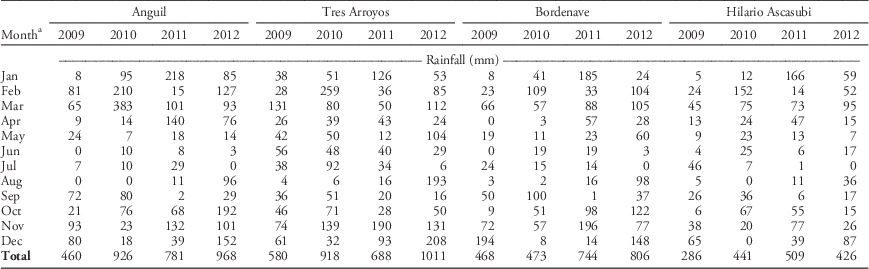
Historical average annual rainfall in Anguil, Bordenave, and Tres Arroyos is 759, 677, and 758 mm, respectively; annual rainfall in Hilario Ascasubi is lower than in other areas (491.9 mm), but crops are often supplemented with irrigation (Table 1). In Anguil, typical soils are sandy loam Haplustolls, with 2.5% organic matter (OM) and pH 6.4. Soils in Bordenave are also loam Haplustolls, with pH 6.4 and 3.3% OM, whereas soils in Tres Arroyos are sandy-clay loam Argiudolls containing 3.8% OM with pH 6.3. In Hilario Ascasubi, soils are a sandy loam Haplustolls but with less OM (1.2%) and higher pH (7.5) than in the other areas.
Monthly rainfall (mm) at experimental stations during 2009, 2010, 2011, and 2012.

a Abbreviations: Jan, January; Feb, February; Mar, March; Apr, April; Jun, June; Jul, July; Aug, August; Sep, September; Oct, October; Nov, November; Dec, December.
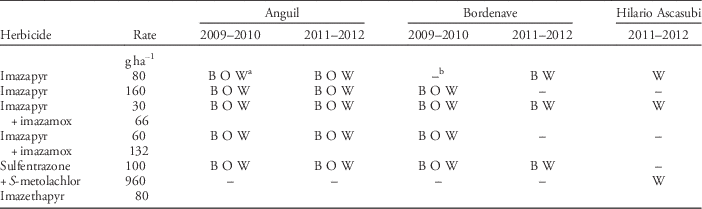
At Anguil in 2009–2010 and 2011–2012, treatments were arranged in a split-plot design with herbicide treatment as the whole plot and the crops sown after the sunflower harvest as split-plots. Herbicide treatments in sunflower (Table 2) were applied when broadleaf weeds were at the two- to four-leaf stage on December 12, 2009 (30 d after sunflower emergence). Barley, oat, and wheat were sown at recommended population densities (300 plants m–2) 90 days after the sunflower harvest on June 23. In 2011–2012, herbicide treatments were applied to sunflower on December 1 (26 d after sunflower emergence), and barley, wheat, and oat were sown at 300 plants m–2 on June 19, 100 d after sunflower harvest. Non-IMI control plots were treated with PRE herbicides (Table 2). In addition, propaquizafop was applied post emergence. The effect of IMI treatments was compared to these plots.
Herbicide treatments applied and crops sown in field experiments conducted in Anguil, Bordenave, and Hilario Ascasubi.

a Abbreviations: B, barley; O, oat; W, wheat.
b Dash (–) indicates that treatment was not included at location/year.
At Bordenave in the 2009–2010 trial, treatments in each crop were arranged in a split-plot design, with herbicide treatment as the whole plots and sowing date as split-plots. Herbicide treatments (Table 2) were applied on January 15, 2010 (32 d after sunflower emergence). Barley, oat, and wheat were sown at recommended densities (between 180 and 220 plants m–2) on April 10 and at 230 to 250 plants m–2 on July 1. In 2011–2012, the trial was arranged as a randomized complete block, and herbicide treatments (Table 2) were applied on October 15, December 1, January 15, and March 1 (240, 195, 150, and 105 d before cereal crop sowing). In non-IMI control plots, weeds were controlled by means of PRE application of sulfentrazone plus S-metolachlor. Barley and wheat were sown at recommended densities (250 plants m–2) on June 15.
At Hilario Ascasubi in 2011–2012, treatments were arranged in a split-plot design with timing of herbicide application as the main plot and herbicides treatment as the split-plot. Herbicide treatments (Table 2), were applied on four dates (September 21, November 4, January 12, and March 5) 268 to 104 days before the sowing. Wheat was sown at recommended population density (250 plants m--2) on June 19.
Plot size in Anguil was 10 by 10 m; in Bordenave and Hilario Ascubi, plot size was 5 by 10 m. Four replications of each treatment were established in each experiment at all locations. All the cereal crops were fertilized with 55 kg P ha–1 and 76 kg N ha–1 at sowing. Weeds in cereal crops were controlled with metsulfuron-methyl plus dicamba applied before the beginning of the crop tillering or 2,4-D plus dicamba from the beginning to the end of tillering. Herbicides were applied with a tractor-mounted, compressed-air sprayer calibrated to deliver 100 Lha–1 at 294 kPa using flat-fan nozzles.
Wheat, barley, and oat seedlings were counted 30 to 40 d after emergence in three 1-m² quadrats within each plot. At Anguil and Bordenave, crops were harvested at maturity from 0.5-m² quadrats in each plot, and dry biomass was measured after drying for 48 h at 60 C. Grain yield was also assessed from 5.75-m² quadrats within each plot. At Hilario Ascasubi, each plot was harvested by combine, and grain yield was measured.
Soil Bioassay Experiments
Soil experiments were conducted at Bordenave during 2009–2010 and 2011–2012 and at Tres Arroyos during 2009–2010. Soil samples were extracted from field-treated plots at depths of 0–10 cm and 10–20 cm to determine the impact of herbicide carryover on seedling establishment and growth. At Tres Arroyos, herbicide treatments were the same as those described at Anguil (Table 2), applied on January 15, 2010. Control plots were treated with fluorochloridone (375 g ai ha–1) and acetochlor (900 g ai ha–1).
At Bordenave, soil samples were taken at 120 and 180 d after application (DAA) during 2009–2010, and bioassays were conducted with barley, oat, and wheat. During 2011–2012, samples were taken at 105, 150, 195, and 240 DAA, and bioassays were conducted with barley and rapeseed (Brassica napus L.). At Tres Arroyos, oat and wheat bioassays were conducted using soil samples taken 230 DAA.
Soil samples collected from each plot were sifted through a 1-mm-mesh sieve stored in a freezer for a month; after that 700 g of soil was placed in each pot. Three replications were prepared for each treatment, with seeds of wheat, oat, barley, or rapeseed sown in each pot. Pots were placed in a growth chamber under controlled conditions: 12 h of light and alternating temperatures of 18 C and 25 C (night/day). The pots were watered so as to maintain soil at field capacity, using the same amount of water for each pot. When wheat, barley, or oat seedlings reached Zadoks stage 12 (Zadoks et al. Reference Zadoks, Chang and Konzak1974), number of emerged seedlings, root length and seedling height (cm), and shoot and root dry weights (g) were assessed. For rapeseed, seedlings were counted when they reached the two-leaf growth stage.
Statistical analyses were carried out with the InfoStat statistical software (Facultad de Ciencias Agropecuarias, UNC, Argentina). Because experimental designs and treatments were not identical for the different experiments because different logistic resources were available at each site, analyses were conducted separately for each experiment, location, and year. Thus, location and year were not considered as classification variables in the analyses. For all bioassays, data were analyzed separately for each crop, and the ANOVA was carried out as a randomized complete block design regarding each date of soil sampling×herbicide treatment. All data were subjected to ANOVA with statistical models suited to the experimental design of each experiment, after which, when the F-test indicated effects were significant (P<0.05), means were separated using Fisher’s protected LSD (P<0.05).
Results and Discussion
2009–2010 Field Experiments
Bordenave
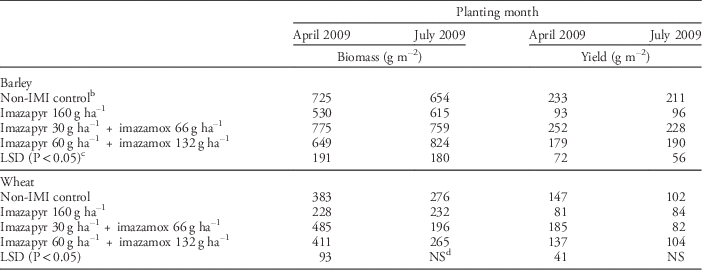
The number of emerged seedlings was not affected by herbicide treatment (P>0.05) in any crop (data not shown). Imazapyr applied at 160 gha–1 reduced barley and wheat biomass and yield when crops were sown in April, but herbicide treatments did not affect oat biomass or yield. When crops were sown in July, imazapyr also reduced barley yield (Table 3). Rainfall between herbicide application and cereal crop sowing, around 210 mm and 240 mm for the April and July sowing, respectively, was not sufficient to reduce imazapyr levels, through either degradation or dissipation, to amounts that were safe for planting barley and wheat. Although 165 d passed between herbicide application and the July sowing, imazapyr at double rate was persistent enough to reduce barley yield. The effects of the double dose represent the damage that can be generated when overlaps occur in the application strips.
Barley and wheat mature biomass and yield at two sowing times with different herbicide treatments at Bordenave (2009–2010).Footnote ª

a Herbicide treatments were applied to sunflower on January 15, 2010. Barley and wheat were sown on April 10 and on July 1, 2010, and biomass and yield were measured on December 5 and 20, 2010, respectively.
b Herbicide treatment: Sulfentrazone (100 g ha–1) + S-metolachlor (960 g ha–1). Abbreviation: IMI, imidazolinone.
c Data were analyzed by ANOVA regarding the split-plot design. Means were separated using Fisher’s protected LSD (P<0.05).
d Non-significant (NS) differences (P>0.05).
Anguil
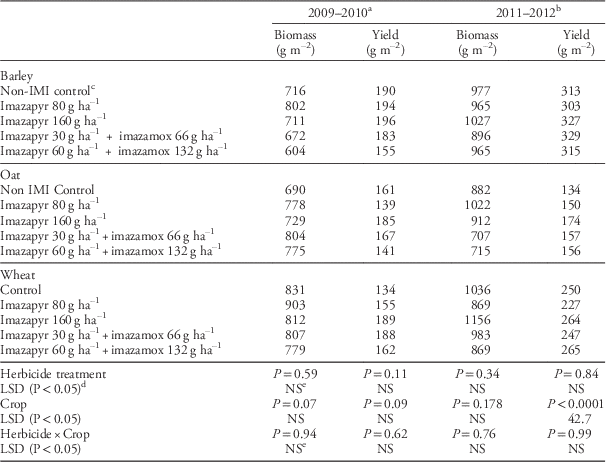
Similarly to Bordenave, there was no effect of herbicide on barley, oat, or wheat establishment. Rainfall from December to June was around 700 mm, and crop grain yield and total biomass were not affected (P>0.05) by herbicide treatment, nor was there a significant interaction between herbicide treatment and crop (Table 4). This result, contrasted with Bordenave, shows the importance of the rainfall regime on microbial degradation of these herbicides to reduce carryover on crops in the rotation. Cantwell et al. (Reference Cantwell, Liebl and Slife1989) concluded that microbial degradation of the IMI herbicides was a function of the amount of herbicide in the soil solution.
Barley, wheat, and oat mature biomass and yield response to carryover of herbicide treatments applied in a previous sunflower crop in Anguil.

a Herbicide treatments were applied to sunflower on December 12, 2009. Small-grain crops were sown on June 23, 2010, and biomass and yield were measured on December 10, 2010.
b Herbicide treatments were applied to sunflower on December 1, 2011. Small-grain crops were sown on June 19, 2012, and biomass and yield were measured on December 12, 2012.
c Herbicide treatment: PRE: Sulfentrazone (100 gha–1) + S-metolachlor (960 gha–1), and POST: propaquizafop (150 cm3ha–1). Abbreviation: IMI, imidazolinone.
d Data were analyzed by ANOVA regarding the split-plot design. Means were separated using Fisher’s Protected LSD (P<0.05).
e Non-significant (NS) differences (P>0.05).
2011–2012 Field Experiments
Bordenave
The number of seedlings was not affected by herbicide treatment (P>0.05) in any crop (data not shown). Wheat biomass and grain yield were not affected by any herbicide treatment at the rates tested, regardless of application timing. Rainfall was at least 320 mm between treatment application and sowing. However, barley yield was reduced when sown 105 d after imazapyr (80 gha–1) application with 187 mm rainfall between application and sowing (data not shown).Thus, it is possible to conclude that 300 mm rainfall during 150 d from the application are sufficient to allow for sowing winter cereals into fields that were previously treated with the IMI herbicides imazapyr and imazamox in a sunflower crop. This result is in agreement with Ball et al. (Reference Ball, Yenish and Alby2003), who also found that barley was more sensitive than wheat to imazamox and that yield of spring wheat grown after pea treated with imazamox was reduced only with a rate of 90 gha–1, but spring barley was reduced by 45 gha–1. Moreover, imazamox application at 36 gha–1 injured barley and canola grown 1 year after imazamox treatment at locations in Oregon with low rainfall (400 mm) and low soil pH, but injury was not observed at locations with higher rainfall.
Anguil
Even though rainfall between January and June was 217 mm less than during the 2009–2010 growing season (Table 1), still no effect of herbicide treatments or interactions of herbicide and crop on biomass and grain yield were apparent (P>0.05) (Table 4). Total rainfall between January and June was 501 mm.
Hilario Ascasubi
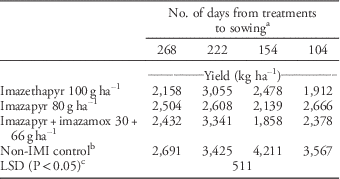
Herbicide treatments reduced yield when applied at either 104 or 154 d before sowing (Table 5). Further, imazapyr reduced wheat yield when applied 222 d before sowing, showing greater carryover than in Anguil and Bordenave. However, herbicide treatments applied 265 d before the sowing did not reduce grain yields. The lower OM, lower rainfall, and higher pH at Hilario Ascasubi explain the greater herbicide carryover when compared with Bordenave and Anguil.
Wheat yield as influenced by timing of imazethapyr and imazapyr application in Hilario Ascasubi.

a Herbicides were applied on September 21, 2011, November 4, 2011, January 12, 2012, and March 5, 2012, and wheat was sown on June 19, 2012.
b Herbicide treatment: Sulfentrazone (100 g ha–1) + S-metolachlor (960 gha–1). Abbreviation: IMI, imidazolinone.
c Data were analyzed by ANOVA regarding the split-plot design. Means were separated using Fisher’s protected LSD (P<0.05).
The ionization coefficients (pKa) of the carboxylic group of imazethapyr, imazapyr, and imazamox are 3.9, 3.6, and 3.3, respectively (PPDB, 2016). For weak acids such as these herbicides, when the pH of the soil solution is equal to the pKa, the molecules are 50% associated neutral (COOH) and 50% dissociated or anionic (COO–) (Kraemer et al. Reference Kraemer, Marchesan, Avila, Machado and Grohs2009). If the pH is higher than the pKa, dissociated molecules predominate, and if pH is below the pKa, neutral molecules predominate. At soil pH values of 5 or greater, these compounds primarily exist as negative ions and are weakly sorbed (Mangels Reference Mangels1991). In contrast, adsorption increases with high OM content in the soil and when pH values decrease (Gianelli et al. Reference Gianelli, Bedmar and Monterubbianesi2011). Although these herbicides differ only slightly in chemical structure, they have widely different potential for carryover injury to subsequent crops (Bhalla et al. Reference Bhalla, Hackett, Hart and Lignowski1991). Imazamox has the shortest rotational restrictions, because it dissipates relatively rapidly compared to other IMI herbicides and thus allows the planting of crops after a shorter interval (Aichele and Penner Reference Aichele and Penner2005; Shaner and Hornford Reference Shaner and Hornford2005). At pH 7, the half-life for imazamox was 1.4 wk; for imazethapyr it was 16 wk (Aichele and Penner Reference Aichele and Penner2005). In addition, among the IMI herbicides, metabolism followed the sequence imazamox > imazethapyr > imazaquin, with metabolism greater at pH 7 than pH 5 (Aichele and Penner Reference Aichele and Penner2005). Imazapyr is not easily degraded in soil and can be very persistent, depending on the type of soil, environmental conditions, and the rate of application (Mangels Reference Mangels1991). The persistence of imazapyr in the soil is mainly affected by microbial degradation. Soil half-life (time required for 50% of the pesticide originally applied to degrade into other products) ranged between 25 and 142 d, being shorter in sandy soil and with elevated temperatures and rainfall (Tu et al. Reference Tu, Hurd and Randall2004, cited in Gianelli et al. Reference Gianelli, Bedmar and Monterubbianesi2011).
In addition, fields treated with IMI herbicides such as imazapic and imazapyr require rainfall >300 mm for the degradation of these herbicides to allow planting oats, wheat, and malting barley without risk of phytotoxicity (Istilart Reference Istilart2005). Our results are in agreement with those of Istilart (Reference Istilart2005), whose recommendations for use of imazamox plus imazapyr in Argentina include a crop rotation restriction of at least 3 mo for barley, wheat, and rye, and 5 mo for oat, rice, and corn. However, our results showed barley to be more sensitive than oat. These results are in agreement with Alister and Kogan (Reference Alister and Kogan2005), who reported barley to be more sensitive than oat after application of the IMI herbicides imazapyr plus imazapic.
IMI herbicide adsorption to colloids increases as the soil dries, rendering them unavailable for microbial degradation. Among the factors that affect microbial activity are moisture, temperature, pH, oxygen, and nutrient supply. Usually a warm, well-aerated, fertile soil with a neutral pH is the most favorable for microbial growth and therefore for herbicide degradation. For IMI herbicides, temperature and moisture are more important factors than soil pH to increase microbial activity.
Bioassay Studies
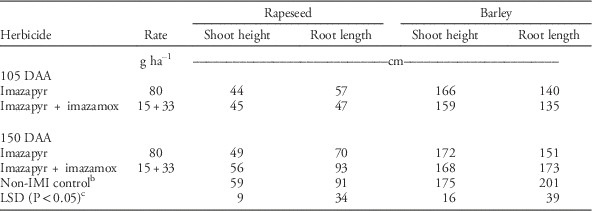
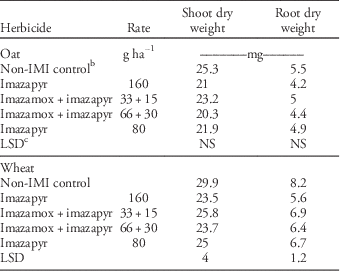
For soil collected at Bordenave during the 2009–2010 season, soil bioassays did not show differences (P > 0.05) between herbicide treatments and sample depth regardless of crop planted (data not shown). For soil collected at Bordenave during 2011–2012, root length and seedling height for rapeseed and barley were less than those of control plots for soil samples taken from 0 to 10 cm depth 105 DAA (Table 6), but no differences were found when samples were taken from 10 to 20 cm depth. Samples taken 150 DAA showed effect on rapeseed shoot height and root length of barley. Interestingly, growth of rapeseed was also reduced in samples taken 240 DAA (data not shown). For soil collected from Tres Arroyos, there was no significant effect (P > 0.05) on oat seedlings and root dry biomass, but all the treatments reduced wheat seedling and root dry biomass (Table 7). Gianelli et al. (Reference Gianelli, Bedmar and Monterubbianesi2011) reported that imazapyr applied at 80 and 160 gha–1 reduced wheat seedling dry weight 25% and 53% compared with the control, respectively, at 138 DAA. It was necessary that 5 to 9 mo pass and for 500 to 730 mm of rain to fall after application of imazapyr to IR sunflower before wheat could be planted without risk of injury. However, the results from bioassay experiments should be considered only as indicative, because damage exhibited in a bioassay may not reflect yield loss in crop fields. It should be noted, however, that residual effects of herbicides may reduce growth and/or yield in more advanced stages than those considered by seedling bioassays because of the movement of herbicides in soil.
Shoot height and root length of rape and barleyFootnote a grown in soil samples in 2011–2012 at Bordenave.

a Samples were taken from a depth of 0 to 10 cm 150 and 105 DAA (days after application).
b Herbicide treatment: Sulfentrazone (100 gha–1)+S-metolachlor (960 gha–1). Abbreviation: IMI, imidazolinone.
c Data were analyzed by ANOVA regarding the split-plot design. Means were separated using Fisher’s protected LSD (P<0.05).
Shoot and root dry weight for oat and wheat grown in soil samplesFootnote a at Tres Arroyos (2009–2010).

a Samples were taken from a soil depth of 0 to 10 cm at 230 DAA (days after application).
b Herbicide treatment: fluorochloridone (375 g ai ha–1) and acetochlor (900 g ai ha–1). Abbreviation: IMI, imidazolinone.
c For each crop, data were analyzed by ANOVA regarding the randomized complete block design. Means were separated using Fisher’s protected LSD (P<0.05).
The main implication of this research is that applying the combination of imazamox plus imazapyr in sunflower is safer than imazapyr alone. In addition, barley was more sensitive than other winter cereals, particularly to imazapyr. However, 300 mm rainfall between application and the sowing was enough to avoid phytotoxic effect when herbicides were applied at recommended rates. Although the technology of IR crops is a highly effective means to help control weeds in sunflower, it must be used carefully because of the high probability to select for resistant biotypes of different types of weeds to this group of herbicides.
Acknowledgments
This study was financially supported by UBACyT G019 (2008-2011) and 20020100100440 (2011–2014), and PICT 2012-0936, carried out at INTA Experimental Stations (Instituto Nacional de Tecnología Agropecuaria), Anguil, Barrow, and Bordenave.
The authors also thank colleagues from BASF Argentina for their logistical support.
The authors extend special thanks to Michael Owen for his assistance in preparing the manuscript.