Introduction
The Cerrado Domain in Brazil is the most diverse savanna globally and originally covered ca. 2 million km2 (Forzza et al. Reference Forzza, Baumgratz, Bicudo, Canhos, Carvalho, Coelho, Costa, Costa, Hopkins, Leitman, Lohmann, Lughadha, Maia, Martinelli, Menezes, Morim, Peixoto, Pirani, Prado, Queiroz, Souza, Souza, Stehmann, Sylvestre, Walter and Zappi2012, Ratter et al. Reference Ratter, Ribeiro and Bridgewater1997). Although more than 50% of the Cerrado has already been replaced due to human activity (Strassburg et al. Reference Strassburg, Brooks, Feltran-Barbieri, Iribarrem, Crouzeilles, Loyola, Latawiec, Oliveira Filho, Scaramuzza, Scarano, Soares-Filho and Balmford2017), the largest extension of well-conserved and protected Cerrado is the Jalapão region, in the far east of Tocantins state (Antar & Sano Reference Antar and Sano2019, Silva & Bates Reference Silva and Bates2002). The main reasons for the Jalapão region still being mostly undisturbed are the dystrophic soils, low human density, the presence of traditional community lands (quilombolas’ homelands – maroon communities) that are mostly well conserved, and large legally protected areas, of which the most important are Jalapão State Park (JSP), the Serra Geral do Tocantins Ecological Station, Jalapão Environmental Protection Area (JEPA) and Nascentes do Parnaíba National Park (Camarâ & Leite Reference Câmara and Leite2005, Schmidt et al. Reference Schmidt, Figueiredo and Scariot2007, Silva & Bates Reference Silva and Bates2002). The region is also recognised for its high plant diversity, which, although not completely known, is expected to number more than 1000 species, many of them recently described (Antar & Sano Reference Antar and Sano2019, Araújo et al. Reference Araújo, Antar and Lombardi2016, Barbosa-Silva & Antar Reference Barbosa-Silva and Antar2020, Devecchi & Pirani Reference Devecchi and Pirani2015, Moreira et al. Reference Moreira, Antar, Simão-Bianchini and Cavalcanti2017, Pastore & Antar Reference Pastore and Antar2021, Proença et al. Reference Proença, Farias-Singer and Gomes2007).
One of the major abiotic factors traditionally associated with the ecology and evolution of the Cerrado Domain flora is fire (Coutinho Reference Coutinho1990, Miranda et al. Reference Miranda, Bustamante, Miranda, Oliveira and Marquis2002, Pivello, Reference Pivello2011, Simon et al. Reference Simon, Grether, Queiroz, Skema, Pennington and Hughes2009). In the Jalapão region, fire occurrence is widespread. It generates a mosaic of different degrees of disturbance across the landscape, making it very hard to find areas unburned for more than 3 years (Pereira Jr. et al. Reference Pereira-Júnior, Oliveira, Pereira and Turkman2014, Schmidt et al. Reference Schmidt, Figueiredo and Scariot2007, Schmidt et al. Reference Schmidt, Moura, Ferreira, Eloy, Sampaio, Dias and Berlinck2018). In this environment, the fire occurrence is natural and has shaped its physiognomy and diversity for about 4 million years (Simon et al. Reference Simon, Grether, Queiroz, Skema, Pennington and Hughes2009). Several studies have recognised the importance of fire in structuring plant communities. For example, burned areas in the Cerrado of the Federal District show higher species richness in the herbaceous layer than in unburned areas (César Reference César1980); frequent fires promote intense flowering in several herbaceous species (Coutinho Reference Coutinho1976, Fidelis & Zirondi Reference Fidelis and Zirondi2021); herbaceous species composition differs among areas with different fire frequencies in the Cerrado of southwestern Goiás State (Loiola et al. Reference Loiola, Cianciaruso, Silva and Batalha2010); richness and diversity were higher in experimentally burned areas than in unburned areas of the Jalapão region (Santos Reference Santos2019); and recurrent burns during the year increase the dominance of Poaceae in the herbaceous layer (Miranda Reference Miranda2002).
Over time and especially in recent decades, human beings have changed the natural fire regimes according to their activities, increasing frequency and moving the season to the driest period (Pivello Reference Pivello2011, Pivello et al. Reference Pivello, Vieira, Christianini, Ribeiro, da Silva Menezes, Berlinck, Melo, Marengo, Tornquist, Tomas and Overbeck2021, Schmidt et al. Reference Schmidt, Moura, Ferreira, Eloy, Sampaio, Dias and Berlinck2018). In the 1980s, studies that were part of the Fire Project (Projeto Fogo at IBGE Reserve) started to investigate the consequences of human-induced fire regimes on the Cerrado biodiversity (Dias & Miranda Reference Dias, Miranda and Miranda2010). These studies were focused on the woody plants and corroborated previous research (e.g., Coutinho Reference Coutinho1976) showing that frequent fires would decrease woody plant density and diversity (Hoffmann Reference Hoffmann1999, Sato et al. Reference Sato, Miranda, Maia and Miranda2010, Montenegro Reference Montenegro2019) and generate open physiognomies dominated by grasses and subshrubs, with few woody elements. On the other hand, fire suppression would favour the woody vegetation to the detriment of herb and subshrub species, leading to more woody physiognomies (Miranda et al. Reference Miranda, Neto, Neves and Miranda2010, Moreira, Reference Moreira2000). Further studies have shown that fire exclusion may cause woody plant encroachment and drive the savanna formation to a forest physiognomy (Abreu et al. Reference Abreu, Hoffmann, Vasconcelos, Pilon, Rossatto and Durigan2017, Gonçalves et al. Reference Gonçalves, Cardoso, Oliveira and Oliveira2021, Mariano et al. Reference Mariano, Rebolo and Christianini2019, Moreira Reference Moreira2000, Stevens et al. Reference Stevens, Lehmann, Murphy and Durigan2017).
For several decades, the diversity of the Cerrado herbaceous flora had been neglected in floristic studies, and only more recently has its role as an essential component of the Cerrado biodiversity become clear (Amaral et al. Reference Amaral, Munhoz, Walter, Aguirre-Gutierrez and Raes2017, Durigan et al. Reference Durigan, Pilon, Assis and Souza2018). It is now known that the herbaceous component represents about 80% of the biome plant species, making the Cerrado the richest savanna in the world, with more than 12,700 species (BFG 2015, Durigan et al. Reference Durigan, Pilon, Assis and Souza2018), being most of them – as components of the herbaceous layer – fire-dependent. Also, considering the most abundant or rarest species, the exclusion of fire in the open Cerrado Domain can reduce the diversity of the herb–subshrub layer compared to areas that are burned biennially (Santos Reference Santos2019).
In the Jalapão region, there is a high demand for knowledge on the biodiversity of protected areas and the factors that regulate them, mostly to direct management for their conservation. Some studies on this subject have been recently conducted but focused mostly on swampy palm forests (veredas) and wet fields (Borges et al. Reference Borges, Eloy, Schmidt, Barradas and Santos2016, Schmidt et al. Reference Schmidt, Fidelis, Miranda and Ticktin2017). On the other hand, the unflooded open savannas, the most common physiognomies in the region (Antar & Sano Reference Antar and Sano2019), have been overlooked, with few recent and yet unpublished studies (Montenegro Reference Montenegro2019, Santos Reference Santos2019). Therefore, our aim in this study is to investigate the plant diversity of the herbaceous stratum across different unflooded open savannas in the Jalapão region. Specifically, we compared species density, richness, diversity, and composition in four areas with different fire regimes. We hypothesised that the species composition and structure would differ between areas and that recurrent fires in some areas conditioned the herbaceous stratum to higher density and diversity. Our results can provide detailed information about the spatial variation of plant diversity and fire management in protected areas of the Jalapão region.
Material and methods
Study area
This study was carried out in two neighbouring, protected areas in the Jalapão region (Tocantins state, Brazil): the JSP (10°08’-10°35’ S; 47°04’-47°35’ W) and the JEPA, which surrounds the JSP. The extension of JSP is 158.885 ha (Seplan 2003a), while that of JEPA is 461.730 ha (Seplan 2003b). The regional climate is tropical seasonal, with humid summers and dry winters (Köppen’s Aw) (Alvares et al. Reference Alvares, Stape, Sentelhas, Gonçalves and Sparovek2014). Mean temperatures vary from 23.5 to 26.5 °C, and annual precipitation is ca. 1,500 mm, with 90% of rainfall concentrated between October and March (Seplan 2012). The most common phytophysiognomies in the region are (i) the veredas (riverine palm forest) with the frequent presence of the palm tree Mauritia flexuosa L.f, and (ii) open savannas in unflooded fields, mostly the campo sujo (Antar & Sano Reference Antar and Sano2019, Silva et al. Reference Silva, Amaral, Bijos and Munhos2018). These broad areas of open savannas are characterised almost entirely by a continuous herbaceous layer, while scattered shrubs and trees cover up to 3% of the area (Coutinho, Reference Coutinho, Huntley and Walker1982, Henriques Reference Henriques, Souza-Silva and Felfili2005, Moreira Reference Moreira2000, Ribeiro & Walter Reference Ribeiro, Walter, Sano, Almeida and Ribeiro2008).
Economic activities in the region are mostly related to tourism and secondarily to subsistence agriculture and extensive cattle raising (Câmara & Leite, Reference Câmara and Leite2005, Eloy et al. Reference Eloy, Schmidt, Borges, Ferreira and Santos2018, Schmidt et al. Reference Schmidt, Figueiredo and Scariot2007), in which a common practice is to burn the native vegetation in the dry season to promote plant resprouting to feed the animals (Schmidt et al. Reference Schmidt, Moura, Ferreira, Eloy, Sampaio, Dias and Berlinck2018). The burning of native pastures may lead to fire spreading and accidental wildfires in the surrounding areas (Pereira et al. Reference Pereira-Júnior, Oliveira, Pereira and Turkman2014). On the other hand, seasonal fire management by traditional cattle ranchers may prevent the spread of wildfires in the Brazilian Cerrado (Eloy et al. Reference Eloy, Schmidt, Borges, Ferreira and Santos2018, Pivello et al. Reference Pivello, Vieira, Christianini, Ribeiro, da Silva Menezes, Berlinck, Melo, Marengo, Tornquist, Tomas and Overbeck2021). Large-scale agriculture has not reached this region yet, mostly due to the sandy soils and poor infrastructure for access. However, the agricultural business is expanding its frontiers towards Jalapão (Antar & Sano Reference Antar and Sano2019, Antar et al. Reference Antar, Santos and Sano2017, Barbosa-Silva & Antar Reference Barbosa-Silva and Antar2020, Borges & Antar Reference Borges and Antar2016).
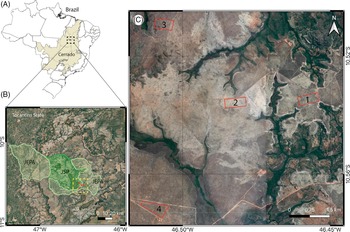
To develop this study, we selected four campo sujo sites (open savanna with scattered woody elements) of approximately 30 ha each, with maximum and minimum distances in a straight line of 7 and 2.7 km and spread over 64 km2 (Figure 1). For decades, three sites have been under a high fire frequency of about 2 years: sites 1 (10°32’07”S; 46°27’14”W), 2 (10°32’05”S; 46°28’51”W) and 3 (10°30’35”S; 46°30’22”W), while at site 4 (10°34’19”S; 46°30’97”W) fire has been suppressed for the last 10 years. Site 4 was the only area protected from fire for a relatively long time that we could find since burning every 2 years is a widespread practice in the region (Pereira-Júnior et al. Reference Pereira-Júnior, Oliveira, Pereira and Turkman2014, Schmidt et al. Reference Schmidt, Figueiredo and Scariot2007). This area has remained unburned for at least 10 years because it is near the JSP guesthouse and surrounded by firebreaks, which are burned every year. The sites selection was based on information about the last burning event provided by the personnel of the protected areas who have worked there for more than 10 years. In addition, we confirmed the burning history for sites 2, 3 and 4 in satellite images from the past 10 years with 1-km resolution (INPE – http://queimadas.dgi.inpe.br/queimadas/aq1km). However, we could not recover the burning history for site 1 due to the unavailability of satellite images.
Study area. A. The Cerrado Domain and Jalapão region, Tocantins state, Brazil. B. Jalapão State Park (JSP) and Jalapão Environmental Protection Area (JEPA). The yellow square is shown in detail in C. C. Satellite image of the four campo sujo study sites spread over 64 km2. Sites 1, 2 and 3 are burned every other year, and site 4 has remained unburned for at least 10 years. Source: Coordenação de Mosaicos e Corredores Ecológicos/DIREP/ICMBio.

The four sites are at similar altitudes (ca. 520 m asl) and have similar temperature and precipitation conditions. Also, the vegetation structure and soil characteristics are similar among them (Santos et al. Reference Santos, Crema, Szmuchrowski, Asano and Kawaguchi2011). We quantified organic matter and texture at the soil surface (0–5 cm) through five randomly collected soil samples at each site. The granulometric analyses followed the Boyocus dosimeter method (Camargo et al. Reference Camargo, Moniz, Jorge and Valadares1986). The organic matter was estimated by oxidation with sodium dichromate in H2SO4 and quantified by colorimetry (Raij et al. Reference Raij, Quaggio, Cantarella, Ferreira, Lopes and Bataglia1987). There is no history of human impact in the area, and native herbivorous animals are rare, represented mainly by the pampas deer (Ozotocerus benzoarticus), a species threatened with extinction (Chiarello et al. Reference Chiarello, Aguiar, Cerqueira, Melo, Rodrigues, Silva, Machado, Drummond and Paglia2008).
Focal species
In this study, we only considered herbs and subshrubs species. We adapted plant habit definitions from Beentje (Reference Beentje2012), in which herbs are plants without a persistent woody stem above ground, and subshrubs are small shrubs with herbaceous stems except at the base, which is woody.
In a recent survey in the area (Antar & Sano Reference Antar and Sano2019), the most species-rich families found, regardless of habit, were Leguminosae, Poaceae, Asteraceae, Lamiaceae, Rubiaceae, Myrtaceae, Malpighiaceae and Euphorbiaceae, that agrees overall with the most species-rich families in the Cerrado Domain (Eiten Reference Eiten1972, Gottsberger & Silberbauer-Gottsberger Reference Gottsberger and Silberbauer-Gottsberger2006, Ratter et al. Reference Ratter, Ribeiro and Bridgewater1997).
Experimental design and sampling of the herb–subshrub layer
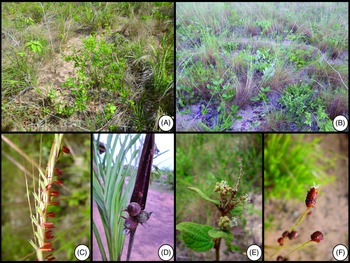
To quantify the different descriptors of plant diversity, we randomly placed 15 plots of 4 m² at each site, totalling 60 plots across sites (Figure 2A-B). The plot randomisation in each site was made by raffling the direction (North, South, East and West) and the number of steps (1–60) taken, starting from the site edge. We sampled all the herb and subshrub individuals whose base was within the plot. Individuals were defined as ramets for subshrubs, and tussocks for grass-like plants due to the clonal habit of some plants, a common feature of herbaceous species in the Cerrado. The specimens collected were morphotyped and identified to the species level by comparing them with nearby reproductive specimens and vouchers in the herbarium of the University of São Paulo (SPF). We followed Antar & Sano (Reference Antar and Sano2019) to guide species identification, and taxonomists were consulted to confirm the identification of doubtful species. Family classification followed APG IV (2016), and species names followed Flora do Brasil 2020 (Flora do Brasil 2020). Field data were collected in the rainy season, from the end of October 2013 to March 2014.
General aspects of the study sites and common herb–subshrub species. A. General view of the 10-year unburned site (site 4). B. General view of a 2-year burned site (site 1). C, D, E and F. Inflorescence of Trachypogon spicatus (L.f.) Kuntze (C), Syagrus glazioviana (Dammer) Becc. (D), Croton agoensis Baill. (E) and Bulbostylis junciformis (Kunth) C.B.Clarke (F).

Statistical analyses
Species accumulation curves were made to infer the sampling sufficiency of each site, and we used the non-parametric species-rich Jackknife estimator (Palmer, Reference Palmer1991) to assess the ‘true’ species richness for each site.
Plant density and species richness of the herb–subshrub layer were estimated for each plot. We used the Fisher’s alpha index to describe the plot plant diversity, since this index accounts for the number of individuals and species (Fisher et al. Reference Fisher, Corbet and Williams1943). To test for differences in the plant density, species richness and diversity index among sites, we applied general linear models with the Gaussian probabilistic distribution having sites as an explanatory variable, followed by a post hoc Tukey’s test (α = 0.008 under the Bonferroni correction). Finally, we used the Shapiro–Wilk test and Levene’s test to assess data normality and homogeneity of variances for the three variables (Legendre & Legendre, Reference Legendre and Legendre1998).
The species composition of the herb–subshrub layer was reduced to two dimensions with non-metric multidimensional scaling (NMDS). Two distinct ordinations were carried out with the plant species composition data: (i) species abundance data (quantitative ordination) and (ii) species occurrence data (qualitative ordination), defined by presence or absence in each plot. For the quantitative ordination, we used the Bray–Curtis distance measure on plot-standardised data (the data for each species were standardised by the plot to the proportions of the total number of individuals). In the qualitative ordination, we used the Sorensen index (Legendre & Legendre, Reference Legendre and Legendre1998). The ordination using species occurrence data captures the rarer species patterns. In contrast, patterns evaluated with abundance data tend to be more related to the most abundant species in the dataset (Zuquim et al. Reference Zuquim, Costa, Prado and Braga-Neto2009). The statistical significance of each axis of NMDS was based on 1000 Monte Carlo permutations. The first two axes of NMDS were used as dependent variables in inferential tests, given that these two axes captured most of the variation related to species composition (60% for quantitative ordination and 28% for qualitative ordination) and the complete absence of correlation between the two NMDS axes (r = 8.4e-17 and r = 2.4e-16). The adjusted r2 of the dissimilarity matrices of original data regressed against the dissimilarity along the one- and two-dimensional ordination was used to evaluate the adequacy of the ordinations (McCune & Grace, Reference McCune and Grace2002). To test for differences in the two NMDS axes among sites, we carried out two variance analyses (one-way ANOVA), followed by a post hoc Tukey’s test, examining each response variable (NMDS axes) separately. We performed all statistical analyses in R software (R CORE TEAM 2020), using the base and the vegan (Oksanen et al. Reference Oksanen, Blanchet, Kindt, Legendre, Minchin, O’Hara, Simpson, Solymos, Henry, Stevens and Wagner2015) packages.
Results
Species collected and soil variables
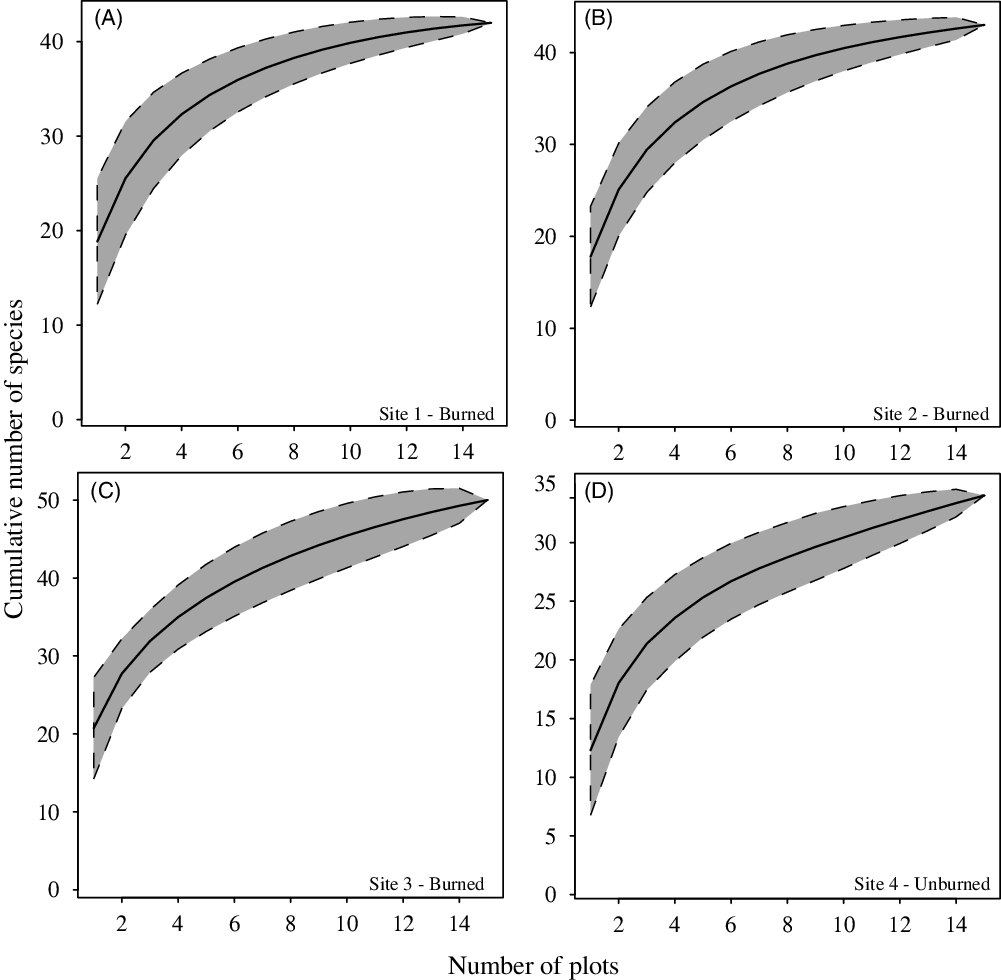
A total of 5,249 individuals belonging to 68 species and 15 families were collected at the 4 sites (Table S1). The most representative families in number of individuals were Poaceae, Cyperaceae, Euphorbiaceae, Arecaceae and Leguminosae. The most representative families in number of species were Poaceae (17), Leguminosae (7), Cyperaceae (6), Amaranthaceae (3) and Polygalaceae (3). The most common species were Trachypogon spicatus (L.f) Kuntze with 918 individuals found in all plots, Bulbostylis junciformis (Kunth) C.B.Clarke, Croton agoensis Baill. and Syagrus glaziouviana (Dammer) Becc. (Figure 2C-F). The species accumulation curves indicate that sampling sufficiency was reached in the four sites (Figure 3).
Species accumulation curve for each study site (A = site 1; B = site 2; C = site 3; D = site 4), 95% confidence intervals (dashed lines). Observed and estimated (Jackknife estimator) richness are indicated for each study site.

Soil analyses showed a very similar texture in the four sites, being very sandy and poor in organic matter (Table S2).
Plant density, richness and diversity
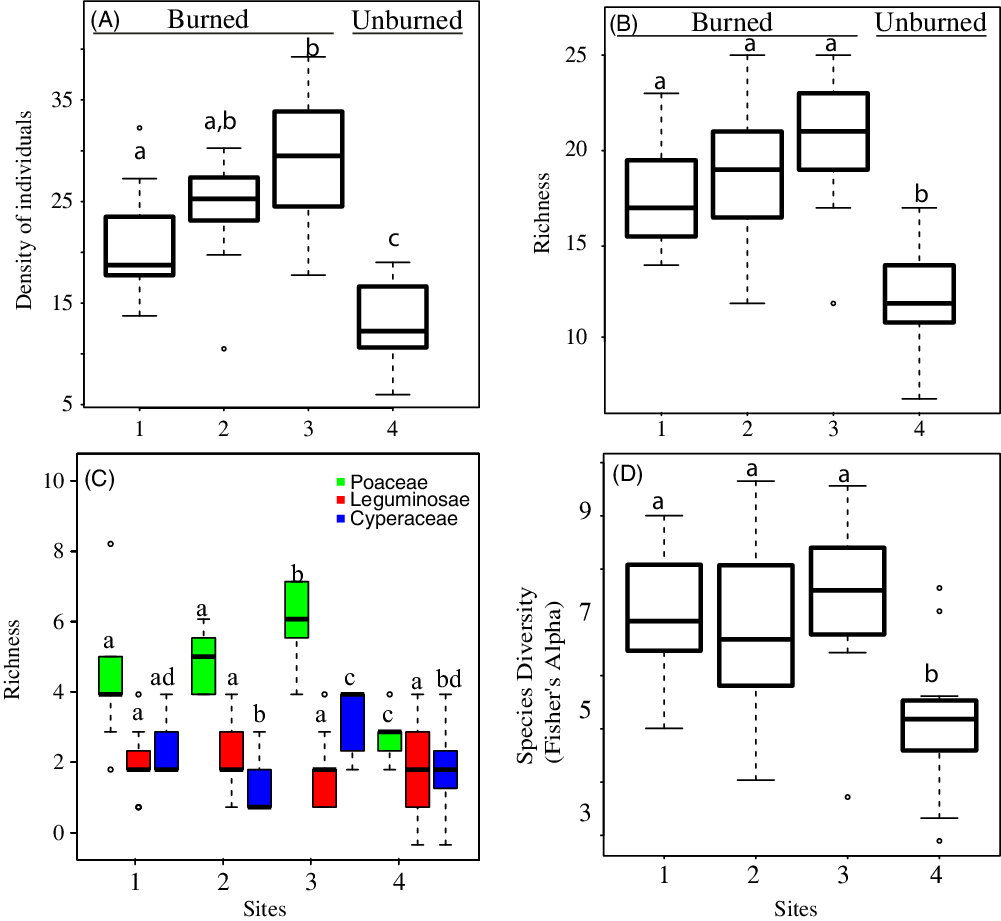
On average, plant density in the herb–subshrub layer was different among sites (F3,56 = 24.5; p<0.001), with site 4 (unburned) being at least 50% less dense than sites 1, 2 and 3 (‘frequently burned’) (Figure 4A). Species richness was similar at sites 1, 2 and 3, but site 4 had, on average, 50% fewer species than the three frequently burned sites 1, 2 and 3 (F3,56 = 19.5; p<0.001) (Figure 4B). A very similar pattern was found for diversity (Figure 4D), with site 4 being up to 1.4 times less diverse than the other frequently burned sites 1, 2 and 3 (F3,56 = 12.17; p<0.0001; Figure 4D). Of the three richest families, Poaceae, Leguminosae and Cyperaceae showed distinct richness at the sites (Poaceae – F3,56 = 29.02; p<0.0001; Leguminosae – F3,56 = 1.02; p = 0.38; Cyperaceae – F3,56 = 14.26; p<0.0001; Figure 4C).
A–C. Variation of the plant density, species richness and diversity index among sites. A. Plant density (number of individuals per plot). B. Species richness (number of species per plot). C. Species richness of the three richest botanical families: Poaceae, Leguminosae and Cyperaceae (number of species per plot). D. Diversity index. Different letters indicate differences among sites based on the post hoc Tukey’s HSD multiple comparison test (p < 0.05).

Species composition across sites
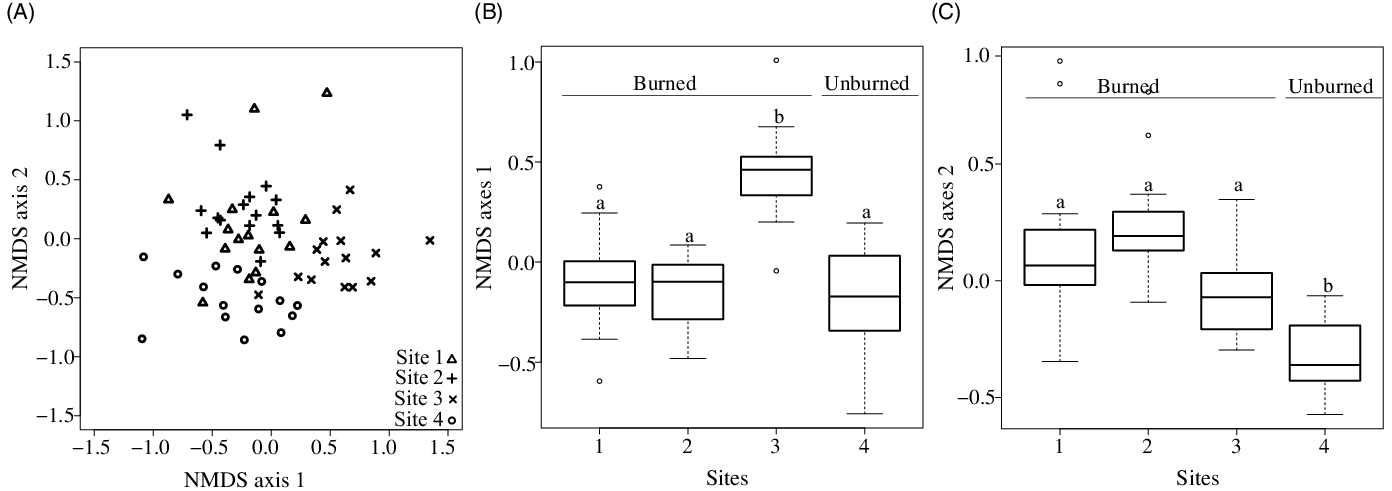
The NMDS ordinations recall a large variation of the species composition of the herb–subshrub layer (Figure 5). In the quantitative ordination using species abundance data, the first and second NMDS axes captured 48% and 12% of the composition variation, respectively (Figure 5A). Thus, considering the first and second NMDS axes of the quantitative ordination, the species composition is not homogeneous across sites (first axis: F3,56 = 22.8, p < 0.001 and the second axis: F3,56 = 16.78, p < 0.001). In the first axis, sites 1, 2 and 4 were similar, but they differed from site 3 (Figure 5B). In the second axis, sites 1, 2 and 3 were similar but different from site 4 (Figure 5C), indicating a different species composition of the unburned site 4 compared to the frequently burned sites 1, 2 and 3. The results of the first and second axes of the qualitative ordination were similar to those of the quantitative ordination (Figure S3).
A–C. Variation of the herb–subshrub species composition across the 60 plots distributed at the 4 campo sujo sites in the Jalapão region (Tocantins state, Brazil). A. The first two axes of non-metric multidimensional scaling (NMDS, r2adj = 0.60). B and C. Changes in the herb–subshrub species composition represented by the first two axes of the NMDS of abundance data. Different letters indicate differences among sites based on Tukey’s HSD multiple comparison post hoc test (p < 0.05).

Discussion
We found that the herb–subshrub layer’s plant density, species richness, diversity index and species composition vary among the sampled sites in the Jalapão region. Water availability, soil depth and nutrient availability, topography (e.g., slope), species interactions, grazing, and fire frequency are important factors determining the structure and diversity of the Cerrado Domain (Coutinho, Reference Coutinho1990, Pivello & Coutinho Reference Pivello and Coutinho1996, Ratter et al. Reference Ratter, Ribeiro and Bridgewater1997, Moreira Reference Moreira2000, Ribeiro & Walter Reference Ribeiro, Walter, Sano, Almeida and Ribeiro2008, Silva & Batalha Reference Silva and Batalha2011, Amaral et al. Reference Amaral, Munhoz, Eugênio and Felfili2013). In our study area, only fire frequency varied strongly across the sampled sites since they are close together, sharing the same local climate, topography, soil features and animal grazing patterns. We thus hypothesise that fire plays an essential role in explaining the variation of the herb–subshrub layer diversity and species composition in the study region. Indeed, the differences among the sites sampled matched the predictions according to the fire pattern in the Cerrado. The unburned site 4 had lower density, richness and diversity than the three frequently burned sites (1, 2 and 3). Also, the species composition of the unburned site differed from the other three sites.
We found a lower number of species (68 species) in the herb–subshrub layer of the Jalapão region compared to other similar studies in Neotropical savannas (César Reference César1980, Loiola et al. Reference Loiola, Cianciaruso, Silva and Batalha2010, Amaral et al. Reference Amaral, Munhoz, Eugênio and Felfili2013, Santos Reference Santos2019), with around 30% fewer species (Loiola et al. Reference Loiola, Cianciaruso, Silva and Batalha2010). Biological reasons or differences in sampling methods can explain this, and the second may be more relevant here. In particular, we considered only herbs and subshrubs in our sampling protocol, while other studies included plants with other habits, such as small shrubs and climbers. Regarding the most frequent plant groups, the families Poaceae, Cyperaceae and Leguminosae have also been the most representative herb–subshrub plants in other campo sujo floras (Munhoz Reference Munhoz2003, Ribeiro & Walter Reference Ribeiro, Walter, Sano, Almeida and Ribeiro2008, Santos Reference Santos2019). Corroborating this pattern, these families showed the highest species richness and number of individuals in our plots. They are also very common in other Cerrado regions (Gottsberger & Silberbauer-Gottsberger Reference Gottsberger and Silberbauer-Gottsberger2006), including other portions of the Jalapão region (Antar & Sano Reference Antar and Sano2019).
Plant density and richness per plot were higher in the sites under the biennial fire regime than in the unburned site, coinciding with other areas with similar physiognomy in the Cerrado Domain (e.g., César Reference César1980). This pattern can be explained by the role of fire in triggering herb and subshrub species vegetative reproduction (Coutinho Reference Coutinho1990), which has also been documented in other savannas worldwide (Sarmiento Reference Sarmiento1984, Canales et al. Reference Canales, Trevisan, Silva and Caswell1994). Also, fire occurrence increases the light incidence and water availability, as well as nutrient availability for herbaceous plants with shallow roots (Coutinho Reference Coutinho1990, Pivello & Coutinho Reference Pivello and Coutinho1992), reducing above- and below-ground competition (César Reference César1980, Abreu et al. Reference Abreu, Hoffmann, Vasconcelos, Pilon, Rossatto and Durigan2017). Furthermore, we showed that among the three richest families, only Poaceae richness differed between burned and unburned sites, having both abundant (Axonopus marginatus, Poaceae) and rare species (Paspalum marmoratum, Poaceae) exclusive to sites under the biennial fire regime (Supplementary material Table S1). These results corroborate the evidence that, considering the most abundant and rarest species, the exclusion of fire in cerrado ralo can reduce the diversity and co-occurrence of herb–subshrub layer species compared to areas that are biennially burned (Santos Reference Santos2019).
In our study, Poaceae species represented the most successful group under frequent fires, clearly more abundant and diverse under such conditions. Thus, the pattern of species composition change across sites in both NMDS ordination axes is mainly impacted by differences in the distribution of Poaceae species. However, some studies have shown different patterns of herbaceous species diversity in fire-suppressed areas. For example, in an area free of fire for 7 years, the floristic composition changed by increasing species richness in wet and dry shrubby grassland (Amaral et al. Reference Amaral, Munhoz, Eugênio and Felfili2013). Also, the Poaceae family in areas frequently burned had less species with a more homogeneous distribution than in unburned areas (Miranda Reference Miranda2002). There is no simple explanation for these contrasting results, but the availability of species (and propagules) at the landscape scale may explain local changes after fire suppression. More correlational studies covering a more comprehensive range of localities and landscape contexts and experimental studies are desired to understand better the role of fire in plant diversity patterns of the Cerrado herb–subshrub layer.
Although the density of herbs and subshrubs was lower in the site under fire suppression for at least 10 years (site 4), there was not much bare soil, as the ground was covered by woody shrub individuals, mostly less than 0.5 m tall. Therefore, it is possible that site 4, although still classified as campo sujo, is a transitional state with a greater proportion of shrubs towards a more woody vegetation type. This transition to more woody vegetation with fire exclusion has also been reported in other studies in the Cerrado Domain (Coutinho Reference Coutinho1990; Moreira Reference Moreira2000, Miranda et al. Reference Miranda, Neto, Neves and Miranda2010, Amaral et al. Reference Amaral, Munhoz, Eugênio and Felfili2013; Abreu et al. Reference Abreu, Hoffmann, Vasconcelos, Pilon, Rossatto and Durigan2017). Despite the soil in the Jalapão region being very sandy and, consequently, with a low proportion of nutrients and organic matter for plants, the open vegetation structure and diversity dominated by the herb–subshrub component (Schimidt et al. Reference Schmidt, Figueiredo and Scariot2007; Antar & Sano Reference Antar and Sano2019) are probably maintained by the effects of high fire frequency (Rodrigues et al. Reference Rodrigues, Zirondi and Fidelis2021). Indeed, 2 years after the last burn, sites 1, 2 and 3 visually showed a complete recovery of the herbaceous vegetation, allowing them to be richer in species composition than the unburned site. This pattern corroborates other studies, which have reported around 8 months (Pilon et al. Reference Pilon, Cava, Hoffmann, Abreu, Fidelis and Durigan2020) to 18 months (Batmanian & Haridasan Reference Batmanian and Haridasan1985) for a total recovery of the herbaceous vegetation after fire.
The Jalapão region and its vast biological diversity are currently being threatened by the advance of mechanised agriculture expansion, which has been stimulated by the Brazilian government (Borges & Antar, Reference Borges and Antar2016, Antar et al. Reference Antar, Santos and Sano2017, Silva et al. Reference Silva, Amaral, Bijos and Munhos2018, Antar & Sano Reference Antar and Sano2019, Barbosa-Silva & Antar Reference Barbosa-Silva and Antar2020). Therefore, studies focused on the biodiversity of the Jalapão region can support proposals for well-grounded conservation strategies (Mace Reference Mace2004), including fire management in areas where burning is widespread (Pereira Jr. et al. Reference Pereira-Júnior, Oliveira, Pereira and Turkman2014, Schmidt et al. Reference Schmidt, Moura, Ferreira, Eloy, Sampaio, Dias and Berlinck2018). Unlike forest ecosystems, in which fire is mainly harmful, fire can benefit the dynamics of savannas (Bond & Keeley, Reference Bond and Keeley2005; Pivello et al. Reference Pivello, Vieira, Christianini, Ribeiro, da Silva Menezes, Berlinck, Melo, Marengo, Tornquist, Tomas and Overbeck2021), but this issue is still poorly understood by society and environmental agencies in Brazil. Research studies on Cerrado fire dynamics over the last five decades (Coutinho Reference Coutinho, Huntley and Walker1982, Reference Coutinho1990, Pivello & Norton Reference Pivello and Norton1996, Pivello & Coutinho Reference Pivello and Coutinho1996, Miranda et al. Reference Miranda, Bustamante, Miranda, Oliveira and Marquis2002, Miranda Reference Miranda2010, Fidelis et al. Reference Fidelis, Alvarado, Barradas and Pivello2018) as well as practical knowledge coming from protected area managers (Borges et al. Reference Borges, Eloy, Schmidt, Barradas and Santos2016, Berlinck & Batista Reference Berlinck and Batista2020, Berlinck & Lima Reference Berlinck and Lima2021) have contributed to slowly change the zero-fire policy rooted in the country for centuries (Durigan & Ratter Reference Durigan and Ratter2016, Pivello et al. Reference Pivello, Vieira, Christianini, Ribeiro, da Silva Menezes, Berlinck, Melo, Marengo, Tornquist, Tomas and Overbeck2021) towards prescribed and controlled fires, and integrated fire management. Recent environmental legislation has incorporated these new approaches by accepting controlled fires in specific situations (Schmidt et al. Reference Schmidt, Moura, Ferreira, Eloy, Sampaio, Dias and Berlinck2018; Pivello et al. Reference Pivello, Vieira, Christianini, Ribeiro, da Silva Menezes, Berlinck, Melo, Marengo, Tornquist, Tomas and Overbeck2021 ). It has been more and more accepted that prescribed, controlled fires are needed in fire-prone vegetation to avoid biomass accumulation and large and high-intensity fires, which are harmful to flora and fauna (Ramos-Neto & Pivello, Reference Ramos-Neto and Pivello2000, Santos et al. Reference Santos, Nogueira, Souza, Falleiro, Scmidt and Libonati2021). Corroborating previous studies (Coutinho, Reference Coutinho, Huntley and Walker1982; Reference Coutinho1990; Pivello & Coutinho, Reference Pivello and Coutinho1996; Miranda et al. Reference Miranda, Bustamante, Miranda, Oliveira and Marquis2002; Miranda, Reference Miranda2010; Fidelis et al. Reference Fidelis, Alvarado, Barradas and Pivello2018), this research shows that adequate fire management to maintain the Cerrado open physiognomies and herbaceous biodiversity should include controlled fires under specific regimes to form a mosaic of burned and unburned sites in protected areas (Ramos-Neto & Pivello, Reference Ramos-Neto and Pivello2000).
Supplementary material
To view supplementary material for this article, please visit https://doi.org/10.1017/S0266467422000232
Acknowledgements
We thank Naturatins for providing a collection permit and field work support at ‘Parque Estadual do Jalapão’; Ubiratan Chagas, Lucas Nascimento, Marcela Escaramai, Heloisa Hortêncio Antar, Vera Scatena, Rebeca Viana and Márcio Martins for helping during field work; Scott V. Heald, for the English revision of the text; Alexandre B. Sampaio and Isabel B. Schmidt for helping with references and information about the Jalapão region. This study was financed in part by the Coordenação de Aperfeiçoamento de Pessoal de Nível Superior – Brasil (CAPES) – Finance Code 001; GMA thanks FAPESP (2014/01851-7) and Idea Wild for financial support; PTS thanks CNPq (Proc. 310331/2019-6) and FAPESP (Proc. 2016/05843-4); VRP thanks CNPq (Proc, 303970/2018-9). Additional funds were provided to A.N. by the Conselho Nacional de Desenvolvimento Científico e Tecnológico (CNPq; grant number 434692/2018-2) and by the São Paulo Research Foundation through a Young Investigators Grant (FAPESP; grant number 2019/19544-7).
Competing interests
The author(s) declare none.