The Edwardian era continues to fascinate historians of the Conservative party.Footnote 1 Whereas the Unionists were the dominant force within British politics for much of the late Victorian and interwar eras, they slumped to three consecutive election defeats between 1906 and 1910. Unsurprisingly, scholars have thus often referred to the Edwardian years as witnessing a ‘crisis of Conservatism’, a subject most vividly explored by Ewen Green.Footnote 2 Before Green, several historians had argued that Conservative values were threatened by the crises of Edwardian political life.Footnote 3 In particular, the Irish home rule crisis of 1912–14 was seen as exerting a destabilizing effect on Conservative politics as factions within the party were willing to flout constitutional values to defend the union with Ireland.Footnote 4
What distinguished Green from earlier scholars was his concern with Conservative ideologies, and he cogently outlined the policy debates which took place on the Right between 1880 and 1914. These were years in which it became increasingly clear to Unionists that they would have to adapt or face redundancy in an age of mass politics. From his early research onwards, Green argued that many Unionists felt that a ‘positive’ electoral appeal was required to prevent the country dividing along class lines. ‘Radical Conservatives’ encouraged the party to support tariff reform in the belief that it was the only major policy that could surmount the Conservatives' crisis.Footnote 5 Nevertheless, for all their campaigning in support of tariffs, the Unionists failed to win a majority at the two elections of 1910.
If anything, Green claimed, the late Edwardian period saw a deepening of the crisis of Conservatism.Footnote 6 In January 1913, the vast majority of Conservative MPs signed a document which became known as the ‘Bonar Law Memorial’. Crucially, the memorial committed the party not to introduce imperial preference until it had won a second general election, a decision said to have demoralized Joseph Chamberlain's supporters. In the immediate pre-war years, Conservatism supposedly suffered from an intellectual aridity. Leaders possessed no policies which could unite the party or enable it to develop an effective popular appeal. According to Green, the party appeared to be drifting towards disaster and possible disintegration on the eve of the First World War.Footnote 7
Other historians have, however, produced more optimistic portrayals of the Conservative party's prospects during the late Edwardian period. Green's focus on the tariff reform movement meant that he tended to overlook other facets of Unionist culture. In particular, Green neglected the importance of religion to Edwardian Conservatism and underestimated the extent to which a distinct Liberal Unionist identity survived into the twentieth century.Footnote 8 Opposition to Irish home rule was integral to the continuation of the Unionist alliance into the Edwardian period and played a vital role in revitalizing Conservative activism after 1912. John Ramsden argued that the outbreak of war in 1914 ‘robbed the Unionist party of a return to power’.Footnote 9 Organizational reforms conducted after 1911 had significantly enhanced the party's vitality, whilst popular hostility to the Liberals' home rule policy, with its threat to submit Ulster Protestants to the yoke of a Dublin parliament, rebounded to the Conservatives' advantage.Footnote 10
Recent research also suggests that Green exaggerated the Conservative party's woes in the late Edwardian period. Daniel Jackson, for example, reinforces the claim that the Ulster crisis aided Conservative prospects as opposition to Irish home rule became a cause that mobilized thousands of political activists across Britain. This contradicts Green's assumption that the Unionist parties could only gain a mass following by advocating a ‘positive’ programme.Footnote 11 Paul Readman has shown that the Conservatives possessed a popular alternative to David Lloyd George's plans for land reform. By 1914, there was broad sympathy amongst Conservatives towards Jesse Collings's idea of promoting yeoman proprietorship.Footnote 12
Whilst such contributions have buttressed the ‘optimistic’ view of the Conservatives' position in the immediate pre-war years, they are of limited value in enabling us to rethink the concept of the ‘Edwardian crisis of conservatism’. In recent years, Jon Lawrence, Matthew Roberts, and Alex Windscheffel have valuably analysed the culture of late Victorian popular Conservatism in great detail. Politics is portrayed by these historians as a fundamentally cultural practice, whereby politicians actively construct constituencies of support by articulating plausible representations of ‘interest’ and ‘identity’ through language. This work has demonstrated that the Conservatives were well attuned to community identities and associational cultures in late Victorian Britain, and that the Unionist ascendancy between 1886 and 1906 was based on a broad coalition of support which transcended class and gender boundaries.Footnote 13 By contrast, the culture of grassroots Unionism in Edwardian Britain has received significantly less attention. The most important recent research on Conservative politics during this era has tended to focus on narrow issues and time periods. Despite the work of Jackson and Readman, we still know little of how Conservatives presented the key issues of 1913–14, including home rule, land reform, and National Insurance, to the electorate.
Although few would concur with Green's claim that the party appeared to be heading towards possible ‘disintegration’ on the eve of the Great War, recent surveys continue to stress the fragility of the Conservatives' position throughout the Edwardian period.Footnote 14 This article offers an alternative thesis, building upon recent work on Victorian and Edwardian popular politics, which has focused on politicians' attempts to construct electoral languages with a wide cultural purchase. The following analysis demonstrates that Unionists were able to develop a popular grassroots movement that came to provide a serious challenge to ‘New Liberalism’ in Edwardian Britain.
The tariff reform campaign is explored in the first half of this article. Whilst Chamberlain's fiscal policy struggled to develop a mass following in many northern industrial districts, it played a vital role in enabling the Unionists to widen the social bases of their support in party heartlands. In particular, the tariff reform campaign encouraged a more ideologically driven activist commitment amongst party supporters and substantially enhanced women's role within Unionist politics. The remainder of the article explores how the Conservative party's co-operation with auxiliary organizations enabled it to promote a variety of populist causes in the immediate years before the Great War. Frans Coetzee has claimed that, during 1913–14, Unionist leaders ‘circumscribed the former independence’ of the various conservative auxiliary organizations which came to prominence during the Edwardian period.Footnote 15 In making this judgement, however, Coetzee neglected the activities of various auxiliary movements that opposed Irish home rule after 1912. The British Covenant organization, in particular, did much to unite and revitalize grassroots Conservatism across the nation during these years. Moreover, auxiliary organizations, which had previously focused on the fiscal debate, such as the Women's Unionist and Tariff Association (WUTRA), devoted their attention to defence of the union in the aftermath of the Bonar Law Memorial.
Aside from the Irish issue, Conservatives promoted a variety of populist causes during 1913–14 including support for rural smallholdings, opposition to existing National Insurance legislation, and defence of the established church. Clearly, the Conservatives were developing a vibrant rank-and-file movement in the immediate pre-war years that was attentive to popular opinion and effective in its use of stratified, or targeted, electioneering. By engaging with popular culture and mobilizing men and women in significant numbers, the party laid the foundations for its post-war success.
I
In recent years, historians have demonstrated that grassroots activism was vital to Conservative success in the 1870s and 1880s. Populist Tories identified with the respectable working man who could be trusted to enjoy a drink and have a flutter in moderation. Nonetheless, the social bases of working-class male Conservatism came under challenge from numerous directions during the 1890s. The rise of the Clubs and Institutes Union meant that working men's clubs often presented themselves as non-political.Footnote 16 Moreover, increasing numbers of Liberal clubs began to sell alcohol, undermining the Conservatives' position as the champion of the working man's pint.Footnote 17 Around this time, Liberal papers were also beginning to reflect the tastes of the populist Tory press in paying attention to sports and betting.Footnote 18 Hence conservative organizations could no longer rely on the party's social culture to maintain a popular following amongst men.
After 1883, women's integration into Conservative politics was facilitated by the Primrose League, which encouraged cross-class sociability through its branch network of habitations, and promoted a respectable ethos centred on the values of domesticity and family life. By the turn of the century, this organization was, however, struggling in many regions. An investigation in Lancashire during 1901, for example, confirmed that only just over half of the county's habitations were active.Footnote 19 Conditions were similarly bleak elsewhere. In 1902, staff from the Primrose League's central office recorded that around a third of habitations in Sussex were ‘inert or practically dead’. Little enthusiasm was shown for reviving these branches: ‘There is not one that could not be reorganised if those in the district who have some leisure would come forward and give the necessary lead.’Footnote 20
A key problem was that habitations were too often acting as primarily social organizations and neglecting political education. Following the Liberals' landslide election victory of 1906, the party's central office produced a privately circulated memorandum which claimed that ‘it frequently happens that the political character of the League is not mentioned at Primrose League gatherings … The efforts of Habitation officials are directed more towards the provision of amusement than of political instruction.’Footnote 21 Formal party organization was also deteriorating. A memorandum on Conservative constituency activity in London noted that the party lacked a ‘practical working organisation’ in twenty-five seats. Several constituencies in the capital had no Conservative agent in 1906.Footnote 22
When a Liberal revival began after 1902, existing conservative organizations had seemed unable to take effective steps to rejuvenate the Unionist cause. The Education Act introduced that year received a hostile reception from Nonconformists, and Unionists subsequently suffered a string of by-election defeats.Footnote 23 Even more problematic was the Liberals' claim that indentured Chinese labourers had been kept in dire conditions in South Africa. The ‘Chinese Slavery’ cry undermined the government's argument that the Boer War had been fought for democratic reasons. Appeals to protect British subjects in South Africa had been vital to the Unionists' successful election campaign of 1900.Footnote 24 Finally, the defence of free trade after 1903 enthused grassroots Liberals, and many party activists worked with the Free Trade Union to defeat Chamberlain's fiscal programme.Footnote 25
In Free trade nation: commerce, consumption, and civil society in modern Britain (2008) Frank Trentmann provided a pioneering study of the popular culture of the fiscal debate in Edwardian Britain. For Trentmann, the failure of Chamberlain's cause was based substantially on shortcomings in his supporters' use of political communication. Free traders alone were able to develop a popular language of the consumer that could appeal to the general public.Footnote 26 Despite the merits of Trentmann's work, its claim that the discourse of tariff reform was focused on the producer reflects existing shortcomings in our understanding of popular Conservatism.Footnote 27 In fact, in their attempts to wrest power from free traders, tariff reformers created a politics appealing to both producers and consumers, electors and non-electors.
Recent work by Jon Lawrence and James Thompson has demonstrated that sensationalist appeals played a vital role in Edwardian electioneering. Politicians employed posters and the platform to develop populist campaigns that could enthuse bands of activists to promote their cause.Footnote 28 The Tariff Reform League (TRL) and WUTRA were very much a product of this culture, promoting their message by various means including plays, fêtes, public demonstrations, and seaside debates with their opponents. These organizations were in the vanguard of attempts to broaden the appeal of Unionist politics in the aftermath of the heavy electoral defeat in 1906. Chamberlain's supporters were able to develop a comparable popular democratic culture to free trade, despite proving unable to defeat the Liberal government.
Scholars have argued that cultures of populist Conservatism which had thrived in the late Victorian period, by defending the working man's pint and masculine civic identity, were sidelined and undermined by the tariff reform campaign.Footnote 29 It is, however, more convincing to see such earlier identities of masculine Toryism as being integrated into wider tariff reform discourses during the 1900s. A striking example of this phenomenon is provided by a procession of Unionists in support of Edward Goulding, a leading figure within the TRL, on polling day at the Worcester by-election of 1908.Footnote 30 The parade was vividly described in the local press:
On a large dray, drawn by a horse … a jovial party dressed in red suits and hats [the local Unionist colour], were around a table spread with prodigious loaves, British beef and bottles of stout. Red poles in four corners supported the inscriptions ‘Made in Worcester, England. Vote for Goulding and have more work and food.’Footnote 31
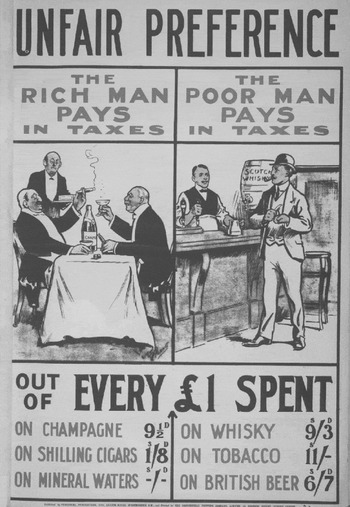
This scene, which the paper called a ‘moving object lesson on an elaborate scale’, was designed as a witty riposte to Liberal slurs. A Free Trade Union pamphlet circulating the constituency at the time proclaimed: ‘Do you want to live on rye bread instead of white bread and horseflesh instead of beef? If not you must vote for Free Trade’.Footnote 32 Black bread and horseflesh were supposedly staple foods for impoverished working families in tariff-protected Germany. Whilst the Liberals claimed that Chamberlain's fiscal policy would force Britons to subsist on a foreign diet, Goulding's supporters portrayed themselves as true patriots. The ‘made in Worcester’ sign and the display of traditional English food and drink underscored the ways in which tariff reform would rejuvenate British agriculture and industry. The success of Goulding and other populist Unionists suggests that Green underestimated the durability and adaptability of traditional forms of masculine working-class Conservatism over the course of the 1900s.Footnote 33 Contemporary Unionist posters tapped into the language of defending the working man's pleasures. One focused on the injustices of the existing fiscal system, alleging that it heavily taxed the British beer and whisky enjoyed by honest working men, whilst levying little or no duties on foreign luxuries commonly consumed by the rich (Figure 1).Footnote 34
Conservative party election poster, 1910. Source: Jan. 1910 election poster, Conservative Party Archive, Oxford, Bodleian Library, CPA 1909/10–09.

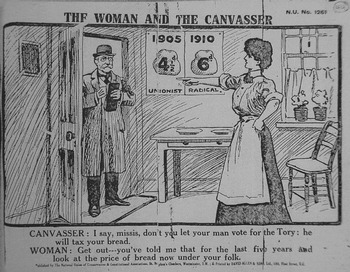
Both sides of the fiscal debate competed for housewives' support. During the 1906 election, free trade literature portrayed tariff reform as a policy that would effectively rob the home larder, increasing food prices.Footnote 35 During the January 1910 general election, the Conservatives retaliated, producing images of assertive housewives, tired of false claims that free trade was the only way to a cheap diet (Figure 2). In fact, as WUTRA argued, the price of living had risen substantially since the Liberals came to power.Footnote 36 WUTRA argued that women could play a vital role in the fiscal debate as housewives had a unique understanding of the strains placed on household budgets by the existing system. WUTRA branches ran speakers' classes to encourage women to canvass in support of Unionist candidates in both local and national elections.Footnote 37
Illustration from Conservative party leaflet, 1910. Source: Jan. 1910 election poster, Conservative Party Archive, Oxford, Bodleian Library, CPA 1909/10–09.

WUTRA was far from being ‘merely an auxiliary of the male Tariff Reform League’, as has recently been claimed.Footnote 38 The development of WUTRA substantially enhanced women's profile in Unionist politics. Whereas Primrose League habitations had often focused chiefly on social activities in times between elections, WUTRA encouraged a more ideologically driven form of activism. Women speakers regularly appeared on mixed platforms at tariff reform meetings and WUTRA played a leading role in the British Covenant campaign in defence of the union.
In his recent studies of London Conservatism, Windscheffel claimed that there was a ‘Tory backlash’ against women's involvement in municipal elections during the 1900s.Footnote 39 If so, it was not particularly effective. Female activists found a new voice in local politics during the Edwardian era, especially after the formation of the Women's League for Municipal Reform in 1909. This body was linked to the London Municipal Society, which sponsored ‘Municipal Reform’ candidates and acted as the voice of Unionism in London borough elections. A WUTRA organizer assisted the Women's League in the capital, contacting female Unionists in each constituency and calling personally on all agents.Footnote 40 Local elections were a crucial arena for female activism as over one million women exercised the municipal franchise. WUTRA's leaders, such as Lady Ilchester, president of the Association, spoke on behalf of Municipal Reform candidates and gave vigorous support to their two female nominees at the 1910 London borough elections.Footnote 41
II
Although tariff reform was ultimately rejected at three successive general elections, this does not mean that the issue was unable to attract significant popular support. The Unionists were able to retrieve many of the losses from their catastrophic defeat at the 1906 election relatively quickly. During the economic downturn of 1908, the Liberals lost seven seats at by-elections, with an average swing of over 10 per cent against the party.Footnote 42 Although the government was able to recover and retain power at the two elections of 1910, with the support of its Irish and Labour allies, the tariff reform campaign clearly revitalized Unionist activism in southern England and the West Midlands. WUTRA, whose organizational strength was concentrated in these regions, undertook operations in 175 constituencies during the January 1910 election. Forty-one of these seats were already held by Unionists, but sixty-two were captured by tariff reformers and, in fifty cases, the majority of the free trade candidate was reduced.Footnote 43
We should be cautious in attributing the party's success solely to the work of the tariff leagues. Besides the fiscal debate, there were various other issues which played a significant role at the January 1910 election, including naval spending, the church schools' question, and the position of the constitution following the Lords' rejection of Lloyd George's budget.Footnote 44 Nonetheless, the tariff leagues' activities clearly did much to enable grassroots Conservatism to emerge from the nadir into which it had fallen during the early years of the twentieth century. Following a third successive election defeat, the 1911 Unionist Reorganisation Committee received testimony from hundreds of activists. Methods of propaganda which were centrally organized by the Conservative party, such as touring vans, were attacked as inefficient. By contrast, the Unionist Reorganisation Committee praised the work of the tariff leagues in enhancing the party's electoral prospects.Footnote 45 Moreover, high office was given to the Liberal Unionist organizers, William Jenkins and John Boraston, who became joint principal agents to the Conservative party. Both had been involved in the Imperial Tariff Committee, which performed the TRL's functions in the Midlands.
The tariff leagues appear to have provided an effective platform for Unionists to remobilize and challenge the free trade ‘lies’ which had swept the country in 1906. In a newspaper interview, Mrs Fletcher, wife of the Conservative MP for Hampstead, attributed the Conservative party's impressive showing throughout the home counties in the January 1910 election to ‘the education of the village people by women workers … having debates, delivering speeches and giving tariff reform plays’.Footnote 46 The advent of the tariff leagues created a sea change in these constituencies. Whereas before the creation of WUTRA, Conservative women had often become used to holding a handful of political gatherings between elections, they could now commonly attend over twenty meetings a year in their constituencies.Footnote 47
As has been well established, tariff reform generally fared less well in northern industrial districts where leaders in key industries such as cotton, steel, shipbuilding, and wool repudiated Unionist claims that they were being ruined by the existing fiscal system.Footnote 48 The TRL and WUTRA found it particularly difficult to develop a vigorous local culture of activism in Lancashire and Yorkshire. A north-west counties division of the TRL was formed in 1910, and organized the majority of public meetings and exhibitions in Lancashire.Footnote 49 Little spontaneous effort had previously been directed to organizing tariff associations in the north-west. In 1906 there had only been six TRL branches covering Lancashire, Cheshire, and Cumberland, before a concerted push was made to employ external organizers.Footnote 50
The Conservative party's decision in January 1913 to abandon plans to introduce imperial preference makes sense in the context of perceived difficulties in promoting tariff reform in the north. Although Unionists scored some notable breakthroughs at by-elections in northern England during 1912, their success was reliant on avoiding the issue of imperial preference. Free traders claimed that imposing taxes on imported produce, to encourage farming in the empire, would effectively be tantamount to introducing a ‘food tax’.
The South Manchester by-election of March 1912 was indicative of problems which Unionists faced in promoting tariff reform in Lancashire. Fortuitously for the party, the pro-Chamberlain candidate for South Manchester missed the first two weeks of the campaign since he had to return by sea from a holiday in Tenerife. By the time he returned, the local committee had already made the Liberals' unpopular 1911 Insurance Act the centrepiece of their campaign and had sidelined tariff reform.Footnote 51 The TRL's campaigning in the constituency, which enabled Liberals to raise the dreaded ‘food tax’ cry, was seen as a hindrance to Conservative prospects that risked losing the seat if conducted with more vigour.Footnote 52 Ultimately, the Conservatives won South Manchester, benefiting from an 11 per cent decline in the Liberal vote, the largest swing against the Asquith government at a by-election since its annus horribilis in 1908.
III
By dropping imperial preference from its immediate programme, the Conservative party angered Chamberlain's ‘Radical Conservative’ supporters. Contrary to Green's argument, however, this does not mean that Unionists were left without an effective populist policy from 1913.Footnote 53 The tariff leagues had never been solely concerned with promoting Chamberlain's fiscal programme. In 1907, Violet Brooke-Hunt, secretary of WUTRA, stated that her organization had four objectives: promoting political education, supporting tariff reform, supporting social reforms, and opposing Irish home rule.Footnote 54 Given that tariff reform had proved so divisive, dropping imperial preference substantially enhanced the Conservative party's prospects. After 1913 the party was able to utilize the dynamic culture of grassroots activism created by the tariff leagues, but harnessed it to promote a broader Unionist programme, with a much wider nationwide appeal.
In early 1914, a group of Chamberlain's supporters, led by Leo Amery and Lord Milner, organized the British Covenant; a mass petition against Irish home rule. Those who signed the Covenant deemed themselves ‘justified in taking or supporting any action that may be effective to prevent [home rule] being put into operation’.Footnote 55 The Conservative party leader, Bonar Law, had been consulted at an early stage of the Covenant's drafting. Amery noted that he ‘was quite sympathetic’ and willing to assist the movement with ‘the general support of the Party, although the actual organisation would be separate’.Footnote 56 That spring, Conservative agents proceeded to work with the newly formed League of British Covenanters in organizing anti-home rule meetings across the country.Footnote 57
The rise of the British Covenant campaign has puzzled historians. Green did not mention the movement, claiming that Conservatives were unable to generate mass support behind opposition to Irish home rule.Footnote 58 Jackson has done much to challenge this viewpoint, demonstrating that popular interest in the cause of defending the Union rapidly gathered momentum in the immediate pre-war years.Footnote 59 Nonetheless, like other historians, Jackson does not recognize a difference between the ethos of the British Covenant and the extremist British League for the Support of Ulster and the Union (BLSUU).Footnote 60 This latter organization was founded in 1912 by Willoughby de Broke and developed close links with the Ulster Volunteer Force. By 1914, the BLSUU claimed to have organized 10,000 men ready to fight in the event of an Irish conflict.Footnote 61 There was an overlap in the leadership of the two movements. Milner was initially a supporter of de Broke's organization and sat on the executive of the League of British Covenanters. Consequently, historians have portrayed the British Covenant as an outgrowth of the League for the Support of Ulster.Footnote 62 Jeremy Smith, for example, has claimed that ‘the Covenant would advertise the strength of popular support for the Union and provide willing recruits who could fight for the cause. Thus it would be a stepping stone to a more military organisation’.Footnote 63 Smith accordingly sees Walter Long's claims of around a million men signing the Covenant as ‘wildly exaggerated’.Footnote 64 Jackson is also sceptical about the Covenant's populist nature, arguing that the members of conservative auxiliary organizations, such as the Primrose League, would have been placed under considerable aristocratic pressure to sign.Footnote 65
Historians have, however, neglected substantial differences between the BLSUU and the British Covenant, analysis of which reveals that organized opposition to Irish home rule had an even greater popular resonance than Jackson supposed. In drafting the British Covenant, Amery believed that ‘the weakness of [Willoughby de Broke's] League lies in the fact that it is too directly concentrated upon a contingency which the British public as a whole … refuses as yet to contemplate … fighting with a rifle in Ulster … it cannot be said to constitute a really national movement’.Footnote 66 Thomas Kennedy has recently claimed that party leaders, such as Robert Cecil and Austen Chamberlain, had grave reservations about the British Covenant, fearing that it might entail a commitment to supporting opposition to home rule through violent means.Footnote 67 Both men were, however, expressing concerns about a draft they had received in January 1914, rather than criticizing the actual Covenant that was launched in March. In fact, both Cecil and Chamberlain spoke in support of the British Covenant movement.Footnote 68 Amery reassured Cecil by stressing that ‘what we want is something less immediately bellicose’ than de Broke's league.Footnote 69
It would have been difficult to avoid the British Covenant during the spring of 1914. Across the country, Unionist activists collected petition signatures through house-to-house canvass, public exhibitions, and even by hawking in pubs.Footnote 70 A parallel Women's Covenant petition organized by WUTRA and the Primrose League gained around 750,000 signatures.Footnote 71 Unionists portrayed the British Covenant as a mass protest against Asquith's defiance of constitutional principles in threatening to coerce Ulster into accepting the authority of a Dublin parliament. The text of the Covenant stated that the government's carrying of the home rule bill into law ‘without submitting it to the judgement of the Nation, is contrary to the spirit of our Constitution’.Footnote 72 In this desperate situation, the Covenant's supporters claimed that their mass protest was the only hope of awakening the government to the depth of hostility liable to be provoked by any attempt to coerce Ulster.
Far from being an overtly bellicose movement, as existing historiography maintains, the British Covenanters presented themselves as seeking to avert the prospects of civil war in Ireland.Footnote 73 A poster outside the premises rented by the Newcastle Conservative Association to collect signatures stated boldly: ‘Are you going to lend John Redmond the British Army to shoot down the loyal inhabitants of Ulster? If not step inside and sign the British Covenant.’Footnote 74 Arguably, by gaining support from a large body of Unionists, the British Covenant campaign usurped the popular authority of the League for the Support of Ulster, steering mainstream popular Conservatism in Britain away from de Broke's brand of extremist politics.
Whereas tariff reform had undermined the Unionist organization in northern England, the new centrality of the Irish issue after 1913 restored vitality to Conservative activism in regions such as Lancashire and Yorkshire. Primrose League workers in Darwen, Lancashire, for example, canvassed energetically for the British Covenant receiving 1,246 signatures within the first month of the campaign and quickly ran out of available forms.Footnote 75 Across the Pennines, Bradford Conservatives felt a new spirit of optimism in the spring of 1914. The local chairman, J. J. Oddy, had been despairing in the weeks before the Bonar Law Memorial, imploring the party leader to remove the threat of ‘food taxes’, which had been so injurious to Conservative prospects in the borough.Footnote 76 A year later, however, Oddy's mood had brightened considerably, when he informed a meeting of Shipley Conservatives that the Liberals knew that, on home rule, ‘they have not the country at the back of them … if you will realise the seriousness of the case and take your coats off, we will sweep them out’.Footnote 77 Although Oddy was speaking in public, his strident tone was significant, and a fortnight later, he reiterated his belief that the Asquith government was living on borrowed time and encouraged Unionists to rally around the British Covenant.Footnote 78
The Irish issue played an important role in the Conservatives' by-election campaigns during the last year of peace, when they gained six Liberal seats and made significant inroads into existing majorities elsewhere. Activists often sought to turn these by-elections into local referenda on the Liberal government's attempts to impose home rule. In November 1913, the Berkshire Chronicle implored Reading electors to vote Conservative at the forthcoming by-election. The paper claimed that victory for the Liberals would mean that the town had endorsed the government's Irish policy, which, in the worst eventuality, could result in the Berkshire Regiment being ordered to shoot down loyal Ulstermen.Footnote 79 The spectre of a potential conflict in Ulster was also raised during the Leith Burghs by-election in February 1914. Speaking in support of the Conservative candidate, the MP for Glasgow Central, Scott Dickson, told an audience that ‘it was no longer a question of voting for a man because they liked him or the policy or party to which he belonged. They had got themselves right up against this – were they going to vote for civil war or against it?’Footnote 80
IV
Ireland was not the only populist campaign promoted by Conservatives in the late Edwardian period. Indeed, the party made systematic efforts to target by-election issues to suit the differing characteristics of constituencies in these years. Whilst David Jarvis claimed that the party's attempts at stratified electioneering began in the 1920s, Windscheffel has recently demonstrated that the Conservatives were already making strides to promote targeted campaigning in the 1890s. In particular, populist Tories in London made great efforts to appeal to East End working men by attacking the local rise of alien immigration.Footnote 81
The Conservatives' experiments with stratified electioneering grew more sophisticated in the immediate pre-war years, as the party developed a targeted, pluralistic campaign strategy across the nation.Footnote 82 By-election candidates focused on criticizing Lloyd George's land policies in rural areas, whilst the National Insurance Act bore the brunt of attacks in the cities. During these years, the Conservatives also experimented with specialized pamphlets appealing to different interest groups. A 1913 leaflet on land taxes, for example, was published in seven editions, targeting agricultural workers, transport workers, building workers, engineers, miners, printers, and textile workers.Footnote 83
The land issue has been seen as an indicator that the Conservatives' malaise showed few signs of easing in the years before the First World War. Ian Packer has argued that Lloyd George's land campaign, launched in October 1913, developed significant rural support. Given the apparent popularity of the Liberals' plans for agricultural wage boards and state encouragement of cottage building, Packer suggested that the Liberals could expect to gain at least twenty seats in rural England at the next general election.Footnote 84 Green concurred with this pessimistic view of Conservative prospects in the countryside, claiming that, aside from supporting Jesse Collings's plans for small holdings, Conservatives lacked consensus on how to provide a competing strategy to Liberal proposals.Footnote 85 However, Readman's recent research has offered a valuable corrective in demonstrating that there was more enthusiasm for Collings's land reform programme within the party than Green and Packer allow, and that such ideas provided a basis for an alternative programme.Footnote 86 Notwithstanding, Readman pays little attention to the important issue of how Conservatives presented their land policies in election campaigns.
Packer's evidence of growing popular support for Lloyd George's land campaign is rather speculative, interpreting the result of the South Buckinghamshire by-election of February 1914, for example, as indicative of growing rural support for the campaign.Footnote 87 Whereas there had been a substantial decline in the Liberal share of the vote in urban by-elections during early 1914, the Liberals managed to reduce the Conservative majority by 1·2 per cent in South Buckinghamshire. Yet this feat is less impressive than it may appear since South Buckinghamshire was a safe Conservative seat which had been won by a 14·8 per cent majority when last contested in January 1910. There seems to be little evidence of a groundswell of enthusiasm for Lloyd George's land campaign in this part of Buckinghamshire. The Times claimed that the turnout at the by-election was 4 per cent lower than in January 1910, due to expectations of a large Conservative majority.Footnote 88
Far from seeing the issue of land reform as a handicap to be played down, rural Conservatives often placed Collings's programme at the centre of their by-election campaigning. In May 1913 John Dennison-Pender, Conservative candidate for East Cambridgeshire, highlighted his support for the Rural Housing Bill, recently proposed by his party and rejected by the Liberals. Dennison-Pender contended that Collings's plans to encourage small holdings would be far more beneficial for the working classes than Liberal proposals for the taxation of land values: ‘If the Radicals taxed land up to the hilt the people could not have cheap cottages.’Footnote 89 In the event, Bonar Law's party won the seat, benefiting from a 6·6 per cent swing against the Liberals. Conservatives also criticized Lloyd George's land valuation at the Reading by-election in November where it was claimed that the Liberal plan to introduce land courts would lead to rent rises, thereby harming tenant farmers. By contrast, Collings's alternative of encouraging English tenants to buy land through low-interest state loans was presented as a more effective means to promote the development of smallholdings.Footnote 90 Collings's programme was also presented as a policy that would enhance the nation's ‘efficiency’. By promoting rural regeneration, Unionists sought to check high migration to the cities, which was supposedly contributing to the development of slum populations.Footnote 91
Whilst rural Conservatives fought on the land issue, urban Tories focused their attacks on the workings of the National Insurance Act. This was especially the case in February 1914 when by-elections occurred at Poplar and South-West Bethnal Green in London's East End, where Charles Masterman, one of the Act's main architects, stood for the Liberals in the latter constituency. Much as Unionists claimed to represent the interests of lowly tenant farmers in the countryside, urban Tories championed casual workers whose interests were allegedly harmed by National Insurance. As Masterman's Conservative opponent, Mathew Wilson, noted at an election meeting: ‘The really poor people who should be assisted were badly treated under the act, and some who paid their contributions got no benefit.’ Instead of the current compulsory system, Wilson supported Bonar Law's proposal to appoint a select committee to investigate the feasibility of converting National Insurance into a voluntary scheme. The Conservative candidate felt that the act infringed on individual liberties, effectively acting as an ‘identification card’ for workers.Footnote 92 Wilson's criticisms were echoed by supporters of the independent Labour candidate, who claimed that National Insurance, as it stood, made workers little more than ‘Poll Tax Serfs’.Footnote 93
The Conservative appeal to working-class voters in Edwardian Britain did not rely solely on tariff reform. Indeed, the campaign against National Insurance demonstrates that the Tories could construct new campaigns rooted in the material concerns of urban working-class communities. Given the nature of local employment patterns, opposition to National Insurance was a particularly emotive cry in Poplar and Bethnal Green. Poplar had a large casual workforce, including many dockworkers who were disadvantaged when seeking work if their insurance cards were not fully stamped.Footnote 94 Bethnal Green likewise had many casual workers, and the Conservatives drew support from several small employers in the constituency, struggling to make the contributory payments required by the National Insurance Act.Footnote 95 The Conservatives took Bethnal Green from the Liberals, who suffered a 2·8 per cent decline from their poll at the constituency's previous contest in July 1911. Although the Liberals managed to retain radical Poplar, their majority was reduced by 18·9 per cent.
The issue of disestablishment of the Church in Wales has often been seen as playing a marginal role in the politics of Edwardian Britain, outside the principality itself. Neil Evans recently suggested that, whilst disestablishment reinforced the vitality of Liberalism in Wales, Conservative-led opposition marches struggled to develop momentum.Footnote 96 Nonetheless, Evans neglects the Unionists' ability to transform anti-disestablishment into a populist cause during 1913–14. Liberal attacks on the established church were presented as the latest in a succession of tyrannical assaults on the British constitution, which had started with the undermining of the Lords' veto, and reached their apogee in attempts to enact Irish home rule without consulting the electorate. Opponents of the Welsh Church Bill claimed that it would impoverish clergy in the principality, and furthermore undermine the Union's stability, which the established church had played an important role in cementing.Footnote 97The Times estimated that around 120,000 people attended a Hyde Park demonstration held in opposition to the Welsh Church Bill in June 1913.Footnote 98 Whilst opposition to Welsh disestablishment may not have played a central role in by-election campaigns, its emotive appeal augmented the Conservatives' populist programme and reinforced the party's Unionist identity.
In short, the claim that the Conservatives failed to develop an electorally appealing cause to replace tariff reform is unconvincing. In the immediate pre-war years, Conservatives presented themselves as champions of social justice: defending loyal Ulstermen and the position of the established church, championing casual workers frustrated by the Liberal Insurance Act, and supporting rural smallholdings. This was a broad-ranging programme that transcended class interests. How the Conservatives' success in by-elections during these months would have affected the outcome of the next general election, had war not intervened, is unclear. Contemporaries differed in their assessments of by-elections, historians have scrutinized the results in detail and this article does not intend to revisit these arguments.Footnote 99
Nonetheless, it should be pointed out that four key factors threatened to stymie Conservative progress in 1914: the unstable Irish situation, the differences between voting motives in general and by-elections, the survival of the Liberal–Labour alliance, and possible amendments to plural voting. Whilst the British Covenant campaign dwarfed the militarist League for the Support of Ulster, the problems of containing belligerent elements across the Irish Sea were very real, not least because Bonar Law had notoriously stated in 1912 that he imagined ‘no length of resistance to which Ulster can go in which I would not be prepared to support them’. By the summer of 1914, both the Ulster Volunteers and the Irish Volunteers had become dangerously militarized and the threat of an Irish civil war loomed large.Footnote 100 Indeed, the Conservative whip, Sir Robert Sanders, was deeply alarmed by the prospect of governing Ireland if his party won the next general election.Footnote 101
Caution is prudent when assessing the Conservatives' by-election successes after 1912. In attacking Irish home rule, National Insurance, and Lloyd George's land proposals, the Conservatives sought to render the by-elections referenda on controversial Liberal reforms. Governing parties commonly lose seats in by-elections and rarely gain them. One-off contests provide the electorate with an opportunity to register a high-profile ‘protest vote’ against unpopular government measures.Footnote 102 Furthermore, it should be remembered the Conservatives benefited from splits in the left-wing vote at by-elections that were unlikely to occur in most constituencies at the next general election.Footnote 103 Moreover, since it attracted much of the business vote, Bonar Law's party would have been worst affected by the proposed abolition of plural voting in 1915.Footnote 104
Whilst there is a need to introduce such caveats to balance the preceding picture of Conservative progress, clearly the party had largely overcome its earlier malaise by 1913–14. During the immediate pre-war years, the Liberal Agent regularly expressed alarm at the Tories' effectiveness in promoting a wide-ranging populist programme with the aid of auxiliary organizations. In July 1913, it stressed that, to win the next election, the Liberals would have to ‘dam the flowing tide’ created by ‘the astute and almost superhuman efforts of the Tory organizers’ at recent by-elections.Footnote 105 By the spring and summer of 1914, Conservative party leaders such as Sanders and Walter Long were increasingly confident that they could break the Liberals' ascendancy.Footnote 106 The divisions caused by tariff reform had proved to be far from insuperable. In the immediate pre-war years, the Conservatives were able to gain popular momentum by promoting a variety of causes which mobilized support across the country.
V
How the Edwardian ‘crisis of conservatism’ is portrayed has significant implications for our understanding of the long-term development of the Conservative party. Scholars have tended to see the 1900s as a largely fallow period for popular Unionism. By this reading, the tariff reform campaign caused chronic divisions within constituency associations and precipitated the slow decline of the Primrose League's influence.Footnote 107 Some historians have, however, recognized 1911–14 as a period of partial recovery, when the party was able to generate support as a result of widespread popular hostility to the government's plans to enact Irish home rule.Footnote 108 Nonetheless, whilst the Conservatives' election prospects may have improved in the immediate pre-war years, this is often regarded as a largely negative, and possibly transient achievement, based on popular frustrations with Liberal reforms. The eventual revival in Conservative fortunes is commonly viewed as rooted in the initiatives of party leaders in the 1920s, who revitalized a demoralized grassroots movement and developed a pluralistic appeal, well attuned to a diverse electorate through embracing stratified electioneering.Footnote 109
This article proposes an alternative narrative. Undeniably, tariff reform divided Unionist activists and alienated many traditional supporters, particularly in the industrial north.Footnote 110 These rifts contrasted markedly with the success which conservative organizations, such as the Primrose League, had achieved during the late-Victorian period, developing a wide appeal across the classes and nationwide.Footnote 111 But this is to miss the point. Earlier conservative associational cultures were not removed by the onset of the tariff reform campaign; rather, the development of the tariff leagues was a response to a growing sense that existing conservative organizations were failing by the early 1900s.
Edwardian Unionists managed to shape a new culture of Conservatism better suited to dealing with the challenges of twentieth-century politics. Unionist politicians were able to develop a more wide-ranging appeal to working-class men in Edwardian Britain: they claimed that a protected economy would increase families' affluence, an overhaul of National Insurance legislation would aid the casual worker, and that tenant farmers stood to benefit from smallholdings.
The Edwardian period was a crucial period in advancing women's position within Unionist activism. By making housewives central to the fiscal debate, tariff reformers encouraged women to pursue a more assertive political role. The rapid development of WUTRA in the 1900s partly explains the party's success in appealing to women after 1918, since the Conservatives clearly enjoyed a substantial head-start over Labour in organizing the female electorate. In some regions, the women's association already constituted the dominant form of Conservative organization during the Edwardian period. The mid-Devon association, for example, claimed 4,800 members, in a constituency of only 12,000 electors.Footnote 112
After 1918, WUTRA formed the backbone of the Conservative party's new women's organization. Many of the most prominent female Conservatives of the 1920s, such as Caroline Bridgeman and Katherine Stewart-Murray, duchess of Atholl, had undergone their political apprenticeship in the rough-and-tumble of the Edwardian tariff reform campaign.Footnote 113 Their new party auxiliary, the Women's Unionist Organisation estimated its strength at one million members by 1928.Footnote 114 By contrast, at no point during the interwar period could the Labour women's section claim more than 300,000 members, which was a figure that WUTRA had already reached before 1914.Footnote 115 The consumer-based appeals directed at housewives, which the Conservatives began to utilize in the Edwardian period, remained vital to the party's appeal to women up to mid-century and beyond.Footnote 116
It is clear that the ‘Radical Conservatives’ who reformed the culture of party grassroots in the 1900s were not merely concerned with tariff reform, as Green implied. Despite its wide-ranging concerns, tariff reform was clearly no panacea to cure the Unionists' ills; far from it. The Conservatives lost three successive general elections in Edwardian Britain whilst supporting tariff reform. Stanley Baldwin's ill-advised decision to base his 1923 campaign around the need for protective tariffs lost the Conservatives their parliamentary majority and reinforced the policy's reputation as a vote-loser.
As Jarvis and Philip Williamson have shown, the party's success after the Great War owed much to its ability to offer a broad range of policies and target multiple interest groups.Footnote 117 But Unionist activists were already taking substantial steps to reduce their dependence on tariff reform and to develop a wide-ranging programme in the immediate years before the Great War. Rather than being merely passive beneficiaries of existing hostility to Liberal policies, populist Tories crafted campaigns to reflect the characteristics of different constituencies, thereby constructing, rather than simply reflecting, popular antipathy towards Liberal reforms. The targeted electioneering developed during these years laid the basis for successful campaign strategies nurtured by the Conservatives in the 1920s. We should not think of grassroots Conservatism as a divided and demoralized force that required resuscitation by party leaders after 1918. To a greater extent than previously realized, the Edwardian years were a fertile period in the development of the Conservative party.