Introduction
It is well documented that the Gilded Age (ca. 1870–1900) was a tumultuous and transformative period for the US labor movement. While only 51 establishments went on strike in 1879, strikes increased sixteenfold a year later, and more than tripled again in 1881 approaching 3,000 walkouts (US Bureau of Labor 1888). As the movement continued to grow in size and intensity, women’s participation in the labor movement also increased rapidly. Women accounted for only 4 percentof all strikers in 1880, but within six years the proportion had grown to nearly 15 percent (ibid.). Industries like millinery and garments in some cities had workforces that were majority women (Jensen Reference Jensen, Jensen and Davidson1984c: 95). Through the late nineteenth and early twentieth centuries, women in such industries appeared increasingly on the picket lines, playing an important role in the wider movement.
Despite an increased presence in strikes during this critical period, surprisingly little is known about how women’s participation in the labor movement affected the efficacy of the movement’s major tactic, the strike. On the one hand, it is possible that women’s participation was helpful to the movement, by adding numerical strength, militant energy, new perspectives, tactics, resources, or networks. On the other hand, it is also possible that when women participated in strikes it hindered the movement, either by external stigmatization due to women’s participation and/or internal factionalism. We address these possibilities in this article. How did the participation of women in workplace walkouts influence the outcome of the contest between capital and labor? Specifically, did gender composition matter for strike success?
We use a unique historical data source to test the impact of women’s participation on the success of every strike that took place in the Northeastern United States between 1881 and 1886. We find that numbers—or, more accurately, proportions—matter. In a general linear sense, an increased proportion of women strikers reduced the likelihood of strike success. We argue this is due to negative cultural attitudes toward women, and men’s (employers and employees) subsequent use of them within the labor movement. However, we also find that among strikes that were relatively mixed in gender composition, women’s participation increased the chances of strike success. We suggest this is because when men and women comprised similar proportions of a strike, women were more likely to participate and be taken seriously by their male counterparts (co-workers and employers), while also maintaining some movement legitimacy. So to the question of whether women’s strike participation in Gilded Age America was harmful or helpful, our answer contains elements of both. The contingent key on which the impact turns is the proportion of women involved in a strike action. The question posed here is important in its own right—were women strikers a liability or an asset in labor struggles, and under what conditions? More generally, our focus speaks to the question of heterogeneity and potential social cleavages in contentious collective actions, constituent elements of social movements. We turn to the relevant literature on divisions in class formation and social movement factions, formulating several hypotheses about why women’s participation would either help or hurt the primary contentious activity of the labor movement, the strike.
Intraclass Divisions and Movement Factions
Collective action always requires cooperation and solidarity, but this is especially true when the action is being taken against a powerful adversary, is high risk, and is noninstitutionalized. These are precisely the conditions under which strike activism took place in the late nineteenth century (e.g., Isaac Reference Isaac2002; Lipold and Isaac Reference Lipold and Isaac2009). The literature on class formation in particular and social movements more generally is acutely aware of the potential sources of divisiveness and factionalism that might weaken collective action.
As early as the Communist Manifesto, Marx and Engels (Reference Marx and Engels1967 [1848]: 90) wrote: “This organization of the proletarians into a class, and consequently into a political party, is continually being upset again by competition between the workers themselves. But it ever rises up again, stronger, firmer, mightier.” While competition creates intraclass weakness, the forces for class formation tend to trump competition for Marx and Engels. Subsequent class-formation scholarship has been less optimistic when considering class divisions. The literature on class formation is replete with studies highlighting the deleterious influence of divisions within the working class including race, ethnicity, gender, occupation, and skill levels (e.g., Aronowitz Reference Aronowitz1973; Davis Reference Davis1986; Hofstader Reference Hofstader1955; Katznelson and Zolberg Reference Katznelson and Zolberg1986; Rosenblum Reference Rosenblum1973). The major takeaway from this literature is that difference can become a cleavage that impedes collective action. Thus, intraclass struggle over social cleavages must be overcome before interclass struggle can be effectively pursued.
Social movement scholars have found factionalism to have a potent negative impact. In his study of protest groups, Gamson (Reference Gamson1975) highlights the negative consequences of factional divides within movement groups. Likewise, writing about the decline of the US civil rights movement, McAdam (Reference McAdam1982: 189–90) argues: “Once effective insurgent organizations were rendered impotent by factional disputes that drained them of their unity, energy, and resolve to sustain protest activity.” In a rare turn that questions the universal negative impact of heterogeneity and infighting, Ghaziani (Reference Ghaziani2008: 15) argues for a “conditional perspective.” One of the ways that divisions and infighting may result in a positive impact on collective action is through its “potential to generate creative strategic possibilities.”
Given the powerful exclusionary role of gender at work during this historical period, much less women in the highly masculine arena of strike activity, it seems likely that “girl strikers” would have a harmful impact on strike success. However, one potentially important conditional feature (in addition to those suggested by Ghaziani for social movements) is the proportional size of the female contingent in strikes. We ask if gender proportions in strike events conditioned the likelihood of success in a systematic way.
Gender Composition on Gilded Age Strikes
The late nineteenth century Gilded Age is an ideal historical period for understanding the impact of women’s participation in strikes for several reasons. The first is the precarious position of women during this period. Although the suffrage movement was growing, women were still denied political, legal, and citizenship rights (McCammon et al. Reference McCammon, Campbell, Granberg and Mowery2001). The impact of their inclusion into, or exclusion from, workplaces and the labor movement during this period is particularly interesting, as it may speak to broader questions—beyond gender in particular—about how status differentials within contentious events may affect outcomes.
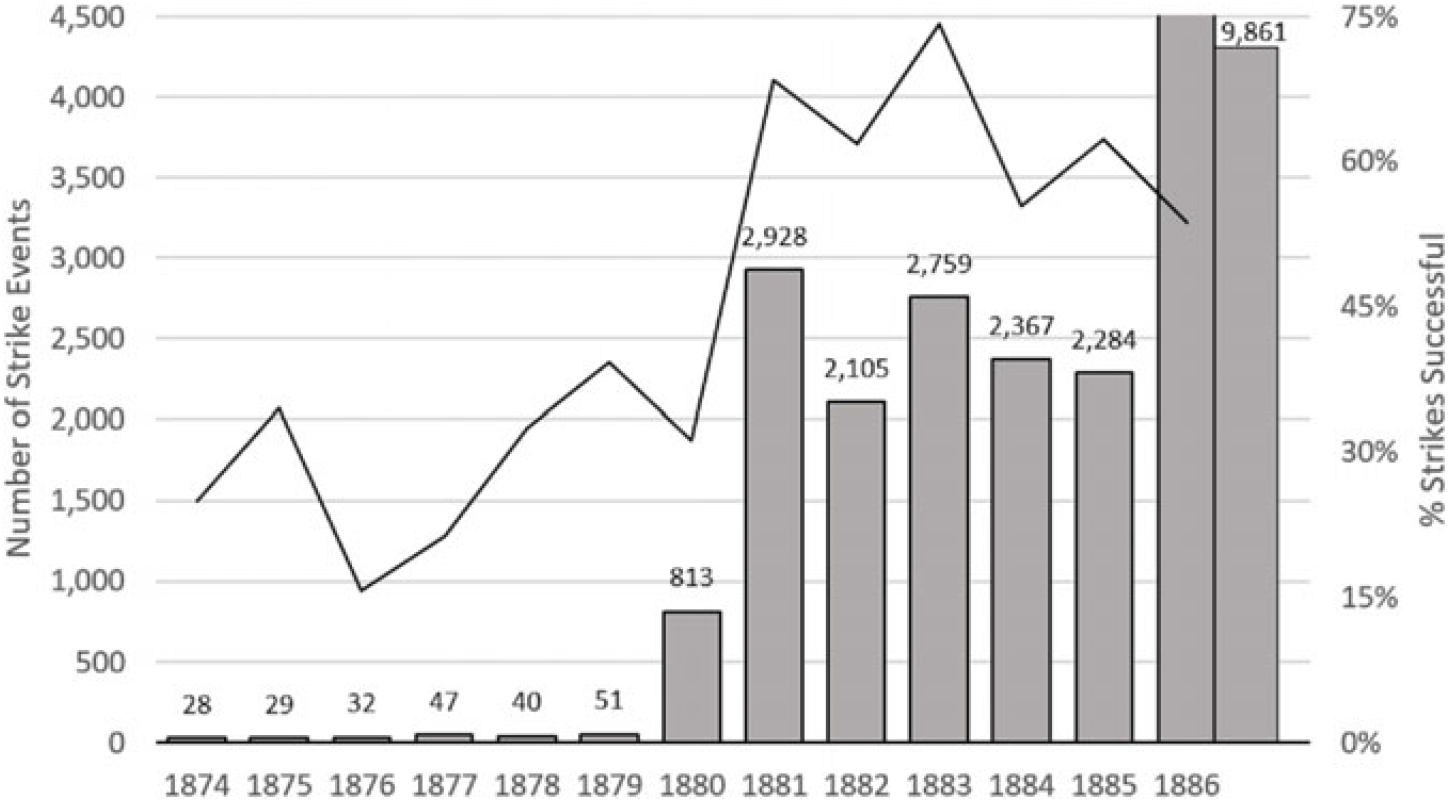
Second, this was a tumultuous time for the US labor movement. Trades were becoming more industrialized, and the number of semiskilled and unskilled workers grew rapidly. Large unions were beginning to form, and strikes were becoming more frequent each year. The period is also marked by the rise of the Knights of Labor (KOL), a union determined to organize all workers, men and women, white and black, native and immigrant (Voss Reference Voss1993). Figure 1 shows that between 1874 and 1879 there were fewer than 250 total establishments that were struck (US Bureau of Labor 1888). However, in 1880 more than 800 establishments went on strike, growing to more than 2,000 establishments each year from 1881 to 1885. In 1886 alone, workers collectively withheld their labor from 9,861 workplaces.
Number of strike events in the United States, 1881–86.

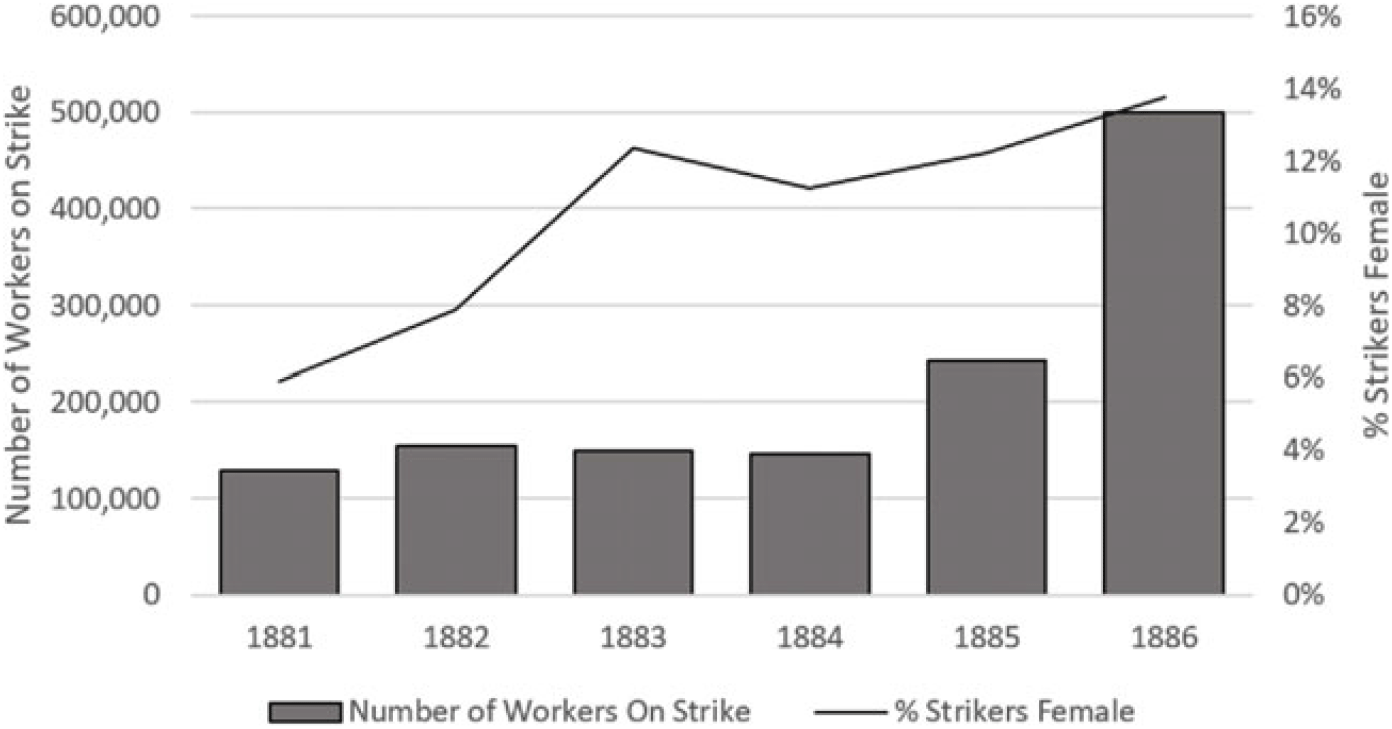
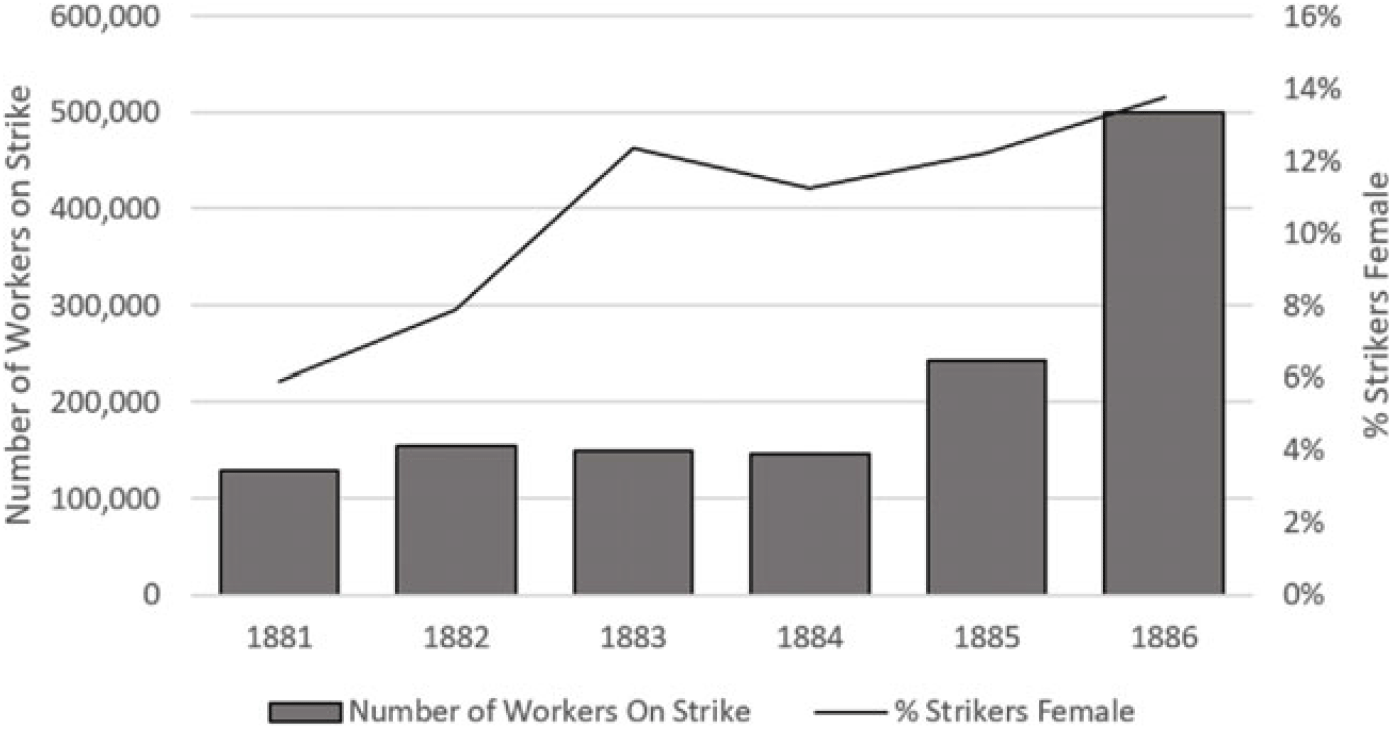
The third motivation for studying the late nineteenth century is the growing involvement of women in workplace struggles during this period (ibid.). The participation of women in strikes increased rapidly between 1880 and 1890, as illustrated in Figure 2. The gray bars indicate the total number of female workers on strike during a specific year (left axis), and the black line represents the percentage of strikers who were female during that year (right axis).
Number of workers on strike and percent strikers female, 1881–86.
Research on the role of women in the US labor movement illustrates how, beginning in the colonial era, women struggled against both employers and male co-workers to first earn the right to work, and second to gain dignity in treatment as paid employees (Foner Reference Foner1979; Jensen Reference Jensen, Jensen and Davidson1984a; Levine Reference Levine1984; Wertheimer Reference Wertheimer1977). In both factories and textile mills, women had an important presence in the labor movement. Wertheimer (Reference Wertheimer1977) shows how the creation of the first women’s unions (founded in the mid-nineteenth century) were born out of resistance against male-dominated unions to include women.
Foner’s (Reference Foner1979) historical account of women in the US labor movement echoes the findings of Wertheimer (Reference Wertheimer1977). His premise is that women have played an important, although largely unnoticed role in the movement’s development. Around 100 female weavers participated in the first factory workers’ strike in Rhode Island in 1824. By the 1830s to 1840s, female textile workers in the New England region would strike with relative frequency, and even began forming unions. However, women’s attempts to organize were met with strong resistance from employers and male workers, as well as broader social disapproval. The organizing efforts of women remained relatively stalled until the KOL gained strength in the 1880s. Foner (ibid.: 211) notes that “thousands of women found a sisterhood in the Knights, and through it they fought some of the most militant battles of the 1880’s. Out of the Knights emerged a cadre of courageous and tireless female leaders.”
Levine’s (Reference Levine1984) study of women carpet makers is also informative. As the carpet weaving industry became increasingly mechanized, business owners began to hire unskilled female workers, resulting in wage depression and strained relations between male and female workers. To redirect the negative impact of gendered factions, the KOL, at its peak of organizational success, began an organizing campaign that promoted both workers’ rights in general, and women’s rights in particular. Levine argues that the Knights formulated an ideology of “labor feminism” that was based on a definition of labor as productive citizenship, emphasizing both labor and social reform. However, these ideals squarely opposed broader cultural standards concerning women and work. As the Knights were repressed into nonexistence during the late 1880s (Voss Reference Voss1993), social reform and their brand of labor feminism largely evaporated too.
Wertheimer (Reference Wertheimer1977), Foner (Reference Foner1979), and Levine (Reference Levine1984) were among the first to examine the impact of women on the male-dominated labor movement in the nineteenth century. However, much remains to be investigated. Although these authors’ focused on organizing tactics and ideology of the women’s unions and the KOL, these studies are mainly historical accounts, and do not give a systematic assessment of impact women had on workplace struggles. Voss (Reference Voss1993) reports important findings about gender composition influences on organizing, but not on women’s participation in strikes. Thus, there is little direct empirical evidence linking gender composition to strike outcomes. We simply do not know what impact women strikers had on strike success. In the following text we draw from other literatures in formulating several hypotheses about how women’s participation may have affected strikes in Gilded Age America.
Gender Attitudes and Social Movement Outcomes
Cultural attitudes about gender roles have shaped and continue to shape the roles and rights of women. Beliefs about women’s place in the private sphere reinforced their lack of political and legal rights during the 1880s (Clemente et al. Reference Clemente, Brenner, Day and Ness2009; Rose Reference Rose1992). Women’s rights movements had yet to make inroads by changing attitudes and institutional practices (Clemens Reference Clemens1993; McCammon et al. Reference McCammon, Campbell, Granberg and Mowery2001). The cultural attitudes that saw women as incompetent and dependent on men had other consequences beyond formal rights; they depressed women’s wages (Laslett and Brenner Reference Laslett and Brenner1989), shaped doctors’ relationships with female patients (Barker-Benfield Reference Barker-Benfield2004), and affected family planning decisions and options (Lewis and Lockridge Reference Lewis and Lockridge1988). The general tendency to disparage and not take women’s rights movements seriously is well illustrated in Rev. John Todd’s (Reference Todd1867, 26) popular Woman’s Rights:
O woman! your worst enemy is he who … tries to flatter you with honeyed words about your rights; … who would cruelly lift you out of your sphere, and try to reverse the very laws of God; who tries to make you believe that you will find independence, wealth, and renown in man’s sphere.
Though they seem extreme today, such views were commonplace then (Barker-Benfield Reference Barker-Benfield2004; Laslett and Brenner Reference Laslett and Brenner1989; Weiner Reference Weiner1985).
During the nineteenth century, which Weiner (Reference Weiner1985) deems the “working girl era,” single and self-supporting women began to make up an increasingly large proportion of the urban labor force. Nonetheless, women’s paid employment was widely viewed as a social problem that contradicted cultural expectations of women (Foner Reference Foner1979; Rose Reference Rose1992; Wertheimer Reference Wertheimer1977). Capitalist employers used single women to undercut men’s wages, and men responded by attempting to exclude women, rather than trying to organize women or demand equal wages (Laslett and Brenner Reference Laslett and Brenner1989; Milkman Reference Milkman1980; Rose Reference Rose1988).
This literature suggests that women, as a subordinate faction of the working class, were devalued as both citizens and workers in the nineteenth century. Thus, negative cultural attitudes toward women from employers, male coworkers, and the broader public would likely undermine women’s legitimacy as political actors. Indeed, social movement research finds that movement success is more likely among those that have the support of the public (e.g., Burstein Reference Burstein, Giugni, McAdam and Tilly1999; Oegema and Klandermans Reference Oegema and Klandermans1994). One study (Card and Olson Reference Card and Olson1995) does report a significant negative effect of fraction female on the probability of strike success. However, this study uses proportion female as a control variable and does not probe its conditions nor theorize its influence. The foregoing literature would, therefore, lead us to expect that “girl strikers” would be a universal liability on the picket line leading to our first hypothesis:
1. Sexist Cultural Attitudes Hypothesis: a greater proportion of women participating in a strike will be associated with a general linear decrease in the likelihood of strike success.
However, some strands of labor organizing history suggest the opposite proposition; that is, there have been major labor organizations that followed an inclusivism-as-strength philosophy, contrary to some of the trade unions that practiced an exclusivist organizing strategy. During our period, the major inclusivist union was the KOL who worked to include workers other than only white, native-born males (Voss Reference Voss1993), practicing an important version of labor feminism (Levine Reference Levine1984). While we cannot distinguish particular labor organizations connected to the strikes in our data, a simple alternative hypothesis follows:
2. Inclusivist Labor Solidarity Hypothesis: a greater proportion of women participating in a strike will be associated with a linear increase in the likelihood of strike success.
Heterogeneity and Social Movement Outcomes
Some social movement research examines how the demographic composition of the rank and file affects movement success. Generally, there are two broad arguments concerning the impact of diversity on movement participants and mobilizing. One side, drawing from the theory of group threat (Quillian Reference Quillian1995), argues that diverse membership creates factions within the movement, hindering solidarity (Clawson and Clawson Reference Clawson and Clawson1999; Form Reference Form1985; Perlman Reference Perlman1928). The other side argues that diverse social identities can aid in organizing by uniting members around shared identities and promoting innovative tactics and strategies (Cornfield Reference Cornfield1989; Milkman Reference Milkman2006).
Heterogeneity Hindering Movements
The emergence of a social movement partially depends on the strength of the group’s collective identity. Without a strong attachment to a shared sense of identity, individuals will be less willing to sacrifice time and resources for the collective good (Taylor and Whittier Reference Taylor, Whittier, Morris and Mueller1992). While little research focuses directly on how a strong collective identity predicts the success of movements, the relationship seems intuitive: movement members united around a shared sense of identity will be more likely to succeed because they are more likely to remain collectively committed to the movement (Gamson Reference Gamson1991).
The argument against diversity in a movement is that diversity can weaken collective identity, leading to infighting and ultimately factionalism. In our case, employers frequently pitted one group of workers against another and sought to fan the flames of sexism (and other divisions). As factions fight internally, resources are channeled into solving the dispute rather than propelling the movement forward, leading to decline (Miller Reference Miller and Freeman1983). Factions can be the result of a disagreement about ideology and tactics, or heterogeneous membership that disrupts the collective identity (Zald and Ash Reference Zald and Ash1966). For example, the 1938 split between the AFL and CIO was the result of disagreements about organizing tactics. Conversely, the Student Nonviolent Coordinating Committee (SNCC) split into factions when the tensions between white and black members resulted in an expulsion of white members from the organization. To SNCC members, the exclusion of the “other” (here, white members) was necessary for the movement members to maintain a collective identity (Carson Reference Carson1981).
When addressing the lack of a strong labor movement in the United States, Perlman (Reference Perlman1928: 168) noted that immigrants were seen as “a competitive menace to be fought off and to be kept out” and that “the strongest animosity was felt not for the employer who … stimulated the new immigrant wave, but for the immigrants who came and took the jobs away.” He proposed that the heterogeneous nature of the US population prevented unions from being able to focus on class-wide issues. The major reason there was no socialist movement in the United States, according to Sombart (Reference Sombart1976 [1906]), was the extreme status diversity permeating the working class. Workers ultimately fail to unify because they are hopelessly divided among themselves by race, ethnicity, gender, skill level, and income, all working to undermine class solidarity.
In their research on black workers in the labor movement, Spero and Harris (Reference Spero and Harris1968) note that the business unionism of the AFL required the exclusion of blacks. During the nineteenth century, blacks were almost entirely unskilled workers and were thought to be unfit for skilled work, so unions generally did not train them. By excluding African Americans from apprenticeships, craft unions were able to maintain their craft-consciousness, and eliminate an entire group of potential labor competition. However, this came at the price of a heightened sense of animosity along the color line.
The social psychological literature is also helpful in understanding why heterogeneity may hurt movements. Gender differences tend to be more salient in mixed-gender groups (Abrams et al. Reference Abrams, Joanna and Hogg1990; Cota and Dion Reference Cota and Dion1986). Identity salience can then lead to work group conflict and the establishment of hierarchies (Randel Reference Randel2002; Ridgeway Reference Ridgeway2014). Cultural beliefs about lower status groups bias individuals’ evaluation of competence in each other, channeling resources to higher status group members (here, men) and away from the lower status group members (here, women). Challenges to status biases evoke tension, animosity, and attempts for the higher status group members to reassert their dominance (Ridgeway Reference Ridgeway2014).
Research on the impact of diversity on movements and attitudes generally focuses on the inclusion of minorities or females into white- and male-dominated groups. However, if heterogeneity is detrimental because it fractures the collective identity of a group, we would expect it to work in both ways. That is, highly homogenous movements should be more successful, regardless of whether the movement is primarily men, women, white, or black. This leads to the development of our third hypothesis:
3. Harmful Heterogeneity Hypothesis: the relationship between women’s participation in a strike and strike success is curvilinear, convex from below, or U-shape. The odds of strike success will be higher when strikers are homogenous (a high proportion of men or high proportion of women) and lower when the gender composition is more evenly mixed.
Heterogeneity Helping Movements
Although it is possible that heterogeneity hurts movement success by fracturing collective identity, it is also possible that diversity helps by leading to tactical innovation. Morgan’s (Reference Morgan1997) study of the English cotton industry found that although male spinners initially tried to exclude women from the workplace, male and female workers later developed a cooperative working relationship; women often showed solidarity with their male co-workers by joining their strikes and their campaigns for union recognition. Voss and Sherman’s (Reference Voss and Sherman2000) study of labor movement revitalization found that when unions incorporate leaders with diverse experience from other social movements, the labor movement is more likely to revitalize its tactics, and diversity in strategies and tactics increases the likelihood of movement success (Olzak and Ryo Reference Olzak and Ryo2007).
Morris and Staggenborg (Reference Morris, Staggenborg, Snow, Soule and Kriesi2002: 188) note that social movements are more successful when “they attract leadership teams with diverse backgrounds, skills and viewpoints. Quality decisions are likely to emerge from … concerted deliberations and brainstorming.” Most of this research focuses on racial and ethnic diversity. For example, Ganz’s (Reference Ganz2000) study of the differences between the United Farm Workers (UFW) movement and the AFL-CIO’s Agricultural Workers Organizing Committee (AWOC) movement illustrates how racial diversity was helpful under the Cesar Chavez leadership (ibid.).
Although research on diverse movements often focuses on racial and ethnic diversity, findings may be suggestive for gender heterogeneity as well. Women’s personal experiences and cultural diversity might have worked to benefit worker strikes. Because the suffrage movement was also growing across the period, it is possible that women workers were carriers of oppositional culture from this or other movements, aiding in tactical innovation. For example, Isaac and Christiansen’s (Reference Isaac and Christiansen2002) theory of intermovement relations suggests that a social movement operates in a field of movements and can affect other social movements through diffusion channels, overlapping personnel, and cultural environments. The suffrage movement may have helped to address shortages in the organizational resources of weak labor movements locally. Sometimes Gilded Age feminist movements helped inspire and support labor movements (cf., Davidson Reference Davidson, Jensen and Davidson1984; Scharf Reference Scharf, Jensen and Davidson1984), similar to the role played by the civil rights movement in the 1960s and 1970s (see Isaac and Christiansen Reference Isaac and Christiansen2002). In addition, Clemens (Reference Clemens1993) argued that Gilded Age women’s movements were often more democratic than other organizations at the time, and were therefore effective in resisting “conservative transformation,” or the Iron Law of Oligarchy (see Michels Reference Michels1962 [1911]). In doing so, these women’s organizations were often successful in achieving political and cultural change. There is also case evidence that suggests other mechanisms for women’s strike involvement and success. One is that women, when given a chance, were more active than men in some labor struggles due to their close connection with daily household travails and the need to fight for better terms of employment to support the domestic front. Footnote 1 Scholars have found evidence to indicate that while women were more difficult to organize, when organized they could be more militant than their male counterparts (e.g., Kessler-Harris Reference Kessler-Harris1982; Turbin Reference Turbin, Groneman and Norton1987; Voss Reference Voss1993). There is also evidence that rough treatment and even “official violence visited upon unarmed women strikers” sometimes increased the support of the public and progressive leaders for strikers and thus increased strikers’ chances of success (Davidson Reference Davidson, Jensen and Davidson1984: xiv). These insights lead to our fourth hypothesis:
4. Helpful Heterogeneity Hypothesis: the relationship between women’s participation in a strike and strike success is curvilinear, concave from below or ∩-shaped. The odds of strike success will be lower when the strike is homogenous (a high proportion of men or women) and will be higher when the strike has a more even gender mix.
Conditional Relation between Gender Composition Proportions and Strike Success
The aforementioned literature would suggest that the relationship between women’s participation in strikes and strike success could be driven either by cultural attitudes toward women or the level of gender heterogeneity. However, it is possible that both explanations could play a role—that is, the negative impact of women’s participation on strikes could be moderated or conditioned by the level of gender heterogeneity in the strike. Although there is, to our knowledge, no research that tests this proposition, there are both historical and theoretical reasons for such an expectation.
Uneven Development of Women in Industry and Labor Movement
Young women were central to the workplaces of the northeastern textile and shoe factories by the mid-nineteenth century (Jensen Reference Jensen, Jensen and Davidson1984a). Within several decades, textile, millinery, and shoe industries had workforces that were comprised mostly of women (ibid.). Throughout the Gilded Age, women in such highly feminized industries appeared increasingly on the picket lines, playing an important role in the labor movement. This was not, however, a smooth or homogeneous process.
Early organizing was exclusively male and trade based. But with increased mechanization, employers turned to cheap unskilled labor, relying heavily on women, children, and immigrants, fueling resentment from the white male trade unionists. As Davidson (Reference Davidson, Jensen and Davidson1984: xiii) observes: “Most male workers did not regard women workers as important or trustworthy allies; attitudes toward them were at best ambivalent, at worst hostile.” However, with growing mechanization, organizing shifted from trade unionism to more industry-wide strategies. With such changes “older male unionists had to successfully incorporate into their strategy both the immigrant male and the women worker, or lose the place they had carved out for themselves in the economic order” (Jensen Reference Jensen1984b: 87). By the end of the first decade of the twentieth century, hundreds of thousands of women had been involved in strikes, and “the militance and organizational strength of women often encouraged their male comrades to join in demands for better working conditions” (ibid.: 83). But these developments did not unfold smoothly over time or evenly across locations and industries. The old scenario of exclusively white male trade union organizing, often in smaller workplaces, was mixed in the aggregate with the newer scenario of increased mechanization, deskilling, and concomitant greater proportions of women in larger workplaces. Therefore, organizing and striking would need to rely more heavily on women’s involvement if struggles against employers were to succeed.
Our analytic period falls squarely within the meteoric rise of the KOL which became the largest and most significant labor organization of the Gilded Age (Voss Reference Voss1993: 73). The Knights organizing strategy was a broad-based inclusivist labor solidarity approach contrary to trade union exclusivism. Inclusion extended to women, and the Knights fostered a labor feminism. By 1887, women comprised 11 percent of the Knights membership (ibid.: 129). Voss’s (Reference Voss1993) research on the Knights finds that the proportion of women in a local industry would dampen union formation but extended survival of labor assemblies post-1886. This pattern is interpreted by Voss to be consistent with the work of Kessler-Harris (Reference Kessler-Harris1982) and Turbin (Reference Turbin, Groneman and Norton1987) who argue “that although women were more difficult to organize, once organized they could be much more militant than men” (Voss Reference Voss1993: 195). It is this uneven historical development across industries and locations coupled with the importance of gender proportions in organizational settings (e.g., Kanter Reference Kanter1977) and the role of the KOL that lead us to anticipate a mixed or more complicated nonlinear impact of women’s strike participation on outcome success.
There are two likely scenarios in which more evenly split gender proportions might alter or complicate the simple nonlinear relations associated with Hypotheses 3 and 4. As women show a greater presence on picket lines, approaching parity with men in some industries, they might exacerbate the negative impact (per the harmful heterogeneity hypothesis) and produce a more severe dampening impact on strike success. The alternative is that the more evenly split the gender composition in strikes, the greater the likelihood of success due to a buffering influence resulting from greater parity (per the helpful heterogeneity hypothesis). In this case, the more evenly split gender distribution allows women to exert a greater numerical force, one that might be seen (by male co-strikers) as numerically critical for strike success. Two related conditional hypotheses follow:
5. Heterogeneity Exacerbation Hypothesis: relatively even gender composition will exacerbate the negative impact of women’s participation in strikes.
6. Heterogeneity Buffering Hypothesis: relatively even gender composition will buffer the otherwise negative impact of women’s participation in strikes.
Both Hypotheses 5 and 6 anticipate a nonlinear cubic relationship between gender composition and strike success, allowing for two possible bends in the relationship between women’s participation and strike success.
Data
The data for our analysis were collected by the US Bureau of Labor (1888), and published as The Third Annual Report of the US Commissioner of Labor. The bureau’s goal was to collect as much detailed information as possible on every labor strike in the United States that took place between January 1, 1881 and December 31, 1886. The primary motivation for this enormous task was the increasingly contentious character of labor relations manifested in the growing prevalence of strikes and lockouts.
The bureau first generated a list of strike events by combing newspapers, magazines, trade, and commercial publications that mentioned strikes or lockouts anywhere in the United States. Then, field agents were sent to gather details of each event, interviewing both employees and employers. Agents often gathered information about additional strikes while collecting their data. Overall, the bureau was able to document approximately 5,000 strikes targeting more than 23,000 establishments. Footnote 2 The uniqueness of this collection resides not only in the vast number of strikes documented, but also the detailed information about each event: agents collected information on 35 variables for each strike, including strike success or failure. By contemporary strike study standards, the bureau’s data collection effort was “extraordinary,” according to two leading labor economists (Card and Olson Reference Card and Olson1995: 35).
From this document, we extracted and coded all of the information on every strike occurring in northeastern states: Connecticut, Delaware, Washington, D. C., Maine, Maryland, Massachusetts, New Hampshire, New Jersey, New York, Pennsylvania, Rhode Island, and Vermont. The total number of strike events in our sample is 2,930. We chose to focus on the Northeast because this is the region where the vast majority of female wage labor resided, it provides a large range of variation in women’s participation in the labor movement, and previous research highlights the importance of this region for women in the early labor movement (e.g., Foner Reference Foner1979; Jensen Reference Jensen, Jensen and Davidson1984a, Reference Jensen1984b, Reference Jensen, Jensen and Davidson1984c; Wertheimer Reference Wertheimer1977).
Measures
We estimate the impact of gender composition on strike outcomes with multilevel models, which allow us to explicitly take into account both contextual conditions and specific strike event characteristics. The latter are referred to as “Level 1” variables and the contextual conditions are the “Level 2” measures.
Level 1 Measures
Dependent variable
Our dependent variable is strike success, measured as a dichotomous variable, where 1 indicates the strike was successful and 0 indicates the strike was a failure. This database records three possible outcomes to a strike: successful, partially successful, and failure. An example of a partially successful strike would be one that demanded a raise of $1.00 per day, but received a compromise raise of 75 cents. We treat partially successful strikes as successful for several reasons. First, there were only 215 partially successful strikes (7 percent of all strikes), which would make an unevenly distributed ordinal outcome. Second, it makes sense to count these as successful on a practical level because workers were able to gain some concessions from employers; the partial success category represents a compromise on the full set of strike demands, a classic case of poor, relatively powerless people sometimes winning something (Piven and Cloward Reference Piven and Cloward1979). Third, ordered logistic regression models using all three categories as the dependent variable violated the proportional odds assumption of such models.
Gender composition of strikes
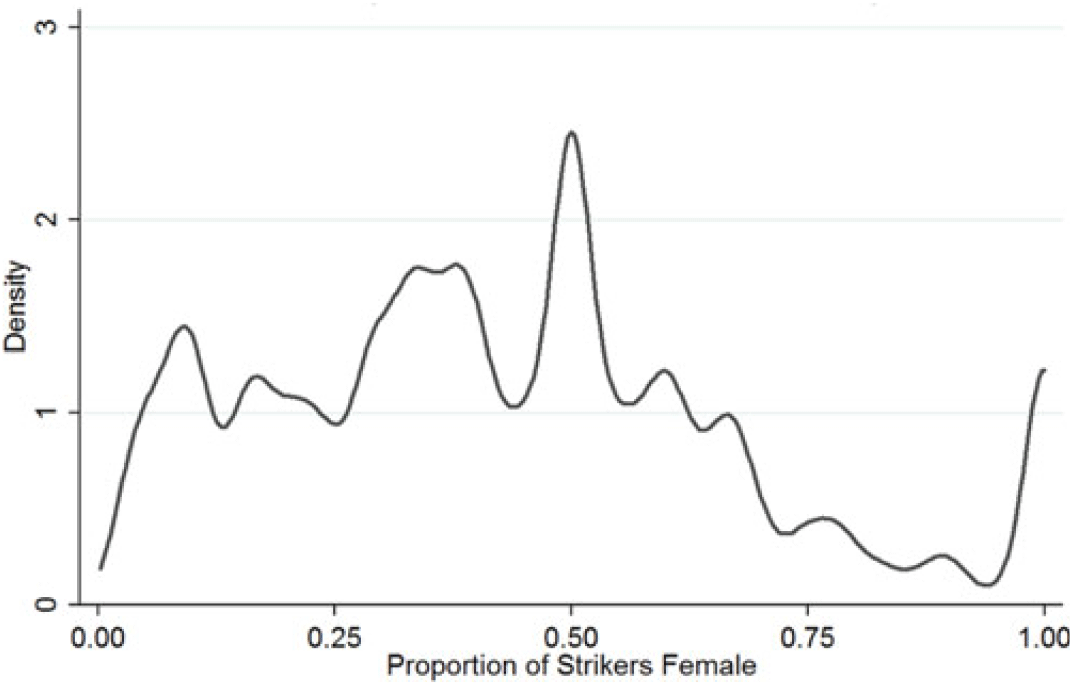
Our central independent variable is the gender composition of the strike, which is measured as the percentage of strikers in an event who are female. The majority of strikes (about 75 percent) had no female participants (which we account for in the following text). However, the distribution of strikes with women is not particularly skewed. Figure 3 displays a density plot of the gender composition of strikes that include at least one female participant. Because the distribution is not heavily skewed and because our main analysis (described in the following text) will include polynomials, we do not transform this measure.
Density plot of strike gender composition.
Note: N = 728; only strikes including women.

Strike characteristics
Our analysis includes control variables gauging characteristics of the strike event. Footnote 3 First, we control for whether there were any women in the strike (1 = yes). This is a separate measure from the gendered composition of the strike because 75 percent of all strikes had only men, and a transformation of a combined measure was still not an improvement to the model. We also control for strike size, measured as the logged number of strikers. Financial assistance measures whether strikers received any financial aid during the strike (1 = yes). We use a dummy variable because there was little variance in the amount of assistance received, and most strikes received no assistance. Employer’s Loss is the gross financial loss (in logged dollars) sustained by the employer during the strike; and Employees’ Loss is the counterpart for strikers. Replacements Used is a dichotomous measure of whether replacement workers were hired to break the strike (1 = yes). Although we do not have a measure of skill level of the striking workers, we do use average wage rates (in logged dollars) as a proxy for skill level. Union-Led is a dichotomous measure indicating whether the strike was organized by a union (1 = yes). Worker Control is a dichotomous variable that captures whether the strike was started for reasons of worker control (measured as 1) or for economic reasons, such as a wage increase (measured as a 0). “Worker control” reasons include sympathy strikes, strikes to form unions, strikes to reinstate fired workers, and strikes to protest unfair rules. Others have referred to such strikes as either “organizational” (Montgomery Reference Montgomery1979: 98) or “political” (Edwards Reference Edwards1981) because they contest the prerogative of employer’s control more deeply than economic strikes. Finally, we control for the Year of the strike, as a set of dummies with 1881 as the reference category.
Unfortunately, the bureau did not collect information on racial or ethnic/immigrant status of workers. Because we cannot control for these unobserved worker characteristics, the main concern is possible conflation of gender effects with race and/or ethnic-immigrant status. Unobserved racial (i.e., black-white color line) information is not likely a major source of distortion in our models because the vast majority of African Americans were located in the South during this period. Only about 1% of the population residing in the northeastern states was African American in 1880 (US Bureau of the Census 1975: 22). Therefore, the fact that our data are drawn exclusively from the northeastern states means that there are very few black workers generally, much less black strikers, in our historical sample.
Unobserved ethnic-immigrant status is a bigger issue. There were substantial numbers of immigrants in the Northeast, especially in some industries in large cities like New York, Boston, and Philadelphia. Many of these immigrant workers were female, especially in industries with sizeable female workforces (e.g., cloth manufacturing, clothing, footwear, tobacco). So it is quite possible that our gender estimates are also gauging, in part, ethnic-immigrant status effects as well. The impact of such gender-immigrant combination is likely to deepen divisions in the workplace.
Level 2 Measures
Our analyses also control for two sets of contextual variables: industries and states. Industry is an important control because strikes are known to spread within industries, thus creating problems for case independence assumptions. States are important contextual controls because they are the units to which labor laws are configured at this point in history. In our data, strikes took place in 20 different industries (see Appendix 1) and 11 states (see Appendix 2).
Methods
Multilevel Modeling
We use a cross-classified mixed-effects multilevel model to establish the relationship between gender composition and strike outcome. Multilevel modeling is useful in our case because it addresses the assumption of independent observations. When data are clustered (in this case by industry and state), observations will likely be correlated, violating the independence assumption. Without properly controlling for within-cluster error correlation, standard errors are underestimated, leading to an overestimated t-statistic and lower p-values (Cameron and Miller Reference Cameron and Miller2015).
Multilevel modeling is one of the most common methods of adjusting for clustered data. In multilevel modeling, the observations are nested within the cluster variable(s), in this case, industry and state. Multilevel modeling measures variance at each level, allowing for errors to vary randomly within clusters and accounting for unexplained variation between clusters (Gelman Reference Gelman2006). A particular advantage of multilevel modeling is that it gives separate estimates for the individual clusters, and it enables an estimate of how much each level of analysis contributes to the explained variance in the model (Raudenbush and Bryk Reference Raudenbush and Bryk2002).
Our models contain two levels. Level 1 captures characteristics of the strike event, and Level 2 captures the state and industry contextual effects. Strike success as a function of these conditions is presented in the following equation:
 $$ Succes{s_{i\left( {{j_1},{j_2}} \right)}} = {\beta _{0j}} + {\beta _1}{\rm{pstrike}}{{\rm{f}}_i} + {\beta _2}{X_i} + {\beta _3}{{\rm{X}}_i}.{\rm{}}.{\rm{}}. + {\beta _n}{{\rm{X}}_i} + {\varepsilon _{i\left( {{j_1},{j_2}} \right)}}$$
where the success of the strike
i
nested within industry
j1
and state
j2
is a function of the intercept β
0j
, the percentage of female strikers (βpstrikef
i
), the control variables (
 $\beta {2_i} + \beta {3_i}... + \beta {{\rm{n}}_i})$
, and the error terms (
 ${\varepsilon _{i\left( {{j_1},{j_2}} \right)}}$
). In other words, the intercept and error terms are allowed to vary by industry and state. This cross-classified model differs from a traditional multilevel model because there are two Level 2 variables that are independent of each other (see Fielding and Goldstein Reference Fielding and Goldstein2006).
To determine if multilevel modeling is an appropriate method we calculated an intraclass correlation coefficient (ICC), a descriptive statistic that estimates the level of correlation among observations within a cluster. The ICC can be derived by estimating an “empty” intercept-only model, then using the resulting Level 1 and Level 2 errors in the following equation:
 $$ICC = {{{\sigma ^{{j_1}}}^2} \over {{\sigma ^{{j_1}}}^2 + {\sigma ^{{j_2}}}^2 + {\sigma _e}^2}}$$
where
 ${\sigma _e}^2$
is the Level 1 variance,
 ${\sigma ^{{j_1}}}^2$
is the Level 2 variance for industry, and
 ${\sigma ^{{j_2}}}^2$
is the Level 2 variance for state. An ICC score ranges from 0 to 1, where 0 would suggest fully independent observations, and a score of 1 would be fully dependent observations. Our estimated ICC was 0.292, indicating 29.2% of the variance in strike success is attributable to state and industry clustering, suggesting that the cross-classified multilevel model is preferable to a standard logistic regression.
Analytic Strategy
Our analytic strategy includes several steps. First, we present the means and proportions of all study variables. We also include bivariate tests to gauge possible significant differences between all-male strikes and strikes that include women. Second, we use multilevel modeling to estimate a baseline model of all control variables. Third, we predict a linear relationship between the percentage of women in a strike and the odds of strike success, testing the Cultural Attitudes Hypothesis(H1) and the Inclusivist Labor Solidarity Hypothesis (H2). Fourth, we include a quadratic term to test the Harmful Heterogeneity (H3) and Helpful Heterogeneity Hypotheses (H4). Adding a quadratic term provides for a single bend in the relationship between women’s participation and strike success (allowing for the hypothesized U-shape of H3 and ∩-shape of H4). Finally, we include a cubic term to test the Heterogeneity Exacerbation Hypothesis (H5) and Heterogeneity Buffering Hypothesis (H6). A cubic term provides for two possible bends in the relationship between women’s participation and strike success, allowing us to determine if there are different relationships in strikes with (1) a low proportion of women, (2) a medium proportion of women, and (3) a high proportion of women.
Results
Descriptive Statistics
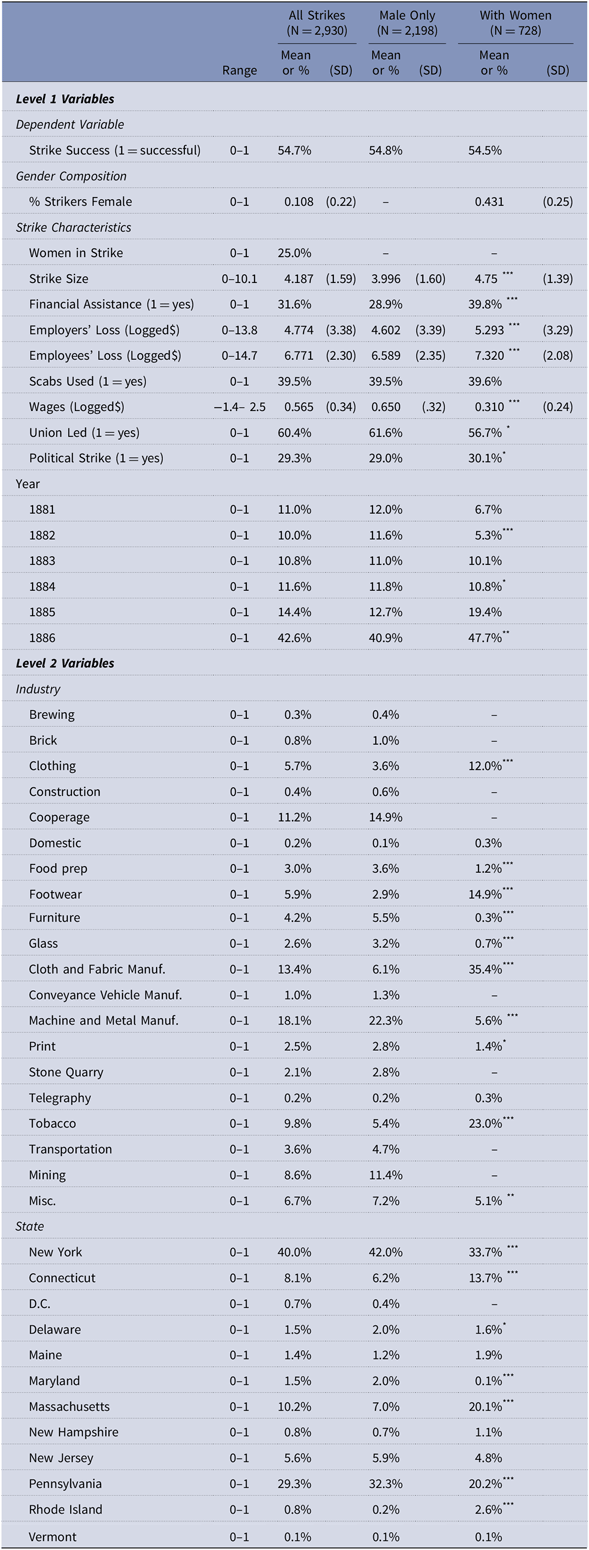
Table 1 presents the descriptive statistics for all study variables. Means and proportions are presented for all strikes (N = 2,930), strikes with only men (N = 2,198), and strikes that have at least one female participant (N = 728). We conducted bivariate tests for significant differences among strikes with women. Twenty-five percent of strikes have at least one female participant. Overall, the average strike contained just more than 10% women. Nearly 55% of all strikes were successful, and there is no bivariate difference between strike success for all-male strikes and strikes with women. Strikes with women were, on average, larger than all-male strikes, and both employees and employers tended to lose more money in strikes that included women. Not surprisingly, workers in establishments with women made much lower wages than those with all men. Strikes with women were less likely than all-male strikes to be union led, but more likely to be driven by worker control, rather than economic issues. Of strikes with at least one female participant, women made up an average of 43% of the strikers per event. There is also significant gender segregation among the industries, states, and years at the bivariate level. No women participated in any strikes in brewing, bricklaying, construction, cooperage, vehicle manufacturing, stone quarry, transportation, and mining industries. Women were mostly concentrated in the clothing, cloth manufacturing, footwear, and tobacco industries. Overall, most strikes occurred in New York, Pennsylvania, and Massachusetts, but women were especially concentrated in Massachusetts, due to the large number of textile, garment, millinery, and shoe mills.
Means and proportions of all study variables

*p < .05; **p < .01; ***p < .001 (two-tailed)
Notes: Asterisks indicate a significant difference between all-male strikes and strikes that included at least one female participant.
Multilevel Model Estimation of Strike Success
Table 2 presents our multilevel logistic regressions predicting strike success. Recall that, in all models, the Level 1 variables are nested within Level 2 variables to control for the variation of success between industries and states. Model 1 is the baseline, and the coefficients are as expected. Larger strikes are associated with a significant increase in the odds of strike success, as are union-led strikes. The greater employers’ financial loss, the higher the odds of worker success, whereas employees’ financial loss is negatively associated with success. Workers with higher weekly wages (presumably more skilled) also have higher odds of success. The use of replacement workers (“scabs” as the labor movement called them) is highly detrimental to strike success. There is also an association between strike success and year, with the odds of strike success showing decreasing trend. There is no association between strike success and whether women participated in the strike, if strikers received financial assistance, or if the strike was motivated by worker control.
Mixed-effects logistic regression of strike success, all strikes

*p < .05; **p < .01; ***p < .001 (two-tailed tests).
Notes: N = 2,930 Standard errors in parentheses. Asterisks indicate significance. Significant χ2 tests indicate the nested models are a better fit than a standard logistic regression.
Model 2 in Table 2 tests the Cultural Attitudes Hypothesis. In support of this hypothesis, the inclusion of women in strikes is associated with a substantial linear decrease in the odds of strike success. The exponentiation of the coefficient (–.88) translates into an odds ratio of 0.41, meaning that for every percentage increase in female strikers, the odds of strike success decrease by 59 percent.
Model 3 of Table 2 adds a squared term for percentage of female strikers, testing the Harmful Heterogeneity Hypothesis (H3) and the Helpful Heterogeneity Hypothesis (H4). The squared term tests whether there is a curvilinear relationship between strike success and women’s participation in strikes. A significant negative linear coefficient and a significant positive quadratic coefficient would take a ∪-shape, supporting H3. A significant positive linear coefficient and a significant negative quadratic coefficient would take a ∩-shape, supporting H4. In this model, there is no significant linear or quadratic term, suggesting that gender heterogeneity alone does not help explain variation in strike success.
Model 4 adds a cubed term in addition to the linear and squared terms for the percentage of female strikers, testing the Heterogeneity Exacerbation Hypothesis (H5) and the Heterogeneity Buffering Hypothesis (H6). The cubic term tests whether there is a polynomial relationship with two bends between women’s participation in strikes and success. In this model, all three women’s participation measures are significant. The negative linear coefficient indicates that at low levels of female participation (male-dominated strikes), the increased inclusion of female strikers is detrimental to strike success. The positive quadratic coefficient indicates a bend where the relationship between female strikers and strike success reverses (approximate gender parity strikes). The negative cubic term indicates another bend turning negative such that, at high levels of female participation (female-dominated strikes), increased inclusion of female strikers is again detrimental to strike success. In sum, these coefficients support the Heterogeneity Buffering Hypothesis, that heterogeneity (approaching parity) buffers the negative impact of women’s participation in strikes, turning the impact of women strikers positive over the mid-range of gender proportions.
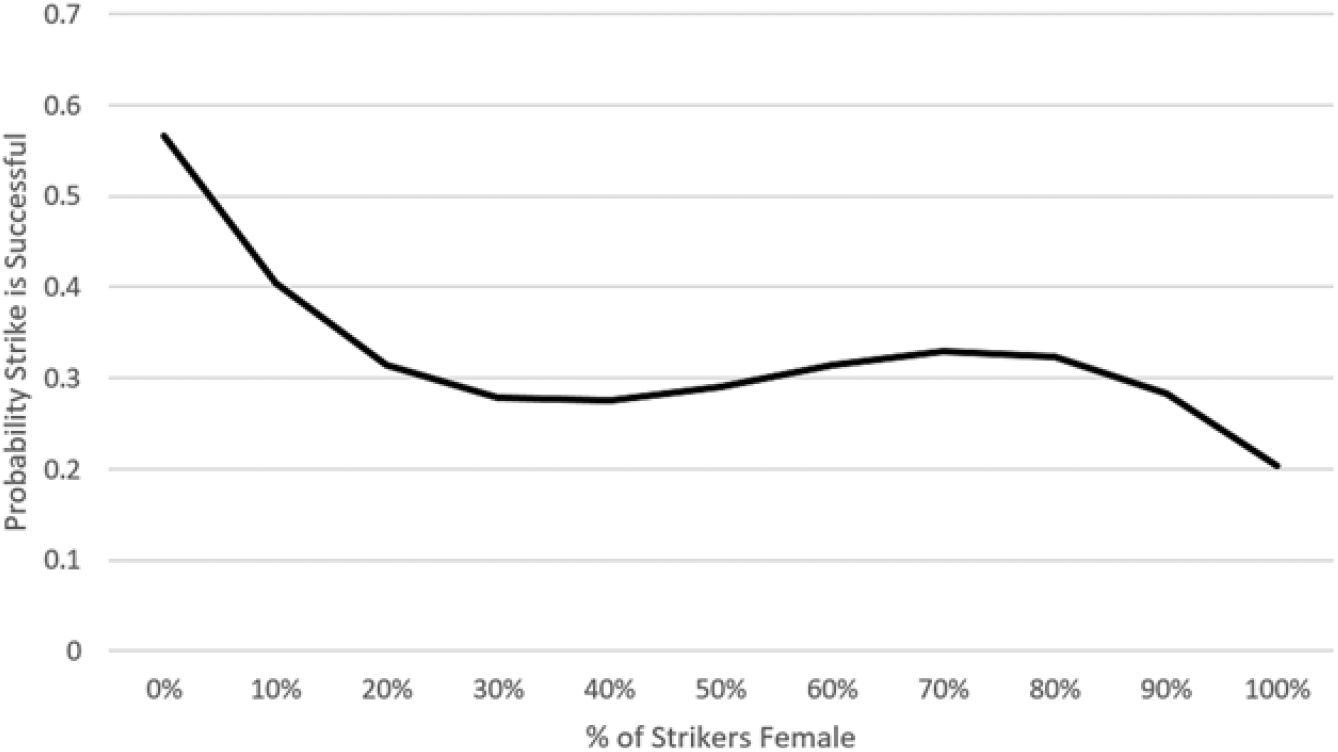
To facilitate interpretation, we used this model to calculate the predicted probabilities of strike success according to the percentage of strikers female, all else equal. Figure 4 presents the predicted probability of strike success by level of women’s participation. Indeed, we see that the probability of strike success decreases drastically as more women are included in strikes that are more gender homogenous: strikes that are more than 80 percent men or more than 80 percent women show a similar relationship. However, strikes with a more mixed-gender composition (in the range of 40 to 70 percent) show the reverse relationship: there is a small increase in the probability of success in more heterogeneous strikes, suggesting that heterogeneity approaching parity buffers the negative impact of women’s strike participation.
Probability of strike success based on percentage of strikers that are women, all strikes.

Sensitivity Analyses
Multilevel modeling is only one way to account for nonindependent observations. Another common method is to adjust the standard errors. Clustered standard errors can also account for intracluster correlation (Primo et al. Reference Primo, Matthew and Milyo2007), and works across many types of regression methods, including logistic regression. To ensure that our findings are robust to other methods, we estimated the relationships using clustered standard errors, and our results (available upon request) were substantively the same.
We also estimated a subsample analysis of our findings to test if the relationships are different for only those strikes with women. This analysis dropped all male-only strikes, reducing the sample size to 728. We estimated subsample analyses with both multilevel modeling and clustered standard errors. Our results (available upon request) were also substantively the same in both of these analyses.
Illustrative Qualitative Data
Because we do not have detailed information on how men and women interacted within strikes or public opinion toward strikes, our interpretations are suggestive. To supplement our theoretical arguments, we searched historical newspaper articles between 1881 and 1886 that covered strikes including women. In the text that follows we incorporate several articles that add interpretive case value to our findings. We did not conduct a systematic analysis of all articles covering all strikes; these are selected articles from major newspapers that focused on women’s participation in strikes, and are meant to be illustrative of our quantitative analyses.
Women’s Participation in Male-Dominated Strikes: Factional Weakness
It is not surprising that male-dominated strikes have the highest odds of success because the labor movement at this historical moment (as all else in the public sphere) was very much male dominated, and these strikes would likely be taken more seriously. It also makes sense that the addition of women into male-dominated strikes would decrease the odds of success because the introduction of women would likely pose a threat to men. This threat could lead to a disrupted collective identity, thus weakening solidarity and collective action. Although our database contains no measures of in-group fighting, this relationship is supported by past research that finds the inclusion of women and minorities to be at times detrimental to the labor movement (Clawson and Clawson 1990; Davis Reference Davis1986; Laslett and Brenner Reference Laslett and Brenner1989; Milkman Reference Milkman1980; Perlman Reference Perlman1928; Rose Reference Rose1988). Further, when there is only a small number of women in a strike, it may be easier for men to exclude them from taking an active role in workplace actions. An article from the New York Times (January 24, 1886) describes a meeting of striking cigar workers in January 1886. We were able to link this article to a specific strike event in our database where women made up 25% of the strike. During this meeting on strategy, the women were not present:
There was not a woman in the room, and yet it was obvious from the debate that all the important questions had come before them for consideration…. There was a great deal of talk pro and con without reaching an agreement, and finally further consideration of the subject was postponed until the next evening.
This story is suggestive of the possible mechanisms occurring when a small number of women are present in a strike. Although we do not know if the women strikers were officially excluded from the meeting, they were not present, and the men decided not to take any action or make any demands on behalf of the women. It is possible that when women make up a minority of strike participants, it is easier for the men to exclude and ignore them entirely from decision-making processes. Consequently, gender-based factionalism can weaken strike solidarity and success.
Women’s Strikes in Female-Dominated Workplaces: “Girls” Out of Control
It also makes sense that female-dominated strikes are the least successful, and become even less successful as more women are included. It could be that with fewer male strikers, the movement may lose cultural legitimacy, making it easier for capital to resist the strike and women’s demands if there is little public support for strikers. Again, although we cannot directly measure the cultural attitudes of capitalists or the public toward female-dominated strikes, previous literature suggests that women’s work and movements during this time were not taken seriously (Barker-Benfield Reference Barker-Benfield2004; Laslett and Brenner Reference Laslett and Brenner1989; McCammon et al. Reference McCammon, Campbell, Granberg and Mowery2001). Other research finds that success is more likely among movements with public support because elites must strive to remain popular among the general public (Burstein Reference Burstein, Giugni, McAdam and Tilly1999; Oegema and Klandermans Reference Oegema and Klandermans1994). Consider, for example, the title of an article in The Cincinnati Enquirer (June 6, 1886) covering a female-dominated manufacturing strike: “Troy Factory Girls: They Pass Their Time Flirting While They Are on a Strike for Want of Something Better to Do.” In another example, an article from The New York Times (October 22, 1881) covered an all-female strike of tobacco workers who were protesting a fired foreman:
Of the precise reason for this devoted loyalty to [the foreman] the public as yet knows nothing. Probably he had a sympathetic soul…. Perhaps he was a handsome young man, whose “perfectly splendid” eyes lit up the dull factory room and whose “awfully lovely hair” won the admiration of his subordinates.
Both articles, like others we found, attributed the motivation of the strike to an infatuation with a handsome foreman, rather than focus on their workplace issues with their new foreman. Elsewhere it mentions that the strike was “led by a determined girl named Nellie, who is probably a member of the International, and very likely a secret agent of the Nihilists,” again characterizing “girl strikers” in a negative and threatening light (cf., Isaac Reference Isaac2008).
This pattern of mocking women workers was consistent across many articles we found that were about female-dominated strikes. An article in The St. Paul Daily Globe (June 25, 1886) was titled “Three Hundred Silly Girls Quit Work at Cincinnati.” The Chicago Tribune (July 28, 1885) covered a strike of female cotton mill employees where “it was decided that the girls should confer with their fathers, brothers, or guardians, and procure their assistance and advice” about what to do.
One of the most well-known examples of a major female strike in a female-dominated industry was the 1909 Shirtwaist Strike in New York City, where the labor force was 85% to 90% female and the strikers were almost exclusively female. Here the full weight of sociocultural sexism was brought to bear on the strikers from all quarters—employers, police, magistrates, newspapers, and even some labor leaders. Theresa Malkiel (Reference Malkiel1990 [1910]) wrote about the critical disapproval she received from her father and boyfriend for her role in the strike. If during this historical period, wage-earning women were suspect and operating inappropriately in the male public sphere, then politically contentious striking women were even worse. Authorities used a combination of strikebreaking tactics; some were time-tested techniques used generally against strikes (e.g., strikebreaking replacement workers, police harassment and violence, arrests), but there were also “gendered attacks designed to undermine women’s basic claim to political subjectivity” (Enstad Reference Enstad1999: 91). For instance, the women strikers were chastised by the press and court magistrates for their “unlawful” and “immoral behavior,” with a general characterization of “striking women as ‘girls’ who are out of control” (ibid.: 95). The attack to break the strike worked to undermine both class solidarity and women’s legitimacy as political actors.
Women’s Participation in Mixed-Gender Strikes: Potential for Solidarity
The finding that more proportionately even mixed-gender groups buffer, and even reverse, the negative impact of women’s participation in strikes is novel. This supports the idea that an evenly mixed group would have a more diverse range of tactics, networks and resources (McCammon et al. Reference McCammon, Campbell, Granberg and Mowery2001; Morris and Staggenborg Reference Morris, Staggenborg, Snow, Soule and Kriesi2002), but that women’s negative social standing is still detrimental. Although we do not have data to gauge tactics, networks, or resources, this interpretation is consistent with our evidence. Experience by some women in the suffrage movement may have been a source of beneficial practice. Moreover, a relatively equal number of women in a strike would make it harder for women to be marginalized by male co-workers. It is also possible that, in more equally mixed groups, women would be more respected by their male co-workers, if only because their numbers really mattered for success. An article published in The New York Times (May 29, 1885) covered a ceremony after a successful carpet factory strike that was comprised of 58% women:
The three young women from the Yonkers carpet factories recently arrested while on “picket” duty sat on the platform. They were vociferously cheered. Factory girls and sewing women were plentifully sprinkled among the listeners .… John Swinton came in late and presented silver medals to [the women]. He made a speech commending the strikers for their courage and perseverance, and a collection was taken up for them at the door.
This article suggests that at least some women took active leadership roles in the strike. It is possible that, with a more even gender mix, men and women cooperated, bolstering solidarity and producing more effective action. In larger numbers, women may be able to mobilize their experiences and resources without being easily marginalized. However, because there was still a sizeable proportion of men, it is possible that the strike still retained gender legitimacy, thus weakening the negative frame of “girls out of control.”
Another article published in The New York Sun (January 28, 1885) covered a strike in a dry goods store. The workers went out over the firing of a clerk. The article notes how although the male and female workers joined the strike, it was the women who led the corresponding boycott of the store: “The girls followed customers into the store and coaxed them not to buy.” The article also notes how the men and women worked together: “At 6 o’clock a crowd of workingmen and women and young girls and the striking clerks gathered about the doors of the store, shouted, sung songs, and stopped customers.”
One of The New York Times (January 24, 1886) articles discussed in the preceding text also covers a meeting of workers from several strikes in different industries. Although we were not able to locate the exact proportions of women in each strike or their outcomes, the article is consistent with our findings:
In strikes of carpet weavers, cotton spinners, telegraph operators, paper box makers, and various other trades that included a large number of women the reporter invariably found a fair representation of the petticoats [women] at the labor meetings… and taking an influential, if not orally active, part in the discussions.
In this case, the women who were more evenly represented were actively engaged in the discussions about the strikes with their male counterparts.
While our data do not contain information on race or ethnicity, there is evidence that worker racial composition may have worked similarly in strikes. For example, in cases in which there were relatively even proportions of black and white workers and no major racial segregation in the labor process, racial strike solidarity tended to be stronger. This was the case in the greatest strike of the 1880s involving black workers—strikes against sugar growers in Louisiana (Foner Reference Foner1981: 60–61)—and in sit-down strikes in the auto industry in 1936 (Meier and Rudwick Reference Meier and Rudwick2007: 35–36).
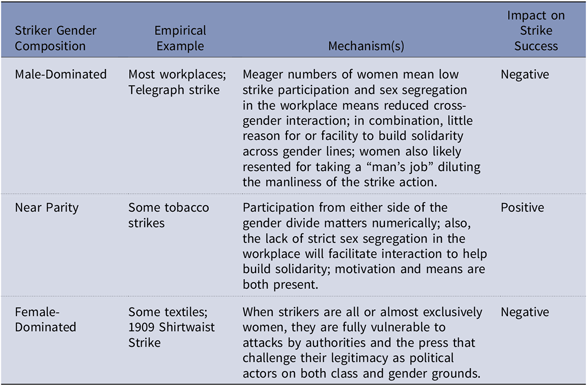
Again, these accounts are illustrative and are meant to supplement our interpretations of the quantitative findings. They are consistent with the theory that, when proportions of men and women approached parity, women tended to be taken more seriously and were more active in strikes, which could enhance solidarity and effectiveness in struggle. This condition is shown in Table 3 which summarizes the three major scenarios in our results.
Striker gender composition, mechanisms, and impact on strike success

Discussion and Conclusion
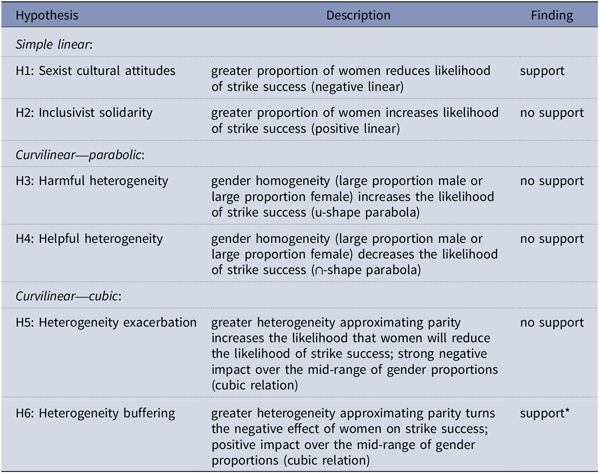
We have examined how women’s participation in Gilded Age strikes affected the chances of strike success. Based on previous research, we theorized that the effect of female participants on strike success may be due to cultural attitudes that devalue women, the effect of heterogeneity within groups, or a combination of both. We developed six hypotheses, which are summarized with findings in Table 4. The Sexist Cultural Attitudes Hypothesis predicted that a greater proportion of women participating in a strike would be associated with a linear decrease in the odds of strike success. Preliminary analysis supports this hypothesis. The Inclusivist Labor Solidarity Hypothesis predicted that a greater proportion of women participating in a strike would be associated with a linear increase in the likelihood of strike success, but we found no support for this hypothesis.
Summary of hypotheses and findings

* Most complete explanation.
The third and fourth hypotheses focused on the effects of heterogeneity. The Harmful Heterogeneity Hypothesis, predicted that the relationship between women’s participation in a strike and strike success would be curvilinear, forming a U-shape relation. Conversely, the Helpful Heterogeneity Hypothesis, predicted that the relationship between women’s participation in a strike and strike success would curvilinear, but forming an inverted U-shape. Our findings do not support either of these hypotheses in isolation. In other words, the ratio of diversity alone does not explain why some strikes were more successful than others.
Finally, we considered whether heterogeneity influenced the negative effect of women’s participation on strikes. Our Heterogeneity Exacerbation Hypothesis predicted that gender heterogeneity would exacerbate the negative impact of women’s participation in strikes. We did not find support for this hypothesis. Conversely, the Heterogeneity Buffering Hypothesis predicted that gender heterogeneity buffers the negative impact of women’s participation in strikes. This hypothesis was supported in the cubic nonlinear specification, and offers the most complete explanation for the data. When men are overrepresented in strikes, the odds of strike success are high and increasingly attenuated by greater proportions of women. Also, when women are overrepresented in a strike, the odds of success are low, and increasingly attenuated by greater proportions of women. However, when men and women are relatively equally represented in strikes, the odds of strike success are moderate, and increase with increasing proportions of women. We suggest that this is because, under conditions of relatively even gender proportions in collective action, it would have been more difficult to ignore or exclude women from movement participation without paying a significant price in the struggle against employers. Under such conditions, women’s relative numerical strength mattered. Moreover, it is also possible that female participants could have brought innovative tactics, resources, militant energy (Voss Reference Voss1993: 195), and networks to the movement, aiding in success. Overall, the heterogeneity buffering explanation is well grounded in theory, history, and best fits the data.
We note two data limitations. First, The Third Annual Report of the US Commissioner of Labor does not provide data on the tactics utilized or the characteristics of the strike leaders, nor is there data about public opinion toward particular strikes. To address these limitations, we included qualitative data in the form of excerpts from news articles during this period that covered women’s involvement in strikes. Second, this source does not include data on the race or ethnicity of the strikers. It is likely that a sizeable proportion of the female strikers were immigrants (Glenn Reference Glenn1991; Kessler-Harris Reference Kessler-Harris1976). This means we cannot parse possible ethnic effects from gender effects featured here, so we must caution that the central effects likely embody some influence of ethnicity as well as gender.
Nonetheless, our findings are valuable in two major ways. First, the character of the data we employ are unique and allow for important insights. The data are among the most detailed available on strikes and their outcomes in the United States. For example, currently there is no systematic data collection on strikes that involve less than 1,000 people (US Bureau of Labor Statistics 2015), not to mention the lack of systematic information on strike outcomes. Second, this study makes an important theoretical contribution. We bring together two separate literatures focusing on how the lower status of women is related to movement success and how this relationship is buffered under conditions of approximate proportional gender parity. Social movement scholarship tends to bifurcate on the issue of social compositional diversity consequences; that is, compositional diversity is either harmful or beneficial. We advance an argument that finds that gender composition can be both beneficial and harmful to strike success conditional on gender proportions in collective action.
Although women in current US workplaces are generally not as socially disadvantaged as in the late nineteenth century, our findings may be seen as a case in point regarding vulnerable, low-status workers in the labor movement. Specifically, undocumented immigrants today experience a similar lack of formal and cultural rights as did women in the late nineteenth century. They are also culturally vilified, and resented among some (but not all) groups of workers. Our proportional parity proposition may work more generally for other status group differentials in contentious collective action. It follows that future research should examine subgroup proportional patterns in contentious collective action of other culturally marginalized populations, past and present.
Archival Sources
“Labor and Capital.” Chicago Tribune, July 28, 1885.
“Troy Factory Girls: They Pass Their Time Flirting While They Are on a Strike for Want of Something Better to Do.” Cincinnati Enquirer, June 6, 1886.
“Saleswomen on Strike.” New York Sun, January 28, 1885.
“The Tobacco Strike.” New York Times, October 22, 1881.
“Cheering Three Yonkers Strikers.” New York Times, May 29, 1885.
“Settled by the Girls: The Congress of the Female Cigarmakers. Meetings at Which They Discuss Such Questions as Arise during the Present Labor Troubles,” New York Times, January 24, 1886.
“A Season of Strikes: Three Hundred Silly Girls Quit Work at Cincinnati.” St. Paul Daily Globe, June 25, 1886.