Introduction
Postoperative delirium is a common neuropsychiatric complication in hospitalized elderly patients, with an incidence up to 56% after hip-surgery (Inouye et al., Reference Inouye, Viscoli, Horwitz, Hurst and Tinetti1993). This acute disorder is characterized by a decline in attention and cognition. Psychotic symptoms may occur, such as delusions and hallucinations, as well as mood instability. Although delirium is usually considered a brief transient state, it can persist and/or have long-term negative outcomes like cognitive deterioration and institutionalization (Adamis et al., Reference Adamis, Treloar, Martin and Macdonald2007; Cole, Reference Cole2010; Witlox et al., Reference Witlox, Eurelings, de Jonghe, Kalisvaart, Eikelenboom and van Gool2010).
Much less is known about the impact of delirium upon affective functioning. Preoperative delirium is an identified risk factor for delirium, but what about postoperative delirium as a risk factor for depression afterward (Greene et al., Reference Greene, Attix, Weldon, Smith, McDonagh and Monk2009). Previous work suggest that approximately 50% of the patients who experience in-hospital delirium have clinically significant depressive symptoms after hospital discharge, while other work suggests that depressive symptoms may be evident up to two years afterward (Dolan et al., Reference Dolan2000; Olofsson et al., Reference Olofsson, Lundström, Borssén, Nyberg and Gustafson2005; Lenze et al., Reference Lenze2007; Davydow, Reference Davydow2009). Screening for depression after hip fracture found that the majority cases emerge within the first ten weeks (Burns et al., Reference Burns2007). A review from Davydow (Reference Davydow2009) identified eight studies relating to delirium and affective disturbances, of which four studies found an association between in-hospital delirium and subsequent depressive symptoms, two of the studies concerned delirium after hip fracture. Almost all of these studies are based on screening questionnaires only, with the exclusion of one study that used a semi-structured diagnostic interview in a cardiac surgery population. This review also noted that the existing studies were incapable of differentiating between depression after in-hospital delirium or a possible persisting delirium. A study on treatment and prevention of depression, as measured with the Geriatric Depression Scale (GDS), after hip surgery reported no significant effect of their interventions at follow-up assessments. If indeed delirium is subsequently associated with clinically manifest depression, this raises the question as to why intervention had no effect. In the case of increased depressive symptoms without full syndromal depression present, it might be that usual interventions are inappropriate. Yet, increased depressive symptoms after delirium are still of importance, because it interferes with rehabilitation after hip surgery (Lenze et al., Reference Lenze2004).
Anxiety levels, post-traumatic stress disorder (PTSD) symptoms and their association with delirium have been investigated in different populations, other than hip fracture patients. In a study of 52 hematopoietic cell transplantation (HCT) patients, aged between 22 and 62 years, no association was found between delirium and anxiety levels at six months to one-year follow-up (Basinski et al., Reference Basinski, Alfano, Katon, Syrjala and Fann2010). A limitation of this study is that the original Delirium Rating Scale was used for delirium diagnosis, which includes a relatively narrow range of delirium symptoms. A study with 34 burn victims found that affective distress during delirium correlated with worse psychopathological adjustment. Since burn injury can be considered as a traumatizing event in itself and this study population was also relatively young, the association between delirium and long-term psychiatric symptoms in elderly patients remains unclear (Blank and Perry, Reference Blank and Perry1984). In the study on HCT patients, delirium was associated with more symptoms of PTSD at one-year follow-up, whereas no association was found with PTSD in intensive care unit (ICU) patients requiring mechanical ventilation (Girard et al., Reference Girard2007; Basinski et al., Reference Basinski, Alfano, Katon, Syrjala and Fann2010).
The aim of the present study was to examine affective functioning at follow-up, three months after hospital discharge, in elderly hip fracture patients with and without in-hospital delirium. This is the first study that simultaneously investigates anxiety and depression levels, and PTSD symptoms three months after hospital discharge, and their association with delirium, in elderly hip fracture patients. The three months time period is relevant, since onset of depression has been suggested to be at its highest risk within the first ten weeks after hip fracture. In an attempt to clarify why previous studies have found contradicting results, this study used a variety of measurements for each symptom domain, including screening questionnaires and structured diagnostic interviews.
Methods
Ethical considerations
This study was conducted in accordance with the Declaration of Helsinki and the guidelines on Good Clinical Practice. Approval of the regional research ethics committee was obtained. All patients gave written informed consent including permission for the follow-up part of this study.
Study design and objectives
The study was conducted in a series of consecutively admitted elderly hip fracture patients to a teaching hospital in Alkmaar, the Netherlands. Eligibility was checked for all patients aged 75 years and older admitted for primary surgical repair of hip fracture, from March 2008 to March 2009. A subgroup of this study cohort also participated in a clinical trial that compared the effectiveness of taurine versus placebo in reducing morbidity and one-year mortality in elderly hip fracture patients (http://Clinicaltrials.gov; registration number NCT00497978; Research on delirium has been published previously.) (Witlox et al., Reference Witlox2011).
Patients were ineligible to participate in the study if they had no surgery, had a malignancy, had a previous hip-fracture on the identical side, were in contact isolation, incapable of participating in interviews (language barrier, aphasia, coma), had no acute trauma, were transferred to another hospital, or received a total hip prosthesis.
Examining affective functioning three months after hospital discharge in patients who did or did not develop delirium during hospitalization was a pre-specified secondary aim of the study. All patients with delirium during hospital admission were asked to participate in the follow-up. Based on random selection by a computer-generated randomization code, a subgroup of patients without delirium during hospitalization were selected and invited to participate as controls. Declination to participate in the follow-up study did not significantly differ between people with and without in-hospital delirium.
Because we were specifically interested in the effects of postoperative in-hospital delirium on affective functioning three months after hospital discharge, we excluded patients with prevalent delirium (already delirious at admission) from all the analysis. At the follow-up assessment, we excluded patients who were still delirious from the analysis. An additional analysis was performed where we excluded patients with subsyndromal delirium. Definitions of (full syndromal) delirium and subsyndromal delirium were based on Confusion Assessment Method (CAM) criteria (Inouye et al., Reference Inouye, van Dyck, Alessi, Balkin, Siegal and Horwitz1990). Patients who met full CAM criteria were classified as delirious (CAM: item 1 and 2 plus either 3 or 4). Those patients with two CAM criteria but without full criteria were classified as having subsyndromal delirium (Marcantonio et al., Reference Marcantonio2005). Before surgery, a standardized baseline assessment had been completed to document patient characteristics, risk factors of delirium, and global cognitive performance. During hospital admission, presence of delirium was assessed daily from time of admission until the fifth postoperative day or discharge, in case of delirium until it remitted for three consecutive days or until discharge. At the follow-up assessment, patients were asked about additional hospitalizations or possible delirium episodes between discharge and follow-up. Three months after discharge, patients underwent a comprehensive assessment that included among others the repetition of several tests presented at baseline. Baseline characteristics and neuropsychiatric test scores were compared between patients with and without in-hospital delirium. When applicable, we compared baseline and follow-up scores within groups. We also performed additional analyses to further examine the association between delirium and affective functioning in specific subgroups. Since participants were at high risk for delirium during hospitalization (i.e. aged 75 years or older, and acute hospital admission), they all received routine care, according to hospital guidelines, with prophylactic treatment of 0.5 mg haloperidol, three times daily, from time of admission until postoperative day three, unless contraindications regarding its use were present (Kalisvaart et al., Reference Kalisvaart2005).
Baseline (preoperative) assessment
The baseline assessment was completed within 12 hours of admission and before surgery. It consisted of patient and proxy interviews, assessment of delirium, and inspection of all available medical records. We documented the following demographic variables: age, gender, and educational level. To assess mental status, we used the Mini Mental State Examination (MMSE) as a measure of baseline cognitive functioning on a scale of 0 (poor) to 30 (good) with scores lower than 24 indicating cognitive impairment (Folstein et al., Reference Folstein, Folstein and McHugh1975). The 16-item Informant Questionnaire on Cognitive Decline in the Elderly Short-Form (IQCODE-N) was used as an estimate of pre-fracture cognitive decline and was scored by a close relative or caregiver on a scale of 16 (improvement) to 70 (decline) (Jorm and Jacomb, Reference Jorm and Jacomb1989). A score higher than 57 (i.e. mean item score of 3.6) indicates cognitive decline (de Jonghe et al., Reference de Jonghe, Schmand, Ooms and Ribbe1997). We used the Hospital Anxiety and Depression Scale Part A (HADS-A) to measure anxiety levels (Zigmond and Snaith, Reference Zigmond and Snaith1983). This screening tool consists of seven questions, on a four-point (1–4) scale. The maximum score is 28, with higher scores indicating more anxiety. Depressive symptoms were assessed with the Geriatric Depression Scale-15 (GDS-15), which is a 15-item self-rating scale for depression with higher scores indicating depression (Sheikh and Yesavage, Reference Sheikh and Yesavage1986). Based on the items of the GDS, we also calculated a separate core depression (items 1, 3–8, 10–12, and 14–15) and apathy (items 2, 9, and 13) score (Brodaty et al., Reference Brodaty, Altendorf, Withall and Sachdev2010). Burden of illness included the number and type of medical comorbidities and medications before hospital admission. We also reviewed the medical record to document the American Society of Anesthesiologists (ASA) physical status classification system (range of 1 (normal health patient) to 5 (moribund patient)) and the Acute Physiology Age and Chronic Health Examination (APACHE II) score (range of 0 (no acute health problems) to 70 (severe acute health problems)) (Knaus et al., Reference Knaus, Draper, Wagner and Zimmerman1985). Functional status comprised pre-fracture living arrangement, visual acuity, activities of daily living (ADL), and instrumental activities of daily living (IADL). Visual acuity was assessed with the standardized Snellen test for visual impairment, and visual impairment was defined as binocular near vision, after correction, worse than 20/70 (Hetherington, Reference Hetherington1954). Pre-fracture ADL functioning was determined with the Barthel Index (BI), which is scored by a close relative or caregiver on a scale from 0 (dependence) to 20 (independence) (Mahoney and Barthel, Reference Mahoney and Barthel1965). IADL was also assessed by a close relative or caregiver on the Lawton IADL scale with a range of 8 (no disability) to 31 (severe disability) (Lawton and Brody, Reference Lawton and Brody1969).
A diagnosis of delirium was defined according to the criteria of the CAM, which consists of an acute onset and fluctuating course of cognitive function, inattention, and either disorganized thinking and/or altered level of consciousness (Inouye et al., Reference Inouye, van Dyck, Alessi, Balkin, Siegal and Horwitz1990). The CAM algorithm was rated on the basis of an interview with the patient and hospital staff, brief cognitive assessment with the MMSE and the expanded digit span test, and screening of the medical and nursing records for signs of delirium (Lindeboom and Matto, Reference Lindeboom and Matto1994). CAM positive patients were those that demonstrated an acute change or fluctuation in their mental status plus the accompanying inattention and disorganized thinking and/or altered level of consciousness. Delirium severity was measured using the Delirium Rating Scale Revised-98 (DRS-R-98), which is a 16-item rating scale comprised of 13 severity items and 3 diagnostic items. The item-scores range from 0 (no severity) to 3 (maximum severity). Possible total severity scores range from 0 (no severity) to 39 (maximum severity) (Trzepacz et al., Reference Trzepacz, Mittal, Torres, Kanary, Norton and Jimerson2001). Delirium assessments continued until delirium remitted for three consecutive days or until discharge.
In case of the IQCODE-N, BI, and Lawton IADL, proxies were asked to describe the patient's condition a week before the fracture as to determine function unbiased by the event of hip fracture itself or any acute or sub-acute event leading to hip fracture.
Follow-up assessment at three months
The CAM was used to screen for delirium symptoms at follow-up and to exclude patients with persistent (i.e. from hospital discharge until follow-up) or recurring delirium.
Several neuropsychiatric questionnaires were administered three months after hospital discharge by two trained neuropsychologists. The questionnaires were selected to assess several affective domains and contained standardized and validated instruments. The collection consisted of the following tests: the Mini-International Neuropsychiatric Interview (M.I.N.I.), the Post-Traumatic Stress Syndrome Scale-10 (PTSS-10), the HADS-A, and the GDS-15 (Sheehan et al., Reference Sheehan1998; Richter et al., Reference Richter, Waydhas and Pajonk2006). It took approximately one hour to complete the whole follow-up assessment. Most patients were examined at home, but some patients preferred to visit the hospital.
The M.I.N.I. was used to assess the presence of a depressive episode, generalized anxiety disorder and PTSD according to the Diagnostic and Statistical Manual of Mental Disorders-IV (DSM-IV) criteria (DSM-IV-TR, 2000). Each domain is assessed with several yes/no questions. In addition to the M.I.N.I., the rating scale PTSS-10 was used to assess the presence of PTSD. The PTSS-10 is a self-report questionnaire assessing symptoms related to PTSD. The PTSS-10 consists of ten items, each of which ranges from 1 point (none) to 7 points (always). The ten symptoms are: sleeping problems, nightmares, gloom, jumpiness, the need to draw back from contact with other people, irritability, mood swings, the feeling of guiltiness, fear of locations or situations that remind the patient of the fall or hospitalization, and tensed muscles. The total score ranges from 10 to 70, with higher scores indicating more symptoms; scores of 35 or above are considered indicative of PTSD (Stoll et al., Reference Stoll1999; Nickel et al., Reference Nickel2004).
Statistical analysis
Statistical calculations were performed using SPSS for Windows, version 19 (SPSS Inc., Chicago, IL, USA). Descriptive statistics are provided to characterize patients with and without previous delirium. Quantitative variables are presented as mean (standard deviation (SD)) or median (inter-quartile range (IQR)). We presented raw test scores of neuropsychological tests. χ2 or Fisher Exact tests were used to analyze categorical variables. The assumption of normality was tested with the Kolmogrov–Smirnov test. Continuous variables were analyzed with student t-tests or Mann–Whitney U tests for between group comparisons and paired t-tests or Wilcoxon's signed ranks tests for within group comparisons. To examine whether delirium is associated with scores on neuropsychiatric questionnaires independent of important covariates, we fitted a multiple linear regression model for those affective measures that were associated with delirium in univariate analyses. In the multivariate models, we entered delirium as an independent variable together with age, baseline MMSE score (continuous variable), living independently (yes/no), and baseline measure of the outcome variable. These covariates were selected based on their potential to influence delirium and neuropsychiatric symptoms. Given our sample size, we aimed to restrict the number of independent variables to a maximum of five. We repeated the analysis with the variable treatment allocation (taurine or placebo for the patients who participated in the RCT). In the regression models that are presented in the results section, we entered the MMSE, and not the IQCODE-N, as a measure of pre-existent cognitive impairment. Compared with the IQCODE-N (which measures intra-individual differences), the MMSE provides a score that can more easily be compared between patients. The core assumptions of linear regression modeling were tested for each model: linearity of the relationship between dependent and independent variables, independence of the errors, constant variance of the errors, and normality of the error distribution. Statistical significance was set at p < 0.05.
Results
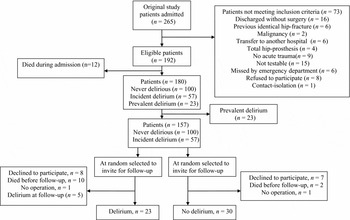
The final patient sample consisted of 53 patients of whom 23 (43.4%) experienced in-hospital delirium (Figure 1).
Flow diagram of the study.

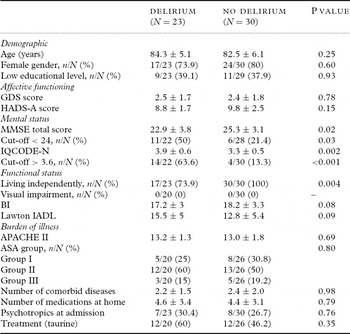
The baseline characteristics of the 23 patients with and 30 without in-hospital delirium are presented in Table 1. Patients who developed in-hospital delirium were more cognitively impaired and more often institutionalized compared to patients who remained free from delirium postoperatively. Anxiety and depressive symptoms at admission did not differ between the patients with and without delirium, and no patient had a GDS-15 score higher than 7, indicative of more severe depressive symptoms.
Baseline characteristics of patients with and without in-hospital delirium

Values are expressed as means ± SD or n/N is number with characteristic/total number with available data, (%) is percentage.
GDS is Geriatric Depression Scale, ranges from 0 (depression not likely) to 15 (depression very likely).
HADS-A is Hospital Anxiety and Depression Scale Part A to measure anxiety levels. Seven questions with a four-point (1–4) scale. The maximum score is 28.
MMSE is Mini Mental State Examination, ranges from 0 (severe cognitive impairment) to 30 (no cognitive impairment), score <24 indicates cognitive impairment.
IQCODE-N is Informant Questionnaire on Cognitive Decline in the Elderly Short-Form, ranges from 16 (cognitive improvement) to 80 (severe cognitive decline), mean score >3.6 indicates cognitive decline.
Visual impairment measured with the standardized Snellen test for visual impairment and defined as binocular near vision worse than 20/70 after correction.
BI is Barthel Index, ranges from 0 (severe disability) to 20 (no disability).
Lawton IADL is Lawton Instrumental Activities of Daily Living scale, ranges from 8 (no disability) to 31 (severe disability).
APACHE II is Acute Physiological and Chronic Health Evaluation II, ranges from 0 (no acute health problems) to 70 (severe acute health problems).
ASA is American Society of Anesthesiologists physical status classification system, ranges from 1 (normal health patient) to 5 (moribund patient).
Treatment, taurine or placebo for patients who participated in the RCT.
Three months after hospital discharge
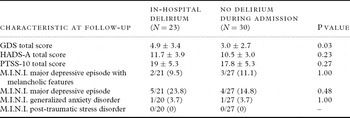
At follow-up patients who had experienced in-hospital delirium had more depressive symptoms as reflected in the higher GDS-15 total scores and they remained more cognitively impaired compared to patients without delirium (Table 2).
Characteristics at three months follow-up of patients with and without in-hospital delirium

Values are expressed as means ± SD or n/N is number with characteristic/total number with available data, (%) is percentage.
GDS is Geriatric Depression Scale, ranges from 0 (depression not likely) to 15 (depression very likely).
HADS-A is Hospital Anxiety and Depression Scale Part A to measure anxiety levels. Seven questions with a four-point (1–4) scale. The maximum score is 28.
PTSS-10 is the Post-Traumatic Stress Syndrome Scale-10, ranges from 10 to 70, with higher scores indicating more symptoms; scores of 35 or above are considered indicative of PTSD.
M.I.N.I. is the Mini-International Neuropsychiatric Interview.
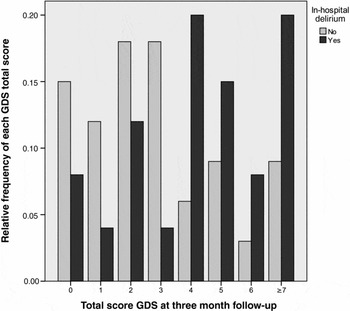
Further analysis showed that patients with in-hospital delirium scored higher on the core depressive symptoms of the GDS (p = 0.02), and not on the total score of the apathy items, compared to patients without in-hospital delirium at follow-up. Figure 2 shows the relative frequency of the GDS total scores at follow-up within the delirium and the control groups. This figure shows that the scores of the non-delirious patients are centered within a lower range compared to the delirious patients, indicating that the differences between both groups are not caused by outliers.
Relative frequency of GDS total scores within each group.

Repetition of this analysis without patients who had subsyndromal delirium during hospitalization or at follow-up showed that patients with in-hospital delirium (n = 18) had again significantly more depressive symptoms at follow-up compared to patients without delirium (n = 23) (p = 0.004). Of 23 patients, 5 patients with in-hospital delirium had subsyndromal delirium at follow-up, and of 30 patients, 7 patients without full-syndromal delirium did experience subsyndromal delirium during hospitalization.
At follow-up, the HADS-A score did not differ between patients with and without in-hospital delirium. Patients with and without delirium did not differ on diagnoses of generalized anxiety disorder and major depressive episode according to the M.I.N.I. However, almost half (47.1%) of the patients that had been delirious previously, did have three or more depressive symptoms according to the M.I.N.I. compared to 5/20 (25%) patients without in-hospital delirium, this difference was not significant. Patients with and without delirium did not differ on the PTSS-10 total scores. Also, no patients were diagnosed with PTSD according to the M.I.N.I.
Within group analysis
Within group analysis showed that both in the post-delirium group (p = 0.003) and the control group (p = 0.04), HADS-A scores increased from baseline to follow-up. Depressive symptoms showed a significant increase from baseline to follow-up within the post-delirium group (p = 0.007), while no significant change was noted among controls who had remained free from delirium.
Multivariate analysis
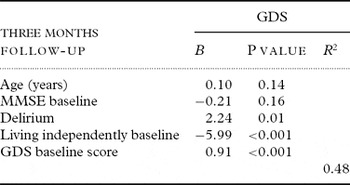
In multivariate analysis, we examined the association between in-hospital delirium and GDS-15 scores at follow-up. We adjusted for age, MMSE at baseline, GDS-15 at baseline, and living situation. In-hospital delirium remained associated with higher GDS-15 scores at three months follow-up (Table 3), also when excluding the apathy associated items from the score (B = 1.72, 95% CI = 0.42–3.02, p = 0.01).
Multiple linear regression models of GDS scores at follow-up and in-hospital delirium

GDS is Geriatric Depression Scale, ranges from 0 (depression not likely) to 15 (depression very likely).
MMSE is Mini Mental State Examination, ranges from 0 (severe cognitive impairment) to 30 (no cognitive impairment), score <24 indicates cognitive impairment.
Living independently (yes or no) before hospital admission.
Repeating the multivariate analysis with treatment allocation to either taurine or placebo as a covariate did not change the results.
Discussion
This study highlights the importance of monitoring elderly hip fracture patients after in-hospital delirium. It examined the association between in-hospital delirium after hip fracture surgery and affective functioning three months after hospital discharge. Depressive symptoms, anxiety levels, and post-traumatic stress symptoms were assessed in an elderly population free from delirium at a three-month follow-up. The main finding of this study is that the occurrence of in-hospital delirium was independently associated with increased depressive symptoms three months after hospital discharge.
Although increased depressive symptoms at follow-up was associated with in-hospital delirium, this association did not equate with the diagnosis of major depressive disorder as measured with the M.I.N.I. This might explain why interventions after hip surgery had no effect on depression in a study with elderly hip fracture patients (Burns et al., Reference Burns2007). Patients received six weekly sessions short after hip surgery aimed at either treatment or prevention of depression. Patients were assessed at follow-up, after six weeks, three months, and six months. In this study, the GDS-15 was used to identify depression and patients with delirium were excluded. In our study, persistent or recurring full syndromal delirium does not explain the increased depressive symptoms, because patients with delirium at follow-up were excluded from analysis. An alternate explanation might be that the depressive symptoms might have been part of an existing subsyndromal delirium. However, repetition of the analysis in this study without patients that had subsyndromal delirium showed that patients with in-hospital delirium had again significantly more depressive symptoms at follow-up compared to patients without delirium.
Experimental findings and neuropathological observations suggest that activation of microglia is pivotal for mediation of the acute behavioral and cognitive effects of systemic inflammation (van Gool et al., Reference van Gool, van de Beek and Eikelenboom2010). A mild systemic inflammatory response suffices to increase the production of pro-inflammatory cytokines within the brain when microglia are already “primed” by chronic pathologic events as chronic neurodegeneration or advanced age (Cunningham, Reference Cunningham2011). After hip surgery, the release of pro-inflammatory cytokines as a consequence of fracture and surgery induces a systemic inflammatory response. In older hip-fracture patients, delirium was associated with higher postoperative serum levels of proinflammatory cytokines, while no differences were seen in the preoperative serum levels between the delirium and non-delirium patients (van Munster et al., Reference van Munster, Korevaar, Zwinderman, Levi, Wiersinga and de Rooij2008; Cerejeira et al., Reference Cerejeira, Nogueria, Luis, Vaz-Serra and Mukaetova-Ladinska2012). A recent study with elderly hip fracture patients found that depressive symptoms were associated with increased cytokine levels at one-year follow-up (Matheny et al., Reference Matheny2011). However, rates of delirium were not reported in this study. In animal studies, the acute behavioral changes induced by a single dose of lipopolysaccharide (as a bacterial mimic) was followed by an increase of depressive-like symptoms. There was a temporal dissociation between the acute behavioral changes and the symptoms of depression with a time interval varying from hours to weeks depending on the eliciting conditions (O'Connor et al., Reference O'Connor2009). The inflammation-associated depression was found to be mediated by a pro-inflammatory cytokines-induced elevated activity of the tryptophan-degrading enzyme indoleamine 2,3 dioxoxygenase (IDO). Blockade of IDO activation either indirectly by the microglia inhibitor minocycline or directly by a specific IDO antagonist prevented the development of the inflammation-associated depressive symptoms. These findings indicate that the temporal dissociation between the acute behavioral changes and the depressive symptoms are based on distinct and time-related differences in the underlying biological mechanisms. In the present study, we found that patients with in-hospital delirium have increased depressive symptoms three months later, in the absence of (sub)syndromal delirium. So, increased depressive symptoms after a delirious episode cannot readily be explained by prolonged delirium or (sub)syndromal delirium. The animal studies discussed above may provide a biological rationale for this temporal dissociation in clinical symptoms.
Another explanation for the increase in depressive symptoms after in-hospital delirium in elderly patients could be underlying cognitive impairments. Depression and dementia are suggested to be related, with increased prevalence of depression in people with dementia (Pattanayak and Sagar, Reference Pattanayak and Sagar2011). People with delirium were more cognitively impaired at baseline and were still more cognitively impaired three months after hospital discharge. This is why we controlled in this study for baseline cognitive functioning in multivariate analysis, after which in-hospital delirium was still associated with more depressive symptoms at follow-up. In a sub-sample of patients without evidence of cognitive impairment at baseline (MMSE > 23 and IQCODE-N < 3.6) again that patients with in-hospital delirium had more depressive symptoms at follow-up compared to controls.
Previous research found mixed results concerning the association between delirium and anxiety levels at follow-up. Some did find an association between delirium and subsequent anxiety (Fann et al., Reference Fann, Alfano, Roth-Roemer, Katon and Syrjala2007), others did not (Blank and Perry, Reference Blank and Perry1984; Basinski et al., Reference Basinski, Alfano, Katon, Syrjala and Fann2010). In the present study, no difference was found in anxiety levels between patients with and without in-hospital delirium three months after hospital discharge. However, anxiety levels did increase in both the delirious and the control groups. This might be related to the effects of hospitalization and having experienced surgery and interventions.
The present study did not find an association between in-hospital delirium and PTSD symptoms at follow-up. A previous study in 90 patients undergoing HCT did find that delirium was associated with higher levels of post-traumatic stress at one-year follow-up (Basinski et al., Reference Basinski, Alfano, Katon, Syrjala and Fann2010). The average duration of a delirium episode in this study, two days, and average total score of 19 on the PTSS-10 is comparable to previous research, which does not explain the current findings (Girard et al., Reference Girard2007). It has been suggested that higher levels of PTSD symptoms are less likely to occur in older patients, like the patients in the present study (Girard et al., Reference Girard2007). It is suggested that the development of PTSD symptoms is associated with delusional memories (Jones et al., Reference Jones, Griffiths, Humphris and Skirrow2001). Experiencing delusions and hallucinations during delirium might be the underlying link between in-hospital delirium and neuropsychiatric symptoms at follow-up. Further work might explore this relation more into detail by monitoring the occurrence of these symptoms during the delirious period and investigating the association with neuropsychiatric symptoms at follow-up.
Strengths of the current study are the detailed investigation of depressive symptoms using screening questionnaires as well as structured diagnostic interviews. We extensively investigated the possible effect of (subsyndromal) delirium, cognitive impairment, and differentiated between increased depressive symptoms and actual depression. Moreover, this study used standardized and validated instruments to assess affective functioning in the hospital and at follow-up. The limitations are that the sample is not a pure observational cohort. Taurine was administered to a part of the sample, which might have influenced outcome measures. However, treatment allocation was not associated with the incidence of delirium or affective functioning at follow-up. We controlled for treatment allocation in multivariate analysis, and found that a strong significant association between depressive symptoms at follow-up and in-hospital delirium remained. A larger cohort could however control for more factors that possibly interact with delirium and affective functioning, as well as reduce the likelihood of type II errors.
To conclude, the findings in this study suggest that in-hospital delirium relates to poor affective functioning afterward, namely increased depressive symptoms. The increase in depressive symptoms does not seem to be a reflection of an ongoing (subsyndromal) delirium, or be part of an actual major depressive disorder.
Conflict of interest
None.
Description of authors’ roles
Chantal J. Slor assisted with conception and design, analyzed and interpreted the data, wrote the manuscript, and critically revised the manuscript for intellectual content. Joost Witlox assisted with conception and design, interpretation of data, writing of the manuscript, and critical revision of the manuscript for intellectual content. Rene W. M. M. Jansen supervised conception and design, writing of the manuscript, and critical revision of the manuscript for intellectual content. Dimitrios Adamis assisted with conception and design, interpretation of data, and critical revision of the manuscript for intellectual content. David J. Meagher assisted with conception and design and critical revision of the manuscript for intellectual content. Esther Tieken assisted with conception and design. Alexander P. J. Houdijk critically revised the manuscript for intellectual content. Willem A. van Gool supervised conception and design and assisted with interpretation of the data, writing of the manuscript, and critical revision of the manuscript for intellectual content. Piet Eikelenboom supervised conception and design and assisted with interpretation of the data, writing of the manuscript, and critical revision of the manuscript for intellectual content. Jos F. M. de Jonghe supervised conception and design and writing of the manuscript and assisted with interpretation of the data and critical revision of the manuscript for intellectual content.
Acknowledgments
We would like to thank Mireille van Stijn, MD (principal investigator clinical trial) and Tjeerd van der Ploeg (support data analysis) for their work on the study.