

Introduction
The January 6th (J6) attack on the U.S. capitol brought renewed attention to the effects of violent protest on political attitudes and group attachments. Previous research has shown that instances of highly publicized (racialized) violent mass behavior can shape support for partisan policy issues and mobilize voters on both the political right (Wasow Reference Wasow2020) and left (Enos et al. Reference Enos, Kaufman and Sands2019). Despite these findings, the distinct anti-democratic and white supremacist message associated with January 6th that was rejected by both Democrats and establishment Republicans opened questions about the consequences of the attack on mass support for Trump among Republicans.
Several existing studies find that J6 induced backlash against Trump among co-partisans (Eady et al. Reference Eady, Hjorth and Dinesen2023; Frye Reference Frye2023; Noort Reference Noort van2023), though this backlash was short term and persisted a few weeks (Frye Reference Frye2023) to two months post-J6 (Noort Reference Noort van2023). Still, these studies conclude that norm-violating behavior has an effect on public support and expressive partisanship, which could render such behavior electorally undesirable (Almond and Verba Reference Almond and Verba1963; Svolik Reference Svolik2020; Weingast Reference Weingast1997). However, we know less about whether this backlash occurred among all Republicans, and if not, why this backlash did or did not occur among segments of the Trump voter base.
To address these questions, we examine the attitudinal antecedents to changes in support for Trump among Republicans as a result of J6, focusing specifically on perceptions that whites’ status is under threat. Prior research has identified consistent associations between perceptions of threat due to demographic change and populist tendencies, including support for far-right politicians like Donald Trump (Inglehart and Norris Reference Inglehart and Norris2017; Maier et al. Reference Maier2023; Mutz Reference Mutz2018; Sides et al. Reference Sides, Tesler and Vavreck2019), support for political violence to achieve desired electoral goals (Armaly et al. Reference Armaly, Buckley and Enders2022; Krekó Reference Krekó and Forgas2021; Piazza Reference Piazza2022), and a decline in confidence in democratic processes, including elections (Morris and Shapiro Reference Morris and Shapiro2024). Building on this research and in light of the overtly racialized nature of the J6 insurrection, we ask specifically whether racial in-group status threat among white Republicans moderated the backlash against Trump after J6 found in previous studies. Our results speak more broadly to the ways in which white status threat undercuts backlash against anti-democratic politicians.
In Study 1, we use an unexpected-event-during-survey design (UESD) with a large survey in the field around J6 and replicate prior research identifying a statistically significant decline in support for Trump among white Republicans shortly before (December 16–31) and after (January 12–21) J6. However, unlike prior research, we find that this decline in support occurs only among white Republicans who do not strongly perceive discrimination against their racial in-group. Among white Republicans who do perceive discrimination against whites, there is no change in support for Trump post-J6. The lack of change in support among aggrieved white co-partisans is of the same magnitude as the decline in Trump support among non-aggrieved white Republicans, effectively cancelling out the effects of co-partisan distancing from Trump due to J6’s violation of democratic norms. Aggrieved white Republicans are steadfast in their support, even in the face of violent anti-democratic events.
In Study 2, we replicate Study 1 with another UESD using a separate survey fielded during J6 and a different measure of status threat (economic anxiety). In Study 3, we use a difference-in-differences design and panel surveys fielded around J6 to show J6 decreases Trump support among the same white Republicans over time who do not perceive anti-white discrimination over a year prior to J6. But, we show J6 does not shift Trump support among the same white Republicans who do perceive anti-white discrimination. In Studies 4–7, we leverage 4 cross-sectional surveys and assess whether the dynamics explicated in Studies 1–3 persist between 2021 and 2024 by analyzing the association between disapproval of J6 (and Trump’s role in it) and support for Trump conditional on racial status threat among white Republicans. Consistent with Studies 1–3 and our theoretical account, we find that there is a negative association between disapproval of J6 and Trump support (broadly construed), but that this relationship is attenuated for white Republicans that are status threatened.
Our results are important for understanding the effects of violent, anti-democratic behavior on public support for elites. We build on previous research that shows violent protest leads in-group members to temporarily alter their expressions of group affiliation (Eady et al. Reference Eady, Hjorth and Dinesen2023). However, we provide new, clarifying evidence that suggests deviant in-group behavior affects mass partisan support conditional on perceptions of dominant group status threat. We find that racial status threat moderates Republican backlash against Trump due to J6. This is an important caveat to consider when examining the conditions under which pro-democratic tendencies manifest in response to norm-violating, violent behavior.
Theoretical Motivation and Expectations
Anti-democratic Behavior in an Era of Polarization
The convergence of partisanship and policy preferences with social identities over the past five decades, and the ensuing animus between out-partisans, has been well-documented (Iyengar et al. Reference Iyengar2019; Iyengar and Westwood Reference Iyengar and Westwood2015; Mason Reference Mason2015, Reference Mason2018). Given the highly crystallized nature of partisan identity (Mason Reference Mason2018) and Trump’s steadfast support among Republicans, it was unclear whether to expect a political event—even an extreme one like J6—to change expressive partisanship and public opinion.
Several studies have emerged that find a definitive, though ephemeral, backlash against Trump among Republicans due to January 6th. Eady et al. (Reference Eady, Hjorth and Dinesen2023) find that the number of Twitter users whose bios (a proxy for group identification) included terms associated with Trump and/or the Republican party dramatically decreased post-January 6th. This persisted for up to two months. Keeter (Reference Keeter2021) tracks approval of Trump among the same set of respondents using panel data from August 2020 to January 2021 and finds changes from approval to disapproval of Trump amongst 25% of the sample. Other studies take a quasi-experimental approach to identifying the effect that J6 had on support for the Republican party and Donald Trump. Van Noort (Reference Noort van2023) leverages a Gallup phone survey that was in the field during J6 to identify differences in support two days before and nine days after the insurrection. Van Noort finds that identification with the Republican party declined by about 11% points after J6 and favorability toward Trump declined by about 5% points, but that these modest declines persisted for about a month before returning to pre-J6 levels. Taking a similar approach, Frye (Reference Frye2023) also capitalizes on an “unexpected event during survey” design (Muñoz et al. Reference Muñoz, Falcó-Gimeno and Hernández2020) but restricts the temporal window to gain further causal leverage. Frye is able to identify differences in partisan identification (a decline of 9% points overall, 15% points for those who voted for Trump in 2020) and a 0.62-point decline in evaluations of Trump (on a 7-point scale). Together, these studies suggest electorally meaningful consequences to norm-violating behavior – even for co-partisans.
But experimental work has found that politicians and parties face stark electoral consequences for flagrant violations of democratic norms (Carey et al. Reference Carey2022; Graham and Svolik Reference Graham and Svolik2020; Scoggins Reference Scoggins2022). Voters of all partisan identifications are willing to dole out such electoral penalties, though voters with the strongest partisan in-group attachments are those least likely to do so when the violation comes from a co-partisan (Albertus and Grossman Reference Albertus and Grossman2021; Saikkonen and Christensen Reference Saikkonen and Christensen2023).
This finding shapes our theoretical expectations about the factors that condition backlash to anti-democratic behavior. Because steadfast supporters are those most tolerant of such violations, we do not expect to see backlash to Trump among his core voter base, which skews older, non-college educated, and is majority white (Pew Research Center 2018). Instead of exploring how the strength of partisan attachment impacts support for Trump after J6, we focus on threats to a specific dimension of status: race.
The Resurgence of White Status Threat in American Electoral Politics
The January 6th insurrection represented the culmination of a decade-plus-long effort under President Trump to thwart democratic politics and divert power and capital away from groups other than white Americans. Indeed, we build on the argument that J6 represented the most extreme modern iteration of a long-standing relationship (Sears et al. Reference Sears, Hensler and Speer1979) between grievances over and threats to whites’ status and anti-democratic behavior (Barreto et al. Reference Barreto2023).
White status threat and its relationship to mass politics reemerged as a salient topic with the election of President Obama in 2008. The politics of the Tea Party, a reactionary conservative faction within the Republican party, underscored the degree to which white status grievances masqueraded as a commitment to free markets and freedom from government intervention. In a similar vein, the birther movement, which questioned Obama’s nationality and viability to be president, was led by Trump himself and reintroduced a “paranoid style” (Hofstadter Reference Hofstadter1967) of politics that preyed on whites’ fears about societal change (Kelley-Romano and Carew Reference Kelley-Romano and Carew2019; Parker and Eder Reference Parker and Eder2016). Indeed, it positioned Trump as a figurehead for Americans, especially Republicans, for whom questioning Obama’s nationality was a natural continuation of the fight to protect American values in the midst of these changes (Kelley-Romano and Carew Reference Kelley-Romano and Carew2019). The movement that would see Trump’s own eventual presidential victory and, ultimately, position him as an instigator of violence on J6, was predicated on the role he assumed speaking for Americans during the Tea Party era.
Parker and Barreto (Reference Parker and Barreto2014) provide evidence that supporters of the Tea Party were reacting to “the perceived loss of social prestige of those who see themselves as ‘real’ Americans” (106). Echoing Tesler (Reference Tesler2012), they argue that the election of Obama renewed the sense of outgroup threat experienced by white conservatives. This led white conservatives to mount a countermovement to preserve their relative power and resources. They did so under the guise of fighting to protect “freedom,” namely from government intervention and fiscal irresponsibility.
But it became clear that Tea Party members defined freedom as the ability to act without constraint and were less concerned with advocating equally for anti-discrimination laws and freedom of speech. Supporters favored security over freedom on several metrics of civil liberties, revealing inconsistencies in their belief that big government was at the heart of American political issues (Parker and Barreto Reference Parker and Barreto2014, 122). Big government was only a problem when threatening whites’ place in the political order. When it was acting to preserve their place, it was seen as a necessary means for protection–not as an infringement on the rights of those they were being protected from. Importantly, these trends were more prevalent amongst Tea Party conservatives compared to all conservatives, which suggested that grievances, not ideology, were driving behavior.
In a similar vein, Williamson et al. (Reference Williamson, Skocpol and Coggin2011) found that racial animus, half-disguised through dog-whistles, drove the Tea Party’s overwhelming focus on individuals abusing the social welfare system at the expense of law-abiding, employed Americans, and backlash against Obama. Arceneaux and Nicholson (Reference Arceneaux and Nicholson2012) further identify authoritarian preferences “for obedience to authority and traditional morality…in spite of appeals to freedom and liberty common in Tea Party rhetoric” to be a significant driver of Tea Party support (702–703). Together, their findings are consistent with prior research that shows perceptions of threat condition the degree to which groups are willing to violate in-group norms in the pursuit of security (Davis Reference Davis2007). In this case, Tea Party supporters appeared willing to contradict their freedom-minded ideals in order to protect their relative status when sufficiently threatened by the advancement of racial minorities.
Building on these arguments, we further highlight the role that status threat–the degree to which whites perceive discrimination against their racial group to be a problem–played in reactions to J6. Moreover, we argue that this perceived threat motivated a willingness to accept the violation of democratic norms.
How Racial Status Threat Shapes Responses to Violent, Anti-democratic Events
The highly racialized nature of Trump’s presidential and “Stop the Steal” campaigns, a continuation of the paranoid style of politics that characterized the Tea Party era, highlights the importance of considering the role that racial status threat played in conditioning responses to J6 amongst co-partisans. Trump supporters often subscribe to an ethnocentric worldview that frames their in-group–white, Republican, Christian–and its political and cultural dominance as being under threat due to demographic change (Parker and Barreto Reference Parker and Barreto2014). Moreover, resentment toward racial and ethnic minorities consistently predicts support for right-wing populist candidates (Maier et al. Reference Maier2023), including Trump. More than a mere dislike of minorities (Inglehart and Norris Reference Inglehart and Norris2017; Mason et al. Reference Mason, Wronski and Kane2021), these resentments motivate a sense of fear that whites are being displaced politically and culturally (Mutz Reference Mutz2018; Sides et al. Reference Sides, Tesler and Vavreck2019)–that their racial status is being threatened.
Indeed, several prior studies find that populist attitudes are consistently associated with support for political violence to achieve political goals (Armaly and Enders Reference Armaly and Enders2024; Krekó Reference Krekó and Forgas2021; Piazza Reference Piazza2022). Decomposing populist preferences, Piazza (Reference Piazza2024a) and Piazza (Reference Piazza2024b) find that concerns about demographic change and the socio-cultural transformations it might bring mediate the relationship between populism and political violence.
Other recent studies replicate these findings, identifying links between a sense of threat due to perceptions of demographic change and lack of confidence in democratic processes (Morris and Shapiro Reference Morris and Shapiro2024), including elections (Thompson Reference Thompson2022), and even support for J6 specifically (Armaly et al. Reference Armaly, Buckley and Enders2022). These studies emphasize the partisan nature of demographic change and anti-democratic beliefs and behavior. Thompson (Reference Thompson2022) shows that beliefs about the ways in which demographic change will advantage each party shapes white Republicans’ anti-democratic attitudes. Republicans assume minorities will identify as Democrats and displace the Republican party in electoral competition. This leads Republicans to hold steadfast to their party at all costs, going along with an anti-democratic agenda that represents their last chance at a fair electoral shot. Racial status threat, in this case, appears refracted through partisan threat. In a similar vein, Morris and Shapiro (Reference Morris and Shapiro2024) show that claims of electoral fraud perpetrated by racial minorities allow white Republican voters to avoid the tradeoff that remaining committed to the idea of democracy despite recent gains by non-white groups would require. In other words, feelings of threat due to ethnoracial minority advancement, specifically in the form of electoral gains, shape anti-democratic beliefs about election integrity. A loss of trust in democratic electoral processes is associated with support for political violence (Piazza Reference Piazza2024a).
As the U.S. continues to diversify and whites are under threat of being displaced as the ethnoracial majority group, white voters have mobilized in electorally consequential ways. As Jardina (Reference Jardina2019) writes, conservative white voters have mobilized around their white identity with the specific intent of preserving their racial group’s relative status. This is a form of in-group status concern distinct from racial prejudice or resentment, which we also find evidence of in this paper. We show that status threat, not racial resentment (Barreto et al. Reference Barreto2011; Williamson et al. Reference Williamson, Skocpol and Coggin2011) or concerns about racial minorities using government benefits to get ahead (Edsall and Edsall Reference Edsall and Edsall1992; Glenn and Teles Reference Glenn2009; Schwartz Reference Schwartz2008), was the primary driver in tempering backlash against Trump in the wake of J6.
Additionally, racial status threat as a moderator of the effects of anti-democratic, violent manifestations fits with psychological models of group-based behavior. Individuals have consistently been found to show preferences toward their in-group (Fiske Reference Fiske2000). But in-group biases are also affected by making out-group identities salient. For example, discriminatory attitudes and behaviors increase when the salience of race is manipulated in laboratory experimental settings (Enos and Celaya Reference Enos and Celaya2018; Sidanius and Pratto Reference Sidanius and Pratto2001). Beliefs that an individual’s group is under threat of being “replaced” due to demographic change also drive discriminatory intergroup attitudes (Obaidi et al. Reference Obaidi2022).
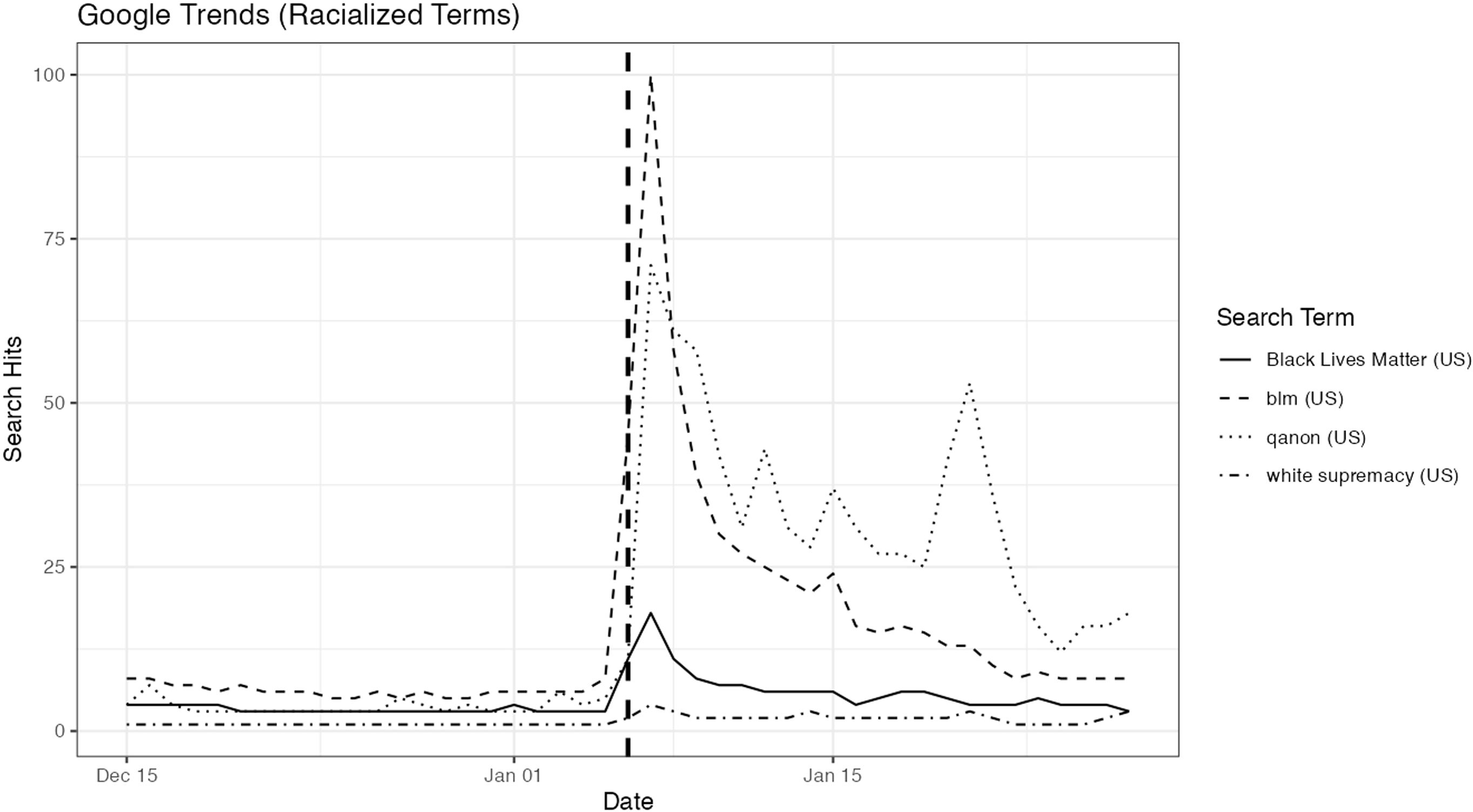
News media coverage of J6 drew explicit comparisons between the capitol insurrectionists and Black Lives Matter (BLM) protesters, which may have made race especially salient amongst Trump’s base and further heightened a race-based sense of threat. Indeed, previous work has found “among white Americans, strong rejection of BLM and feelings that whites are being ‘left behind’ are highly correlated with support for the January 6th insurrection” (Barreto et al. Reference Barreto2023, 6). In a descriptive exercise, we find that Google search trends for the terms “Black Lives Matter” and “blm” spike after J6 (Fig. 1), which suggests that racial group-based concerns were being centered in the discourse surrounding J6 and may have been at play in shaping mass responses to the event.
Google search trends 22 days before and after January 6th (denoted by vertical dashed line). Searches for racialized terms peak after J6.

We expect that support for Trump was not affected by J6 amongst white Republicans who felt most concerned about their racial in-group status. This stands in contrast to prior work that does find J6 causes co-partisans to distance themselves from the Republican party. These studies fail to consider the distinctly racialized—not just partisan—nature of the insurrection, and how it represented the culmination of the heretofore dominant racial group’s desire to maintain their place in the American social hierarchy.
H1: White status threat will undercut the J6-induced decline in support for Trump amongst white Republicans.
To summarize, our paper differs from previous studies examining the effects of J6 on mass attitudes in several important ways. First, we center on white Republicans, as opposed to voters of both parties or all Republicans, in our analyses. Previous studies have already shown that declines in support for Trump post-J6 were driven by Republicans (Eady et al. Reference Eady, Hjorth and Dinesen2023; Loving and Smith Reference Loving and Smith2024; Noort Reference Noort van2023), not voters of other parties, because of ceiling effects in Trump disapproval among non-Republicans. Given disproportionate support for Trump amongst white Republicans, they serve as the ideal demographic to study the effects of J6. Because white Republicans already hold comparatively high and stable rates of support for Trump,Footnote 1 we might expect their opinions to remain obdurate, even in the face of an unprecedented and norm-violating event like J6. Any changes in support amongst Trump’s core constituency would highlight the true effects of anti-democratic behavior on public opinion. Furthermore, 80% of registered Republicans identify as white compared to 56% in the Democratic party. Thus, we focus solely on Anglo white Republican voters in our analyses, as we theorize white status threat will undercut J6-induced backlash toward Trump.
As previously stated, we also examine whether perceptions of racial status threat moderate backlash to Trump. Finally, we focus only on changes in support for Trump, not changes in expressive partisanship or party identification (Eady et al. Reference Eady, Hjorth and Dinesen2023; Loving and Smith Reference Loving and Smith2024; Noort Reference Noort van2023), following work by Frye (Reference Frye2023). We believe that focusing on attitudinal changes as opposed to behavioral changes may better capture short-term expressive backlash against Trump that is not reflected in more crystallized partisan attachments and preferences that are more difficult to consciously manipulate.
Study 1: Nationscape
Data and Design
Study 1 tests our hypothesis with the UCLA+Democracy Fund Nationscape survey (NS). The NS is a large survey of the American public (
 $N\,=\,495,000$
), fielded between July 2019 and January 2021 in 77 weekly sample waves. Samples are provided by Lucid, a market research platform operating an online survey respondent exchange. The NS samples match national quotas for age, gender, race, ethnicity, region, income, and education. The sample is high quality. Inattentive respondents and repeat survey-takers were screened out. NS socio-demographic marginals match other high-quality surveys (Tausanovitch et al. Reference Tausanovitch2019).
We subset the NS data to white Republican respondents surveyed between 2020-12-16 and 2021-01-16 (
 $N\,=\,5030$
).Footnote
2
On average, 252 white Republicans take the survey daily during this period.Footnote
3
NS was not fielded between 2020-12-31 and 2021-01-11, so we do not have data immediately before or after J6. However, given prior research has identified Republican declines in Trump support during this time period are primarily due to J6 and not other events (Frye Reference Frye2023; Noort Reference Noort van2023), we feel confident declines in Trump support for NS white Republican respondents interviewed after J6 are not driven by other events.
We analyze three Trump support outcomes. Favorability is a 4-point scale of respondent favorability toward Trump between “very unfavorable”-“very favorable.” Approval is a 4-point scale of respondent approval of Trump’s job between “strongly disapprove”-“strongly approve.” Trump index is an additive index of favorability and approval.
The independent variable is equal to 1, 0 otherwise, if the respondent is interviewed post-J6 (2021-01-06). The moderator is white status threat. We measure this with a 5-point scale of respondent perceptions of anti-white discrimination from “none at all” to “a great deal.” This is an appropriate measure. Prior research demonstrates perceptions of anti-white discrimination motivate support for perceptibly pro-white policies and politicians (Jardina Reference Jardina2019; Mutz Reference Mutz2018), particularly after non-white groups achieve some socio-political progress (Wilkins and Kaiser Reference Wilkins and Kaiser2014). Our main estimates adjust for several controls prognostic of Trump support (age, gender, income, college-education, union membership, ideology, and state). All covariates are rescaled between 0 and 1, so we estimate min-max coefficients.
Our estimation strategy is similar to an unexpected-event-during-survey design (UESD) (Muñoz et al. Reference Muñoz, Falcó-Gimeno and Hernández2020), that is, we compare Trump support levels between respondents interviewed before and after J6. The core UESD identifying assumption is ignorability: respondent characteristics should be similar pre/post-J6 conditional on the survey sampling mechanism. We find evidence in support of this assumption. White Republican respondents interviewed pre/post-J6 are compositionally dissimilar on only 1/11 demographic, socioeconomic, and political characteristics (Fig. A1), a result consistent with statistical chance. Thus, our J6 coefficient estimates are relatively insulated from omitted variable bias.
We rule out the prospect of secular temporal trends affecting our J6 coefficient estimates by assessing the placebo “effect” of being interviewed after the median pre-treatment date (2020-12-23). The J6 placebo effect conditional on or not on status threat is null, implying our main results are not driven by secular attitudinal trends disfavoring Trump (e.g. backlash to Trump’s 2020 election loss, his fraud accusations, see Table A1).
Results
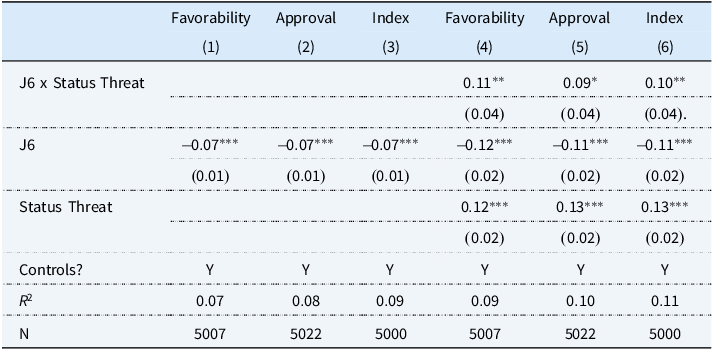
Table 1 displays post-J6 coefficients unconditional and conditional on status threat.Footnote
4
Consistent with prior research (Frye Reference Frye2023; Noort Reference Noort van2023), J6 reduced Trump favorability, approval, and the index among white Republicans by 7 points (
 $p \lt .001$
, Models 1–3), equivalent to 23%–24% of the respective outcome standard deviations. However, consistent with our hypothesis, the negative post-J6 effect on Trump support among white Republicans is cancelled out by white Republicans who feel white people are status threatened (
 $0.01 \lt p\lt\,0.05$
, Models 4–6).
White Republicans backlash against Trump post-J6, but the backlash is attenuated among the status threatened (Study 1)

***p < 0.001; **p < 0.01; *p < 0.05.
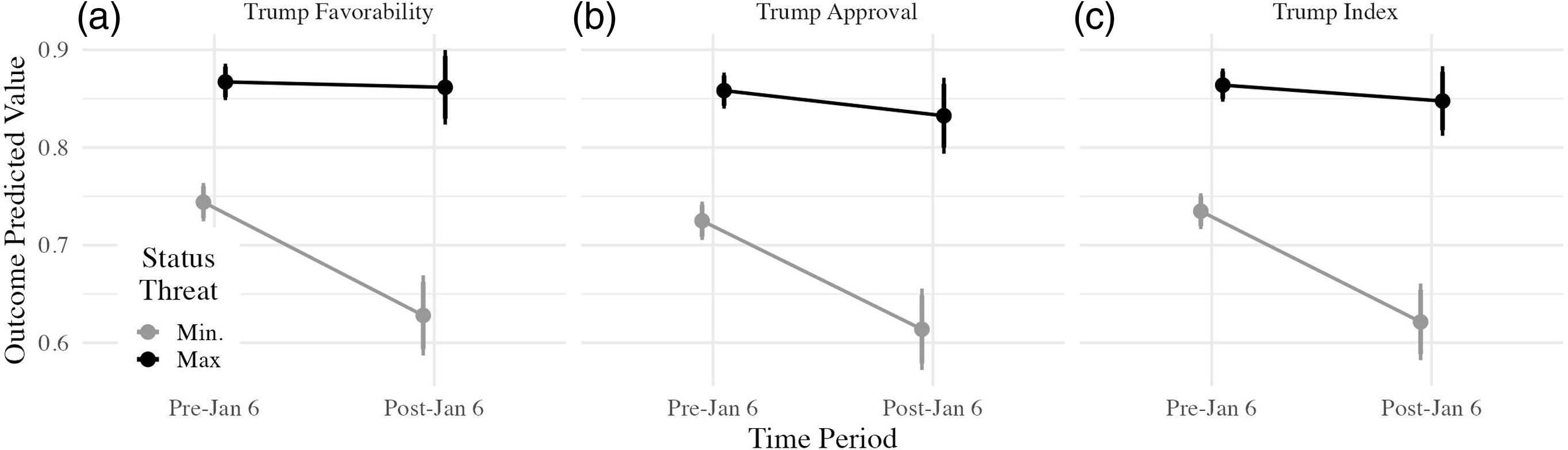
To illustrate these heterogeneous effects, we plot predicted values of the relevant outcomes conditional on respondents interviewed pre/post-J6 and status threat (Fig. 2). For the least status threatened white Republicans, Trump favorability, approval, and the index decline by 11–12 points (38%–41% of the outcome standard deviations). However, for the most status threatened white Republicans, Trump favorability, approval, and the index remain stable regardless of being interviewed pre/post-J6. These findings suggest perceptions of white status threat undercut the prospect of backlash against anti-democratic elites among white Republicans who may be predisposed to support Trump.
Status threat (min/max, denoted by color) attenuates anti-Trump backlash post-J6 among white Republicans (Nationscape). Y-axis is the predicted value of the respective outcomes (denoted by panel title), and x-axis is the time period during which respondents are interviewed. Predicted values from fully-specified models with control covariates held at their means. 95% CIs displayed from robust HC2 SEs.

Robustness Checks
We rule out whether other political, racial, and/or psychological attitudes that may be associated with status threat among white Republicans are motivating the mollification of backlash to Trump post-J6. The interaction between status threat and post-J6 remains positive and statistically significant after adjusting for interactions between post-J6 and ethnocentrism (Kinder and Kam Reference Kinder and Kam2010), old-fashioned racism (Lajevardi and Oskooii Reference Lajevardi and Oskooii2018), perceived discrimination against Black people, racial resentment (Agadjanian et al. Reference Agadjanian2023), political ideology (Sniderman and Piazza Reference Sniderman and Piazza1993), partisan strength (Albertus and Grossman Reference Albertus and Grossman2021), and economic anxiety (Mutz Reference Mutz2018). Moreover, interactions between post-J6 and these alternative attitudinal constructs are largely null (Table A2). These results suggest status threat is the superordinate mechanism undercutting backlash toward Trump post-J6, not other attitudes that could plausibly mollify anti-Trump backlash.
A criticism of our study is that our results are substantively uninformative given prior research suggests attitudes toward Trump revert to their pre-J6 average among his base a few weeks post-J6 (Noort Reference Noort van2023). First, we contend that short-term effects are meaningful given the high stability of Trump’s support among his base (Jacobson Reference Jacobson2020). Indeed, we estimate a series of temporal placebo effects over the course of the entire pre-J6 Nationscape temporal domain (2019-07-18 to 2020-12-30) and show the “true” post-J6 effect in addition to the post-J6 effect conditional on status threat is statistically larger than all pre-J6 placebo effects (Fig. A2). These findings are consistent with evidence from the Pew Research Center showing the drop in Trump approval after J6 was the largest survey-to-survey decline in Trump’s approval they identified throughout his presidency (Keeter Reference Keeter2021). Second, we also provide evidence that status threat may accelerate the decay in the anti-Trump backlash effect post-J6. Figure A3 shows, initially, both status and non-status threatened white Republicans are less likely to support Trump post-J6 (Jan 12–13). But, in the last round of Nationscape interviews (Jan 14–15), status threatened white Republicans revert to pre-J6 Trump support levels whereas non-status threatened white Republicans are still less supportive of Trump. These results suggest, to the extent that there is a previously identified average decay in anti-Trump backlash post-J6 among Trump’s base, this decay may be less prominent if Trump’s base was less status threatened.
Another concern is that our moderator (status threat) may be affected by post-treatment bias through J6. We do not find evidence our moderator is affected by post-treatment bias, as status threat is balanced pre/post-J6 (Table A3).
Moreover, perceptions of electoral fraud may serve as a constraint on white Republican backlash to Trump post-J6 since Trump’s support for and association with J6 may be understood as legitimate in light of perceived (but false) electoral malfeasance on part of the Democratic party (Justwan and Williamson Reference Justwan and Williamson2022). The NS includes a reasonable proxy for electoral fraud perceptions: distrust in the fairness of the 2020 election. Thus, we adjust for distrust in the 2020 election and the interaction between electoral distrust and J6. Although the coefficient for the interaction between J6 and status threat is attenuated after the adjustment, status threat still attenuates anti-Trump backlash post-J6 (Table A6). Moreover, part of the reason the J6/status threat interaction may be attenuated is because electoral distrust is downstream of status threat for white Republicans (Table A7), which further clarifies the primacy of status threat in attenuating anti-Trump backlash post-J6.
Finally, we empirically justify our emphasis on evaluating how white status threat undercuts anti-Trump backlash post-J6 among white Republicans specifically. Using the full white NS subsample between December 12, 2020 and January 16, 2021, we show white status threat undercuts white backlash against Trump post-J6, but only among white Republicans, not white non-Republicans (Table A5). These findings demonstrate both racial status threat and partisanship play an important interrelated role in the extent of backlash against anti-democratic politicians.
Study 2: Gallup
A disadvantage of Study 1 is that we do not have data on respondents interviewed immediately after and before J6, which could mean our results are driven by secular events and/or factors other than the onset of J6. Study 2 mitigates this concern by using another survey in the field close to J6 that includes respondents interviewed shortly before and after J6.
Data and Design
Study 2 tests our hypothesis using white Republicans from the Gallup World Poll (N = 383), a nationally representative adult survey fielded between January 4, 2021 and January 15, 2021.Footnote 5 The outcome is Trump approval, equal to 1 if the respondent approves of Trump’s job, 0 otherwise. The independent variable is the same as Study 1, J6, equal to 1 if the respondent is interviewed after January 6, 2021 otherwise. 81 white Republicans are interviewed pre-J6, 302 post-J6.
Our measure of status threat in Study 2 is equal to 1 if the respondent reports their personal financial situation is “worse off” than a year ago and/or their personal financial situation will get “worse off” in one year, 0 otherwise. Although our measure of status threat in Study 2 does not explicitly reference race or the socio-political status of whites, prior research demonstrates economic anxiety for white people is filtered through their concerns over the loss of white socio-political dominance (i.e. “racialized economics”) (Fabian et al. Reference Fabian, Breunig and De Neve2020; Sides et al. Reference Sides, Tesler and Vavreck2019). Indeed, our own analysis using Nationscape data shows personal economic anxiety is associated with perceptions of discrimination against white people among whites, but not non-whites (Fig. B5). Although our status threat measure in Study 2 is relatively blunt, if the same statistical pattern manifests in Study 2 like Study 1, then we can be more confident our measure may be tapping into a racialized economic anxiety. Control covariates are the same as Study 1 with the exception of union membership since the Gallup poll does not include union membership data.
Like Study 1, we use an UESD. White Republican respondent characteristics are balanced on 1/10 covariates pre/post-J6 (Fig. B4), suggesting our J6 coefficients are insulated from omitted variable bias. Moreover, we rule out secular temporal trends by conducting a placebo test comparing outcome levels between respondents interviewed on January 4th to those interviewed on January 5th unconditional and conditional on status threat. The placebo test is statistically null, suggesting our main results are not driven by secular attitudinal trends disfavoring Trump in Study 2 (Table B11).
Results
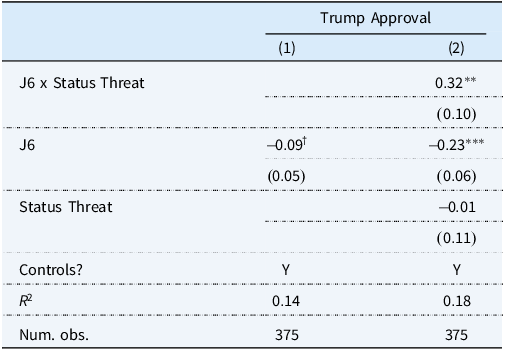
Table 2 displays the post-J6 effect unconditional and conditional on status threat for white Republicans.Footnote
6
Consistent with prior research and Study 1, J6 reduced Trump approval by 9% points (Model 1,
 $p \lt 0.10$
), 18% of the pre-J6 approval standard deviation. However, consistent with our hypothesis and Study 1, the negative effect of J6 on Trump approval is obviated by status threat (Model 2,
 $p \lt 0.01$
). Figure 3 displays predicted values of approval by being interviewed pre/post-J6 and status threat among white Republicans. Among white Republicans who are not status threatened, J6 reduces approval by 24% points. Conversely, among white Republicans who are status threatened, J6 motivates an increase in Trump approval of 8% points (albeit statistically insignificant). In sum, like Study 1, Study 2 demonstrates members of Trump’s base are less inclined to engage in pro-democratic backlash toward anti-democratic elites (i.e., Trump) conditional on feeling status threatened.
White Republicans backlash against Trump post-J6, but the backlash is attenuated among the status threatened (Study 2)

***p < 0.001; **p < 0.01; *p < 0.05; † p < 0.1.
Status threat attenuates anti-Trump backlash post-J6 among white Republicans (Gallup World Poll).

Robustness Checks
Our heterogeneous effects may be driven by political ideology since it may be correlated with status threat and Trump approval. However, the interaction between J6 and status threat adjusting for the interaction between J6 and ideology is still positive and statistically significant whereas the interaction between J6 and ideology is null (Table B12).
We assess temporal decay in effects post-J6. Like Study 1, we find the decay in the backlash effect post-J6 among white Republicans would have been slower if there were less status threatened white Republicans. Among the full white Republican sample, Trump approval is similar to pre-J6 by January 12th (Fig. B6, Panel A). However, among the non-status threatened white Republican sample, Trump approval does not revert to pre-J6 levels until at least January 14th (Figure B6, Panel B). This discrepancy in temporal effect decay may be due to the absence of a commensurate reduction in Trump approval among status threatened white Republicans (Figure B6, Panel C). Thus, consistent with Study 1, although prior research identifies a decay in the anti-Trump backlash effect post-J6, the decay would not be so quick if there were less status-threatened white Republicans.
We further validate our use of economic anxiety as a measure of white status threat by showing non-white Republicans do not backlash against Trump on the basis of being economically insecure (Table B13). Given economic anxiety only seems to mollify anti-Trump backlash among whites, our status threat measure in Study 2 may be capturing economic anxiety refracted through racialized insecurity.
Study 3: Pew Panel
Studies 1–2 are limited in that we compare support for Trump among different respondents interviewed pre/post-J6 instead of the same respondents interviewed pre/post-J6. Although we provide evidence respondents are compositionally similar pre/post-J6 in Studies 1–2, our results may still be driven by unobserved compositional differences in respondents interviewed before and after J6. Panel data interviewing the same respondents at multiple time periods can mitigate these concerns. Therefore, we use panel data interviewing the same respondents between September 2019 and January 2021 to evaluate the effect of J6 conditional on status threat.
Data and Design
We identify consistent respondents in three nationally representative Pew Research American Trends Panel (ATP) surveys to assess the effect of J6 conditional on status threat: Wave 53 (September 2019), Wave 71 (July 2020), and Wave 80 (January 8–12 2021).Footnote
7
Waves 53 and 71 were fielded pre-J6. Advantageously, Wave 80 was fielded immediately post-J6. We subset to white Republican respondents in the Pew ATP data surveyed in all three waves (
 $N\,=\,562$
).Footnote
8
Each Pew ATP survey wave samples from a Pew-curated online respondent panel. Thus, only a subset of respondents in a given wave is re-interviewed in other waves. Although the Pew ATP data allow us to construct several panels between Waves 1 and 80 (Mar. 2014–Jan. 2021), we construct a panel using only Waves 53, 71, and 80 for several reasons. First, these waves all use consistent measures of Trump support (approval, our outcome of interest, equal to 1 if a respondent approves of Trump’s job, 0 otherwise.). Second, Waves 71 and 80 are the last two ATP surveys asking respondents about their approval of Trump, so they are the least susceptible to intervening events between waves that could affect approval. Third, Wave 53 has a measure of white status threat that is the same as Study 1 (perceived discrimination against whites, from “none at all” to “a lot”) and is recorded well before J6 (mitigating posttreatment bias) and other secular events that may shift status threat between waves (e.g., the 2020 BLM protests, Trump’s election).
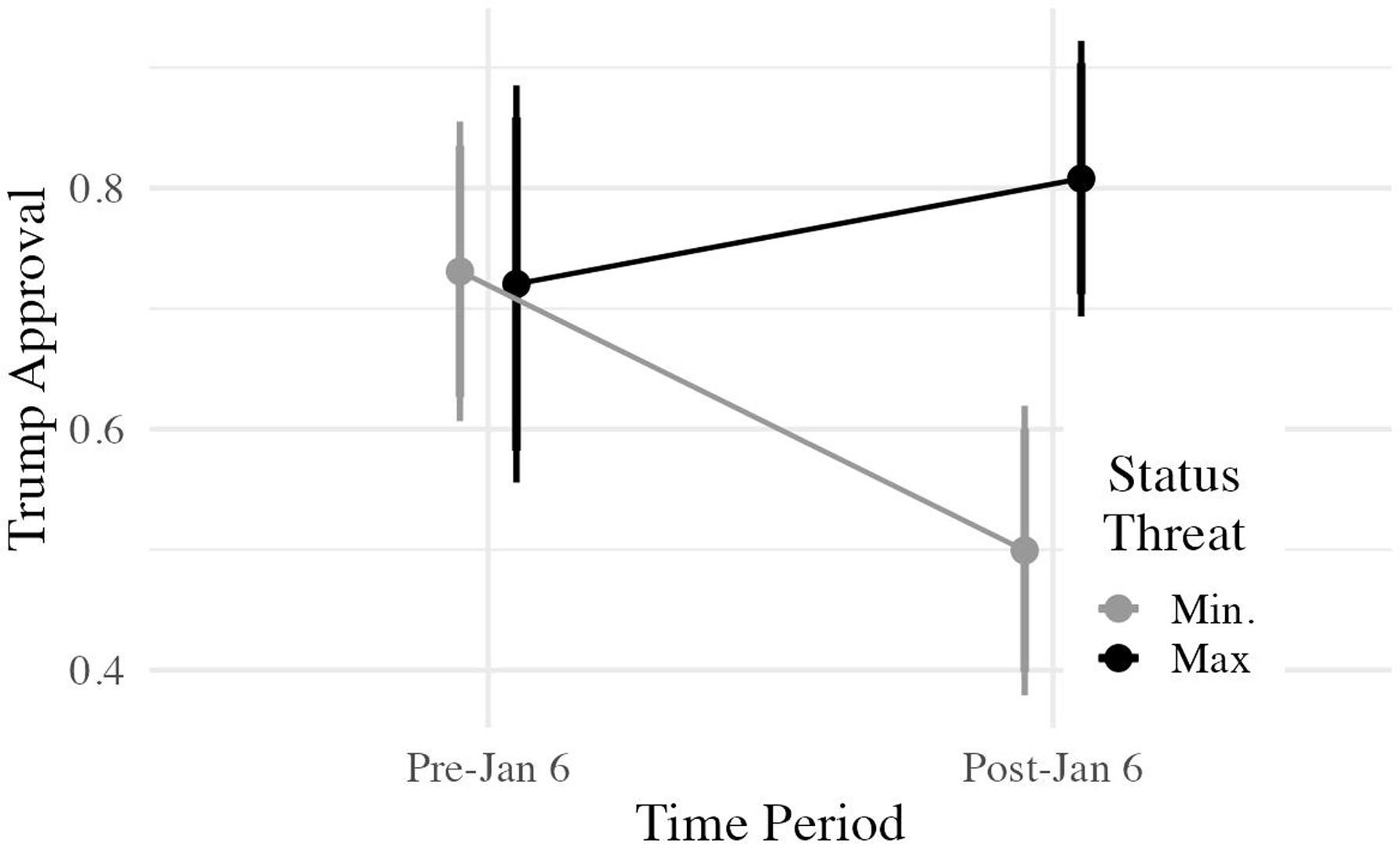
Our estimation strategy is a difference-in-differences (DD) approach evaluating the effect of being interviewed post-J6 (Wave 80) conditional on status threat. Given the DD approach partials out fixed differences between status threatened and unthreatened white Republicans, the core DD identifying assumption is parallel trends: status threatened respondents should have similar approval trends post-J6 as unthreatened respondents in a counterfactual world where J6 did not occur, implying no time-varying confounders differentially affecting the status threatened. This assumption is theoretically reasonable since attitudes toward national politicians tend to move in parallel (on average) between different mass public segments (i.e., the parallel publics thesis, see Page and Shapiro (Reference Page and Shapiro2010)). Given the absence of a world where J6 was not observed, the parallel trends assumption cannot be tested. But, parallel pre-J6 outcome trends provide some evidence the assumption could have held. Across the Pew ATP Waves (53, 71, 80), we identify parallel outcome pre-trends. An event study demonstrates differences in Trump approval levels across status threatened and unthreatened white Republicans between Waves 53 and 71 are remarkably stable over the course of 10 months (Fig. 4, Panel A).Footnote 9 Visually, predicted values of Trump approval for status threatened and unthreatened white Republicans also appear to move in parallel until after J6 (Fig. 4, Panel B). Thus, we believe our estimates assessing the effect of J6 on approval conditional on status threat are relatively insulated from unobserved time-varying covariates differentially affecting the status threatened relative to the unthreatened.
Status threat attenuates anti-Trump backlash post-J6 among white Republicans (Pew American Trends Panel). Panel A characterizes the association between status threat and Trump approval (y-axis) conditional on wave (x-axis). Annotation denotes generalized difference-in-differences estimate for J6 conditional on status threat. Panel B characterizes predicted values of Trump approval (y-axis) by wave for respondents at the minimum and maximum level of status threat (denoted by color). 95% CIs displayed from HC2 robust respondent-clustered SEs.

Results
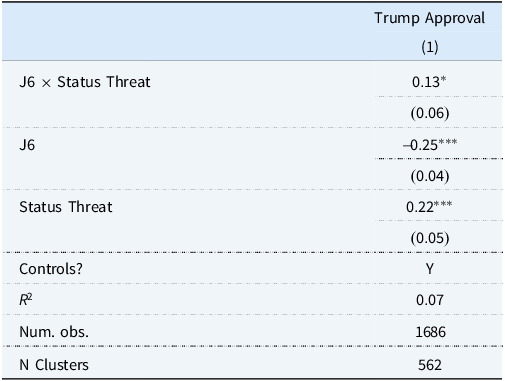
Table 3 characterizes a generalized DD estimate assessing the post-J6 effect on Trump approval conditional on status threat.Footnote 10 Consistent with our hypothesis, relative to the unthreatened, status threatened white Republicans are more likely to approve of Trump by 13% points, equivalent to 1/3 of the pre-J6 approval outcome standard deviation. This effect is driven by a decline in Trump approval among status unthreatened white Republicans post-J6 while the status threatened maintain their approval consistent with the outcome trend (Fig. 4, Panel B). In sum, these findings are consistent with Studies 1–2, but are advantageous in that they evaluate trends in Trump approval pre/post-J6 among the same white Republican respondents, mitigating the risk compositional differences explain our empirical conclusions.
Status Threat attenuates anti-Trump backlash post-J6 among white Republicans

Note: ***p < 0.001; **p < 0.01; *p < 0.05.
HC2 robust respondent-clustered SEs in parentheses.
Robustness Checks
We rule out alternative mechanisms that may forestall anti-Trump backlash post-J6 other than status threat. Our results hold even after adjusting for interactions between J6 and political ideology and perceived discrimination against Black people (Table C14), further suggesting white status threat is the superordinate mechanism undercutting anti-Trump backlash in the presence of anti-democratic activity.
We further validate the parallel trends assumption by using different Pew ATP panel data combinations between Waves 26 (April 2017), 37, 38, 39, 48 to Wave 52 and Wave 52 to Waves 53, 59, 64, 65, and 69 (June 2020). We assess the differential placebo effect of being interviewed between these wave pair combinations on Trump approval conditional on status threat. One caveat is that these samples use different combinations of white Republicans between two waves than the set of white Republicans in the three waves we primarily analyze. However, if approval trends remain similar across these different wave pairs conditional on status threat, we can be more confident in the parallel trends assumption for our sample of interest. Indeed, Fig. C7 shows that these placebo effects are nearly all statistically null, and all are smaller than the DD estimate between Waves 53, 71, and 80 in our main set of analyses. These results imply our results are not driven by secular factors differentially affecting the status threatened relative to the unthreatened other than J6.
Although Study 3 is advantageous vis-à-vis Studies 1–2 because we analyze the same respondents over time, a critical Study 3 shortcoming is that the final pre-J6 wave is well before J6 in our sample of interest (July 2020). Therefore, intervening events between July 2020 and January 2021 may drive our results. To this end, we use the Nationscape data in Study 1 and assess whether white Republicans interviewed in December 2020 are more or less likely to approve of Trump conditional on status threat. Although this exercise does not allow us to compare the same white Republicans interviewed between several time periods like Study 3, we can be more confident that intervening events between July 2020 and January 2021 do not explain our Study 3 results if we identifying if we identify statistically indistinguishable differences in Trump approval between July 2020 and December 2020 conditional on status threat among white Republicans. Indeed, we find Trump approval is not statistically different between July and December 2020 conditional on status threat (Table C15), suggesting Study 3’s results are not driven by intervening events in the months between the last two waves of Pew ATP data on Trump approval. Finally, our results do not change including respondent and wave fixed effects (Table C16).
Like Study 1, we justify our emphasis on evaluating how white status threat undercuts anti-Trump backlash post-J6 among white Republicans specifically. Using the full white subsample in the Pew ATP for Waves 53, 71, and 80, we show white status threat undercuts white backlash against Trump post-J6, but only among white Republicans, not white non-Republicans (Table C17). These findings further demonstrate both racial status threat and partisanship affect the prospect of anti-Trump backlash after J6.
Studies 4–7: The Persistent Role of Status Threat
Studies 4–7 assess whether the dynamic in Studies 1–3 persists after J6. Thus, we identify several surveys fielded post-J6 with white Republican subsamples that include measures of Trump support, disapproval of J6 plus Trump’s role in J6, and white status threat. Consistent with our theory and hypothesis, we expect disapproval of J6 will be associated with less support for Trump among white Republicans. However, status threatened white Republicans may still support Trump despite their reservations concerning J6 and Trump’s role in the insurrection.
Data and Design
Study 4, Nationscape (NS, Jan. ’21)
The last NS wave (2021-01-12 to 2021-01-16) included several questions measuring disapproval of the January 6 insurrection (J6 disapproval). To this end, we generate a J6 disapproval index of several items: 1) disapproval of the “actions of the people who stormed the U.S. Capitol”; 2) disapproval of the way “Trump handled the storming of the Capitol?”; 3) agreement with the notion that “Donald Trump should have done more to end the violence at the Capitol.” This is our main independent variable of interest for Study 3. We rescale this variable between 0 and 1. The last NS wave includes
 $N\,=\,1075$
white Republicans. Our outcomes and status threat moderator are the same as Study 1. We assess the relationship between J6 disapproval and Trump favorability, approval, and the Trump index adjusting for control covariates conditional on Study 1’s status threat measure.
Study 5, Pew American Trends Panel (Pew, Mar. ’21)
Study 5 uses the March 2021 Pew American Trends Panel survey (Wave 84), a high quality nationally representative poll administered by the Pew Research Center. Like Studies 1–3, we subset the survey to white Republicans (
 $N\,=\,3848$
. ). There are three outcomes: Trump favorability, measured with a 0–100 feeling thermometer toward Trump where higher (lower) values = warmer (colder); Trump support, measured from 0 to 4 with a survey item where respondents can report if they think Donald Trump was a “terrible president” to a “great president;” and the Trump index, an additive index of favorability and support. The independent variable (J6 disapproval) is an additive index of three items measuring: (1) how important respondents think it is for federal law enforcement agencies to find and prosecute those who broke into the U.S. Capitol on January 6 (scaled from 0 to 3, “not at all” to “very important”); (2) how little attention respondents think has been paid to the riot at the U.S. Capitol (scaled from 0 to 2, “too much attention” to “too little attention.”); and (3) the extent to which respondents think Trump’s conduct surrounding January 6 “was wrong, and senators should have voted to convict him” (scaled from 0 to 2). The moderator, white status threat, is measured similarly as Study 1, where respondents report “how much discrimination there is against white people” from “none at all” to “a lot” on a 0–3 scale. Models using Pew ’21 data adjust for several control covariates: age, gender, ideology, college-educated, income, and census area fixed effects. All covariates are rescaled between 0 and 1.
Study 6, Collaborative Multiracial Post-Election Survey (CMPS, Apr. ’21)
Study 6 uses the April 2021 Collaborative Multiracial Post-Election Survey white sample, a nationally representative poll of whites administered by a UCLA-led team. We subset the survey to white Republicans (
 $N\,=\,1421$
). The outcome of interest is Trump favorability, a scale between 0 and 4 from “not at all” to “very” favorable. The independent variable (J6 disapproval) is an additive index of two survey items: (1) if respondents think J6 was a “coordinated act of insurrection against the United States” instead of “a protest that went too far” (scaled from 0 to 1); (2) if respondents think Trump “encouraged or incited the (J6) attack” and “shares blame for what happened” as opposed to thinking “Trump had no connection to the rioters, he should not be blamed at all” (scaled from 0 to 2). The white status threat moderator is similar to Study 1, where respondents report “how much discrimination exists against whites” from “none at all” to “a lot” on a 0–3 scale. Models using CMPS ’21 data adjust for several controls: age, gender, college-educated, income, ideology, and state fixed effects. All covariates are rescaled between 0 and 1.
Study 7, Axios Survey (Axios, Jan. ’24)
Study 7 uses the January 2024 Axios survey, a nationally representative poll administered by Ipsos. We subset the survey to white Republicans (
 $N\,=\,1559$
). The outcome is Trump vote intention in the 2024 election (Trump vote), an indicator if respondents report they will vote for Trump in the 2024 election instead of Biden or another candidate. J6 disapproval is measured with an item measuring the extent to which respondents feel the following statement is believable (from “very” to “not at all,” scaled between 0 and 3): “Donald Trump tried to incite a mob to attack the U.S. Capitol on January 6, 2021 to overturn the election results.” White status threat is an additive index of responses to two items: (1) the extent to which respondents believe “Government or elite policies discriminating against white people” is important in determining their 2024 election vote (from “not at all” to “most” important, scaled 0–4); (2) how much respondents agree that “white people’s rights are under attack in America today” (from “strongly disagree” to “strongly agree,” scaled between 0 and 3). Models using Axios ’24 data adjust for several controls: age, woman, college-educated, income, and state fixed effects. All covariates are rescaled between 0 and 1.
Results
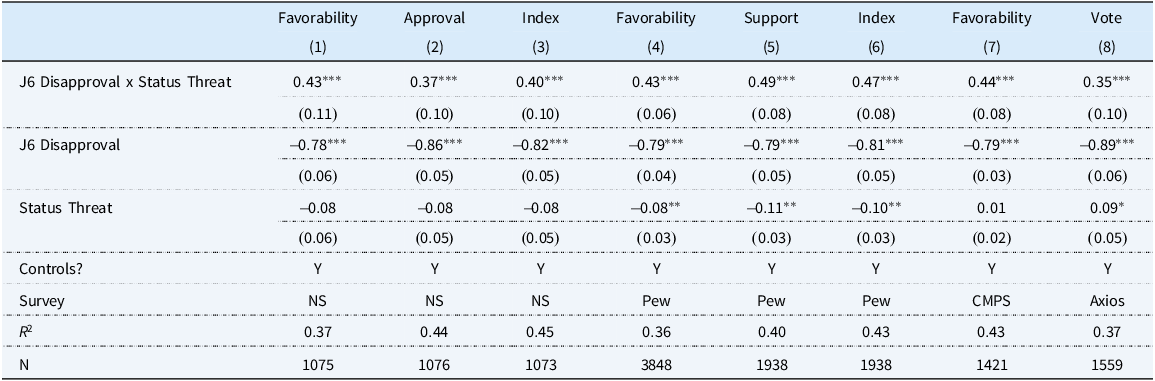
Table 4 and Fig. 5 characterize the association between J6 disapproval and the outcomes of interest across Studies 4–7. Consistent with our hypothesis and Studies 1–3, the negative association between J6 disapproval and the outcomes of interest measuring Trump support is attenuated by 38%–61% for status threatened white Republicans (
 $p \lt 0.001$
). These findings: (a) further suggest that the extent of pro-democratic backlash against Trump among Trump’s base is constrained by concerns related to the loss of white socio-political dominance and (b) suggest white status threat continues to play a role in motivating evaluations toward Trump among white Republicans despite reservations concerning anti-democratic behavior in the form of January 6.
Status threat attenuates the negative relationship between J6 disapproval and support for Trump

***p < 0.001; **p < 0.01; *p < 0.05.
Predicted values showing the negative association between J6 disapproval (x-axis) and Trump support (y-axis) are attenuated for white Republicans who report white status threat (min/max, denoted by color). Panels A-G denote different outcomes and surveys specified on panel title. Estimates from fully-specified models with covariates held at their mean. 95% CIs displayed from robust SEs.

Robustness Checks
We rule out if alternative mechanisms other than white status threat attenuate the relationship between J6 disapproval and support for Trump. Across the surveys in Studies 4–7, we demonstrate white status threat attenuates the negative relationship between J6 disapproval and Trump support net of adjusting for interactions between J6 disapproval and: ethnocentrism; perceived discrimination against Black people; old-fashioned racism; racial resentment; the FIRE racism scale (DeSante and Smith Reference DeSante and Smith2020); partisan strength; political ideology; and economic anxiety (Table D18). These results further suggest white status threat is a superordinate mechanism that explains support for anti-democratic politicians among white Republicans despite reservations white Republicans have concerning anti-democratic elite behavior.
Moreover, like in Study 1, we evaluate if status threat attenuates the relationship between J6 disapproval and support for Trump conditional on perceptions of electoral fraud. The NS, CMPS, and Axios surveys all include proxies of perceived electoral fraud. The NS proxy is the same as in Study 1. The CMPS proxy is based on a question asking respondents if they “believe there was voter fraud in the presidential election.” Respondents can respond on a 0–4 scale from “No I don’t think there was any fraud” to “Yes, there was definitely fraud.” The Axios proxy is based on a question asking respondents if they believe “Donald Trump solicited election fraud.” Respondents can respond on a 0–3 scale from “Not at all believable” to “Very believable.” We rescale these proxies of electoral fraud between 0 and 1. The interaction between J6 disapproval and status threat is still statistically significant and positive in the NS and Axios surveys, but not the CMPS survey after adjusting for the interaction between perceived fraud and J6 disapproval (Table D20). However, the interaction between J6 disapproval and status threat barely misses statistical significance in the CMPS survey (
 $p = .11$
). Yet, it is important to note the attenuation of the J6 disapproval/status threat interaction may be a function of posttreatment bias since status threat is strongly associated with perceptions of fraud (Table D21). These results suggest status threat still determines the extent of backlash against Trump as a function of J6 disapproval net of adjusting for fraud perceptions.
Again, we empirically justify our emphasis on assessing how white status threat undercuts anti-Trump backlash post-J6 among white Republicans specifically. Using the full white subsamples in the NS, Pew, CMPS, and Axios surveys, we show white status threat attenuates the negative relationship between J6 disapproval and Trump support primarily among white Republicans, not white non-Republicans (Table D19).
Conclusion
In this paper, we reexamine the effects of the January 6th insurrection, when thousands of Americans, goaded and guided by former President Trump and other far-right Republican elites, stormed the U.S. capitol to prevent the peaceful transition of power between presidential administrations. We test whether perceptions of racial status threat moderate backlash to Trump caused by the January 6th insurrection. Across three studies, we leverage a quasi-experimental approach to show that a decline in favorability toward Trump occurs only for white Republicans who do not perceive discrimination against their racial in-group. However, among racially aggrieved white Republicans—the core of Trump’s voter base—we observe that the negative post-J6 effect on Trump support is not present. In Studies 4–7, we examine whether evaluations of J6 up to three years after the attack are also moderated by racial status threat. We find that there is a negative association between opposition to J6 and support for Trump, broadly measured, but that this relationship is attenuated only for white Republicans that are status threatened.
Our results show that status-threatened white Republicans are steadfast in their support for Trump, even in the face of violent anti-democratic events. This speaks to both the conditional nature of reactions to anti-democratic norm violations (Studies 1–3) as well as their semi-durable effects (Studies 4–7). Where previous studies have concluded that co-partisans are willing to punish norm-violating elites (Eady et al. Reference Eady, Hjorth and Dinesen2023; Frye Reference Frye2023; Noort Reference Noort van2023), at least in the short-term, we show that pro-democratic tendencies may fail to manifest altogether because of dominant group status threat.
Our findings also highlight the role of elite influence and group identity in shaping public opinion following anti-democratic events. We suggest that perceptions of racial status threat (Fig. 1) may have been particularly salient in the immediate aftermath of J6, amplified by media comparisons between the insurrection and the Black Lives Matter protests of the previous summer (Barreto et al. Reference Barreto2023). By framing the J6 attack as either justified or exaggerated, Republican elites and right-wing media outlets may have activated perceptions of racial group threat among their base, mollifying any potential backlash. This underscores the need to contextualize public reactions within the broader political and media environments in which norm violations occur. Future research should further investigate the role that elite and media rhetoric play in moderating public reactions to anti-democratic events, particularly among individuals predisposed to racial status threat.
Supplementary material
To view supplementary material for this article, please visit https://doi.org/10.1017/rep.2025.7
Acknowledgments
We thank Alexander Agadjanian, Amanda D’Urso, Zachary Hertz, Jane Junn, the Enos Working Group, participants at the UCLA Race and January 6th Conference, and participants at MPSA 2024 for helpful and insightful feedback.
Funding Statement
Hernandez acknowledges that this research was supported by a James M. and Cathleen D. Stone PhD Scholar fellowship from the Multidisciplinary Program in Wealth Distribution, Inequality and Social Policy at Harvard University.
Competing interests
The authors declare none.