Introduction
Two affective disorders, namely bipolar disorder and major depressive disorder, are chronic, remitting, and relapsing severe mental disorders, and they affect more than 2% and at least 4% to 6%, respectively, of the world’s population regardless of nationality, ethnic origin, and socioeconomic status.Reference Blanco, Compton and Saha 1 , Reference Ferrari, Somerville and Baxter 2 Independent of mood status (ie, euthymic, manic, or depressive episode), both bipolar disorder and major depressive disorder interfere with cognitive function, including attention and executive function, and further lead to functional and work impairment.Reference Grande, Berk, Birmaher and Vieta 3 , Reference Kupfer, Frank and Phillips 4 Metabolic syndrome, especially obesity, is another crucial health issue in patients with bipolar or major depressive disorder because it may be a crucial link between affective disorders and cerebrocardiovascular diseases, such as stroke and acute cardiac infarct.Reference Fagiolini, Frank and Houck 5 , Reference Levitan, Davis, Kaplan, Arenovich, Phillips and Ravindran 6
The associations of affective disorder with cognitive dysfunction and proinflammatory cytokines have been widely investigated and reported. 7-9. In our previous studies, we discovered that patients with remitted bipolar disorder had significantly higher levels of interleukin (IL)-6, C-reactive protein (CRP), and tumor necrosis factor (TNF)-α compared with those with major depressive disorder after controlling for age, clinical symptoms, and body mass index (BMI).Reference Bai, Su and Li 7 Among patients with major depressive disorder, IL-2 level was the most significant predictor of depressive symptoms; when further controlling for the severity of depressive symptoms, sP-selectin was the only predictor of somatic and pain symptoms.Reference Bai, Chiou, Su, Li and Chen 9 This evidence may support the hypothesis of systemic inflammation in the pathophysiology of affective disorders.Reference Osimo, Cardinal, Jones and Khandaker 10 , Reference Berk, Williams and Jacka 11 Furthermore, Millett et al measured the CRP level of 222 euthymic patients with bipolar disorder (bipolar I disorder: ~80% of the sample) and 52 healthy controls and demonstrated that the participants with CRP level ≥5 mg/L performed more poorly in several measures of executive functioning, processing speed, reasoning, and problem solving compared with those with lower CRP level.Reference Millett, Perez-Rodriguez and Shanahan 12 Goldsmith et al reported that increased levels of IL-6 and monocyte chemoattractant protein-1 were consistently associated with psychomotor speed among patients with major depressive disorder.Reference Goldsmith, Haroon and Woolwine 13 Experimental models and clinical studies have provided some encouraging preliminary evidence regarding the efficacy of anti-inflammatory agents, such as TNF-α antagonists, in mitigating depressive symptoms and improving cognitive deficits.Reference Bortolato, Carvalho, Soczynska, Perini and McIntyre 14
Increasing evidence suggests a potentially harmful role of obesity and overweight in cognitive function regardless of the presence of mental disorders. 15-17 Ribeiro et al evaluated the cognitive performance of 120 patients with obesity aged between 18 and 65 years and found that their cognitive performance was lower than the mean for the general population in immediate recall, visuoperception, resistance to interference, and cognitive flexibility.Reference Ribeiro, Carmo, Paiva and Figueira 17 They also reported that patients with obesity were more likely to experience emotional distress, which may have further impaired their cognitive function.Reference Ribeiro, Carmo, Paiva and Figueira 17 A recent review reports the biological link of obesity with cognitive performance, with executive function found to be one of the most strongly affected cognitive components.Reference Inoue, Antunes, Bin Maideen and Lira 16 Furthermore, Yang et al reported that obesity, higher BMI, and higher CRP level were all separately related to lower working memory.Reference Yang, Shields, Wu, Liu, Chen and Guo 18 CRP level mediated the association of obesity with working memory, with CRP accounting for 44.1% of the variance in working memory explained by BMI.Reference Yang, Shields, Wu, Liu, Chen and Guo 18 However, no study has yet investigated the complex and interactive association between affective disorders (bipolar disorder and major depressive disorder), systemic inflammation, obesity, and cognitive function, although each individual relationship between the aforementioned conditions has been frequently evaluated.
In this study, we assessed the cognitive function of patients with bipolar I disorder or major depressive disorder and clarified the roles of obesity and systemic inflammation in cognitive function in these groups. We hypothesized that patients with bipolar I disorder or major depressive disorder would have greater cognitive impairment, higher levels of proinflammatory cytokines, and elevated prevalence of obesity or overweight compared with the control group. We also hypothesized that diagnosis (bipolar I disorder and major depressive disorder), obesity, and increased proinflammatory cytokines are independently associated with cognitive dysfunction in patients with bipolar I disorder and major depressive disorder.
Methods
Inclusion criteria for patients with bipolar I disorder or major depressive disorder and the control group
Patients aged between 20 and 64 years; who met the Diagnostic and Statistical Manual of Mental Disorders, Fourth Edition, Text Revision or Fifth Edition (DSM-IV-TR or DSM-5) criteria for bipolar I disorder or major depressive disorder; had a Global Assessment of Functioning (GAF) score ≥61; and were in a relatively stable condition were enrolled as the study group. Age- and sex-matched healthy controls who did not have a DSM-IV-TR or DSM-5 diagnosis, who were not pregnant or breastfeeding, and who did not have a severe physical disease (ie, epilepsy, stroke, or systemic lupus erythematosus) or unstable physical illnesses were enrolled as the control group. For all participants, demographic characteristics—including duration of illness, education, and BMI—were recorded, and clinical assessments, namely the Young Mania Rating Scale (YMRS) and Montgomery–Åsberg Depression Rating Scale (MADRS), were conducted. Obesity/overweight was defined as BMI ≥ 25 kg/m2 on the basis of the World Health Organization’s definition.Reference Apovian 19 This study was approved by the Institutional Review Board of Taipei Veterans General Hospital and conducted in accordance with the Declaration of Helsinki. Written informed consent was obtained from all participants prior to their inclusion in the study.
Measurement of proinflammatory cytokines
Proinflammatory cytokines, including IL-6, TNF-α, and CRP, were assayed using enzyme-linked immunosorbent assay (ELISA) kits (R&D systems, Minneapolis, MN) for all participants. Fasting serum samples were collected in serum separator tubes, clotted for 30 minutes, and stored at −80°C until use. All assays were performed according to the vendor’s instructions. The final absorbance of each sample of the mixture was measured and analyzed at 450 nm using an ELISA plate reader with Bio-Tek’s Power Wave Xs and Bio-Tek’s KC junior software (Winooski, VT). The standard range was considered as specified in the vendor’s instructions. A linear regression R-square value of at least 0.95 was considered a reliable standard curve.
Assessment of cognitive function
In this study, Wisconsin Card Sorting Test (WCST) and go/no-go task were examined for executive function and sustained attention and response control. 20-22 WCST required strategic planning, organized searching, utilizing environmental feedback to shift cognitive sets, directing behavior toward achieving a goal, and modulating impulsive responding. In the go/no-go task, participants were asked to respond as quickly as possible after the × symbol appeared. They were not to press the key when the + symbol appeared. WCST and go/no-go task were commonly used in our previous studies. 23-25
Statistical analysis
For between-group comparisons, the F test was used for continuous variables and Pearson’s test was used for categorical variables. General linear models (GLMs) with the adjustment of demographic data (ie, age, sex, education, medications, duration of illness, and smoking) and clinical symptoms (MADRS and YMRS) were performed to examine the association between BMI/obesity and cognitive function and the association between BMI/obesity and proinflammatory cytokines. In addition, GLMs were further performed to clarify the association between BMI/obesity, proinflammatory cytokines, and cognitive function. A two-tailed P value of less than .05 was considered statistically significant. All data processing and statistical analyses were performed using the SPSS version 17 software (SPSS Inc., Chicago, IL).
Results
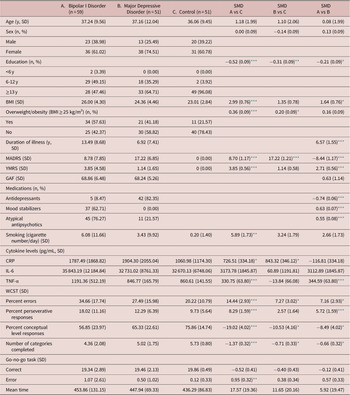
Overall, 59 patients with bipolar I disorder, 51 with major depressive disorder, and 51 age- and sex-matched controls were enrolled, and the sample had female predominance (Table 1). The patients with bipolar I disorder or major depressive disorder had lower education level, higher BMI, and greater incidence of obesity/overweight than the controls (Table 1). Only eight subjects (five in the major depressive disorder group and three in the control group) had a BMI <18.5 kg/m2, ranging between 16.14 and 18.43 kg/m2. The GAF score did not differ between patients with bipolar I disorder and those with major depressive disorder. However, patients with major depressive disorder were more likely to have higher MADRS score and lower YMRS score than those with bipolar I disorder (Table 1).
Demographic Characteristics, Cytokine Levels, and Cognitive Function Between Patients with Bipolar I or II Disorder and the Controls

Abbreviations: BMI, body mass index; CRP, C-reactive protein; GAF, Global Assessment of Functioning; IL-6, interleukin-6; MADRS, Montgomery–Åsberg Depression Rating Scale; SD, standard deviation; SMD, standardized mean difference; TNF-α, tumor necrosis factor-α; WCST, Wisconsin Card Sorting Test; YMRS, Young Mania Rating Scale.
* P < .05.
** P < .01.
*** P < .001.
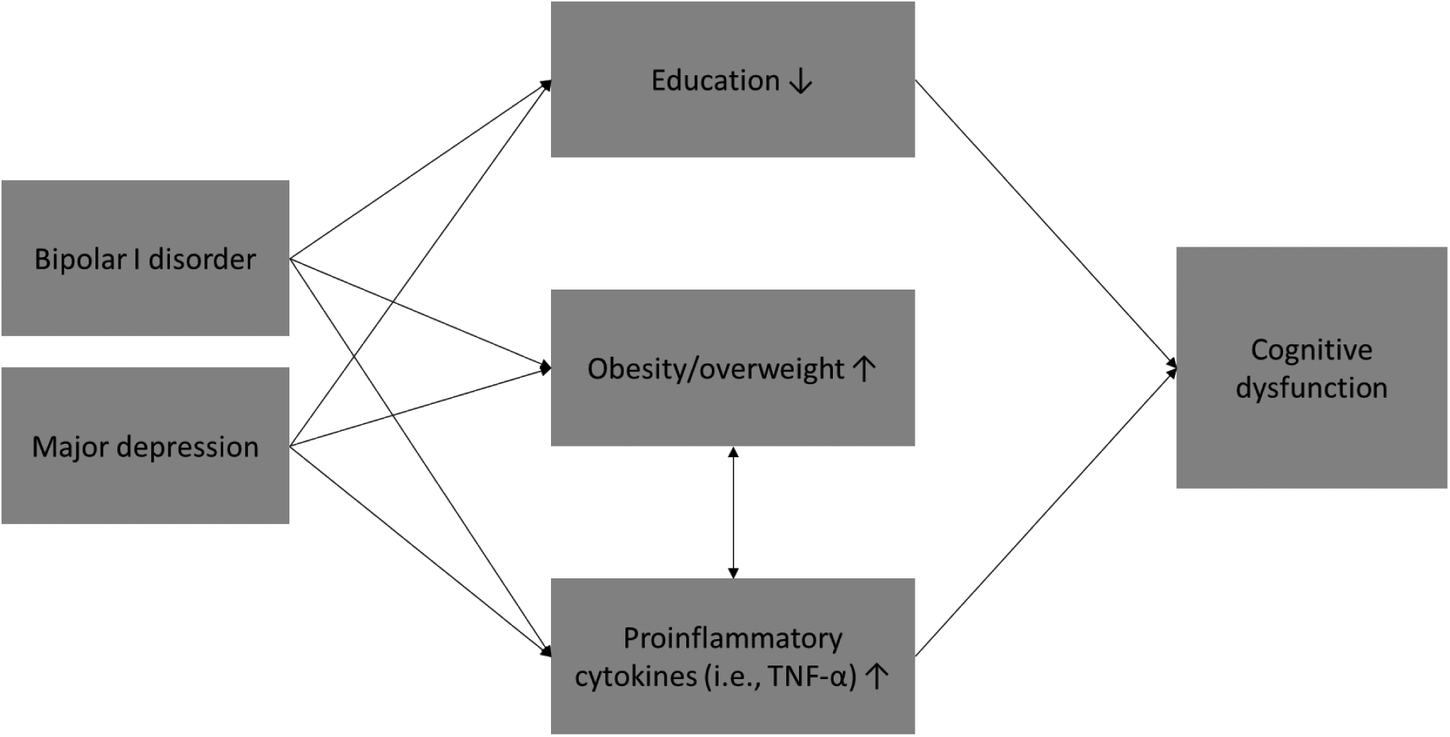
The study concept between major affective disorder, obesity, proinflammatory cytokines, and cognitive dysfunction. Solid line indicates the significant association. Abbreviations: TNF-α, tumor necrosis factor-α.

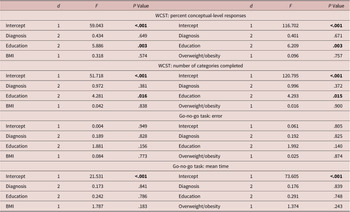
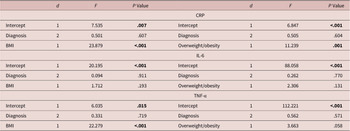
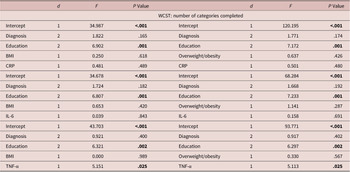
For the proinflammatory cytokines, patients with bipolar I disorder had the higher levels of CRP and TNF-α and the greater cognitive deficits in WCST and go/no-go task compared with those with major depressive disorder and the controls (Table 1, Figure 1). GLMs reported that BMI or obesity/overweight was not related to the cognitive deficits in WCST and go/no-go task, but showed that BMI and obesity/overweight were significantly associated with the levels of proinflammatory cytokines, especially CRP and TNF-α (Tables 2 and 3, Figure 1). In addition, diagnosis was also related to the levels of TNF-α (Table 3, Figure 1). Finally, we examined the association between cognitive function, proinflammatory cytokines, and BMI and obesity/overweight, and found that only education level and concentrations of TNF-α, but not diagnosis and obesity/overweight, were associated with the deficits in executive function measured by WCST (Table 4, Figure 1).
Correlation of BMI or Obesity and Cognitive Dysfunction from GLM Models with Adjustment of Age, Sex, Education, Smoking, Medications, Duration of Illness, and Clinical Symptoms

Bold type indicates statistical significance.
Abbreviations: BMI, body mass index; GLM, general linear model; WCST, Wisconsin Card Sorting Test.
Correlation of BMI or Obesity and Proinflammatory Cytokines from GLM Models with Adjustment of Age, Sex, Smoking, Medications, Duration of Illness, and Clinical Symptoms

Bold type indicates statistical significance.
Abbreviations: BMI, body mass index; CRP, C-reactive protein; GLM, general linear model; IL-6, interleukin-6; TNF-α, tumor necrosis factor-α.
Correlation of Proinflammatory Cytokines, BMI/Obesity/Overweight, and Cognitive Dysfunction from GLM Models with Adjustment of Age, Sex, Education, Smoking, Medications, Duration of Illness, and Clinical Symptoms

Bold type indicates statistical significance.
Abbreviations: BMI, body mass index; CRP, C-reactive protein; GLM, general linear model; IL-6, interleukin-6; TNF-α, tumor necrosis factor-α; WCST, Wisconsin Card Sorting Test.
Discussion
The findings of this study demonstrated that education level and TNF-α level but not diagnosis, obesity, and overweight played crucial roles in cognitive function deficits, especially executive dysfunction in the WCST. Interestingly, BMI, obesity/overweight, and diagnosis were significantly associated with the levels of proinflammatory cytokines, especially TNF-α, but they had no significant influence on cognitive function among patients with bipolar I disorder and major depressive disorder. Our findings may indicate that proinflammatory cytokines, but not obesity and overweight, are crucial to cognitive function among patients with bipolar I disorder and major depressive disorder, although proinflammatory cytokines and obesity and overweight are strongly associated.
As mentioned in the introduction, our findings support the associations between affective disorders, increased levels of proinflammatory cytokines, especially TNF-α, and cognitive dysfunction, especially executive dysfunction.Reference Bai, Su and Li 7 , Reference Bai, Chiou, Su, Li and Chen 9 , Reference Millett, Perez-Rodriguez and Shanahan 12 , Reference Bortolato, Carvalho, Soczynska, Perini and McIntyre 14 In our study, patients with bipolar I disorder were more likely to have obesity and systemic inflammation and exhibit greater deficits in cognitive function compared with those with major depressive disorder and the control group; however, the patients with bipolar I disorder had the lower MADRS scores than those with major depressive disorder.Reference Bai, Su and Li 7 , Reference Bai, Chiou, Su, Li and Chen 9 , Reference Millett, Perez-Rodriguez and Shanahan 12 , Reference Bortolato, Carvalho, Soczynska, Perini and McIntyre 14 Regarding the association between obesity and cognitive function in patients with affective disorders, Mora et al revealed that obesity was significantly associated with cognitive impairment in euthymic patients with bipolar disorder and appeared to affect cognition in the long term.Reference Mora, Portella and Martinez-Alonso 26 Yim et al also demonstrated that euthymic patients with bipolar disorder who were overweight or obese obtained significantly lower scores in a verbal fluency test than subjects of normal weight.Reference Yim, Soczynska, Kennedy, Woldeyohannes, Brietzke and McIntyre 27 Mansur et al further reported that in patients with major depressive disorder, the proportion of hard task choices was more strongly correlated with BMI than with depressive symptoms.Reference Mansur, Subramaniapillai and Zuckerman 28 Hidese et al discovered that working memory, motor speed, and executive function were lower in patients with major depressive disorder and obesity than in patients without obesity.Reference Hidese, Ota and Matsuo 29 Our findings did not support the direct harmful effect of obesity on cognitive function among patients with bipolar disorder and major depressive disorder, but we did discover a crucial effect of proinflammatory cytokines on cognitive dysfunction in patients with bipolar disorder and major depressive disorder, although obesity/overweight and proinflammatory cytokines were found to be significantly correlated.Reference Millett, Perez-Rodriguez and Shanahan 12
Studies have indicated the critical roles of systemic inflammation and proinflammatory cytokines in cognitive function deficits among patients with affective disorders.Reference Millett, Perez-Rodriguez and Shanahan 12 , Reference Goldsmith, Haroon and Woolwine 13 , Reference Misiak, Beszlej and Kotowicz 30 , Reference Charlton, Lamar and Zhang 31 Charlton et al demonstrated that high IL-6 level interferes with cognitive function, including learning and memory, in patients with major depressive disorder but not in healthy controls.Reference Charlton, Lamar and Zhang 31 Bobińska et al found that elevated expression of the TNF-α gene was negatively correlated with cognitive efficiency—including working memory, executive functions, and attention—in patients with major depressive disorder.Reference Bobińska, Galecka, Szemraj, Galecki and Talarowska 32 A large cohort study of 222 euthymic patients with bipolar disorder demonstrated that those with CRP level ≥5 mg/L were more prone to developing cognitive dysfunction, especially executive dysfunction, compared with those with CRP level <5 mg/L.Reference Millett, Perez-Rodriguez and Shanahan 12 The detrimental effect of increased levels of proinflammatory cytokines, especially TNF-α, on cognitive functions such as processing speed and working memory has been noted in the early stage (first manic or mixed episode within the 3 months prior to enrollment) of bipolar I disorder in partial remission.Reference Chakrabarty, Torres, Bond and Yatham 33 However, our study and the aforementioned studies were only cross-sectional and thus could not clarify the temporal or causal relationships between affective disorders, obesity, systemic inflammation, and cognitive dysfunction. McIntyre et al reported that individuals at risk of bipolar disorder exhibited greater cognitive impairment and were more likely to have obesity or overweight, with negative correlations discovered between BMI and measures of working memory and overall cognitive function.Reference McIntyre, Mansur and Lee 34 Further longitudinal follow-up studies are necessary to elucidate the reciprocal or causal relationships between these conditions.
Several limitations of this study should be addressed here. First, only the WCST and go/no-go tasks were employed for measuring cognitive function. Additional studies may be required to more comprehensively evaluate cognitive function in patients with bipolar or major depressive disorder. Second, the medications used by the patients with bipolar or major depressive disorder were not discontinued during the cognitive function assessment and cytokine examination in this study, and they may have affected the assessment and cytokine level results. Allowing the patients to continue their medications was more ethical and prevented disease exacerbation and relapse; additionally, it enabled the collection of more naturalistic data. However, a drug-free study design may be required to confirm our findings. Third, previous studies suggested the diurnal variations in the levels of proinflammatory cytokines, including TNF-α.Reference Keller, Mazuch and Abraham 35 , Reference Naidu, Morgan and Bailey 36 The blood samples of our patients were not collected at the same time (between 9 am and 5 pm at the work time), which may confound our findings. In addition, sleep, diet, and exercise levels may also impact circulating cytokines. Further studies would be necessary to validate our results based on the samples that were collected at the same time and with the further adjustment of sleep, diet, and exercise levels. Fourth, in the regard of a correction for multiple comparisons, the statistical significance of P value was reduced from 0.05 to 0.05/3 (0.0168) in Table 4. The significance of the association between TNF-α level and executive function became nonsignificant (0.025 > 0.0168), which indicated that TNF-α may have the crucial role in the deficits in executive function. Further studies may be necessary to validate our findings. Fifth, we enrolled a group of patients who were in relatively stable condition (GAF score ≥ 61). The associations between obesity, cytokine levels, and cognitive function in the acute phase of bipolar disorder and major depressive disorder required further investigation.
In conclusion, patients with bipolar I disorder or major depressive disorder had greater deficits in executive function, which were associated with education level and TNF-α level, than the controls. Our study suggests that education level and TNF-α level are major predictive factors of cognitive function regardless of affective disorder, obesity, or overweight diagnosis. Our findings may imply that reducing the biological burden placed by systemic inflammation may improve cognitive function in patients with bipolar I disorder or major depressive disorder even if they have obesity or overweight. The complex relationships between affective disorder diagnosis, proinflammatory cytokine levels, obesity or overweight, and cognitive function require further investigation.
Acknowledgment
We thank Mr. I-Fan Hu for his support and friendship.
Financial Support
The study was supported by grant from Taipei Veterans General Hospital (V103E10-001, V104E10-002, V105E10-001-MY2-1, V105A-049, V106B-020, V107B-010, V107C-181, and V108B-012), Yen Tjing Ling Medical Foundation (CI-109-21, CI-109-22), and Ministry of Science and Technology, Taiwan (107-2314-B-075-063-MY3 and 108-2314-B-075-037). The funding source had no role in any process of our study.
Authorship Contributions
Dr. M.-H.C., Dr. Y.-M.B., and Dr. J.-W.H. designed the study, and wrote the protocol and manuscripts. Dr. M.-H.C. and Dr. Y.-M.B. performed the statistical analyses. Dr. P.-C.T., Dr. K.-L.H., Dr. C.-T.L., Dr. W.-C.L., Dr. T.-P.S., and Dr. S.-J.T. assisted with the preparation and proofreading of the manuscript.
Disclosures
The authors do not have any conflicts of interest and any financial relationships relevant to this article to disclose.