Introduction
Vegetable crops, especially the cucurbits (gourds, melons, squashes and pumpkins), are rich sources of nutrients, namely carbohydrates, proteins, fats, fibres, vitamins, minerals, ash content and nutraceutical compounds, which thus help in providing a balanced diet to human food. Cucurbits represent rich diversity especially in the Indian subcontinent. Luffa, a popular vegetable in the tropics, is essentially an Old-World genus that is considered to comprise nine species, of which seven are native to India. Luffa acutangula (Roxb.) L. (ridged gourd), Luffa aegyptiaca Mill. (sponge gourd) and Luffa hermaphrodita Singh and Bhandari (a minor hermaphrodite species, sometimes considered as a form of L. acutangula) are the cultivated species. The three cultivated species along with the wild species Luffa graveolens Roxb., Luffa echinata Roxb. and Luffa umbellata M. Roem. constitute the Luffa gene pool. Immature fruits of the cultivated species of Luffa are used as vegetables and mature fruits as fibres.
The use of cucurbit seeds as sources of oil and protein have been well explored (Jacks et al., Reference Jacks, Henserling and Yatsu1972). In general, the dehulled seeds of cucurbits contain about 50% of oil and 35% of protein (Martin, 1984). The oils predominantly contain unsaturated fatty acids, which are of high nutritive value. Luffa is becoming an indispensable crop species because of its wide application for the possibility of harnessing, converting and recycling of waste seeds for various purposes, especially L. aegyptiaca is used for industrial and domestic applications. There is a large potential for the use of Luffa cylindrica L., M.J. Roem (syn. L. aegyptiaca Mill.), as a source of vegetable protein in animal and human nutrition (Dairo et al., Reference Dairo, Aye and Oluwasola2007). The oils extracted from the seeds of two species of Luffa, L. acutangula and L. aegyptiaca, are bitter and may be poisonous when consumed in large amounts, even though some of the seeds are consumed sparingly in some countries (Cynthia et al., Reference Cynthia, Okoye and Akuzuo2012). However, their use as mineral-rich seed oils in the cosmetic industry for skin is highly recommended (www.essence-of-mineral-makeup.com/luffa-cylindrica.html). Luffa sponge is a suitable natural matrix for immobilization of micro-organisms and has been successful in the processes of biosorption of heavy metals from waste water (Oboh and Aluyor, Reference Oboh and Aluyor2009). The oil extracted from L. cylindrica is finding increasing use in the production of biodiesel, which is now gaining wide acceptance due to low CO2 emission (Ajiwe et al., Reference Ajiwe, Ndukwe and Anyadiegwu2005). Since studies related to the importance of genetic variability for exploiting the species for a specific trait in breeding have long been recognized (Bhatt, Reference Bhatt1970; Arunachalam, Reference Arunachalam1981; Varalakshmi et al., Reference Varalakshmi, Reddy and Reddy1994), the present study aims to determine the nature and magnitude of variations between the wild and cultivated species of Luffa among the accessions of different species based on seed morphological characteristics and soluble seed protein and oil contents. This study envisaged the potentialities of this genus as a source of oil and protein based on seed variation patterns in Luffa species, which can thus serve as an emerging future cash crop.
Materials and methods
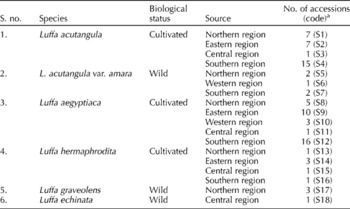
The seeds of 80 Luffa accessions comprising L. acutangula (35 accessions), L. aegyptiaca (35 accessions), L. hermaphrodita (6 accessions), L. graveolens (3 accessions) and L. echinata (1 accession) were used in this study. The diversity represented both the cultivated and wild species collected from diverse eco-geographical/phytogeographical zones of the country. The states of the country were grouped based on their geographical location: northern region – New Delhi, Punjab, Uttarakhand and Uttar Pradesh; eastern region – Bihar, Jharkhand and Odisha; western region – Rajasthan; central region – Madhya Pradesh and Chhattisgarh; southern region – Andhra Pradesh and Karnataka (Table 1 and Supplementary Table S1, available online). The collected seeds were stored in a medium-term storage facility (4°C and 35% relative humidity) and multiplied under experimental farming conditions (suitable environment for crop-specific site) in the month of June–July. The seed material after multiplication and regeneration was used for the present study.
Source and code-wise data of different Luffa species

a Code used in the construction of the 2D scatter plot diagram.
The study was conducted at a seed conservation and processing laboratory, Division of Germplasm Conservation, NBPGR, New Delhi. Seed sorting was done manually by observing the seed samples and separating the fully mature seeds from the immature/unfilled and deteriorated seeds. The selected seeds were separated for morphological and biochemical testing using various traits (Supplementary Table S2, available online). The various seed morphological characteristics studied were 100-seed weight, seed length, seed breadth, length/breadth ratio (L/B ratio), thickness, shape, colour, presence of a beak or wing and seed-coat surface. Measurements of the different morphological traits, namely seed length, seed width and seed thickness, were made using a digital vernier caliper. Weight of 100 seeds was measured using an electronic balance (model: Afcoset FX400) up to two digits of decimal points. The quality traits were recorded by visual observations (Joshi et al., 2004). Whole seeds (kernel with seed-coat) were used for biochemical analysis. For the biochemical analysis, seed samples of various accessions were oven-dried at 130°C for 1 h and powdered using a grinder. The powder was stored in a refrigerator in airtight containers until use. The oil content was determined in 42 accessions representing five species (due to the limited availability of seeds in some accessions of the wild species) by the Soxhlet extraction method with good-grade petroleum ether (boiling point 40–60°C). Results are expressed as the percentage of oil in the dry matter of seed powder AOAC (Reference Horwitz2005). The soluble protein content was estimated in all the 80 accessions by Lowry's method (Lowry et al., Reference Lowry, Rosebrough, Farr and Randall1981). The intensity of the blue colour was measured colorimetrically at 660 nm, and the amount of the protein content in the sample was calculated and expressed in percentage. All the morphological data were recorded on five replicates of 20 seeds each, and the biochemical analysis was carried out in two replicates of ten seeds each. Results are presented as preliminary findings on the evaluation of oil/protein data in this study. Statistical analyses were performed using SPSS 16.0 statistical software (SPSS Inc., 233 South Wacker Drive, Chicago).
Results
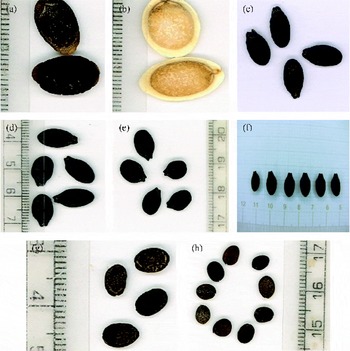
The results of this study represented the data on the 80 accessions of Luffa species collected from different regions of India (Supplementary Table S3, available online). The maximum representation of the data was from states of the southern region followed by those of the eastern and northern regions (Table 1). The wild species were collected mainly from Uttar Pradesh, Karnataka and Punjab, while the cultivated species were obtained from most of the geographical regions of India. The cultivated and wild species of Luffa under investigation showed a wide variation in seed qualitative and quantitative characteristics. The preliminary evaluation of the data on seed morphological characteristics revealed differences in seed size, shape and colour within the different species and different accessions of the same species (Fig. 1 and Table 2). The seed shape was oval with the presence of a beak in L. acutangula and L. hermaphrodita, while L. aegyptiaca was distinguished by an elongated membranous wing (Supplementary Table S3, available online). Among the accessions of two wild species, L. graveolens and L. echinata, the seed shape was completely round with a non-prominent beak. The seed-coat surface was mostly rough (80% of accessions), but seeds with a smooth surface were also observed (20% of accessions) among the cultivated species (Supplementary Table S4, available online). The degree of roughness varied within the different species. The accessions of L. acutangula var. amara, which is considered as the wild form of the cultivated species, showed a bigger seed size with high depressions (roughness) on the seed-coat. The seeds of L. hermaphrodita were black in colour, but distinctly shiny with a smooth surface. The seed-coat surface of L. graveolens and L. echinata were rough with a black-grey colour, while that of L. aegyptiaca had both black and white colours. There is a variation in the intensity of colour within each group. In L. acutangula and L. hermaphrodita, the seed-coat colour varied from greyish black to black (Fig. 1). Generally, the seeds contained either beaks or wings. Only four accessions were free of beaks and wings (Supplementary Table S4, available online).
(colour online) Seed variation in the cultivated and wild species of Luffa in India: Luffa aegyptiaca black-seeded (a), white-seeded (b); Luffa acutangula var. acutangula (c); Luffa hermaphrodita (d) and (e); L. acutangula var. amara (f); Luffa graveolens (g); Luffa echinata (h).

Descriptive statistical analysis of seed characteristics in the cultivated and wild species of Luffa

SD, standard deviation; L, seed length; W, seed width.
Table 2 presents the results of the descriptive statistical analysis on various seed characteristics including 100-seed weight, protein content, oil content, length/width ratio (L/W) and thickness. Significant variability in seed morphological traits was observed. The wild and cultivated species exhibited a range of variations in seed size, colour, seed-coat surface and 100-seed weight both within the species and between the species. The accessions within the L. acutangula group showed enormous variability in 100-seed weight (6.86–21.35 g), length (8.4–13.0 mm), width (4.8–8.8 mm), soluble protein content (5.85–9.14%) and oil content (16.15–25.41%). For the accessions of the L. aegyptiaca group, variability was observed in 100-seed weight (6.58–18.58 g), length (10.0–14.0 mm), width (5.6–9.8 mm), soluble protein content (4.46–9.58%) and oil content (16.35–27.41%) (Table 2). For the wild species of L. graveolens and L. echinata, much lower values were recorded for the above-mentioned traits. For the accessions of L. graveolens, the mean values were found to be 3.44 g (100-seed weight), 4.8 mm (length), 3.3 mm (width), 6.03% (soluble protein content) and 18.72% (oil content), while for the accessions of L. echinata, the mean values were 2.82 g (100-seed weight), 4.7 mm (length), 3.5 mm (width), 7.9% (soluble protein content) and 19.45% (oil content). The seeds of the wild species showed morphological traits such as much smaller size and less 100-seed weight. The average amounts of oil and protein contents were slightly lower in the wild species than in the cultivated species. Both the qualitative and quantitative data of the seed morphological characteristics of the L. hermaphrodita accessions were nearly similar to those of the L. acutangula accessions.
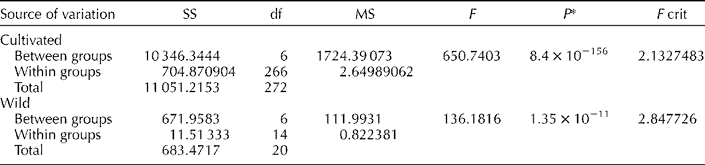
The ANOVA revealed that there was a significant difference (P< 1%) among the various quantitative characteristics, namely protein and oil contents (Table 3). In general, the accessions of the cultivated species had more oil content than those of the wild species. On an average, 21.13% of oil content was recorded in all the species. There was a significant variability in percentage protein content for the accessions of the same species (within the group). However, less amounts of protein content were recorded in the seeds of the wild species than in those of the cultivated ones.
Analysis of variance of the seed characteristics of Luffa species

SS, sums of square; MS, mean square.
* Level of significance: 5%.
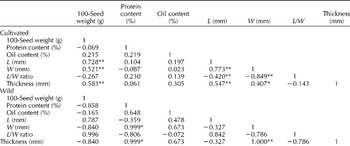
Table 4 shows Pearson's correlation coefficients for the relationships among the various morphological characteristics with soluble protein content and oil content in the seeds of different Luffa species. A highly significant and positive correlation of 100-seed weight with seed length, width and thickness; length with width, ratio (L/W) and thickness; width with ratio (L/W) and thickness was observed in the seeds of the cultivated species, while only a significant and positive correlation of seed width with thickness and protein content with seed width and thickness was observed in the seeds of the wild species (Table 4).
Pearson's correlation coefficient among various seed traits in Luffa species

*Correlation is significant at the 0.05 level.
**Correlation is significant at the 0.01 level.
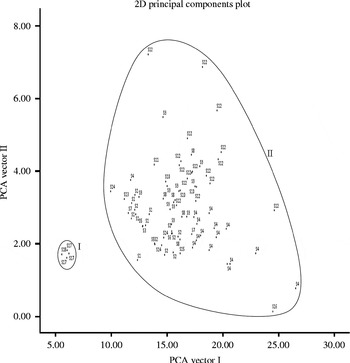
A 2D scatter plot diagram was constructed using the principal components analysis (PCA), PCA vector I and PCA vector II, for calculating the quantitative data (100-seed weight, protein content, oil content, L/W and thickness) of seed materials from the 80 Luffa accessions (Fig. 2). The accessions of two wild species, L. graveolens (accessions KC/CSR-41, KP/RS/PKS-4 and KP/RS/PKS-26) and L. echinata (accession SS2871/KP), were clustered together (cluster I) and fell far apart from the major cluster (II) of the cultivated species in which the accessions of L. acutangula, L. aegyptiaca and L. hermaphrodita were grouped together. The accessions of L. acutangula var. amara, which is considered as the wild form of the cultivated species (L. acutangula), were grouped within cluster II of the cultivated species. The off-types were clustered apart, irrespective of the species or the region of availability, especially the accessions from the regions of Andhra Pradesh and Karnataka (cultivated species). All the accessions of the wild species were clustered together.
2D scatter plot constructed based on the first (83.39%) and second (8.26%) components using the principal components analysis (PCA) of the 80 Luffa accessions.

Discussion
The seeds of the cultivated and wild species of Luffa under investigation varied in size, shape and colour. The seeds of the cultivated species were bold and large, while those of the wild species were smaller in size. The seed size varied from large and bold in L. aegyptiaca accessions, medium in both L. acutangula and L. hermaphrodita accessions and smaller in both L. echinata and L. graveolens accessions. The 100-seed weight varied from highest in L. aegyptiaca accessions, medium in both L. acutangula and L. hermaphrodita accessions and lowest in both L. graveolens and L. echinata accessions. The seed size of the wild species are generally very small compared with that of the cultivated species, but this lack in size is compensated for by the abundance of seeds (quantity) and thinly fleshed fruits produced; thereby, the net yield of the kernel/fruit remains to be high (Andres, Reference Andres2000). Seed-coat and seed shape are the most distinguishing characteristics for the identification of the species, which varied from elongated-oblong, smooth testa with a black-ivory coat colour in L. aegypitaca accessions, ovate with a prominent beak in both L. actangula and L. hermaphrodita accessions and oval-ovate, slightly varicose, greyish-black testa without beaks/wings in both L. echinata and L. graveolens accessions. Papery membranous wings surrounding the seeds was the most distinguishable characteristic of the L. aegyptiaca group that demarcated it from the rest of the species. Similar studies of genetic variability in the landraces of L. hermaphrodita from the Indo-Gangetic region of India have been reported earlier by Ram et al. (Reference Ram, Rai, Verma and Singh2006).
Cucurbitaceae is an important plant family and ranked as one of the highest for seed oil and protein contents (Earle and Jones, Reference Earle and Jones1962). In the present study, the accessions belonging to the cultivated species showed more oil content than those of the wild species (Table 2). On an average, the oil content was found to be 21.13%. Similar results have been observed in the dehulled seeds of the cultivated species of Luffa (Amoo et al., Reference Amoo, Emenike and Akpambang2008; Elemo et al., Reference Elemo, Elemol and Erukainure2011) from the Nigerian material where the seeds of one of the landraces of L. aegyptiaca had a very high percentage of oil content (54.2%), which mainly comprised unsaturated fatty acids and 86.5% of the total fat (Adebooye, Reference Adebooye2009). Most of the properties analysed in seed oils varied significantly among fruit cultivars. Inter-varietal variations in the composition of seed and seed oil from winter melon have been observed in a study by Anwar et al. (Reference Anwar, Mohammed, Othman and Nazamid2011). Similarly, in our study, there was a wide range of protein contents, while the average amount of the soluble protein content was 7.58%. Four accessions of the cultivated species (IC284946, IC397606, KPS-102/2011 and KPS-110/2011) showed a high protein content (9–10%). Even the accessions of the same species showed differences in protein content. These findings are in agreement with the earlier reports of Amoo et al. (Reference Amoo, Emenike and Akpambang2008) in which the crude protein content in the manually dehulled seeds of L. aegyptiaca have been reported to be about 33.55 ± 1.01%. In general, these values are comparatively on the higher side, which may be probably due to the estimation undertaken in dehulled seeds. Studies conducted by Mariod (Reference Mariod, Ahmed, Bertr, Galaledin, Abdeen, Mohamed and Abdelwahab2009) have reported 14.5–17.5% of protein content and 10.9–27.1% of oil content in the seeds of L. echinata. Published studies have shown notable differences in the seed oil and protein composition of the least worked out species. This may be due to the environmental differences or any instability of the species during their development. Species among the genus Luffa contain both edible and non-edible or poisonous oil (which may be due to the contamination from the seed-coat).
Although the 2D scatter plot diagram revealed two distinct clusters of the wild and cultivated species, the morphological characteristics showed significant differences within the cultivated and wild species. The grouping of the accessions of L. acutangula var. amara within the cluster of the cultivated species indicated that the measurable attributes of the seeds of this species were comparable with that of the accessions of L. acutangula, except for its biological status as wild species. The off-types in the 2D scatter plot diagram were clustered apart, irrespective of the species or the region of availability. This was indicative of the high variability in this species complex. Within this cluster of the cultivated species, the germplasm from the region of South India (Karnataka and Andhra Pradesh) was grouped towards the periphery and represented a distinct population having vigorous seeds. This result is in contrast to the earlier reports (Tolentino et al., Reference Tolentino, Laude and DelaVina1997) suggesting that not much diversity within and among the species was observed (based on seed protein profiling) from the genetic diversity analysis of Luffa species.
The current amount of vegetable oil production in India from various sources is 2.7 Mt, which could be further increased given their tremendous potential (>4.4 Mt). Future needs of vegetable oils can easily be met by increasing the production of supplementary sources of vegetable oils together with bridging the yield gap in annual oilseeds (Hedge, Reference Hedge2012). In addition to oilseed crops, rice bran, cotton seed, corn, coconut, oil palm, tree-borne oilseeds and some underutilized crops are being exploited for oil extraction. Some of the underutilized species and tree-borne oilseed species have considerable oil potential, contributing more than 25% of the total vegetable oil consumption in the country, which needs to be fully tapped (Hedge, 2012). However, unbridled increases in the consumption of vegetable oil may be difficult to control if the current trend of consumption continues for a long period of time in the future. Under the current scenario of increased demand over production, Luffa species can be considered as one of the various sources that can be explored for both protein and oil contents. There is a lack of scientific data concerning thermal, mechanical and chemical properties of the fibres from Luffa species, and thus their potentialities need to be fully explored. With regard to industrial and technological development, the cost of fuel is on the rise. Oil is extracted from seeds for industrial use (Bal et al., Reference Bal, Bal and Lallam2004). The seed of L. cylindrica is used as a source of oil (Lee and Yoo, 2006). The oil extracted from L. cylindrica is finding increasing use in the production of biodiesel, which is now gaining wide acceptance because of low CO2 emission and other beneficial effects (Ajiwe et al., Reference Ajiwe, Ndukwe and Anyadiegwu2005). The potential use of L. cylindrica as a source of vegetable protein in animal and human nutrition was well illustrated by Dairo et al. (Reference Dairo, Aye and Oluwasola2007). The need for the diversification of protein sources is imperative, especially in developing countries. Plant protein is needed in such countries and could play a significant role in human nutrition (Abitogun and Ashogbon, Reference Abitogun and Ashogbon2010). With India being a rich region for diversity in both cultivated and wild species of Luffa, its seeds may be considered as a potential source of oil and protein to enrich the food and industrial applications. The Cultivated species of Luffa are widely grown as summer vegetables, while seeds of wild species are produced in abundance naturally in undisturbed areas. The seeds are a concentrated source of energy, give flavour to foods and are used as a cooking medium. The nutritional value and possible toxicity of wild species needs to be studied further, and the seeds need to be evaluated for the suitability of edible oil versus drying oil for industrial purposes, such as paints and varnishes. The correlation study based on morphological traits can help in identifying the genotypes: good seed quality in combination with oil- and protein-rich accessions, which not only will improve the national economy but also will emerge as a future potential cash crop.
Conclusion
The present study revealed the seed morphological variability in the cultivated and wild species of Luffa collected from the regions of India. The study not only showed variations in morphological characteristics, but also gave an insight into the variability in the chemical constituents of the seeds. The seeds of Luffa species could be viewed as a formidable source of valuable nutrients such as proteins and oils, which could be exploited directly or indirectly for ameliorating the problem of malnutrition in developing countries by their incorporation into various food and feed fortification formulations after further validation. The seeds of the wild species of Luffa are equally important sources for industrial purposes, provided there is further validation on anti-nutritional factors or inhibitors of the seed-coat. Thus, considering the numerous potential of this species, their cultivation under suitable zones should be encouraged as a potential source of a future cash crop.
Supplementary material
To view supplementary material for this article, please visit http://dx.doi.org/10.1017/S147926211300035X
Acknowledgements
The authors thank the Director, NBPGR, for guidance as well as providing help during the course of the study. The authors also acknowledge Dr K. Pradheep and Dr K.C. Bhatt, Plant Exploration Division, NBPGR, New Delhi for generously providing the collected seed material. This study was funded by PG School, IARI.