1. Introduction: the problem of knowledge between scientific realism and constructive empiricism
The debate on scientific realism has raged among philosophers of science for decades. The scientific realist's claim that science aims to give us a literally true description of the way things are, has come under severe scrutiny and attack by Bas van Fraassen's constructive empiricism. All science aims at is to save the observable phenomena, according to van Fraassen. Scientific realists have faced since a main sceptical challenge: the burden is on them to prove that the entities postulated by our scientific theories are real and that science is still in the ‘truth’ business.
But how do we know that the entities, their properties and relations as described by our best scientific theories truly correspond to the way things are in nature? How is it possible to bridge the gap between what we believe there is (to the best of our scientific knowledge) and what there is? Let us call this the problem of knowledge. It is not a new problem, not one specifically concerning current debates in philosophy of science: it is indeed one of the oldest problems in the history of philosophy. I believe that this problem is the source of the ongoing controversy between scientific realists and constructive empiricists today, who in different ways are trying to give answers to it.
Traditional realist answers to the problem of knowledge via the success of science have been challenged. Bas van Fraassen has reformulated the realist ‘no miracle’ argument as an argument for the survival of empirically adequate (as opposed to true) theories. Pessimistic meta-induction has questioned the alleged success of science. Underdetermination of theory by evidence has challenged the view that we may have objectively good reasons for believing in one theory over another. The quest for explanation as a royal road to truth has also been played down as unnecessary.
The antirealist's answer to the problem of knowledge, on the other hand, is not itself exempt from difficulties. Bas van Fraassen's solution to the problem of knowledge consists in confining it: science does not aim at bridging the gap between what we believe there is and what there is, tout court. We can only bridge this gap as far as observable phenomena are concerned. If a theory ‘saves the observable phenomena’ (i.e., if it is empirically adequate), then what it says about observable things and events in the world is true. But if a theory goes beyond the observable phenomena and involves unobservable entities, then we can no longer know that what the theory says about unobservable things and events in the world is true, and we should ‘suspend’ belief. The main problem for constructive empiricists—as their opponents have noted—is that there seems to be a clear gap between the sort of phenomena observable-to-us qua human beings with inherent perceptual limitations, and the far richer variety of phenomena scientists deal with in practice. No wonder, most of the debate surrounding van Fraassen's view has concentrated on the observable/unobservable distinction, trying to show how this distinction has less epistemological relevance than van Fraassen attaches to it, and that the limits of what we can know cannot be identified with our rough-and-ready perceptual limits.
It is not my aim in this paper to review this philosophical literature or to enter into the details of the various arguments and counterarguments offered on both sides. Instead, I want to draw attention to the fact that we have reached an intellectual stand-off: either we set great expectations for scientific knowledge, which are however vulnerable to antirealist's objections; or we confine our scientific expectations to observable phenomena at the cost of leaving behind a remarkable class of scientific practices. Both options seem to face some serious difficulties. I believe that one of the main causes (although arguably not the only one) for this intellectual stand-off can be traced back to a widespread and influential conception of phenomena, around which in my view most of the current debate seems to have revolved.
According to this widespread conception, phenomena are what ‘appear’ to us, and to our perceptual apparatus. It seems to me that—with some important distinctions, as clarified in footnotes 1 and 2—both scientific realists and constructive empiricists surreptitiously tend to subscribe to the view that phenomena are empirical manifestations (from the Greek phainómena) of what there is, while of course disagreeing about epistemic commitments. For scientific realists, science aims at inferring the hypothesis that best explains the phenomena, and hence that it is more likely to be true about what there is in nature.Footnote 1 For constructive empiricists, on the other hand, science aims at introducing hypotheses that do not claim to be true about what there is or the way things are in nature, but that can simply save the observable phenomena.Footnote 2
My original motivation for this paper was a sense of dissatisfaction with this widespread conception of phenomena. I believe that this picture is inadequate to capture the great variety of phenomena that scientists deal with: from particle physics to astrophysics, from geophysics to condensed matter physics, the phenomena scientists deal with are surely not just empirical manifestations of what there is. The purpose of this paper is to show that phenomena are not ready-made for a scientific theory to either save them or give a literally true story of them. Hence, we need to redefine the very same philosophical conception of what a phenomenon is so as to make it more pertinent to scientific practice.
The alternative philosophical conception of phenomena that I am about to explore goes back to Immanuel Kant. As we shall see in section 2, from a Kantian point of view phenomena are not empirical manifestations of what there is. Kant developed a sophisticated conception of phenomena, which—in my opinion—does better justice to the complexity of phenomena we encounter in scientific practice while at the same time can help us overcome the current stand-off in the debate between scientific realism and constructive empiricism. But, first, let me say something about how the view of ready-made phenomena could become so widespread to still influence modern debates in philosophy of science.
If we want to understand the philosophical origins of this view of phenomena as empirical manifestations of what there is as well as the very same origins of van Fraassen's view on ‘saving the phenomena’, we have to go back to the empiricist tradition behind it. And no one, in my opinion, has better described those philosophical origins than the French philosopher and physicist Pierre Duhem in a short but illuminating series of historical essays called To Save the Phenomena. Duhem traced the philosophical tradition of saving the phenomena back to Plato. Plato introduced what Duhem calls the method of the astronomer, which influenced the development of astronomy for many centuries: the astronomer should be fully satisfied when the hypotheses he has introduced succeed in saving the phenomena. However, as ancient astronomers such as Hipparchus and Ptolemy were well aware of, different hypotheses may all render the same phenomena equally well: indeed we can use epicycles or eccentric circles to save the same phenomena, so that it is impossible for astronomy to discover the true hypothesis, the one that presumably corresponds to the nature of things. Saving the phenomena was the principal aim of astronomy, according to Duhem, who saw it as a natural consequence of Platonism and of the divide it imposed between heavenly things and earthly things, as is well captured in Proclus's commentary on Plato's Timaeus.Footnote 3 Duhem concludes with an insightful note that is worth quoting:
Astronomy cannot grasp the essence of heavenly things. It merely gives us an image of them. And even this image is far from exact: it merely comes close. Astronomy rests with ‘the nearly so’. The geometric contrivances we use to save the phenomena are neither true nor likely. They are purely conceptual, and any effort to reify them must engender contradictions. (…) Very different hypotheses may yield identical conclusions, one saving the appearances as well as the other. Nor should we be surprised that astronomy has this character: it shows us that man's knowledge is limited and relative, that human science cannot vie with divine science. (…) In more than one respect, Proclus' doctrine can be likened to positivism. In the study of nature it separates, as does positivism, the objects accessible to human knowledge from those that are essentially unknowable to man. But the line of demarcation is not the same for Proclus as it is for John Stuart Mill. (…) By extending to all bodies what Proclus had reserved for the stars, by declaring that only the phenomenal effects of any material are accessible to human knowledge whereas the inner nature of this material eludes our understanding, modern positivism came into being.Footnote 4
Whether or not Duhem gives in this passage a philosophically accurate depiction of Platonism is of course questionable, but for the purpose of this paper we should leave this question aside. What matters for the purpose of this paper is the fact that Duhem gives us a historical reconstruction of how the modern empiricist/positivist idea that our knowledge is confined to the ‘phenomenal effects of any material’ derives from the old adage of ‘saving the phenomena’ that for centuries, in his view, Platonism recommended as the only feasible aim of astronomy. Duhem places himself within this philosophical tradition. Indeed, after a detailed reconstruction of how this idea passed on from Medieval Christian Scholasticism to Osiander's Preface to Copernicus' De revolutionibus, Duhem takes a look at the turning point marked by Galileo's new sciences. According to Duhem, it is only with Galileo that the philosophical trend of ‘saving the phenomena’ stopped and reversed. Galileo wanted the foundations of astronomy to conform to reality, he believed that the Copernican system was not just a system of ‘mere contrivances for the calculation of astronomical tables but propositions that conform to the nature of things. He wanted them established on the ground of physics. (…) and since he did not think that a truth could contradict Scripture (whose divine inspiration he recognised), he was bound to attempt to reconcile his assertions with biblical texts’.Footnote 5 Galileo's attempt to reconcile heavenly things with earthly ones, and to raise the status of astronomy from a system of mere contrivances to a system of physical truths cost him a condemnation by the Inquisition. Duhem concludes with a pessimistic note: ‘Despite Kepler and Galileo, we believe today, with Osiander and Bellarmini, that the hypotheses of physics are mere mathematical contrivances devised for the purpose of saving the phenomena. But thanks to Kepler and Galileo, we now require that they save all the phenomena of the inanimate universe together’.Footnote 6
Are we really the heirs of Bellarmini, rather than of Galileo? Surely, there is a kernel of truth in Duhem's surprising remark. Current philosophers of science defending the view of saving the phenomena are indeed on the same conceptual path that from Duhem's take on Platonism arrives at Osiander, Bellarmini, and modern empiricism in claiming that there are some intrinsic limitations to human knowledge and that we should refrain from taking our physical hypotheses as truths about nature. They believe that a gap inevitably remains between what we believe there is and what there is (which is precisely what the problem of knowledge is about). Consider, for instance, van Fraassen's analysis of Galileo's mathematization of nature, in a recent article devoted to the philosophical origins of structuralism:
Perhaps, Galileo's contemporaries might have said, the scientific image represents only some aspects of the real and manifest world, leaving many other real aspects out of account. (…) We are reminded here of Cardinal Bellarmini's advice to Galileo of how to view the Copernican system. One imagines that Bellarmini would wish Galileo to think no better of his ‘new sciences’ in general. Galileo himself, and the mechanical philosophers generally [Descartes's followers] were more radical. They rejected any such moderate structuralism in favour of reification of their world image. They said, No, THIS is all there is to it. (…) Galileo's discipline was to determine beforehand a small set of properties and restrict scientific descriptions to those. Not coincidentally, of course, they were the properties representable by geometry and arithmetic: number, size, shape…(…) Modern science began with Galileo's and Descartes' evangelical reification of the scientific image of the world.Footnote 7
In the light of these remarks, we can now see how Galileo's mathematization of nature is historically at the crossroad of two rival philosophical traditions about the aims of science. For scientific realists, Galileo was one of the fathers of the scientific revolution by fighting for the view that science gives us a true story about nature. For Duhem and van Fraassen, on the other hand, Galileo marks the end of the tradition of saving the phenomena and the beginning of the ‘evangelical reification of the scientific image’, in van Fraassen's words.
In this paper, I want to go back to Galileo, and take Galileo's mathematization of nature as a springboard for illustrating a Kantian answer to the problem of knowledge, alternative to both scientific realism and constructive empiricism. This Kantian answer is based on a new conception of phenomena that goes against the widespread view of phenomena sketched above. Most importantly, the Kantian conception of phenomena is strictly intertwined with Galileo's mathematization of nature, as I shall discuss at length in this paper. Kant's new conception of phenomena is indeed patterned upon Galileo's in believing that the scientific investigation of nature can reveal its inner lawfulness, and therefore that the gap between what we believe there is and what there is, is not as big as Bellarmine and his followers claimed. Insofar as it goes back to Galileo, Kant's conception of phenomena is old. But, at the same time, there is a revolutionary new element in it. Kant believed that phenomena are not ready-made in nature: ‘experience cannot be received as a representation which comes to us, but must be made’.Footnote 8 This fragment taken from Kant's ‘Transition from the Metaphysical Foundations of Natural Science to Physics’, of which we have to talk more in this paper, expresses precisely this revolutionary new idea that phenomena are something that—in a way that has to be clarified in this paper—we make, rather than something that comes to us as ready-made in nature. Hence the title of my paper.Footnote 9 It is now time to spell out the slogan.
2. Kant's solution to the problem of knowledge: a new conception of phenomena
The Kantian solution to the problem of knowledge can be found in Kant's Copernican turn, according to which ‘our representation of things as they are given to us does not conform to these things as they are in themselves but rather these objects as appearances conform to our way of representing’.Footnote 10 Traditionally, the problem of knowledge has been set in the following terms: how can our representations ever conform to things as they are in nature? In other words, how can we bridge the gap between what we believe there is (to the best of our scientific knowledge) and what there is? In terms of the ongoing debate in philosophy of science, how can we bridge the gap between the scientific hypotheses that we form about nature and nature itself? Do these hypotheses give us a true story about the way things are in nature, or do they simply save the observable phenomena? Kant's Copernican revolution turned this traditional way of posing the problem of knowledge topsy-turvy. Kant realised that the above questions are ill-posed, and as such bound to remain unanswered (despite strenuous and ongoing attempts to try to explain how science can represent nature). According to Kant, we should instead ask a different type of question: namely, how objects as they appear to us (as appearances) can conform to our way of representing (and not the other way around). It is only by turning topsy-turvy the traditional way of posing the problem of knowledge that knowledge ceases to be a problem. We are no longer faced with the aforementioned dilemma of either being unable to answer the problem (with scientific realists) or confining it at the cost of sacrificing scientific practice (with constructive empiricists). Kant's solution to the problem of knowledge is a truly revolutionary one, and, as with all revolutionary solutions, it sidesteps the traditional terms of the debate altogether.
We should immediately avoid a possible misunderstanding at this point. When Kant speaks of appearances that have to conform to our way of representing, ‘appearances’ should not be confused with sense data, i.e. with things as they appear to our senses as phenomenalism would have it. For Kant, appearances are not perceptual states; rather, the possibility of perception is defined in terms of conformity to a set of a priori conditions of sensibility, such as space and time. What is then given to us as appearances, for Kant, are spatiotemporal objects as given to the mind in intuition. It is at this point that we have to mark an important distinction between appearances and phenomena that is pivotal to the rest of my analysis.
At the outset of the Transcendental Aesthetic Kant defined an appearance as ‘the undetermined object of an empirical intuition’ (A20/B34). Appearance refers then to an object as merely given in sensibility and conceptually still ‘undetermined’, not brought yet under the categories of the faculty of understanding. A phenomenon, on the other hand, is a conceptually determined appearance, namely an appearance that has been brought under the categories of the understanding. Kant gives a detailed analysis of this distinction in the Third Chapter of the Analytic of Principles ‘On the ground of the distinction of all objects in general into phenomena and noumena’, where he speaks of the ‘empirical use of a concept’, which consists in its being related ‘to appearances, i.e. objects of a possible experience’ (B298/A239). The concepts of the faculty of understanding have to be related to ‘empirical intuitions, i.e., to data for possible experience. Without this they have no objective validity at all’. For instance, in mathematics, concepts such as space has three dimensions or between two points there can be only one straight line, although a priori, ‘would still not signify anything at all if we could not always exhibit their significance in appearances’, by which Kant means the construction of a figure ‘which is an appearance present to the senses (even though brought about a priori)’ (B299/A240). That is why he concludes that the pure concepts of the understanding should always be of empirical use, in the specific sense that they must be related to empirical intuitions. And he clarifies that ‘appearances, to the extent that as objects they are thought in accordance with the unity of the categories, are called phenomena’ (A249). Thus, while appearances are the spatiotemporal objects of empirical intuitions, the data for possible experience, phenomena are appearances brought under the concepts of the faculty of understanding so as to make experience finally possible:
If, therefore, we say: The senses represent objects to us as they appear, but the understanding, as they are, then the latter is not to be taken in a transcendental but in a merely empirical way, signifying, namely, how they must be represented as objects of experience, in the thoroughgoing connection of appearances, and not how they might be outside of the relation to possible experience and consequently to sense in general, thus as objects of pure understanding. For this will always remain unknown to us. (… .) With us understanding and sensibility can determine an object only in combination. If we separate them, then we have intuitions without concepts, or concepts without intuitions, but in either case representations that we cannot relate to any determinate object. (A258/B314)
Going then back to the Copernican turn and to the problem of knowledge, we have now found the answer in the revolutionary conception of phenomena that Kant proposes. From a Kantian perspective, the problem of knowledge disappears. We gain scientific knowledge of nature by subsuming appearances (i.e. spatiotemporal objects as given to our mind in empirical intuition) under a priori concepts of the understanding (via schemata). Our scientific knowledge of nature is then confined to phenomena intended as objects of experience, i.e. as conceptually determined appearances. Phenomena are not empirical manifestations of what there is. Kant's solution to the problem of knowledge can be found in the revolutionary new conception of phenomena that he put forward in opposition to both the empiricist and realist tradition. And in the Preface to the second edition of the Critique of Pure Reason (1787), as a paradigmatic example of his Copernican turn, Kant chose Galileo (together with Torricelli and Stahl), and his famous experiment with the inclined plane:
When Galileo rolled balls of a weight chosen by himself down an inclined plane, (…) a light dawned on all those who study nature. They comprehended that reason has insight only into what it itself produces according to its own design; that it must take the lead with principles for its judgements according to constant laws and compel nature to answer its questions, rather than letting nature guide its movements by keeping reason, as it were, in leading-strings; for otherwise accidental observations (…) can never connect up into a necessary law, which is yet what reason seeks and requires. Reason, in order to be taught by nature, must approach nature with its principles in one hand, (…) and, in the other hand, the experiments thought out in accordance with these principles—yet in order to be instructed by nature not like a pupil, who has recited to him whatever the teacher wants to say, but like an appointed judge who compels witnesses to answer the questions he puts to them. (…) This is how natural science was first brought to the secure course of a science after groping about for so many centuries. (B xiii–xiv, emphases added)
Galileo is here portrayed as the scientist who paradigmatically accomplished the revolutionary shift that Kant was urging: namely, the shift from the deeply instilled view that our scientific knowledge proceeds from nature itself (i.e. that what we believe there is proceeds from what there is, which is the very source of the problem of knowledge) to the opposite revolutionary Kantian view, according to which ‘we can cognize of things a priori only what we ourselves have put into them’.Footnote 11 The certainty and secure foundation achieved by natural science from the time of Galileo onwards is—to Kant's eyes—the paradigmatic expression of this shift. Reason must approach nature with its principles on the one hand, and with experiments thought out in accordance with these principles, on the other hand. We should therefore take a look at Kant's new conception of phenomena in close connection with his position on Galileo's mathematization of nature as outlined in the Preface.
3. Kant on Galileo's mathematization of nature: why there are no ready-made phenomena
3.1. From the Metaphysical Foundations of Natural Science to the ‘Transition from the Metaphysical Foundations of Natural Science to Physics’: developing a new conception of phenomena
In what follows, I want to clarify the particular stance Kant took on Galileo against the empiricist tradition exemplified by Duhem's and van Fraassen's aforementioned remarks. Kant too, like Duhem and van Fraassen, saw in Galileo a turning-point in the history of science, but for very different reasons. By asking how pure natural science is possible, Kant was trying to justify why we can have and indeed do have a new science of nature from the time of Galileo onwards, against the empiricist tradition that takes nature as a bunch of phenomena to be saved by introducing hypotheses that do not claim to be true. It is from this particular perspective—I want to suggest—that we can read the Metaphysical Foundations of Natural Science (1786, henceforth abbreviated as MAN) and, more in general, Kant's philosophical enterprise from MAN until his last incomplete work ‘Transition from the Metaphysical Foundations of Natural Science to Physics’ published in the Opus postumum. I shall in particular take a look at the Xth/XIth fascicles of the Opus postumum (presumably written between August 1799 and April 1800, almost ten years after the third critique and four years before Kant's death).Footnote 12 Indeed, it is in this last and incomplete work, which in Kant's intentions was meant to fill a gap that he felt was still open in his critical philosophy after the Critique of Judgment, that we find some interesting clues about Kant's new conception of phenomena and his view on Galileo's mathematization of nature.
In the Metaphysical Foundations of Natural Science, in the chapter called ‘Metaphysical Foundations of Dynamics’, Kant had defined the empirical concept of matter according to the category of quality as the movable that fills a space through a particular moving force. More precisely, he had introduced attractive and repulsive forces as two fundamental moving forces, through which matter can fill a space by either causing other bodies to approach it or to be removed from it. Kant derived these two fundamental moving forces a priori from two basic properties of matter, namely its ability to resist penetration (impenetrability) and, at the same time, its ability to strive to enlarge the space that it fills so as to counteract the opposite tendency expressed by the repulsive force.
In the ‘Transition’, almost fourteen years after the Metaphysical Foundations, Kant claimed that in order to complete the transition from the metaphysical foundations of natural science to physics, it was not enough to establish a priori attraction and repulsion as two fundamental moving forces in nature. It was not enough because there remains a gap between postulating these two fundamental moving forces in nature from a metaphysical point of view, on the one hand, and accounting for the more specific empirical properties of matter that the chemical revolution was discovering at the end of eighteenth century, on the other hand:Footnote 13
The transition to physics cannot lie in the metaphysical foundations (attractions and repulsion, etc). For these furnish no specifically determined, empirical properties, and one can imagine no specific forces of which one could know whether they exist in nature, or whether their existence be demonstrable; rather, they can only be feigned to explain phenomena empirically or hypothetically, in a certain respect (22:282).
The increasing number of empirical properties of matter revealed by the chemical revolution at the end of eighteenth century was simply too rich to be encompassed by the two fundamental forces of attraction and repulsion, established a priori in MAN. Hence the necessity to bridge the gap between the all-encompassing metaphysical framework canvassed in the Metaphysical Foundations, on the one hand, and the multifarious range of more specific empirical properties of matter that natural scientists were discovering, on the other hand. This is the specific task that Kant aimed to accomplish with the ‘Transition to Physics’, where by physics Kant meant ‘the systematic investigation of nature as to empirically given forces of matter, insofar as they are combined among one another in one system’ (22: 298). The main concern of the ‘Transition’ was then to justify and ground a system of empirically given forces in nature. The problem is that in nature we may observe objects moving in space and time, changing physical state (from solid to liquid to gaseous) or displaying some properties (e.g. being elastic). But these are only appearances [Erscheinungen]. Only when we introduce moving forces as the underlying causes that make the objects move in space, or change their physical state, or displaying some physical or chemical properties, do we have a conceptually determined appearance or phenomenon as the proper object of scientific knowledge.
I think this is the crucial, distinctively new feature that Kant introduced in the conception of phenomena: a physical phenomenon—intended as a conceptually determined appearance—has built in it from the very outset the concept of a moving force as the cause of the observed appearance. It is the causal concept of a moving force that distinguishes phenomena from appearances, or better, that transforms appearances into phenomena, i.e. objects of possible experience into objects of experience.
Kant had already made this point very clearly in chapter 4 of MAN. In that chapter, the empirical concept of matter as the movable in space is defined according to the category of modality, and Kant's aim is to show how to transform appearance (Erscheinung) into experience (Erfahrung); more precisely, how to transform apparent motions into true motions. According to Friedman,Footnote 14 since Kant rejected Newton's view on absolute space and time, he needed to find a way of explaining true or absolute motions without resorting to absolute space as a privileged reference frame. Kant's strategy consisted in identifying the centre of mass of our solar system as a privileged reference frame. To this purpose, he needed Newton's law of universal gravitation, responsible for the planetary motions in the solar system, as a necessary and universal feature of matter as the movable in space. Only in this way could he show how to transform apparent motions into true or absolute motions, intended now as motions with respect to the privileged reference frame of our solar system. Kant starts then from observed relative motions of satellites with respect to their primary bodies: the orbits of the moons of Jupiter, the orbits of the planets around the sun as described by Kepler's laws are all examples of apparent or relative motions that can be subsumed under the category of possibility. The next step consists in assuming that relative motions approximate to true motions: the reference frame defined by apparent motions is meant to approximate to the inertial reference frame, which in Newton's theory would be identified with absolute space but which Kant identified with the centre of mass of the solar system, following Friedman's interpretation. At this point Kant's second law of mechanicsFootnote 15 (which is meant to encompass Newton's I and II law) can be applied. And it is on the basis of Kant's second law of mechanics—previously introduced and justified in ch. 3 of MAN—that Kant concludes that there must be an external cause for the relative accelerations of orbiting bodies. This external cause must be an impressed force, and—Friedman concludes—it follows mathematically from Kepler's laws (in particular from Kepler's first law) that this force must satisfy the inverse-square law. In this way, the true or absolute motions (inverse-square accelerations) are subsumed under the modal category of actuality. Without going any further into this discussion, the point I want to stress is that following Friedman's reading here, already in MAN Kant delineates a procedure to transform appearances into phenomena, or better to transform appearance (Erscheinung) into experience (Erfahrung). Most importantly, this procedure hinges on the concept of cause embodied in Kant's second law of mechanics and in its transcendental counterpart, namely the second analogy of experience.
If this analysis is correct, we can begin to catch a glimpse of the radically new conception of phenomena that Kant was introducing. Physical phenomena as conceptually determined appearances have already built in them the concept of, say, a dynamic cause responsible for the observed appearances and their kinematical (spatiotemporal) properties. But how do we know that we are not feigning gravitational attraction as a hypothesis to save appearances? How could Kant claim to know that the moving forces, as the dynamic causes of the observed appearances, are real?
In order to answer the above questions, the top-down approach typical of the Metaphysical Foundations of Natural Science—whereby the empirical concept of matter is schematized according to the four transcendental categories of quantity, quality, relation and modality, and ascribed a priori a series of fundamental properties (including attraction and repulsion)—cannot be of much help. And Kant's dissatisfaction with this top-down approach is testified by his search for an alternative, complementary approach from the time of the Critique of Judgment to the ‘Transition’ of the Opus postumum. We need a bottom-up approach that starts from appearances and empirically given forces, in order to show that those forces are not feigned to save appearances, i.e. they are not introduced as hypotheses to fit empirical regularities. In addition, we need to show that the increasing number of empirically given forces do not just form an aggregate, but a system instead. If physics is defined as ‘the systematic investigation of nature as to empirically given forces of matter, insofar as they are combined among one another in one system’, the key for the ‘Transition’ project was to show how such a system is possible.
Thus, I take that the crucial question Kant was trying to answer in the ‘Transition’ was the same question that concerns philosophers of science today: how do we know that we are not just and simply feigning hypotheses to save phenomena (in Duhem's and van Fraassen's sense)? Moreover, how do we know that our science does not reduce to a mere aggregate of empirical regularities, and that there is in fact some lawfulness in the empirical regularities we see in nature? In other words, how do we know that
1) the alleged moving forces are the true causes of appearances;
2) they form a system conferring lawfulness to what would otherwise be only an aggregate of empirical regularities?
In the next section 3.2, I take a look at Kant's answer to question 1). We shall see in section 3.3 his reply to question 2), and how it is related to his answer to 1). Once we clarify Kant's answer to point 1), we can get a better understanding of his radically new conception of phenomena, and why he believed that there are no ready-made phenomena in nature.
3.2. How do we know that the alleged moving forces are the true causes of appearances? The Galileo case
I want to suggest that Kant's reply to question 1) can be found in the passage of the Preface on Galileo that I quoted above, where Galileo is presented as someone that interrogated nature ‘through principles of reason, on the one hand, and through experiments thought out in accordance with these principles, on the other hand’ (Bxiv). Let us take a look at these two aspects of Galileo's case, starting with the role of observation and experiment.
Galileo's experiment with the inclined plane is instructive to illustrate Kant's view of phenomena as not ready-made in nature, and no wonder Kant mentioned it not only in the Preface to the second edition of the first Critique but also in the Opus postumum. Galileo started indeed with appearances, namely with observed relative motions of heavy bodies, whose kinematics he carefully studied. For the sake of experience, he inserted something a priori into these appearances: namely he took those relative motions as approximating to uniformly accelerated motions due to a moving force. Finally, with the experiment of the inclined plane, he extracted and demonstrated what he had previously inserted into appearances for the sake of possible experience, namely uniform acceleration due to a force. Of course, Galileo's focus was kinematics, not dynamics: he did not identify the moving force causally responsible for uniformly accelerated motions with gravitational attraction. This was Newton's achievement, building up on Galileo's kinematical studies. Galileo simply inferred a priori to a force causally responsible for the uniformly accelerated motion of free-falling bodies. It was only later with Newton that the force was identified and a full dynamical analysis given. But the very idea of a moving force as the true cause (‘vera causa’, in Galileo's language) of uniformly accelerated motion is already in Galileo's kinematics and in his opposition to Aristotelian physics. To Kant's eyes, Galileo paved the way to Newton by anticipating a concept of moving force that Newton filled in with gravitational attraction:
The laws of motion were sufficiently established by Kepler's three analogies. They were entirely mechanical. Huygens knew also of composite yet derivative motion… .But no matter how close they both [came to postulating universal gravitation]–for Galileo had long before that given the law of the gravity of falling bodies at heights which led to an approximately equal moment in their fall—all that which had been achieved remained empiricism in the doctrine of motion, and there was as yet no universal principle properly so-called, that is, a concept of reason, from which it would be possible to infer a priori to a law for the determination of forces, as from a cause to its effect. This solution was given by Newton, inasmuch as he gave the moving force the name attraction, by which he made apparent that this cause was effected by the body itself immediately, not by communication of the motion to other bodies—thus, not mechanically, but purely dynamically (‘Transition’ 22: 528. Emphases added).
In this important passage, Kant claims that before Newton there was only empiricism in the doctrine of motion, and no concept of reason yet from which one could infer a priori—as from a cause to its effect—to a law for the determination of forces. To Kant's eyes, this was achieved by Newton, who championed a ‘metaphysical-dynamical’ approach, while scientists before Newton, such as Kepler for instance (but also Huygens and Descartes) defended a ‘mathematical-mechanical’ approach that tried to give an explanation of nature in terms of extended matter and geometrico-mathematical motions. It is only with Newton that fundamental moving forces were introduced and a dynamical analysis of nature became finally available, something that Kant regarded as crucial for the advancement of science.Footnote 16 Of course, from a historical point of view, Kant's take on Kepler here is questionable, because in his own ways Kepler too may be said to have provided a dynamical analysis of planetary motions in terms of his mystical doctrine of the anima motrix of the sun.Footnote 17 However, for the purpose of our analysis, what matters is the fact that Kant locates in Newton the crucial passage from the observation of relative motions with their kinematical properties to a proper dynamical analysis of nature:
Motion can be treated entirely mathematically, for it is nothing but concepts of space and time, which can be presented a priori in pure intuition; the understanding makes them. Moving forces, however, as efficient causes of these motions, such as are required by physics and its laws, need philosophical principles. All mathematics then brings one not the least bit nearer to philosophical knowledge unless a causal combination, such as that of attraction and repulsion of matter by its moving forces, is first brought onto the scene and postulated for the sake of appearances. As soon as the latter occurs, the transition to physics has taken place, and there can be philosophiae naturalis principia mathematica. This step was taken by Newton in the role of a philosopher who bring new forces onto the scene… .Once Kepler's three analogies had grounded all the mathematically determined laws of motion of the planets by sufficient observation, there yet remained the question for physics regarding the efficient cause of this appearance; Newton, in order to find a way out of this difficulty, built a bridge from mathematics to physics, namely the principle of an attractive force… . according to the law of the inverse square of the distance. He did not, thus, rest content with appearances, but brought into play a primordially moving force (‘Transition’, 22:516. Emphasis added)
The fundamental role that Kant assigned to moving forces, in particular to Newton's gravitational force in the ‘Transition’ as the efficient cause of appearances, e.g. of relative motions of planets kinematically described by Kepler as well as of relative motions of free-falling objects described by Galileo, sits squarely with the interpretive line I have been suggesting about Kant's view of phenomena as conceptually determined appearances. Let us then take a closer look at this passage from kinematics to dynamics in the Galileo–Newton case.
The experiment Kant refers to is the famous experiment of the inclined plane that Galileo discussed in the Third Day of his Discourses and Mathematical Demonstrations concerning Two New Sciences (henceforth abbreviated as Two New Sciences, 1638). Galileo's aim was to prove that Aristotelians were wrong in claiming that free-falling bodies were moving towards a natural place. Galileo starts by describing an alternative possible type of motion, called uniformly accelerated that ‘starting from rest, it acquires, during equal time-intervals, equal increments of speed [temporibus aequalibus aequalia celeritatis momenta sibi superaddit]’.Footnote 18 In other words, a uniformly accelerated motion is such that the ratio between Δv (i.e. the equal increments of speed or celeritatis momenta) and Δt (i.e. equal time-intervals) is constant. But this is only a definition, and—as Sagredo, one of the characters of Galileo's Two New Sciences, points out—as with any definition, one may doubt whether this definition is verified in the kind of accelerated motion that heavy bodies in fact employ in free fall. Salviati, who in the Two New Sciences speaks for Galileo himself, replies
The present does not seem to be the proper time to investigate the cause of the acceleration of natural motion concerning which various opinions have been expressed by various philosophers, some explaining it by attraction to the center [‘avvicinamento al centro’, i.e. getting closer to the center—note no mention of ‘attraction’ in the Italian original text, MM], others to repulsion between the very small parts of the body [‘restar successivamente manco parti del mezo da fendersi’] while still others attribute it to a certain stress in the surrounding medium which closes in behind the falling body and drives it from one of its position to another. Now, all these fantasies, and others too, ought to be examined; but it is not really worth while. At the present it is the purpose of our Author merely to investigate and to demonstrate some of the properties [‘passioni’] of accelerated motion whatever the cause of this acceleration may be.Footnote 19
The refusal to investigate the causes of uniformly accelerated motion in the quotation above should be understood—I want to suggest—as a stance against the tradition that takes phenomena as ready-made and reduces science to introducing a series of hypotheses that can save them (i.e. the same tradition that Duhem saw exemplified in what he called the method of the astronomer). Galileo seems to be taking the distance from this tradition in declaring himself not interested in speculating about the causal hypotheses that can save the phenomenon of uniformly accelerated motion. Instead, he is interested in demonstrating some of the properties of accelerated motions. But how could Galileo prove that free-falling bodies do indeed have uniformly accelerated motions?
It is at this point that Salviati introduced a key assumption or as he calls it supposition: ‘This definition established, the Author makes a single assumption, namely: the speeds acquired by one and the same body moving down planes of different inclinations are equal when the heights of these planes are equal’.Footnote 20 This is the key assumption that is supposed to be true, and from which Galileo's demonstration of the law of free fall follows. Despite Galileo knew of the law of free fall as early as 1604 as originally announced in a letter to Paolo Sarpi on 16 October following a long period of experimenting with inclined planes in Padua, at the time he did not have what he called a natural principle from which to deduce the law. And the fact that thirty-four years later in Two New Sciences, when almost blind and under house-arrest in Arcetri, he felt the need to spell out the key assumption or supposition behind the mathematical demonstration of the law of free fall testifies to the central role that this supposition plays in Galileo's mathematization of nature.Footnote 21
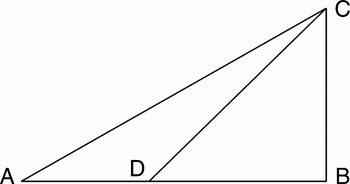
The supposition says that the speeds acquired by the same body descending along say the inclined planes CA and CD, respectively, are equal since the heights of theses planes are equal, namely CB [see Figure 1].
Figure 1.

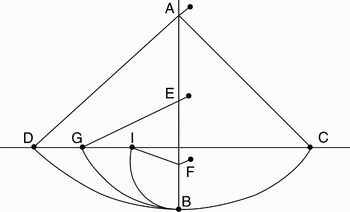
More in general, this is the same speed that would also be acquired by the body falling vertically from C to B. In order ‘to increase the probability [of this assumption] to an extent which shall be little short of a rigid demonstration’, Salviati presents the following thought experiment (‘esperienza’).Footnote 22 Imagine a vertical wall with a nail driven into it, and from the nail let us suspend a fine vertical thread with a lead bullet from A to B [see Fig. 2].
Figure 2.

Then consider the horizontal line DC, at right angles to the vertical thread AB. If we now bring the thread with the bullet into the position AC and we set it free, we can observe it to descend along the arc CBD, until it almost reaches the horizontal DC. From this we infer that the bullet in its descent through the arc CB acquired a momentum [‘impeto’] on reaching B which was sufficient to carry it through a similar arc BD to the same height. The same applies to all other arcs BG and BI (starting from points E and F, respectively). Salviati then concludes:
this experiment leaves no room for doubt as to the truth of our supposition; (…) in general, every momentum acquired by fall through an arc is equal to that which can lift the same body through the same arc. (…) Therefore all the momenta gained by fall through the arcs DB, GB, IB are equal.Footnote 23
This is further generalised and taken to be valid not just for arcs but also for the chords subtended to these arcs, and hence for inclined planes as required by the supposition. There is however an obvious inferential leap in this procedure and Salviati concedes that ‘we are not able, by similar means, to show that the event would be identical in the case of a perfectly round ball descending along planes whose inclinations are respectively the same as the chords of these arcs.’ This difficulty notwithstanding, Salviati concludes ‘but this obstacle, which interferes with the experiment, once removed, it is clear that the momentum [impeto] (which gains in strength with descent) will be able to carry the body to the same height. Let us then, for the present, take this as a postulate, the absolute truth of which will be established when we find that the inferences from it correspond to and agree perfectly with experiment’.Footnote 24 In other words, Galileo's quasi-demonstration for the supposition depends on accepting the postulate; but the postulate is not self-evident and in fact it goes against intuitive experience. This supposition, and the postulate on which it relies, incorporates what I take to be the a priori element in Galileo's procedure, namely that the moving force causally responsible for the observed appearances must be such that the rate of acceleration must be constant (i.e. equal increments of speed in equal time-intervals, as is indeed the case with gravitational acceleration).
From the supposition Galileo then derives two theorems, in particular ‘[Theorem II] If a moveable descend from rest in uniformly accelerated motion, the spaces run through in any times whatever are to each other as the duplicate ratio of their times; that is, are as the squares of those times’. The demonstration of this theorem is very ingenious indeed: Galileo could not in fact avail himself of calculus to calculate instantaneous velocities. Nevertheless, he was able to prove that the ratio between space intervals was equal to the ratio between the squares of the time intervals required to traverse those spaces.Footnote 25 But Simplicius, who represents the naïve Aristotelian in Two New Sciences, at this point intervenes in the discussion to cast doubt on this entire procedure and to ask for some experimental evidence to prove that these mathematical conclusions are indeed true. To which Salviati replies by describing the famous experiments with the inclined planes that Kant refers to.
Consider a bronze ball descending along a groove in a wooden beam tilted by elevating one end of it above the horizontal plane at will, and measure with precision the time it takes for the ball to descend along the entire groove. By repeating the experiment with the same ball descending this time only one-quarter the length of the groove, Galileo found out that the time it takes to descend one-quarter of the groove is precisely one-half of the time it takes to descend the entire groove. By repeating the experiment for other lengths (two-thirds, or one-half) many times, it was always found that spaces were to one another as the squares of the times (and this held for all possible inclinations of the plane). Thus, despite the fact that Galileo could not measure instantaneous velocity, but only space intervals and time intervals, he was able to derive relations between space, time, velocity, and hence acceleration that allowed him to demonstrate the uniformly accelerated motion of bodies descending through an inclined plane. Galileo did not give any numerical value for the acceleration of the rolling ball; nevertheless the result he found about s = at 2 (when the initial velocity is 0) smoothed the path to Newton, who identified the moving force causally responsible for those accelerated motions with gravitational acceleration (a was replaced by the gravitational constant g) which is indeed at work both in the case of balls rolling down an inclined place and in the case of free-falling bodies.
For the purpose of my Kantian analysis, I want to draw attention to Galileo's deductive procedure of starting with a supposition and a postulate and deriving a series of theorems from them. This procedure has nothing to do with and should not be confused with hypothetico-deductivism, as also the Galilean scholar W. L. Wisan has rightly noted.Footnote 26 From a Kantian perspective, the goal of the inclined plane experiment was to extract from the appearance (motion of a bronze ball along an inclined plane) the property of uniform acceleration that Galileo had himself a priori inserted in the appearance for the sake of possible experience. Hence, from a Kantian point of view, we should not think that what we observe, say, a free-falling object, is the rough-and-ready observable phenomenon (in van Fraassen's terms) to be saved by introducing hypotheses that do not give us a literally true description of the way things are (since there may well be alternative hypotheses that save the same phenomenon equally well). If we stick to the level of observable phenomena (again in van Fraassen's terms), then Galileo may seem no more right than Aristotle. What appears to us as a free-falling object can well be accounted for either by the hypothesis of motion towards a natural place, with Aristotle, or by the hypothesis of uniformly accelerated motion, with Galileo. And the role of Galileo's experiment would simply reduce to testing these alternative hypotheses, according to some sort of hypothetico-deductive procedure.
No wonder then many philosophers of science—including Feyerabend's famous analysis of Galileo's tower argumentFootnote 27—have concluded that there was an element of propaganda in Galileo. In the end, Galileo was inventing new auxiliary dynamic hypotheses (be it circular inertia for the tower argument, or the aforementioned one about uniformly accelerated motion), and there was no intrinsic reason for the scientific community to shift to Galileo's new science, apart from the propaganda that finally gathered scientists' consensus around Galileo. I think that Feyerabend captured very nicely the theory-ladeness of observation in Galileo's strategy, but went astray in concluding that Galileo ‘invented’ a new conceptual system and used propaganda to defend it. This conclusion follows—I believe—from a widespread scepticism among philosophers of science about the possibility of choosing between alternative hypotheses that can both accommodate the available evidence. And this scepticism is of course nothing but a consequence of the empiricist tradition about ‘saving the phenomena’.
By contrast with this tradition, I want to suggest that the particular use Galileo made of the postulate in backing up the supposition, from which the law of free fall follows, incorporates what I take to be the a prioriFootnote 28 element that Kant might have rightly seen in Galileo's procedure. Namely, for the sake of experiencing uniformly accelerated motion, we must constitute the kinematical properties of free-falling bodies according to the aforementioned supposition (no matter how counterintuitive the postulate necessary to back it up). But Galileo not only constituted the kinematical properties of free-falling bodies according to this supposition, he tried also to subsume these kinematical properties under the causal concept of a moving force that he called momentum gravitatis or ‘impeto’.Footnote 29 And no matter the fact that Galileo's notion of impeto (as weight times speed) was still reminiscent of the Archimedean science of weight and was not the exact causal story about free-falling bodies. What matters is that for the very first time, physics was not regarded as introducing hypotheses to save the phenomena, but instead as a science whose secure foundations depended on the specific mathematical–physical way in which phenomena were constituted. This is the central contribution Galileo's mathematization of nature made to the scientific revolution. This is the central role Galileo occupies in the transition from Aristotelian to Newtonian physics, as Kant saw it.
To sum up, Kant suggested a radically new conception of phenomena, according to which a phenomenon, say the phenomenon of a uniformly accelerated free-falling object, is something that from the very outset we have mathematically–geometrically constituted as an object having certain spatiotemporal properties (for instance, the property of acquiring the same speeds over different inclined planes with the same height), and, most importantly, subsumed under a causal concept by tracing those spatiotemporal properties back to some moving force, such as Galileo's momentum gravitatis or ‘impeto’. Only in this way, can we transform kinematical appearances into physical phenomena that become the actual objects of scientific inquiry.Footnote 30
In this specific sense, Galileo exemplified Kant's Copernican turn by showing how the phenomena that scientists investigate are not ready-made for us to either save them or give a literally true story of them, but instead they have built in them some a priori elements that we have then to extract and prove through experiment. We can now understand why, according to Kant, Galileo marks the beginning of modern physics by displaying a unique and distinctive scientific methodology: we can gain scientific knowledge of nature only through principles of reason, on the one hand, and through experiments thought out in accordance with these principles, on the other hand. In other words, we can gain scientific knowledge of nature only by making appearances conform to our way of representing, rather than trying hard to make our hypotheses conform to nature. And this is why, as I hope to have clarified, Galileo's method inspired Kant's Copernican turn, and as such it is all the more relevant to address the problem of knowledge that still troubles us today. In this way and in this way only, could Kant answer positively the aforementioned question about how we know that 1) the alleged moving forces are the true causes of appearances (as opposed to hypotheses feigned to save them).
3.3. How do we know that moving forces form a system conferring lawfulness to empirical regularities? The Newton case
An obvious question arises at this point. What has the concept of cause—which, if the above analysis is correct, Kant saw as inserted in the Galilean phenomenon of free-falling bodies from the ground up—got to do with principles of reason? Is not causation a principle of the faculty of understanding, namely the second analogy of experience, rather than a principle of the faculty of reason? A propos of this specific point, Michael Friedman has pointed out how ‘the dynamical principles of the understanding—in particular, the analogies of experience—are regulative rather than constitutive’Footnote 31 because they provide us with a regulative ideal. For instance, causation (the second analogy of experience) is instantiated in Kant's II law of mechanics (which, recall, is a combination of Newton's I and II law); in particular, it is instantiated in Newton's F = ma and hence in Kant's II law that requires an impressed force F as the cause of any change of uniform motion into accelerated motion. But Kant's II law of mechanics, with its a priori nature and transcendental backing in the second analogy of experience, per se cannot guarantee that there are phenomena in nature that instantiate such an impressed force as the causal factor responsible for their change of motion. We can only infer their actual existence a posteriori, namely via observation and experiments. Yet the second analogy of experience provides us with a rule for seeking after such phenomena: without it, we would not even be able to identify some empirical regularities as instantiating accelerated motion (as opposed to uniform motion), and hence as instantiating an impressed force causally responsible for it. It is in virtue of this regulative function—which in the first Critique Kant deemed to be distinctive of the faculty of reason—that I think we can legitimately regard causation as one of the ‘principles of reason’ Kant refers to a propos of Galileo in the Preface. Galileo transformed the appearance of free-falling bodies into a physical phenomenon to study by inserting from the ground up the concept of cause via a moving force, whose nature nonetheless he did not investigate. It was Newton who completed the work that Galileo begun, by investigating the properties of this moving force that Galileo had simply hinted at, as a regulative ideal of scientific inquiry.
While the analogies of experience, in particular causation, can be regarded as having a regulative function (despite being principles of the faculty of understanding), on the other hand, there is one principle of the faculty of reason that Kant repeatedly presented as the regulative principle par excellence: this is the principle of systematic unity or systematicity. In the Appendix to the Transcendental Dialectic, Kant spoke of systematicity as a regulative ideal of scientific inquiry ‘bringing unity into particular cognitions’ and hence transforming a ‘contingent aggregate’ into a ‘system interconnected in accordance with necessary laws’.Footnote 32 Despite this regulative function, Kant however did not regard systematicity only as a desirable feature of the faculty of reason in its striving towards the never fully attainable goal of a complete science of nature, but instead as a necessary requirement for a coherent use of the very same faculty of understanding, and even as a ‘mark of empirical truth’ (see A651/B679).
I think we can foresee here an important link between systematicity and causation as having itself a regulative function. For the faculty of understanding to work properly, and hence for the second analogy of experience to apply, we need an overarching regulative principle of reason, namely systematicity, which can guide us to bring unity into particular cognitions and to transform a contingent aggregate into a system interconnected in accordance with necessary laws. In other words, we need to go beyond the specific causal judgments concerning, for instance, the causal factor responsible for uniformly accelerated motion, and seek after a broader system of moving forces causally responsible for the great variety of phenomena in nature (from cohesion, to liquefaction, to elasticity, etc.).
Kant assigned an increasingly important role to systematicity in the First (unpublished) Introduction to the Critique of Judgment, where systematicity is no longer assigned to the faculty of reason, but to the faculty of reflective judgment. The task of reflective judgment consists in arranging lower-level empirical regularities into a system of higher-level laws, which are nonetheless still empirical. In this respect, the faculty of reflective judgment too has a distinctively regulative function, with its own transcendental principle that postulates the systematic unity of empirical concepts and laws as a regulative ideal so that a system of empirical science becomes possible.Footnote 33 And systematicity as a regulative principle of reflective judgment becomes a key feature in the ‘Transition’ project.Footnote 34 No wonder there are plenty of references to physics as a system or as a ‘systematic investigation of nature’ throughout the Opus postumum. There is a clear continuity between systematicity as advocated in the Critique of Judgment and in the ‘Transition’, whereby physics is defined as ‘the systematic investigation of nature as to empirically given forces of matter, insofar as they are combined among one another in one system’. Kant's task in the ‘Transition’ was to endorse the bottom-up approach typical of the faculty of reflective judgment (with the regulative principle of systematicity) in order to show whether, and eventually how the wide range of empirically given forces in nature could form a system.
Thus, we can now go back and answer question 2) above, namely how we know that such forces form indeed a system conferring lawfulness to what would otherwise be only an aggregate of empirical regularities. It is only in virtue of a regulative principle such as systematicity that we can seek after a system of moving forces, through which and within which only one can claim that the alleged moving force necessarily causes the observed appearance (e.g. gravitational attraction necessarily causes free-falling bodies to move with uniformly accelerated motion). Systematicity is what confers nomic necessity upon an otherwise contingent aggregate of Humean empirical regularities. I want to suggest then that it is this regulative principle of reason that complements observation and experiment in Kant's analysis of Galileo's mathematization of nature.
Although with his experiment of the inclined plane, Galileo arrived at the law of free-falling bodies, he fell nonetheless short of investigating the properties of the force causally responsible for uniformly accelerated motion. In order to move from the identification of a moving force as the true cause (the Galilean vera causa) of those motions to a properly physical/dynamical analysis of those motions, is not enough to apply the concept of cause. It is not enough because Kant had already shown in MAN back in 1786 how the concept of cause (the second analogy of experience) underpinned phenomena via the metaphysical principles of pure natural science (namely, via Kant's II law of mechanics). In order to complete the transition from the metaphysical foundations of natural science to physics—the very same ‘Transition’ Kant was working on in the last decade of his life and that he felt was urgently needed to fill a gap in his transcendental philosophy—we need more than just the concept of cause: i.e., we must identify the moving force as a force due to gravity and we must study its nature and properties as Newton did. In order to ground Galileo's kinematics into a proper ‘system’ of nature, we must shift from what Kant calls the ‘philosophical foundations’ (with the concept of cause) to what he calls the ‘mathematical principles of the philosophical doctrine of nature’, namely Newton's Philosophiae Naturalis Principia Mathematica:Footnote 35
Transition from the metaphysical foundations to physics, according to a priori principles. Galileo, Kepler, Huyghens, and Newton. Huyghens's transition from the metaphysical foundations of natural science to the mathematical ones, and that of Newton to physics—merely by means of the concept of gravitational attraction, which did not occur to Kepler (‘Transition’, 22:353).
To Kant's eyes, the passage from Galileo to Newton represents the historical instantiation of what the regulative principle of systematicity commends. Via Galileo and Newton, Kant saw historically realised the system that confers lawfulness to an otherwise contingent aggregate of Humean empirical regularities. In the case of the force of gravitation, we can properly speak of a system that unifies a great variety of phenomena under a single moving force/cause. And it is thanks to being part of this system that every phenomenon (from the planetary motions studied by Kepler to free-falling bodies studied by Galileo) is entrusted with nomic necessity. Nature's lawfulness is then a consequence of phenomena being systematized under a single common cause, under a single dynamical force such as gravitational attraction. To Kant's eyes, Galileo's experiments and Newton's systematization of phenomena under the single force of gravitation represented the two complementary poles of a sought-after ‘Transition to physics’.
Despite what Kant portrays as a serendipitous transition from Galileo to Newton, this story does not have a happy ending. The more general question that Kant was trying to answer in the ‘Transition’ and that was bound to remain open was whether any similar system could be found for many other types of phenomena revealed by pneumatic chemistry and aether theories at the end of eighteenth century. Is there any similar system able to unify all moving forces in nature responsible for solidification, liquefaction, chemical combination of gases, transmission of light and sound, and even biological phenomena? Kant wondered whether it was possible to embed the Newtonian system into a much broader system providing a unified framework for the increasing variety of phenomena revealed by the physical sciences of his time. This was Kant's specific task in the ‘Transition’, a task that he could not fulfil. But we can catch a glimpse of Kant's heroic efforts from many passages of the Opus postumum. In vain did he attempt to identify Lavoisier's caloric (suitably reinterpreted as heat-matter [Wärmestoff] and even identified with aether) with an all-pervasive substance responsible both for the transmission of light and for states of aggregation of matter, and, hence, with a possible candidate for the sought-after unification of an increasing variety of phenomena.Footnote 36 While the answer to this specific question could not be found and Kant's fragments leave us enough leeway to speculate about his views on aether, caloric and the more general project of the Opus postumum, the ‘Transition’ casts light on Kant's life-long stand on phenomena, which I have tried to spell out in this paper. We do not have ready-made phenomena, but somehow we make them. And we make them via observation and experiment on the one hand, and principles of reason, on the other hand:
I cannot say I have this or that experience; rather, I make it for myself, and this system of perception is valid for everybody. Observation and experiment are ingredients [and] presuppose a principle in order to make experience (not experiences). The mathematical foundations of natural science precede a priori, as intuitions [with kinematical properties of appearances that we have to insert a priori for the sake of possible experience, as Galileo did—MM]; the philosophical [foundations] apply appearances to them [via the concept of a dynamical moving force as the cause of these appearances, as in MAN—MM]; the mathematical principles of the philosophical doctrine of nature [Newton's Principia, and hence the identification of the dynamical moving force with gravitational attraction— MM], however, fully ground the doctrinal system of the science of nature as physics (‘Transition’, 22: 444).
4. Conclusion
What good is Kant's conception of phenomena for today philosophy of science? Going back to the ongoing debate between scientific realists and constructive empiricists, I suggested that Kant's conception of phenomena should prompt philosophers of science to reconsider some traditional claims about science and its aims. In particular, it should prompt us to go beyond both scientific realism and constructive empiricism.
To scientific realists, who believe that science aims to give us a literally true description of the way things are in nature, Kant's conception of phenomena shows that we should believe, for instance, in gravitational attraction not because it provides the best explanation for the success of Newtonian mechanics in predicting the motion of free falling objects. Instead, we should believe in gravitational attraction because without it, we would not have the very same kinematics of uniformly accelerated free-falling objects that Galileo found, to start with.
To constructive empiricists, who believe that science aims to save the phenomena, Kant shows on the other hand that there are no ready-made phenomena as observable/perceivable ‘objects’ in nature. In a way, we have to make them. And, once we make them, we have to prove them right, namely we have to demonstrate that what we have inserted in the appearances for the sake of possible experience is truly there. Once we accept that we make phenomena in the specific Kantian sense clarified in this paper, the whole rationale for the epistemological dichotomy between, say, the observable phenomenon of a free-falling apple and gravitational attraction as an unobservable theoretical entity about which we should suspend belief, needs be carefully reconsidered.
Pace Duhem and his followers, we are not the heirs of Bellarmine. We are in fact the heirs of Galileo. Or better, we are the heirs of Kant's Galileo, the same Galileo that by approaching nature with experiments, on the one hand, and principles of reason, on the other hand, made a light dawn on all those who study nature.