Introduction
How do people choose a language when they are proficient in more than one language? This research sheds light on language choice, English use in particular, in diplomacy where an individual speaks primarily for negotiation on behalf of an organization or a community. Nick (Reference Nick, Jovan and Slavik2001: 39) argued that ‘language is not a simple tool … but very often the very essence of the diplomatic vocation’. Despite its importance, little has been investigated about language choice in diplomatic meetings (Finsen, Reference Finsen2016). Wodak, Krzyzanowski and Forchtner (Reference Wodak, Krzyżanowski and Forchtner2012), one of the few studies, illustrated that 45% of the overall percentage of languages in the European Parliament (EP) meetings was English. To accumulate more data of English use in diplomacy, this research investigated addresses made by the heads of state at the United Nations (UN) General Assembly (GA). The EP is the law-making institution of the European Union (EN) (European Union, 2019), and the UN and the EU have contrasting language policies. Under the EU's non-restrictive language policy, national languages of all 23 members are included in the official languages (Finsen, Reference Finsen2016). On the other hand, the UN restricts the number of official languages to six, namely Arabic, Chinese, English, French, Russian, and Spanish. This makes a difference in the payment for interpretation services. If representatives would like to speak in Portuguese, the EU provides interpretation. However, the UN does not. The speakers need to provide interpretation into one of the six official languages on their own. These contrasting language policies between the EU and the UN can influence language choice at the UN meetings. Moreover, the UN has a larger number of member states than the EU, and many of them belong to other language or regional organizations. Therefore, this study focuses on the prevalence of English use by the heads of state at the UN GA meetings according to five language and two regional groups.
The UN GA is ‘the only UN body with universal representation’ for all member states (United Nations, 2019). It is held in September, and high-ranking officials address the meetings. The UN provides videos of speeches, speech manuscripts, and the names and social positions of speakers in the past meetings at its official websites. These resources are ideal for fixed-point observation of language choice over a certain period of time. By using these audio-visual files, and other online resources as the principal sources, the researcher quantified the use of English by the heads of state at eight GA sessions biennially over a period of 15 years (2004–2018). The examination attempted to reveal the degree to which English was used in the 1,540 speeches given by the whole UN member states and attitudes toward English use according to language and regional groups. Admitting that the argument tends to be speculative due to the analysis solely based on online data, the researcher believes this research will provide baseline data for future studies.
Language choice at the United Nations
Respecting linguistic diversity is guaranteed by the Charter of Fundamental Rights of the EU. However, the EU functions ‘in a limited number of official languages, and with an even more limited number of de facto working languages’ (Mowbray, Reference Mowbray2010: 98) due to the ‘astronomical cost of interpretation at conferences and translation of an enormous amount of written materials’ (Nick, Reference Nick, Jovan and Slavik2001: 43). The UN has followed a similar course: challenges in budgets and workload have led to a reduced multilingual use (McEntee–Atalianis, Reference McEntee-Atalianis2017).
In the UN, the Rules of Procedure stipulate that six languages shall be both the official and the working languages of the GA, and that speakers may make a speech in any language as long as they provide interpretation into one of the six official languages (Mowbray, Reference Mowbray2010). However, ‘these policies do not extend into every corner of the organization’ (Tonkin, Reference Tonkin2011: 7), and the superiority of English as a de facto working language in the UN has been often condemned. Tonkin (Reference Tonkin2011: 7) claimed ‘much of the business of the GA is carried on informally, without the presence of interpreters’. In these informal meetings, as Ammon (Reference Ammon2006) argued, using more than one working language is impractical. In many of the cases, English has been used as the working language. Furthermore, English is predominantly used for its outreach activities. Reviewing the UN Secretariat websites, McEntee–Atalianis (Reference McEntee-Atalianis2017) reported that over 90% of the whole content was translated into English with slightly over 50% of the content available in French, 30% in Spanish, and under 30% in Chinese, Russian or Arabic. The UN's non-English-speaking member states are not happy with this dominant use of English. Their complaints resulted in the adoption of multiple resolutions to urge the accomplishment of multilingualism. Multilingualism was adopted in 1995 by a vote of 100 countries in favor (Voicu, Reference Voicu2002: 3). Later, in 2008, in response to the resolutions in 1999 and 2007, the Secretary-General appointed a Coordinator for Multilingualism (Mowbray, Reference Mowbray2010: 95–96). In recent years, the GA published a report A/65/488 in 2010 to address the role of multilingualism in the Secretariat, and another report A/69/282 in 2014 to provide an update on the activities undertaken to promote multilingualism. Furthermore, the GA adopted a resolution A/RES/69/324 in 2015 which recognized the importance of multilingualism and stressed the need for strict observance of the resolutions.
Reasons behind language choice at international meetings
Language choice can tell ‘who they are, who they want to be seen as, and how they relate to the people they are interacting with’ (Bilaniuk, Reference Bilaniuk2010: 109). Thus it is highly plausible that people who are proficient in multiple languages will choose a different language according to context. When more than one language is in repertoire, the simplest choice will be a language they can speak most proficiently. However, ‘there are some tactics, even politics, involved in making that decision’ (Nick, Reference Nick, Jovan and Slavik2001: 42). In this section, the researcher briefly reviews three main reasons for which people are likely to choose one language or another at international meetings.
The purpose of communication at diplomatic meetings is negotiation and consensus decision making. Therefore, the primary reason for language choice is persuasion. If delegates use their own language to address the GA without the help of interpreters, ‘their power of persuasion goes up’ (Tonkin, Reference Tonkin2011: 6). Thanks to its widespread international currency, English provides its users with direct access to a wider audience irrespective of the distinction between native and non-native speakers. An interesting example to support this benefit was documented by Wodak et al. (Reference Wodak, Krzyżanowski and Forchtner2012), who reported on the language choice by the members of the EP. They had an interpretation service, so they usually spoke their native language. However, when conflicts occurred, they often switched to English ‘to emphasize their opinions’ (Wodak et al., Reference Wodak, Krzyżanowski and Forchtner2012: 177). The choice of English in this case underlines positive expectations that people share of the English language as a more efficient tool to persuade members of other language community.
Another important reason for language choice at international organizations is identification (House, Reference House2003). Language choice is closely related to a decision to include or exclude someone from a team (Mahili, Reference Mahili2014). Therefore, sharing the same language is sharing ‘national identity or the bond of nationhood’ (Ammon, Reference Ammon2006: 329). An increased use of a certain language at international conferences suggests a high international standing and prestige of the language, which consequently strengthens national identity and pride of its speakers (Ammon, Reference Ammon2006; Tonkin, Reference Tonkin2011). The reaction of the French President at an international meeting was a striking example of a language for identity. French President Jacques Chirac stormed out of a session at the EU summit in 2006 when a French business leader started to address delegates in English (Mardell, Reference Mardell2006). The President left the room with Foreign Minister and Finance Minister to show protest.
So far we have seen two functions of a language: a language for communication and a language for identity. The third reason concerns primarily non-native speakers of a language. For non-native speakers addressing global audience, the perception of their fellow citizens at home can have a large impact on their language choice. Speeches by the heads of state at international meetings are often broadcast in a news program in their countries. Therefore, the outstanding language talent will contribute to enhancing reputation of the leaders. Many accounts are heard from people who claim that good non-native English speakers enjoy high prestige, e.g., Al–Hayak (Reference Al–Hayek2016), Bamgbose (Reference Bamgbose2011), and Dumanig, David & Shanmuganathan (Reference Dumanig, David and Shanmuganathan2013).
Method
The UN has 193 member states and two observers. The largest change in its membership in the last few decades was recorded in 1992 when 13 countries from the former Soviet Union and former Yugoslavia joined the UN. Since then, except for the admission of one or two countries at a time in the following years, the membership has remained largely static. This study chose 2004 as the starting point because it was the year of the EU's largest extension when ten countries in Eastern Europe joined the EU. Though the UN GA meetings were held annually, language choice was examined for the sessions held in every other year from 2004 to 2018 at eight data collection points (i.e., in 2004, 2006, 2008, 2010, 2012, 2014, 2016 and 2018). This decision was made to ensure a more representative analysis of English use by leaders because they tend to stay in office for multiple years.
Table 1 provides the number of speeches made at the GA meetings. With the total number of member states and observers being 195, the average attendance rate throughout the period was 98.7%. Each speech was made by a single speaker, thus making a total number of speeches 1,540.
Number of speeches at the United Nations General Assembly meetings

First, to clarify who represented countries and addressed the UN GA meetings, the social positions of speakers were categorized into the following six groups: ‘President or Prime Minister,’ ‘Minister of Foreign Affairs,’ ‘Vice President or Deputy Prime Minister,’ ‘Other Minister,’ ‘Royal Family,’ and ‘Other.’ For instance, the ‘Other’ category included ‘chair of the delegation.’ Next, to ascertain whether a speaker used English, the researcher watched the beginning of each speech paying special attention to the speaker's movement of mouth. He also used the language index which was attached to audio-visual recordings by the UN Web Services Section. For instance, when videos or audios titled ‘Original’ were provided besides English ones, it was suggested that the speech was originally made in a language other than English.
The researcher then calculated the percentage of English speeches as part of the total number of speeches in the GA meetings on a yearly basis. Calculations were made a) for all participating UN member states and observers, b) for five language groups, and c) for two regional groups. This analysis aimed to elicit a difference in English use and examine attitudes toward English use according to language affiliation. The language grouping was performed on a basis of membership in four international organizations which share English, French, Arabic, or Spanish as the common language. Considering that the UN has six official languages, the fifth Russian-speaking group was created by the 15 former Soviet Union countries. No language group for Chinese was set up because China is the only UN member state that uses Chinese as an official language. In addition to five language groups, two regional groups were formed on a basis of membership in two regional organizations: The Association of Southeast Asian Nations (ASEAN) and the EU. The ASEAN designated English as the only working language at the inauguration in 1967 (Okudaira, Reference Okudaira1999). However, it was much later in 2007 when English was officially documented as the working language of ASEAN (ASEAN Charter, 2008). Meanwhile, the EU adopts a multilingual policy, meaning all 23 languages of the member states should be equally respected (European Union, 2018). This grouping for analysis aimed to examine if the contrasting language policies of the two regional organizations would have any effect on language choice at the UN meetings.
In addition to the analysis of 1,540 speeches, the researcher scrutinized the names of speakers who addressed the GA meetings to investigate the extent to which the use of English was spread among the leaders of a country. It was hypothesized that the more speakers from a country chose English, the more prevalent the use of English would be among the leaders of the country. After the researcher examined the overlapping speakers who gave a speech at the GA meetings more than once, the number of speakers reduced from 1,540 to 927.
In the course of investigation, several cases were found where the same speaker spoke two languages. These cases were divided into two types. The first type was the use of English in one year and another language in other years. The second type was the use of two languages in one speech. Speakers used more than one language or code-switched in a speech. In these cases, the researcher ascertained the language of the speech again by watching the remaining part of the video or listened to the audio recordings and by examining the speech manuscript. Following the definition by Myers–Scotton (Reference Myers–Scotton1989), the researcher defined code-switching in this study as the speaker-motivated use of two languages in the same speech. Intra-sentential switches occurring in the middle of a sentence and inter-sentential switches occurring between sentences were not differentiated in this study. The researcher calculated the proportion of the use of each language by respective speakers. When videos or audio recordings in the original languages were available, the researcher measured the duration of each turn in seconds for each language. When the researcher could not access audio-visual materials, he examined speech manuscripts and counted the number of words for each language. To make the comparison across years easier, the researcher recorded only the dominantly used language for one speaker. For instance, in the cases of Canadian speakers who used English and French in their speeches, the language of their speeches was recorded as English in a summary on the ground that they spoke for a longer time or uttered more words in English than in French.
Results and discussion
English use as a whole
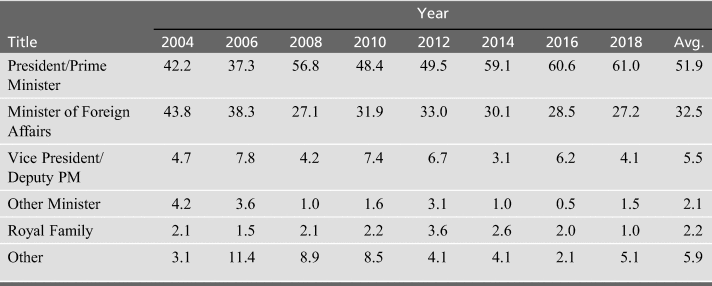
The analysis of titles of 1,540 speakers revealed that the majority of speakers were Presidents or Prime Ministers, followed by Ministers for Foreign Affairs (Table 2). These two social positions accounted for an average of 84.4% of the titles of all the speakers. It is worth noting that this analysis did not consider redundancy in speakers.
Title of speakers at UN General Assembly meetings (%)

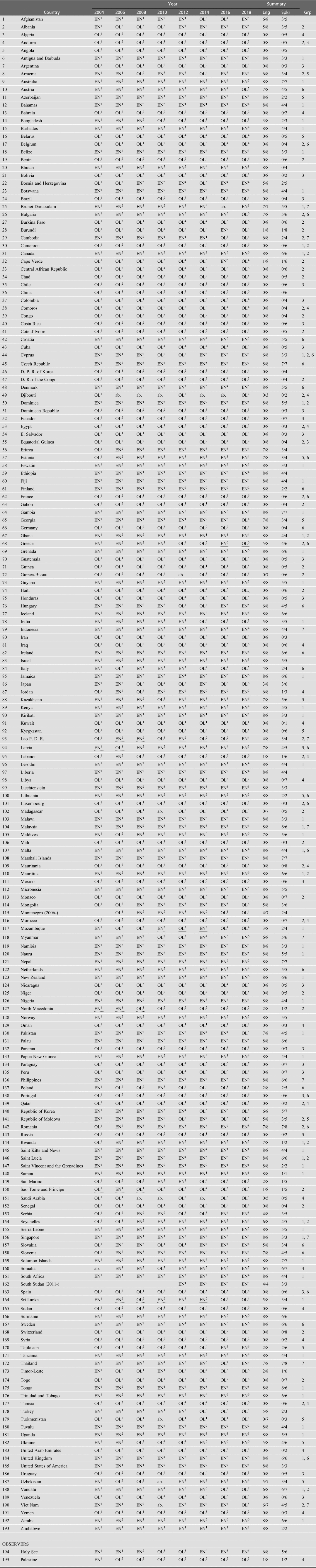
Appendix 1 presents the result of the investigation into the language used by representatives of all the participating member states and observers. The language was recorded as either ‘EN’ (English) or ‘OL’ (other language). The number in superscript above the language indicates the speaker numbers of respective countries. Take Afghanistan, the country on top of the list, for example. At the eight sessions investigated in this study, six speeches were made in English and two in other language. Speaker 1 attended the GA meeting in 2004, 2006, 2008, and 2012, and four other speakers addressed the remaining four sessions. This made the total number of speakers of Afghanistan five. Three of them used English. The speaker who represented Afghanistan four times was consistent in his choice of language. He spoke English every time. When inconsistent use of English was observed, an underline was added either in a straight line or in a dotted line. Take Lao P. D. R. for example. The straight lines drawn for 2012, 2014, and 2016 show that the delivery in English or in other language was reconfirmed with the audio-visual recordings at the time of writing this paper. On the other hand, the dotted line for 2006 and 2008 mean that the aural reconfirmation was not possible due to the disconnection of links to online resources.
Language choice and the number of speakers for each country is summarized in the two right columns. Two numbers with a slash in between under the header of ‘Lng’ (language) indicate the number of English speeches out of a total number of speeches made by representatives of a country. The maximal number of speeches is eight. Likewise, two numbers divided by a slash under the header of ‘Spkr’ (speaker) mean the number of English speakers out of the total number of speakers of respective countries. Unlike the total number of speeches, the total number of speakers differed from country to country. Burundi, Mauritania, and Switzerland had eight different speakers. Conversely, Kuwait and Samoa had only one speaker for the eight sessions held in 15 years. Finally, numbers 1 to 7 in the rightmost column show the affiliation of the country with the language and regional groups discussed in this study: 1 = English, 2 = French, 3 = Spanish, 4 = Arabic, 5 = Russian, 6 = EU, and 7 = ASEAN.
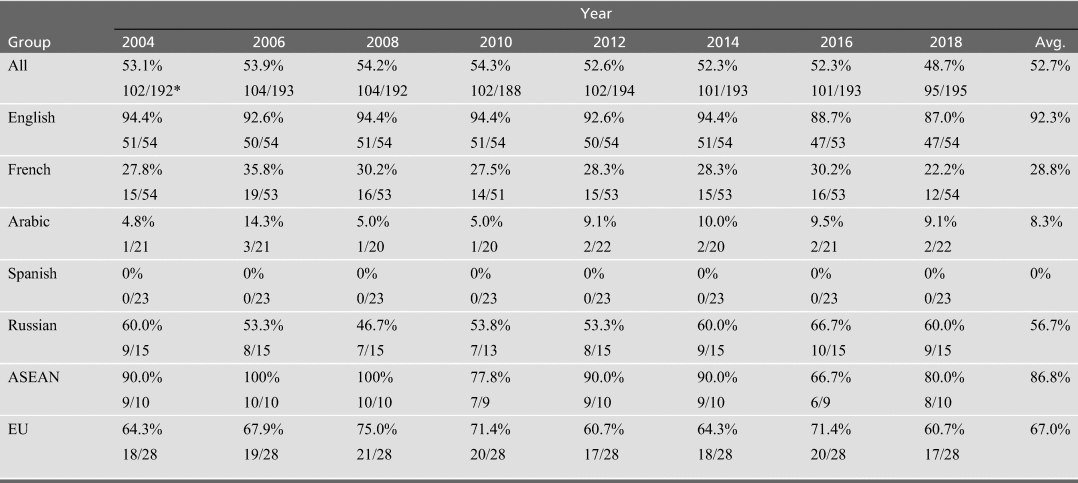
The overview of the results is provided in Table 3. The first row summarizes the proportion of English speeches for all the participating states and observers in a yearly basis. The percentage was computed by dividing the number of English speakers with the total number of speakers who addressed the GA meetings in respective years. Then the average for the eight occasions over 15 years was obtained by dividing the sum of the percentages with eight. English was used for 52.7% of the 1,540 speeches under investigation. Subsequent investigation into speakers revealed a similar percentage of prevalence of English use among speakers. The number of individuals who addressed the GA meetings on eight occasions turned out to be 927, and these individuals made a cumulative total of 1,540 speeches. Further examination revealed that 482 out of 927 speakers (52.0%) used English.
Ratio of English speeches for language and regional groups

*indicates the number of English speakers/the total number of speakers
Compared with the 45% of English use at the EP (Wodak et al., Reference Wodak, Krzyżanowski and Forchtner2012), it revealed a slightly higher proportion of 52.7% at the UN GA meetings. The percentages were stable over the period and they fluctuated between the lowest 48.7% and the highest 54.3%. The narrow fluctuation range may reflect on speakers’ avoidance of unnecessary friction with other member states. Heller (Reference Heller1992: 123) argued that conventional language choice ‘represent[s] relatively stable relations of power, while violations can be seen as forms of resistance.’ Similarly, Myers–Scotton and Bolonyai (Reference Myers-Scotton and Bolonyai2001: 10) maintained that unconventional language choice symbolizes the demand for negotiations to ‘change the CURRENT RO [Rights and Obligations] set to a NEW RO set’.
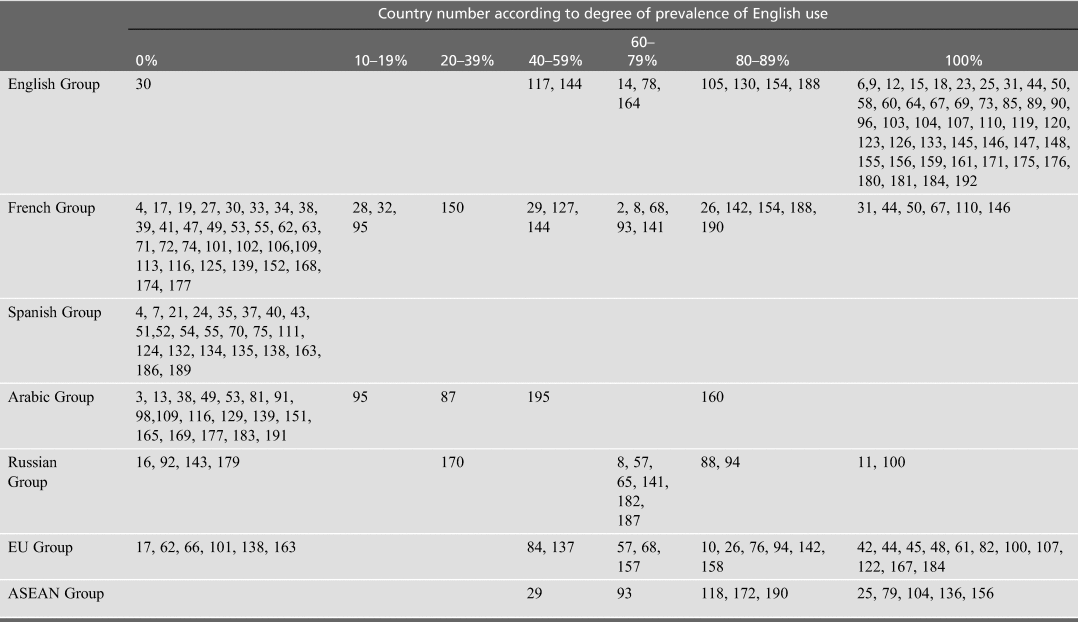
The following section discusses characteristic English use for language and regional groups. Subsequent examination into speakers was made for member states in these groups, and the result is presented in Table 4. In this table, the numbers of respective countries in Appendix 1 were distributed according to the degree of prevalence of English use among the speakers of respective countries. Please note a difference in the treatment of redundancy in speakers. Table 3 is based on the cumulative total number of speakers and Table 4 is not. In other words, Table 3 shows the percentages of speeches made in English out of all the speeches irrespective of redundancy in speakers. On the other hand, Table 4 focuses on individual speakers. For example, in the case of Albania, three cases of redundancy were observed. Speaker 3 represented the country twice in 2008 and 2010, and Speaker 4 spoke three times in 2012, 2014, and 2016. Therefore, the number of individuals for this analysis became five with the three cases of redundancy omitted. On the basis of the finding that three out of five Albanian speakers used English, the prevalence of English use among speakers of this country was calculated to be 60.0%. Albania is affiliated with a French-speaking organization, so Table 4 lists its country number (#2) in the row of ‘French Group’ under the header of ‘60–79%’.
Prevalence of English use among speakers for language and regional groups

English use for five language groups
English Group
English Group consisted of 54 countries which belong to the Commonwealth of Nations. Most of the member states used to be British colony, and they share the common English language background. The average rate of English usage within this group was 92.3%. Table 4 demonstrates that the overwhelming majority of member states in this group consistently used English irrespective of speakers. Meanwhile, some leaders of Bangladesh (#14), India (#78), and Sri Lanka (#164) used their ethnic languages. Speaker 3 of Mozambique (#117) used English in 2010 and 2014 and other language in 2012. This suggests that his decision to use the language other than English was not due to a lack of proficiency in speaking English. In addition, code-switching was seen with some speakers of the countries in this group. For instance, all six Canadian leaders code-switched between English and French in their speeches. The 2018 speech by Mrs. Ardern, Prime Minister of New Zealand, was unique. She started her 22-minute speech in Maori and closed her speech in Maori as well. Her manuscript was also written in Maori and English. Mentioning ‘As is tradition [of the indigenous people of New Zealand]’ in her speech, she showed respect to Maori people at home. In every case mentioned here, English was judged dominant in terms of the duration of speech or word count. Code-switching patterns of Canadian speakers are discussed in more detail later.
French Group
A total of 57 member states and three governments, i.e., French community of Belgium, Canada-New-Brunswick, and Canada-Quebec, belong to the International Organisation of La Francophonie (IOF). The members share French as the common language. Its mission is to embody the active solidarity between its member states and governments (Sabourin & Bélanger, Reference Sabourin and Bélanger2014) and they are expected to ‘work together to maintain and promote French’ (Tonkin, Reference Tonkin2008: 3). For instance, it was reported that IOF ‘raised concerns about the increasing dominance of English within the EU’ (Mowbray, Reference Mowbray2010: 106). Considering the mission of the organization, the finding of this study was somewhat surprising. The analysis revealed that more than a quarter of the representatives of the IOF member states used English to address the GA meetings. The average percentage of English use on the eight data collection points was 28.8%. Moreover, Table 4 lists Bulgaria (#26), Romania (#142), Viet Nam (#190) as 80–89% English-using countries, though they do not have double membership of the English-speaking organization. All these findings suggest a possibility that English is being favored in some Francophone countries. Finally, code-switching was observed among leaders of countries ranked high above the list such as Armenia (#8), Canada (#31), Greece (#68), Romania (#142), and Seychelles (#154). As regards the ten countries affiliating themselves with both English- and French-speaking organizations, leaders of five countries, i.e., Canada, Dominica, Ghana, Mauritius, and Saint Lucia, used English on all eight occasions.
Arabic Group
The Arab League is formed by countries which have Arabic as an official language. A total of 22 countries belong to this organization. The use of English for this group ranged from 4.8% in 2004 to 14.3% in 2006, and the average throughout the period was 8.3%. The ups and downs in percentages were due to a few leaders who used English on each occasion. In other words, the use of English in this group was limited to specific speakers such as King Abdullah II of Jordan. The only exception was Somalia. Four Somalian Foreign Ministers, one Prime Minister, and one President, all spoke in English. Their choice of English might stem from a unique language situation of Somalia. Despite its geographically close location to the Arabian Peninsula, the northern part used to be British Somaliland (Eno, Dammak & Eno, Reference Eno, Dammak and Eno2016). Somali and Arabic are recognized as official languages, but, according to Eberhard, Simons and Fennig (Reference Eberhard, Simons and Fennig2019), most Somalis have very limited or no proficiency in Arabic. Hence the researcher speculates that Somali leaders chose English, not Arabic. In the Arabic group, even the leaders who spoke English in the remaining part of their speeches chose Arabic for greetings. This suggests that consideration for other member states is crucial. Sharkey's (Reference Sharkey2008) argument underpins this assumption. Through her observation of the language use in Northern Sudan, Sharkey (Reference Sharkey2008) emphasized the importance of lip service to promoting Arabic and Arab culture in order to win political and financial support from Arab countries.
Spanish Group
The Organization of Ibero-American States is an international organization of Spanish- and Portuguese-speaking countries. It has 24 member states including dependent territory of Puerto Rico. Puerto Rico was excluded from the analysis because it is not a UN member state or observer. The finding illustrated that none of the 184 speeches made by the leaders of 23 countries in this organization was in English. Not even a single time did the leaders of member states of the organization address the GA in English on eight occasions. The Spanish group demonstrated firm group solidarity. It is reasonable to expect the existence of some political consensus on the non-use of English among the member states. Examining language use for university homepages of the world, Callahan and Herring (Reference Callahan and Herring2012) reported a lack of English use with university homepages in Latin American countries. They reported that ‘the universities in these countries, it seems, do not feel the need to attract students or represent themselves outside the Hispanic world’ (Callahan & Herring, Reference Callahan and Herring2012: 345–6). Moreover, the smoldering discontent expressed by Spanish-speaking representatives at the UN in 2001 highlights their strong determination to protect Spanish. In protest against the overuse of English, 20 permanent representatives of the Spanish-speaking state members of the UN formerly demanded the increased use of Spanish in the UN public information documents (Navarrete, Reference Navarrete2001).
Russian Group
This group had 15 former Soviet Union member states. Slightly over half of the speeches were given in English by the leaders of the countries in this group. The exact rate fluctuated between 46.7% and 66.7%, and the average for the whole period under investigation was 56.7%. The leaders of two countries, Azerbaijan, and Lithuania always chose English, whereas the leaders of Belarus, Kyrgyzstan, Russia, and Turkmenistan invariably used a language other than English all the time. The inconsistent use of English was observed with the leaders of remaining nine countries. For example, in the cases of Georgia, Kazakhstan, and Moldova, English was used on more than half of the occasions. Azerbaijan and Moldova stopped the use of the Cyrillic alphabet imposed by the Soviet Union and changed to Latin orthography (Sharkey, Reference Sharkey2008: 34). This decision can be interpreted as their readiness to depart from the influences of Soviet Union, and the use of English observed with representatives of Azerbaijan and Moldova may reflect it. At the same time, it is interesting that English was also favored in countries where the use of an ethnic language was promoted. Kazakhstan implemented the national policy to increase the number of schools with instruction in the Kazakh language. Callahan and Herring (Reference Callahan and Herring2012: 339) found the use of the Kazakh language in university homepages increased concurrently with the new national policy in Kazakhstan. Despite this emphasis on their ethnic language, however, all six leaders of Kazakhstan addressed the GA meetings in English.
English use for two regional groups
ASEAN Group
The ASEAN consists of ten member states. The average rate of English use for this group was 86.8% in the whole period. English was used by representatives of all ten member states in 2006 and 2008. Lower percentages were recorded in 2010 and 2016 when Cambodian, Laotian, Burmese and Thai leaders chose a language other than English. However, the wide prevalence of English among leaders of the countries in this group is worth noting. Subsequent examination revealed that English use was not limited to specific speakers but widely spread among leaders. For instance, five out of six Burmese, and seven out of eight Thai leaders delivered addresses in English, and Myanmar (#118) and Thailand (#172) are listed as 80–89% English-using countries in Table 4.
The absence of conflicts of interest in language choice in this region seems to have promoted the use of English by leaders. Okudaira (Reference Okudaira1999) argued that English is a language of a third party which belongs to none of the ASEAN countries. An interesting piece of evidence is documented that supports the use of English for conflict avoidance among multilingual ethnic groups. Callahan and Herring (Reference Callahan and Herring2012) found that universities in India, the Philippines, or East African countries favored English over their national languages. The national language was used as the primary language for university homepages in most countries, but, according to Callahan and Herring (Reference Callahan and Herring2012), Hindi, Swahili, and Filipino were the exceptions. No universities in these countries used their national language as the primary language for university homepages. It can be assumed that English was selected to avoid friction because a national language in their countries was closely connected with a certain ethnic group.
EU Group
EU Group had 28 member states. The analysis showed that the average percentage of English speeches as a part of the total number of speeches throughout the period was 67.0%, with the highest being 75.0% in 2008 and the lowest being 60.7% in 2012 and 2018. In terms of a degree of consistency in the choice of English, 28 countries were divided into three sub-groups. The first sub-group consisted of ten countries whose leaders always used English. The countries categorized into this sub-group were Croatia, Czech Republic, Denmark, Finland, Ireland, Lithuania, Malta, Netherlands, Sweden, and the UK. Another six countries in Sub-group II, i.e., Belgium, France, Germany, Luxemburg, Portugal, and Spain, were exactly the opposite. All the leaders used a language other than English irrespective of the year. The leaders of the remaining 12 member states chose English and other language inconsistently across years (Sub-group III).
This grouping matches Ammon's (Reference Ammon2006) classification of the EU member states. Ammon divided the EU member states into three types according to their national or official language. Type I member states had English as their national or official language. Type II member states had French, German, Spanish or Italian. Furthermore, the remaining countries with other language as their national or official language were classified into Type III member states. Ammon (Reference Ammon2006) argued that the last group tends to prefer English as the sole EU working language because ‘they see no chance of their own language gaining this function’ (p. 332). On the other hand, Type II member states object to the use of English because they are afraid of its consequence. These countries have ‘a large language of international standing’ (Ammon, Reference Ammon2006: 332). Therefore, Ammon (Reference Ammon2006) speculated that the adoption of English would downgrade their own language as a working language, and that the prestige and attraction of their language as an object of foreign language studies would be lost. Consequently, the international standing of their language would be diminished (Ammon, Reference Ammon2006: 332). Another researcher confirmed his speculation. Oltermann (Reference Oltermann2013) reported on a recent language situation in Europe as follows, ‘Since the “big bang” of eastern European enlargement in 2004, the use of French has declined in conference meetings – and German is these days an “official language” on paper only.’
This kind of nationalistic motive for language choice was limited to the leaders of a small number of countries in Sub-group II. Indeed, political considerations for people at home are one of the factors that will influence language choice of leaders, but according to Finsen (Reference Finsen2016), the impacts on language choice will be weaker in the UN than in the EU. Finsen (Reference Finsen2016: 63) argued that the GA meetings at the UN do not hold as much official power as most of the EU institutions do because the workings of the EU generally affect the lives of European citizens much more than the actions of the UN. Therefore, Finsen (Reference Finsen2016) concluded that people are perhaps more likely to accept that their language is not being represented within the GA because of the apparent lack of influence it will exert on their lives. As far as the remaining countries were concerned, representatives were in favor of the use of English. Leaders of ten countries chose English all the time and more than half of the leaders of the remaining 12 countries except for Poland spoke English.
Code-switching
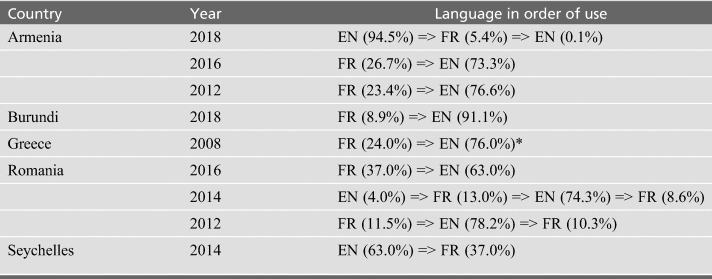
Code-switching patterns observed in this study were classified into three types. The first type was ‘greeting-only’ code-switching. This pattern was observed in the speeches by the leaders of Comoros and Pakistan. They began with the greetings in Arabic and continued their speeches in French or in English. Unlike the other types, code-switching of this type occurred only at the beginning of a speech. The second type appeared in the middle of speech and the speech manuscript was written in two languages. The code-switching of this type was conducted only between English and French. The code-switching occurred when a new paragraph started. Moreover, when they changed languages, they often resumed their speeches with an address to the chair in English or French, for example, ‘Mr. President’ or ‘Monsieur le President’. Type II code-switching was observed with the leaders of five countries: Armenia, Burundi, Greece, Romania, and Seychelles. Table 5 shows the percentages of each language in terms of the duration in seconds and the order of use.
Code-switching in a speech

*Percentages were calculated by word count for this speech.
The number of code-switching in this group was either once or twice. In every speech, English was the dominant language. Myers-Scotton (Reference Myers–Scotton1989: 334) argued that the use of two languages symbolizes a simultaneously shared membership in two social identities. Two countries whose leaders showed Type I code-switching belong to the Arab League, and likewise, five countries belong to the French-speaking organization. Therefore, the use of Arabic for greetings and a partial use of French in a speech will indicate not only their membership in respective organizations but also ‘a gesture of goodwill, courtesy, or a sign of special respect’ (Nick, Reference Nick, Jovan and Slavik2001: 42) for the other members in the audience.
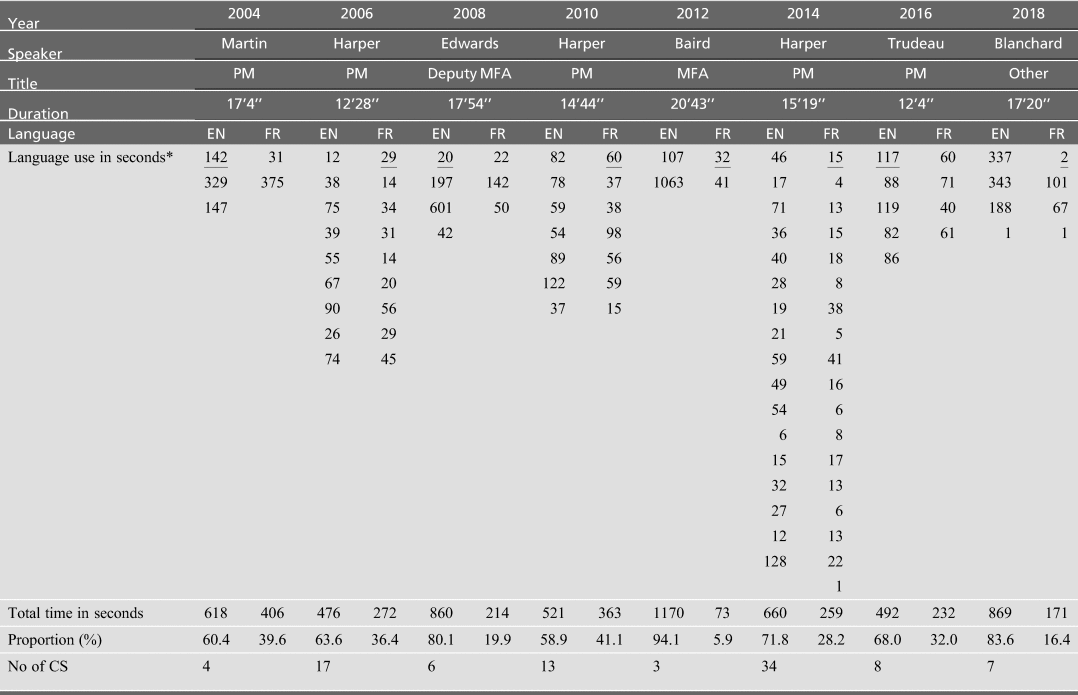
The third type of code-switching was unique to Canadian speakers. They alternated English and French frequently during their speech. The researcher examined the number of code-switching and the duration of time when English and French were used for the eight addresses made by five speakers (Appendix 2). English was spoken for an average of 72.6% of the total speech time. The shortest was 58.9% in 2010 and the longest was 94.1% in 2012. The number of code-switching significantly differed from person to person, ranging from three times in a 21-minute speech to 34 times in a 16-minute speech. Unlike the cases of Type II code-switching, the whole speech manuscript was written in English or in French in this type. The audio recordings showed a state of confusion among interpreters. The recordings suggested that the interpreters did not know the timing of the code-switching. Mr. Harper code-switched most frequently, and he switched to the other language even in the middle of one sentence. He changed the language 13 times in 2010, 17 times in 2006, and 34 times in 2014.
On the basis of these individual differences, it can be speculated that the code-switching peculiar to Canadian leaders was a result of a personal choice of the speakers as well as a political decision for their citizens. English and French were declared to be official languages in Canada, and they ‘possess and enjoy equality of status and equal rights and privileges as to their use in all the institutions of the Parliament and Government of Canada’ (Compendium of Language Management in Canada, 2018). This provision suggests that Canadian speakers would use English and French equally in their speeches. However, all Canadian speakers spent a longer time speaking English. The time for English amounted to as much as 94% of the total time of speech in 2012. Despite the guarantee of equal status and equal rights to use French, Sabourin and Belanger (Reference Sabourin and Bélanger2014) argued for a decline in the use of French in Canada in recent years. The dominant use of English over French observed with all Canadian speakers will support their argument. The use of two languages was not likely to contribute to a better understanding of their speeches. The frequent and irregular code-switching, 34 times in 16 minutes for example, apparently perplexed the interpreters and frequent switching to interpretation was not listener-friendly. All these considered, it can be concluded that all speakers representing Canada had no choice but to use two languages for a political reason but that how they actually used them was of a personal choice.
Limitations
This study is not free from limitations. The analysis was based on the limited source data: audio-visual recordings, speech manuscripts, and information about speakers. In addition, due to an unexpected renewal of the UN websites, the links to the audio recordings of the 2010 session and earlier were inactivated during this research project. However, utmost care was taken to ensure the accuracy of research by scrutinizing speech manuscripts and by making full use of the audio recordings downloaded earlier and those accessible at present.
The peculiarity of speeches at the GA can be another limitation for generalization of the findings. The speeches at the GA and at the plenary meetings at the EP are similar in their objectives. The main purpose of speeches at the plenary meetings of the EP is ‘to express their political and policy positions from a national standpoint in their national language’ (Wodak et al., Reference Wodak, Krzyżanowski and Forchtner2012: 168). Similarly, the speeches investigated in this research were one-sided and they were not open to negotiation. As a consequence, speakers were able to focus on their delivery. Tonkin (Reference Tonkin2008) suggested a dissimilarity in nature of some GA meetings from other meetings in the UN. He stated, ‘ … so in the context of the General Assembly, where English dominates all of the other five working languages in all but the most formal and rule-bound interactions’ (Tonkin, Reference Tonkin2008: 4). The GA meetings attended by the heads of state will fall under the most formal and rule-bound interactions. For this reason, percentages of English use may vary if language choice is examined at other contexts, e.g., at informal meetings in the UN where negotiation is deemed indispensable. It can be speculated that English is used in a higher rate in informal meetings than revealed in this research. Wright (Reference Wright2009: 96) reported an increased use of English for communication beyond formal discourse without interaction in the EU. She wrote, ‘The Commission's electronic discussion board gives options in all 23 languages. However, once past the symbolic, portal level, this equality founders and, on the discussion boards, participants write in the language from their repertoire they believe will give them the largest readership, or the readership they are targeting. Very often this is English’. In this study, no leader of Iran or the United Arab Emirates chose English when they addressed the GA meetings. However, the energy or oil ministers of these countries attending the Organization of the Petroleum Exporting Countries (OPEC) meetings answered interviews in fluent English (Bloomberg, 3 April, 2018; Bloomberg, 19 June, 2018). Therefore, it is no wonder if they use English in other meetings where negotiation is essential.
One last weakness of this study is an unexpectedly high rate of redundancy in speakers. The researcher anticipated this tendency to some extent and he decided to examine the sessions in every other year. However, the redundancy rate of 39.8%, which means 613 out of 1,540 speakers were the same speakers, was unexpectedly high. Nevertheless, this finding will be a useful reference for future studies.
Conclusion
This research project aimed to quantify the use of English by the heads of state at the UN GA meetings. Languages of 1,540 speeches made in the even-number year from 2004 to 2018 were examined. As regards social positions of 1,540 speakers, ‘President or Prime Minister’ and ‘Minister for Foreign Affairs’ accounted for 84.4% of the speakers. The examination of 1,540 speeches revealed that 52.7% of them, on average, were made in English. The percentages were stable throughout the period under investigation and they fluctuated between the lowest 48.7% and the highest 54.3%. Subsequent investigation into speakers showed that, after elimination of redundancy, a total of 927 individuals addressed the GA meetings, and that 52.0% of them used English.
Analysis for countries sharing five official languages of the UN suggested varying degrees of English use in each language group. English was used, in the descending order, for 92.3% of the speeches given by the representatives of the English-speaking Commonwealth of Nations member states, for 56.7% of the speeches made by former Soviet Union member states’ leaders, for 28.8% of the speeches delivered by the representatives of the International Organisation of La Francophonie member states, and for 8.3% of the speeches made by the leaders of the Arab League member states. No leader of Spanish-speaking countries or of China used English. Of the five language groups, French-speaking and former Soviet Union member states showed a greater variation in their attitudes toward English use. Apart from two extreme groups whose representatives always, or never, used English, more than half of the leaders of remaining member states used English. Three types of code-switching were observed in the English-, French-, and Arabic-speaking countries, but in every case English was dominantly used. Analysis of two regional groups revealed that 86.8% of the ASEAN and 67.0% of the EU speakers used English. Further investigation into speakers showed that except for six EU member states, more than half of the speakers representing all the other countries in these two regional groups used English. Despite its speculative nature, this study addressed a lack of data on language choice in diplomatic meetings. The researcher believes this research will provide baseline data for future comparisons.
 TOMOYUKI KAWASHIMA has a PhD from Macquarie University, Australia. He is Associate Professor at Gunma University, Japan. He started his teaching career in Malaysia. After returning to Japan, he taught English to senior high school students for 25 years. He is the 2009 recipient of TESOL Award for an Outstanding Paper on NNEST Issues. His research interests include pedagogical applications of World Englishes in the English language teaching, enhancement of self-confidence in speaking English, and development of speaking and writing skills. Email: tkawashima@gunma-u.ac.jp
Language choice by the heads of state

Canadian speakers’ English and French use in seconds