


Introduction
Music and sounds were essential in a variety of commemorative rituals and agropastoral celebrations in the ancient Andes to promote fertility, abundance, and well-being (Martínez Reference Martínez2014; Olsen Reference Olsen2002; Stobart Reference Stobart and Stobart2002; Reference Stobart2006; Turino Reference Turino1993). They often occurred in prominent ceremonial centres to facilitate social cohesion and political legitimacy, but others took place in communities, households, farming fields and animal corrals. Whatever the scale, they were rich, ritually charged, multisensorial experiences in which reciprocal bonds with other humans, non-humans and more-than-humans were strengthened. These practices persisted with the Inka empire (ad 1400–1532). For instance, Guamán Poma de Ayala, an Indigenous writer of the Colonial era, describes the dances of people from Collasuyu, Antisuyu, Cuntisuyu and Chinchaysuyu in the four Quarters of the empire, as well as the different musical instruments used during the festivals. In his illustrations, women are often depicted playing the drums and singing in araui groups, while male musicians played flutes and a variety of trumpets (Guaman Poma de Ayala [1613] Reference Guaman Poma de Ayala2006, 288–302). Many of them were made from cane and wood, but others were fashioned from the long bones of birds and other animals. They were also made from human tibias. For instance, during military confrontations, the Inka enemies’ skin was made into drums (runa tinya), their long bones into flutes and their crania into drinking bowls (Guaman Poma de Ayala [1613] Reference Guaman Poma de Ayala2006).
In the southern provinces of the empire, the Collasuyu Quarter, a series of agrarian and pastoral rituals, was accompanied by music that ensured the reproduction of life and the social order. They were organized at a communal level, although others took place in the Inka provincial centres. For instance, at the Inka centre of Kaata Pata, in the Kallawaya province to the east of the Titicaca Basin, long bones from camelids were made into flutes and metal blowing pipes. In contrast, in the plaza and patios, guests enjoyed chicha maize beer and camelid meat served in elaborate vessels (Alconini Reference Alconini, Boozer, Düring and Parker2020; Reference Alconini, Hayashida, Troncoso and Salazar2022).
In the territory of the Puquina-speaking Urus along the lakes Coipasa, Poopo and Titicaca, women used laurakes, which were small copper and silver figurines serving as hair-braid pendants. They depicted feminine statuettes with fish tails, small breasts and sometimes two spirals on the head. Most had anthropomorphic facial attributes, but others resembled those of fish (Auza Aramayo Reference Auza Aramayo, Sanchez Canedo and Rivera Casanovas2014; Posnansky Reference Posnansky1918; Sagárnaga Meneses Reference Sagárnaga Meneses, Lleras and Vetter2021). Women using these hair adornments likely produced clashing metallic sounds during processions, dances and ceremonies. Their use is documented as early as Tiwanaku (Sagárnaga Meneses Reference Sagárnaga Meneses, Lleras and Vetter2021). Similar in function, an array of metallic bells was also used in northwestern Argentina and Chile as part of the mortuary paraphernalia (Gonzáles & Cabanillas Reference Gonzáles and Cabanillas2005; Gudemos Reference Gudemos1998a,b; Lechtman Reference Lechtman and Young1973; Reference Lechtman1976; Reference Lechtman1984; Tarragó et al. Reference Tarragó, Gonzáles, Avalos and Lamami2010).
The southern Andes: the Yampara territory
Less information is available on metallic musical instruments from the Charcas region, part of southern Collasuyu. This territory was inhabited by the Charcas multiethnic confederation, comprising the Charcas, Qaraqara, Killaka and Soras from the altiplano, as well as the Chicha, Chui and Yamparas dwelling in the adjacent temperate valleys (Alconini Reference Alconini2016b; Barragán Romano Reference Barragán Romano1994; Espinoza Soriano [1600] Reference Espinoza Soriano, Platt, Bouysse-Cassagne and Harris2006; Platt et al. Reference Platt, Bouysse-Cassagne and Harris2006). As in other areas of Collasuyu, these organizations maintained horizontal relations with the Inkas before the Inka imperial era, culminating in their military incorporation during the reign of Tupac Inka Yupanqui. Because of their bravery, they were granted the status of soldiers of the Inka, a position that carried various privileges (Espinoza Soriano [1600] Reference Espinoza Soriano, Platt, Bouysse-Cassagne and Harris2006; Platt et al. Reference Platt, Bouysse-Cassagne and Harris2006). The Yamparas, ‘Indians of Arch and Bow’ (Barragán Romano Reference Barragán Romano1994), were distributed along the temperate valleys of Chuquisaca, Cochabamba and Santa Cruz. They practised intense farming and were known for their polychrome ceramic vessels.
Today, Jalqa and Tarabuco communities, part of the Yampara territory, excel at producing colourful textiles depicting beautiful natural and supernatural motifs. They also use an array of musical instruments throughout their religious and agrarian calendar. For instance, during Carnival in February, Pujllay is celebrated in the harvest season. Communities erect high wooden Pucara altars adorned with colourful flowers, fruits, bread, crops and maize chicha beer. At the core of this celebration is Tata Pujllay, a capricious and playful earthly divinity imbued with boundless energy, fertility, and the masculine forces of the underworld (Martínez 2010; Reference Martínez2014). Dancing around the Pucara altar and in zigzags mimicking a snake, a creature of the underworld, Pujllay dancers welcome the harvest season, Tata Pujllay and the dead. They dance to the rhythm of pinkillo and toqoro flutes and horn-clarinets. The male dancers, wearing high-platform wooden sandals with large metallic, star-shaped spurs attached to the back, thump rhythmically on the floor to seed and awaken the earth (Martínez Reference Martínez and Arnaud2010). They also tie groups of bells around their chest to produce clashing metallic sounds.
These celebrations also extend to the households: small Pucara altars are erected on the residents’ patios (Sayachico) (Martínez Reference Martínez and Arnaud2010). In these festivities, Tata Pujllay is depicted as a raider mounted on a horse, or a white (and sometimes red) horse, galloping from the underground and the mountains, and announced by clashing metallic sounds (Martínez Reference Martínez and Arnaud2010). All of this reveals an association between the metallic underworld, Tata Pujllay as an earthly divinity imbued with fertility, and metallic acoustics.
In our research in the Oroncota Valley, also part of the Yampara territory, we unearthed a small ritual cache in the site of Yoroma during the Inka occupation, containing six copper bells deposited within a storage qollqa facility. Alongside the bells was a small maize stone effigy, possibly a conopa fertility amulet, a Guácara terrestrial snail shell (Megalobulimus oblongus), a basalt polisher and a variety of bell clappers. Considering that qollqas were circular stone facilities erected by the Inkas and their allies to store a variety of crops, principally maize and potatoes, this reveals the importance of metallic sounds in these rituals. We argue that these bells were musical instruments which served to promote a bountiful harvest, well-being and abundance.
By centring our discussion on the ritual cache with the copper bells in Yoroma, we have three research goals. The first is to understand the nature of ceremonial practices in the Yampara territory during the Inka period. The second goal is to elucidate the importance of sacred metallic sounds in storage and agrarian celebrations in the region. The third is to understand the significance of ancient exchange networks in the provisioning of ritual paraphernalia operating in the Yampara territory. These topics are discussed in the next sections.
The Valley of Oroncota
The Valley of Oroncota was part of the Inka Province of Yampara (Fig. 1). It was inhabited by the Yamparas, including pockets of Chuis and Chichas. Ethnohistoric narratives describe how the Inka ruler Tupac Inka Yupanqui expanded the military incorporation southward to Chile after his father’s death. On his way, he confronted rebellious ethnicities of the Charcas confederation, who fled to the ‘natural fortification of Oroncota’ to escape imperial control. More than 20,000 natives moved to the Pucara Plateau, whereas the Inka army had 10,000 soldiers (Cobo [1582–87] Reference Cobo1993). After several frustrated attempts to take over the Pucara, the narrative describes how the ruler used a clever trick to vanquish them. He ordered a sketch map of the Pucara to identify its weakest flanks, and then he constructed a fortification nearby to mount the attack. He also organized Cachua, where beautiful women danced, drank and celebrated for several nights, inviting the Pucara guards to abandon their posts and join them (Cobo [1582–87] Reference Cobo1993). After the defeat of the Charcas, the Yampara province was created with two moieties and their respective capitals, Quila Quila and Yotala. The Oroncota Valley belonged to Hatun Yampara and was part of ayllu Urinsaya Guaracha (Barragán Romano Reference Barragán Romano1994, 104). To the south were the Chichas, to the west the Qaraqaras and to the east the Arawak-speaking Chané tribes.
Location of the centre of Yampara Yoroma in the valley of Oroncota. This region was part of the Charcas confederation in the southern Andes.
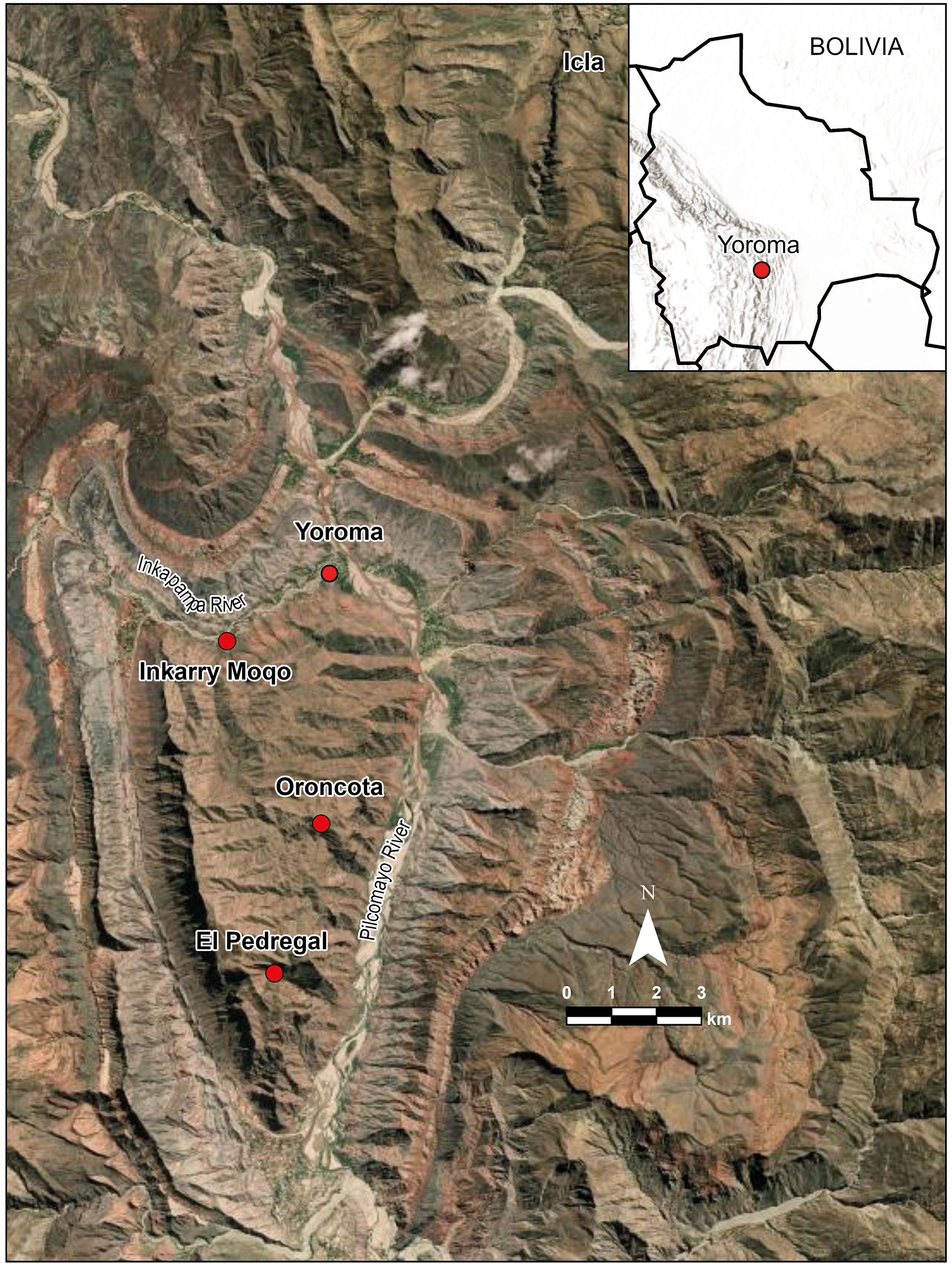
A regional-scale survey in the Oroncota Valley, conducted several years ago, revealed a long history of occupation. It was inhabited in the Early Yampara Period (ad 400–800), with most sites located on the fertile alluvial floor to facilitate farming (19 out of 24 sites). Later in the Yampara Classic Period (ad 800–1300) the population increased, but most settlements moved to the Pucara Platea, forming two clusters (75 out of 107 sites). These trends deepened in the Late Yampara Period (ad 1300–1536), after the Inka arrival. The population almost doubled, with many of the residences still located on the Pucara Plateau (146 out of 190 sites) (see further Alconini Reference Alconini2004; Reference Alconini2016b; Reference Alconini, Hayashida, Troncoso and Salazar2022). Alongside these changes, the Inka administrators established three facilities to ease control; the centre of Oroncota (also known as Inkarry) on the Pucara summit, El Pedregal outpost on a hidden crevice to facilitate surveillance and Inkarry Moqo on the northern lower alluvium with a few storage facilities (Alconini Reference Alconini2004; Reference Alconini2016b). The valley thrived during the Inka intervention. Whereas the valley became an important population magnet that included non-local Churumata and Chicha mitmaqkuna colonies, the adjacent northern Icla Valley saw a decrease in settlement (Alconini Reference Alconini and Alconini2016a; Janusek Reference Janusek and Alconini2008). One of the local settlements that benefited from the Inka arrival was Yoroma, on the lower alluvium on the northeastern corner of the Pucara, the focus of this article (Fig. 1).
Yoroma: a Yampara centre
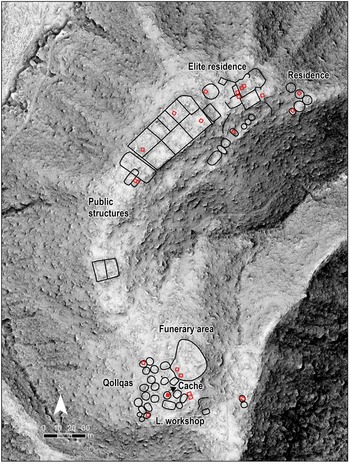
Yoroma was a Yampara settlement of the local elite, located on a small elevation at the intersection of the Pilcomayo and Inkapampa rivers (Fig. 2). This location granted it privileged access to fertile land and natural irrigation. Four kilometres west was the Inka facility of Inkarry Moqo. We excavated 22 units (2×2 m each) across different areas of Yoroma, and the results have been published elsewhere (Alconini Reference Alconini and Rivera Casanovas2008a; Reference Alconini, Malpass and Alconini2010) (Fig. 2).
The site of Yoroma during the Late Yampara Inka period (ad 1300–1536). The test units are in red squares (LiDAR map).
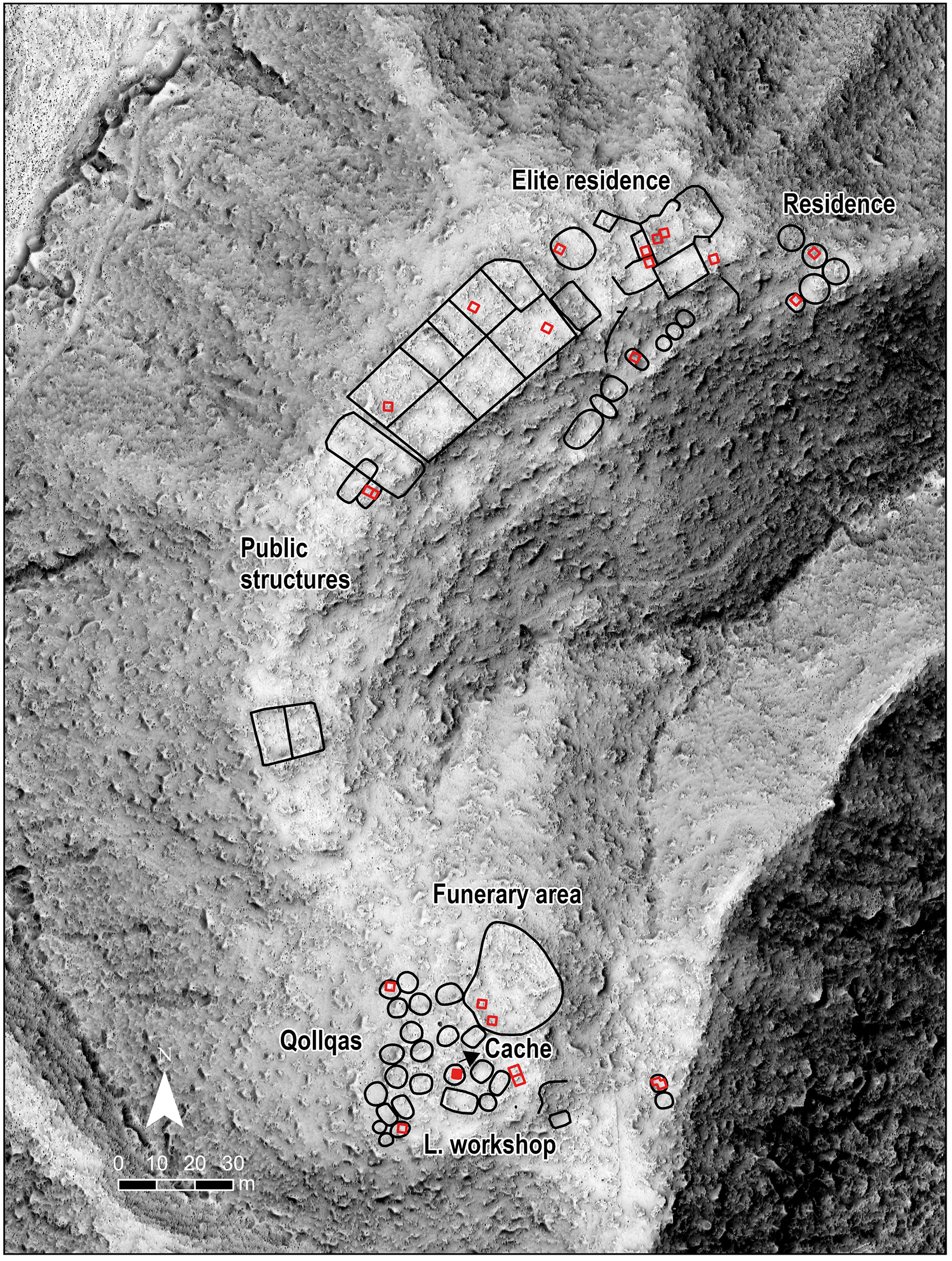
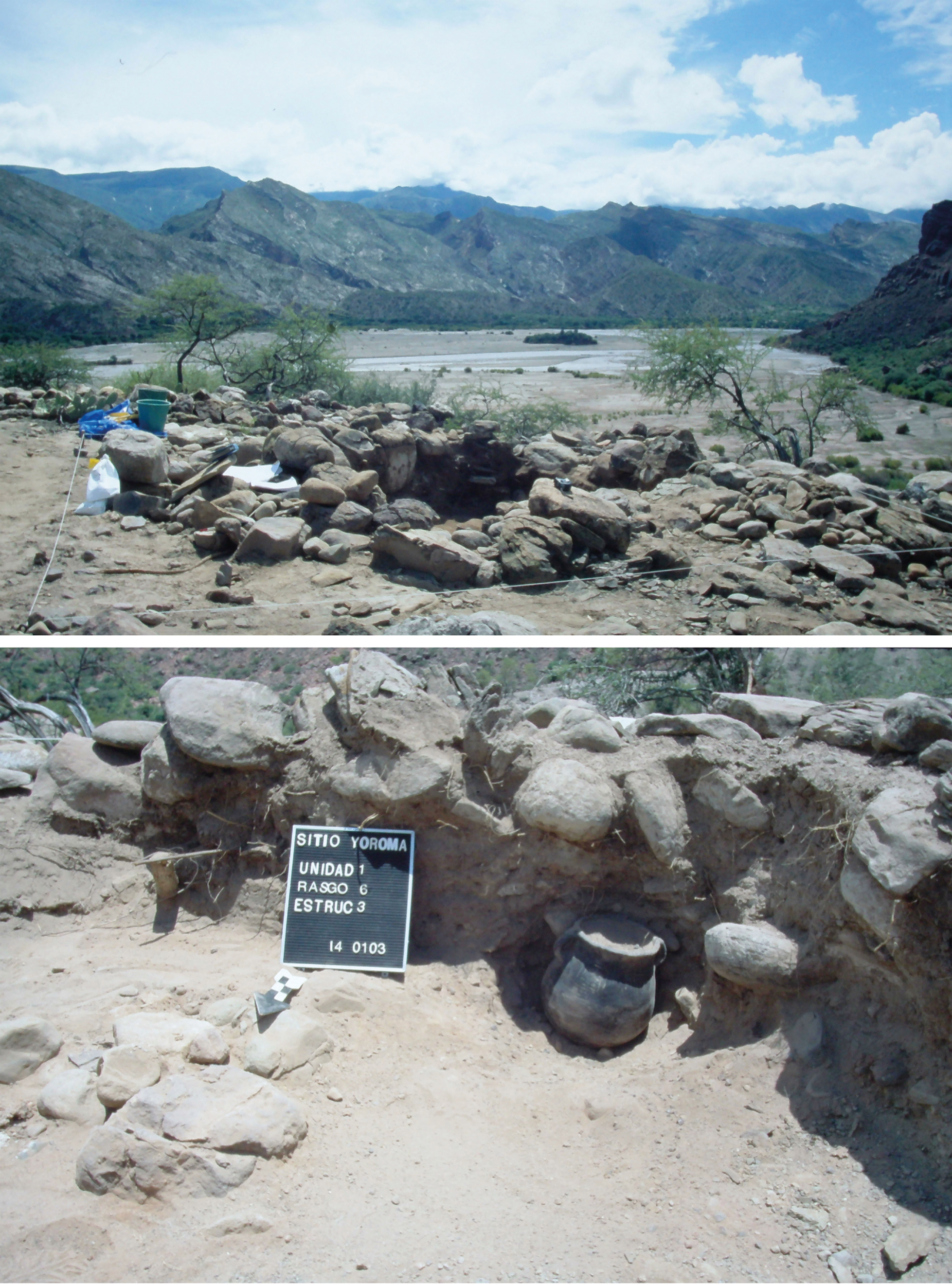
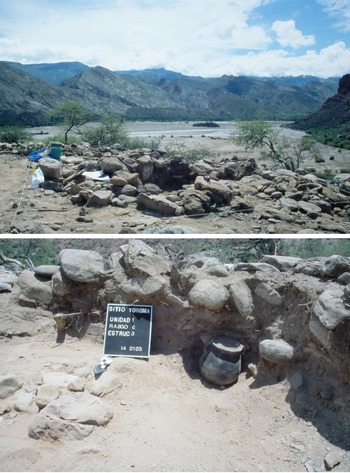
The centre has a long history of occupation that predates the Inkas, and precisely because of this, its residents received privileged treatment as imperial allies. During the Late Yampara-Inka period (ad 1300–1536), Yoroma expanded in size (15 ha), with three main residential spaces. In the first area on the lower northern ridge, a stone platform was erected to accommodate a residential complex (Fig. 2, ‘Residence’). With a set of circular rooms forming an L shape along the ridge, a patio opened inside. Each room was used differently (Alconini Reference Alconini and Rivera Casanovas2008a; Reference Alconini, Malpass and Alconini2010). For instance, St -35 was the kitchen, and on the floor were the remains of a cooking hearth, a grinding stone and two broken mortars for processing grains, lying alongside broken utilitarian pots (Fig. 3). By comparison, structure St-3 was a funerary chamber. After sealing the floor to cover an earlier occupation, the mourners dug a small pit and laid a gravel layer. Inside, they deposited a Yampara Presto Puno-style vessel containing the remains of a severely damaged infant, and then covered it with a flat stone (Fig. 3). The associated funerary paraphernalia comprised a grinding stone and a group of terrestrial Guácara shells (Megalobulimus oblongus) mixed with ash. Later, the mourners deposited another dedicatory cache on top: a second grinding stone and the remains of a collar with 77 finely elaborated white Guácara shell beads. The residents’ status is also revealed in the privileged access to the staples stored in the line of storage qollqa facilities distributed nearby.
Northern ridge residential compound. Above: circular construction (St-35); behind is the Pilcomayo River. Below: Funerary urn recovered in St-3 part of the same compound.
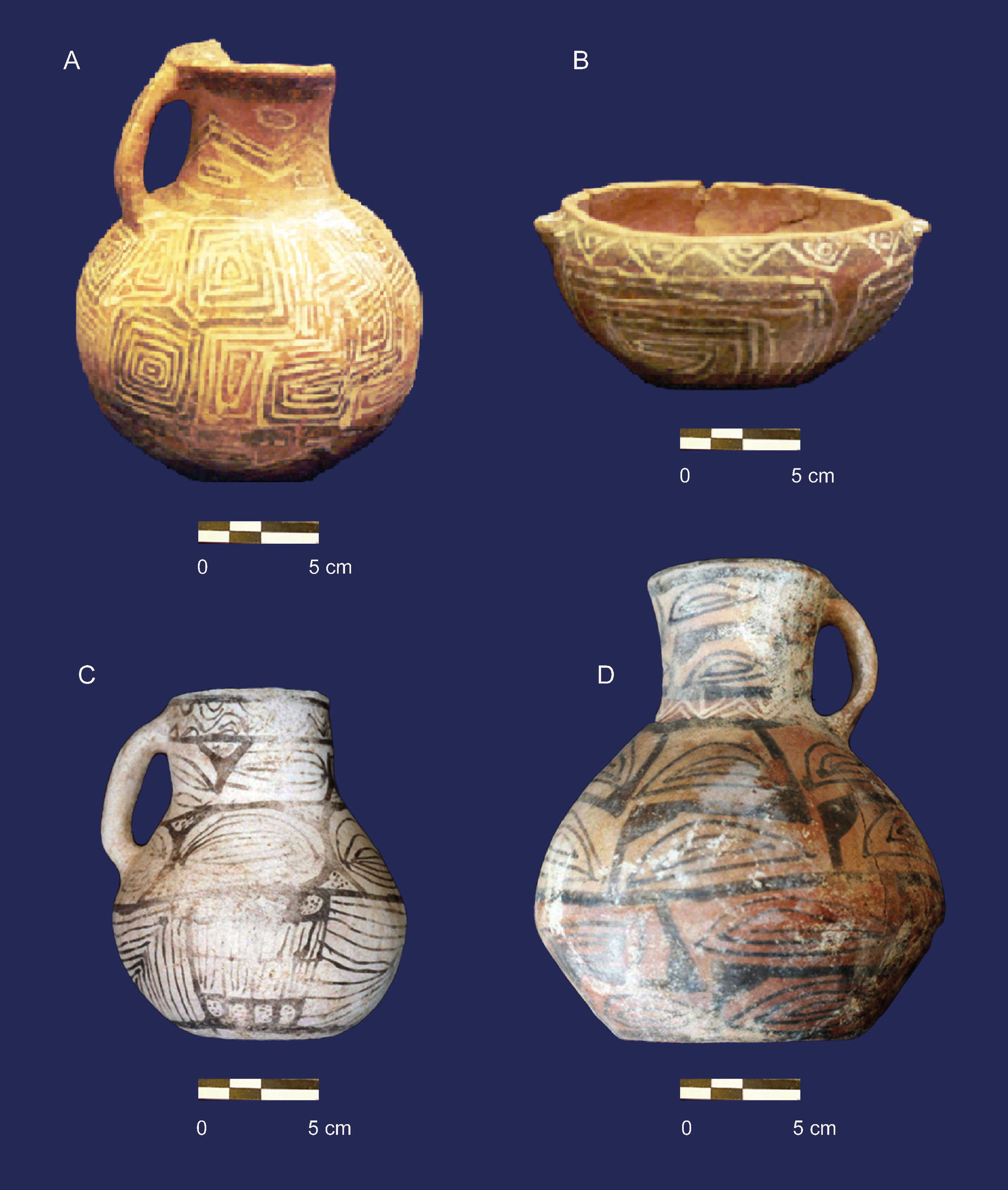
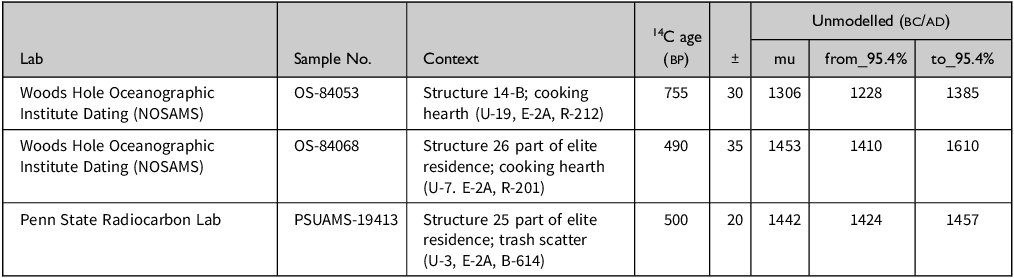
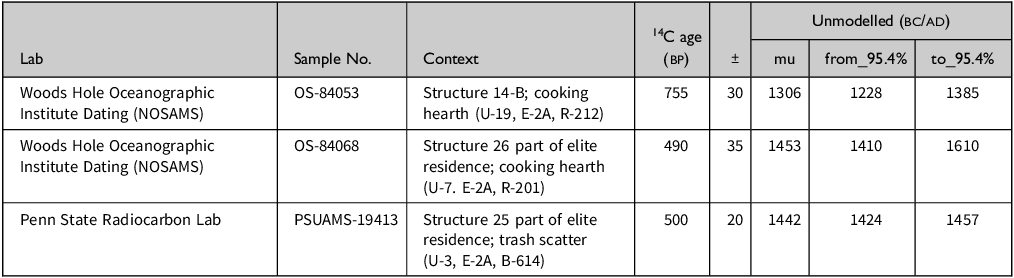
In the second area on the northern summit, the second patio residence was located (Fig. 2, ‘Elite Residence’). Before, in the earlier Classic Yampara period (ad 800–1300), feasting and lithic craft production took place in this open space, and its appropriation during the Inka occupation to erect a private residence signals the rise of a privileged elite segment. Part of the earlier midden was covered with a terraced platform, and oblong rooms were erected using fieldstones (Alconini Reference Alconini and Rivera Casanovas2008a; Reference Alconini, Malpass and Alconini2010). Excavations in two of the rooms (St-25 and St-26) located to the south revealed an informal floor, the discarding of utilitarian cooking and storage vessels, and decorated serving vessels in a variety of local Yampara styles (Classic Yampara, Oroncota White Ware). Residents also enjoyed access to imported variants, such as the Huruquilla, Yura and Huruquilla styles from the Qaraqara territory, in addition to Mojocoya polychrome vessels (Fig. 4). One of the rooms (St-26) also served as a kitchen: a cooking hearth formed by a collar of stones (R-201), lithic implements and utilitarian pottery were recovered. An AMS radiocarbon assay from the hearth revealed that meals were prepared between ad 1410 and 1610 (R-201, 2 sigma NOSAM lab, sample OS-84068) (Table 1). Nearby was the fragment of a copper tupu pin, used by elite women to fasten their shawls. Similarly, excavations in the other room (St-25) exposed the head of a modelled duck from an Inka-style ceramic plate and a trash scatter with charcoal and ash flakes (B-614) disposed around ad 1424–1457 (AMS radiocarbon assay B-614; 2 sigma, PSUAM lab, sample 19413) (Table 1). We also recovered in the fill of this room the remains of a small copper pyramidal bell 3 cm in diameter, used as a personal ornament.
Examples of (A) Yampara Presto Puno; (B) Yampara Classic; (C) Oroncota Whiteware copying Huruquilla decoration and surface finishing; (D) Yura ceramic styles.
Site of Yoroma. Radiocarbon dates for contexts associated with the Late Yampara–Inka Period (charcoal samples). The calibration was performed in Oxcal, using the southern hemisphere SHCal20 curve (two-sigma error, 95.4% confidence).
Outside on the oblong northern patio enclosure, large amounts of trash were discarded from commensal feasting events, including broken remains of decorated and utilitarian serving and storage vessels, quartz flakes and cores at various stages of reduction. The assemblage also included fish, terrestrial molluscs (Hydrobidae and Bulimidae) and camelid bone remains, animals likely consumed in these events (Capriles et al. Reference Capriles, Domic, Alconini and Alconini2008). Notably, camelids are not local, and access to such meat signals the residents’ privileged access.
It is likely that these remains were part of the hospitality celebrations sponsored by the elite as part of reciprocal relations with the valley residents, possibly in exchange for taxed mit’a labour. This might have involved the manufacture of lithic implements to secure their participation in the existing exchange networks. The residents also enjoyed limited, but privileged access to fine Inka pottery (Alconini Reference Alconini and Rivera Casanovas2008a; Reference Alconini, Malpass and Alconini2010).
In the central summit area, large rectangular facilities, erected from fieldstones and built side by side, likely served a public function (Fig. 2, ‘Public Structures’). They had dispersed grinding stones on the surface. To understand their nature, we excavated five test pits in these facilities (Structures 29, 30, 15, and 16B), which revealed a single, light occupation with scattered sherds and quartz flakes (Alconini Reference Alconini and Rivera Casanovas2008a; Reference Alconini, Malpass and Alconini2010) (Fig. 2). In a small enclosure attached to the south (St-16B), perhaps a kitchen, we recovered a cooking hearth surrounded by a stone collar. We also recovered another small pyramidal copper bell from the humus fill (3 cm diameter). Possibly, these large constructions served to compartmentalize grain-processing tasks done simultaneously by different parties.
In the third southern area, a cluster of qollqa storage facilities was erected over an earlier generalized occupational level (Fig. 2, ‘Qollqas’). The foundations were built with fieldstones (approximately 3 m in diameter). Given their proximity, many were used for storage, while others had specialized uses. At the centre of this group of qollqas was Structure 50 (St-50, Unit 14), where a ritual cache was deposited (Fig. 2, ‘Cache’) (Alconini Reference Alconini and Rivera Casanovas2008a; Reference Alconini, Malpass and Alconini2010). After the construction and use, refuse accumulated inside, including a few broken Yampara, utilitarian and Huruquilla sherds (R-207) and a small ash pit (R-206). There was also a discarded grinding stone with its mortar. At some point, the inhabitants refurbished the qollqa floor with a clayish soil layer, and on top, they deposited the ritual bundle (R-205, E-2a). Qollqa floors were regularly renewed to aid in crop preservation (Morris Reference Morris, Murra, Wachtel and Revel1986).
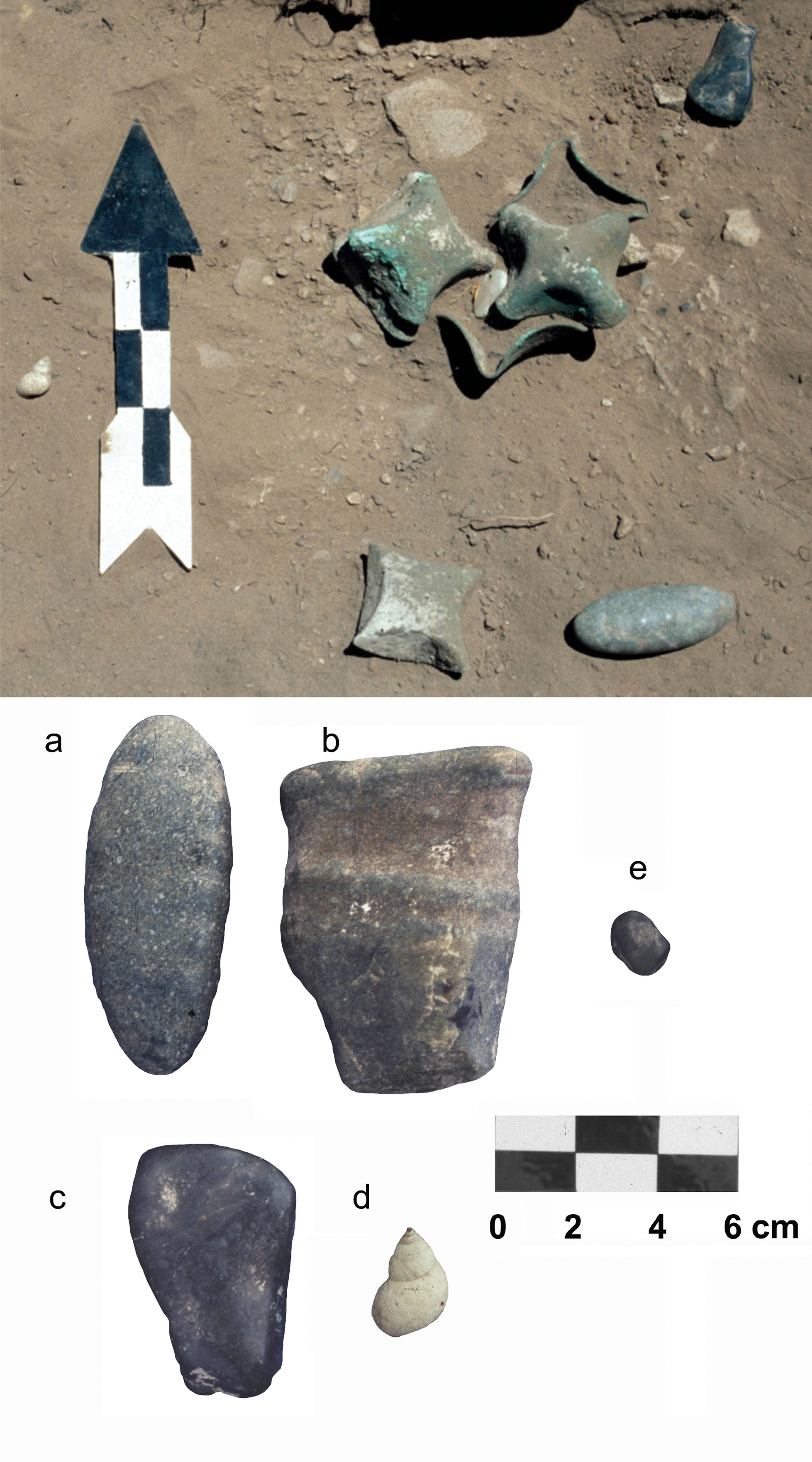
Considering their symbolic importance, the residents carefully assembled the elements in the ritual bundle. At the centre was a group of six large, folded copper pyramidal bells. They were flanked to the southeast by a polished, conopa maize ear sculpted in granitic stone (10 cm long), and to the northeast by a small basalt polisher (Fig. 5). Conopas were stone fertility effigies, amulets and household protectors, carved in the form of animals and crops. In comparison, our collaborators recognized the polished basalt during excavations as a raya rumi (a healing lighting stone). To the west was a complete terrestrial Guácara snail (Megalobulimus oblongus), whereas to the southwest was a stone axe with a central depression. At the bottom of the offering were additional terrestrial snail shell fragments mixed with sherds and ash, likely the remnants of burnt organic materials.
Top: The ritual offering R-205 deposited in a qollqa storage structure (St-50). Below: (a) carved conopa maize ear; (b) stone axe; (c) basalt polisher; (d) Guácara terrestrial shell (Megalobulimus oblongus); (e) undefined.
We also excavated two additional qollqas nearby (Fig. 2). The first was St-41 (U-13) to the north with a light cultural matrix and a handful of sherds and flakes (Alconini Reference Alconini and Rivera Casanovas2008a; Reference Alconini, Malpass and Alconini2010). In contrast, St-14-B to the southeast served as an oven or kitchen area, as indicated by a decayed floor and the concentration of charcoal and carbonized kernels. An AMS radiocarbon date revealed that food was prepared between ad 1228 and 1385 (R-212; 2 sigma, NOSAM lab, sample OS-84053) (Table 1). Considering the relatively early date, and as in other areas of Collasuyo, it is feasibly an early Inka occupation at the site (Marsh et al. Reference Marsh, Kidd, Ogburn and Durán2017). To the north of the qollqas was a large circular enclosure (Fig. 2, ‘Funerary Area’), with funerary urns containing the secondary remains of multiple individuals deposited in earlier periods. On the southern outskirts was a lithic workshop with a vast number of discarded white quartz cores and flakes at various stages of reduction (Alconini Reference Alconini and Rivera Casanovas2008a; Reference Alconini, Malpass and Alconini2010) (Fig. 2, ‘L. workshop’).
Notably, circular qollqa storage warehouses were a hallmark of Inka administration. Their presence in a local Yampara settlement reveals that the residents administered resources on behalf of the state. As valued imperial allies, they also expanded existing lithic production to meet the local and state needs. These elite segments also maintained their privileged access to imported goods, such as the Huruquilla and Yura vessels and a variety of copper implements (Alconini Reference Alconini, Malpass and Alconini2010; Reference Alconini, Hayashida, Troncoso and Salazar2022). Afterwards, Yoroma was abandoned during the Colonial era due to relocation policies aimed at facilitating Christianization and control.
Folded pyramidal musical bells
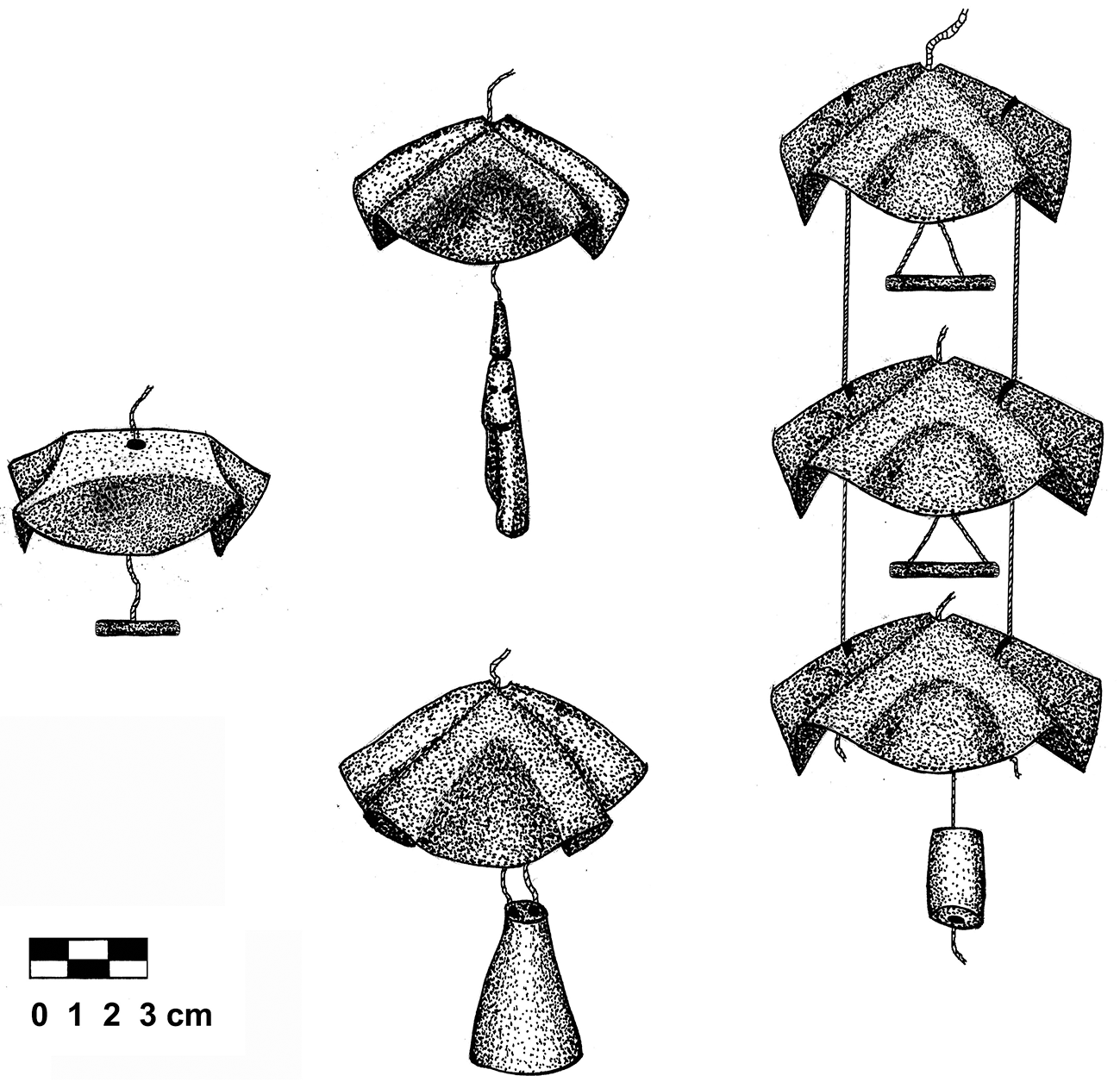
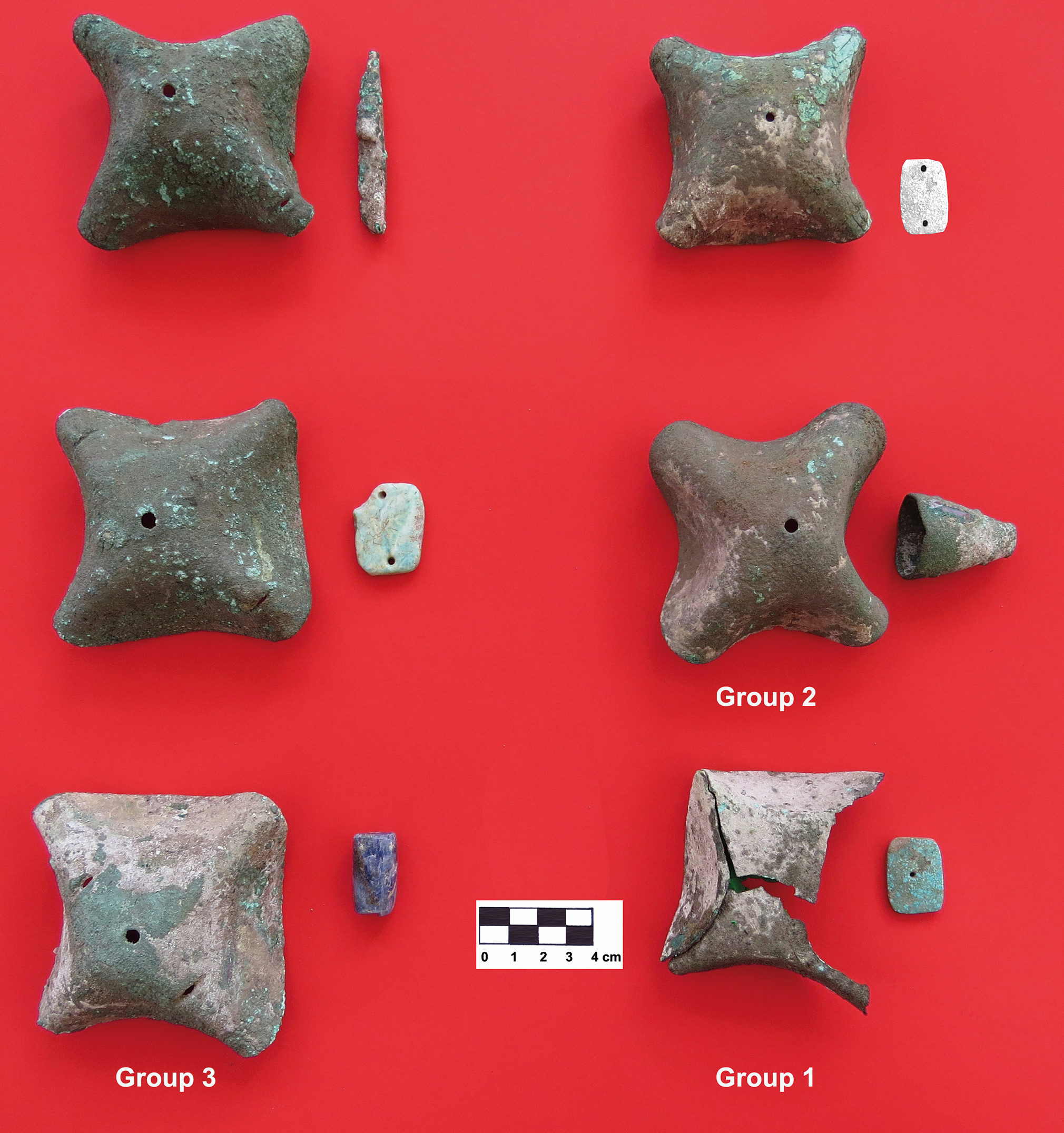
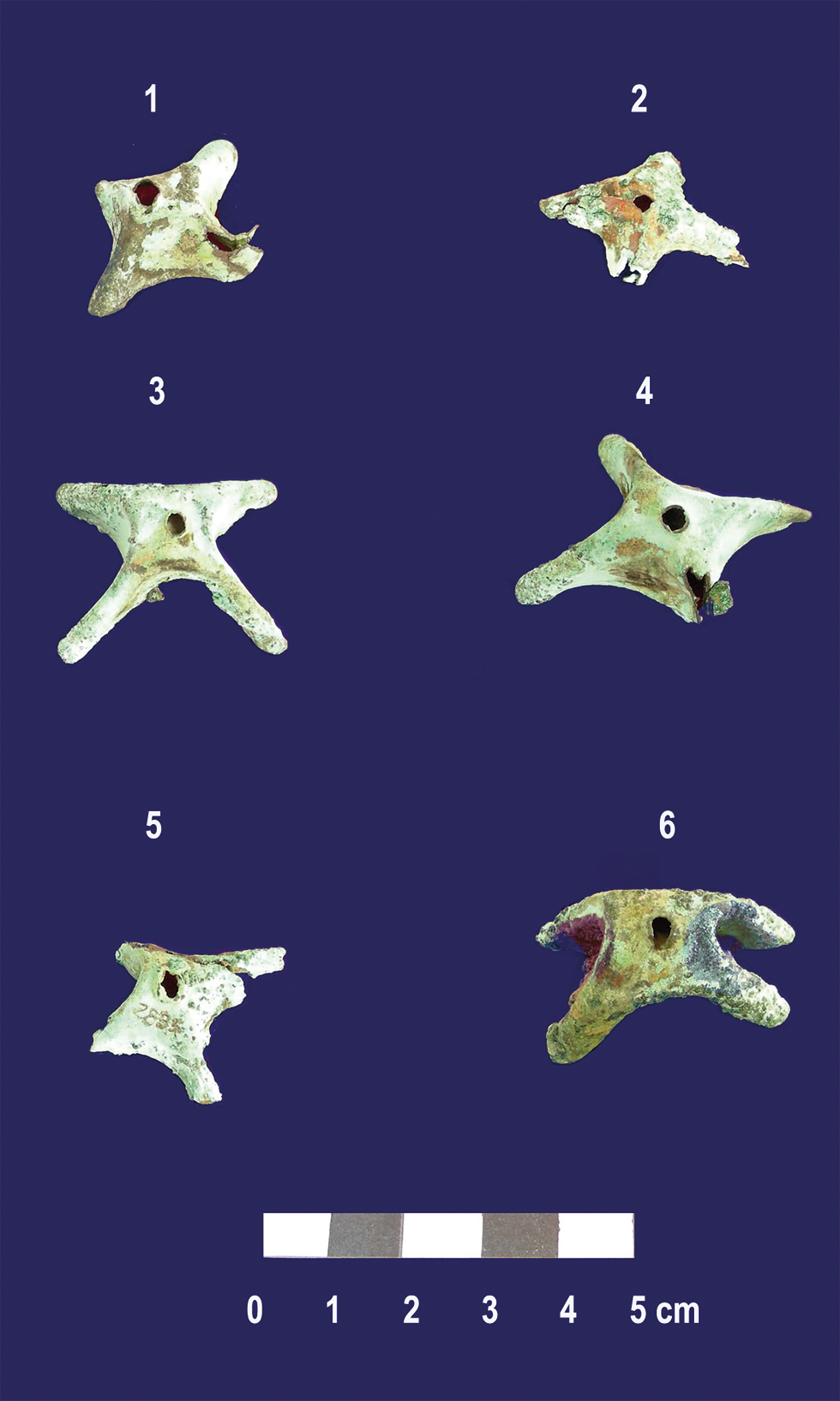
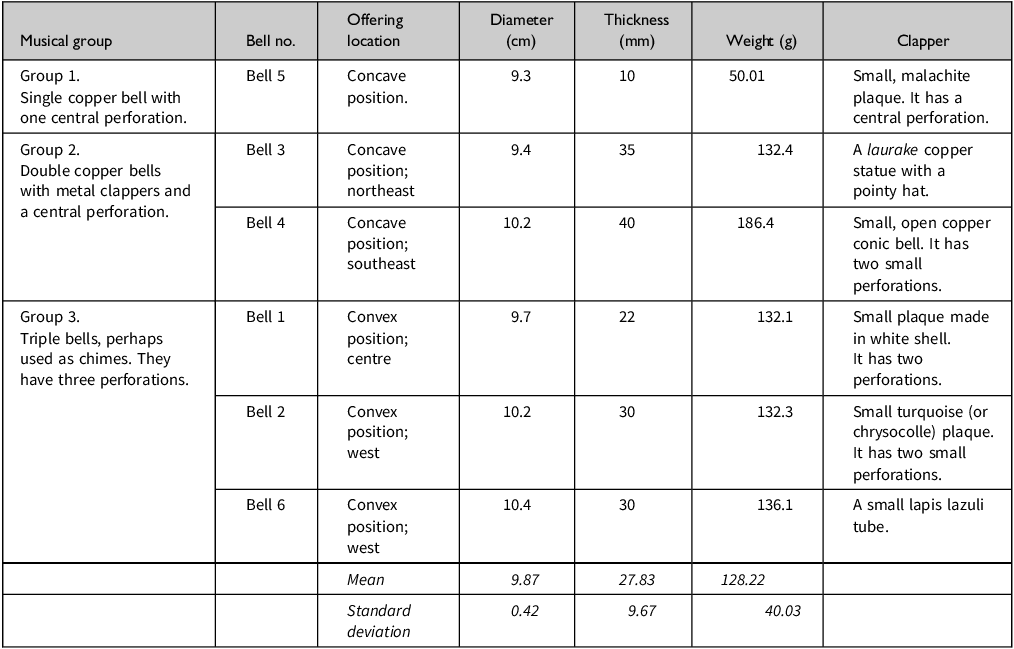
We argue that the copper bells recovered from the storage facility (St-50) were triadic idiophonic musical instruments used in rituals involving a good harvest, fertility and abundance. Each bell had its own clapper, whether made of copper, stone, or shell. When shaken together, they produced clashing metallic sounds (Fig. 6). They were also similarly shaped. A quadrangular or circular copper sheet was first moulded or hammered into four-cornered pyramidal stars and then an orifice was drilled on the tip. Cords, possibly from leather or camelid wool, passed through the orifice to fasten the clappers. Despite their similar shape, there were slight variations in size, thickness and weight, suggesting different craftsmanship (9.3–10.4 cm long, 10–40 mm thick, and 50–186 g; Table 2).
The reconstruction shows the possible use of copper bells as musical instruments (R-205).
Bells recovered in the ritual offering (R-205, Yoroma). The table lists their main morphological attributes, size and location.
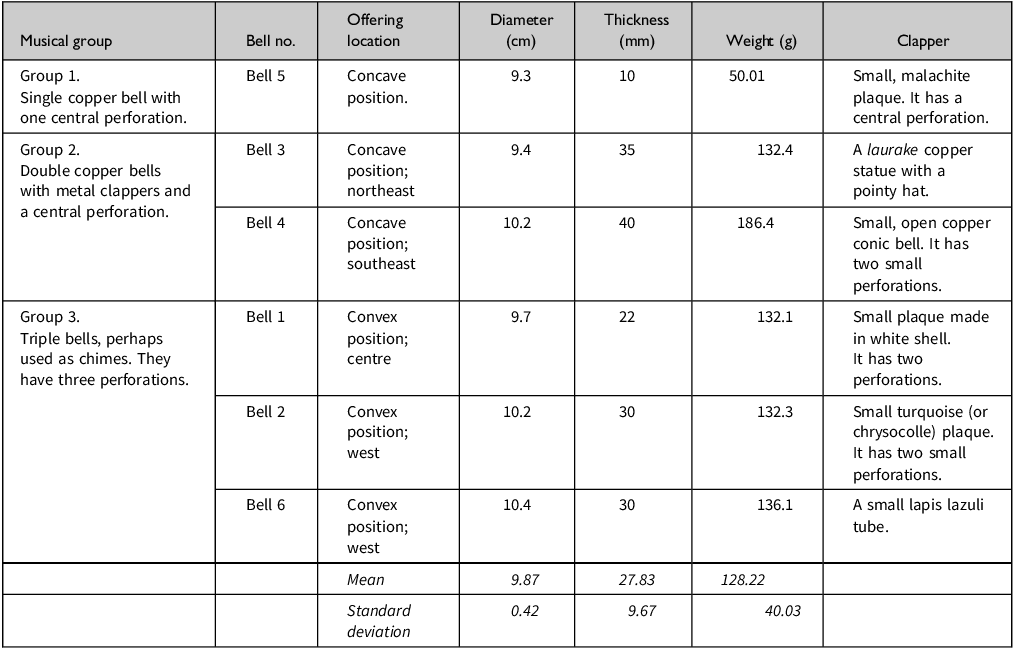
As a triadic musical instrument, the bells were organized into three sets, each producing different acoustics. In the first set was a single, thin, lightweight quadrangular copper bell with defined corners (Ca-5; 10 mm and 9.3 g). Inside, we recovered the ringer, a fine, rectangular green piece of malachite or chrysocolla that might have produced soft but sonorous sounds (Table 2 and Figs 7 & 8). In the second group were two bells stacked together (Ca-3 and Ca-4), and with copper ringers that likely produced bright, crisp sounds. They were deposited in convex positions in the cache. Whereas one clapper (bell Ca-3) was a small copper laurake statuette with protruding, elongated eyes and a small, pointed hat, the other ringer (bell Ca-4) was a small, open, conical copper bell with two tiny openings (Table 2 and Figs 7 & 8).
The copper bells. The column to the left shows the bells and clappers from Group 3 (above: bell 1; centre: bell 2; below: bell 6). At the top of the right column is Group 2 (above: bell 3; centre: bell 4), and at the bottom is Group 1 (bell 5, now fragmented).
Ritual offering R-205. The drawing shows the three groups of folded pyramidal bells and their clappers. The graphic also shows each bell’s front, side and profile.
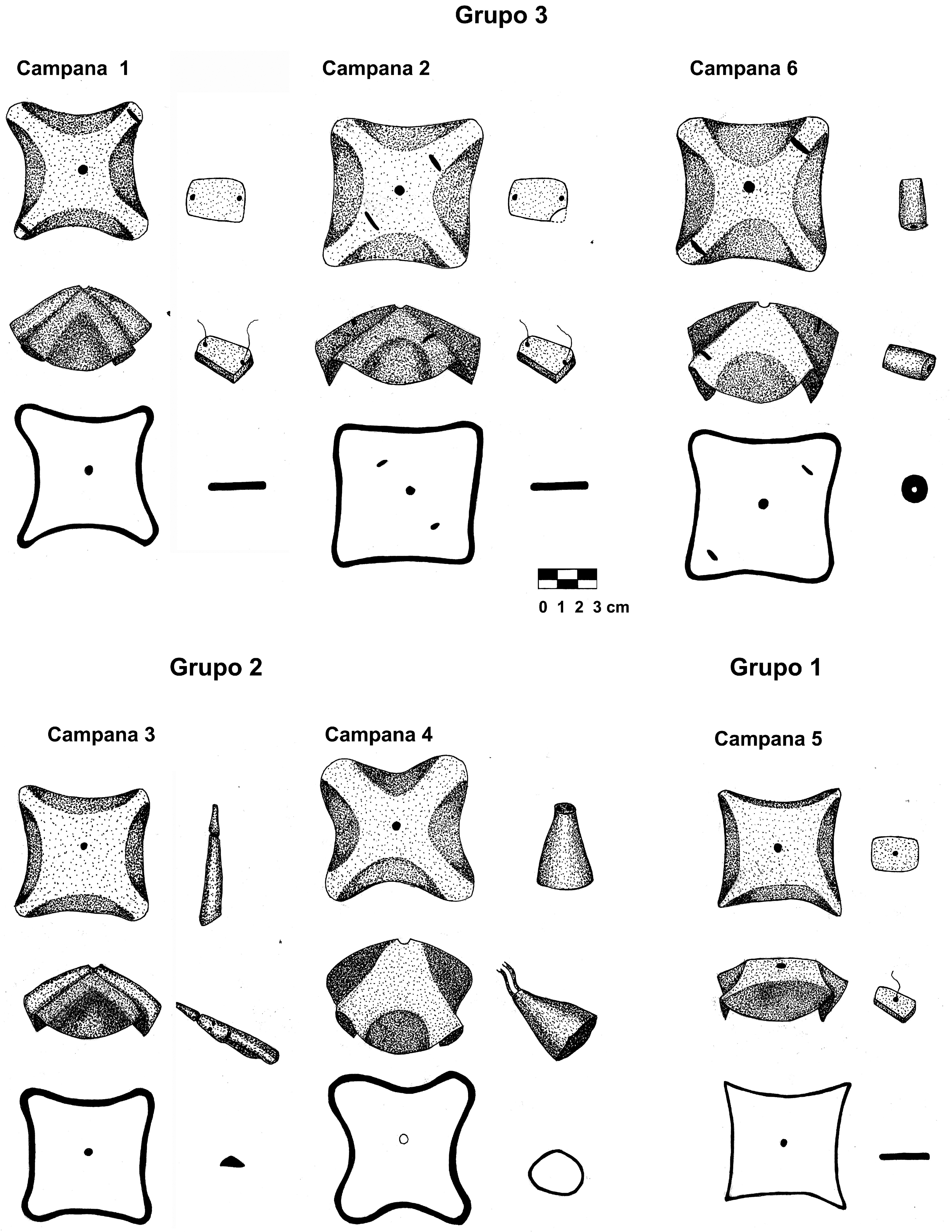
The third group comprised three folded pyramidal bells, assembled into a chime (Table 2; Figs 7 & 8). Whereas two bells were placed in concave positions as containers (C-2 and C-6), the third sat on top as a lid (C-1 bell). Each bell had three perforations for the cords, arranged diagonally: two on the opposing ends, and the third at the centre. If strung together, they formed a chime of three bells (Fig. 6). All had stone clappers, likely producing a range of clashing sounds. One was a fine green button made from malachite or chrysocolla (C-2 bell); the second was a small tube in blue sodalite (C-6 bell); and the third was a small white shell plaque with two tiny holes (C-1 bell). Together, these three sets of folded pyramidal bells produced a rich array of metallic, cascading sounds, some high-pitched, others softer. As with dormant pinkillo flutes awakened during the harvest season with chicha maize beer (Martínez Reference Martínez and Arnaud2010), the copper bells may have been temporarily stored at the qollqa for future rituals.
Research conducted by Gonzáles and Cabanillas (Reference Gonzáles and Cabanillas2005) reveals that these folded pyramidal bells were often produced by first smelting copper and shaping circular or slightly square copper metal plates at 1000–1100°C. Later, each piece was annealed at 600–700°C temperatures, and then folded into four parts using percussion and compression techniques (Gonzáles & Cabanillas Reference Gonzáles and Cabanillas2005). If deep enough, these four-cornered stars acquired a pyramidal form. Other bells, particularly the largest, were directly cast in moulds. Once finished, a hole on the bell’s tip was perforated with an awl (or a sharpened pressure tool), and the clapper was attached with a leather or camelid fibre string. For instance, a folded pyramidal bell recovered in 1901 by Earland Nordenskiöld in Casabindo, northwestern Argentina, had a decayed leather string (Becerra Reference Becerra2021, 201). Depending on the degree of bending and pressure, some bells were four-cornered stars with marked angles, others were more pyramidal, and yet others had wavy edges. In Yoroma, most musical copper instruments were moulded, given their large size and thickness, whereas the smaller folded pyramidal bells used for personal adornment were likely hammered.
Spatial distribution
Although copper was a favorite metal for manufacturing folded pyramidal bells, others were made from other metals (Gonzáles & Cabanillas Reference Gonzáles and Cabanillas2005; Gudemos Reference Gudemos1998a,b). They also varied in size, with a wide spatial distribution (1–10.4 cm long, 0.5–4 mm thick, and up to 210 g) (Fig. 9; Tables 2 & 3). Small pyramidal bells appeared in the Middle Horizon (ad 600–1100), if not earlier, with the rise of Andean metallurgy. For instance, a small folded pyramidal copper-tin alloy bell was recovered in Lak’araña, the ancient city of Tiwanaku (Lechtman Reference Lechtman and Young1973; Reference Lechtman and Kolata2003), whereas a similarly shaped gold bell is stored at the Museo del Oro in La Paz, Bolivia. It may originate from the San Sebastian Tiwanaku elite burial in Cochabamba. In the Peruvian Pacific coast, small folded pyramidal bells were also crafted in gold and silver as personal adornments (Lechtman Reference Lechtman and Young1973; Reference Lechtman and Kolata2003).
Map showing the distribution of metallic folded pyramidal bells and the different alloys utilized. To the left is the natural habitat of the Guácara terrestrial snails (Megalobulimus oblongus) in humid and temperate environments.
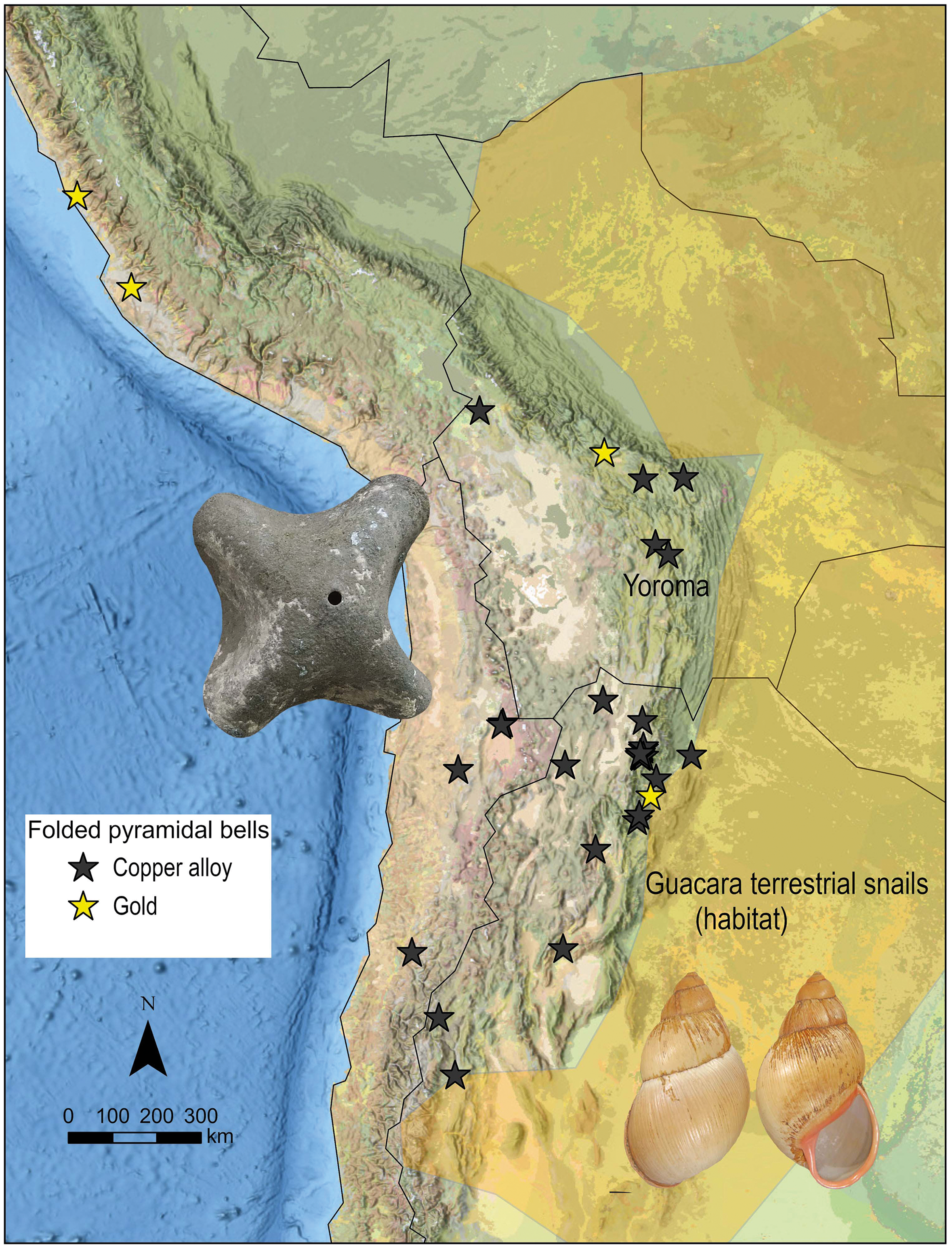
Figure 9 Long description
A map showing the distribution of metallic folded pyramidal bells and the natural habitat of Guacara terrestrial snails in the ancient Andes. The map highlights the geographic region along the western coast of South America, including parts of modern-day Ecuador, Peru, and Chile. Key labeled locations include Yoroma and the habitat of Guacara terrestrial snails. The map uses stars to mark the locations of folded pyramidal bells, with black stars indicating copper alloy bells and yellow stars indicating gold bells. The natural habitat of Guacara terrestrial snails is outlined and shaded in a distinct color to indicate their presence in humid and temperate environments. The map also includes an inset image of Guacara terrestrial snails and an example of a folded pyramidal bell.
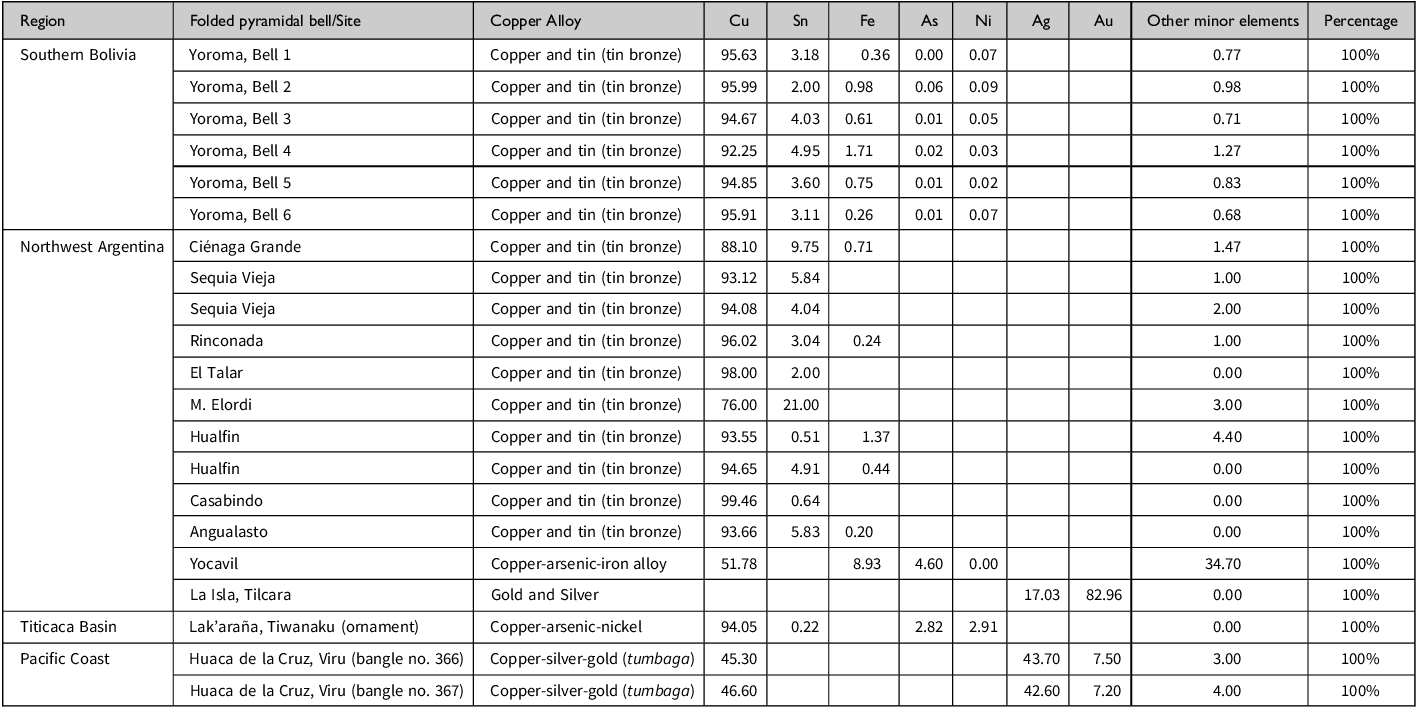
Distribution of folded pyramidal copper bells in the Andes. Estimates are in percentages (Alconini Reference Alconini and Alconini2008b; Boman Reference Boman1908; Gonzáles Reference Gonzáles and Benson1979; Gonzáles & Cabanillas Reference Gonzáles and Cabanillas2005; Lechtman Reference Lechtman and Young1973; Reference Lechtman and Kolata2003; Tarragó et al. Reference Tarragó, Gonzáles, Avalos and Lamami2010; von Rosen Reference von Rosen1904). Observe the limited concentration of Nickel and Arsenic in Yoroma’s copper bells (it is unclear if they were utilized as alloys or were natural trace elements).
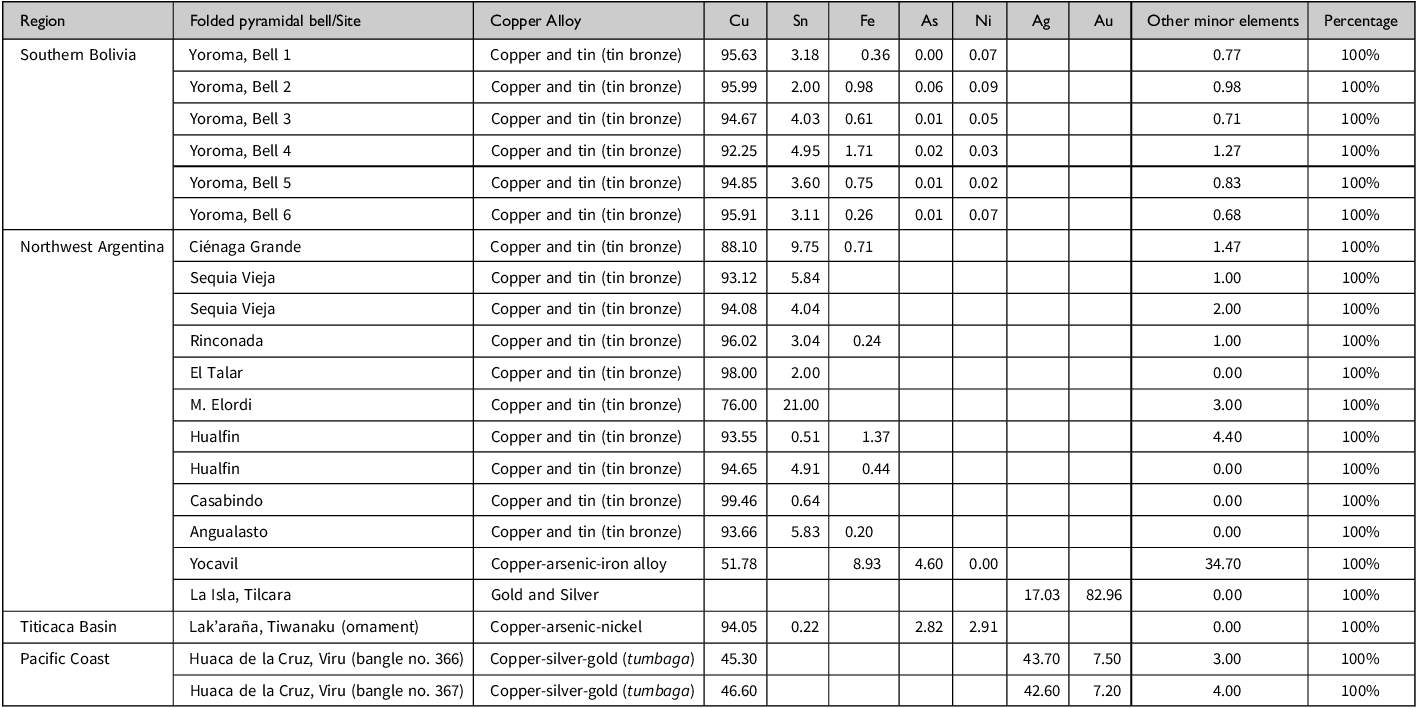
These pyramidal bells gained popularity in the southern Andes as part of a rich metallurgical tradition (Gonzáles & Cabanillas Reference Gonzáles and Cabanillas2005; Lechtman Reference Lechtman and Young1973; Reference Lechtman and Kolata2003; Pérez de Arce Reference Pérez de Arce2001; Tarragó et al. Reference Tarragó, Gonzáles, Avalos and Lamami2010). Copper-tin alloy bells are documented in the Late Formative period in northwestern Argentina, such as in the sites of Condorhuasi and Ciénaga (200 bc–ad 500). Later until the Inka period, their manufacture expanded in northwestern Argentina, Tarija, northern Chile and the Atacama Desert. To enhance their durability and shine, these copper bells contained mixtures of tin, arsenic and nickel as alloys (Gonzáles Reference Gonzáles and Benson1979; Gudemos Reference Gudemos1998a,b; Tarragó et al. Reference Tarragó, Gonzáles, Avalos and Lamami2010; Ventura & Scambato Reference Ventura and Scambato2013) (Fig. 9). Given that these regions were rich in copper and tin ores, they were likely produced as valued exchange items (Becerra Reference Becerra2021; Earle Reference Earle1994; Maldonado et al. Reference Maldonado, Rehren, Pernicka, Núñez and Leibbrandt2013; Taboada et al. Reference Taboada, López Campeny and Angiorama2018). For instance, in the Inka-influenced site of Tolomosa, Tarija, Eric von Rosen’s excavations in the 1900s uncovered evidence of metallurgy, including copper slags, metal chisels, rings, bracelets, and bells, alongside several spindle whorls (Ventura & Scambato Reference Ventura and Scambato2013; von Rosen Reference von Rosen1904). Similarly, six copper-folded pyramidal bells were recovered in Escana, Chuquisaca, near Tarabuco and Yoroma (40 km distant). Considering their small size, they might have served as personal adornments (Fig. 10). The entire area was part of the Yampara territory, revealing that privileged Yampara elite segments enjoyed access to these goods through exchange.
Other folded pyramidal copper from Escana, Chuquisaca (Bolivia). The area is near the Valley of Oroncota, revealing the importance of this technology in the region. The pieces are housed at the Museo Universitario, Universidad San Francisco Xavier de Chuquisaca.
To understand the composition of the bells at Yoroma, we conducted chemical analysis using a Bruker portable XRF unit. The analysis showed that the samples contained predominantly copper (92–96%), tin (2–5%), and, in minor proportions, arsenic, nickel and iron (Table 2). This reveals that experienced metallurgists used these alloys to enhance their durability, strength and shine. They were likely produced somewhere in the southern regions of Tarija, northwestern Argentina, or northern Chile.
Metallic sacred sounds
The copper bells from the cache at Yoroma were triadic musical instruments, but pyramidal copper bells had broader uses, given their metallic acoustics. They could be shaken against the clapper, others were percussed on their external surfaces with solid instruments, whereas others were shaken in groups to produce louder, clashing sounds (Gudemos Reference Gudemos1998a,b; Reference Gudemos2013). When played as part of a larger ensemble, they created a rich metallic ‘sea of sounds’ (Pérez de Arce Reference Pérez de Arce, Hickmann and Eichmann2004, 281).
Similarly, the small, folded pyramidal copper bells recovered at the elite residence and the Public Structures area at Yoroma served as personal ornaments, whether used in private or public settings. As in northwestern Argentina, they were likely attached to the belts, clothing, or hair of prominent individuals (Ambrosetti Reference Ambrosetti1904; Debenedetti Reference Debenedetti1910; Gudemos Reference Gudemos1998a,b). When in motion, these individuals, men and women, produced clashing, jingling metallic sounds.
In the southern Andes, smaller versions of these pyramidal copper bells were also used as ritual paraphernalia. They were tied together as necklaces for the deceased or used to secure the mummy bundles’ textiles (Gudemos Reference Gudemos1998b; Reference Gudemos2013). Other bells had multiple clappers to enhance their metallic pitch. Although the small, folded pyramidal copper bells in Yoroma were not recovered in mortuary contexts, we cannot rule out that they served as mortuary paraphernalia. In fact, precisely because they marked status, some elite individuals were likely buried with them. The shimmer and clacking metallic sounds might have signalled their association with the metallic underworld in the afterlife.
To sum up, the sounds produced by the variety of folded pyramidal bells in Yoroma, whether as musical instruments or personal adornments, echo the use of bells, metallic spurs and similar adornments by descendant Jalq’a and Tarabuco communities. They symbolize the metallic underworld and the reproduction of life in the harvest season. Tata Pujllay, an early divinity returning from the underworld during Carnival after the harvest, is also accompanied by shiny bells and their metallic sounds (Martínez Reference Martínez and Arnaud2010). In the Andes, metals were, and still are, conceived as the flesh and veins of the mountains and the underworld, protected by walchi and supay guardians (Bouysse-Cassagne Reference Bouysse-Cassagne2004; Gose Reference Gose1986; Nash Reference Nash1979).
These folded pyramidal bells were not alone in the Andes. They were part of a larger repertoire of idiophonic metallic bells (Gonzáles & Cabanillas Reference Gonzáles and Cabanillas2005; Gudemos Reference Gudemos1998a,b; Lechtman Reference Lechtman and Young1973; Reference Lechtman1976; Reference Lechtman1984; Tarragó et al. Reference Tarragó, Gonzáles, Avalos and Lamami2010). There were conical and slightly conical bells of different sizes and shapes, whereas larger Santamariana bells in northwestern Argentina had finely engraved decorations (Pérez de Arce Reference Pérez de Arce2001). Other bells were made of wood, producing gentle, low-frequency tones. For instance, altiplano pastoral communities still tie large wooden and ceramic bells (cencerros) to the necks of leading llamas to guide the rest of the pack in their arduous journeys (Ambrosetti Reference Ambrosetti1904; Dransart Reference Dransart2002; Siveroni Reference Siveroni2017; Stobart Reference Stobart2006).
Guácara (Megalobulimus oblongus) terrestrial shells
The use of terrestrial Guácara shells in Yoroma, whether complete, fragmented, or worked into fine beads, was also part of a larger tradition in the southern Andes. Shells, whether marine, freshwater, or terrestrial, were considered delicacies reserved for the divinities and were often crushed or ground into powder for various rituals. They became embodiments of the ocean, rivers, springs and bountiful rain in these celebrations (Cobo [1582–87] Reference Cobo1993; Murra Reference Murra and Murra1975; Paulsen Reference Paulsen1974). They were also worked as beads in circular and tubular forms to make bracelets and collars as status and beauty markers (de Avila [1598] Reference de Avila1966; Murra Reference Murra and Murra1975; Nordenskiöld Reference Nordenskiöld2001; Rostworowski de Diez Canseco Reference Rostworowski de Diez Canseco1989). Other shells were utilized to manufacture hooks and other fishing tools on the southern Pacific coast, whereas different molluscs were consumed and discarded in large shell mounds (Alcalde et al. Reference Alcalde, Covarrubias and Flores2024; Hernández et al. Reference Hernández, Monroy and Flores2020). Many were part of thriving exchange networks, as occured with the valued pink-orange shell (Spondylus princeps) from the warm northern waters of Ecuador (Murra Reference Murra and Murra1975; Rostworowski de Diez Canseco Reference Rostworowski de Diez Canseco1989; Sandweiss Reference Sandweiss1992).
Guácara terrestrial shells (Megalobulimus oblongus) originated in the humid tropical forest. These molluscs had large shells with white to creamy colouration and up to six spirals. Adult individuals also developed beautiful, bright pink tones on their shells. Geographically, the natural habitat of these molluscs spreads over the southeastern humid tropical Yunga mountains of Bolivia, the Chaco, the Tucuman-Bolivian forest in Argentina and the savannas of Brazil, Uruguay and Paraguay (Abbott Reference Abbott1989; Horta Tricallotis et al. Reference Horta Tricallotis, Gordillo and Yáñez2022; Tellez Reference Tellez1997) (Fig. 9). These Guácara shells were also valued in rituals, since they were associated with cycles of rain and humidity. These molluscs hibernate in the cold winters, waking up in the warm, rainy season (Horta Tricallotis et al. Reference Horta Tricallotis, Gordillo and Yáñez2022).
As a result, Gúacara shells were widely used in the southern Andes. In Yoroma, part of the Yampara territory, complete Guácara shells were recovered in the ritual cache (R-205) with the copper musical instruments. They were also used as mortuary paraphernalia, whether complete, fragmented, or made into a collar of fine beads (St-3). Although on a limited scale, they were also worked into beads, considering that shell fragments were recovered in the site’s workshop areas. As revealed by a local collaborator during excavations, Guácara shells are abundant in the nearby Muyurina hill, suggesting that a portion was locally sourced. Others might have been acquired through exchange.
Guácara (Megalobulimus oblongus) shells are also reported in the neighbouring regions, the mollusc’s natural habitat. In the Archaic and Formative cemetery at Inkahuasi in the Bolivian Chaco, complete shells were recovered from several funerary urns (Méncias Bedoya Reference Méncias Bedoya and Alconini2019), as were complete shells at Loma Mendoza in the Moxos Amazonian lowlands (Mannert Reference Mannert and Prümers2015). At the site of Yánimas 1 (ad 750–1200) in the southeastern tropical Tucumán Yungas, Gúacara shell beads were used alongside ceramic pipes bearing traces of cebil and tobacco (Martín Silva et al. Reference Martín Silva, Miguez and Korstanje2016).
Given their ritual and economic importance, Guácara shells have circulated in far-reaching inter-ecological exchange networks since antiquity. These terrestrial shells were recovered at the preceramic city of Caral on the northern Pacific coast (3000–1800 bc) (Shady Reference Shady2017) and in the Formative ceremonial centre of Tulán 54 (500 bc–ad 500) in the southern Atacama Desert (Horta Tricallotis et al. Reference Horta Tricallotis, Gordillo and Yáñez2022; Núñez et al. Reference Núñez, Cartajena and Carrasco2017; Tellez Reference Tellez1997). They were also used as mortuary paraphernalia in Middle Horizon, Tiwanaku-influenced cemeteries such as Sequitor, Coyo and Solcor in the San Pedro de Atacama oasis, Chile (Costa & Llagostera Reference Costa and Llagostera1994; Le Paige Reference Le Paige1957–58; Llagostera Reference Llagostera2004; Llagostera et al. Reference Llagostera, Torres and Costa1988).
Guácara shells also served as containers for storing precious pigments and substances used in shamanic practices. As revealed by chemical analysis, some had remains of ochre and yellow iron oxide mineral pigments, but others held psychoactive substances extracted from Vilca plants (Anadenanthera colubrina, cebil) (Horta Tricallotis et al. Reference Horta Tricallotis, Gordillo and Yáñez2022; Martín Silva et al. Reference Martín Silva, Miguez and Korstanje2016; Tellez Reference Tellez1997). Since these plants originated from similar tropical environments, they were possibly assembled together for transport, or they were part of similar trading routes. Llama caravans, supplemented by riverine routes, might have facilitated their distribution, alongside other valuables such as metal ornaments, stone tools, amulets and ceramics (Nielsen Reference Nielsen, Hirth and Pillsbury2013; Núñez Reference Núñez, Aldunate del Solar, Berenger and Castro1985; Reference Núñez and Mena Larrain1994).
Illas and conopas
The ritual cache in Yoroma also comprised sculpted and polished stones. The conopa carved maize-ear figurine, a Saramama (maize mother) stands out (Arriaga Reference Arriaga1621), and possibly the basalt polisher as a healing stone (Fig. 5). Known as conopas, or illas, these amulets were conceived as household divinities that enticed fertility and good fortune (Allen Reference Allen1982; Reference Allen2016; Flores-Ochoa Reference Flores-Ochoa1979; Isbell Reference Isbell1985; Sillar Reference Tellez2009; Reference Sillar2016). In Yoroma, the carved maize conopa might have promoted fertility and the multiplication of maize and other crops stored in the qollqa warehouses.
Depending on their strength and power, some conopas became guardians of families and communities, whereas the most prestigious ones protected larger ayllu kinship organizations (Albornoz [1584] Reference Albornoz, Urbano and Duviols1989; Arriaga Reference Arriaga1621). These amulets were, and still are, popular in the Andes and are carved in the form of animals, houses and crops (Allen Reference Allen1982; Reference Allen2016; Flores-Ochoa Reference Flores-Ochoa1979; Isbell Reference Isbell1985; Sillar Reference Sillar2009; Reference Sillar2016). Others were unmodified manuports with unique shapes or materials.
Agropastoral communities still use illas to enhance production, and during planting and harvesting, a variety of rituals are organized (Falcón Huayta Reference Falcón Huayta2022; Stobart Reference Stobart1994). In many of them, women sing nurturing songs to the crops (Arnold et al. Reference Arnold, Yapita and Jiménez Aruquipa1991).
Exchange networks
A ritual economy undergirded exchange (Appadurai 1986). All the materials deposited in the ritual cache were acquired by Yoroma residents from overlapping exchange networks. This included an array of copper objects (i.e. musical copper bells, star-shaped adornments, laurake statuettes and tupu pins), exotic stone materials (i.e. the granitic carved conopa, basalt polisher, sodalite, and malachite/chrysocolla bell ringers), and a variety of imported ceramic vessels. Together, these networks ran in different directions over long or short distances, and were likely organized by different parties.
These trading networks reached as far as the northwestern highlands of Oruro, since the closest source of black basalt was in Querimita (Ponce Sanginés & Mogrovejo Terrazas Reference Ponce Sanginés and Mogrovejo Terrazas1970). To the north, it extended to Cerro El Sapo, Cochabamba, as an important source of blue sodalite-rich carbonatite rocks (Ahlfeld & Schneider-Scherbina Reference Ahlfeld and Schneider-Scherbina1964; Kempff et al. Reference Kempff, Tawackoli and Paar2003; Petrov Reference Petrov, Hyrsl, Petrov and Cook2009). In contrast, from the southeastern Atacama Desert, copper-rich semi-precious stones such as malachite and chrysocolla were obtained, possibly from Chuquicamata or San Pedro de Atacama. These different origins demonstrate the far-reaching and overlapping exchange networks that operated in the southern Andes since antiquity. They were facilitated through camelid caravanners from different ethnicities, such as the Chichas, Lipez and Atacameños with whom the Yamparas exchanged (Nielsen Reference Nielsen, Hirth and Pillsbury2013; Núñez Reference Núñez and Mena Larrain1994).
Yampara communities also enjoyed access to a variety of imported vessels from neighbouring regions, likely facilitated through exchange and kinship relations. This included polychrome Mojocoya and Omereque style vessels from eastern Chuquisaca, Cochabamba and Santa Cruz valleys, whereas Yura and Huruquilla ceramic vessels arrived from the western Qaraqara region (Alconini Reference Alconini and Alconini2008b; Reference Alconini and Alconini2016a).
This privileged access was also accompanied by creative emulation. Local communities actively adopted new technologies and decorative motifs into their repertoires, contributing to the variability of Yampara ceramic decorations, forms and technologies. While maintaining a common logic, the Yampara style is characterized by its fluidity (Alconini Reference Alconini and Alconini2008b; Barragán Romano Reference Barragán Romano1994) (Fig. 4). Sometimes imported motifs were included in the panels, and in other cases, surface finishes were replicated with paint rather than firing techniques (e.g. the grey oxygen-poor Huruquilla surface replicated with white paint) (Fig. 4). In other cases, entire surfaces were covered with a foreign style. For instance, an open bowl could have its outer surface decorated in the Yampara style, whereas the inner surface was decorated with Mojocoya or Omereque motifs.
This reveals fluid stylistic and social boundaries, strong exchange relations, and an ethos facilitating the active adoption of technologies, motifs and decorations from their neighbours. As a response to shifting circumstances, the value assigned to some of these goods also changed. In Yoroma, imported Huruquilla and Yura serving vessels were originally used as mortuary paraphernalia in the Classic Yampara Period (ad 800–1300), if not earlier. They were associated with rituals involving the dead and the afterlife. Later, with the Inka conquest, these imported vessels were increasingly used as individual markers of status and utilized in elite residential contexts. Bolstered by state support, the Yampara elite likely reoriented earlier exchange networks for their own benefit (Alconini Reference Alconini and Rivera Casanovas2008a; Reference Alconini, Malpass and Alconini2010; Reference Alconini, Boozer, Düring and Parker2020; Reference Alconini, Hayashida, Troncoso and Salazar2022).
Conclusions: ritual paraphernalia, metallic sounds and exchange
The ritual cache deposited in Yoroma, part of the Yampara territory, provided the opportunity to examine how objects were bundled together (Pauketat Reference Pauketat, Robb and Pauketat2013). Our investigation was guided by three research questions, with the first examining the ceremonial practices at Yoroma. As revealed by the cache deposited in one of the storage qollqas, the offering ensured a bountiful agrarian cycle and the reproduction of crops like maize. The inclusion of the various materials in the bundle emphasized three planes of existence: the copper from the metallic underworld was converted into sacral sounds, whereas the Guácara terrestrial shell and the basalt polisher represented rain, water and healing. In comparison, the conopa maize ear statuette, an amulet and household protector, materialized human concerns about fertility, a good harvest and a bountiful reproduction.
The second question aimed to elucidate the importance of sacred metallic sounds in the Yampara region. The cache included a maize stone conopa, and the metallic sounds produced by the triadic musical instrument played an important role in agricultural rituals. Organized in three groups, these copper bells could be shaken against one another or their clappers, producing cascading metallic sounds, some high-pitched, others low (Fig. 6; Table 2). As with the Pujllay, still organized by the descendant Tarabuco and Jalq’a communities, these celebrations emphasized the collective welcome of the harvest season. A myriad of metallic sounds announce the arrival of Tata Pujllay, an earthly divinity, while male dancers congregate around a tall Pucara altar. Together, they produce loud, metallic clashing sounds with strings of bells tied along their chests, while also thumping on the soil with star-shaped metal spurs attached to their sandals. This reveals the ancestral association of metallic sounds and underworld forces in ensuring a good harvest.
Similarly, other small, folded, pyramidal copper bells in Yoroma served as shimmering personal adornments used by elite women and men. They were utilized as pins to fasten their garments or were tied together to make necklaces, belts and rattles with different metallic sounds. Others might have been used as mortuary rituals. It is also notable that one of the bell clappers was a copper laurake statuette, often used by women to tie their braids. This marks the importance of water, femininity and metallic sounds in these rituals (Auza Aramayo Reference Auza Aramayo, Sanchez Canedo and Rivera Casanovas2014; Posnansky Reference Posnansky1918; Sagárnaga Meneses Reference Sagárnaga Meneses, Lleras and Vetter2021).
The third question aimed to understand the importance of ancient exchange networks in the provisioning of ritual paraphernalia. The evidence at Yoroma reveals that overlapping exchange networks operated in different directions, some of them far-reaching. They included southern copper-rich regions such as Tarija, northwestern Argentina and northern Chile, where a variety of copper artifacts were obtained (Becerra Reference Becerra2021; Earle Reference Earle1994; Maldonado et al. Reference Maldonado, Rehren, Pernicka, Núñez and Leibbrandt2013; Taboada et al. Reference Taboada, López Campeny and Angiorama2018). From these same regions arrived malachite and chrysocolla, two semi-precious green stones rich in copper minerals. In comparison, black basalt was obtained from the northwestern highlands of Oruro, whereas blue sodalite flowed from Cerro El Sapo in Cochabamba (Ahlfeld & Schneider-Scherbina Reference Ahlfeld and Schneider-Scherbina1964; Kempff et al. Reference Kempff, Tawackoli and Paar2003; Ponce Sanginés & Mogrovejo Terrazas Reference Ponce Sanginés and Mogrovejo Terrazas1970). Although terrestrial Guácara shells were gathered locally, a portion likely arrived from the eastern humid tropical Yunga regions. In comparison, polychrome vessels manufactured in different styles were obtained from their closest neighbours.
With the Inka arrival, Yampara elite segments established alliances with Inka emissaries, and their privileged access to materials from afar continued. Other imported vessels were increasingly used to display status (Alconini Reference Alconini and Rivera Casanovas2008a,Reference Alconini and Alconinib; Reference Alconini, Malpass and Alconini2010). As with the ritual cache in the storage qollqa, the acquisition of these exotic valuables signalled status and bountiful social relations. The active incorporation of motifs, metallic sounds and technologies might also have echoed the fluid social relations that the Yamparas strived to maintain.
Acknowledgements
We want to express our appreciation to several colleagues and friends: José Luis Paz, Gary Palacios, Carla Jaimes, Soledad Fernandez, Orlando Tapia, Gastón Vacaflor, José Capriles and Edmundo Salinas. These colleagues have inspired this research with their insightful ideas and comments, and have participated in several fieldwork seasons in the Valley of Oroncota, Bolivia. We are especially thankful to the communities of Yoroma and Oroncota, Cristobal and Valentin Sarabia, and their families, who were crucial in the field activities. We are also grateful for the institutional support of the Unidad de Arqueología in Bolivia, the Museo Antropológico of the Universidad San Francisco Xavier de Chuquisaca, and the Universidad Mayor de San Simón in Cochabamba. This research was funded by the Heinz Foundation, the University of Pittsburgh and the University of Virginia.








 Open access

