INTRODUCTION
Angiostrongylus cantonensis (A. cantonensis) is a zoonotic nematode parasite residing in the pulmonary arteries of rats. In humans, it is a major cause of eosinophilic meningitis. A. cantonensis was first identified and described by Chen (Reference Chen1935) in Canton, China, and was reported to cause human diseases in 1945 in Taiwan (Nomura and Lin, Reference Nomura and Lin1945). A. cantonensis is endemic to several parts of the world such as Southeast Asia and the Pacific Islands (Alicata, Reference Alicata1988). More recently, cases with A. cantonensis have been found sporadically in America, Europe, and Brazil (Slom et al. Reference Slom, Cortese, Gerber, Jones, Holtz, Lopez, Zambrano, Sufit, Sakolvaree, Chaicumpa, Herwaldt and Johnson2002; Malvy et al. Reference Malvy, Ezzedine, Receveur, Pistone, Crevon, Lemardeley and Josse2008; Luessi et al. Reference Luessi, Sollors, Torzewski, Müller, Siegel, Blum, Sommer, Vogt and Thömke2009; Maldonado et al. Reference Maldonado, Simões, Oliveira, Motta, Fernandez, Pereira, Monteiro, Torres and Thiengo2010; Thiengo et al. Reference Thiengo, Maldonado, Mota, Torres, Caldeira, Carvalho, Oliveira, Simões, Fernandez and Lanfredi2010). Most of the infections were caused through eating living or undercooked intermediate hosts such as Achatina fulica or Pomacea canaliculata with the contagious third-stage (L3) larvae of A. cantonensis.
Infection of A. cantonensis can lead to detrimental damage to the functions of the central nervous system (CNS) and is a major risk factor of eosinophilic meningitis in humans (Tsai et al. Reference Tsai, Liu, Wann, Lin, Lee, Lin, Chen, Yen and Yen2001; Tsai et al. Reference Tsai, Liu, Kunin, Lai, Lee, Chen, Wann, Lin, Huang, Ger, Lin and Yen2003, Reference Tsai, Lee, Huang, Yen, Chen and Liu2004, Reference Tsai, Chung, Chen, Liu, Lee, Chen, Sy, Wann and Yen2008). The CNS complications in humans are characterized with symptoms of disorientation, incoherent speech, memory loss, serious headaches, neck stiffness, increased intracerebral pressure, coma, and even death in the most severe infections (Punyagupta et al. Reference Punyagupta, Juttijudata and Bunnag1975; Slom et al. Reference Slom, Cortese, Gerber, Jones, Holtz, Lopez, Zambrano, Sufit, Sakolvaree, Chaicumpa, Herwaldt and Johnson2002; Luessi et al. Reference Luessi, Sollors, Torzewski, Müller, Siegel, Blum, Sommer, Vogt and Thömke2009). Eosinophilic meningitis is defined by the presence of eosinophilia in at least 10% of the total cerebrospinal fluid (CSF) leukocytes, which serves as an important criterion for A. cantonensis infection (Diao et al. Reference Diao, Chen, Yin, Wang, Qi and Ji2009). More often, eosinophilic meningitis is caused by an inflammatory response as a side effect of anthelmintic drugs to kill the helminthic parasites that have already invaded into the CNS, but it can also be induced by the dead worms per se (Calderira et al. Reference Caldeira, Mendonça, Goveia, Lenzi, Graeff-Teixeira, Lima, Mota, Pecora, Medeiros and Carvalho2007; Leone et al. Reference Leone, De Marco, Ghirga, Nicastri, Esposito and Narciso2007). Previous studies indicated that eosinophils of mice could release cytotoxic molecules such as eosinophil cationic protein (ECP) and eosinophil protein X (EPX) to kill A. cantonensis larvae. However, it was noted that ECP, EPX and migrating larvae can also cause damaging effects on the CNS system (Yoshimura et al. Reference Yoshimura, Sugaya, Kawamura and Kumagai1988; Perez et al. Reference Perez, Capron, Lastre, Venge, Khalife and Capron1989).
Since 1965, several vermifuges including thiabendazole, mebendazole, albendazole, levamisole, and cyclosporine have been published (Lai, Reference Lai2006; Tu and Lai, Reference Tu and Lai2006; Chen and Lai, Reference Chen and Lai2007; Lai et al. Reference Lai, Chen, Chang and Lee2008; Chotmongkol et al. Reference Chotmongkol, Kittimongkolma, Niwattayakul, Intapan and Thavornpitak2009; Diao et al. Reference Diao, Chen, Yin, Wang, Qi and Ji2009; Sawanyawisuth and Sawanyawisuth, Reference Sawanyawisuth and Sawanyawisuth2010). Although these agents kill parasites effectively, some researchers have opposed the use of vermifuges, primarily due to the severe inflammatory responses induced by the dead worms. Among factors involved in the induced inflammatory responses, matrix metalloproteinase-9 (MMP-9) plays an important role in regulating neuro-immunological dysfunctions and is associated with the destruction of the blood brain barrier (Rosenberg et al. Reference Rosenberg, Kornfeld, Estrada, Kelley, Liotta and Stetler- Stevenson1992; Leppert et al. Reference Leppert, Leib, Grygar, Miller, Schaad and Holländer2000). MMP-9 expression was found in the brain tissue of ICR (Institute of Cancer Research) mice infected with A. cantonensis and was regarded as a useful marker for eosinophilic meningitis (Lai et al. Reference Lai, Twu, Jiang, Hsu, Chen, Chiaing, Wang, Tseng, Shyu and Lee2004; Lee et al. Reference Lee, Chou, Chen and Lai2004). The anthelmintic drug, albendazole, is highly effective for treating angiostongyliasis caused by the A. cantonensis larvae, if administered in the early stage of infection (He et al. Reference He, Lv, Li, Zhang, Liao, Zheng, Su, Rao, Yu and Wu2011). Albendazole is effective due to its larvicidal activity and reduction of MMP-9 activity (Lan et al. Reference Lan, Wang, Lai, Chen, Lee, Hsu and Lee2004; Tu and Lai, Reference Tu and Lai2006; Chen and Lai, Reference Chen and Lai2007). Nevertheless, if the treatment is begun on or after day 14 post-inoculation (p.i.), the dead larvae will evoke a severe immune response in the brain and impair therapeutic efficacy (Wang et al. Reference Wang, Jung, Chen, Wong, Wan and Wan2006).
Turmeric (curcuma) is a natural herb commonly used as an Indian condiment and spice. The curcuminoids are polyphenols that are responsible for the yellow colour of turmeric. Curcumin (C21H20O6) is the principal curcuminoid of the popular Indian spice turmeric, a member of the ginger family. Previous studies have confirmed the effects of curcuminoids in many aspects, including elimination of free radicals, anti-degeneration of DNA, anti-inflammation, anti-cancer, and inhibition of MMP's activity (Boonrao et al. Reference Boonrao, Yodkeeree, Ampasavate, Anuchapreeda and Limtrakul2010). However, whether curcuminoids may help to alleviate eosinophilic meningitis caused by A. cantonensis infection has not been investigated. In this study, we treated the mice infected with A. cantonensis with albendazole alone, curcumin alone, or both combined, in an attempt to identify any potential beneficial effect of curcumin for the treatment of A. cantonensis infection.
MATERIALS AND METHODS
Preparation of the infective larvae (L3) of A. cantonensis
The procedures for larvae propagation were performed according to a previous report by Yoshimura and Soulsby (Reference Yoshimura and Soulsby1976). The L1 larvae were isolated from rats (final host) infected with A. cantonensis, which were used to infect the intermediate snail host (Biomphalaria glabrata) to develop L3 larvae. The infective larvae (L3) of A. cantonensis were propagated for several months in our laboratory by cycling through rats and B. glabrata.
Animal treatment and chemical preparations
Twenty-five male BALB/c mice (5 weeks of age, average weight 25·0±5·0 g) were purchased from the National Laboratory Animal Center, Taipei, Taiwan. The mice were maintained with a 12 h light/dark photoperiod cycle and fed ad libitum with Purina Laboratory Chow and water. The mice were then randomly divided into 5 groups from (a) to (e), with each group containing 5 animals. The mice in each group were treated as follows: (a) infected with A. cantonensis L3 without treatment; (b) infected with A. cantonensis L3 and treated with albendazole alone (10 mg/kg of body weight, 14 days); (c) infected with A. cantonensis L3 and treated with curcumin alone (20 mg/kg, 20 days); (d) infected with A. cantonensis L3 and treated with albendazole (10 mg/kg of body weight, 14 days) and with curcumin (20 mg/kg, 20 days); and (e) uninfected, nor receiving any treatment. For infection, 40 L3 were given, in addition to ordinary diet and water, to each group, except for group (e). Albendazole (Zentel®, GlaxoSmith Kline, NC, USA) was dissolved with distilled water and curcumin was dissolved with 4·5% dimethyl sulfoxide (DMSO; Sigma Chemical, St Louis, MO, USA), respectively, to optimize the dose for treatment. The day of larvae infection was regarded as day 1. Curcumin was given from day 1 to day 20, while albendazole was administered from day 5 for consecutive 14 days. All animals were sacrificed on day 21 and first used for eosinophil count in the cerebral spinal fluid. After that, the brains of 3 mice in each group were used for worm counts, and then homogenized for zymography analysis. A hemisphere from each of the remaining 2 mice was taken for zymography analysis and the other hemisphere was used for Haematoxylin-Eosin staining. All of the animal procedures had been reviewed and approved by the University Committee of Animal Use and Experiments.
Worm numbers in the brain
On day 21 post-infection, all of the BALB/c mice were sacrificed, with their skulls removed to expose their brains. The brains were then extracted with caution and crushed between two glass plates. The viable worms were counted under a dissecting stereo microscope.
Eosinophil count in cerebral spinal fluid (CSF)
Mice from each group were sacrificed on day 21 after infection, and the brain tissues were removed and placed into a 35 mm dish. For each mouse, the cranial cavity and cerebral ventricles were rinsed with 1 ml of PBS to collect CSF. Following centrifugation, the supernatant was discarded and the cell pellet was smeared and stained with Diff Quik stain solution to calculate the number of eosinophils per 100 leukocytes.
Histological tissue preparation and haematoxylin-eosin stain
The mice were sacrificed on day 21 post-infection and the brains were fixed in 10% formalin. After thorough fixation, the specimens were processed through graded ethanols (50%, 75%, and 100%) and xylene, and then embedded in paraffin at 55°C for 24 h. The brain sections were cut at 5 μm thickness and then stained with haematoxylin and eosin. Morphometric analysis was conducted under an automatic photomicroscope (Axioplan 2; Carl Zeiss MicroImaging GmbH) at 100× magnification.
Immunohistochemistry of MMP-9
Serial 5 μm thick sections from each specimen were stained with monoclonal anti-MMP-9 antibody (1:200 dilution; Santa Cruz Biotechnology, Santa Cruz, CA, USA) by means of a standard avidin-biotin-peroxidase complex method as previously described (Gasche et al. Reference Gasche, Fujimura, Morita-Fujimura, Copin, Kawase, Massengale and Chan1999). Localization of antibody binding was performed by using 3-amino-9-ethylcarbazole (Dako, Carpinteria, CA, USA) as the substrate. The preparations were then counterstained with haematoxylin, mounted, and examined under light microscopy. To demonstrate the specificity of staining, negative controls were included, in which the primary antibody was replaced by a matched isotypic antibody (1:200 dilution; Santa Cruz Biotechnology, Santa Cruz, CA, USA) prepared in phosphate-buffered saline to control for non-specific Fc binding. Analysis of MMP-9 expression was conducted under an automatic photomicroscope (Axioplan 2; Carl Zeiss MicroImaging GmbH) at 100× magnification.
Gelatin zymography of MMP-9 and MMP-2 of the brain tissue
The brain tissues obtained from the mice were homogenized in PBS (1 g tissue/10 ml) by 30 strokes using a Dounce Homogenizer (Knotes Glass, Vineland, NJ, USA). The homogenates were centrifuged at 100 000 g for 1 h at 4°C. The supernatant, i.e. the tissue extract, was stored at −70°C until analysis. The protein concentration of the tissue extracts was determined by the method described by Bradford (Reference Bradford1976) using bovine serum albumin as the standard. The activity of MMP-9 or MMP-2 was determined by gelatin-zymogram protease assay as previously described (Gasche et al. Reference Gasche, Fujimura, Morita-Fujimura, Copin, Kawase, Massengale and Chan1999). Briefly, the samples were prepared with standard SDS-gel-loading buffer containing 0·01% SDS without β-mercaptoethanol and not boiled before loading. Then, the prepared samples were subjected to electrophoresis with 8% SDS polyacrylamide gels (0·75-mm thick, acrylamide/bis-acrylamide=30/1·2) containing 0·1% gelatin. The electrophoresis was performed at 150 V for 3 h in an OWL P-1 apparatus. After electrophoresis, each gel was washed twice with 100 ml of distilled water containing 2% Triton X-100 on a gyratory shaker for 30 min at room temperature to remove the SDS. The gel was then incubated in 100 ml of reaction buffer (40 mm Tris-HCl, pH 8·0, 10 mm CaCl2, 0·02% NaN3) for 12 h at 37·0°C, stained with Coomassie brilliant blue R-250 and then destained with methanol-acetic acid water (50/75/875, v/v/v). For semi-quantification of MMP-9 activity, 5 samples from each study group were scanned for gelatin-zymogram bands and analysed by ImageJ image processing program (National Institutes of Health, Bethesda, MD).
Statistical analysis
The data were analysed using Kruskal-Wallis H test followed by post-hoc Dunn's multiple comparison of means. The results were presented as mean±s.d. (standard deviation), and P<0·05 was considered statistically significant in different experimental groups.
RESULTS
Worm numbers were significantly reduced by albendazole alone or combined albendazole-curcumin treatment
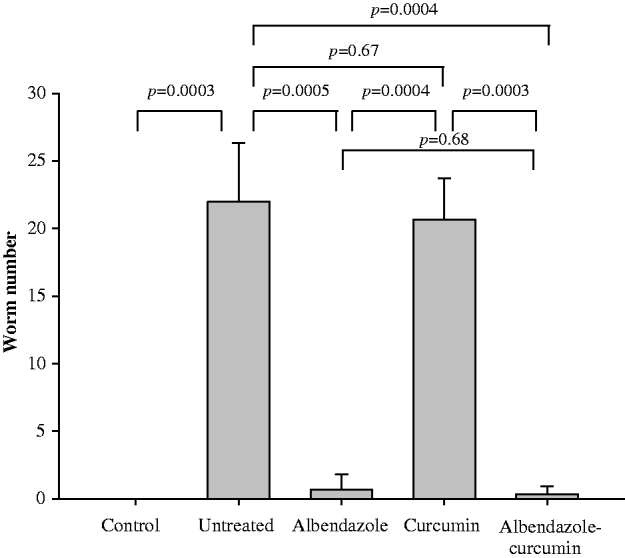
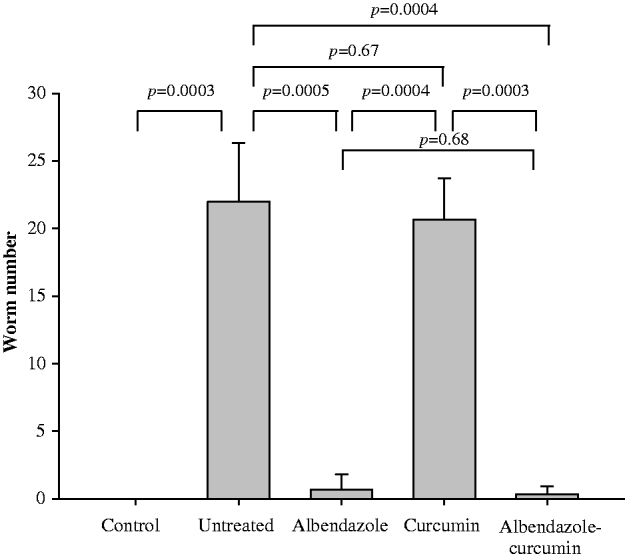
On day 21 post-infection, worms were almost totally eradicated in the brain tissue of mice that received either albendazole alone (P=0·0005) or combined albendazole-curcumin treatment (P=0·0004), when compared with that of the untreated group (Fig. 1). There was no significant difference (P=0·67) in worm number observed between the group treated with curcumin alone and the untreated group, nor was there a significant difference (P=0·68) in worm number between the group treated with albendazole alone and the group treated with combined albendazole-curcumin. This result indicates that although curcumin alone did not help to eradicate worm number, it did not interfere with the effect of albendazole treatment, either.
Brain worm number on day 21 after infection was used for the assessment of anthelmintic efficacy in the study groups. The worms were almost eradicated in albendazole alone and albendazole-curcumin combined groups, in contrast to the high worm number in the untreated group. Using curcumin alone did not reduce worm number (P=0·67). Combined albendazole-curcumin treatment did not add to the anthelmintic efficacy (p=0·68), as compared with treatment by albendazole alone.
Combined albendazole-curcumin treatment significantly reduced the eosinophil count in the CSF
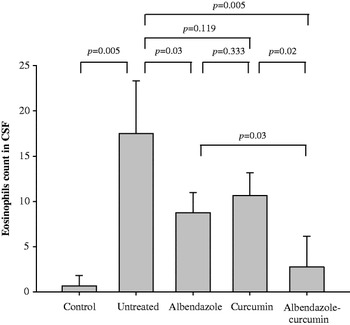
Since curcumin did not appear to help with eradication of the worms, we tried to look at other aspects that could potentially benefit the treatment of A. cantonensis infection. The reduction of eosinophil counts (per 100 leukocytes) in the CSF provided an indicator of alleviation of eosinophilic meningitis induced by A. cantonensis infection. Therefore, we examined whether curcumin could help to reduce eosinophil counts in the CSF of the infected mice. The results showed that, in the uninfected control group, the eosinophil count was extremely low (1·1 in 100 leucocytes), compared with that in the infected but untreated group (17·5 in 100 leucocytes) (P=0·005) (Fig. 2). Although albendazole treatment alone significantly (P=0·03) reduced the eosinophil counts to 8·8 in 100 leucocytes, when compared with that in the infected but untreated group, further reduction (2·8 in 100 leucocytes) was found in the combined albendazole-curcumin treatment group (P=0·005). The more interesting finding was that the combined albendazole-curcumin treatment had been more effective than albendazole treatment alone (P=0·03) in reducing eosinophil counts in the CSF.
Eosinophil counts in CSF in the study groups on day 21 after infection. All the eosinophil counts were significantly higher than the uninfected control group. The eosinophil counts were significantly reduced with albendazole treatment alone (P=0·03) and with combined albendazole-curcumin treatment (P=0·005), as compared to that of the untreated group. Curcumin treatment alone did not reduce eosinophil counts (P=0·119). However, the combined albendazole-curcumin treatment was more effective in reducing the eosinophil count than albendazole treatment alone (P=0·03).

Brain histological observations and immunohistochemical examination of MMP-9
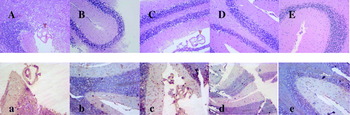
The occurrence of eosinophilic meningitis was confirmed on day 21 post-infection in BALB/c mice with A. cantonensis infection, by optical microscopic examination of tissues stained with haematoxylin and eosin. The worms were found in the cerebellum of the infected mice that had received either no treatment or curcumin treatment alone (Fig. 3A and C). On the contrary, no worms were observed in the treated group with albendazole alone (Fig. 3B) or in the group treated with combined albendazole-curcumin (Fig. 3D) or the uninfected group (Fig. 3E). The pattern of MMP-9 expression was found in the infected mice without treatment (Fig. 3a) or with curcumin treatment alone (Fig. 3c). In contrast, there was no specific pattern of MMP-9 expression observed in the mice treated with albendazole alone (Fig. 3b) or with combined albendazole-curcumin treatment (Fig. 3d), nor in the uninfected control group (Fig. 3e).
Histopathological changes and immunohistochemical detection of MMP-9 expression in mice cerebellums on day 21 after infection. (A)–(E) Haematoxylin-eosin stain. (A) Specimen from the untreated group showing a worm in the cerebellum (indicated by an arrowhead). (B) Specimen from the infected group with albendazole treatment alone showing no worm. (C) A worm remained detected (indicated by arrowhead) in the infected mouse cerebellum treated with curcumin alone. (D) No worm was found in the infected mice with combined albendazole-curcumin treatment. (E) Uninfected control mouse without any treatment. (a)–(e) Immunohistochemistry for MMP-9 expression in the cerebellums. Stronger MMP-9 expression was detected in the infected mice without any treatment (3a) and in infected mice treated with curcumin alone (3c).

Inhibition of MMP-9 activity in the brain by albendazole alone and by combined albendazole-curcumin treatment
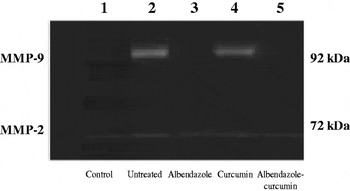
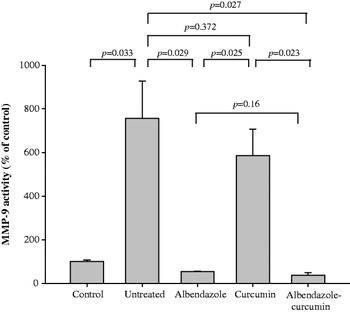
To further elucidate MMP-9 status in the brain following A. cantonesis infection, we performed gelatin zymography to evaluate MMP-9 activity in all the study groups. No MMP-9 activity was observed in the brain tissue of the uninfected control mice (lane 1 in Fig. 4), while the infection with A. cantonensis induced the activity of MMP-9 (lane 2 in Fig. 4). Albendazole treatment following the infection evidently abolished the activity of MMP-9 (lane 3 in Fig. 4) and curcumin treatment alone appeared to inhibit MMP-9 activity (lane 4 in Fig. 4). The combined albendazole-curcumin treatment after the infection totally abolished the activity of MMP-9 (lane 5 in Fig. 4). To further clarify the effect of curcumin treatment, we scanned the density of the MMP-9 gelatin zymography bands in Fig. 4, using the control as an arbitrary standard. We found that MMP-9 activity was highly induced after A. cantonensis infection if no treatment was given, when compared to that of the control group (P=0·033) (Fig. 5). A significant suppression of MMP-9 activity in the infected mouse brain was found with albendazole treatment alone (P=0·029) or with combined albendazole-curcumin treatment (P=0·027), when compared with that of the untreated group (Fig. 5). Nevertheless, curcumin treatment alone did not quantitatively exert an inhibitory effect on MMP-9 activity in the brain tissue, as compared with that of the untreated group (P=0·372), and neither did the combined albendazole-curcumin treatment exert a better inhibitory effect on MMP-9 activity than albendazole treatment alone (P=0·16). These results are in agreement with the finding regarding worm number, in that although curcumin alone did not totally abolish MMP-9 activity, it did not interfere with the effect of albendazole treatment, either.
Gelatin zymography analysis of MMP-9 activity. MMP-9 activity was not detected in the control group (lane 1), but was induced with Angiostrongylus cantonensis infection without treatment (lane 2) or with curcumin treatment alone (lane 4). On the contrary, albendazole treatment alone (lane 3) or combined albendazole- curcumin treatment (lane 5) completely inhibited the MMP-9 activity. MMP-2 activity was not detected in all study groups.

Semi-quantitative analysis of MMP-9 activity by scanning gelatin-zymogram bands. The results showed a significant suppression of MMP-9 activity in the infected mouse brain with albendazole treatment alone (P=0·029) or with combined albendazole-curcumin treatment (P=0·027), when compared with that of the untreated group. Curcumin treatment alone did not exert a significant inhibitory effect on MMP-9 activity as compared to the untreated group (P=0·372).

DISCUSSION
Albendazole (C12H15N3O2S) exerts its anthelmintic effect through inhibition of the metabolic pathway of glucose utilization in A. cantonensis, resulting in energy depletion and death of the parasites. The treatment effects are reliable for targeting at the larvae with higher basal metabolic rates (Venkatesan, Reference Venkatesan1998). Our results are comparable with those reported previously (Tu and Lai, Reference Tu and Lai2006), supporting that the vermifuge agent, for example albendazole alone in this study, has sufficient anthelmintic effect. However, while albendazole kills A. cantonensis larvae effectively, this drug alone did not improve survival rate in the infected mice (He et al. Reference He, Lv, Li, Zhang, Liao, Zheng, Su, Rao, Yu and Wu2011). Following albendazole treatment, neurological damage was also found in the infected mice, possibly due to the hypersensitivity reaction evoked by the dead larvae, causing severe inflammatory reactions through the activation of eosinophils in the host CSF (Wang et al. Reference Wang, Jung, Chen, Wong, Wan and Wan2006). Therefore, to increase the survival rate, it may be helpful to use albendazole in combination with anti-inflammatory agents that can suppress the hypersensitivity reaction and eosinophil activation.
Curcumin, a polyphenolic organic molecule derived from turmeric, has been found to have a variety of therapeutic effects including anti-inflammatory, anticarcinogenic, antimicrobial, and antiprotozoal effects (Sharma et al. Reference Sharma, Gescher and Steward2005; Mishra et al. Reference Mishra, Dash, Swain and Dey2009; Epstein et al. Reference Epstein, Sanderson and Macdonald2010; Marathe et al. Reference Marathe, Ray and Chakravortty2010; Perry et al. Reference Perry, Demeule, Régina, Moumdjian and Béliveau2010). Curcumin has also been shown to reduce blood parasitaemia by 80–90% in mice infected with malaria parasites (Plasmodium berghei) and to enhance survival rates significantly (Reddy, Reference Reddy, Vatsala, Keshamouni, Padmanaban and Rangarajan2005). Thus, curcumin may serve as a good candidate for the treatment of eosinophilic meningitis induced by A. cantonensis infection. Indeed, in our previous study, we demonstrated that 2·0% curcumin treatment alone could mildly reduce eosinophil count in both the blood and the CSF (Shih et al. Reference Shih, Lee, Lai, Chen, Jiang, Chen and Shiow2007). We also showed that curcumin alone could not treat the A. cantonensis infection, nor does it reduce the MMP-9 activity in the brain tissue (Shih et al. Reference Shih, Lee, Lai, Chen, Jiang, Chen and Shiow2007). In agreement with our previous findings, in the present study, our data confirm that using curcumin alone did not exert anthelmintic effects nor did it significantly reduce the eosinophil count in mice after A. cantonensis infection. Despite previous findings, since curcumin has dual effects in suppressing inflammation and eosinophil count, it may help if administered as a complementary treatment in addition to the vermifuge agent. Albendazole is an effective vermifuge agent with high larvicidal activity but may simultaneously induce a severe inflammatory response (Lai et al. Reference Lai, Chen, Chang and Lee2008). It is likely that combined albendazole-curcumin treatment could benefit simultaneously from the anthelmintic effect by albendazole and from the anti-inflammatory effect of curcumin, if both agents do not interfere with each other. In the present study, we demonstrated that both the worm number in the brain and the eosinophil count in the CSF were significantly reduced with combined albendazole-curcumin treatment. To our knowledge, this is the first demonstration of the beneficial effects of using combined albendazole-curcumin treatment for the alleviation of parasitic meningitis after A. cantonensis infection of the mice. With caution, this therapeutic strategy may be applied for the treatment of human A. cantonensis infection in the future.
The use of a vermifuge agent in combination with traditional anti-inflammatory herbs has attracted extensive attention in recent years. For example, by using albendazole and baicalein (a flavonoid from the roots of Scutellaria baicalensis Georgi, a medicinal plant documented in the Chinese Pharmacopoeia), similar results against eosinophilic meningitis induced by A. cantonensis in mice have been reported (He et al. Reference He, Lv, Li, Zhang, Liao, Zheng, Su, Rao, Yu and Wu2011). Both our and He's results suggest that although albendazole alone is effective in killing A. cantonensis larva, the additional administration of anti-inflammatory substances should be applied simultaneously to prevent the severe inflammatory responses caused by albendazole treatment alone. Another example is the use of long-dan-xie-gan-tan (a Chinese herbal medicine) combined with albendazole (Lai et al. Reference Lai, Chen, Chang and Lee2008). In addition to the combined use of traditional anti-inflammatory herb, previous studies have also reported albendazole treatment together with various other agents such as dexamethasone, thalidomide, or the Chinese herbal medicine Yin-Chen-Extract, leading to more effective treatment of parasitic meningitis than by using albendazole alone (Lai, Reference Lai2006; Tu and Lai, Reference Tu and Lai2006; Chen and Lai, Reference Chen and Lai2007; Lai et al. Reference Lai, Chen, Chang and Lee2008). In the present study, our results help to add curcumin to the list of candidates for the prevention of brain damage caused by A. cantonesis infection. Compared with other candidates, however, curcumin appears to be more acceptable due to its common use as a dietary spice ingredient. Therefore, we regard curcumin as the leading candidate for such a therapeutic strategy.
In the present study, we have also confirmed that this combined medication cannot effectively inhibit matrix metalloproteinase-9 (MMP-9) activity. Previous studies have already discovered the presence of MMP-9 in the brain of infected ICR mice and MMP-9 is found to be associated with meningitis caused by infection of A. cantonensis (Shih et al. Reference Shih, Lee, Lai, Chen, Jiang, Chen and Shiow2007; Lai et al. Reference Lai, Chen, Chang and Lee2008; Tsai et al. Reference Tsai, Chung, Chen, Liu, Lee, Chen, Sy, Wann and Yen2008; He et al. Reference He, Lv, Li, Zhang, Liao, Zheng, Su, Rao, Yu and Wu2011). Curcumin, despite its potential anti-inflammatory effects, did not appear to inhibit MMP-9 activity effectively. In a recent report on transgenic mice expressing human MMP-9 in a mouse model of asthma (Mehra et al. Reference Mehra, Sternberg, Jia, Canfield, Lemaitre, Nkyimbeng, Wilder, Sonett and D'Armiento2010), it was shown that lymphocyte accumulation, rather than macrophages, eosinophils, or neutrophils, was altered in the walls of asthmatic airways. Likewise, it is possible that the reduction of eosinophil count under the influence of curcumin in our study model is unrelated to MMP-9 expression. Obviously, the entire scenario of MMP-9 expression under this therapeutic strategy remains to be elucidated in future studies.
In conclusion, by combined albendazole-curcumin treatment, we can alleviate symptoms in mice infected with A. cantonensis effectively through reduction of worm numbers in the brain and eosinophil counts in the CSF, which may reduce the risk of blood-brain barrier breakdown commonly found in eosinophilic meningitis.
ACKNOWLEDGEMENTS
The authors appreciate the full support from the Department of Parasitology, and the Department of Pathology, Chung Shan Medical University, Taichung City, Taiwan.
FINANCIAL SUPPORT
This study was supported by a research grant CSMU 93-OM-B-043 from Chung Shan Medical University, Taichung City, Taiwan.