


Introduction
Relational contract theory has been creeping into the courts. Though hardly entrenched, the concept of the ‘relational contract’ has been invoked with increasing visibility by parties and judges, especially in recent years.Footnote 1 In academic literature, relational theory's place among the standing cast of contract theories is well known, and its core insight – the recognition of norms beyond the paper deal – is well taken.Footnote 2 The two scholars most associated with the label, Ian MacneilFootnote 3 and Stewart Macaulay,Footnote 4 have had their prodigious bodies of work commented on and extended in multifarious directions.Footnote 5 The importance of their work, beginning in the 1960s, has been flagged out by symposiums in the US in 1985 and 2000,Footnote 6 and leading English and international scholars interested in ‘cooperative’ models of contractingFootnote 7 have joined their American counterparts in recognising and celebrating the influence of both Macaulay and Macneil.Footnote 8 There are entire monographs built primarily on Macneil's ideas about relational theory, spanning both publicFootnote 9 and private lawFootnote 10 aspects of contract, not to mention a large corpus of articles applying relational theory in a wide range of contexts, including employment,Footnote 11 corporate,Footnote 12 marriage and family,Footnote 13 construction,Footnote 14 franchising,Footnote 15 housing,Footnote 16 insurance,Footnote 17 and consumer regulation.Footnote 18 Hence, Feinman re-asserts the ‘vitality of… relational contract theory in continuing to frame issues for scholars to debate and in providing a vehicle for considering new social and legal phenomena’.Footnote 19 More familiar is the incantation ‘we are all relationalists now’, uttered first by ScottFootnote 20 and picked up with some delight by Macneil himself,Footnote 21 and subsequently repeated ad nauseam by every new contribution to the field.Footnote 22
Yet the doctrinal impact of relational theory remains unclear. Do we need to re-interpret existing doctrines, or are more radical reconstructions of concepts and categories required? Does this re-orientation take place at intra-doctrinal or inter-doctrinal levels? Or is doctrine to be ignored in place of some sort of more ‘contextualised’ judicial inquiry? While scholars have from time to time suggested reforming aspects of contract law in line with relational theory's insights,Footnote 23 a broad understanding of the terms upon which the latter might engage with contract law remains elusive. Hence, Austen-Baker tells us that Macneil himself ‘wait[ed] in vain for [a] proposal’ for a relational contract law, and eventually settled on relational theory being used as an ‘explanatory and analytical tool for examining exchange relations… from a social or anthropological point of view’.Footnote 24 Likewise, Feinman mooted the possibility that relational theory could ‘reshape the core of contract doctrine – the traditional doctrinal structure of rules and principles of formation, performance, etc’ and answered in the negative: ‘While… I was once optimistic about the project, I now believe that the relational norms will not supplant the more familiar doctrines anytime soon, much less replace the even more fundamental doctrines such as indefiniteness, conditions, or parol evidence’.Footnote 25
My aim in this paper is to offer a framework for understanding and projecting the potential impact of relational contract theory on contract law going forward. The impact might be seen as a ‘disruptive’ intervention to doctrine, not in the traditional pejorative sense of the term, but in the contemporary sense in which ‘disruption’ is used to convey a shaking up of existing orders and practices, with its connotations of both promise and perils. The balance of this paper proceeds as follows. Part 1 provides a high-level overview of the state of play in the relational contracts literature. Part 2 expands on the framework for understanding how relational theory might impact contract doctrine. Drawing from insights on conceptual change and transformation in private law theory, I suggest three pathways for relational intervention: (i) re-interpretive relationalism; (ii) re-orientative relationalism; and (iii) reconstructive relationalism, three approaches which differ in terms of the level of doctrine at which they operate, and the scale and visibility of their possible impact. Finally, Part 3 takes a more critical look at the promises and perils of introducing relational theory into contract doctrine.
1. Relational contract theory in academic discourse
The emergence of relational theory has been well-documented by commentators,Footnote 26 and my aim here is simply to outline key aspects of its evolution. As Scott notes, relational theory has branched out into two broad camps, which travel at times under different designations. The former has been labelled ‘economic relationalism’, and is commonly associated with a (neo-)formalist approach to contract adjudication. The latter, in contrast, has been called ‘socio-relationalism’ and subscribes to contextualism.Footnote 27 The former takes inspiration from Macaulay's famous 1963 paper ‘Non-contractual relations in business: a preliminary study’,Footnote 28 where he pointed out the marginal role of contract law in defining performance, planning for contingencies and defective performance, and providing sanctions, given the propensity for relational norms to govern the ‘real’ deal.Footnote 29 As Gordon observes, the study's ‘main implication seemed to be that contract law was very nearly irrelevant to a good deal of actual business contracting’.Footnote 30 Taking off from Macaulay, a number of early studies sought to replicate his findings, for example Beale and Dugdale's 1975 study highlighting how ‘factors such as low risk, mutually accepted norms and duties and various extra-contractual devices may operate to reduce the use of contract law’.Footnote 31 The economic-relationalist strand has dovetailed more generally with a focus on private orderings, in particular work in the same vein as the Ellicksonian ‘order without law’ thesis.Footnote 32 The ‘relational contracting without law’ school of thought is best represented by Bernstein's body of work on private ordering in diamond markets,Footnote 33 cash cotton markets,Footnote 34 the grain and feed business,Footnote 35 and most recently, original equipment manufacturing supplier relationships.Footnote 36 In each case the aim of the study has been to show how merchants have ‘opted out of the public legal system’Footnote 37 and ‘systematically rejected state-created [contract] law’.Footnote 38 The key moves made in this thesis include establishing the viability of non-legal trust-based sanctions empirically – in the cotton industry, it is said that ‘social connections and information channels encouraged by industry institutions have succeeded in making so much reputation-related information available, that reputation-based nonlegal sanctions are able to play an important, and generally positive, role in commercial transactions’,Footnote 39 often supported by the game-theoretic logic that the ‘long-run cost of defection will often be greater than the short-term gain from defection, so a transactor… is more likely to cooperate than to defect’.Footnote 40 Bernstein's work has in turn provided the basis for the further entries into ‘relational contract without law’ literature, for instance recent studies demonstrating the reliance on extensive reputational networks and private enforcement mechanisms in transnational software trade,Footnote 41 and is also bolstered by the rich body of law and economics literature supporting ‘neo-formalist’ methods of adjudication on account of, inter alia, litigation, judicial error, secrecy and ‘crowding-out’ costs.Footnote 42 Taken together, the implications of this school of thought for contract law and doctrine are straightforward: as Morgan points out, law should be ‘minimalist’, employing ‘easily determined formal criteria rather than intractable questions of substance or context’.Footnote 43 The upshot is that this version of relationalism has no interest in working out how relational insights can be translated into doctrine.
On the other hand, the socio-relationalist camp builds on the work of Macneil, who – unlike Macaulay, whose focus was mainly the empirical workings of the ‘law in action’ –developed a fuller socio-cultural account of contractual relations which he coined ‘relational contract theory’.Footnote 44 Macneil's key ideas can be stated as follows. First, all exchange occurs in complex and enveloping social relations.Footnote 45 In examining these relations, one can identify ten behavioural patterns, and ‘[s]ince repeated human behaviour invariably creates norms’, these patterns are also termed ‘common contract norms’: role integrity; reciprocity; implementation of planning; effectuation of consent; flexibility; contractual solidarity; restitution, reliance and expectation interests; creation and restraint of power; proprietary of means; and harmonisation with the social matrix.Footnote 46 Exchange takes place along a spectrum from the ‘discrete’ to the ‘relational’. The former involves an intensification of the ‘planning’ and ‘consent’ norms, with the transaction being relatively separated from other aspects of the relationship between parties, performance being clearly defined and ‘presentiated’ (brought from the future into the present), and little cooperation or sharing of benefits and burdens being expected. In contrast, the latter involves an intensification of more ‘cooperative’ norms, for instance the ‘solidarity’, ‘flexibility’ and ‘role integrity’ norms, and tends to be enmeshed with other aspects of the broader relationship (such as friendship), performance not being presentiated but seen as part of a long-term ongoing integration of behaviour (as in a marriage). Importantly, the invariable ‘incompleteness’ of the transaction indicates a need for future cooperation and sharing of benefits and burdens (like in a partnership or joint venture).Footnote 47
Socio-relationalists following Macneil argue for ‘key relational norms [to be]… deployed by courts to require relational sanctions’, in what is associated with ‘contextualist’ modes of adjudication.Footnote 48 However, a large part of the literature is not primarily concerned with demonstrating the actual translation of relational norms into doctrine at a granular level, but rather with more ‘macro’ arguments showing a role for law to complement relational norms. For instance, some arguments seek to show how law can ‘minimis[e]… the magnitude of the potential risk of the deal… mak[ing] the initial transaction possible, which can lead to the establishment of a trusting relationship that otherwise would have not commenced’,Footnote 49 often contained in a larger ‘law and development’ narrative that shows how the assurance of legal sanctions encourages businesses to establish new long-term trading relationships,Footnote 50 counteracting the economically detrimental exclusionary or discriminatory effect that close-knit privately ordered communities have on enterprise.Footnote 51 Hence, Milhaupt notes in his study of the Japanese corporate contract that in ‘highly relational contexts, which are characterised by complex and undefined obligations, judicial enforcement of general legal principles to fill gaps in incomplete contracts and to punish opportunism may be the most important function of law’.Footnote 52 Other types of ‘contextualist’ arguments for the incorporation of relational norms focus on demonstrating the magnitude of ‘specification costs’ saved via incorporation of business custom, while downplaying the rate of interpretive error (through calibrating evidentiary bases, standards and burdens of proof, and the like).Footnote 53 Some studies focus on highlighting the importance of contracting context in deciding whether incorporationist approaches are appropriate, often highlighting economic variables that matter to the calculus. For example, Badawi suggests that in transacting circumstances of low frequency, high uncertainty, high asset specificity and low insularity, such as mergers and acquisitions or customised software contracts, contracts may be relatively more incomplete and parties would prefer courts to incorporate relational norms and administer legal sanctions given the stakes of the dispute and the absence of reputational sanctions.Footnote 54
Taken together, the arguments of socio-relationalism have provided at least a side wind against the forces of economic relationalism, yet while much fruit has been reaped from focusing on comparative institutional analysis, and the relative costs of legal and non-legal modes of contract governance, there remains a bridge to be crossed in understanding what impact relational theory ultimately has on contract doctrine.
2. How relational theory can impact contract doctrine
(a) Groundwork for doctrinal transformation
While previous work on doctrinal evolution sometimes focused on staticity at the expense of change, or vice versa,Footnote 55 the latest work on doctrinal transformation emphasises how their dynamic is maintained over time, and highlights the systemic opportunities and characteristic channels for evolution at every level of doctrine: conceptual building blocks, rules and standards, categories and taxonomies.
For example, Balganesh and Parchomovsky identify three ways in which common law develops at the conceptual level, each of which stretch existing doctrinal structures to varying degrees. First, interpretive change involves shifting the emphasis of a single concept away from a more specific normative meaning to its more general jural meaning, which then allows the court to imbue the concept with new normative content. In describing interpretive change, Balganesh and Parchomovsky refer to Horwitz's observation that ‘[c]ommon lawyers are more comfortable with a process of gradually giving new meanings to old formulas than with explicitly casting the old doctrines aside’.Footnote 56 While the authors do not refer to contractual examples, these are not difficult to locate. Take, for instance, Atiyah's well-known exposition on ‘consideration’ – as a matter of historical fact, it is said that it is ‘highly probable that when the courts first used the word “consideration” they meant no more than that there was a “reason” for the enforcement of a promise’,Footnote 57 as the concept served as the main gatekeeper for policing the validity of enforceable promises at law. In due course, however, it acquired the familiar narrower technical meaning of a counter-promise or performance given in exchange for a promise.Footnote 58 As Balganesh and Parchomovsky observe, this is a ‘fairly well-known method of infusing the common law with new normative ideas and content, without actually altering the doctrinal content and jural structure of the rules’.Footnote 59 Secondly, the authors describe inter-conceptual change as the process of re-prioritising the normative valence of a particular concept over others embedded within a doctrine, for instance shifting the focus or giving more weight to one element or factor in a multi-factor or multi-element doctrine.Footnote 60 Thirdly, additive change involves the recognition of a new conceptual device with its own normative ideal,Footnote 61 for instance, Lord Atkins’ neighbour principle in Donoghue v Stevenson,Footnote 62 or to use a contemporary contractual example, the more explicit recognition of the concept of ‘legitimate interest’ in Cavendish Square Holdings BV v Makdessi; ParkingEye Ltd v Beavis Footnote 63 grounding the applicability of the penalty doctrine.Footnote 64
Other commentators have focused on opportunities for change at the level of rules and standards. Adopting the conventional understanding of the distinction, standards are said to leave the determination of a legal directive's content to the applier of the standard ex post, relying on evaluative triggers, as opposed to rules which define the content of the law ex ante by prescribing concrete empirical triggers that dictate fairly determinate responses.Footnote 65 Those associated with a realist line of thought have often seized upon the alleged indeterminacy of formal legal material, including rules and standards, as a portal through which new normative content can be injected. Standards, in particular, are particularly effective mechanisms of change given their relative ‘fuzziness’. In the realm of contract, for instance, Rakoff has suggested an approach to implying default terms in law which borrows from Llewellyn's well-known notion of ‘situation-sense’.Footnote 66 The basic intuition involves considering the ‘implications of various legal rules, matched up against reasonably intricate models of social situations’ (models which describe paradigmatic type-situations and the relationships between type-characters), to reach a fair and workable result.Footnote 67 Other commentators (who may not identify completely with an American strain of realism) also look to exploit the potential of standards for legal change. Collins, for instance, has suggested that market convention can be ‘incorporated as implicit aspects of the agreement, known in legal discourse as implied terms’, while other broad doctrines such as ‘reasonable expectations’ or ‘good faith’ might be seen as ‘gateways which permit social science perspectives to become relevant sources of information to legal doctrine’.Footnote 68 In doing so, this leads to the ‘productive disintegration’ of private law, as it seeks to ‘reinvent itself in a more contextual way’, to become ‘more refined in its differentiation and normative orientation’.Footnote 69
Similarly, though dealing with more ‘macro’-type changes, some private law theorists seek to re-orient doctrinal categories by invoking the idea of ‘developmental’ taxonomies, involving both ‘conceptual’ and ‘contextual’ elements,Footnote 70 which may be organised along multiple axes capturing both traditional categories and relationship-specific contextual factors.Footnote 71 Doctrinal categorisation ‘cannot be done through definition or deterministic logical reasoning, but turns equally on questions of purpose… context… and history’.Footnote 72 In this regard, they expressly observe that relational contract theory has been marginalised particularly because its key notions, such as ‘projections of uncertainty into the future’, tend to be ‘much more empirically derived’ – hence more contextual – than other conceptual alternatives, for instance promissory theories tied instead to certain conceptions of critical morality.Footnote 73 Likewise, contemporary legal realists like DaganFootnote 74 suggest that correctly understood, ‘Legal Realism appreciates the purposes served by doctrinal categories, which allow law to consolidate expectations and also express the normative ideals underlying its regulation of core types of human relationships’.Footnote 75 However, given that legal regulation involves a process of continual testing and refinement, legal actors ‘should occasionally use social developments and new cases as triggers for rethinking the doctrine's conventional understanding’, thus periodically ‘reconstruct[ing] doctrinal taxonomy so as to incorporate… insights on the inherent dynamism of law and the important function of contextual normative analysis in the evolution of doctrinal categories’.Footnote 76
In sum, the latest work on doctrinal transformation exploits the potential for change latent at different but interconnected levels of doctrine, and moreover points us to the various types of changes that may take place – from ‘re-interpretations’ of micro-level concepts to major ‘renovations’ of macro-level taxonomies. These works set the stage for an understanding of how relational theory can be mediated through doctrine.
(b) A framework for mediating relational contract theory through doctrine
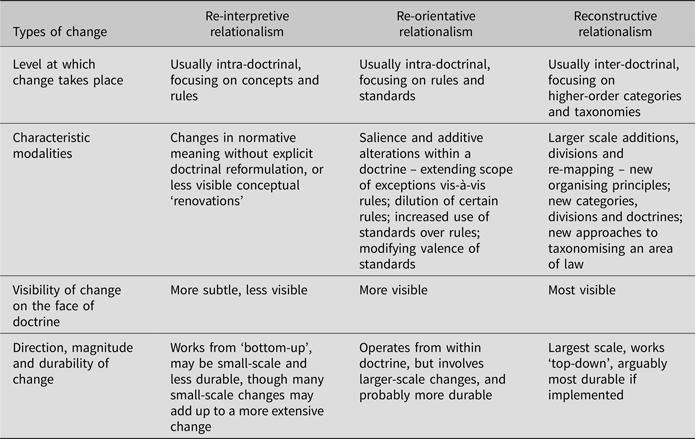
In attempting to grasp relational theory's doctrinal ramifications, it is arguably useful to begin with a broad framework rather than focusing immediately on a particular rule or doctrine. I suggest three pathways for relational theory to impact contract doctrine, which might be classified: (i) re-interpretive relationalism; (ii) re-orientative relationalism; and (iii) reconstructive relationalism. The first, re-interpretive relationalism, works by altering normative meaning without performing any surgery on the explicit face of concepts and rules, and can be considered relatively ‘smaller-scale’, though a multitude of interpretive changes can be aggregated into a significant and enduring intervention. Second, re-orientative relationalism is more visible, pervasive and lasting due to its process of making explicit salience and additive changes to the content, structure and priority of rules and standards within a doctrine. Third, reconstructive relationalism focuses on higher order doctrinal categories and taxonomies, involving larger-scale additions, subtractions and re-divisions, and to the extent it is implemented (usually less often) is relatively the most visible and permanent. The table below summarises the key characteristics of each model, which I flesh out in further detail below with examples drawn from the commentary and case law on ‘relational contracts’.
(i) Re-interpretive relationalism
Re-interpretive relationalism is an approach implicitly suggested by various commentators who take the view that relational values are best understood as existing within the concepts and rules of current doctrine, even without other additional conceptual reconfigurations.Footnote 77
For example, Austen-Baker has suggested that Macneil's common contract norms are reflected in well-known doctrinal concepts – one could see the notion of ‘role integrity’ (a pattern of behaviour expected of a person occupying a given social position) embodied in rules governing minors’ or mentally impaired persons’ capacity to contract,Footnote 78 or in the doctrine of intention to create legal relations, which recognises role-dependency as between the exchanges made by a person in commercial settings on the one hand, or familial settings on the other.Footnote 79 Likewise, the characteristic relational norm of ‘flexibility’ is said to be ‘readily achieved within the confines of conventional contract doctrine’, for instance through the concepts of ‘waiver and estoppel [which] allow businesspeople to rely on even quite informal arrangements in variation of the contractual terms’.Footnote 80 In this regard, one might also see the Court of Appeal decision of MWB Business Exchange Centres Ltd v Rock Advertising Ltd Footnote 81 as attempting to implement the ‘flexibility’ norm, by extending the reach of ‘practical benefit’ to amount to valid consideration in the Foakes v Beer Footnote 82 part payment of debts scenario.Footnote 83 Again, the ‘harmonisation with the social matrix’ norm might be understood as one rationale for the illegality and public policy doctrine, which is clearly concerned with various categories of anti-social behaviour such as immorality, fraud and corruption, and compromise of the legal process, to name a few.Footnote 84
Campbell has also adopted a similar approach to re-interpreting doctrine along relational lines, though he understands ‘cooperation’ as the overarching idea underpinning Macneil's specific relational norms, and hence seeks to demonstrate that extant law contains such ‘cooperative’ elements, which he terms the ‘relational constitution’ of discrete (ie classical) contract law. For instance, the extension of concepts of duress to economic duress and lawful act duress seems to suggest a recognition that certain cases ‘need to be conducted under more consciously co-operative than competitive bargaining relations in order to produce optimal outcomes’.Footnote 85 Campbell also argues that the rules relating to breach and damages in Robinson v Harman,Footnote 86 properly understood, give effect not just to the principle of protecting a claimant's expectation, but also to the countervailing principle of promoting cooperation between parties to reduce losses.Footnote 87 Campbell suggests that defaulting parties often breach contracts without bad faith to minimise their losses as rising costs make performance prohibitively expensive, and that in this scenario the law expresses its normative commitment to a cooperative ideal through rules requiring mitigation and limiting claims for specific performance or consequential losses.Footnote 88 Protecting a claimant's expectation ‘in such a way as to minimise the defendant's expense’ furthers the ‘co-operative project of joint cost minimisation within a contractual framework’, one that is realised both ‘within the instant contract and in the economy over time’.Footnote 89
Of course, one can proffer any number of alternative rationales for the rules and concepts discussed above. Some have theorised that contract law's concepts were first driven with moral ideals but began to acquire consequentialist meaning over time.Footnote 90 These types of claims are difficult to prove conclusively – hence persistent debates over the correct interpretive justification for contract doctrines. While the existence of alternative interpretations does not invalidate re-interpretive relationalism as a process for transformation, it does suggest that it is a somewhat ‘weaker’ source of transformation, since it is invariably open to question whether any normative shift in meaning has actually taken place. Yet one should not dismiss re-interpretive relationalism entirely. Should an appellate court be persuaded by relationalist arguments akin to those suggested by Campbell and Austen-Baker, a corpus of contractual concepts and rules could be re-worked in a relational image, the collective result of which could be a more enduring change in the choice of paradigm for contract, even without re-writing the relevant rules. Moreover, re-interpretive changes can often provide the impetus for and complement more visible changes – as relationalism is utilised to ‘fit and justify’ extant law, to use Dworkinian terminology, it would also tend to exert ‘gravitational force’ in crafting new legal material to fit a more relational mould through the process of case law development.Footnote 91
(ii) Re-orientative relationalism
Re-orientative relationalism involves intra-doctrinal salience and additive alterations, which would be generally be more visible than purely re-interpretative changes. There are different ways of effecting these alterations.
One form of disruption might be to extend the scope of exceptions to what are traditionally regarded as fairly hard and fast rules, not necessarily to swallow up the general rule entirely, but to re-focus doctrine to see the dominant general rule as simply one rule among others depending upon context. This extension of exceptions has been advocated in relation to the rules governing disclosure by relationalists who view the content of a disclosure duty as varying with contract type. For instance, it is often said that short of a misrepresentation, there is generally no duty to actively disclose material facts to the other contracting party.Footnote 92 It can be argued that the existence and content of a disclosure obligation depends on the relational nature of the agreement. Clearly, ‘[t]here can be no market for corporate control if securities traders have to reveal what is going on in their minds’, since the market works by differing valuations placed on returns, yet disclosure requirements are a key aspect of contracts of ‘utmost good faith’ such as insurance and re-insurance contracts, a not insignificant type of commercial transaction.Footnote 93 In the much-discussed decision of Yam Seng v International Trade Corp Ltd,Footnote 94 Leggatt J argued against a categorical distinction between fiduciary and other contractual relationships that are usually taken not to impose a duty of disclosure, expressly holding that relational contracts may require a higher degree of communication, cooperation and predictable performance, and that the specific contractual context may give rise to expectations of information-sharing, such that a deliberate omission to disclose such information may amount to bad faith.Footnote 95 Indeed, the various exceptions that have cropped up around the general rule regarding disclosure can be rationalised as giving effect to the relational norms surrounding a particular contracting context. As suggested, the long-term insurance relationship, with the imbalance of information between the insurer and insured, is one example where a relational norm of cooperation would give rise to an information-sharing obligation.Footnote 96 In relation to the pre-contractual context, this obligation is presently structured as the duty of ‘fair presentation’ under s 3 of the Insurance Act 2015, and extends to ‘disclosure of every material circumstance which the insured knows or ought to know’, or alternatively ‘disclosure which gives the insurer sufficient information to put a prudent insurer on notice that it needs to make further enquiries for the purpose of revealing those material circumstances’.Footnote 97 In the same vein, one might see another well-known example – disclosure obligations in certain family arrangementsFootnote 98 – as operationalising relational norms. In a contract to settle a family dispute over the division of property, a particular family member who possesses material information, for instance in relation to the value of the estate, is expected to fully and completely disclose such information.Footnote 99 In this regard, the familial context arguably heightens the relational norms of solidarity and reciprocity, translating into an amplified disclosure norm at law. Of course, the argument here should not be taken to license an undiscriminating imposition of disclosure obligations without reference to contractual text and context. For instance, it would not be correct to impose a higher duty on parties to a distributorship agreement to provide each other with ‘accurate and honest appraisals for the prospects from time to time of the relationship continuing’ as a precondition to termination, where the agreement expressly allows the principal a termination by notice procedure as well as a termination for unsatisfactory performance procedure (with an attendant notice period and opportunity for remedial action by the distributor).Footnote 100
Relatedly, re-orientative relationalism might also involve the dilution of certain rules and concepts. Obvious examples are the rules relating to certainty and completeness.Footnote 101 It is often said that ‘[i]n reality, few contracts can be complete’ (that is, able to specify in a manner immediately verifiable by a third party the precise performances required for all future possible conditions).Footnote 102 Moreover, incomplete contracts ‘often exist deeply embedded in an ongoing relationship’, which necessitates both bounded and flexible responses to uncertain future conditions.Footnote 103 One illustration of this re-orientation taking place is the Court of Appeal in Durham Tees Valley Airport Ltd v BMIBaby Ltd,Footnote 104 where BMIBaby had breached its obligations under a ten-year agreement to base and operate two aircraft out of the airport, with eight years of the agreement still left to run. The airport's claim for losses of income arising from airport charges payable per departing passenger under an agreed formula and from duty free and other passenger expenditures was rejected by the trial court given the alleged uncertainty relating to the number of flights and passengers BMIBaby was expected to deliver, which went to the enforceability of the agreement and calculation of damages.Footnote 105 The Court of Appeal, however, reframed an understanding of the ‘certainty’ and ‘completeness’ concepts, citing for instance Lord Wright's dictum in Hillas & Co Ltd v Arcos Ltd Footnote 106 that ‘in contracts for future performance over a period the parties may neither be able nor desire to specify many matters of detail, but leave them to be adjusted in the working out of the contract’.Footnote 107 It reasoned that the absence of a minimum performance clause would not be fatal to the contract's enforceability, since the number of flights and destinations would be within the airline's commercial discretion subject to clear instances of non-performance such as token flights or complete absence of flights,Footnote 108 and damages could be calculated by reference to the likely profitability of the contract, taking into account relevant economic and other surrounding circumstances to decide on the level of performance which the defendant would have adopted, and assuming parties are ‘to have acted in good faith although with their own commercial interests very much in mind’.Footnote 109 Mitchell argues that the enforcement of a more open-ended and uncertain set of obligations in this case ‘recognises the significance and importance of [norms of] collaboration and interdependence’, and ‘resists one party's strategic attempts to undermine the relational underpinning of the contract scheme’.Footnote 110
One final, but significant, approach to re-orientative relationalism involves the increased use of standards over rules, often coupled with the infusion of relational content into such standards, thus combining both intra-doctrinal salience and additive alterations. Relational standards can be expressly provided for or implied into a contract. Some commentators only allow for the former, which naturally limits the scope of relational content to what parties have explicitly articulated in the contractual text. Even then, this approach has faced various obstacles, including traditional unworkability or uncertainty objections,Footnote 111 suggestions that such standards are merely aspirational,Footnote 112 and restrictive readings that limit the standard's application to particular contractual matters.Footnote 113 In response, commentators have attempted to justify express relational standards. McKendrick, for instance, suggests ‘long-term contracts must often be phrased in broad, flexible terms to enable the parties to adjust their bargain to meet changing circumstances’,Footnote 114 citing a plethora of commonly encountered commercial clauses such as standards of work, variation clauses in construction contracts, force majeure and hardship clauses.Footnote 115 No separate law of relational contracts is required, and the court's role is simply to give effect to express relational clauses while avoiding an overzealous approach to striking down such clauses on the basis of vagueness or uncertainty.Footnote 116 Mitchell points to ‘morals’ clauses in celebrity endorsement contracts, ‘best endeavours’ provisions, and stipulations of ‘good faith’ and ‘reasonableness’ in commercial contracts as examples of standards infused with higher normative demands of cooperative behaviour above what a self-interested party may do.Footnote 117 Such standards may be justified especially in ‘long-term complex projects requiring reliable information flows, co-ordination of activities and personnel over lengthy periods’ since they play a key role in ‘signal[ing] expectations concerning conduct that encourages dialogue, acts of reliance and investment’,Footnote 118 expectations are often meant to be legally enforceable, given the distinct possibility that non-legal or reputational sanctions may be inadequate when a defaulting party has a countervailing financial interest in non-performance.
More significantly, re-orientative relationalism might involve using the doctrine of implication of terms in fact to import standards of good faith which express relational norms. In Leggatt J's landmark judgment in Yam Seng, a duty of ‘honesty’ in contract performance was implied into a distributorship contract on the basis that the expectation of honest behaviour ‘is so obvious that it goes without saying’ and that ‘[s]uch a requirement is also necessary to give business efficacy to commercial transactions’.Footnote 119 While Yam Seng’s reasoning has been criticised,Footnote 120 it has received some measure of continued support in recent case law. In the decision of National Private Air Transport Services Co (National Air Services) Ltd v Creditrade LLP,Footnote 121 the court upheld Yam Seng’s authority,Footnote 122 further referencing its approval by the Court of Appeal in Globe Motors Inc v TRW Lucas Varity Electric Steering Ltd,Footnote 123 which concerned an exclusive supplier's breach of contract claim against a car maker arising out of its purchase of motors from another party.Footnote 124 For our purposes, the court recognised that the relational quotient of a contract could matterFootnote 125 and suggested that given its long-term nature, the ‘flexibility of approach [required in relational settings] might have given considerable force to a submission that there was an implied obligation on [the carmaker] to give [the supplier] an opportunity’ to show that it could provide the particular motor which the carmaker had instead purchased from the third party.Footnote 126 Such norms of contractual solidarity and cooperation were also effected via the implied terms route in Bristol Groundschool Ltd v Intelligent Data Capture Ltd,Footnote 127 where a contractual joint venture for the development of pilot training materials was described as a relational contract that contained an implied good faith duty, the content of which included the requirement of honesty and commercially acceptable behaviour,Footnote 128 which one party had breached by downloading materials from the other's system to separately create its own product. Likewise, in D&G Cars Ltd v Essex Police Authority,Footnote 129 a vehicle recovery business was held to have been in repudiatory breach of an implied term of ‘honesty and integrity’ in its contract with a police authority, as it had ignored the latter's instructions to destroy a recovered vehicle and instead absorbed it into its own fleet. Following Yam Seng,Footnote 130 the court recognised that the contract in question was a ‘“relational” contract par excellence’, given its long duration which covered a potentially large number of transactions.Footnote 131 It thus stipulated an ‘integrity’ standard that went beyond dishonesty to acts which would ‘compromise the mutual trust and confidence between parties in [a] long-term relationships without necessarily amounting to the telling of lies, stealing or other definitive examples of dishonest behaviour’, in other words, anti-cooperative conduct which parties would have identified as ‘obvious acts which were inconsistent with the maintenance of their intended long-term relationship of fair and open dealing’.Footnote 132 The implied terms mechanism is thus a fairly popular pathway to incorporating relational norms, and given its filtration of relational content through the gateway of relatively broad standards, allows for an intervention which can be accommodated intra-doctrinally.
(iii) Reconstructive relationalism
Lastly, some types of relational interventions might go beyond re-interpretative and re-orientative relationalism. These include macro-level additions, divisions and re-categorisations to accommodate relational norms. One recent example of this form of ‘reconstruction’ in the common law world is the Supreme Court of Canada's decision in Bhasin v Hrynew,Footnote 133 which referenced Macaulay's and other commentators’ empirical studies on relational norms and commercial expectationsFootnote 134 in recognising an ‘organising principle of good faith’ which requires that ‘parties generally must perform their contractual duties honestly and reasonably and not capriciously or arbitrarily’.Footnote 135 This organising principle was said to underpin many elements of modern contract law, including the implication of terms in fact and law, and extending to doctrines such as unconscionability and statutory duties of good faith and fair dealing in franchise and labour regulation.Footnote 136 Importantly, this organising principle was seen in a jurisgenerative light, capable of originating a novel common law duty of honesty in contractual performance, requiring parties not to lie or otherwise knowingly mislead each other about matters directly linked to the performance of the contract.Footnote 137 In contrast to the less interventionist method of infusing existing standards with relational content (as in Yam Seng), the court in Bhasin held that the novel duty of honesty ‘should not be thought of as an implied term, but a general doctrine of contract law that imposes as a contractual duty a minimum standard of honest contractual performance’.Footnote 138 Accordingly, Bhasin exemplifies a macro-level intervention: the introduction of a new and distinct foundational principle in contract, coupled with an immediate application of its creative potential in generating a new doctrinal duty of honest contractual performance.Footnote 139
The extent to which this intervention is potentially disruptive is discernible from the pushback it has received in some quarters. Moore-Bick LJ has suggested in the Court of Appeal decision of MSC Mediterranean Shipping Company SA v Cottonex Anstalt Footnote 140 that ‘the better course is for the law to develop along established lines rather than to encourage judges to look for… some “general organising principle” drawn from cases of disparate kinds’,Footnote 141 citing standard freedom of contract concerns.Footnote 142 It may thus appear that while relational considerations are not rejected outright, a Bhasin-type scale of intervention would not be welcome in English contract law at present. At the same time, this may not necessarily signal the ‘end of history’ for good faith. In some areas, there may be room for a limited parallel to a Bhasin organising principle of good faith. Soyer and Tettenborn have recently argued that the recast s 17 of the Marine Insurance Act 1906 (‘a contract of marine insurance is a contract based upon utmost good faith’), which retains the reference to good faith as an ‘interpretive principle’, is ‘likely to make courts more willing to extend the doctrine interstitially to other situations where the remedy can be more nuanced’ (compared with avoidance).Footnote 143 These may include restraining a liability insurer's rights where they would be exercised not in the common interest of both parties but primarily to protect the insurer's separate commercial priorities;Footnote 144 a duty to correct certain mistakes where for instance the insurer realises the assured has made an obvious technical mistake;Footnote 145 a duty to provide information in certain circumstances following the conclusion of the insurance contract;Footnote 146 and a duty on the insured to minimise losses on the insurer.Footnote 147 While one can acknowledge an argument for rationalising these four aspects of good faith under existing doctrines (such as, respectively, the control of contractual discretion, rectification, misrepresentation and mitigation), the point at present is simply to recognise the potential for their unification within the frame of a larger interpretive principle, at least in the insurance context.
Beyond the generation of macro principles, reconstructive relationalism might also involve wider taxonomical changes. One obvious option is to have a separate body of ‘relational contract law’, with its own rules and principles, distinct from general contract doctrine. This essentially gives rise to a ‘dual-track’ law of contract, bifurcated between relational and non-relational contracts. Some of the older cases expressly referencing relationality could be understood as adopting this line of thought, for instance the suggestion in Johnson v Unisys Ltd Footnote 148 that employment contracts are a distinct category of relational contracts, distinguishable from commercial contracts generally.Footnote 149 Nonetheless, most commentators have rejected this alternative. Eisenberg has observed the difficulty of pinning the concept of relationality down to a few decisive factors such as the non-existence of a clearly-defined beginning, duration, termination and subject-matter, or non-exhaustive assignment of contractual benefits and burdens:
a 25-year partnership agreement would surely be relational even though it has a defined beginning, duration, and termination… [yet] a contract between strangers to buy and sell 100 bushels of wheat, with delivery on 1 February at Fargo, North Dakota at the then-market price, would surely be discrete, even though there is no precise definition of the price and the benefits and burdens of the contract remains to be determined.Footnote 150
Accordingly, the preferred relationalist view of contract taxonomy appears to reject a simplistic bifurcation of contract law in favour of an analysis that is responsive to particular contract types and the relevant balance of relational norms which infuse the contracting context. The image suggested by Macneil is that of a spectrum or sliding scale from the ‘as if discrete’ (ie presentiated exchanges where more relational content is hived off into a non-legal sphere and norms of consent and planning are intensified) to the ‘relational’ (ie incomplete contracts where relational norms permeate the legal sphere of the transaction).Footnote 151 In this vein, Campbell has often emphasised that: ‘the main point of the relational theory of contract is not that there is a class of relational contracts which should be recognised in addition to the class of discrete contracts, but that all contracts are relational’.Footnote 152 Anticipating the objection that this renders the concept of ‘relationality’ somewhat vague and potentially vacuous, other commentators have sought to give more guidance on the transition from the less relational to the more relational, for example drawing a distinction between parties ‘contracting in similar industries with active trade associations, strong intra-industry networks, patterns of repeat trading and heightened awareness of accepted division of risks’, and parties who are involved in ‘complex, longer-term trading with high levels of uncertainty… where conditions militate against long-term planning, and where there are relationship-specific investments’, as well as high levels of interdependence and flexibility between parties.Footnote 153
This view of reconstructive relationalism would arguably appear to be the most disruptive to contract taxonomy, in replacing a unitary paradigm not only with a dual-track idea of contract but with a spectral understanding of varying contracting contexts. While the idea of a scale naturally invites all manner of ‘slippery slope’ concerns, a relationalist understanding of a reconstructed taxonomy may adopt as its starting point and working assumption the contextual boundaries drawn up by social convention as well as legal regulation. Hence existing classifications of employment, franchising, or joint-venture transactions already signal a particular contract's putative relational content, which can be confirmed, denied or more precisely pinned down upon closer factual examination. Under a reconstructed taxonomy, each of these areas would reconfigure contract doctrine slightly differently in response to the relevant relational norms informing the transacting context. To some extent, this is not surprising if we take a birds’ eye view of all contracting contexts, including areas governed by regulation, though contract lawyers have sometimes missed these relational dimensions by excluding such transactions from the province of private law.
Take, for instance, the ‘unfair prejudice’ jurisprudence under s 994 of the UK Companies Act 2006,Footnote 154 which provides a statutory remedy for minority shareholders in respect of personal wrongs done to them by the majority. It is often said that ‘[c]lose corporations are quintessential relational contracts’.Footnote 155 When a small number of founding shareholders come together in a closely-held corporation in contemplation of a longer-term relationship for a business venture, no amount of business planning can fully obviate contractual open-endedness. Accordingly, the nature of agreement is better regarded as ‘an organic ongoing set of obligations which are modified and extended as circumstances change’.Footnote 156 Often, the evolving shareholder relationship, as well as the parties’ prior social, familial or commercial relationships (for instance, a previous contractual joint venture or partnership) which provides the impetus for incorporation, are sources of normative ordering generating expectations beyond the express terms in a shareholders’ agreement or articles of association.Footnote 157 There may be particular relational norms embodied in informal agreements that ‘all investors should have a right to participate in management, or to receive as income some proportion of company profits, because these are commonly accepted as fair ways to run small companies’.Footnote 158
The doctrinal rules and case law governing ‘unfair prejudice’ reflect the attempt to both give effect to and stem the flow of extra-textual norms generated from relational sources, which in turn requires the construction of a different regulatory structure as compared with traditional contract doctrine. For instance, the Law Commission has observed that the corporate contract ‘differs from other contracts in that it constitutes what has been called “the framework of a long-term relationship between the contracting parties”’.Footnote 159 To this end, corporate law creates its unique boundary-defining lines for this type of relational contract by instituting a ‘quasi-partnership’ requirement,Footnote 160 traditionally tied to criteria such as having a pre-existing personal relationship of mutual confidence (as where a partnership has been incorporated), an understanding that shareholders will participate in management, and some restrictions on share transfer or exit.Footnote 161 The requirement acts as a proxy for circumscribing the situations in which close relationships would give rise to certain expectations. For instance, in Re BC&G Care Homes Ltd Footnote 162 an expectation of participation in management in a closely-held company was recognised due to an informal understanding between the parties that there would be no ‘sea change’ from their previous partnership agreement, the court observing that the parties did not consider their relations to be exhaustively set out by the corporate constitution and further that informal understandings ‘do not have to be legally binding contracts at law’;Footnote 163 in contrast to more widely-held or listed companies where inter-shareholder relations are insufficiently thick to generate such understandings.Footnote 164
Moreover, principles of contractual interpretation and implication are tweaked to suit the relational context. While express terms in the articles or shareholders’ agreement are the natural starting point, there is space provided for informal understandings giving rise to ‘equitable considerations’ which make it ‘unfair for those conducting the affairs of the company to rely upon their strict legal powers’,Footnote 165 and such informal understandings are not simply filtered through the rhetoric of ‘business efficacy’, which the Law Commission has suggested may not be appropriate in this situation.Footnote 166 Rather, the law is sensitive to the specific details of relationships; it is observed that ‘[c]onduct which is perfectly fair between competing businessmen may not be fair between members of a family’.Footnote 167 In Rahman v Malik,Footnote 168 for instance, the court gave effect to an informal agreement between a father and uncle that the former's son would succeed him as a 50% shareholder and director in the existing family business which was to be transferred to a new company. In holding that the uncle's acts of exclusion towards his nephew (such as refusing to appoint him as a director and attempting to dilute his shareholding) constituted unfair prejudice,Footnote 169 the court observed that it was ‘important to note, that the context was one of a Bangladeshi family tied by blood, religion, culture and tradition’.Footnote 170 As one commentator has noted, the decision that a quasi-partnership between the uncle and father could give rise to an immediate quasi-partnership between the uncle and nephew was ‘doubtless influenced not only by the preceding quasi-partnership, but also by the parties’ close family, cultural, and religious ties’.Footnote 171 In effect, the relational norms in Rahman were thick enough not only to generate bilateral expectations of participation, but possessed a centripetal force in extending these expectations within the family community (extensions which from the perspective of general contract law may have encountered further doctrinal obstacles as encroachments upon formation and privity principles). More broadly, the unfair prejudice jurisprudence, recognising the uniqueness of inter-shareholder relations, crystallises its own sub-divisions of ‘unfair conduct’ in breach of relational norms and expectations of behaviour specific to this transacting context, hence the textbook categories of ‘exclusion from management’,Footnote 172 ‘excessive remuneration and failure to pay dividends’,Footnote 173 ‘breaches of fiduciary duties’Footnote 174 and the like – all of which demonstrate self-interested behaviour at the expense of the relational ideal of cooperative interest-seeking.
None of this analysis is meant to downplay the challenges of stabilising the scope of relational norms and expectations of cooperation in shareholder relationships, reflected in the well-known history of the unfair prejudice case law, which has attempted to navigate between a more expansive but potentially unconstrained approach of giving effect to shareholders’ ‘legitimate expectations’, and a narrower but potentially over-scrupulous approach giving priority to express agreementsFootnote 175– challenges that persist as commentators continue to debate whether inter-shareholder relational norms should be ‘implied’, ‘inferred’, or ‘imputed’.Footnote 176
For our purposes, these difficulties illustrate the fact that interactions between shareholders take place in a different contracting sphere, one that requires a re-alignment of rules and principles to accommodate relational values. Under a paradigm of reconstructive relationalism, shareholder relations are but one of many differing spheres of contract, each requiring some measure of ‘disruption’ to general contract law in order to respond to its relevant relational content. Hence the relational approach to taxonomy is pluralistic and highly context-sensitive, while recognising the need for each sphere to evolve its own boundary-defining rules and gateways to incorporating relational norms.
3. Promises and perils of disrupting doctrine
On one hand, it seems to emerge from the above analysis that relational contract theory has the potential to go beyond a theory of social relations to having differing degrees of impact on contract law and doctrine. It is useful for the doctrinal contract lawyer to appreciate the fact of this possible impact and the variety of ways it might manifest across contract law going forward. On the other hand, this is not to say that all of these potential ramifications should be undiscriminatingly welcomed. The introduction of an organising principle of good faith or commercial reasonableness (in line with reconstructive relationalism) is clearly a more disruptive intervention as compared with a mere shift in normative meaning of existing and accepted doctrine, such as the ‘practical benefit’ exception to the rules on consideration (in line with re-interpretive relationalism), and a keen sensitivity to rule of law considerations might certainly give one pause before embracing such far-reaching changes.
At the same time, it is important to refute the suggestion that relational theory is ideologically motivated in a manner incompatible with quintessential liberal commitments to freedom of contract; in other words, involving an instrumentalist agenda which threatens to derail the wheels of commerce. This involves an association between relational theory and critical accounts of contract law,Footnote 177 animated by an invitation to draw parallels between, on the one hand, the move from the discrete to the relational paradigm, and on the other, a progressive programme pressing for (in Kennedy's lingo) the ascendancy of altruism over individualismFootnote 178 (alternatively, community over contract,Footnote 179 or consumer-welfarism over market-individualismFootnote 180). The appearance of this instrumentalist affiliation may gain further traction if one views a critical account of contract as embodying first, a set of jurisprudential claims aimed at demonstrating, inter alia, the radical indeterminacy of and fundamental contradiction within legal doctrine,Footnote 181 and second, an underlying moral brief informed by an aspirational vision of less ‘alienated’ forms of social organisation.Footnote 182 Put together, these two features of a critical account make the case for the ‘possibility’ and ‘moral necessity’ of fundamental legal change.Footnote 183 Likewise, might it not be said that relational theory is galvanised by a similar methodological strategy (seizing upon doctrines’ fractures and fluidity), in order to realise a radical vision of cooperation and reciprocity in contract?Footnote 184 This would, understandably, give rise to some anxiety among commercial lawyers – for instance, as Bridge pointedly observes, ‘commodities cases are replete with examples of what might be called bad faith conduct that goes unpunished… a buyer of March shipment goods on CIF terms can terminate the contract for shipment out of time even though the buyer's only reason for doing so is a fall in the rice market… many more examples could be cited’, and yet while ‘courts may draw breath through bared teeth… they will not sacrifice certainty on the altar of justice in the individual case’.Footnote 185
A defence of relational theory must thus tackle the charge that judges are likely to utilise relational norms in an unconstrained, paternalistic or instrumentalist fashion. One might begin with Campbell's comment that while relational theory has been ‘interpreted as a very paternalistic theory opposed to freedom of contract’, by leaving ‘no or very little place for competition’,Footnote 186 this is a fundamental misinterpretation of relational theory's objectives, which has never meant to advance some radical agenda but rather to give competition its central place in some instances but not others, depending on the degree of relationality involved in the given context.Footnote 187 Relational theory eschews any adherence to the idea that ‘we are divided, among ourselves and also within ourselves, between irreconcilable visions of humanity and society’,Footnote 188 with the implication that every judicial decision presents an opportunity for altruism to triumph over individualism – with scant reference to whether the transaction is an arms-length commercial contract between comparably situated parties or a joint venture-like transaction necessitating thicker norms of cooperation in pursuit of the common contractual interest.
As to constraint, a renewed vision of relational theory may be said to invoke Llewellyn by locating rational resolution in judicial ‘working knowhow’ or ‘craft conscience’,Footnote 189 suggesting that judges by dint of professional experience acquire a ‘synoptic vision’ which enables them to master contextual subtleties and adjust legal treatment accordingly.Footnote 190 Similarly, ‘situation-sense’ is said to set its own boundaries, as judges refer to recurrent transactions that occur within structured social situations and cultural forms, which makes it possible to ‘model the dynamics of the interaction of type-characters’, and thus give meaningful content to notions of ‘expected behaviour, or reasonable behaviour, or efficient behaviour, with some specificity because there is a structured context to give those terms some content’.Footnote 191 One need not identify oneself as a card-carrying member of the realist school to place some stock in the ability of courts to respond with appropriate sensitivity to context. In the arena of contract interpretation, for instance, the Supreme Court in Arnold v Britton reiterated a commitment to reading language in its ‘documentary, factual and commercial context’, taking into account ‘commercial common sense’ as one factor amidst textual meaning, the document as a whole, the purpose of the contract, and surrounding circumstances known to both parties.Footnote 192 In the recent Court of Appeal decision of Metlife Seguros de Tetiro SA v JPMorgan Chase Bank,Footnote 193 Lewison LJ referred to Re Sigma Finance Corp Footnote 194 in cautioning against an unduly textualist approach to interpreting financial instruments that attached too little weight to context and threatened to ‘distort or frustrate the commercial purpose’, principles which were expressly emphasised as not having been overtaken by Arnold.Footnote 195 At the same time, of course, as Neil Andrews has recently argued, judges ‘should know when they are venturing perilously beyond their mercantile comfort zone… [and] pretend to greater experience than they in fact possess’.Footnote 196
A number of examples may help to demonstrate how courts have the capacity to exhibit sensitivity in translating relational norms into doctrine, and adjust legal treatment according to the degree of relationality in specific contexts, while avoiding the charges of unbounded discretion or instrumentalism. In C v T Borough Council,Footnote 197 a teacher and his employer (a local authority running the school) had reached a compromise agreement terminating the former's employment, arising from allegations made as to his inappropriate use of force in dealings with students. The agreement incorporated a letter of reference to be provided to any third party who might request a reference, and provided that any oral reference should be given in the terms and spirit of the reference. When the police requested information on the teacher for a criminal record, the local authority provided them with a detailed chronology, which was reproduced in the criminal record and led to the teacher losing his employment with another school. In rejecting the teacher's argument that the employment relationship was a relational contract which buttressed the local authority's duty not to misrepresent that it would limit disclosure to any third party (including the police), the court held that this was ‘an entirely adversarial situation’, where both parties had been represented in an ‘arms’ length negotiation’ leading to the compromise agreement, and moreover had ‘agreed that remaining at the school was not a possible option’.Footnote 198 The court was thus careful not to let the rhetoric of relationality substitute for a close examination of the particular stage and circumstances of the employment relationship. We might say that, unlike an ongoing employment relationship governed by cooperative norms, at the stage close to termination (arising from misconduct), such norms, while operative to facilitate a compromise agreement, would not support an enhanced duty to limit disclosure of publicly relevant information to safeguarding authorities.
Likewise, in National Private Air Transport, a sub-lessee of an aircraft failed to meet the scheduled redelivery date as the sub-lessor refused to accept redelivery due to aircraft compliance issues. The sub-lessee argued that the additional rent payable should be reduced as the sub-lessor had an implied duty of good faith to not to insist on ‘full and literal compliance’, on the basis that it was industry practice to negotiate and agree compensation for outstanding non-compliant items. The court recognised that an aircraft lease is not a relational contract in the Yam Seng sense, given that the parties’ obligations are generally documented and legislated for in express terms, with clear provisions for redelivery. While there ‘may be an expectation of cooperation upon redelivery… this does not give rise to an implied term redefining the redelivery obligation’.Footnote 199 Again, the court was discriminating in its treatment of relationality, recognising a distinction between typically incomplete joint venture-like agreements, and more completely specified contracts with a more circumscribed role for general cooperative norms.
Similarly, in the recent Newfoundland and Labrador Court of Appeal decision of Avalon Ford Sales (1996) v Evans,Footnote 200 the court took a calibrated approach to good faith in the context of an employee's purported resignation in the ‘heat of the moment’. Following Bhasin, it held that the overarching principle of good faith required an employer to clarify whether an employee truly intended to resign (despite making statements to that effect) particularly where there has been ‘a lengthy employment relationship and the employer is aware that the employee has a sensitive disposition and may be emotionally and financially vulnerable’.Footnote 201 On the other hand, the court was keen not to let notions of good faith run out of hand, rejecting the lower court's holding that even where there is a genuine resignation, an employer is obliged in good faith to give an employee a grace period before accepting it, and that a failure to do so amounts to wrongful dismissal.Footnote 202 In other words, the court recognised that a valid resignation alters the relational context and attenuates pre-existing norms of solidarity and cooperation.
What can we draw from these examples? First, it is precisely because courts are being sensitive to relational context that they refrain from implementing cooperative norms blindly across all contracting spheres. To do so would subvert the notion of relationality and substitute it with a radical agenda seeking to impose altruistic duties regardless of contracting type, stage or party position. Secondly, constraints on judicial discretion or activism are more meaningfully explained as being located not solely within extant doctrine but also within a firm appreciation of the relevant relational context. Finally, instead of viewing these cases as demonstrating a swing back to formalism (as one might be tempted to do), the better view as articulated in National Private Air Transport is that the varying treatment of the ‘relational contract’ concept in case law following Yam Seng ‘reflect[s] the very different factual circumstances in which it has been raised’.Footnote 203 Instead of diagnosing insurmountable bipolarity within the case law as a whole, one might say that the process of working out the boundaries of relational norms in different contracting situations naturally requires both extension and appropriate circumscription.
Conclusion
In this paper I have explored the potential impact of relational contract theory on contract law by offering a broad framework for understanding how the former's insights might be translated by courts into contract doctrine going forward. Building on insights on doctrinal transformation in private law theory, this framework includes three approaches: (i) re-interpretive relationalism, a smaller-scale intervention which works by altering normative meaning without performing any surgery on the explicit face of concepts and rules; (ii) re-orientative relationalism, which is more visible and involves making explicit salience and additive changes to the content, structure and priority of rules and standards within a doctrine; and (iii) reconstructive relationalism, which involves larger-scale changes at the level of doctrinal categories and taxonomies. I have suggested that the possibility and pathways of impact are of interest to both academic and practising lawyers, especially if the idea of the ‘relational contract’ continues to gain momentum in the courts. At the same time, relational theory certainly offers both promises and perils. We must recognise the enduring challenges of demarcating the appropriate reach of relational theory, which ultimately does require courts to be sensitive to differing relational contexts, and avoid any wholesale activism which equates relationalism with instrumentalism. While it remains too early to adjudicate relational contract theory's impact on practice, one can remain cautiously optimistic that its insights will receive a fair hearing in our courts.


