Introduction
The Příbram uranium and base-metal ore district is remarkable for numerous reasons: it is one of the most significant ore districts in the Czech Republic with more than 2500 hydrothermal ore veins (1641 with uranium mineralisation, 35 with Pb–Zn and 19 with monometallic silver mineralisations) with an exposed vertical extent of more than 1800 m from main 26 shafts – altogether 23 km of vertical shafts, more than 2100 km of horizontal tunnels and 300 km of chutes in an area of 57.6 km2 (Ettler et al., Reference Ettler, Sejkora, Drahota, Litochleb, Pauliš, Zeman, Novák and Pašava2010). The total production of 48,432 tons of pure U metal represented 49% of Czechoslovak production in the period 1947–1991. The parallel mining of base-metals and silver from these veins produced more than 6100 tons Pb, 2400 tons Zn and 28 tons Ag (Litochleb et al., Reference Litochleb, Černý, Litochlebová, Sejkora and Šreinová2003). These data qualified the Příbram uranium district to be of worldwide importance. It is also marked by incredible mineralogical diversity (~200 species known so far) reflecting the occurrence of various types of mineralisation – from the earliest gold-bearing veins to main uranium and base-metal veins locally with rich selenide mineralisation and also Ag, Ag–Sb, Sb or As bonanzas to post-ore zeolite mineralisation.
Hrabákite, the first known member of the hauchecornite group containing Pb, was found in an arsenide assemblage during a research program focused on the mineralogy and genesis of this ore district – especially selenide (Sejkora et al., Reference Sejkora, Škácha, Laufek and Plášil2017; Škácha et al., Reference Škácha, Sejkora and Plášil2017a, Reference Škácha, Sejkora and Plášilb, Reference Škácha, Sejkora and Plášil2018), and base-metal and Ag-bearing bonanza-type mineralisations (Sejkora et al., Reference Sejkora, Škácha and Dolníček2019; Škácha et al., Reference Škácha, Sejkora and Dolníček2019, Reference Škácha, Sejkora, Plášil and Makovicky2020).
The new mineral and the name were approved by the Commission on New Minerals, Nomenclature and Classification of the International Mineralogical Association (IMA2020-034, Sejkora et al., Reference Sejkora, Škácha, Plášil, Dolníček and Ulmanová2020). Hrabákite is named after Josef Hrabák (13th April 1833 – 15th July 1921) born in Sirá, in the present Czech Republic. He studied at the Příbram Mining College (later the Mining College of Further Education and now the Technical University of Ostrava). After a few short periods of employment in Banská Štiavnica (Slovakia) and Tergive (Croatia), he worked for a short time in Leoben Mining College as an assistant. In 1867 he started to work in Příbram Mining College, where he became Professor in 1871. He helped to keep the Příbram Mining College in operation despite the intense pressure to close it from Austro–Hungarian empire officials. He wrote several influential books and articles about the mining technology, history of mining and geology of mining districts in the Czech Republic and the first Příbram tourist guide (Trantina, Reference Trantina2003). The cotype material (two polished sections) is deposited in the Mineralogical collection of the Department of Mineralogy and Petrology of the National Museum, Prague, Czech Republic (catalogue number P1P 30/2020) and in the mineralogical collection of the Mining Museum Příbram, Příbram, Czech Republic, under the catalogue number 1/2020.
Occurrence
The Příbram ore area, central Bohemia, Czech Republic, is known for the deposits of base-metals as well as for uranium ores. It can be divided into two main ore districts: the base-metal Březové Hory ore district and the complex uranium and base-metal Příbram district. The latter represents the most considerable accumulation of vein-type hydrothermal U ores in the Czech Republic and is comparable to world-class deposits of this type. The hydrothermal U mineralisation of late Variscan age is related to a 1–2 km wide and almost 25 km long zone formed by a strongly tectonised series of Upper Proterozoic rocks at the contact with granitoids of the Devonian–Carboniferous Central Bohemian Plutonic Complex (Janoušek et al., Reference Janoušek, Wiegand and Žák2010). The Příbram uranium and base-metal district can be sub-divided into several ore deposits (also called ore nodes) – among them the most important were Bytíz, Háje and Brod (Ettler et al., Reference Ettler, Sejkora, Drahota, Litochleb, Pauliš, Zeman, Novák and Pašava2010).
One hand sample of hrabákite was found at the mine dump of the shaft No. 9 – Jerusalem, near Příbram, that mined (1951–1991) the shallow parts of the Jerusalem deposit (to a depth of ~600 m) of the uranium and base-metal Příbram ore district, central Bohemia, Czech Republic (Komínek, Reference Komínek1995). The GPS coordinates of the occurrence of hrabákite are 49°40′12.806″N, 14°1′48.102″E. The Jerusalem deposit is located in the central part of the Příbram uranium and base-metal district with host rocks represented by conglomerates, sandstones, siltstones and mudstones of Upper Proterozoic age in contact with Carboniferous granodiorites. A single Jerusalem vein system J1–J38 was mined from the surface to a depth of ~1400 m. The veins are usually steep to sheer and of NW–SE or N–S orientation. The main uranium content was concentrated in 14 veins, which contain more than 100 tons of uranium. The base-metal ores, which were usually not the subjects of mining, were recorded on ~15 veins and rich silver ores were found on vein B117 (Komínek, Reference Komínek1995).
The new mineral was found in siderite–sphalerite gangue with minor dolomite–ankerite and chlorite; the ore mineralisation is represented by brown to red sphalerite, very rare galena and (sulfo)arsenides. Sphalerite forms dark red to brown, coarse-grained aggregates up to 3 cm × 1 cm in size. Less typical are crystals up to 1 mm and hydrothermally etched out of carbonates. Sphalerite commonly has just minor contents of Ni (up to 0.02 atoms per formula unit (apfu)), Co (up to 0.01 apfu), Fe (up to 0.005 apfu) and Cd (up to 0.002 apfu). Carbonates are represented by prevailing older siderite and younger dolomite–ankerite. Carbonates of the dolomite–ankerite series are strongly zoned and show highly variable composition (Dol26–76Ank14–69Ktn4–38). The youngest dolomite, associated intimately with native silver, Co-sulfides and sulfoarsenides, shows the highest amount of Mn, lowest Fe, and, sometimes, also detectable Co and Ni (up to 0.006 apfu). Siderite occurs in two generations. Siderite I, the oldest mineral of the ore vein, forms coarse-grained layers up to 15 mm thick and contains a high rhodochrosite component (Sid70–72Rdc17–19Mag8–12Cal1–4) and lacks Co and Ni. Fine-grained microscopic siderite II (Sid74–84Rdc1–8Mag10–11Cal4–8) is associated with native silver, Co-sulfides, gersdorffite and nimite and contains detectable Ni and Co (up to 0.008 apfu). Sulfoarsenides and arsenides occur macroscopically as very thin silver-coloured spherical layers probably originally formed around native arsenic, which was dissolved hydrothermally during late hydrothermal processes. Gersdorffite contains, except for the main elements, Co (up to 0.30 apfu), Sb (up to 0.09 apfu) and Zn, Fe (below 0.06 apfu). Microscopic inclusions of Pb-rich tučekite, Co,S-rich nickeline, millerite, stephanite and a CoS-phase occur in association. Native silver with Hg contents up to 16 wt.% forms abundant aggregates up to 0.5 mm in size. Fine-grained trioctahedral chlorite has a nimite composition containing 23–26 mol.% chamosite, 10–18 mol.% clinochlore, 4–6 mol.% baileychlore, <1 mol.% pennantite and slightly elevated contents of Co, Pb, Ca, Sb and Cu (up to 0.22 apfu).
Physical and optical properties
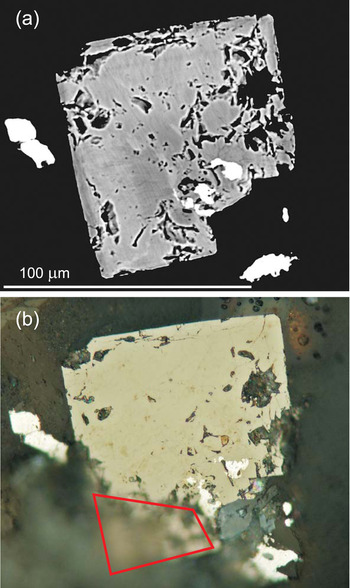
Hrabákite forms euhedral prismatic crystals with a cross-section ca. 120 μm × 120 μm (Fig. 1) and allotriomorphic grains up to 100 μm in length. The mineral is grey with a brownish tint and is opaque in transmitted light; it has a metallic lustre. No cleavage was observed; the fracture is conchoidal. The calculated density (Z = 1) for the empirical formula is 6.37 g/cm3; for the ideal formula 6.41 g/cm3. Mohs hardness is assumed at 5–6 by analogy with the hauchecornite group of minerals. In reflected light, hrabákite is grey with a brown hue and weak bireflectance. Pleochroism is not observed. Anisotropy under crossed polars is very weak (brownish tints) to absent. Internal reflections were not observed. Reflectance spectra were measured in air with a TIDAS MSP400 spectrophotometer attached to a Leica microscope (50× objective) using a WTiC (Zeiss no. 370) standard, with a square sample measurement field of ca. 7 μm × 7 μm. The results from the 400–700 nm range are given in Table 1 and plotted in Fig. 2. The measured data of hrabákite are compared (Fig. 3) with published data for tučekite, hauchecornite and arsenotučekite (Criddle and Stanley, Reference Criddle and Stanley1993; Picot and Johan, Reference Picot and Johan1982; Zaccarini et al., Reference Zaccarini, Bindi, Tsikouras, Grammatikopoulos, Stanley and Garuti2020).
Euhedral prismatic crystal of hrabákite from Příbram; (a) back-scattered electron photo, white mineral is silver; (b) reflected light photo, partly crossed polars; the fragment for single-crystal study was removed from the area outlined in red; cotype sample P1P 30/2020.

Reflectivity curves for hrabákite.

Reflectivity curves for hrabákite compared with published data for tučekite (Criddle and Stanley, Reference Criddle and Stanley1993), hauchecornite (Picot and Johan, Reference Picot and Johan1982) and arsenotučekite (Zaccarini et al., Reference Zaccarini, Bindi, Tsikouras, Grammatikopoulos, Stanley and Garuti2020).

Reflectance values (%) for hrabákite.

R min and R max correspond to minimum and maximum reflectance, respectively, measured in different extinction positions. The reference wavelengths required by the Commission on Ore Mineralogy (COM) are given in bold.
Chemical composition
Chemical analyses were performed using a Cameca SX100 electron microprobe (National Museum, Prague) operating in wavelength-dispersive mode (25 kV, 20 nA and 2 μm wide beam). The following standards and X-ray lines were used to minimise line overlaps: Ag (AgLα), Au (AuMα), Bi (BiMβ), CdTe (CdLα), Co (CoKα), chalcopyrite (CuKα, SKα), FeS2 (FeKα), HgTe (HgMα), Ni (NiKα), NiAs (AsLα), PbS (PbMα), PbSe (SeLα), PbTe (TeLα), Sb2S3 (SbLα), Tl(Br,I) (TlLα) and ZnS (ZnKα). Peak counting times were 20 s for all elements and 10 s for each background. Some elements, such as Au, Bi, Cd, Te and Zn were found to be below the detection limits (0.02–0.05 wt.%). Raw intensities were converted to the concentrations of elements using the automatic ‘PAP’ (Pouchou and Pichoir, Reference Pouchou and Pichoir1985) matrix-correction procedure.
Analytical data for the hrabákite crystal used for single-crystal study are given in Table 2; it leads to the empirical formula (n = 11) (Ni8.91Co0.09Fe0.03)Σ9.03(Pb0.94Hg0.04)Σ0.98(Sb0.91As0.08)Σ0.99S7.99. The ideal formula is Ni9PbSbS8, which requires Ni 47.44, Pb 18.60, Sb 10.93 and S 23.03, a total of 100.00 wt.%. Representative analyses for all the hrabákite and Pb-rich tučekite grains in the cotype samples are given in Table 3. The grains studied show distinct PbSb–1 substitution, from Pb-rich tučekite with 0.34–0.47 apfu Pb to hrabákite with Pb up to 1.29 apfu (Fig. 4). The contents above 1 apfu Pb confirmed the possibility of partial occupation of Pb at Sb2 octahedrons (see below).
The Pb vs. Sb (apfu) graph for hrabákite (crystal used for single-crystal study) and members of hrabákite–tučekite solid solution found in cotype samples from Příbram.

Chemical data (wt.%) for the hrabákite crystal used for single-crystal X-ray study (n = 11).

S.D. – standard deviation
Representative analyses (wt.%) for hrabákite and Pb-rich tučekite from Příbram.

Samples: [1–3] hrabákite – crystal used for the single-crystal study; [4–11] hrabákite – cotype samples; [12–14] Pb-rich tučekite – cotype samples; coefficients of empirical formula were calculated on the basis 19 apfu. ‘–’ = not detected.
The determined minor contents of Co and Fe do not exceed 0.31 and 0.13 apfu, respectively (Fig. 5), and no correlation with Pb/Sb ratio was observed.
Comparison of Co and Fe contents (apfu) for hrabákite (crystal used for single-crystal study) and members of hrabákite–tučekite solid-solution found in cotype samples from Příbram.

X-ray diffraction data
Powder X-ray diffraction data could not be collected due to paucity of material, therefore calculated (PowderCell 2.3; Kraus and Noltze, Reference Kraus and Nolze1996) powder diffraction data using the atom coordinates from our crystal structure study are given in Table 4. The calculated data for hrabákite are very close to the powder X-ray diffraction pattern of hauchecornite (Kocman and Nuffield, Reference Kocman and Nuffield1974).
Calculated X-ray powder diffraction data for hrabákite.

Intensity and d hkl were calculated using the software PowderCell2.3 (Kraus and Nolze, Reference Kraus and Nolze1996) on the basis of the structural data given in Tables 5 and 6. Only reflections with I rel. ≥ 4.0 are listed. The eight strongest reflections are given in bold.
A short prismatic fragment of hrabákite, 28 μm × 16 μm × 11 μm in size, extracted from the polished section analysed using electron microprobe (Fig. 1), was mounted on glass fibre and examined with a Rigaku SuperNova single-crystal diffractometer equipped with an Atlas S2 CCD detector and a microfocus MoKα source. Data reduction was performed using CrysAlisPro Version 1.171.39.46 (Rigaku, 2019). The data were corrected for Lorentz factor, polarisation effect and absorption (multi-scan, ABSPACK scaling algorithm; Rigaku, 2019). The ω rotational scans (frame width of 1.0°, counting time 700 seconds) were adopted for the acquisition of the three-dimensional intensity data. From the total of 3783 reflections, 262 were independent and 216 classified as unique observed with I >3σ(I). Corrections for background, Lorentz effects and polarisation were applied during data-reduction in CrysAlis software. A correction for absorption, using Gaussian integration (μ = 32.05 mm−1) was applied in Jana2006 (Petříček et al., Reference Petříček, Dušek and Palatinus2014) to the data, with R int of 0.0218.
The crystal structure of hrabákite was solved from the X-ray data using the intrinsic phasing algorithm of the SHELXT program (Sheldrick, Reference Sheldrick2015) and refined using Jana2006 (Petříček et al., Reference Petříček, Dušek and Palatinus2014). The crystal data and the experimental details are given in Table 5, atom coordinates, atomic displacement parameters and site occupancies in Table 6 and selected interatomic distances in Table 7. Atom labels are given in a similar style to tučekite and hauchecornite. Anisotropic displacement parameters are reported in the crystallographic information file that has been deposited with the Principal Editor of Mineralogical Magazine and is available as Supplementary material (see below).
Summary of data collection conditions and refinement parameters for hrabákite.

Atom positions and equivalent displacement parameters (in Å2) for hrabákite.

Selected interatomic distances (in Å) in hrabákite.

The unit-cell of hrabákite is undoubtedly the same as reported for tučekite by Just and Feather (Reference Just and Feather1978). There were no, not even weak, reflections for arsenohauchecornite, which might have indicated using metrics given by Grice and Ferguson (Reference Grice and Ferguson1989). The structure of hrabákite (Fig. 6) has a general structure architecture similar to hauchecornite (Kocman and Nuffield, Reference Kocman and Nuffield1974). It consists of alternating layers of Ni atoms and S, Pb and Sb atoms, parallel to (100), at approximately one-fourth intervals of the a cell dimension. The structure contains four distinct metal cation sites; two are labelled here as Sb and the other pair as Ni; both are mixed sites. The Sb1-coordination polyhedron site is a distorted cube (six direct neighbours and eight half-direct neighbours up to 3.53 Å); the Sb1 site is populated dominantly by Pb (Table 6). The Sb2-coordination polyhedron is a distorted octahedron, dominated by Sb. The corresponding volume of the Sb1 Voronoi–Dirichlet polyhedron (Fig. 7) is larger (19.81 Å3) than that of Sb2 (17.10 Å3), which is in line with the preferential substitution of Pb into the larger cubic-Voronoi polyhedron. The Ni1 site is occupied dominantly by Ni, with minor Co (~0.9/0.1); the Ni1 Voronoi–Dirichlet polyhedra is a nearly regular cube (V VDP = 14.01 Å3). The Ni2 site is dominated by Ni along with minor Fe; the coordination polyhedra is an irregular square pyramid (distorted octahedron for Voronoi polyhedra represented by eight neighbours; V VDP = 13.91 Å3). Unlike arsenohauchecornite, the bond lengths of Sb and Pb in hrabákite are relatively similar and do not lead to structural distortions. Therefore, it keeps metrics similar to hauchecornite (Fig. 8).
The crystal structure of hrabákite projected down the c axis. Atoms: Sb1 = dark grey; Sb2 = light grey; Ni = azure blue; and S = yellow spheres. Unit-cell edges are outlined in black lines.

Voronoi–Dirichlet polyhedra for selected atoms in the structure of hrabákite. (a) Sb1 and Sb2; (b) Ni1; and (c) Ni2.

Geometric relationship of the hrabákite/tučekite unit cell metrics (light-grey square) and arsenotučekite (dashed lines). The colour scheme is the same as in Fig. 6.

Relationship to known species
Hrabákite does not correspond to any valid or invalid unnamed mineral (Smith and Nickel, Reference Smith and Nickel2007). It is the first Pb-containing member of the hauchecornite group, Strunz class 2.BB.10, Dana class 3.2.5. A comparison of selected data for valid members of this group is given in Table 8.
Members of the hauchecornite group.

(1) This paper; (2) Just and Feather (Reference Just and Feather1978); (3) Kocman and Nuffield (Reference Kocman and Nuffield1974); (4) Just (Reference Just1980); (5) Kovalenker et al. (Reference Kovalenker, Evstigneeva, Begizov, Vyal´sov, Smirnov, Krakovetskii and Balbin1978); (6) Gait and Harris (Reference Gait and Harris1980); (7) Grice and Ferguson (Reference Grice and Ferguson1989); (8) Zaccarini et al. (Reference Zaccarini, Bindi, Tsikouras, Grammatikopoulos, Stanley and Garuti2020).
Remarks on the origin of hrabákite
The economically most important uranium and base-metal mineralisation of the Příbram uranium ore district originated during four main mineralisation stages: (I) siderite–sulfidic; (II) calcite; (III) calcite–uraninite; and (IV) calcite–sulfidic (Komínek, Reference Komínek1995). The oldest siderite–sulfidic stage (I) is developed on a smaller scale in comparison with the neighbouring Březové Hory district. The younger calcite stages, characterised by notably lower temperatures, are more abundant; calcite generations were used in distinguishing individual mineralisation stages (Komínek, Reference Komínek1995). For the calcite stage (II), pre-ore calcite DK and calcite K1 are characteristic. In the calcite–uraninite stage (III), carrying the main part of the economic uranium mineralisation (uraninite, coffinite and U–bearing anthraxolite), calcite types K2–4 are present. The age of the uranium mineralisation obtained by U–Pb radiometric age determination of two uraninite samples is early Permian, 275 ±4 and 278 ±4 Ma (Anderson, Reference Anderson1987). In the last calcite–sulfidic stage (IV), post-ore calcites K5 appear and Ag, Ag–Sb, Sb and As–Sb bonanza-type accumulations occur in this mineralisation stage.
Siderite I found in mineralisation in this investigation undoubtedly belongs to the oldest siderite–sulfide mineralisation stage, as is shown by its composition and fluid-inclusion homogenisation temperatures between 190 and 220°C (cf. Žák and Dobeš, Reference Žák and Dobeš1991). Hrabákite crystals, observed in polished sections, enclose or overgrow grains/aggregates of native silver (Fig. 1) and are overgrown by gersdorffite and, later, by galena. This evidence implies a paragenetically late position of this mineral phase and its relation to younger hydrothermal processes possibly related to some of the younger mineralisation stages. This is in line with temperature estimates derived from associated minerals present in the studied material: chlorite thermometry based on the amount of tetrahedral Al (Cathelineau, Reference Cathelineau1988) suggests temperatures between 66 and 133°C and aqueous primary fluid inclusions hosted by dolomite show homogenisation temperatures between 58 and 101°C. The presence of structures from the replacing of native arsenic by (sulfo)arsenides and abundant occurrence of Hg-rich silver indicates remobilisation processes caused by later hydrothermal fluids. Partial dissolution of earlier Ni–Co arsenides (represented here by nickeline) associated with remobilisation of Ni and Co by younger S-rich Pb–Zn–Sb bearing hydrothermal fluids led to the formation of minerals with an exotic ‘mixed’ geochemical signature including Co–Ni-bearing sphalerite, Co–Ni-bearing carbonates, Cu–Pb–Zn–Sb–Co-bearing Ni-chlorite and also Ni–Pb–Sb mineral hrabákite. Ore dissolution, remobilisation and replacement phenomena were also detected widely in other ore veins of the Příbram uranium and base-metal ore district (Sejkora et al., Reference Sejkora, Škácha and Dolníček2019; Škácha et al., Reference Škácha, Sejkora and Dolníček2019).
Acknowledgements
The helpful comments of two anonymous reviewers, Daniel Atencio, Associate Editor František Laufek and Principal Editor Stuart J. Mills are greatly appreciated. The research was financially supported by the project 19-16218S of the Czech Science Foundation for PŠ, JS, ZD and JU.
Supplementary material
To view supplementary material for this article, please visit https://doi.org/10.1180/mgm.2021.1