




No CrossRef data available.
Article contents
PREVENTION COULD BE LESS COST-EFFECTIVE THAN CURE: THE CASE OF HEPATITIS C SCREENING POLICIES IN FRANCE
Published online by Cambridge University Press: 21 April 2004
Abstract
Objectives: To access the cost-effectiveness of French recommendations for hepatitis C virus (HCV) screening and the extent to which earlier identification of carriers may or not improve the cost-effectiveness of therapeutic strategies.
Methods: Cost-effectiveness analysis were performed using decision-tree analysis and a Markov model. Four alternative strategies were compared: no screening and no treatment; initiation of HCV treatment after the diagnosis of cirrhosis; and two alternative strategies refer to the current French policies of HCV testing, i.e., two enzyme immunoblot assay (EIA) tests in series, or a polymerase chain reaction (PCR) analysis after the first positive EIA test. Costs were computed from the viewpoint of the health care system. The analysis has been applied to populations particularly at risk of infection, as well as the general population.
Results: The “wait and treat cirrhosis” strategy was more cost-effective in the general population and in transfusion recipients. The incremental cost-effectiveness ratio of this strategy compared with baseline strategy was 3,476 of euros and €15,300 in respective cohorts. Considering the HCV screening strategy, the additional cost would be of €4,933 and €240,250 per additional year of life saved, respectively. In the intravenous drug user (IDU) population, the “two EIA” screening strategy was the more cost-effective alternative, with an additional cost of €3,825 per additional year of life saved.
Conclusions: HCV screening would be discarded for transfusion recipients but should be encouraged for IDUs and also for the general population, in which the additional cost of screening is an order of magnitude more acceptable.
Information
- Type
- GENERAL ESSAYS
- Information
- International Journal of Technology Assessment in Health Care , Volume 19 , Issue 4 , December 2003 , pp. 632 - 645
- Copyright
- © 2004 Cambridge University Press
Since the identification of the hepatitis C virus (HCV) in 1989, there has been increasing evidence that hepatitis C has become a major public health problem in most industrialized countries (1). In France, hepatitis C virus carrier rate has been estimated to be 1.2% in the general adult population, which leads to an estimate of more than 600,000 infected individuals in the country (10).
Systematic HCV screening in blood donations was introduced in France as soon as 1991 to improve blood safety. Effective treatments for patients with chronic hepatitis C, who are at very high risk of developing liver disease, have been available since 1991 with the first results of clinical trials using interferon alpha (IFN) monotherapy (48); more recently, bitherapy of IFN with specific antiretroviral agents (such as ribavirin) have proved to increase therapeutic effectiveness (9;37;38). In addition, it has been suggested that early initiation of treatment among patients with chronic hepatitis C is associated with a higher response rate (8;44). Economic evaluation of these treatments has shown that their cost-effectiveness ratios (marginal cost per life year or quality adjusted life year [QALY] saved) are in the order of magnitude of many already implemented heath interventions and have, therefore, supported diffusion of these therapeutic innovations (6;25;51). Only a limited fraction of HCV-infected individuals, estimated at less than 5% in France, currently have access to these treatments. Such a gap may partly be due to uncertainties in estimation of needs for HCV treatment and to contraindications for treatment among diagnosed patients. It is very likely, however, that the main factor for limited access to treatment has to be related to the fact that most HCV-infected patients may not know their serologic status (4;41) and have not been offered HCV screening.
Limited access to available cost-effective treatment raises the issue of public health recommendations for HCV screening, of the extent to which earlier identification of carriers and initiation of treatment may or not improve the cost-effectiveness of therapeutic strategies, and of the specific populations who may justify systematic screening.
In 1997 and 1999, two consensus conferences, one at the French (2) and the other at the European (14) levels, issued recommendations that urged health care professionals to systematically offer hepatitis C screening to the following patient groups: hemodialysis patients, patients with history of blood transfusion before 1991, drug users who either inject or sniff drugs, persons with history of incarceration, and health care professionals after occupational exposure to potentially infected blood. On the reverse, “on the basis of current evidence,” recommendations excluded systematic HCV screening targeted toward pregnant women, patients who had surgery or other invasive medical interventions before 1986, health care professionals (outside the context of occupational needlestick injury), as well as the general population (40). The explicit rationale for such recommendations was that screening targeted toward specific high-risk groups would be more cost-effective than mass screening. The consensus conferences also recommended the following strategy for HCV screening in the concerned populations: enzyme immunoblot assay (EIA) serologic test followed by another EIA or a polymerase chain reaction test (PCR) to confirm a positive EIA preliminary result, and included the necessity to investigate for HCV diagnosis among patients who present clinical signs or biological indicators that suggest chronic hepatitis C such as chronic fatigue, nausea, irritability, abnormal serum alanine aminotransferase (ALT), and so on.
These recommendations were ultimately officially endorsed by the French Ministry of Health. In 2001, the French public agency for accreditation for medical centers and for evaluation of medical practice (ANAES) was asked to review the impact of these recommendations. In parallel, we carried out a cost-effectiveness study to assess the economic rationale of current French guidelines for HCV screening.
The aim of the study was to compare the incremental cost per life year saved of alternative strategies for initiation of treatment of chronic hepatitis C in various groups who differ for HCV prevalence rates: systematic screening and early initiation of HCV treatment for true HCV-positive patients versus initiation of HCV treatment after clinical diagnosis in routine medical practice. Both alternatives were compared with the baseline strategy (no screening no treatment).
STUDY DESIGN
Decision Analytic Model
The decision analytic model estimated the population's life expectancy and the lifetime expenditures for each alternative strategy, then, the cost and the effectiveness between exclusive strategies were compared such that the additional cost that is required to obtain the additional effectiveness of a more effective strategy can be determined. The lower the value of the ratio is, the higher the priority in terms of maximizing the benefits derived from a given health expenditure. Four strategies were entered into a decision tree by means of the software package TreeAge (DATA 3.5).
Markov Model
To assess the potential longer-term impact of HCV screening program in terms of years of life saved, we developed a Markov model of health status in hepatitis C to describe the progression of liver disease from chronic hepatitis C through health states and the possible transition among them for each year (46). The natural history of HCV infection was defined by six disease states: chronic hepatitis C, compensated cirrhosis, decompensated cirrhosis, liver transplantation, hepatocellular carcinoma, and death. As shown in Figure 1, patients may progress from one state to another each year by given probabilities of transition, obtained from published clinical studies (3;25;32). Prognosis depended on whether the treatment was given, the response to treatment, and the natural mortality of each group, based on age repartition. We modeled a cohort of 1,000 individuals, and we assumed that patients would be initially in two HCV states according to the recent data of a French study (11): 70% in chronic hepatitis C state and 30% in cirrhotic state, irrespective of the prevalent group.

Natural history of hepatitis C virus disease in Markov model with transition probabilities (pound sign=1−SPi)
METHODS
Alternative Strategies Compared
Four different attitudes toward initiation of HCV treatment in various groups, who differ for HCV prevalence rates, were compared. The first attitude refers to the baseline strategy and consists of neither HCV screening nor HCV treatment, but management of HCV complications (cirrhosis, decompensated cirrhosis, hepatocellular carcinoma, and liver transplantation). In the literature, there has been reported the possibility that the treatment of hepatitis C even for patients with cirrhosis may be effective. Therefore, we analyzed a second alternative strategy (strategy “wait and treat cirrhosis”) using the hypothesis of initiation of HCV treatment after the diagnosis of cirrhosis, when disease becomes symptomatic. The third and fourth alternative strategies refer to the current French policies of HCV testing. Two different technical modalities available for HCV screening were considered: strategy “two EIA” in which a EIA test followed a first positive EIA test; strategy “EIA, PCR” in which a PCR test was added to a first positive EIA test. These modalities for HCV testing were recommended according to the level of prevalence: an additional PCR test in high-risk groups for HCV infection, and an additional EIA test in the opposite groups. In our model, we analyzed both screening strategies, irrespective of the prevalent groups to evaluate the relevance of French screening policy. The study assessed the additional costs and effectiveness of the strategies of treatment of cirrhosis and of screening in comparison to the baseline strategy.
Screening Strategies
Screening tests are characterized by their own sensitivity and specificity (numbers into brackets represent low and high estimations for sensitivity and specificity issued from published studies): EIA testing were used to determine the presence of HCV antibody in the sera. Sensitivity and specificity of a third-generation EIA are, respectively, 97.2% [92-99%] and 99.7% [98-100%] (7;20;29); testing nucleic acids by PCR technique were used to determine the presence of HCV RNA in sera (31), PCR sensitivity and specificity are, respectively, 99.9% [99.8-100%] and 99.8% [98-100] (17;34;39).
Treatment Options
Regardless of the screening strategy under consideration, only patients with chronic hepatitis C and cirrhosis would undergo treatment, except for patients who are medically noneligible for treatment, and for patients who refused to receive any treatment (approximately 50% of chronic hepatitis and 40% of cirrhosis cases were treated in France in 1999) (11).
Only the most effective treatment strategy published in the literature was considered: recombinant IFN plus ribavirin for twelve months and another six months for relapsers, who were defined as patients with detectable HCV RNA at the end of the follow-up period. According to international published studies, this treatment gives, in infected chronic hepatitis C patients, a sustained response rate of 45% after twelve months and for relapsers after an additional six months of combination therapy (9;33;37;44). For patients with cirrhosis, the rate of sustained response is lower and estimated in the two studies to be around 33% (33;37). We assumed that patients with no response have the same prognosis as patients who are not treated and that they receive no longer term benefit from treatment. We assumed also that patients with sustained response would not develop progressive diseases, and they are considered to have recovered from the hepatitis C.
Populations Studied
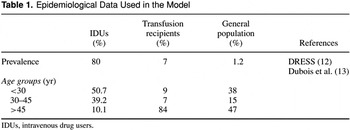
We assumed three different populations at more or less risk for HCV infection: intravenous drug users (IDUs), patients transfused before 1991, and the general French population. To determine the expected consequences of alternative strategies, we defined each population according to HCV prevalence, age repartition, and natural mortality, based on published studies or official French government statistics (Table 1) (12;13). The posttransfusion mortality, in the absence of HCV infection, was issued from two studies (26;43). After reviewing several studies on mortality of IDUs, the standardized mortality rate in the IDU population was estimated to be at least 3.5 (3.5-63.8) times higher than in the general population (16;19;22;35;36;52). We used those estimates to value the mortality of IDUs.

MAIN OUTCOME MEASURES
Effectiveness Outcomes
Effectiveness was calculated by using different outcome measurements: number of true positive HCV-infected detected, number of cases of HCV infection averted, and finally, number of potential life years saved. The number of life years saved was calculated according to the population's age repartition and population's life table. In the model, the time period was the life expectancy of the population.
Costs Outcomes
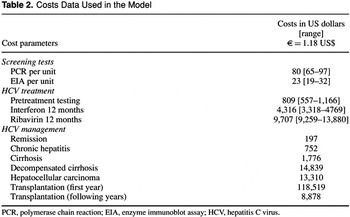
Taking the health care system perspective, the model incorporated both the costs of screening and pretreatment testing (as PCR and biopsy investigations) and the costs of treating and managing HCV disease (Table 2); 1998 prices were used. Nonmedical direct costs and indirect costs were excluded. The estimated costs of treating and managing HCV disease were based on a previous French report, including inpatient, outpatient, and drug costs for each state of health (3). Additional cost implications of false-positive results issued from screening strategies were calculated by adding the cost of pretreatment testing (as biopsy for example); additional cost implications of false-negative results were calculated by taking into account that false-negatives would be diagnosed later and represented then future costs of managing HCV disease complications.

All costs were converted to US$ for presentation by use of December 1998 currency conversion rates of 1.18 US$ per Euro. Costs of screening strategies were based on the French social insurance reimbursement tariffs. Treatment and medical care costs were obtained from a French published study (3). Both costs and effectiveness were discounted at the recently recommended rate of 3% (18), but we also repeated our analysis with the earlier figure of 5% and the extreme value of 10% to compare with previous economic analyses.
Sensitivity Analysis
To take into account the variation in published data, a series of one-way sensitivity analyses were undertaken to examine the effect of varying data over a wide range on the results. We used the range from the literature (the low and high estimations) for sensitivity and specificity for screening tests, for natural mortality rate and disease prevalence in each subgroup at risk for HCV infection, and for discount rate. Also, we checked if a variation of 50% in the treatment and medical follow-up costs would fundamentally affect the results.
RESULTS
Baseline Analysis
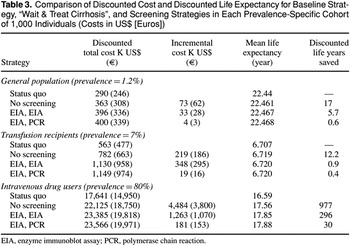
Table 3 summarizes the effects of the four initiation treatment strategies on costs and effectiveness based on our base-case scenario. Among the three prevalence-specific cohorts, the model estimated the length of time for disease progression from chronic hepatitis C to later stages of liver disease and death. Our model estimated that the effect of both screening and treatment on effectiveness outcome of chronic hepatitis C was small. In the general population, cumulative discounted life expectancy increased from 22.44 years without either screening or treatment to 22.46 with “wait and treat cirrhosis” strategy and 22.47 with screening and treatment of medically eligible HCV-infected patients. The effectiveness issued from screening and treatment was affected by the prevalence but also by the mortality characteristics of the specific groups. For example, in IDUs, the increase of life expectancy was a little higher (respectively, 16.59, 17.56, and 17.88). In transfusion recipients, these values were 6.707, 6.719, and 6.720.

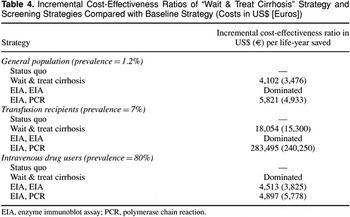
Results of the cost-effectiveness analysis for each cohort are shown in Table 4. By referring to the decision rules for cost-effectiveness analysis illustrated by Karlsson and Johannesson (23), we have introduced the principle of dominance to exclude dominated strategies. Then, no one strategy has been eliminated on the principle of strictly dominance (more expensive and less effective), irrespective of the population considered.

Although screening strategies were more efficacious (that is more life years saved), the strategy “wait and treat cirrhosis” was more cost-effective in the general population for which HCV prevalence is small and in transfusion recipients for which the mortality rate is high. The incremental cost-effectiveness ratio (ICER) of this strategy compared with baseline strategy was $4,102 (€3,476) and $18,054 (€15,300) per additional life-year saved. Considering the “EIA, PCR” screening strategy applied in the general population, less than seven additional years of life would be saved in a cohort of 1,000 individuals, compared with “wait and treat cirrhosis” strategy for an additional cost of $5,821 (€4,933) per additional year of life saved. The decision to screen and treat early infected transfusion recipients dramatically increased the cost-effectiveness ratio: $283,495 (€240,250) per additional life year saved.
In IDUs, screening strategies dominated by extension the strategy “wait and treat cirrhosis.” The “two EIA” screening strategy was the more cost-effective strategy with an additional cost of $4,513 (€3,825) per additional year of life saved, compared with the baseline strategy. To save an additional life year, using strategy “EIA, PCR,” the additional cost would be $5,778 (€4,897).
Sensitivity Analysis
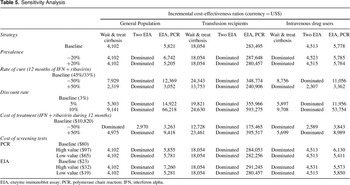
We varied each model variable over a wide range of possible values (Table 5). By using a 5% or 10% discounting rate increased the value of the ICER in all populations but did not change the hierarchy of cost-effective strategies, except for the IDU population, in which a discount rate above 5% induced an alteration in strategies hierarchy: “wait and treat cirrhosis” became more cost-effective than screening strategies with an ICER of $5,897. When the discount rate was 10%, then, the ICER screening strategy doubled in the general and the IDU populations ($9,141 and $9,708, respectively).

If sensitivity and specificity of EIA were modified considering plus 1%, the “two EIA” strategy became more cost-effective than the “EIA, PCR” screening strategy. Change in sensitivity and specificity of 1% for PCR test did not alter the hierarchy of alternative strategy. As expected, sensitivity analysis of prevalence rates changed, slightly, the magnitude order of the results, but the hierarchy of the cost-effectiveness of alternative strategies was not altered.
A diminution of 50% in the cost of treatment changed the magnitude order of ICERs in each population but also changed the hierarchy of the strategy in the general population: screening strategies became more cost-effective than “wait and treat cirrhosis,” with an ICER for “EIA, PCR” of $2,970. In the IDU population, the consequence of a 50% increase in treatment costs was that “wait and treat cirrhosis” became more cost-effective than screening strategies. Indeed, the true cost was probably overestimated in the base-case scenario. Considering an alteration of the rate of cure, a 50% reduction revealed that “wait and treat cirrhosis” was more cost-effective than screening strategies in the IDU population but altered also the value of ICERs in each prevalent group.
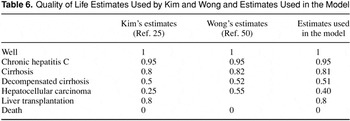
With regard to the potential interest of utility weight, quality of life adjustments based on published data (Table 6) were used as a second outcome in sensitivity analysis (25;50). In both studies, utility weights were estimated by using expert assessments, thus there were potential biases. Nevertheless, when the quality of life associated with HCV disease states was estimated, ICERs remained stable.

Considering, at last, a change in the cost of screening tests, and using the extreme value of the interval, results were not modified. PCR cost would have to fall to a value of $18 to reveal the “EIA, PCR” strategy at the lowest ICER in IDUs compared with the “two EIA” screening strategy.
DISCUSSION
Our decision analysis suggests that, in the case of general and blood-transfused populations, the most cost-effective strategy is “wait and treat cirrhosis.” On the other hand, a screening option appears to be the strategy of choice for the IDU population. Indeed, in the former, benefits from an early treatment following a screening program – as they can be assessed in terms of life-years saved – appear to be much less than the additional costs induced by the program in question. Nevertheless, compared with current medical care strategies, ICERs of hepatitis C screening strategies are clearly lower than the socially acceptable threshold – estimated by health economists at $70,000 (€59,300) per life-year saved (except in the case of transfusion recipients) (28). This finding is particularly true for the subgroup of IDUs for which the ICER of the “two EIA” screening strategy is less than $4,513 (€3,825) when compared with the baseline strategy. Compared with other accepted public policies, an incremental cost-effectiveness ratio of less than $7,000 (€5,930) per life-year saved has been considered acceptable for recent advances in breast cancer chemo- and hormonal therapies in the case of postmenopausal women; this is also true for some road accident prevention programs (21;47). If one considers this threshold in relation to screening for hepatitis C, we can argue that HCV screening should be discarded for transfusion recipients, but encouraged for the general population.
To compared our results with cost-effectiveness analysis of HCV treatment in published study (5;51), combination therapy for twelve months has a cost-effectiveness ratio (when compared with no treatment) ranging between $500 and $62,000 (1995 prices), according to age at time of HCV treatment (5). Combination therapy of IFN and ribavirin for twelve months (when compared with bitherapy for 6 months) yielded a cost-effectiveness ratio of $2,330 (2000 prices) per life-year saved (51). These results suggest that the cost-effectiveness of HCV screening followed by potential treatment for IDUs compares favorably to cost-effectiveness ratios of HCV treatment.
Furthermore, our analysis demonstrates that the range of cost-effectiveness ratios of screening strategies between different prevalent groups does not follow the law of diminishing returns – if one takes into account the corresponding age repartition and natural mortality rates in each prevalent population. Nevertheless, the reference to diminishing returns has not been always used. In a previous study, we showed that decision makers can be more sensible to the “principle of caution” than to the law of diminishing returns (30). In October 2000, the French public authorities decided the systematic adjunction of a PCR testing to a third-generation EIA test to screen hepatitis C in blood donations. Previously, in 1999, we realized a cost-effectiveness analysis, which showed that the additional cost per potentially life-year saved due to the introduction of the PCR was higher than $77 million. Based on these considerations, our results emphasize the nonsense of decisions on HCV screening in blood donations and not in the wide population where screening would be more cost-effective. Furthermore, our results emphasize the relevance of a mass-screening program compared with the screening of transfusion recipients, even if the prevalence in transfusion recipients is higher than in the general population.
An important question commonly addressed to health economics by public health professionals is whether prevention is more cost-effective than cure. Kenkel (24) explained that “prevention is often mentioned as a system-cost-containment strategy,” suggesting that prevention usually reduces medical expenditures. In the case of a screening program, the objective is to reduce morbidity and mortality after a prevalent disease, and in some cases, to reduce disease incidence in the case of transmissible disease. Thus, hepatitis C screening associated with potential early treatment might reduce future medical expenditures. However, our results show that this is not always the case and that screening increases medical expenditures. Indeed, several publications showed that prevention is not always cost-effective. In this way, Russell (42) suggests that, for many cases, prevention could be more expensive than cure. Tengs et al. (47) also provide many examples for which prevention is less cost-effective than cure. One can suspect that discounting future costs due to time preference rate for the present may play a role in this issue. In effect, this makes the costs of screening and early treatment higher than those of late treatment and its associated medical follow-up. However, the sensitivity analysis shows that the choice of the discount rate alters the magnitude of cost-effectiveness ratios but not the hierarchy of cost-effective strategies. In practice, the choice between accepting the strategy with the lowest incremental cost-effectiveness ratio (no screening) or accepting a deterioration of the ICER to increase the overall effectiveness with HCV screening has to be taken in relation with the amount of resources allocated for health programs.
Bearing in mind the above discussion, we shall focus on the limitations of our analysis. First, our analysis considers the availability of all effectiveness and costs outcomes components of all the alternative strategies, including the screening option. However, for both false-positives and false-negatives, consequences have been estimated including only direct costs. A more adequate estimation without neglecting human costs of the misleading information, including the psychological well-being of the false-positive patients, as well as the indirect costs of false-negatives (particularly the loss of productivity) could have been used. Moreover, we have not considered external costs related to other future medical consequences (for example, HCV transmission decrease due to screening). In light of these considerations, it would also be informative to assess HCV screening social costs and benefits using a cost-benefit approach. This assessment makes use of respondents willingness to pay (WTP) values elicited, the most common, directly using the contingent valuation approach. This method would permit the assessment of the value of different health states (including death) directly and in the same measurement units as the costs. However, despite substantial advances in this area, the validity and the reliability of the stated WTP values remain questionable.
Second, we have not taken into account the frequency of the screening. The results presented were based on the assumption that screening programs were effective in the first year. This assumption tends to bias in favor of both screening and no screening. Considering that all infected people would be detected in the first year of the screening program, whereas treatment would occur overall the life time period, this method overestimates the cost of screening due to discount rate applied on future costs. On the other hand, early treatment after screening program gives effectiveness the first year, and then underestimates the effect of the natural history of the disease during the first years.
POLICY IMPLICATIONS
To conclude, our analysis suggests that HCV screening should be encouraged for the IDU population and the general population. Even if treatment is more cost-effective than screening in low-risk groups, the additional costs of screening compared with no screening is in an order of magnitude more acceptable for the general population. Of course, the formulation of policies for HCV screening should also take into account other factors, including social benefits, as we discussed above, but also ethical aspects (45;49), as well as public perceptions of risk (15;27).
References
Alter MJ,
Kruszon-Moran D,
Nainan OV,et al.
1999
The prevalence of hepatitis C virus infection in the United States, 1988 through 1994.
N Engl J Med.
34:
556-
562.Google Scholar
ANAES.
1997
Conférence de consensus française. Hépatite C: dépistage et traitement.
Virologie.
1:
145-
162.
Aubert C,
Colin C.
1998
Dépistage de l'hépatite C avant et après transfusion; Evaluation médico-économique des stratégies de dépistage des hépatites C et non-A, non-B, non-C chez les receveurs de produits sanguins labiles.
Lyon (France):
Département d'Information Médicale, Hospices Civils de Lyon;
sponsored by the Fonds d'Orientation à la Recherche en Transfusion Sanguine (FORTS);
Bello PY,
Pasquier C,
Gourney P,et al.
1998
Assessment of a hepatitis C virus antibody assay in saliva for epidemiological studies.
Eur J Clin Microbiol Infect Dis.
17:
570-
572.Google Scholar
Bennett W,
Inoue Y,
Beck R,et al.
1997
Estimates of the cost-effectiveness of a single course of interferon alpha2b in patients with histologically mild chronic hepatitis C.
Ann Intern Med.
127:
855-
865.Google Scholar
Bennett W,
Pauker S,
Davis G,
Wong J.
1996
Modelling therapeutic benefit in the midst of uncertainty: Therapy for hepatitis C.
Dig Dis Sci.
41:
56S-
62S.Google Scholar
Colin C,
Lanoir D,
Touzet S,et al.
2001
Sensitivity and specificity of third generation hepatitis C virus antibody detection assays: An analysis of the literature.
J Viral Hepat.
8:
87-
95.Google Scholar
Craxi A,
Di Marco V,
Camma C,et al.
1996
Duration of HCV infection as a predictor of nonresponse to interferon.
Dig Dis Sci.
41:
86S-
92S.Google Scholar
Davis G,
Esteban MR,
Rustgi V,et al.
1998
Interferon Alpha 2b alone or in combination with ribavirin for the treatment of relapse of chronic hepatitis C.
N Engl J Med.
339:
1493-
1499.Google Scholar
Desenclos J,
Dubois F,
Couturier E,et al.
1996
Estimation du nombre de sujets infectés par le VHC en France, 1994-95.
BEH.
5:
22-
23.Google Scholar
DRASS.
2001
Hépatite C: Programme régional Provence Alpes Côte d'Azur: Un état des lieux en 2000.
Marseille:
Direction Régionale des Affaires Sanitaires et Sociales;
1-
111.
DRESS.
2001
La prise en charge des toxicomanes dans les structures sanitaires et sociales – nov 1999.
Paris:
Séries études – documents de travail;
Dubois F,
Desenclos J,
Mariotte N,et al.
1997
Hepatitis C in a French population based survey, seroprevalence, frequency of viremia, genotype distribution, and risk factors.
Hepatology.
25:
1490-
1496.Google Scholar
EASL.
1999
International Consensus Conference on Hepatitis C. Paris, 26-28 février 1999, Consensus statement.
J Hepatol.
30:
956-
961.
Fischhoff B,
Lichtenstein S,
Slovic P,et al.
1981
Acceptable risk.
Boston:
Cambridge University Press.
Galli M,
Musicco M.
1994
Mortality of intravenous drug users living in Milan, Italy: Role of HIV-1 infection.
AIDS.
8:
1457-
1463.Google Scholar
Gerken G.
1996
Clinical evaluation of a single reaction, diagnostic polymerase chain reaction assay for the detection of hepatitis C virus RNA.
J Hepatol.
24:
33-
37.Google Scholar
Gold M,
Siegel J,
Russell L,et al.
1996
Cost-effectiveness in health and medicine.
Oxford:
Oxford University Press.
Grönbladh L,
öhlund L,
Grunne L.
1990
Mortality in heroin addiction: Impact of methadone treatment.
Acta Psychiatr Scand.
82:
223-
227.Google Scholar
Hennig H.
2000
Evaluation of newly developed microparticle enzyme immunoassays for the detection of HCV antibodies.
J Virol Methods.
84:
181-
190.Google Scholar
Hillner B,
Smith T,
Desh C.
1993
Assessing the cost-effectiveness of adjuvant therapies in breast cancer using decision analysis model.
Breast Cancer Res Treat.
25:
97-
105.Google Scholar
Joe G,
Simpson D.
1987
Mortality rate among opioid addicts in a longitudinal study.
Am J Public Health.
77:
347-
348.Google Scholar
Karlsson G,
Johannesson M.
1996
Decision roles of cost-effectiveness analysis.
Pharmacoeconomics.
9:
113-
120.Google Scholar
Kenkel D.
2000
Prevention.
In: Culyer AJ,
Newhouse JP, eds.
Handbook of health economics.
Amsterdam:
Elsevier;
1675-
1719.
Kim W,
Poterucha J,
Gross J,et al.
1997
Cost-effectiveness of 6 and 12-months of interferon-alpha treatment for chronic hepatitis C.
Ann Intern Med.
127:
866-
873.Google Scholar
Koretz R.
1993
Non A Non B post-transfusion hepatitis: Looking back in the second decade.
Ann Intern Med.
119:
110-
115.Google Scholar
Kourilsky P,
Viney G.
2000
The precaution principle: Report to the Prime Minister.
Paris:
Odile Jacob Editors;
Laupacis A,
Feeny D,
Detsky A,et al.
1993
Tentative guidelines for using clinical and economic evaluations.
Can Med Assoc J.
148:
927-
929.Google Scholar
Lavanchy D.
1996
Evaluation of a new automated third-generation anti-HCV enzyme immunoassay.
J Clin Lab Anal.
10:
269-
276.Google Scholar
Loubière S,
Rotily M,
Durand-Zaleski I,
Costagliola D.
2001
Including polymerase chain reaction in screening for hepatitis C virus RNA in blood donations is not cost-effective.
Vox Sang.
80:
199-
204.Google Scholar
MacDonald KL,
Mills WA,
Wood RC,et al.
1994
Evaluation of clinical and laboratory aspects of antibody tests for detection of hepatitis C virus infection in blood donors and recipients from a low-risk population.
Transfusion.
34:
202-
208.Google Scholar
Mathoulin-Pelissier S,
1998
for the Centre National d'Hémovigilance.
Etude sur les receveurs et produits transfusés en France Métropolitaine
(study RECEPT).
Bordeaux:
Université Victor Segalen Bordeaux 2;
McHutchison JG,
Poynard T.
1999
Combination therapy with interferon plus ribavirin for the initial treatment of chronic hepatitis C.
Semin Liver Dis.
19:
57-
65.Google Scholar
Morishima C,
Gretch D.
1999
Clinical use of hepatitis C virus tests for diagnosis and monitoring during therapy.
Clin Liver Dis.
3:
717-
740.Google Scholar
Oppenheimer E,
Tobutt C,
Taylor C,et al.
1994
Death and survival in a cohort of heroin addicts from London clinics: A 22-year follow-up study.
Addiction.
89:
1299-
1308.Google Scholar
Perucci C,
Davoli M,
Rapiti E,et al.
1991
Mortality of intravenous drug users in Rome: A cohort study.
Am J Public Health.
81:
1307-
1310.Google Scholar
Poynard T,
MarcellinP,
Lee S,et al.
1998
Randomised trial of interferon alpha2b plus ribavirin for 48 weeks or for 24 weeks versus interferon alpha2b plus placebo for 48 weeks for treatment of chronic infection with hepatitis C virus. International Hepatitis Interventional Therapy Group (IHIT).
Lancet.
352:
1426-
1432.Google Scholar
Reichard O,
Norkrans G,
Fryden A,et al.
1998
Randomised double-blind placebo-controlled trial of interferon alpha-2b with and without ribavirin for chronic hepatitis C.
Lancet.
351:
83-
87.Google Scholar
Roth W,
Marijke W,
Erhard S.
1999
Feasibility and efficacy of routine PCR screening of blood donations for hepatitis C virus, hepatitis B virus, and HIV-1 in a blood-bank.
Lancet.
29:
1596-
1601.Google Scholar
Rotily M,
Loubière S,
Nixon J,et al.
1997
Analyse socio-économique de différentes stratégies de dépistage de l'hépatite chronique C dans la population française.
Gastroenterol Clin Biol.
20:
S33-
S40.Google Scholar
Rotily M,
Vernay-Vaisse C,
Rousseau S,et al.
1999
Prevalence of HCV and HIV antibodies and related risk factors among entrants to the main south-eastern French prison.
Clin Microbiol Infect.
5:
733-
739.Google Scholar
Russell L.
1986
Is prevention is better than cure?
Washington:
The Brookings Institution;
Shapiro S,
Gershtein V,
Elias N,et al.
1998
mRNA cytokine profile in peripheral blood cells from chronic hepatitis C virus (HCV)-infected patients: Effects of interferon-alpha (IFN-alpha) treatment.
Clin Exp Immunol.
114:
55-
60.Google Scholar
Sicard D.
2000
The precaution principle and blood transfusion.
Transfus Clin Biol.
7:
220-
227.Google Scholar
Sonnenberg F,
Beck J.
1993
Markov models in medical decision making: A practical guide.
Med Decis Making.
13:
322-
338.Google Scholar
Tengs O,
Adams M,
Pliskin J,et al.
1995
Five hundred life-saving interventions and their cost-effectiveness.
Risk Anal.
15:
369-
390.Google Scholar
Tine F,
Magrin S,
Craxi A,et al.
1991
Interferon for chronic non-A, non-B hepatitis: A meta-analysis of randomized clinical trials.
J Hepatol.
13:
192-
199.Google Scholar
Wong J,
Bennett W,
Koff R,et al.
1998
Pre-treatment evaluation of chronic hepatitis C: Risks, benefits and costs.
JAMA.
280:
2088-
2093.Google Scholar
Wong JB,
Poynard T,
Ling MH,et al.
2000
Cost-effectiveness of 24 or 48 weeks of interferon alpha-2b alone or with ribavirin as initial treatment of chronic hepatitis C. International Hepatitis Interventional Therapy Group.
Am J Gastroenterol.
95:
1524-
1530.Google Scholar
Woody G,
Metzger D.
1993
Causes of death in injection-drug users.
N Engl J Med.
329:
1661.Google Scholar

Natural history of hepatitis C virus disease in Markov model with transition probabilities (pound sign=1−SPi)
Epidemiological Data Used in the Model
Costs Data Used in the Model
Comparison of Discounted Cost and Discounted Life Expectancy for Baseline Strategy, “Wait & Treat Cirrhosis”, and Screening Strategies in Each Prevalence-Specific Cohort of 1,000 Individuals (Costs in US$ [Euros])
Incremental Cost-Effectiveness Ratios of “Wait & Treat Cirrhosis” Strategy and Screening Strategies Compared with Baseline Strategy (Costs in US$ [Euros])
Sensitivity Analysis
Quality of Life Estimates Used by Kim and Wong and Estimates Used in the Model
 You have
Access
- 17
- Cited by