Introduction
Pearl millet [Pennisetum glaucum (L.) R. Br.] is the staple food crop in Africa. About 17 m ha in West and Central Africa and over two million hectares in Eastern and Southern Africa is under pearl millet cultivation (CGIAR Research Program on Dryland Cereals, 2014). Pearl millet grains are used to prepare roti (flattened bread), porridge, beer, snacks, flakes and bakery items and stalks are used as fodder, hut walls, fences, thatches, mats, baskets, sunshades, etc. (IFAD, 1999; Dwivedi et al., Reference Dwivedi, Upadhyaya, Senthilvel, Hash, Fukunaga, Xiamin, Dipak, Baltensperger, Prasad and Janick2012).
Smallholder agriculture must have resilience to biotic and abiotic stresses and adverse climate that threaten crop yields. New approaches are needed to produce resilient varieties for sustainable production (Erskine, Reference Erskine1997). Landrace is ‘a dynamic population of cultivated plants that has historical origin, distinct identity and lacks formal crop improvement as well as often being genetically diverse, locally adapted and associated with traditional farming systems’ (Cleveland et al., Reference Cleveland, Soleri and Smith1994; Tania et al., Reference Tania, Maxted, Scholten and Liod2005). For decades, plant breeding was carried out by farmers who selected for crop specific adaptations leading to the formation of landraces in an ecological region possessing one or more clearly defined traits and named mostly by ethnic or linguistic groups in the region (Dwivedi et al., Reference Dwivedi, Ceccarelli, Blair, Upadhyaya, Ashok and Ortiz2016). These named landraces will provide yield-stability and required resilience, serves as readily available sources for modern plant breeding contributing to the sustainable production (Mansholt, Reference Mansholt1909; Richharia, Reference Richharia1979; Patra, Reference Patra2000; Bidinger et al., Reference Bidinger, Sharma and Yadav2008; Yadav, Reference Yadav2010; Dwivedi et al., Reference Dwivedi, Ceccarelli, Blair, Upadhyaya, Ashok and Ortiz2016).
Best example is Iniadi, an early maturing and large-seeded landrace from West Africa, which has been used extensively to develop new cultivars such as ICTP 8203, MP 124, PCB 138 and ICM 356 in India; Okashana 1 in Namibia and Nyankhombo in Malawi (Andrews and Anand Kumar, Reference Andrews and Anand Kumar1996; Upadhyaya et al., Reference Upadhyaya, Reddy, Gowda, Irshad Ahmed and Singh2007). The composite cultivar CZP 9802, bred from the landrace based early Rajasthan population recorded 24 and 56% higher grain and stover yields than ICTP 8203 (675 and 1903 kg/ha, respectively) in drought-prone environments (Yadav and Bidinger, Reference Yadav and Bidinger2007). Dauro (IP 15533 and IP 15536), a landrace from Burkina Faso was identified as a source for yellow endosperm (Hash et al., Reference Hash, Bhasker Raj, Appa Rao and Singh1997). Sanio (IP 11036) from Mali was found as resistant to four pathotypes of pearl millet blast (Sharma et al., Reference Sharma, Upadhyaya, Manjunatha, Rai, Gupta and Thakur2013).
The genebank at the International Crops Research Institute for the Semi-Arid Tropics (ICRISAT), India conserves the world's largest collection of 22,888 pearl millet germplasm accessions from 51 countries, including 19,696 landraces, of which 5,028 were named by farmers. The adoption pattern and agronomic potential of these landraces is little understood. More user friendly documentation about the named landrace collection is needed to access this variation more effectively (Quendeba et al., Reference Quendeba, Ejeta, Hanna and Kumar1995; Newton et al., Reference Newton, Akar, Baresel, Rebeli, Bettencourt, Bladenopoulos, Czembor, Fasoula, Katsiotis, Koutis, Koutsika-Sotiriou, Kovacs, Larsson, Pinheiro de Carvalho, Rubiales, Russell, Dos Santos and Vaz Patto2010; Dwivedi et al., Reference Dwivedi, Ceccarelli, Blair, Upadhyaya, Ashok and Ortiz2016). Therefore, the present study was aimed at studying the genetic potential of African pearl millet named landraces conserved at ICRISAT genebank, India and identification of promising sources to enhance the utilization of germplasm in pearl millet improvement.
Materials and methods
ICRISAT pearl millet germplasm passport and characterization databases were used in the present study. The experimental material includes 2,929 accessions of 89 named landraces (here after called landraces) originating from 15 countries in Africa and has minimum of five accessions per landrace. Out of 89 landraces under study, 71 were grown in one country, 11 in two countries, six in three countries and Haini Kirei was grown in a maximum of four countries (Benin, Burkina Faso, Mali and Niger). The passport information of landraces, particularly the collection site and corresponding geographic coordinates were updated using collection reports, catalogues and Microsoft EncartaR, an electronic atlas (MS EncartaR Interactive World Atlas, 2000).
Pearl millet germplasm, including the landraces under study were characterized in batches of 500–1000 accessions at Patancheru (17.53°N latitude, 78.27°E longitude and 545 m a.s.l.), India, in alfisols during the rainy (R) and postrainy (PR) seasons during 1974–2012. The rainy (June–October) and postrainy seasons (November–March) are typical to the semi-arid regions (Reddy et al., Reference Reddy, Rao and Irshad Ahmed2004). These seasons differ in day length, 13.2 h (in June) to 11.7 h (in October) in rainy season and from 11.10 h (in December) to 12.0 h (in March) in postrainy season. The monthly mean minimum temperature varies from 22.4°C (in June) to 20.4°C (in October) and the monthly mean maximum temperature ranged from 32.8°C (in June) to 28.2°C (in August) in rainy season. During postrainy season, monthly mean minimum temperature increased from 11.4°C (in December) to 19.4°C (in March) and the mean maximum temperature increased from 27.8°C (in December) to 33.1°C (in March). The mean annual rainfall at Patancheru was 877 mm. Accessions were randomized and sown in unreplicated augmented design with one of the three controls after every 20 test accessions, during planting in all seasons. Controls varied depending on the new varieties developed at ICRISAT. Each accession was grown in two rows of 4 m length each with a spacing of 75 cm between rows and 10 cm between plants within a row, accommodating a total of 80 plants in two rows. Fertilizers were applied at the rate of 100 kg N and 40 kg P2O5/ha. Need based irrigations were given during rainy season, while the crop was fully irrigated at regular intervals during postrainy season. Appropriate agronomic management practices were used to raise a good crop in all years.
The landraces were characterized for 21 morphoagronomic characters following the pearl millet descriptors (IBPGR and ICRISAT, 1993). Days to 50% flowering, plant height (cm), panicle length (cm) and thickness (mm) were recorded in both rainy and postrainy seasons, whereas number of total and productive tillers, panicle exsertion (cm), panicle shape, panicle density, bristle length, seed yield potential, green fodder yield potential and overall plant aspect were recorded only in the rainy season. Observations on grain characters, such as 1000 seed weight, seed shape, color and endosperm texture was recorded after harvesting during the postrainy season. Accessions were visually scored on 1–9 scale for panicle density, bristle length, seed yield potential, green fodder yield potential and overall plant aspect, where 1 was most undesirable and 9 was most desirable. Number of days from sowing to stigma emergence in 50% plants in a plot was recorded as days to 50% flowering. Three representative plants were used to record plant height, total and productive tillers, panicle exsertion, panicle length and thickness. Height of the plant from base to the tip of panicle measured in centimetres was recorded as plant height. Mean of three plants for number of total and productive tillers was recorded. Distance measured in centimetres between the ligule of the flag leaf and the base of panicle was recorded as panicle exsertion. Length from base to the tip of the panicle in centimetres as panicle length and thickness of panicle at the maximum in millimetres was recorded as panicle thickness. Accessions were scored for seed yield potential by considering number of productive tillers per plant, panicle length, thickness and compactness and seed size and the green fodder yield potential based on plant height, total tillers per plant, leafiness and overall biomass per plant. Overall plant aspect is the overall agronomic desirability of the accession considering, flowering, tillering, panicle size, grain size and colour. Weight of 1000 seeds drawn from plot yield was recorded in grams. Endosperm texture was recorded following the Descriptors for pearl millet (IBPGR and ICRISAT, 1993). After cutting seeds by hand, corneous and starchy portions were observed visually and scored on 1–9 scale. Score of 1–3 was recorded as mostly corneous, 4–6 as partly corneous and 7–9 as mostly starchy. Clusterwise frequencies were estimated for all classes of qualitative traits under study and also seed and green fodder yield potential and overall plant aspect.
Measured values of individual accessions were standardized by subtracting the mean value of the trait from each observation and subsequently dividing by its standard deviation. This resulted in standardized values for each trait with an average value of 0 and standardized deviation of 1 or less. The standardized values were used to perform principal component analysis (PCA) on Genstat 13.1 release (VSN International, 2010). Cluster analysis (Ward, Reference Ward1963) was performed using scores of first five principal components (PCs) capturing 88.4% variation to cluster different landraces. Mean, range and variances were calculated for 12 quantitative characters for each cluster and identified promising sources for agronomic traits. The cluster means of different traits were compared using the Newman–Keuls procedure (Newman, Reference Newman1939; Keuls, Reference Keuls1952). Homogeneity of phenotypic variances was tested by Levene's test (Levene, Reference Levene and Olkin1960). Shannon–Weaver diversity index (H′) was used to measure and compare the phenotypic diversity for 12 quantitative traits in each cluster (Shannon and Weaver, Reference Shannon and Weaver1949). A low H′ indicates extremely unbalanced frequency classes for an individual trait and lack of genetic diversity in the collection.
Climatic data such as monthly mean (over 30 years) minimum and maximum temperature, rainfall and day length for each collection site, was downloaded from http://www.worldclim.org/current using the spatial analyst extension in ArcGIS® software in June 2014 (Hijmans et al., Reference Hijmans, Cameron, Parra, Jones and Jarvis2005). The high-resolution (1 km) interpolated climate surfaces are a useful source of data for studying the spatial relationship between environmental variables and the vegetation existing at particular location. Minimum and maximum of the lowest and highest monthly mean minimum and maximum temperatures, day length and annual mean rainfall for each cluster and individual landraces were estimated. Landraces from high temperature (>41°C) and low rainfall (<200 mm) at collection sites were considered as possible drought- and heat-tolerant sources.
In the present study, photoperiod and temperature responses were defined as described by Upadhyaya et al. (Reference Upadhyaya, Reddy, Irshad Ahmed, Dronavalli and Gowda2012a). When days to 50% flowering of an accession were high during relatively cool short-day postrainy season than in rainy season, the accession was considered as temperature sensitive and requires higher temperature for flowering. When the measurements are high in the warm long day rainy season than in postrainy season, then the accession was considered as photoperiod sensitive and requires short days for flowering. When there was no difference in measurements (rainy–postrainy = 0 d), then the accession was considered as insensitive to both temperature and photoperiod. Though, this procedure may not give the exact sensitivity of the accessions to temperature and photoperiod, it serves as a preliminary tool to stratify the large number of germplasm accessions based on their sensitivity to temperature and photoperiod. Though, the characterization data used in this study are preliminary in nature and collected over several years, it still reflects genetic differences among the accessions (Upadhyaya et al., Reference Upadhyaya, Reddy, Gowda, Irshad Ahmed and Singh2007). Frequencies were estimated for temperature and photoperiod-sensitive and -insensitive accessions in the collection under study.
In the past (during 1974–2012), limited and varying numbers of landrace accessions under study were evaluated in different years by pathologists at ICRISAT, Patancheru, for downy mildew, rust, ergot and smut in disease sick plots using standard procedures (Thakur et al., Reference Thakur, Williams and Rao1982, Reference Thakur, Rai, King and Rao1993; Singh et al., Reference Singh, Wilson, Navi, Talukdar, Hess and Reddy1997). A total of 1,119 accessions belonging to 75 landraces were screened for downy mildew resistance under field conditions at ICRISAT, Patancheru, India (Singh et al., Reference Singh, Wilson, Navi, Talukdar, Hess and Reddy1997); 663 accessions of 51 landraces for rust resistance and 507 accessions of 48 landraces for ergot resistance at ICRISAT (Thakur et al., Reference Thakur, Rai, King and Rao1993). The resistant sources were selections in germplasm accessions based on their disease severity percentage recorded under field conditions. These selected genotypes/accessions were tested across the locations and hotspots in different years by pathologists. The disease resistant genotypes/accessions were registered as resistant germplasm accessions in genebank.
Only 125 accessions of 40 landraces under study were evaluated (two replications) for seed protein content and 57 accessions of 22 landraces for seed iron and zinc content at Crop Quality laboratory, ICRISAT. Seed protein was determined in the digests using an Auto analyser (Sahrawat, Reference Sahrawat2002a). Digestion method was used to determine seed Fe and Zn contents (Sahrawat, Reference Sahrawat2002b). Using the available data on nutritional traits, promising accessions (seed protein >12%, seed iron >100 ppm, seed zinc >75 ppm and seed iron and zinc >50 ppm) were identified for further testing and utilization in pearl millet improvement programmes globally.
Results
Adoption of landraces
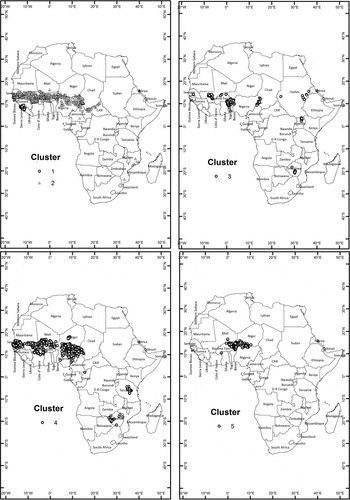
The pearl millet landraces grown by farmers in different countries are from latitudes ranging between 23.75°S (in Mozambique) and 18.12°N (in Niger) (Fig. 1). Among the landraces, Mexiora, Rushambo, Halale, Sifumbata and Tsholotsho were from higher latitudes (>15.00°), while the Uwele was from lower latitudes (4.40° to 7.50°) in southern hemisphere. All other landraces were from northern hemisphere indicating the predominance of pearl millet landraces in northern hemisphere. Sounari, Olal, Tjindari, Sindari, Haini and Enele were originated from higher latitude (>15.00°) in northern hemisphere.
Geographical adoption of different clusters of pearl millet landraces in Africa.

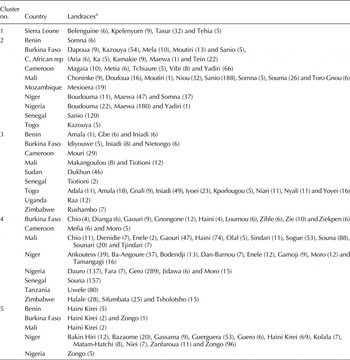
Among the landraces, Sanio (313 accessions), Gero (289 accessions), Souna (245 accessions), Maewa (228 accessions), Dauro (137 accessions) and Zongo (102 accessions) represented more than 100 accessions indicating their popularity among the farmers and extensive collection of pearl millet germplasm in the region (Table 1). Among the countries, Mali and Niger represented 22 landraces each followed by Burkina Faso (19) and Togo (10) indicating high adoption of diverse landraces in these countries.
Cluster wise pearl millet landraces collected in different countries of Africa

a Values in parenthesis are number of accessions in each landrace.
Cluster analysis
A hierarchical cluster analysis conducted on the scores of the first five PCs resulted in five clusters of landraces (Fig. 1 and Table 1). Cluster 1 consisted of 52 accessions of four landraces from Sierra Leone, cluster 2 consisted of 960 accessions of 23 landraces, cluster 3 consisted of 301 accessions of 18 landraces, cluster 4 consisted of 1303 accessions of 33 landraces, and cluster 5 consisted of 313 accessions of 11 landraces. Landraces of cluster 1 are from a mean latitude range of 7.23°N to 9.33°N; those of cluster 2 from 14.57°S to 23.75°S and 3.58°N to 16.35°N; cluster 3 from 18.22°S to 20.85°S and 2.20°N to 15.46°N; cluster 4 from 4.42°S to 21.73°S and 1.98°N to 18.12°N and cluster 5 from 10.36°N to 16.46°N (Fig. 1).
Climate and geographic origin
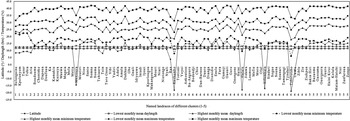
Results indicated a close association of latitude of collection sites in different clusters and prevailing climatic factors such as lowest and highest monthly mean day length, minimum and maximum temperatures (online Supplementary Fig. S1). The minimum of the lowest and highest monthly mean minimum and maximum temperatures were less in clusters 2, 3 and 4 when compared with that of clusters 1 and 5. In cluster 5, except Zanfaroua and Zongo, all other landraces recorded higher monthly mean minimum and maximum temperature when compared with all other landraces in the collection. Mexioera, Rushambo, Halale, Sifumbata, Tsholotsho and Uwele grown in southern hemisphere are from relatively low-temperature regions (Fig. 2).
Climatic factors at collection sites of different pearl millet landraces from Africa.

Diversity in the collection
Qualitative traits
Qualitative traits are important to differentiate landraces and show less response to climate-related traits than quantitative traits. Pearl millet is a cross-pollinating crop and the germplasm samples collected in farmer's fields' shows lot of heterogeneity for several traits. In the genebank, heterogeneity of the accessions was maintained while regeneration.
Panicle shape: Nine panicle shapes (cylindrical, conical, spindle, club, candle, dumb-bell, lanceolate, oblanceolate and globose) were found in the collection. Candle shape was predominant in the collection (50%). Cluster 4 was found highly diverse with all the nine panicle shapes. Among the landraces, Maewa was most diverse with seven panicle shapes.
Panicle density: A maximum of 2.4% accessions belonging to cluster 4, including Ankoutess (1), Gaouri (2), Gero (5), Haini (6), Souna (14) and Sounari (3) were found promising with score between 7 and 9 for panicle density. A maximum frequency of 27% accessions belonging to Kpelenyom (3), Tasur (9) and Tehia (2) of cluster 1 has the score of 7.
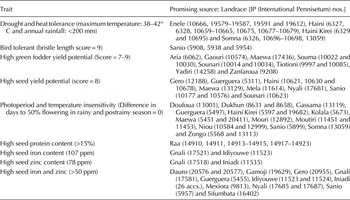
Bristle length: More than 90% accessions in all clusters produced bristles below the seed level (score < 4). Fourteen accessions of Sanio, which belong to cluster 2 have produced longer bristles (score 7–9) (Table 4).
Seed shape: Five seed shapes (obovate, oblanceolate, elliptical, hexagonal and globular) were found in the collection. Globular seed shape was predominant (39%) in the entire landrace collection. Among the clusters, cluster 2, 3, 4, 5 were found as sources for all the five seed shapes. More than 55% accessions of clusters 2 and 3 had produced globular shape seeds.
Seed colour: Ten seed colours (ivory, cream, yellow, grey, deep grey, grey brown, brown, purple, purplish black and mixture of grey and white) were observed in the landrace collection. Accessions of cluster 1 were found as important sources for farmer preferred cream (77%) and ivory (1.9%) colour seeds. Among the landraces, Kpelenyom, Kamakie, Sanio, Tein, Dukhun, Kporlougou, Yoyei, Ba-Angoure, Mefie, Guerguera and Zongo were found as sources for ivory colour seeds. All landraces of cluster 1; Choninke, Ka, Kamakie, Kazouya, Maewa, Magaia, Mela, Sanio and Tein of cluster 2; Adala, Amala, Dukhun, Kporlougou, Mouri, Nietongo and Raa of cluster 3; Gamoji, Gaouri, Gero, Gnongone, Haini, Halale, Mefie, Moro, Souna, Tjindari and Zie of cluster 4 and Bazaome, Guerguera and Haini Kirei of cluster 5 were found as sources for cream colour seeds.
Endosperm texture: In entire collection, 11% accessions were found as mostly corneous. Landraces of cluster 1 with 77.2% accessions with scores of 1–3 were found as an excellent source for protein-rich corneous endosperm.
Quantitative traits
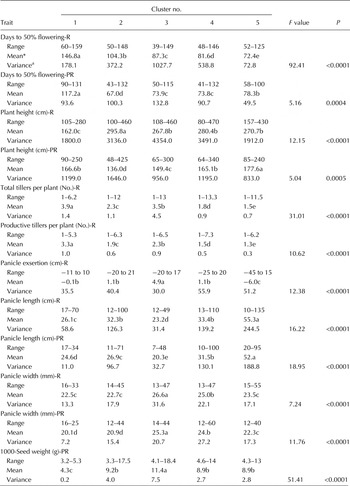
The homogeneity of variances for all 12 traits of landraces in five clusters was tested using Levene's test. The variances for all traits were heterogeneous (P ≤ 0.0001) indicating significant differences among clusters for all traits under study (Table 2).
Range, mean and variances for different traits in clusters of pearl millet landraces from Africa, evaluated at ICRISAT, India

R, Rainy season; PR, Postrainy season.
a Variances were tested using Leven's test.
*Means were tested by Student–Newman–Keuls test; means followed by different letter are significantly different at P = 0.05.
Range: Landraces in cluster 2 varied widely for plant height in postrainy season, and those of cluster 3 for days to 50% flowering in rainy season and 1000 seed weight; cluster 4 for days to 50% flowering in postrainy season, plant height, total and productive tillers per plant in rainy season, panicle length and thickness in postrainy season and those in cluster 5 for panicle exsertion, panicle length and thickness in rainy season (Table 2). Among all landraces, Iniadi for days to 50% flowering in rainy season (39–141 d) and 1000 seed weight (4.1–18.4 g), Sanio for days to 50% flowering (47–127 d) and plant height (48–425 cm) in postrainy season, Dauro for total tillers per plant (1–13), Maewa for productive tillers per plant (1–6.3), Zongo for panicle length in rainy season (20–135 cm), Gero for panicle length in postrainy season (13–100 cm), Bakin Hiri for panicle thickness in rainy season (19–55 mm) and Halale for panicle thickness in postrainy season (20–60 mm), showed wide variation (online Supplementary Table S1).
Means: Newman–Keuls test of significance for mean values indicated significant differences between clusters for one or more traits under study (Table 2). Landraces of cluster 1 differed significantly from those of other clusters for late flowering in both seasons, short height in rainy season, high tillering and thin panicles with smaller seeds. Cluster 2 landraces differing significantly for early flowering during postrainy season, tall height in rainy season, short height in postrainy season; those of cluster 3 for higher panicle exsertion and thickness in both the seasons and larger seeds and those of cluster 5 for early flowering in rainy season, tall height in postrainy season and longer panicles in both the seasons, were found as promising sources.
Mean values averaged over all accessions of individual landraces indicated cluster 1 for late flowering (>115 d) in both seasons, Gnali and Nyali for early flowering (<50 d) in rainy season, Dapoua, Makangoulou and Dianga for tall height (>350 cm) in rainy season, were found as promising sources (online Supplementary Table S2). On the other hand, interestingly, all landraces of cluster 2, 3, 4, 5 grew short (≤203 cm) in postrainy season when compared with the rainy season indicating high photoperiod sensitivity of landraces. Among all landraces under study, only Mefie recorded 203 cm plant height in postrainy season. All landraces of cluster 1, Gbe and Raa of cluster 3 produced more than three total and productive tillers per plant. Moutiri and Somna of cluster 2; Ba-Angoure, Gero, Jidawa of cluster 4 and all landraces of cluster 5 produced longer panicles (>40 cm) in rainy season. Gnali and Nyali of cluster 3; Ankoutess and Sogue of cluster 4 produced thick panicles (thickness >30 mm) in rainy season. Dapoua of cluster 2; Adala, Amala, Gbe, Gnali, Idiyouwe, Iniadi, Kporlougou, Makangoulou, Niari, Nietongo, Nyali and Yoyei of cluster 3 produced larger seeds (1000 seed weight >12 g).
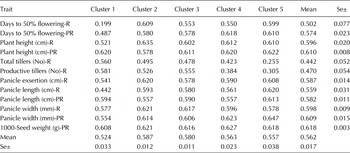
Phenotypic diversity: The Shannon–Weaver diversity index (H′) values were variable for traits among clusters (Table 3). Mean diversity over all clusters varied from 0.442 ± 0.052 for total tillers per plant to 0.618 ± 0.003 for 1000 seed weight. Mean diversity over traits ranged from 0.524 ± 0.033 in cluster 1 to 0.587 ± 0.012 in cluster 2. Diversity was high for total and productive tillers in cluster 1; for days to 50% flowering, plant height, panicle exsertion and panicle thickness in rainy season in cluster 2; for days to 50% flowering in postrainy season and 1000 seed weight in cluster 4 and for panicle length in both seasons and panicle thickness in postrainy season in cluster 5.
Shannon–Weaver (H′) diversity index for various traits in different clusters of pearl millet landraces from Africa, evaluated at ICRISAT, India

R, Rainy season; PR, Postrainy season.
Green fodder yield potential: In the entire collection, 61% accessions scored high (7–9) indicating high fodder yield potential of the landrace collection. Among the clusters, more than 50% accessions in cluster 2, 3 and 4 had score of more than 6. Thirty one accessions of 10 landraces were found promising for fodder yield potential with score of 9. Out of 31 accessions scoring 9, Mali alone represented 27 accessions indicating the genetic potential of the collection from Mali for fodder yield.
Seed yield potential: None of the accessions in the collection scored 9 for this trait. However, 11 accessions of eight landraces scored 8 for seed yield potential (Table 4).
Pearl millet landraces identified as promising sources for important traits

Overall plant aspect: A maximum of 14% accessions in cluster 5 followed by cluster 4 with 12.2%, cluster 2 with 9.7% and cluster 3 with 4.7% scored high (7 or 8). None of the accessions in the collection scored 9 for this trait.
Landraces as promising sources
Promising sources were identified for different agronomic traits, disease resistance, drought tolerance, photoperiod and temperature sensitivity and nutritional traits within each cluster and entire landrace collection under study. Accessions performing above threshold level for individual traits were considered as promising sources.
Agronomic traits
Out of 2929 accessions under study, 951 accessions (32.5%) belonging to 81 landraces were found promising for one to four agronomic traits (online Supplementary Table S3). Among the clusters, 51.5% accessions of cluster 3, 42.5% of cluster 5, 38.5%, of cluster 2, 25% of cluster 1 and 21.5% of cluster 4 were found promising for one or more traits. Within each landrace, more than 60% accessions of Belenguine, Mela, Vibi, Tchiaure, Gnali, Nyali, Iniadi, Niari, Gbe, Nietongo, Dukhun, Dianga, Kolala and Zongo were found promising for agronomic traits (online Supplementary Table S3). In the entire collection, only eight accessions (IP 6409 of Doufoua, IP 6255, IP 10106, IP 10113 and IP 10116 of Sanio; IP 6270 of Souma; IP 6216 of Vibi and IP 12029 of Belenguine were identified for early flowering (<50 d) in postrainy season. In the collection, a maximum of 438 accessions for short plant height (<120 cm) in postrainy season, 163 accessions for long panicles (>60 cm) in rainy season and 105 accessions for long panicle (>60 cm) in postrainy season were found superior. Interestingly, all landraces of cluster 5 were found as promising source for long panicles (>60 cm) in both the seasons. IP 19628 of Zongo produced longest panicle (135 cm) in rainy season (online Supplementary Table S3).
Landraces such as Sanio (313 accessions), Maewa (228), Yadiri (67) and Kazouya (59) representing more accessions in the collection also resulted in high frequency of promising sources for more traits indicating the high adoption of these landraces by farmers and high intensity of germplasm collection in the regions. These results suggest the need for extensive collection of pearl millet landraces during future germplasm collection missions. Forty nine out of 63 accessions of the Iniadi landrace were found promising for seven traits. IP 17812 of Iniadi originating in Niger has flowered in less than 40 d in rainy season.
Disease resistance
Downy mildew: More than 70% of total accessions evaluated for downy mildew were found promising with ≤10% disease severity. Among the landraces, more than 80% accessions of all landraces in cluster 5 showed ≤10% disease severity. Similarly, all accessions of Somna, 19 out of 20 accessions of Tein, all accessions (18) of Mouri, all accessions of Gnongone (12) and Souna (143) and 31 out of 33 accessions of Ba-Angoure and all accessions of Bakin Hiri and 98% accessions of Haini Kirei and Zanfaroua were found promising with ≤10% disease severity.
Rust: A maximum of 26% of total accessions screened had shown 0% disease severity for rust in cluster 5, followed by 22.5% in cluster 2, 18.5% in cluster 3 and 3.3% in cluster 4. Among the landraces, Tchiaure, Tein, Iniadi, Bazaome, Haini Kirei and Niei were found as promising sources with 0% rust incidence.
Ergot: Fifty-one per cent of total accessions screened for ergot in cluster 1 (45 accessions) were found promising with ≤10% disease severity. Four out of five accessions of Tehia showing ≤10% disease severity were found to be promising for ergot resistance.
Drought tolerance
Germplasm collected from stress regions are known for stress resistance. Annual mean rainfall at the collection sites of cluster 1 landraces (2,899 mm) was high when compared with that of cluster 2 (788 mm), cluster 3 (948 mm), cluster 4 (687 mm) and cluster 5 (423 mm). Among the landraces, collection sites of Boudouma (346 mm) of cluster 2; Ankoutess (324 mm), Ba-Angoure (328 mm), Bodendji (332 mm), Enele (126 mm), Gamoji (389 mm), Gaouri (396 mm), Haini (256 mm), Olal (367 mm), Sindari (307 mm), Sounari (382 mm), Tamangagi (334 mm) and Tjindari (327 mm) of cluster 4 and Bakin Hiri (399 mm), Bazome (392 mm), Gassama (332 mm), Guerguera (369 mm), and Kolala (383 mm) of cluster 5, received <400 mm mean annual rainfall and recorded relatively higher maximum temperature at collection sites, indicating these landraces as possible promising sources for drought and heat tolerance (Fig. 2 and Table 4).
Photoperiod and temperature insensitivity
The entire collection under study includes a maximum of 63.6% photoperiod sensitive, 34.7% temperature sensitive and 1.7% insensitive accessions for flowering. Frequency of photoperiod-sensitive accessions varied from 98.1% in cluster 1 (mean latitude 8.5°) to 16.9% in cluster 5 (mean latitude 13.9°). On the other hand, frequency of temperature-sensitive accessions increased from 1.9% in cluster 1 to 80.8% in cluster 5 indicating the positive association of latitude and temperature sensitivity. In the entire collection, 19 accessions of 13 landraces were identified as promising for photoperiod and temperature insensitivity (Table 4). All accessions of Guero, Gnali, Matam-Hatchi, Nyali, Rushambo and Zanfaroua had shown temperature sensitivity. On the other hand, all accessions of Idiyouwe, Makangoulou and Raa had shown photoperiod sensitivity. Iniadi landrace, which was a source for most of the ICRISAT bred varieties, had 86% temperature-sensitive accessions and 14% photoperiod-sensitive accessions.
Nutritional traits
Seed protein content: Seeds of 75 accessions belonging to 26 landraces were found promising with >12% seed protein content. Notably, six out of 11 accessions of Sanio, 11 out of 15 accessions of Yadiri; six out of 7 accessions of Mouri; five out of eight accessions of Souna and all seven accessions of Zongo that were evaluated for seed protein content had >12% seed protein. Interestingly, all accessions of Raa belonging to cluster 3 had high seed protein content (>15%) (Table 4).
Iron and Zinc contents: In cluster 3, all 33 accessions that were evaluated for seed iron and 28 out of 33 accessions evaluated for seed zinc content were important sources with more than 50 ppm iron and zinc. IP 17521 of Gnali (106.9 ppm) and IP 11523 of Idiyouwe (106.5 ppm) for seed iron content and IP 17518 of Gnali (79.1 ppm) and IP 11535 of Iniadi (78.4 ppm) for seed zinc content were found as the most promising sources for nutritional traits (Table 4).
Multiple traits
In the entire collection under study, IP 9208 of Zanfaroua landrace was found as promising sources for panicle length (>60 cm) and thickness (>35 mm) in rainy and postrainy seasons and IP 11247 of Rushambo for short height in postrainy season (<120 cm), more total (>5) and productive (>4) tillers per plant and blast resistance (online Supplementary Table S3). IP 6138 of Yadiri was found promising for short height (<120 cm), downy mildew resistance and seed protein content (>15%) and IP 6270 of Souma for early flowering in postrainy, downy mildew resistance and high seed protein content (>15%); IP 17518 and 17581 of Gnali were found as promising sources for early flowering and panicle thickness in rainy season, 1000 seed weight, seed iron and zinc content. The accessions of Iniadi IP 8957, IP 8958, IP 8959, IP 8962, IP 8964 were identified as promising for short height, downy mildew and rust resistance, high seed iron and zinc content (online Supplementary Table S3 and Table 4). IP 19584, IP 19585, IP 10586 and IP 19612 of Enele mostly grown in low rainfall (126 mm) areas were also found to be tolerant to soil salinity.
Discussion
Named landraces are time-tested cultivars and forms an important source to breed improved cultivars. The main contributions of landraces to plant breeding are useful traits for more-efficient nutrient uptake and utilization and genes associated with adaptation to water stress, salinity and high temperatures (Newton et al., Reference Newton, Akar, Baresel, Rebeli, Bettencourt, Bladenopoulos, Czembor, Fasoula, Katsiotis, Koutis, Koutsika-Sotiriou, Kovacs, Larsson, Pinheiro de Carvalho, Rubiales, Russell, Dos Santos and Vaz Patto2010). All landraces of cluster 1; Aria, Ka, Kamakie and Tein of cluster 2; Adala, Amala and Raa of cluster 3; Dauro, Fara, Jidawa and Uwele of cluster 4 mostly grown at lower latitudes (<10°), where the day length was close to 12 h and temperatures are relatively high, has flowered late (Upadhyaya et al., Reference Upadhyaya, Reddy, Singh, Gowda, Irshad Ahmed and Ramachandran2014) (Fig. 2 and online Supplementary Table S1). Pearl millet requires 12°C as the base temperature, 30–35°C as the optimum temperature and 45°C as the lethal temperature (Ong, Reference Ong1983). Kowal and Kassam (Reference Kowal and Kassam1978) reported more acute inverse relation between latitude and the length of growing season in Africa. Wareing and Phillips (Reference Wareing and Phillips1981) reported that in many plant species, a day length change as short as 15–20 min will have a significant effect on flowering. Pearson and Coaldrake (Reference Pearson and Coaldrake1983) reported the delay in flowering of pearl millet by 4–5 d per degree reduction in latitude. Drought is the primary abiotic constraint and it is caused by low and erratic distribution of rainfall (Yadav and Rai, Reference Yadav and Rai2013). Early flowering, high tillering and asynchrony of tillering contribute to the drought tolerance (Bidinger et al., Reference Bidinger, Mahalakshmi and Rao1987; Fussel et al., Reference Fussel, Bidinger and Bieler1991). All landraces of cluster 5 grown at relatively higher latitudes (mean latitude 13.30°N to 14.70°N) with longer days (day length 11.3 to 13.0 h), high temperatures (maximum temperature 31.0–40.7°C) and low rainfall (mean annual rainfall ≤423 mm) produced long and thick panicles. These landraces can form drought and heat tolerance sources (Upadhyaya et al., Reference Upadhyaya, Reddy, Singh, Gowda, Irshad Ahmed and Ramachandran2014) (online Supplementary Fig. S1) Accessions, IP 19579 – IP 19587 of Enele landrace collected in very low rainfall (<100 mm) areas could be good sources for drought- and heat-tolerant pearl millet and suitable for cultivation in dry regions of Africa. IP 19586 of Enele identified as a promising source for forage in the present study was recommended for release as variety in Mexico by National Institute of Forestry and Livestock Research (INIFAP), Mexico (pers. commun.). Yadav et al. (Reference Yadav, Weltzien–Rattunde and Bidinger2003) reported local landraces as a good source of adaptive genetic variation for tolerance to drought stress and thus represent suitable breeding material for arid zone environments.
In pearl millet, damage due to birds is a serious problem and sometimes results in yield losses up to 60–70% depending on the region and season. Long bristles of panicles provide protection against bird damage. IP 5938 of Souna with long bristles (score 9) is an ideal germplasm resource to breed pearl millet resistant to bird damage (Table 4). Landrace accessions from Mali (27 of 33 evaluated) scored high (9) for fodder yield. Likewise, landraces identified with a score of 8 for seed yield potential are very useful in developing high-yielding pearl millet varieties and hybrids. Photoperiod and temperature-insensitive landrace germplasm identified based on differences in flowering in rainy and postrainy season could be exploited to develop insensitive pearl millet varieties and hybrids for growing more crops in a year for increased pearl millet production. Curtis (Reference Curtis1968) reported that the evaluation for photoperiod sensitivity could be conducted to indirectly select lines expected to have more stable performance over varied seasons. Landraces are clearly a potential source of nutritional traits (Newton et al., Reference Newton, Akar, Baresel, Rebeli, Bettencourt, Bladenopoulos, Czembor, Fasoula, Katsiotis, Koutis, Koutsika-Sotiriou, Kovacs, Larsson, Pinheiro de Carvalho, Rubiales, Russell, Dos Santos and Vaz Patto2010). Landraces viz. Mouri, Raa, Sanio and Yadiri were identified as excellent sources for high seed protein content (>15%). IP 17521 of Gnali (106.9 ppm) and IP 11523 of Idiyouwe identified for high seed iron (Fe) content (106.5 ppm); IP 17518 of Gnali (79.1 ppm) and IP 11535 of Iniadi (78.4 ppm) identified for high seed zinc (Zn) content, need to be exploited for developing nutrient-rich pearl millet varieties to lower the problem of malnutrition across the countries, particularly in Africa and Asia (Table 4). Rai et al. (Reference Rai, Velu, Govindraj, Upadhyaya, Rao, Shivade and Reddy2015) observed large variability for seed Fe (51–121 mg/kg) and Zn (46–87 mg/kg) densities in Iniadi germplasm assembled at ICRISAT genebank.
Replacement of landraces by improved cultivars entails a significant loss of genetic variation for resistance to biotic and abiotic stresses. Downy mildew, rust and ergot are the most important diseases of pearl millet causing severe crop losses (Singh et al., Reference Singh, Wilson, Navi, Talukdar, Hess and Reddy1997). Although pearl millet hybrids often give better grain yields than landraces, they are vulnerable to biotic and abiotic stresses (Gemechu et al., Reference Gemechu, Endashaw, Imtiaz and Dagne2012). In such situations, all accessions of Somna, Mouri, Gnongone, Souna, Bakin Hiri, Haini kirei and Zanfaroua identified as promising sources with ≤10% disease severity, are very useful in developing pearl millet varieties and hybrids resistant to downy mildew. Wilson et al. (Reference Wilson, Burton, Wells, Zongo and Dicko1989) also reported the resistance for leaf spot, rust and smut in pearl millet landraces from Central Burkina Faso. As the landraces under study are readily available sources for several useful genes, knowledge on genetic potential of landraces in the collection helps to broaden the genetic base of new cultivars and maximizes the use of pearl millet germplasm resources (Escribano et al., Reference Escribano, Santalla, Casquero and De Ron1998; Dwivedi et al., Reference Dwivedi, Ceccarelli, Blair, Upadhyaya, Ashok and Ortiz2016).
Increasing the diversity in the collection by filling gaps is essential to achieve near completeness of the collection in any species. Upadhyaya et al. (Reference Upadhyaya, Reddy, Irshad Ahmed, Gowda and Bettina2009, Reference Upadhyaya, Reddy, Irshad Ahmed and Gowda2012b) reported several gaps in the world collection of pearl millet landraces from West and Central Africa and East and Southern Africa being conserved at ICRISAT genebank. These geographical gaps (districts) may be explored further. Countries with gaps represented in cluster 1 for high tillering; in cluster 2 for flowering, plant height, panicle exsertion and panicle thickness; in cluster 4 for flowering and 1000-seed weight and in cluster 5 for plant height and panicle length and thickness may be explored. While launching germplasm collection missions, the collection sites of promising sources identified in the present study, particularly the hot-spots for different traits may be considered for exploration. Some countries had less number of landraces than other countries. For example, Mali and Niger representing 22 landraces, Burkina Faso 19 and Togo 10 landraces, may be further explored to increase the diversity in landrace collection. The close association of latitude, climatic conditions prevailed at collection sites and agronomic performance of landraces, as observed in the present study indicates no effect of origin country of landraces on their cultivation. Tostain (Reference Tostain1994) reported highest diversity in early-maturing pearl millet cultivated between 8.00°E and 13.00°E longitude. Upadhyaya et al. (Reference Upadhyaya, Reddy, Singh, Gowda, Irshad Ahmed and Ramachandran2014) reported wide variation in pearl millet landraces from lower latitudes indicating the impact of latitudinal variations on diversity among landraces. In Francophone, West Africa, the geographic differentiation of pearl millet landraces revealed clearer geographic patterns especially for days to flowering, with early-flowering materials being prevalent in the north and late-flowering landraces being prevalent in the south. This corresponds to the rainfall gradient in the region (Haussmann et al., Reference Haussmann, Boubacar, Boureima and Vigouroux2006). Therefore, location-specific geo-reference data, name of landraces, information on climate at collecting sites are critical and need to be recorded while collecting germplasm to enhance the use of germplasm for sustainable pearl millet production.
Conventional breeding require skills, more resources and time to develop a variety when compared with identifying highly adaptable promising landraces through replicated multilocation evaluation. Therefore, for immediate use, it is suggested to evaluate systematically all the promising landrace accessions identified, for agronomic, nutritional and climate-related traits and also biotic stress resistance (Dwivedi et al., Reference Dwivedi, Ceccarelli, Blair, Upadhyaya, Ashok and Ortiz2016). The landrace accessions selected from such evaluations can be introduced directly for cultivation in regions with suitable environments. For long-term benefits, breeding efforts using these promising landraces need to be continued. Developing crop models using promising landraces identified in the present study to mitigate the effect of climate change in sub-Saharan Africa may be very useful for sustainable production.
Some landraces, such as Iniadi in the past, have been extensively evaluated and used in breeding programmes worldwide and the products were preferred by the farmers and widely cultivated. ICTP 8203, a variety developed using Iniadi landrace was promising for early maturity, high yield, large seed size, and downy mildew resistance has been released in India and Africa (Rai et al., Reference Rai, Hash, Singh and Velu2008). Likewise, an S2 progeny of ICTP 8203 was identified as maintainer of A1 cytoplasmic–nuclear male sterility system in pearl millet (Rai et al., Reference Rai, Hash, Singh and Velu2008). Further inbreeding and selection led to the development of maintainer line 863B and its male-sterile counterpart 863A, which is a seed parent for three commercial hybrids in India (Rai et al., Reference Rai, Hash, Singh and Velu2008). These examples indicate that the large seeded ICTP 8203 has unique combination of several useful traits, including high levels of resistance to multiple pathotypes of downy mildew, tolerance to terminal drought, high stover yield and quality and higher levels of grain iron and zinc concentrations (Rai et al., Reference Rai, Hash, Singh and Velu2008).
Because of continuous threat to the on-farm conservation of landraces, specific measures are needed to safeguard them for future sustainable agriculture and food security (Upadhyaya and Gowda, Reference Upadhyaya and Gowda2009; Dwivedi et al., Reference Dwivedi, Ceccarelli, Blair, Upadhyaya, Ashok and Ortiz2016). Such measures include documentation of landraces for indigenous knowledge; increasing awareness about importance of landraces; their role in sustainable agriculture and food security; establishing community genebanks conserving seeds of landraces for easy access to the smallholder farmers. Planning for in situ conservation and farmer participatory plant breeding makes the smallholder agriculture in SAT region, particularly in African countries, more profitable and resilient. Seeds of all landrace accessions under this study are available at ICRISAT genebank, India, under Standard Material Transfer Agreement (SMTA) of the International Treaty on Plant Genetic Resources for Food and Agriculture (ITPGRFA).
Supplementary material
The supplementary material for this article can be found at https://doi.org/10.1017/S1479262116000113.
Acknowledgements
Authors sincerely acknowledge the contribution of all former and present staff of genebank at ICRISAT, Patancheru, India, in collection, assembly and conservation of pearl millet genetic resources. The help of D Bapa Rao and G Ram Reddy, Research Technicians, in recording observations for this study is highly appreciated.