Antibiograms, which provide data on bacterial resistance patterns, are advocated for antibiotic stewardship. The controversy surrounding the approach to generating antibiograms pertains to avoiding over- or underrepresentation of antibiotic resistance based on isolate inclusion or exclusion.Reference Hindler and Stelling 1 , Reference Bantar, Alcazar and Franco 2 According to current Clinical and Laboratory Standards Institute (CLSI) guidelines, cumulative antibiograms should be prepared by including the first isolate from a given species per patient within a specific time period regardless of culture source. 3 The option of preparing supplemental analyses utilizing variables such as infection site and patient population is presented in the guidelines; however, no guidance is provided on the methods of analysis with regard to time after hospital admission. The purpose of the present study is to determine the effects of time in hospital on antibiograms, considering culture source.
Methods
We included all bacteria from clinical samples at Rambam Health Care Campus, a primary and tertiary, university-affiliated, 900-bed hospital, between January 1, 2009 and December 31, 2014. We included the first isolate per patient based on culture source and antibiotic susceptibilities. We excluded surveillance cultures. We classified the culture sources as follows: blood (group 1); CSF, pleural effusion, peritoneal fluid, abscess and other sterile body fluids (group 2); urine and sputum (group 3); and skin and superficial wounds (group 4).
Susceptibility testing was performed using Vitek 2.0 (Vitek, Valencia CA) and Etest (bioMérieux SA, Marcy l’Etaile, France) based on CLSI criteria. Classifications of resistance were based on the European Centre for Disease Prevention and Control (ECDC) and Centers for Disease Control and Prevention (CDC) definitions for multidrug-resistant (MDR), extensively drug-resistant (XDR) and pandrug-resistant (PDR) bacteria,Reference Magiorakos, Srinivasan and Carey 4 which define resistance categories for Staphylococcus aureus, Enterococcus spp., Enterobacteriaceae, Pseudomonas aeruginosa, and Acinetobacter spp.
We assessed the frequency of resistant bacteria by time in hospital and compared this frequency between the different source groups. Source group 1 (blood) served as the reference for the later comparisons. Comparisons between groups and odds ratios (ORs) with 95% confidence intervals (CIs) were calculated using χ2 tests. A logistic regression analysis was performed to assess association between frequency of MDR phenotype and time from hospital admission. Analyses were conducted using SPSS 21 (IBM, Armonk, NY) and VassarStats (Richard Lowry, Vassar College, Poughkeepsie, NY).
Results
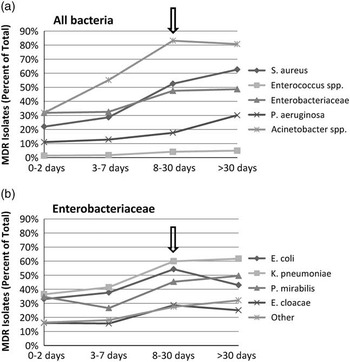
A total of 51,467 patient-unique isolates were analyzed: 4,416 S. aureus; 7,608 Enterococcus spp.; 30,667 Enterobacteriaceae; 5,918 P. aeruginosa; and 2,858 Acinetobacter spp. The percentages of MDR isolates in the respective groups were 33.1%, 2.3%, 36.2%, 16.7%, and 66.3% overall. Resistance increased linearly with time in hospital. The association was weakest for enterococci (OR for MDR increased by 1.004 per day, P=.008) and strongest for Acinetobacter spp. (OR increased by 1.017 per day, P<.001). The optimal dichotomizing time point for resistance was hospital day 7 (Figure 1a). For all groups apart from P. aeruginosa, the increase in resistance thereafter was minimal. Escherichia coli, K. pneumoniae, Proteus mirabilis, and E. cloacae together constituted the majority of Enterobacteriaceae isolates (48.3%, 18.7%, 7.2%, and 6.9%, respectively) and showed the same pattern of greatest increase in resistance at hospital day 7 although levels of resistance at baseline and each time point varied (Figure 1b).
Rates of MDR isolates by time from hospitalization. Arrow points indicate the optimal time point for susceptibility dichotomization. MDR, multidrug resistant.

We compared the culture source group susceptibilities for community-associated isolates (taken within 48 hours of hospital admission), early hospital-acquired isolates (taken between 3 and 7 days of hospital admission), and late hospital-acquired isolates (taken >7 days from hospital admission). The mean times from hospital admission to culture-taken-date were similar for the different sample sources in the late hospital-acquired subgroup for all bacteria apart from Enterococcus spp., allowing a comparison between sample sources in late hospital-acquired isolates. For Enterococcus spp., cultures from urine or sputum and sterile body fluids apart from blood were taken on average after a longer interval from admission than blood (blood, 37.8 days; sterile body fluids, 50.7 days [P=.005]; and urine/sputum, 48.2 days [P=.009]).
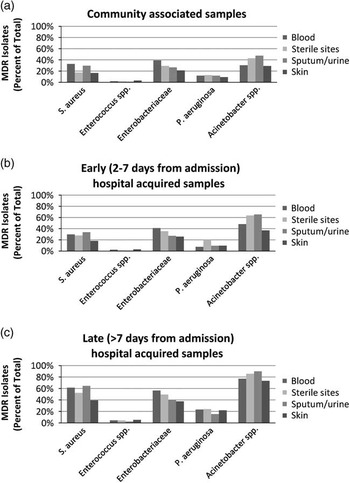
Enterobacteriaceae blood isolates were consistently more resistant than isolates from other culture sources (MDR organisms accounted for 48.1%, 41.6%, 34.6%, and 31.1% of groups 1, 2, 3 and 4; OR 0.77, 0.57 and 0.49 for comparison with group 1, respectively, P<.001 for all). This finding remained in analyses of time from hospitalization (Figure 2a–c). Acinetobacter species were the most resistant organisms overall and the only bacterial group in which blood isolates were significantly less resistant than isolates cultured from other sources. MDR organisms accounted for 59.3%, 71.1%, and 74.0% of isolates in groups 1, 2, and 3, respectively (P=.007 and P<.001 for groups 2 and 3 vs group 1). However, isolates from wound cultures displayed less resistance (44.6%; OR, 0.55; 95% CI, 0.43–0.71; P<.001) than blood isolates. These findings were consistent in analyses of time in hospital. S. aureus exhibited a dichotomy between more resistant isolates from blood and sputum or urine (MDR organisms accounted for 42.9% and 42.8%, respectively) and less-resistant isolates from other sterile fluids and wound cultures (27.4% and 21.7% MDR, P<.001 for both). Although the difference in antibiotic susceptibility between blood and other sterile fluids disappeared with time in hospital, wound-site isolates remained significantly more sensitive than blood isolates in the late hospital-acquired subgroup. Pseudomonas and Enterococcus displayed minimal variation in susceptibility based on culture site, a finding consistent in subgroup analyses by time from hospitalization.
Resistance rates by time from hospital admission and culture source. MDR, multidrug resistant.

Discussion
Bacterial resistance increases continuously with time in hospital, eventually plateauing. However, when generating an antibiogram, discrete time points need to be defined because reporting day-by-day susceptibility results relies on too few isolates and provides too much information. We found the time point of >7 days in hospital to be the optimal discrete time point rather than the 48-hour time point defining hospital acquisition.Reference Garner, Jarvis, Emori, Horan and Hughes 5 , Reference Cardoso, Almeida and Friedman 6 Overall in our analysis, relying exclusively on blood isolates for antibiogram generation would have resulted in overestimation of resistance. This held true for all time points from hospitalization.
Consistent with our results, previous studies have found that rates of antibiotic susceptibility were higher among community-associated infections than among nosocomial infections and that rates of susceptibility decreased as time from hospitalization increased for some antibiotics and bacteria but not for others.Reference Kuster, Ruef and Zbinden 7 – Reference Draper, Farland, Heidel, May and Suda 9 A possible explanation for the dichotomy we found at hospital day 7 rather than at 48 hours (as previously described) is that the population at admission represents a mixture of truly community-acquired and healthcare-associated infections and that the ratio between them might have changed over the years. When generating automatic antibiograms, the precise source of acquisition for community-onset isolates is usually unknown. This raises the question of whether the standard use of 48 hours from admission is an accurate cutoff.
As a single-center study, the number of isolates in our study was limited, although our main findings achieved statistical significance with a narrow margin of error. Lack of data on resistance mechanisms makes it unclear whether our findings would remain relevant in locations where the epidemiology or genotypes of resistance are different. Our laboratory reports antibiotic breakpoints using CLSI criteria. The alternative use of European Committee on Antimicrobial Susceptibility Testing (EUCAST) guidelines has been shown to increase reporting of resistant isolates, and the effect this might have on our findings is uncertain.Reference Hombach, Bloemberg and Böttger 10
We conclude that antibiograms should include a patient’s first isolates of bacterial species, regardless of culture source. If a finer classification cannot be performed, dichotomizing isolates to those obtained in the first week and thereafter will best represent resistance epidemiology.
Acknowledgments
Financial support. Part of this work was funded by the EU-project AIDA (grant no. Health-F3-2011-278348) to YD.
Potential conflicts of interest. All authors report no conflicts of interest relevant to this article.