Introduction
Rhubarb includes approximately 60 species in the genus Rheum, most of them occuring in mountainous and desert regions of central and northern Asia (Wang et al., Reference Wang, Yang and Liu2005). Rhubarb has been used for medicinal purposes in China for thousands of years. In the middle of the 17th century, rhubarb species began to be grown in Europe for medicinal uses (Turner, Reference Turner1938; Foust, Reference Foust1992). In the early 1700s, it was discovered that some rhubarb plants had edible stalks (Foust, Reference Foust1992). Culinary rhubarb, R. xhybridum Murray (R. rhabarbarum L.), was primarily identified by selecting seedlings from open-pollinated seeds that exhibited desirable horticultural characteristics. It is believed that R. rhaponticum, R. undulatum (also referred as R. rhabarbarum) and R. palmatum were involved in early hybridizations, although pedigrees are mostly absent from these early open pollinations (Morse, Reference Morse1901; Turner, Reference Turner1938; Foust and Marshall, Reference Foust and Marshall1991). Rhubarb species range in chromosomes from 2n = 22 to 66; however, culinary rhubarb is generally considered a tetraploid, 2n = 44 (Chin and Youngken, Reference Chin and Youngken1947; Englund, Reference Englund1983). The true species composition of culinary rhubarb remains unclear today. Over the years, many cultivars have been identified with a wide range of uses from tarts to wine. The term cultivar here on will refer to culinary rhubarb cultivars.
Ideally, rhubarb cultivars are propagated asexually through crown divisions (Zandstra and Marshall, Reference Zandstra and Marshall1982) or through micropropagation (Walkey and Mathews, Reference Walkey and Mathews1979). The use of seed is discouraged, since it can lead to variation in phenotype; however, seed propagation still occurs, leading to the propagation of cultivars with the same name but varying phenotypes. In fact, cultivar development has relied on identifying promising plants from open-pollinated seed of popular cultivars (Rumpunen, Reference Rumpunen1996), hence names like ‘Parson's Crimson’. Unfortunately, different names do not necessarily identify different cultivars. Turner (Reference Turner1938) mentions numerous cases of the same cultivar appearing under different names. In one example, ‘early red’ was reportedly grown under a dozen different names. In general, pedigree information about cultivars is missing or never recorded, making cultivar identification difficult and nearly impossible to authenticate.
Rhubarb cultivar identification has primarily relied on morphology, and although molecular markers are prevalent, morphological identification may be the only means available and can include valuable information about horticulturally valuable traits. The Commission of the European Union (Kyprianou, Reference Kyprianou2007) has endorsed the International Union for the Protection of New Varieties of Plants and the use of morphological traits for the examination of distinctness, uniformity and stability of rhubarb cultivars (UPOV, 1999). Other institutes such as Agriculture and Agri-Food Canada and the Nordic Gene Bank have used similar traits to describe rhubarb cultivars. The information generated from this research project will be loaded into the USDA/ARS, Germplasm Resources Information Network (GRIN, 2009), and made available to the public upon publication of this article.
This study reports the results of morphological data collected during two seasons for 36 rhubarb cultivars and two rhubarb species accessions in Palmer, Alaska (61.57°N, 149.26°W). Traits of interest are discussed and future modifications suggested.
Materials and methods
Plant material
The majority of rhubarb accessions in the Subarctic Agricultural Research Unit (SARU) collection in Palmer, Alaska, originated from Dale E. Marshall (Retired), United States Department of Agriculture (USDA), Agricultural Research Service (ARS), Fruit and Vegetable Harvesting and Handling Unit, East Lansing, Michigan. Accessions were transferred from Michigan to the Western Regional Plant Introduction System in Pullman, Washington, in 1999 and then to Palmer, Alaska, in 2001. The Palmer site (located at the University of Alaska Fairbanks, Agricultural and Forestry Experiment Station, Matanuska Experiment Farm) acts as the primary rhubarb repository (SARU, 2009) for the USDA, ARS and National Plant Germplasm System (NPGS). The NPGS is responsible for maintaining a diverse collection of plant genetic material in the United States. The Western Regional Plant Introduction Station, Pullman, Washington, serves as the back-up site for rhubarb. Primary notes and records for culinary cultivars and rhubarb species accessions originated from Dale E. Marshall, including the original MSU plot numbers, which are available online at GRIN (2009) and SARU (2009).
Crowns were moved from one Palmer location to their current location in 26 July 2004 (GRIN, 2009; SARU, 2009). The collection is planted in a typical haplocryepts soil (NRCS, 2009). As part of the move, many crowns were divided in 2004. Plants were planted at 0.9 m in-row spacing and 3 m between rows, without replication. Irrigation was applied as needed through drip irrigation with fertilizer adjusted to 100 ppm nitrogen, 15-16-17. Seed stalks were removed as they appeared. In-row and between-row weeds were manually removed; no pesticides were applied. In September–October of each year, remaining petioles and leaves were removed in preparation for winter. During the first winter after transplanting (2004–2005), rows were covered with straw and a felted barrier cloth, this practice has subsequently been discontinued as plants survived the winter without protection.
Descriptors
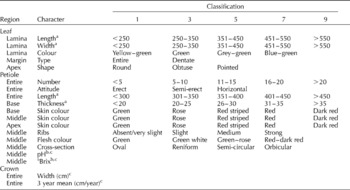
Fifteen morphological descriptors (Table 1) were collected in the second week of August 2005 and the first week of August 2007 from 36 cultivars available at SARU (2009). Morphological descriptors were adapted or modified from previous studies (Rumpunen and Henriksen, Reference Rumpunen and Henriksen1999; UPOV, 1999; Persson et al., Reference Persson, Rumpunen and Möllerstedt2000; Kyprianou, Reference Kyprianou2007). The first five fully mature plants from each accession were evaluated. Rumpunen and Henriksen (Reference Rumpunen and Henriksen1999) reported reliable morphological characterization using two unreplicated rhubarb plants. In 14 cases (AG numbers 1160, 1161, 1165, 1169, 1204, 1206, 1210, 1212, 1219, 1227, 1230, 1231, 1234 and 1235), less than five plants were available for evaluation. The leaf lamina was measured for length and width and scored for margin type (entire, crisped, sinulate, cleft, lobed or dentate). The leaf apex was classified into four groups (round, obtuse, pointed or acute). Petiole length, thickness, number, colour and attitude were measured or scored. Petiole skin colour at the apex, mid and the base was scored and classified based on the dominant colour (green, red stripped, red and dark red).
List of rhubarb descriptors collected in 2005 and 2007 on 36 culinary rhubarb cultivars and two rhubarb species accessions

a Measurements in mm.
b Collected in 2007 only and included in 2007+ analysis.
c Included in 2007+ analysis.
Chemical analysis
Soluble solids' concentration and acidity were evaluated in 2007 on the first three (or less) plants. Both soluble solids concentration and acidity were determined by crushing the middle section of petiole and sampling the resulting extract three times, generating three readings per plant. Soluble solids' concentration was determined using a digital handheld refractometer PAL-1 (ATAGO Co. Ltd, Tokyo, Japan). The PAL-1 refractometer automatically compensates for temperature. Acidity was determined using a Cardy Twin pH meter B-213 (Horiba Ltd, Kyoto, Japan). Crown widths were measured in May 2005, at the beginning of the season, and November 2007, at the end of the season. This allowed the calculation of crown growth (cm) per year for 2005–2007.
Data analysis
The mode was calculated for morphological characters with qualitative categories (Table 1), for example leaf margin type (1, entire; 3, dentate). A mean was calculated for characters with quantitative categories, such as petiole number. Means and modes were used to generate the cultivar data matrices. Comparative analysis was conducted using NTSYS-pc version 2.20e (Applied Biostatistics, Setauket, NY, USA). All data were standardized (Stand) by subtracting the mean of each variable and dividing by the standard deviation. Distance matrices (Simint) were generated using Euclidean distances. Clustering was performed using the unweighted pair-group method (SAHN), with a ‘FIND’ option that enabled detection of all possible trees. The COPH and MXCOMP modules of NTSYS calculated the goodness of fit of the clustering to the data matrix. Comparison of different distance matrices used the MXCOMP module. Linear regression and analysis of variance were conducted using XLSTAT version 2006.5 (Addinsoft, New York, NY, USA).
Three different distance matrices were generated and analyzed. Two matrices, 2005 and 2007, included the first 15 characteristics described in Table 1. The third matrix, 2007+, included all 19 characters in Table 1, including 4 characters not used in the first two matrices, °Brix, pH, crown width and average crown growth per year. The MXCOMP module of NTSYS calculates a matrix correlation of the distance matrix and cophenetic values generated from the UPGMA dendrogram.
Results
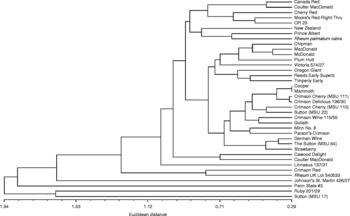
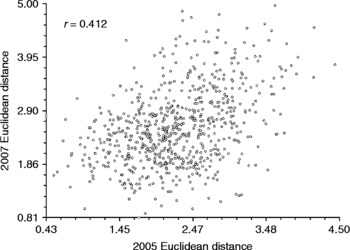
The r values for the three matrices evaluated were 0.762, 0.736 and 0.917 for 2005, 2007 and 2007+, respectively. The 2007+ dendrogram correlated closely with the distance matrix (Fig. 1) showing cultivar relationship based on 19 characteristics (Table 1). A number of cultivar clusters were resolved, for example cultivars from ‘Chipman’ to ‘Timperly Early’ (Fig. 1). The comparison of the 2005 and 2007 distance matrices, using the MXCOMP module, resulted in an r value of 0.412 (Fig. 2), which indicated a poor correlation between the years.
Dendrogram of 36 culinary rhubarb cultivars and two rhubarb species using 19 morphological and phytochemical characters, using Euclidean distances and UPGMA clustering.

Comparison of 2005 and 2007 Euclidean distance matrices generated from 15 morphological measurements for 36 culinary rhubarb cultivars and two rhubarb species.

Various characters were analyzed in pairwise comparisons, both within years and between years. Flesh colour between years was poorly correlated (R 2 = 0.448). Interestingly, flesh colour was significantly (P < 0.001) darker in 2007, overall mean 3.5 versus 3.3. Similarly, skin colour at the base was significantly (P < 0.001) darker in 2007 than in 2005, overall means were 6.5 and 5.5, respectively. In both 2005 and 2007, skin colour was more red at the base than in the middle of the petiole, P < 0.001. Mean petiole length scores were 7.3 and 5.4 in 2005 and 2007, respectively. Mean leaf lamina scores were 3.9 × 3.9 and 2.8 × 2.0, length by width for 2005 and 2007, respectively, neither significant at 0.05 in 2007, leaf lamina was significantly (P < 0.001) longer than width.
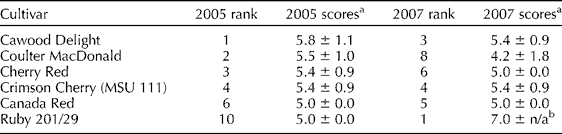
In both evaluation years, six cultivars appeared in the top ten red-fleshed accessions, Cawood Delight, Coulter MacDonald, Cherry Red, Crimson Cherry (MSU111), Canada Red and Ruby 201/29 (Table 2). ‘Crimson Cherry’ (MSU 111) and ‘Canada Red’ each had the same score in 2007 as in 2005. The second ranked cultivar for red-fleshed petioles, ‘Crimson Wine’ 115/55, in 2007 (not shown) was number 11 in 2005. A single plant of ‘Ruby 201/29’ was evaluated in 2007; therefore, standard deviation is not provided. A cultivar that might have been expected to have red flesh, Moore's Red-Right-Thru, was 19th and 17th (out of 36 cultivars) for flesh colour in 2005 and 2007, respectively.
Six cultivars ranked in the top ten reddest flesh cultivars in 2005 and 2007

Flesh colour scored on a scale from 1 to 7, green to dark red, respectively.
a Flesh colour mean score ± standard deviation.
b No standard deviation was calculated since a single plant was scored.
The 2007 dataset was evaluated for horticultural characters. ‘Moore's Red-Right-Thru’ had the largest petioles based on the product of petiole length and width. ‘German Wine’ had similar basal thickness, as Moore's Red-Right-Thru ranked second and first, respectively. ‘Johnson's St Martin 426/27’ and ‘New Zealand’ had the largest leaves based on the product of leaf length and width; however, Johnson's St Martin 426/27 was determined from a single plant. Also based on observations from a single plant, Ruby 201/29 was highly ranked for flesh colour and basal skin colour, first and second, respectively.
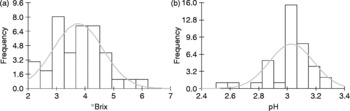
Four additional traits, soluble solids' concentration, acidity, crown size and growth per year were evaluated in 2007. Distribution of soluble solids and acidity is shown in Fig. 3. Soluble solids (°Brix) in petioles ranged from a low of 2.2, Timperly Early, to a high of 6.1, Ruby 201/29, with a mean of 3.8. Petiole pH ranged of 2.6, ‘Sutton’ (MSU 17) and ‘Oregon Giant’, to a high of 3.3, Parson's Crimson, with a mean of 3.0. In 2007, crown width in 2007 ranged from 19 to 50 cm with a mean of 33 cm. From 2005 to 2007, the average crown growth ranged from 4.7 to 10.4 cm/year and the highest was observed in ‘Plum Hutt’.
Distribution histograms of °Brix (a) and pH (b) in 2007 for 36 rhubarb cultivars and two rhubarb species. The bell curve represents a normal distribution about the overall mean, 3.8 and 3.03, °Brix and pH, respectively.

Discussion
The 15 morphological characteristics used in this study deviate somewhat from those endorsed by the European Union (Kyprianou, Reference Kyprianou2007) and specified in UPOV (1999). Out of 15, 13 characters evaluated were close to those specified by UPOV (1999). Leaf margin type and number of petioles are not included by UPOV (1999). UPOV (1999) specifies 27 characteristics, 14 were not considered in this study, including flower and inflorescence characters. Characters described here and those listed by UPOV utilize categories rather than quantitative measurements. This simplifies the collection of data, but limits statistical analysis. Predetermined categories also preclude adjustment for year-to-year variation. In this study, categories for traits such as petiole base thickness relied on predetermined widths. Petiole base thickness scores in 2007 were nearly all 1, ( < 20 mm), whereas in 2005 the categories detected more variation. Perhaps in 2007, the collection was more established than in 2005 or was affected by differences in temperature and precipitation (cloudiness) between the 2 years. The 2005 season was warmer and rainier than the 2007 (National Climatic Data Center, 2008). Categories for petiole number did not anticipate the large number in either 2005 or 2007, resulting primarily in scores of 9. With several years of data available, the categories may be adjusted to take into account the expected variation, but may require additional adjustment in the future. Additional research is needed to better understand petiole thickness and number, especially under short summer and long days under Alaska subarctic conditions. The use of actual measurements for petiole and leaf lamina width and length would remove the need for predetermined categories.
The distance matrices for 2005 and 2007 correlate poorly (Fig. 2). Seasonal variation undoubtedly contributed to this result. The 2005 growing season was warmer than 2007 (National Climatic Data Center, 2008) requiring more irrigation than 2007. Crowns were 2 years younger in 2005 and may have provided more vigorous vegetative growth; however, a 10–15 year production life span of rhubarb (Zandstra and Marshall, Reference Zandstra and Marshall1982) suggests differences between years 1 and 3 as not relevant. Poor correlation of the 2005 and the 2007 data was also evident in relative cultivar rankings, for example significant differences between years for flesh and skin colour. Not only values are different, but also relative cultivar ranking was not the same between years. Adding four additional characters in 2007 (pH, soluble solids, crown width and a 3 years mean) contributed to higher correlation between the distance matrix and the dendrogram. This suggested that combining years may lower resolution, and refinement of the descriptors' categories might be helpful in cultivar distinction. Additional research is needed to better understand rhubarb biology, development and refine morphological descriptors as related to plant phenology.
Of the cultivar relationships shown in Fig. 1 (2007+ dataset), a few are worth mentioning. ‘MacDonald’ and ‘McDonald’ are shown to cluster together, suggesting a possible genetic relationship. Collection source information indicates that these were originally obtained from different sources; however, the originating material is unknown and may be related. Three Sutton cultivars are included in this analysis. Three Sutton cultivars identified in GRIN (2009) as MSU 17, 22 and 64 were originally kept separate by Dale Marshall (pers. commun.) to determine their uniqueness. Passport information indicated that these accessions were obtained from different sources; however, the origin of the material is unknown and the three accessions may be related. Cultivars like Sutton may have been propagated by seed resulting in segregating phenotypes and divergence from the parent cultivar. The cluster of cultivars from ‘Cooper’ to Parson's Crimson scored from 4.6 to 5.5 for flesh colour and all ranked in the top 15 red cultivars in 2007. This is not particularly surprising since clustering is based on common characters. Unfortunately, red flesh ranking was not consistent, likely contributing to different cultivar relationships suggesting the need for additional research to better understand the interaction of rhubarb leaf petiole colour and the environment. This will be of particular importance in subarctic Alaska, where plants perform well in less than ideal growing conditions where there is a relatively larger diurnal temperature difference and shorter growing season than in southern growing regions. In rhubarb, anthocyanin content is correlated with the colour of the petiole base, middle and apex (Rumpunen and Henriksen, Reference Rumpunen and Henriksen1999). The stability and intensity of anthocyanin pigments are dependent on factors including temperature and light intensity (Laleh et al., Reference Laleh, Frydoonfar, Heidary, Jameei and Zare2006).
Rumpunen and Henriksen (Reference Rumpunen and Henriksen1999) reported a soluble solids' average of 4.3, and a range from 3.4 to 5.8 °Brix for 71 rhubarb cultivars. We report a slightly lower overall mean of 3.8, but a greater range 2.2 to 6.1. Studies have linked pH to the active transport of sugars (Daie, Reference Daie1984); however, this report detected no correlation between soluble solids' concentration of rhubarb petiole tissue and pH (R 2 = 0.095). The refractometer measured the concentration of soluble solids in the rhubarb petioles and not necessarily the simple sugars that impart sweetness (Echeverria and Ismail, Reference Echeverria and Ismail1990; Gills et al., Reference Gills, Resurreccion, Hurst, Reynolds and Phatak1999). Evaluations should be conducted by controlled taste panels to determine the cultivars with the sweetest taste. Research is also needed to better understand the chemical composition of rhubarb, e.g. oxalate and malate concentrations and its relationship with °Brix and taste in these cultivars.
Caution should be used in extrapolating morphological results to genetic relationships. Persson et al. (Reference Persson, Rumpunen and Möllerstedt2000) found poor correlation between morphological and molecular analyses. It is interesting that the two other rhubarb species accessions included in this study, R. palmatum Rubra and Rheum UK Lot 540533, are not outliers but cluster among the cultivars. This may reflect on the source of these two accessions, since it is possible that these cultivars were derived by open pollination and represent progeny from a cross with culinary cultivars. In fact, molecular analysis places both of these accessions in close relationship with culinary cultivars (Kuhl and DeBoer, Reference Kuhl and DeBoer2008).
This study provides some of the information necessary for the refinement of rhubarb morphological descriptors. This is the first attempt to characterize the genetic variation on the Rheum species in the USDA, GRIN system. Information on plant characters and its relationship with the environment is needed to develop and refine plant descriptors for this plant species that is grown over a wide range of climates and geographical zones.
Acknowledgements
The authors wish to thank David C. Ianson and Daniel Hall for their contributions to this project. We would also like to thank Dale E. Marshall for acquiring the collection and donating it to the National Plant Germplasm System.