Introduction
Perinatal depression may be defined as minor or major depression that occurs during pregnancy and up to 1 year after birth.Reference Gavin, Gaynes, Lohr, Meltzer-Brody, Gartlehner and Swinson 1 Approximately 5% to more than 25% of pregnant women and new mothers experience perinatal depression,Reference Gavin, Gaynes, Lohr, Meltzer-Brody, Gartlehner and Swinson 1 and the minority never receive any formal treatment.Reference Marcus, Flynn, Blow and Barry 2 Symptoms of depression that do not meet criteria for major depressive disorder, including minor depression, have been noted as a public health problem that needs more attention.Reference Cuijpers, De Graaf and Van Dorsselaer 3 Women with low incomes, such as women who qualify for Medicaid, are at particularly high risk for experiencing depression at various levels, as well as multiple co-occurring risk issues around the time of childbearing.Reference Holzman, Eyster, Tiedje, Roman, Seagull and Rahber 4 Symptoms of depression during the perinatal period have been associated with debilitating effects on the mother and infant,Reference Gawlik, Waldeier, Muller, Szabo, Sohn and Reck 5 including impaired parent–child bonding and child development problems.Reference Lovejoy, Graczyk, O’Hare and Neuman 6 , Reference Binaro, Pinto, Ahn, Einarson, Steiner and Koren 7 Therefore, untreated depression during pregnancy, variously defined, can have short- and long-term detrimental effects, not only for the mother, but for the infant, even into adolescence.Reference Gavin, Gaynes, Lohr, Meltzer-Brody, Gartlehner and Swinson 1 , Reference Lovejoy, Graczyk, O’Hare and Neuman 6 , Reference Binaro, Pinto, Ahn, Einarson, Steiner and Koren 7 – Reference Field, Diego and Hernandez-Reif 10
In routine practice, prenatal care clinicians may not have systems in place to diagnose and treat depression, but may conduct some form of screening, either through the use of depression screening tools or through clinical inquiry. It is recommended practice that healthcare providers perform some form of depression screening at some point in the pregnancy. Additionally, pregnancy is a time of high utilization of healthcare services, making it an ideal time to assess for depression and anxiety. Clinicians encountering pregnant women are concerned with an array of maternal factors, in addition to mental health, that may be associated with poor birth outcomes. Since prenatal depression seldom occurs in isolation from other associated risk factors, it is important to understand the effect of these factors alone and in combination so that clinicians may improve their ability to feasibly detect risk for poor infant outcomes. Therefore, the goal of this research is to provide information on the association of depression, as assessed during routine obstetrical practice, in conjunction with co-occurring risk factors (anxiety, socioeconomic status, maternal medical morbidity) on key birth outcomes known to have the highest impact on health outcomes of the infant. This study aims to inform the field by analyzing multiple risk factors and their interactions while adjusting for important covariates as contrasted with analyses examining depression and anxiety with each birth outcome independently.
Some studies have found that depression during pregnancy is associated with increased odds for premature deliveryReference Grigoriadis, VonderPorten and Mamisashvili 9 and low birth weight.Reference Evans, Heron, Patel and Wiles 11 Those 2 outcomes have been associated with severe infant health problems at the time of delivery (eg, respiratory distress)Reference Reading 12 , Reference Wang, Dorer, Fleming and Catlin 13 and increased developmental deficiencies (eg, cardiovascular disorders, intraventricular hemorrhage, and necrotizing entercolitis)Reference Capra, Tezza, Mazzei and Boner 14 ; therefore, they are 2 of the highest impact birth outcomes for infant and lifelong health.Reference Reading 12 , Reference Wang, Dorer, Fleming and Catlin 13 Research on the direct effects of depression alone on these poor birth outcomes, however, is equivocal.Reference Grote, Bridge, Gavin, Melville, Iyengar and Katon 15 , Reference Alder, Fink, Bitzer, Hosli and Holzgreve 16 One reason for the inconsistent findings may be related to the fact that depression commonly co-occurs with several other factors that also have been associated with poor birth outcomes on their own. For example, maternal anxiety, socioeconomic status, and medical conditions during pregnancy have all been found to have an association with poor birth outcomes.Reference Alder, Fink, Bitzer, Hosli and Holzgreve 16 – Reference Shapiro-Mendoza, Tomashek and Kotelchuc 20 Low income, lower educational attainment, unemployment, and food insecurity have all been associated with depressive symptoms during pregnancy,Reference Hromi-Fiedler, Bermúdez-Millán, Segura-Pérez and Pérez-Escamilla 21 , Reference Bennett, Einarson, Taddio, Koren and Einarson 22 as well as with poor birth outcomes. Moreover, the risk for prenatal depression symptoms can be compounded with circumstances such as low incomes, single status, and poor relationship quality, commonly related with low socioeconomic backgrounds.Reference Bennett, Einarson, Taddio, Koren and Einarson 22 These circumstances are associated with high levels of stress, which has also been shown to be associated with poor pregnancy outcomes, including low birth weight and preterm birth.Reference Alder, Fink, Bitzer, Hosli and Holzgreve 16 , Reference Rodrigues, Rocha and Barros 23 – Reference McFarlane, Parker and Soeken 25 The increased likelihood of depressive symptoms among pregnant women with socioeconomic stress, therefore, poses a serious risk for the health of the mother and her infant.
Prenatal depression, socioeconomic status (SES), and their combination may or may not co-occur with other problems that also have deleterious effects on the infant. Anxiety or pre-existing medical conditions can have adverse effects on the infant as well.Reference Shapiro-Mendoza, Tomashek and Kotelchuc 20 , Reference Pinto, Dodd, Walkinshaw, Siney, Kakkar and Mousa 26 , Reference Ding, Wu and Xu 27 It is estimated that up to 20% of women report severe anxiety symptoms during pregnancy, and these symptoms continue at this prevalence, if not higher, postpartum.Reference George, Luz, DeTychey, Thilly and Spitz 28 Perinatal anxiety has been shown to be associated with increased risk for spontaneous preterm birth and low birth weight.Reference Ding, Wu and Xu 27 Field et al Reference Field, Diego and Hernandez-Reif 17 showed a possible additive effect of depression co-morbid with anxiety on preterm birth. In addition to anxiety, several maternal medical conditions (eg, diabetes, obesity, cardiac disease, infection) have been shown to be associated with poor fetal outcomes and even in worst case, infant mortality.Reference Shapiro-Mendoza, Tomashek and Kotelchuc 20
Thus, one explanation for the equivocal findings regarding the direct effect of depression on poor birth outcomes is that many studies only measure depression and not these potential co-occurring problems (anxiety, medical conditions, SES), and often examine bivariate associations between each risk factor (eg, depression) and each birth outcome. In addition, selection bias related to study participation may play a role. Most research in this area involves recruitment of participants who are asked to complete measures for a research study. These procedures may result in a selection bias based on differences between women who choose to participate and those who refuse. The present study aimed to overcome some of these limitations by collecting medical record information, based on consecutive visits, regarding depression, anxiety, and medical conditions from an outpatient obstetrics clinic that serves serving primarily women enrolled in Medicaid. The purpose of the study was to examine the relationship of depression, considered along with these other factors, to key birth outcomes. Birth weight, gestational age at delivery, and APGAR (appearance, pulse, grimace, activity, respiration) scores were chosen as outcomes, given their clear association with infant health, as well as longer-term outcomes. Information on the possible interactive effects of depression with other factors, also found to be independently associated with birth outcomes, will help inform the design of future studies that will elucidate strategies for screening and intervention with the highest risk women.
Methods
All research procedures were approved by Florida State University’s Institutional Review Board. Data for this study were extracted from medical records at an obstetrical clinic located in Northwest Florida. This clinic is composed of a diverse provider mix, including 14 resident physicians, 6 attending physicians, 1 physician assistant, and 1 nurse midwife. The majority (75%) of the clinics are resident continuity clinics, with the remainder of the clinics staffed by attending and mid-level providers Full service obstetrical and gynecological care are provided, with the exception of family planning services. The majority of the patients (80%) are funded through the Medicaid program, 10% are self-pay, and about 10% have private insurance.
Records of all patients aged 18 and older who presented for care at the clinic between 2010 and 2012 were reviewed. Trained research staff under the supervision of an attending obstetrician (J.D.) extracted the following information from the medical record: participant’s age; race; highest education received; body mass index (BMI); any current maternal medical conditions; and all relevant pregnancy, labor, and delivery information. Documentation of any anxiety or depressive disorder was also extracted. The medical records also included the Patient Health Questionnaire-9 (PHQ-9), a depression screening tool, which was administered by clinic staff when women arrived for their initial obstetrics appointment. The PHQ-9 has been shown to be a reliable and valid measure of the Diagnostic and Statistical Manual for Mental Health Disorders, Fourth Edition (DSM-IV) criteria–based diagnoses of major depressive disorder.Reference Kroenke, Spitzer and Williams 29 The PHQ-9 was designed for brevity, as it was based on the original PHQ.Reference Kroenke, Spitzer and Williams 29 The 9 items assess the 9 symptoms of depression, as well as severity. Each of the 9 items corresponds to a depressive disorder criterion as stated in the DSM-IV, and participants rate the severity of each symptom on a scale of 0–3. Research suggests that individuals with diagnosed depression are 7.1 times likelier to score a 10 or greater on the PHQ-9 than individuals without depression, therefore establishing a cutoff of moderate to severe depression.Reference Kroenke and Spitzer 30 A score of 10 or greater was used as the cut-off score for this study. All information collected was de-identified to ensure confidentiality.
For the purposes of this study, 3 birth outcomes were analyzed from the information collected during medical record extraction. First, the gestational age of the infant at the time of delivery was collected. Second, the birth weight of the baby was collected and analyzed on a continuous scale in grams. Research has shown that a birth weight of less than 2,500 grams suggests problematic health and developmental issues in the future because the infant is not fully developed.Reference Boulet, Schieve and Boyle 31 , 32 The third birth outcome analyzed was the 5-minute appearance, pulse, grimace, activity, respiration (APGAR) score, which is based on a scale of 0–10. The 5-minute APGAR score has been shown to be a reliable indicator of infant health and mortality.Reference Casey, McIntire and Leveno 33 – Reference Haddad and Green 35 A score between 0 and 6 is an indication of poor infant health, and the lower the score means that more medical attention is necessary.Reference Casey, McIntire and Leveno 33 , Reference Haddad and Green 35
Statistical Analysis Plan
There were 419 subjects included in the analyses. Specific variables in the analyses included: maternal age, race, and education; body mass index (BMI); any current medical conditions, such as kidney problems, high blood pressure (HBP), and diabetes, mental health status (any depression or anxiety related information, PHQ-9 score); key labor and delivery information (induction and vaginal delivery type); and birth outcomes (gestational age, birth weight, and 5-minute APGAR). Race was collapsed into 3 levels (white, black, and other), and education was combined into 3 categories (below high school, high school or GED, and beyond high school graduate). Any chronic and active medical conditions listed in the medical records we extracted (diabetes, heart disease, high blood pressure, preeclampsia, eclampsia, asthma, AIDS, anemia, sickle-cell anemia, kidney problems, autoimmune disorders, active sexually transmitted infections, cancer, chronic infections, and others). The most commonly documented maternal medical conditions (kidney problems, HBP, and diabetes) were selected for the analyses. The primary depression variable was defined as any depression (binary) noted in the medical record or a score above the cut-off on the PHQ-9 (≥10). A binary variable of anxiety was created based on whether any anxiety-related information was documented (yes or no). Induction and vaginal delivery type were dichotomous, and all 3 key birth outcomes were continuous variables. Because women at the clinic site may have received either group prenatal care (centering) or individual prenatal care, a prenatal care type variable was created in order to explore a relationship to the outcomes. Since no effect was found based on whether women received centering versus individual prenatal care, the centering group variable was not included in the final analyses.
Descriptive statistics, including the mean and standard deviation (S.D.) or frequency and percentage for continuous or categorical covariates, were computed respectively. Differences on the birth outcomes (gestational age, birth weight, and 5-minute APGAR) between women with and without depression and anxiety, and between each type of medical conditional were conducted initially with 2 sample t-tests. General linear models (GLM) were performed for 3 birth outcomes, respectively, to look at the effect of comorbid depression and anxiety or medical conditions adjusting for the covariates shown. The 2-way interactions were entered together along with each predictor. The α of 0.05 was used as the statistical significance level for all tests. SAS 9.2 was used for all analyses.
Results
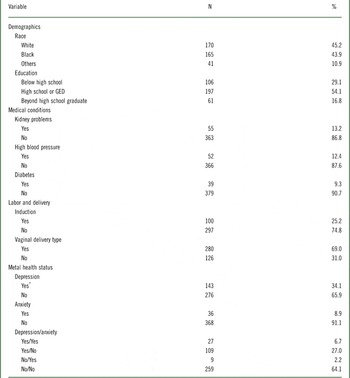
The descriptive statistics can be seen in Table 1. Subject ages ranged from 18 to 47 with a mean of 28 (S.D.=5.9). The sample race was approximately half white and half black, and only 17% overall were educated beyond high school graduate. About one-third of women showed evidence of any depression, and 9% with anxiety. The total PHQ-9 score, one measure used to identify depression, ranged from 0 to 27, with a mean of 5.23 (S.D.=4.7). Among maternal medical conditions documented in the records, kidney problems, HBP, and diabetes ranked as most common conditions. Most women in the sample delivered vaginally.
Descriptive statistics on subjects included in the analyses

Note: Missing data exist when the information was not provided in the medical record, which causes the sum of N to be not equal to 419.
* 66 based on PHQ-9 sum score, 108 based on medical documentation, 31 based on both.
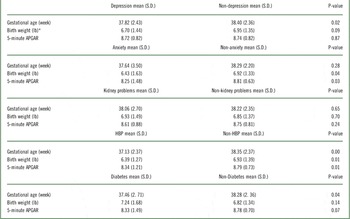
Table 2 shows the unadjusted t-tests results on the birth outcomes by depression, anxiety, and maternal medical condition. Gestational age was significantly different based on depression, HBP, and diabetes, but not based on anxiety or kidney problems. No significant difference was seen on birth weight based on depression, diabetes, and kidney problems, but statistically significant differences were found based on anxiety and HBP. For the 5-minute APGAR outcome, only anxiety and HBP showed significant differences.
Unadjusted results on birth outcomes from two sample t-tests by the status of depression, anxiety, and medical conditions

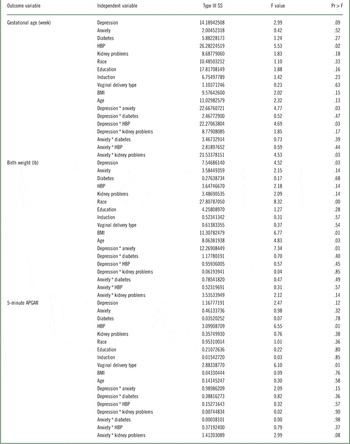
The adjusted results from the general linear model for gestational age, birth weight, and 5-minute APGAR, respectively, are shown in Table 3. P-values along with F statistics based on Type III Sum of Squares are presented, which tested whether the individual factors in the model explained a significant proportion of the variance given all other variables in the model. R-squares indicated that around 13–14% of variances were explained by each model. As can be seen in Table 3, as contrasted with the unadjusted bivariate comparisons, different relationships were found between depression, anxiety, and medical conditions with the birth outcomes after adjusting for other important covariates, including maternal characteristics (age, race, education), delivery factors (induction and mode of delivery), BMI, and the interactions between depression, anxiety, and medical conditions. For gestational age, the main effect of depression was marginally significant, and there was a significant main effect for HBP. Significant interactions with gestational age were found for depression with anxiety, depression with HBP, and anxiety with kidney problems. For birth weight, significant main effects were found for depression, race, BMI, and maternal age. There was a significant interaction between depression and anxiety for the birth weight outcome. No significant interaction among the risk factors was found for the 5-minute APGAR, but main effects were found for HBP and vaginal delivery.
Adjusted results (Type III sum of squares) for birth outcomes from general linear regressions

Specific (pairwise) mean differences after controlling for the covariates were examined for each significant predictor in our model based on comparison of the expected population-averaged means (least squares means). For the gestational age outcome, women with both depression and anxiety had infants born at 38.4 weeks on average (S.E.=1.1) as compared to women with anxiety only (no depression; mean gestational age=35.5 weeks, S.E.=1.6, p<.04). For the HBP by depression interaction effect, women with HBP and no depression had infants with the lowest gestational age (mean=35.3, S.E.=1.2) as compared to women with both depression and HBP (mean=37.8, S.E.=.9, p<.04), and as compared to women with no depression and no HBP (mean=37.8, S.E.=.7, p<.01). For the birth weight outcome, women with anxiety and no depression had infants with the lowest birth weight on average (mean=4.8 pounds, S.E.=.9), as compared to infants of women with both depression and anxiety (mean=6.9 pounds, S.E.=.6, p<.02) and to infants of mothers with no depression and no anxiety (mean=6.8 pounds, S.E.=.3, p <.03).
Discussion
The goal of the study was to examine the relationship of depression, which is commonly linked to poor birth outcomes, considered alone and together with anxiety and other maternal risk factors using clinical information that is routinely assessed in the context of prenatal care. This study was conducted in a clinic that serves predominately women enrolled in Medicaid because of the high prevalence of depression and poor birth outcomes among women of lower socioeconomic status. Overall, more than one-third of women were found to have an indication of some depression, either based on PHQ-9 scores of 10 or greater, or any documentation of depression in the medical record by the obstetrics clinician. A smaller percentage (9%) of women in the sample had any evidence of anxiety documented in the record. We found different associations between depression and infant outcomes depending on whether depression was examined alone or considered together with the other risk factors. That is, the unadjusted birth outcome mean comparisons based on depression showed different results than the comparisons that adjusted for the covariates. For example, mean gestational age was found to be significantly higher among the women without depression based on a simple t-test, but mean differences were not significant when adjusting for anxiety and other covariates in the multivariate model.
Significant interactions between depression and anxiety were found for gestational age and for birth weight. These interactions may explain, in part, inconsistent research findings related to the question of whether prenatal depression (when measured and analyzed alone) has a direct effect on birth outcomes.
For the gestational age outcome, we also found a main effect for maternal HBP as well as an interaction with depression, and an interaction of anxiety with maternal kidney problems. These interactions of depression and anxiety with maternal medical morbidity provide additional support for the complexity of the relationship of depression and anxiety on birth outcomes. Closer analyses of the specific mean comparison among these interactions revealed some unexpected results. For example, women with both depression and anxiety had infants born an average of 2.9 weeks later than infants of mothers with anxiety and no depression. In addition, infants of women with both depression and HBP were born on average 2.5 weeks later than infants of women with HBP and no depression. Women with anxiety and no depression had infants who weighed significantly less than women with both depression and anxiety. These findings differ from a previously published study that used validated measures of depression and anxiety in a mainly Latina prenatal sample and found worse outcomes for comorbid depression and anxiety on prematurity as compared to either depression or anxiety alone.Reference Field, Diego and Hernandez-Reif 17 There are several possible explanations for our findings and for equivocal findings in the literature in general. First, it is possible that mental health treatment use may impact birth outcomes. In our study, since depression and anxiety were noted in the chart, it is possible that some patients were receiving treatments, including antidepressant medications. Antidepressant use, as well as socioeconomic status, have been found to be moderators of the relationship between depression and birth outcomes in a meta-analysis.Reference Grigoriadis, VonderPorten and Mamisashvili 9 It is also possible that other important psychosocial and biological factors that are not typically measured (and were not measured here) exert substantial “third-factor” effects on birth outcomes. For example, lower dopamine and serotonin levels have been associated with prematurity and low birth weight.Reference Field, Diego and Hernandez-Reif 36 Other factors such as severity and course of depression, psychosocial impairment, sleep, and social problems have also been shown to impact birth outcomes.Reference Field, Diego and Hernandez-Reif 36 This suggests that future studies that aim to understand the relationship between prenatal mental health and infant outcomes should measure multiple factors known to have independent and perhaps additive or synergistic effects, and should employ multivariate analyses.
Another consideration for perinatal mental health research involves the sampling strategy. Both systematic reviews of the literature and meta-analyses have found a strong effect of methods, such as the sample, setting, and measures used, on the study results.Reference Grigoriadis, VonderPorten and Mamisashvili 9 , Reference Gaynes, Gavin and Meltzer-Brody 37 For example, a meta-analyses of the effect of prenatal depression on birth outcomes found a weaker association of depression alone on prematurity in studies that used convenience samples (ie, samples not drawn randomly or consecutively).Reference Grigoriadis, VonderPorten and Mamisashvili 9 Moreover, meta-analyses also found socioeconomic status of the sample to have a strong effect on the associations found between prenatal depression and birth outcomes. The present study analyzed medical record information from consecutively selected patients presenting at a health system that serves primarily Medicaid enrollees. Both the selection method and the lower SES sample may have affected the results.
The reliance on medical record information for all of the study data also introduces limitations. Although a validated measure of depression was used (PHQ-9), information on anxiety and maternal medical conditions was based entirely on clinical documentation. Therefore, the anxiety variable in particular was not confirmed by validated assessment and may not represent anxiety disorders as defined in the DSM-V. Future studies should include a validated anxiety tool or diagnostic assessment. However, the goal of the study was to examine the association of these risk factors for poor birth outcomes as clinically assessed and noted in the context of routine prenatal care. This information may be used to help clinicians develop a more refined, but feasible, strategy to determine which women are at highest risk for poor infant outcomes. For example, women with lower socioeconomic status, elevated depressive symptomatology, along with anxiety and/or other medical conditions may require greater surveillance than women with depression alone. The severity, history, and specific symptoms (eg, suicidality) must also be closely monitored, even in the absence of these co-occurring risk factors. Studies of this kind may be used to develop and test a risk algorithm that may be used in prenatal care settings to improve precision of prevention of poor birth outcomes.
Other important results of this study converge with other studies that have used different methods. For example, white women had babies with significantly higher birth weights than black women, and women with a higher BMI overall had infants with higher birth weights. Taken together, the results of this study highlight the importance of considering mental health, physical health, and socioeconomic risk factors for a comprehensive and accurate detection of infant risk outcomes.
Conclusion
In this sample of primarily lower SES pregnant women, over one-third evidenced depression, and maternal anxiety and chronic medical conditions were also relatively common. Each of these maternal factors may pose serious risk to neonatal and lifelong health of the child, either alone or in combination. Results of this study suggest that the interaction of prenatal depression and anxiety with medical conditions may have a greater impact on birth weight and gestational age. Each of these risk factors is typically included in obstetrical patient records. Therefore, it is feasible for prenatal care clinicians to develop levels of risk based on knowledge of multiple risk factors that may exert an influence on poor birth outcomes. Future studies should be designed to further develop and test multiple risk algorithms to inform clinical monitoring and intervention to possibly prevent these consequences.
Disclosures
Nicole McBride, Yuxia Wang, and Aura Cely have nothing to disclose. Julie DeCesare has the following disclosure: Bayer, consultant, speaker’s fee. Heather Flynn has the following disclosures: NIH, Grant recipient, Research support (salary); Florida State University College of Medicine, grants, research support.