Introduction
Weed management is a major challenge for organic and transitioning farmers 1 . Such farmers typically rely on short-term, high-cost control tactics such as hand weeding and cultivationReference Riemens, Groeneveld, Kropff, Lotz, Renes, Sukkel and van der Weide 2 , Reference Dedecker 3 which, respectively, are costly and of variable efficacy. Increased weed density generally occurs in both organic and transitioning systemsReference Riemens, Groeneveld, Lotz and Kropff 4 , Reference Hawes, Squire, Hallett, Watson and Young 5 . To improve this situation, scientists have placed considerable effort on researching ecological weed management (EWM) strategies, but they know little about how organic farmers’ perceptions and knowledge of such strategies inform implementation.
Incorporating the human dimension of agricultural management into biological research provides a valuable perspective on implementation of these practices, particularly given there is as much diversity in the human dimension of management as in the biophysical resources that farmers manageReference Nowak and Cabot 6 . Three recent studies provide insight into organic farmer weed management practices and beliefs in the Midwestern USA and the UKReference Dedecker 3 , Reference Doohan, Wilson, Canales and Parker 7 , Reference Turner, Davies, Moore, Grundy and Mead 8 . In terms of practice, in both the USA and the UK at least three-fourths of organic farmers discussed mechanical weeding, most often cultivation. EWM strategies such as seeding rate and variety choice were mentioned less often, roughly by one-third of farmersReference Dedecker 3 , Reference Turner, Davies, Moore, Grundy and Mead 8 .
In terms of the beliefs that may be informing attitudes toward practices, organic farmers in Ohio were less likely to mention biological concepts such as seed dormancy than their conventional counterpartsReference Doohan, Wilson, Canales and Parker 7 , yet such knowledge is likely a critical component of successfully implementing EWM strategiesReference Zwickle 9 . However, there are many ways to construct knowledge, and organic farmers rely on experiential learning, trial and error, and problem solving to develop and reinforce their knowledge, which may or may not conform to ‘best practices’Reference Eckert and Bell 10 , Reference Eckert and Bell 11 . Farmer knowledge has also been described as unspoken knowledge-in-practice, in contrast to formal, explicit knowledgeReference Macé, Morlon, Munier-Jolain and Quéré 12 . For example, UK farmers associated success in weed management with informal on-farm trials of strategies, and ascribed failures to either inexperience or lack of time and moneyReference Turner, Davies, Moore, Grundy and Mead 8 . Overall, adoption of EWM strategies lags behind the widespread use of cultivation. We aimed to learn how farmer knowledge and perception of management tradeoffs influences their decision to implement a given strategy on their farm.
In this study, we constructed ‘mental models’ of New England organic farmers to summarize their knowledge, beliefs and perceptions of weeds and weed managementReference Morgan, Fischhoff, Bostrom and Atman 13 . A mental model can be described as a complex network of beliefs that affects how a person defines a problem, assesses risks and benefits, gathers and processes information, and makes decisionsReference Wilson, Tucker, Hooker, LeJeune and Doohan 14 . The mental models approach is designed to tell us how and what organic farmers think about weeds and weed management, and particularly how this compares to the scientists and extension professionals working to support themReference Doohan, Wilson, Canales and Parker 7 . This approach has already been used to study perceptions and beliefs of conventional and organic farmers in Ohio regarding weed management, with a focus on herbicide resistance as the hazardReference Doohan, Wilson, Canales and Parker 7 , Reference Wilson, Tucker, Hooker, LeJeune and Doohan 14 , Reference Wilson, Hooker, Tucker, LeJeune and Doohan 15 , as well as with other agricultural hazards, such as microbial contamination on produceReference Parker, Wilson, LeJeune and Doohan 16 .
Our study compared farmer mental models to a baseline expert model of critical organic weed management knowledgeReference Zwickle 9 . We assessed (1) knowledge and beliefs regarding EWM strategies; and perceptions regarding (2) the risks and benefits of weeds; and (3) the risks and benefits of organic weed management strategies. Differences between the farmer and expert models in each of these areas will highlight areas of opportunity for improving extension-based communication and design of scientific research for the benefit of organic farmers. Focusing on the most salient beliefs, as well as potential inaccurate beliefs, in communication efforts can be the best route to knowledge-based behavioral changeReference Ajzen 17 .
Methods
Expert model development
Development of the expert model is described briefly below; details regarding this process and outcome are described in full by ZwickleReference Zwickle 9 . Sixteen ‘experts’ (eight PhD-level scientists, four extension specialists chosen because of involvement with farmer education, and four experienced organic farmers) were interviewed by phone or as part of a focus group in the winter of 2010. The farmers were identified by extension personnel as farmers particularly experienced with weed management, and they participated in focus groups to strengthen the expert model as a whole. This group represented three regions in the USA (the Northeast, Midwest and California) and one scientist from the Netherlands. Interviews began with open-ended questions about weeds, weed management and organic farmers. Once the expert exhausted his or her knowledge in response to an open-ended question, the interviewer used prompts to elicit more specific thoughts. Finally, the interview concluded with pointed questions ranging from beliefs about weeds to farmer experiences, risk perceptions and values.
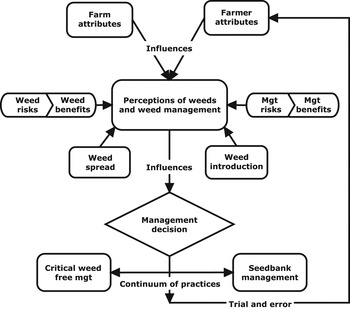
The results of the expert interviews were organized into a conceptual model of the weed management decision-making process (Fig. 1). This model synthesized the expert view with decision science theories that recognize the tandem roles of experiential and deliberative processing in decision makingReference Plous 18 – Reference Corselius, Simmons and Flora 20 . First, experts believed that farm attributes, such as scale, and farmer attributes, such as knowledge, informed a farmer's perceptions of weeds and weed management. These beliefs are consistent with research that identifies how intuitive judgments of risk associated with a hazard (in this case weeds) vary by a range of individual characteristicsReference Sjöberg 21 . In turn, these perceptions influenced the acceptability of management strategies, categorized here as either critical weed-free period (i.e., short-term, cultivation-based) or seedbank (i.e., longer-term, multi-tactic) strategies, consistent with research that identifies perceived risks and benefits as predictive of the acceptability of new technologies to usersReference Siegrist 22 , Reference Siegrist, Cvetkovich and Roth 23 .
Conceptual model representing the expert view of the organic weed management decision-making process.

Farmer interviews
The concepts highlighted in the expert model were used to develop the farmer interview protocol available online (see Supplemental Table 1). Farmers were contacted by email based on recommendations from Maine Organic Farmers and Gardeners Association and Northeast Organic Farming Association. Participating farmers included those who responded affirmatively to the initial email solicitation and several who learned about the project in newsletter postings. Farmers from Maine (n=12), New Hampshire (n=5) and Vermont (n=6) were interviewed in fall 2010 by the same interviewer, using a consistent protocol.
We used a semi-structured open-ended interview strategy such that all farmers received the same initial prompts, but farmers were asked to clarify or provide more information about the concepts important to them. Interviews were conducted to uncover farmer knowledge, perceptions and experiences in a way that minimized the influence of the interviewer and provided farmers freedom of expression. At the same time, responses to questions were prompted in a focused way. For example, an interviewee may have responded to the open-ended question ‘What is a weed?’ with a narrative of undirected information. Further into the interview, however, the interviewer directed these responses to major areas identified by the expert model, for example ‘what are the benefits of weeds?’ A set of standard response phrases was prepared in advance to clarify answers without questioning their legitimacy, such as ‘How did you come to that conclusion?’
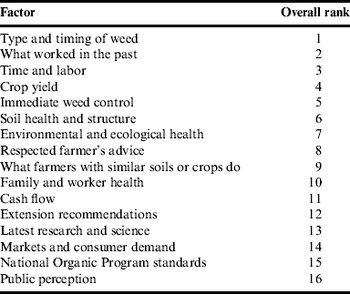
The farmer interview protocol also included an exercise that required farmers to rank by ordering index cards with text that described various sources of information specific to the organic weed management decision-making process. The 16 options (Table 1) included sources of analytical information (e.g., latest science and research), experientially based information (e.g., what worked in the past) and value-based information (e.g., soil health). Farmers were asked to work quickly and rank them from most to least important in their decision-making process. This exercise was included to cross-validate the interview data and verify the importance of different types of information during the weed management decision-making process.
Importance of 16 factors for weed management decisions, as ranked by farmers.

Interview coding
The interviews were independently transcribed and entered into the qualitative software program MAXQDA 24 . Coding has been defined as ‘the analytic process through which concepts are identified’Reference Corbin and Strauss 25 , through which labels are assigned to segments of the interviews, identifying what that segment was about. Each interview was coded separately according to the schematic developed from the expert model. If a farmer mentioned a concept not found in the expert coding schematic, it was added and marked as a uniquely farmer response. After the coding schematic was developed, it was tested for inter-coder reliability to examine its potential to produce repeatable results and to judge the intuitive logic of the model. Mental models studies expect coders to agree at least two-thirdsReference Morgan, Fischhoff, Bostrom and Atman 13 . Six farmer interviews were coded by an independent researcher, and inter-coder reliability tests revealed between 90 and 96% agreement in each interview.
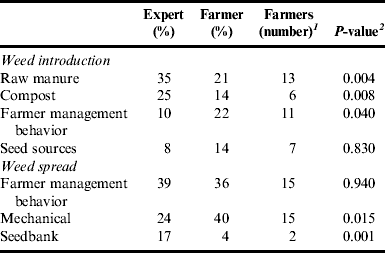
Coding the frequency of response is important in mental modelsReference Morgan, Fischhoff, Bostrom and Atman 13 . The more often a farmer mentioned a concept, the greater the importance in their decision-making process. If a farmer took time to explain a concept more fully, it was coded as only one mention, but the details of his or her responses within that concept were coded in detail. If a farmer mentioned the same concept later on, it was coded again. Coding hierarchically to increasing level of detail provides a way to more accurately compare between groups (farmer to expert) and within groups (amongst farmers)Reference Corbin and Strauss 25 – Reference Charmaz 27 . For example, both experts and farmers agreed that agricultural causes of weed introduction are most important (86 and 69% weed introduction codes, respectively). However, at the next level of detail we observed that experts thought manure was the most important agricultural source of weeds (35% agricultural weed introduction codes) in contrast to farmers, who placed near equal emphasis on management behavior and manure (22 and 21% agricultural weed introduction codes, respectively).
Coding for knowledge
The expert model established long-term, ecologically based methods as crucial for reducing the risks associated with weeds on organic farms. Rather than asking a farmer directly about the general aspects of EWM, responses were coded when one of the principles was inherent in a farmer response to measure ‘knowledge.’ For example, Farmer 9 discussed the importance of rotating row crops with forage crops to utilize grazing as a way to reduce weed seed density. This discussion was coded in the knowledge area ‘Managing Weed Seedbank,’ in the particular concept ‘Interrupting Weed Cycles Through Strategic Rotation.’ Specifically, Farmer 9 said:
“With forage—with the cows grazing it, they're eating up the seeds before they even become viable. If I can mix a forage rotation in there I can really reduce the amount of weed seeds for the next year.”
Coding for management strategies
Management strategies were grouped according to whether they primarily allowed for a critical weed-free crop period (generally mechanical strategies targeting seedlings) or managed the seedbankReference Gallandt 28 . The following strategies were grouped as critical weed-free period strategies: cultivation and tillage, hand weeding, organic herbicides, flaming, mowing and grazing. Seedbank management strategies included crop rotation, cover crops, mulch, nutrient management and seeding rates. For each strategy, codes were placed in the categories of location, timing, implementation and type, as appropriate, to capture detailed information of the specific context in which these strategies were discussed.
Data analysis
Results are reported as the percentage of codes within a category to compare the relative emphasis between farmers and experts. For instance, science and research comprised 58% of learning codes in the expert model in contrast to 9% of learning codes in the farmer model. To test for significant differences between farmer and expert emphasis, we calculated the difference between proportion of farmer mentions and proportion of expert mentions of a given concept. We used the Wilcoxon Signed Rank test to determine if the difference between farmers and experts significantly differed from zero. P-values <0.05 indicate divergence in emphasis between farmers and experts. For the farmer model, the number of farmers discussing a given concept (out of 23 total) is also reported. Finally, quotes are included to provide examples and context. Farmers are cited with their identification number with F19 indicating Farmer 19, for example.
Results and Discussion
This northeast New England farmer model was based on interviews with farmers who identified their major crops as either vegetables (n=19) or field crops (n=4). All field crop farmers interviewed were also dairy farmers. Gross farm income varied widely between these farms: 30% of farms (n=7) had a gross income of less than US$100,000; 35% of farms (n=8) had income in the US$100,000–250,000 range; 17% of farms (n=4) had income in the US$250,000–499,000 range; and 17% of farms (n=4, 2 dairy and 2 vegetable farms) had gross income greater than US$500,000. One farmer was new to organic farming (0–4 years of experience). Six farmers (26%) had 5–9 years of experience, eight farmers (35%) 10–14 years, and eight farmers (35%) more than 15 years.
The results that follow compare the farmer and expert models, with a focus on the role of (1) knowledge, (2) perceptions of weeds, and (3) perceptions of weed management strategies. We discuss particular farm attributes as they relate to perceptions, for example the importance of resources. We acknowledge the importance of farmer traits and values in decision makingReference Zwickle 9 ; however, we will not focus on these topics here. In the final results section (Ranking exercise), we report results of the farmer ranking exercise.
Knowledge, learning and experience
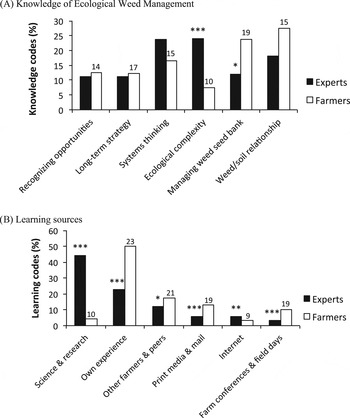
Experts addressed knowledge of EWM according to six main topics (Fig. 2A). Farmers exhibited knowledge of each topic, although overall emphasis varied in comparison to experts (Fig. 2A). We report details of farmer and expert models below for each knowledge topic, followed by discussion of farmer seedbank beliefs and on-farm weeds. Finally, we address learning and the role of experience.
Relative emphasis on EWM knowledge concepts (A) and learning sources (B), according to frequency of codes in expert and farmer interviews. The number of farmers, out of 23 total, that discussed each concept is listed above the farmer bars. Bars labeled with *, ** or *** denote significant differences between expert and farmer emphasis at levels of P<0.05, 0.01 or 0.001, respectively.

Ecological complexity
Experts placed more emphasis on ecological complexity than farmers (P<0.001, Fig. 2A). Experts repeatedly stated that organic farmers must be comfortable with and motivated by the complexity of organic systems in contrast to conventionally managed systems. Farmers did not dwell on complexity and were just as likely to identify conflict between their organic farming practices and ecological complexity, e.g., ‘what's best for the ecosystem is if we just leave it the hell alone’ (F10). Experts’ discussion included connections between management and ecology (64% of ecological complexity codes)—specifically between marketing, labor and crop sequences; between suites of organisms; and the complex, undetermined cause and effect relationships regarding EWM. Experts believed that farmers want proof of a relationship between a given tactic and the success of weed management, but delayed results often make this difficult. Farmers also discussed connections between management and ecology, but focused on their dependency on weather or climate to achieve successful management (32% of farmer ecological complexity codes), a concept rarely mentioned by experts (3% of expert ecological complexity codes).
Systems thinking
Farmers and experts placed similar emphasis on systems thinking (Fig. 2A), with a focus on the concept of diversifying. Experts discussed the role of crop diversity and crop rotations in EWM. An effective crop rotation for weed management included rotating cash crops with cover crops, and the timing of disturbances, not merely the crop sequence. Experts acknowledged the importance of crop rotation not only to maximize weed control, but also to contribute to the farm's fertility needs. Farmers’ discussion of diversity (nine farmers) differed subtly from experts. In addition to specific details regarding their rotations, farmers described diversity of disturbances in their rotations, including tillage, fallows, mowing hay fields and grazing pasture. Farmers stated they use many strategies within the year, specifically citing the ‘many little hammers’ theoryReference Liebman, Gallandt and Jackson 29 or describing management practices as ‘…the tools in our toolbox…the weapons in my weapon chest’ (F4).
Managing the weed seedbank
Farmers placed more emphasis on managing the weed seedbank than experts (P=0.033, Fig. 2A). Within this topic, experts and farmers both discussed the concept of interrupting weed cycles through rotation. Experts discussed stressing weeds at different points in their life cycle throughout the rotation and using strategically timed disturbances. They equally emphasized the importance of using appropriate tillage tactics, including minimizing use of tillage, and changing planting times. Farmers agreed that weed life cycles can be interrupted through crop rotation, and also emphasized using appropriate tillage tactics within a rotation (seven farmers). In contrast to experts, farmers placed more emphasis on pre-empting seed rain (nine farmers) than on changing planting times within a rotation (one farmer).
Relationships between weeds and soil
Farmers and experts placed similar emphasis on knowledge related to weed/soil relationships (Fig. 2A). Both groups discussed the concept that agricultural soils, due to high fertility, in particular nitrogen, invite weeds (nine farmers, 26% of farmer weed/soil codes and 24% of expert weed/soil codes). Farmers (12 farmers, 37% of weed/soil codes) and experts (8% of weed/soil codes) also discussed the relationship between weeds and soil structure, focused on the influence of compaction, drainage and soil texture.
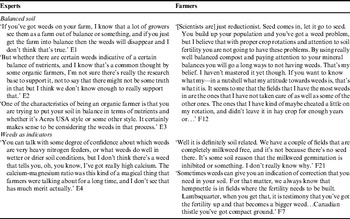
Farmers and experts showed divergence in their discussion of the relationship between weeds and soil nutrients. Experts expressed uncertainty regarding the relationship between weeds and nutrients other than nitrogen, specifically mentioning calcium, magnesium, and potassiumReference Tilman, Tilman, Crawley and Johnston 30 in their lengthy discussions on this topic (69% of expert weed/soil codes). One-third of farmers discussed associations between weeds and soil nutrients (19% of farmer weed/soil codes), ranging from general to explicit relationships between weed germination or presence and excess or deficient nutrients. Farmers uniquely discussed weeds as a way to ‘heal’ the soil (six farmers, 10% of farmer weed/soil codes) and weeds as ‘indicators’ (six farmers, 8% of farmer weed/soil codes) of problems with cultivation, nutrient levels and soil conditions such as compaction (Table 2). Farmers and experts diverged with beliefs of weeds as indicators for soil nutrients. Farmers discussed this concept in the same breath and with the same confidence and finality as the relationship between weeds and compaction or soil moisture, whereas experts were careful to distinguish between these concepts and weeds and nutrient balance. Experts varied in how dismissive they were of such claims (Table 2).
Weeds as indicators of soil conditions: divergent philosophies from expert and farmer models.

Long-term strategy
Experts and farmers both agreed on the importance of long-term strategy (Fig. 2A), focused on the concept of evidence-based management (ten farmers) and the challenge of proving effectiveness of long-term strategies. Farmers may need to wait several years before evidence of successful EWM implementation is apparent. In addition, seedbank management may require a short-term loss (e.g., land in summer fallow) to result in long-term gain (e.g., decreased seedbank). Farmer discussion of evidence-based management includes making decisions based on weed abundance in that year or the following year, a decision made on short-term gains (less observed weeds) that may discount longer-term goals such as soil healthReference Frederick and Loewenstein 31 . At the same time, farmers discuss the potential long-term benefits of soil quality as a result of cover cropping. This tension between long-term gain and short-term loss is apparent in both models.
Recognizing opportunities to manage weeds
Experts stressed the importance of a farmer's ability to recognize when, how and where to manage weeds. They identified concepts that enable farmers to recognize such opportunities: in particular, knowing the biology or type of the weed, timing management appropriately and knowing whether the weed is an annual or perennial. Farmers placed similar emphasis on knowledge of weed biology (nine farmers), explaining that in part their weed management decisions are in response to the type of weed or growth stage. They highlight the ‘white thread’ stage as an opportunity for management, and the importance of timing (five farmers).
Farmer seedbank beliefs
Each farmer was asked, ‘How would you describe the term weed seedbank?’ followed by ‘How does it work on your farm?’ Most coded responses regarding seedbank beliefs (71%) were in response to these questions, although farmers also discussed these beliefs throughout the interview (remaining 29% coded responses). Nearly half of these codes (47%, 22 farmers) were associated with a response describing the seedbank as ‘viable seeds in the soil.’
Five farmers emphasized the maximum extent of seed longevity, mentioning seeds that can live from 20 to 80 years in the soil (8% seedbank belief codes). Farmers also stated that seed survival varies with soil depth (eight farmers, 8% seedbank belief codes). These farmers discussed the role of tillage and burial in determining depth of seeds in the soil profile, and consequently, whether these seeds would germinate or be susceptible to predation or decay. Expert discussion of seed longevity clarified that ‘although some seeds are long-lived…the majority of weed seeds do not have a long life in soil.’ In this context, experts explained that management practices such as zero-seed rain can have a measurable impact on weed densities over a short-time frameReference Riemens, Groeneveld, Lotz and Kropff 4 .
Weeds on their farms
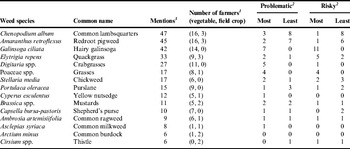
Farmers were asked to name or describe the types of weeds on their farm, and identify the most and least problematic and risky weeds (Table 3). On average, farmers named nine species during the course of their interview, with a range of 5 to 13 species of weeds mentioned per farmer. Farmers most often mentioned hairy galinsoga (Galinsoga ciliata) as the most problematic and risky weed on their farms. They described hairy galinsoga as risky due to biological traits such as the short time before seed set and before germination. Farmers also considered it risky based on the experience of others: ‘Other farmers say do whatever you can to keep that one out of your fields. I will go out of my way to pull that out…’ (F4). Weed species discussed differed between vegetable and field crop farmers. Although hairy galinsoga was mentioned by roughly three-fourths of vegetable farmers, no field crop farmers mentioned this species. In turn, only field crop farmers mentioned thistle (Cirsium spp.). Common lambsquarters (Chenopodium album) was the weed species mentioned most often overall, but this species was most likely to be identified as the least risky and the least problematic weed. Farmers acknowledge that common lambsquarters produces a lot of seed, but describe it as being easy to identify, cultivate, pull by hand and control.
Weeds mentioned during farmer interviews.

1 Number of farmers in each farm type (from a total of 19 vegetable and four field crop farmers) that mentioned a given weed.
2 Number of farmers that identified a weed as most or least problematic or risky.
3 Total number of mentions summed over all farmer interviews.
Learning and the role of experience
Experts most often discussed science and research-related sources for weed management knowledge, placing greater emphasis on this learning source than farmers (Fig. 2B, P<0.001). Farmers placed more emphasis on learning from their own experience (Fig. 2B, P<0.001). Farmers discussed knowledge gained from trial and error, specifically regarding timing (ten farmers), weed life cycles (nine farmers), crop rotation (eight farmers), equipment (six farmers) and soil fertility (five farmers). Farmers placed more emphasis on learning from other farmers (P=0.014), print media (P=0.001), and farm conferences and field days (P<0.001) than experts. Experts placed more emphasis on learning from the internet than farmers, although this was a small category in both farmer and expert models (P=0.004).
Perceptions of weeds, weed introduction and spread
Risks of weeds
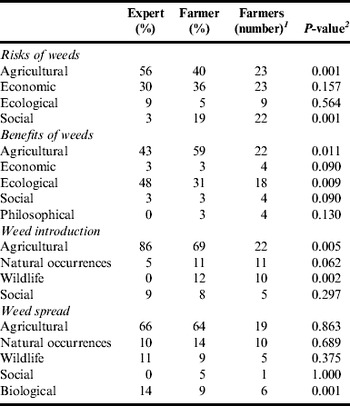
Farmers were specifically asked whether there are risks and benefits to having weeds on the farm. Both experts and farmers mentioned the risks of weeds more than twice as often as the benefits of weeds. Risks of weeds were coded in four major categories: agricultural, economic, ecological and social. Farmers and experts both discussed agricultural and economic risks of weeds most often (Table 4). Both farmers and experts agreed on the agricultural risk of competition by weeds (70 and 54% of farmer and expert agricultural risk codes, respectively; P=0.157; 19 farmers). Farmers discussed the rapid growth of weeds and their ability to compete for nutrients, moisture and sunlight, concepts included in the expert model. Experts, and farmers to a lesser extent (P=0.018), identified a weed's ability to exploit niches as risky (25 and 12% of expert and farmer agricultural risk codes, 14 farmers). Economic risks closely followed agricultural risks in importance to both farmers and experts, in particular risks associated with production. Experts emphasized risk of reduced yield more than farmers (P<0.001, 71% expert versus 39% farmer production risks, 18 farmers), whereas farmers placed more emphasis on the risk of time and labor costs due to weeds than experts (P=0.006; 27% farmer versus 9% expert production risks, 15 farmers). As described by farmer 5,
“Labor is one of our biggest concerns. The margin of profit of any of these things is so slim that if you put too much labor into trying to weed them, then you're not making any money on it.”
Perceptions of weeds according to experts and farmers. Percentages reported reflect the relative emphasis based on frequency of codes from interviews.

1 Number of farmers (out of 23 total) that discuss a particular perception category.
2 Wilcoxon sign-rank test for difference in emphasis between experts and farmers.
Benefits of weeds
Farmers discussed agricultural benefits of weeds more often than experts, who, in turn, discussed ecological benefits of weeds more often than farmers (Table 4). However, both groups discussed ecological and agricultural benefits more than economic and social benefits of weeds, which they agreed were minimal (Table 4). Farmers and experts agreed that the primary agricultural benefit provided by weeds is for the soil (P=0.441; 88 and 89% of agricultural benefits, respectively). Farmers primarily described this as weeds ‘acting like a cover crop’ (31% of codes in soils category, 18 farmers), an analogy experts used less often (8% of soils codes in expert model). Experts focused on the concept of weeds adding organic matter and nutrients to the soil (28% codes), a concept also mentioned by farmers (11% codes). Farmers and experts also discussed the contribution of weeds to nutrient cycling of soils (15 and 12% codes, respectively) and erosion prevention (19 and 20% of codes in soils category, respectively).
Experts placed more emphasis on the ecological benefits of weeds as habitat (P=0.035) and as biodiversity (P<0.001) than farmers. Experts and farmers agreed on the beneficial role weeds play as part of the agroecosystem (P=0.115) and as food for wildlife (P=0.858). Farmers uniquely described weeds as Mother Nature's way of healing the soil, for instance by colonizing disturbed ground. The beneficial ecological role of weeds has become a popular research topic in the European Union, with recent studies emphasizing the role of weed species diversityReference Roschewitz, Gabriel, Tscharntke and Thies 32 , Reference José-María and Sans 33 and the role of weeds in food websReference Bàrberi, Burgio, Dinelli, Moonen, Otto, Vazzana and Zamin 34 , Reference Evans, Pocock, Brooks and Memmott 35 .
Perceptions of weed introduction
Both farmers and experts discussed weed introduction due to agricultural causes most often, although experts placed relatively more emphasis on agricultural sources of introduction than farmers (Table 4). Farmers placed more emphasis on wildlife as sources of weed introduction (Table 4). Experts placed more emphasis on manure and compost as agricultural sources of weed introduction than farmers, whereas farmers placed more emphasis on farmer behavior (Table 5). Experts may be overemphasizing the role of manure that generally contributes a small number of seeds relative to the existing seedbankReference Mt. Pleasant and Schlather 36 . Unique introduction of pernicious species is, however, a legitimate concern. Farmer discussion of behavior included the role of previous cropping systems, such that weeds were brought in historically or already on the farm (six farmers). Farmers and experts placed similar emphasis on natural and social occurrences as sources of weed introduction (Table 4).
Agricultural causes of weed spread and introduction. Percentages reported represent the relative emphasis based on frequency of codes from interviews by experts and farmers.

1 Number of farmers (out of 23 total) that discuss a particular category.
2 Wilcoxon sign-rank test for difference in emphasis between experts and farmers.
Perceptions of weed spread
Farmers and experts agreed on agricultural causes as the dominant source of weed spread (Table 4), specifically farmer behavior as the most important factor (Table 5). Expert discussion of farmer behavior focused almost entirely on allowing weeds to set seed. Farmers discussed allowing weeds to set seed (seven farmers) as well as seeds spread by foot travel (seven farmers). Farmers placed more emphasis on mechanical causes of weed spread than experts (Table 5), primarily discussing movement with equipment. Experts placed more emphasis on biological causes of weed spread than farmers, but overall discussed this concept much less often than agricultural causes (Table 4). The farmers interviewed were very management centered, and they took a great deal of responsibility for weed introduction and spread, more so than conventional farmers interviewed in the MidwestReference Wilson, Tucker, Hooker, LeJeune and Doohan 14 who placed more emphasis on factors such as flooding that were out of their control.
Weed management perceptions
We first discuss practices associated with critical weed-free management (e.g., cultivation and tillage, hand weeding and flaming), followed by seedbank management (e.g., cover cropping and green manures, crop rotation and mulches). We view these approaches to weed management as reflective of seedling-focused, short-term, reactionary practices, in contrast to longer-term, more system-level practices. We recognize that individual farmers may be successful by emphasizing either philosophy, and that most employ a combination of management practices that are seedling- as well as system-focused.
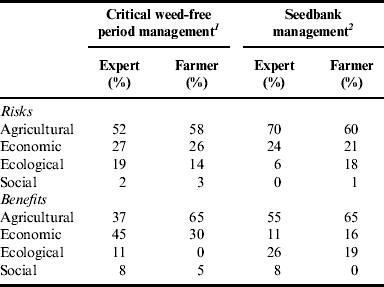
Risks and benefits were categorized as agricultural, economic, ecological or social (Table 6). Farmers and experts both placed more emphasis on benefits of seedbank management practices than on benefits of critical weed-free management practices (P=0.463), mentioning benefits of seedbank management practices 1.6–1.8 times more often. The most discussed type of seedbank management benefits, agricultural, were equally emphasized by farmers and experts (P=0.224). Farmers placed more emphasis on agricultural benefits of critical weed-free management than experts (Table 6, P=0.005). Experts uniquely discussed ecological benefits to critical weed-free strategies, although this was less important than agricultural and economic benefits.
Risks and benefits of weed management strategies. Percentages reported represent the relative emphasis based on frequency of codes from interviews by experts and farmers.

1 Strategies that allowed for critical weed-free period, generally mechanical strategies targeting seedlings.
2 Strategies that managed the seedbank.
Farmer discussion of risks was more focused on critical weed-free practices than expert discussion (P=0.032). Farmers discussed risks of critical weed-free practices 4 times as often as risks of seedbank management practices, in contrast to expert discussion 2.3 times as often. However, the relative emphasis on types of risk was similar between farmers and experts (Table 6, P>0.1 for all categories). Farmers and experts most often discussed agricultural risks, followed by economic risks.
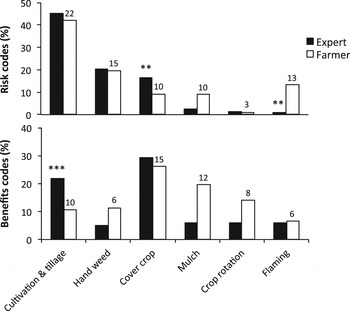
In the following sections, we present results and discussion for the six types of management practices most discussed by farmers. Farmers and experts also discussed other practices less frequently, including mowing, grazing, herbicides, nutrient management, crop choice and seeding, tiling and use of transplants. The relative emphasis reported in Fig. 3 was calculated based on all discussed practices.
Relative emphasis on risks and benefits of weed management practices, according to frequency of codes in expert and farmer interviews. The number of farmers, out of 23 total, that discussed each concept is listed above the farmer bars. Bars labeled with ** or *** denote significant differences between expert and farmer emphasis at levels of P<0.01 or 0.001, respectively.

Cultivation and tillage
Farmers and experts most often discussed bare fallow or stale seedbed cultivation practices (16 farmers), including the importance of completing multiple passes with equipment. Both groups discussed the importance of timing cultivation when weeds are small (six farmers), specifically mentioning the ‘white thread stage’ during which seedlings are most susceptible to cultivation (seven farmers).
Experts and farmers agreed that cultivation and tillage was the riskiest practice overall (P=0.459). They primarily discussed agricultural risks of cultivation and tillage such as missing cultivation windows (19 farmers), particularly in ‘too wet’ conditions. Both groups acknowledged risks of implementation associated with crop damage (eight farmers) and ecological risks of damage to soils and erosion (nine farmers). Farmers uniquely discussed economic risks of cultivation: cost of time, labor, purchasing and using a tractor (five farmers). Experts placed more emphasis on the benefits of cultivation and tillage than farmers (P<0.001). Experts primarily discussed economic benefits, including the concept that controlling weeds through cultivation pays for itself through increased crop yield, and that accepting some crop damage can result in better yield due to decreased competition. Farmers did not discuss the latter concept.
Hand weeding and hoeing
Farmers discussed both hoeing (13 farmers) and hand pulling (eight farmers). They emphasized timing, particularly two main concepts: (1) hand weeding before a weed goes to seed to preempt seed rain, and (2) hoeing at the white thread stage. Experts did not focus on timing, and discussed instead whether the entire plant, roots included, needed to be removed depending on the species, as well as use of the correct tool. Hand weeding was the second riskiest practice discussed by both experts and farmers (P=0.657, Fig. 3). Experts placed nearly all emphasis on economic risks of hand weeding, whereas farmers also acknowledged other types of risks. Economic risks focused on the cost and availability of time and labor associated with hand weeding (12 farmers). Social risks discussed by farmers focused on the challenging nature of hand weeding. Experts and farmers both discussed benefits of hand weeding minimally (P=0.492, Fig. 3).
Flaming
Experts and farmers discussed flaming both pre- and post-emergence, and implementing it as a stale seedbed strategy. Farmers exhibited more concern of risks associated with flaming than experts (P=0.008, Fig. 3) mentioning danger, panic and setting a field on fire (12 farmers). Timing of flaming was identified as crucial (five farmers), ‘critical within hours’ (F13). Farmers and experts agreed on the emphasis on benefits of flaming (P=0.470), particularly the added flexibility flaming allows in response to weather conditions when preparing a seedbed. Farmers discussed the value of the stale seedbed approach of killing weed seedlings without also bringing up new seeds as you would with a cultivation-based, false seedbed techniqueReference Davis, Renner, Sprague, Dyer and Mutch 37 .
Crop rotation
Farmers were asked, ‘Do you use crop rotation to manage weeds? If so, what makes a crop rotation successful at managing weeds?’ Twenty-one farmers said they used crop rotation to manage weeds, although several qualified that weeds are considered in combination with disease, fertility requirements and soils. Farmers discussed rotating crops that are easier to control weeds in or ‘keep clean’ with those that are not (ten farmers). Six farmers described using rotation to temporally break weed life cycles.
Farmers and experts rarely discussed risks from crop rotation (Fig. 3). Experts indicated that vegetable growers may not execute a crop rotation in the same way a grain grower would, for example. Organic vegetable farmers often rely on particular sequences of crops, e.g., ‘couplets,’ but not longer-term, predictable sequencesReference Mohler and Johnson 38 . One vegetable farmer supported this claim, explaining that she ‘can't have a specific crop rotation’ due to variability in soil moisture on her farm. Farmers and experts placed similar emphasis on crop rotation benefits (P=0.691), discussing agriculture, economic and ecological benefits.
Cover cropping and green manures
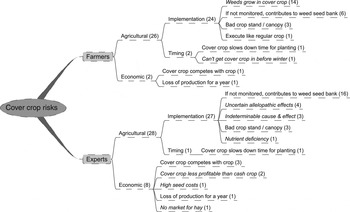
Farmers were asked, ‘Do you use cover crops to manage weeds? If so, what makes a cover crop successful at weed management?’ Sixteen farmers stated that they use cover crops to manage weeds, using them as a physical barrier, as well as mowing the cover crop. Cover crop management details were coded as regarding implementation, timing or type. The expert model included roughly 3 times more implementation codes than timing codes; in contrast, the farmer model included 12 times more implementation codes than timing codes. In other words, farmers rarely discussed timing of cover crop management.
Farmers and experts offered a detailed assessment of both the risks and benefits of implementing cover crops. Overall, experts placed more emphasis on the risks of cover crops than farmers (P=0.005). Both groups discussed agricultural risks of implementing cover crops most often, particularly that weeds grow in cover crops and that both weeds and cover crops could contribute to the seedbank if not monitored and controlled (Fig. 4). Experts placed more emphasis on economic risks of cover crops than farmers. Farmers rarely mentioned these economic risks (Fig. 4), perhaps because they use cover crops for benefits beyond weed management.
Detailed categorical breakdown of cover cropping risks cited by farmers and experts. Numbers in parentheses indicate number of codes in each category. Unique concepts, mentioned only by farmers or experts, but not both groups, are indicated by italic font.

Farmers and experts, in agreement (P=0.532), mentioned benefits of cover cropping most often among management strategies discussed (Fig. 3). Farmers most often mentioned benefits of cover crops to soils by adding organic matter, fertility and preventing erosion (nine farmers, 50% of cover crop benefits codes). Farmers also discussed the ability of a cover crop to smother, outcompete and shade weeds (seven farmers, 25% of cover crop benefits). Experts placed more emphasis on benefits to soils (79% of cover crop benefits), and less emphasis on competition with weeds.
Mulches
Experts and vegetable farmers discussed both black plastic mulches (12 farmers) and organic mulches (ten farmers), such as straw, crop residue and landscape fabric. Experts and farmers placed similar emphasis on risks of mulch (P=0.301, Fig. 3), both groups discussing ecological risks of plastic mulch, focused on the waste associated with use of this practice (seven farmers), and economic risks, including the costs of mulch, time and labor. Farmers uniquely discussed risks of weed growth between pathways and rows, efficacy only against certain weeds and introducing weed seed in dirty straw mulch. Farmers and experts agreed on benefits of mulch (P=0.064), such as smothering weeds (four farmers) and warming up the soil faster (four farmers), important in the short New England growing season.
Ranking exercise
Farmers quickly ranked 16 factors in order of importance to them when making weed management decisions (Table 1). The most important factors were: (1) type and timing of weed; (2) what worked in the past; and (3) available time and labor. These priorities align with the results of the coded interviews, with farmers relying heavily on their own experience as a source of knowledge, and emphasizing the constraint of time and labor as a major risk of weeds.
Conclusions
This study was motivated by the goal of improving EWM outreach and research to better target organic farmers. New England farmers, as a group, demonstrated knowledge of the major concepts important to experts, although there were differences in emphasis between experts and farmers. Farmers were management-centered, more concerned with management of the weed seedbank than the ecological complexity that surrounds it. They discussed specifics rather than complex generalities, for instance focusing on specific problem species. Knowledge about weeds and available management strategies does not appear to be a general constraint for organic farmers as much as constraints of time and labor. However, there were gaps between expert and farmer beliefs regarding two components of weed biology, weeds as indicators of soil nutrient levels and weed seed longevity.
One-third of farmers discussed weeds as indicators of soil conditions. Experts usually discussed this concept with skepticism or uncertainty. The idea of a ‘balanced’ soil, with ideal base cation saturation ratios, is promoted by some private soil-testing laboratories and is discussed in several popular publications as an effective weed management practiceReference Pfeiffer 39 , Reference Walters 40 . The general argument is compelling: Weeds are simply indicators of soil problems; address the ‘root of the problem’ by correcting the soil problem and, by extension, weeds will no longer be a problem. Weed scientists have conducted considerable research on fertility effects on weeds, generally focusing on selective delivery of nitrogen to crop plantsReference Di Tomaso 41 . A recent review on this subject concludes that existing data do not support the base cation saturation ratio conceptReference Kopittke and Menzies 42 , and effects were not observed in the two published accounts of field studiesReference Schonbeck 43 , Reference Kelling, Schulte and Peters 44 .
Weed seed longevity is another belief to target in future communication efforts. One-fourth of farmers focused on the maximum length of time seeds live in the soil. Knowledge of seed longevity for different species can strongly influence management choices farmers make. For instance, the impact and timeliness of zero seed rain practices or burying seed with inversion tillage will vary with the seed longevity of a given species. Hairy galinsoga, the species named as most problematic and most risky by New England vegetable farmers, lacks dormancy in the soilReference Warwick and Sweet 45 . Data on actual seed decay indicates that farmers may be overestimating seed longevity in the soilReference Ullrich, Buyer, Cavigelli, Seidel and Teasdale 46 . In other words, farmers focus on the relatively low number of seeds that persist many years rather than the large decline in seed density in the first few years, when most seed loss occurs. Farmers do, however, discuss this in species-specific contexts, for instance always making sure to hand weed species such as mustard.
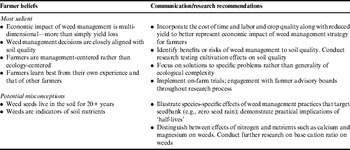
Scientific research was not of great importance to farmers when making weed management decisions (Table 1). Farmers placed a great deal of emphasis on learning from their own experiences and those of other farmers, consistent with other studiesReference Turner, Davies, Moore, Grundy and Mead 8 , Reference Eckert and Bell 10 – Reference Macé, Morlon, Munier-Jolain and Quéré 12 . Scientists and extension professionals can work to incorporate these learning avenues into future research and outreach. Funding agencies such as the USDA now emphasize stakeholder involvement and participatory research as a necessary component of research projects. Examples of participatory learning of weed science has been demonstrated both in classroom and extension settingsReference Smith, Gareau, Mortensen, Curran and Barbercheck 47 , Reference Gallagher, Luschei, Gallandt and DiTommaso 48 . Mental models research findings should be used to decide both the content of outreach materials as well as the framing and delivery of these messagesReference Morgan, Fischhoff, Bostrom and Atman 13 to best address both misconceptions and farmers’ most salient beliefs (Table 7). Our research suggests that scientists and extension professionals need to focus more on the framing of educational materials to address the farmer priorities of soil quality and time and labor. Collaboration among weed scientists, soil scientists and economists to produce outreach material could provide more realistic framing in contrast to traditional, discipline-specific materials.
Key communication points based on incongruities between farmer and expert weed management knowledge and perceptions.

A long-held basic tenant of organic agriculture, soil health is mentioned repeatedly amongst farmers. The major risks of cultivation and tillage discussed were damage to soils, and the major benefits of cover cropping were for soils. Farmers described scenarios in which they knew that their cover crop was detrimental due to weed management, but beneficial to soils, thus they let it grow. Weed management research that not only measures yield effects, but also includes a multi-dimensional assessment of time and labor constraints and effects on soil health, may better serve farmers. Tools such as spider plots used to assess ecosystem services of cover cropsReference Smith, Gareau, Mortensen, Curran and Barbercheck 47 , Reference Gareau, Smith, Barbercheck and Mortensen 49 could be modified to incorporate economic components and information regarding effects on specific problematic weed species in a given regionReference Turner, Davies, Moore, Grundy and Mead 8 .
All farmers interviewed discussed cultivation as a critical strategy and demonstrated awareness of the risks of this practice, in agreement with expert emphasis on cultivation risks. Adoption of seedbank management approaches such as crop rotation and use of cover crops were widespread among this population as well, although the motivation was not purely driven by weed problems. Cover crop perceptions in particular were exemplary of the depth of understanding the mental models approach provided, illustrating risk and benefit tradeoffs that farmers face, and the importance of context of the management practice—success or failure depending on the type of weed being managed, the type of cover crop, how it is implemented (seeding density, residue management) and timing. This goes far beyond asking organic farmers whether they use cover crops on their farm. Farmers and experts agreed that cover crops provide many benefits, yet farmers placed less relative emphasis on risks of cover cropping (Fig. 3). Education and outreach can capitalize on this by providing details on the types of benefits and risks of cover cropping, and the management strategies or context (type of crop or weed) that magnify or minimize either the benefits or risks. For example, several farmers clarified that it is the disturbance associated with cover crops that manages the seedbank rather than cover crops themselves, a point supported by recent researchReference Mirsky, Gallandt, Mortensen, Curran and Shumway 50 .
In conclusion, these incongruities have prompted us to develop new educational materials focused on weed seed longevity and management of the weed seedbank, and, secondly, to conduct regional focus group meetings with farmers who prioritize fertility management in their efforts to control weeds, especially manipulations of soil nutrients. More broadly, we will frame organic weed management outreach in the context of the soil health, economic and labor benefits whenever possible, to better relate to the whole-farm priorities of organic farmers. Future communication efforts should be evaluated to assess changes in beliefs or practices by farmers.
Acknowledgements
We are exceedingly grateful to the twenty-three Maine, New Hampshire and Vermont farmers who participated in these interviews. This research was supported by the United States Department of Agriculture, Organic Agriculture Research and Extension Initiative competitive grant program (‘Mental Models and Participatory Research to Redesign Extension Programming for Organic Weed Management.’ USDA Award No. 2009-51300-05653). The manuscript was improved thanks to thoughtful comments from two anonymous reviewers. This is Publication Number 3321 from the Maine Agriculture and Forestry Experiment Station.
Supplementary online material is available at http://cambridge.journals.org/RAF.