Introduction
Executive functioning is a compilation of higher order mental processes conceptualized as the cognitive abilities required to plan, initiate, shift, monitor, and inhibit purposeful behavior that are essential for the execution of goal-directed behaviors (Aron, Reference Aron2008). These mental processes are believed to be crucial for engaging in and successfully completing numerous every day activities. Given that neuropsychological dysfunction in a range of domains has been linked to deficits in daily living and that deficits in activities of daily living (ADLs) are required for the diagnoses of dementia syndromes, much research has been directed at parsing out the specific links between various neuropsychological domains and ADLs.
Several studies investigating the association between executive dysfunction and decreases in level of daily functioning have found tests of executive measures to correlate with functional status more so than measures of other cognitive domains (Royall et al., Reference Royall, Palmer, Chiodo and Polk2004; Reference Royall, Lauterbach, Kaufer, Malloy, Coburn and Black2007, Whelihan et al., Reference Whelihan, Dicarlo and Paul2005; Mitchell and Miller, Reference Mitchell and Miller2008), with some studies finding executive measures to be a better predictor of functional status than demographic variables such as age, sex, and education(Cahn-Weiner et al., Reference Cahn-Weiner, Malloy, Boyle, Marran and Salloway2000). In 2007, Royall et al. (Reference Royall, Lauterbach, Kaufer, Malloy, Coburn and Black2007) conducted a review of 68 articles investigating the capacity to predict functional outcomes by cognitive task performance and found that executive functioning accounted for more variance than memory, visuo-spatial, attention, and verbal domains. In a longitudinal study following 47 elderly individuals, it was found that executive functioning, measured by the Executive Interview (EXIT25), was more sensitive to cognitive impairments and decline than the Mini-mental State Examination (MMSE), a general measure of cognition (Royall et al., Reference Royall, Palmer, Chiodo and Polk2004).
It has also been reported that the domain of executive functioning accounted for more of the variance in instrumental activities of daily living (IADL) than in activities of daily living (ADL) (Royall et al., Reference Royall, Lauterbach, Kaufer, Malloy, Coburn and Black2007). This suggests that executive dysfunction has a greater impact on an individual's ability to perform tasks such as balancing a checkbook, driving, and housekeeping than on performing general hygiene and self care-related activities (Cahn-Weiner et al., Reference Cahn-Weiner, Malloy, Boyle, Marran and Salloway2000; Bell-McGinty et al., Reference Bell-McGinty, Podell, Franzen, Baird and Williams2002; Farias et al., Reference Farias2008.
When looking at clinical populations, several other neuropsychological domains have been linked to ADLs as well. Freilich and Hyer (Reference Freilich and Hyer2007) examined the relation of daily functioning in individuals with dementia using the Repeatable Battery for Assessment of Neuropsychological Status. Overall, their results found that the domains of Attention and Visuospatial/Constructional had the highest correlations with daily functioning, followed by Immediate Memory. In a more recent study, we found that the RBANS indices of Language and Immediate Memory were significantly related to informant-ratings of functional loss in the areas of community and home activities, judgment and problem solving, as well as memory in a sample of patients diagnosed with Mild Cognitive Impairment (MCI) and Alzheimer's disease (AD) (Hobson et al., Reference Hobson, Hall, Humphreys-Clark, Schrimsher and O'Bryant2010).
Prior findings (Farias et al., Reference Farias2008) are suggestive of some form of interaction between executive and non-executive neuropsychological domains and functional status. In fact, Royall et al. (Reference Royall, Palmer, Chiodo and Polk2005) proposed that executive functioning mediated the link between memory and functional status. Using data from the EXIT25 and the California Verbal Learning Test (CVLT), these authors reported that EXIT25 scores were independently associated with IADL scores at baseline and that the change in EXIT25 was independently associated with change in IADL scores, yet there was no association between CVLT scores and IADL scores independent of EXIT25 scores. The authors are not aware of any study to date formally examining the mediating impact of executive functioning on the link between a broad range of neuropsychological domains (non-executive) and functional status of adults and elders.
The purpose of the current study was to formally test the potential mediating impact of executive functioning scores on the link between other neuropsychological domains (immediate and delayed memory, attention, language, and visuospatial skills) and informant ratings of functional status in a rural sample of community-dwelling adults and elders. It was hypothesized that (1) RBANS Index scores would be significantly related to informant report of daily functioning (Clinical Dementia Rating Sum of Boxes scores), and (2) executive functioning (EXIT25 scores) would significantly mediate (partial or complete) that relationship.
Methods
Participants
Data were evaluated from 181 participants (55 men and 126 women) from an ongoing study of the epidemiology of health issues among rural-dwelling adults and elders called Project FRONTIER (Facing Rural Obstacles to healthcare Now Through Intervention, Education and Research). The mean age and education of the sample was 64.6 (SD = 13.8, range = 41–97) and 10.0 (SD = 4.1, range = 0–20), respectively. Self-report of racial status was white (n = 151), African American (n = 19), American Indian (n = 4), and not reported (n = 7). There were 95 participants who reported being not of Hispanic origin while 76 reported being Mexican American and 7 reported being Hispanic not of Mexican American origin. Current reported annual household income was: ≤$10,000 (23%), $10,001–$20,000 (36%), $20,001–$30,000 (11.8%), $30,001–$40,000 (7.9%), $40,001–$50,000 (5.1%), $50,001–$60,000 (1.7%), $60,001–$70,000 (2.8%), ≥ $70,000 (10.1%), not reported (1.6%).
Project FRONTIER is a recently established epidemiological study of health among rural-dwelling individuals. This community-based participatory research (CBPR) study includes a standardized medical examination, clinical labs, neuropsychological testing (including the RBANS and EXIT25), as well as a detailed interview with participant and a brief interview with an informant. Inclusion criteria are (1) age 40 years and above, and (2) residing in one of the counties that form part of Project FRONTIER. The two communities currently part of project FRONTIER are Cochran County and Parmer County, both located on the Texas–New Mexico border. The process utilized for establishing and maintaining this epidemiological research program has been described previously (O'Bryant et al., Reference O'Bryant2009). Participant recruitment is conducted by community recruiters through brochures/flyers, community presentations and events, as well as door-to-door solicitation.
Project FRONTIER is conducted under an IRB approved protocol (Texas Tech University Health Sciences Center) and all participants signed written informed consent. After completing the informed consent process, participants are scheduled for the medical examination (completed by community clinicians), fasting blood work at the local hospital laboratory, a detailed interview, and neuropsychological testing. Informants are called and interviewed by telephone after the participant interview and cognitive testing is completed. All examiners receive extensive training on neuropsychological testing according to the standardized instructions provided for the respective instrument; all results are reviewed by neuropsychologists at the weekly consensus review, with administration questions raised and addressed at that time. In-person administration quality checks (to correct for drift) are conducted semi-annually.
Once all data are collected, the information is reviewed by a consensus diagnostic committee that consists of a neuropsychologist, a psychologist, a geriatric psychiatrist, and multiple geriatricians. Diagnoses of medical, psychiatric, and cognitive conditions are assigned according to standard criteria. Cognitive status assigned are normal cognition (no observed deficits on cognitive examination and no self- or informant-report of cognitive dysfunction – adapted from the Mayo criteria), Age Associated Cognitive Impairment (AACI; Crook et al., Reference Crook1986), Mild Cognitive Impairment (MCI; Petersen, Reference Peterson2003), Alzheimer's disease (McKhann et al., Reference McKhann1984), vascular dementia (Chui et al., Reference Chui, Victoroff, Margolin, Jagust, Shankle and Katzman1992), or dementia not otherwise specified (NOS; meets criteria for dementia but does not fit into one of the other categories). The breakdown of cognitive diagnoses was as follows: normal cognition n = 94, AACI n = 22, MCI n = 52 (amnestic single domain n = 13, amnestic multi-domain n = 20, non-amnestic single domain n = 12, non-amnestic multi-domain n = 6), dementia n = 11 (AD n = 6, dementia NOS n = 5), not sufficient information for a diagnosis n = 2.
Measures
Repeatable Battery for the Assessment of Neuropsychological Status (RBANS) (Randolph, Reference Randolph1998). The RBANS was developed as a brief screening measure for dementia. It contains 12 subtests which combine to create five index scores: Immediate Memory (subtests include List and Story Memory), Visuospatial/Constructional (subtests include Line Orientation and Figure Copy), Language (subtests include Semantic Fluency and Picture Naming), Attention (subtests include Coding and Digit Span), and Delayed Memory (subtests include List Recall and Recognition, Story Recall, and Figure Recall). The RBANS demonstrates good reliability and validity (Randolph, Reference Randolph1998) as well as excellent diagnostic accuracy in Alzheimer's disease (Duff et al., Reference Duff, Humphreys, O'Bryant, Mold, Scheffer and Sutker2008). Administration time is approximately 30 minutes.
The Exit Interview (EXIT25 (Royall et al., Reference Royall, Mahurin and Gray1992). The EXIT25 is a well-validated global measure of executive control that covers a range of tasks including sequencing, fluency, anomalous sentence repetition, thematic perception, automatic behaviors, go-no-go, automatic behavior, as well as others. EXIT25 scores are significantly related with other validated measures of executive functioning. Scores range from 0 to 50 with higher scores suggestive of greater impairment; a cut-off point of 15 out of 50 best discriminates non-demented elderly controls from both cortical and non-cortical dementing illnesses. Administration time is approximately 10 minutes (Royall et al., Reference Royall, Mahurin and Gray1992).
The Clinical Dementia Rating Scale (CDR; Morris, Reference Morris1997). The CDR is a semi-structured interview of patients and informants. Once completed, the patient's level of functional impairment due to cognitive decline is rated in six domains including memory, orientation, judgment and problem solving, community affairs, home and hobbies, and personal care. Each domain is rated on a five-point scale of functioning as follows: 0 = no impairment, 0.5 = questionable impairment, 1 = mild impairment, 2 = moderate impairment and 3 = severe impairment. (Note: Personal Care is scored on a 4-point scale without a 0.5 rating available.) The CDR demonstrates good reliability (Burke et al., Reference Burke1988; Morris et al., Reference Morris1997) and has been validated against neuropathological findings (Berg et al., Reference Berg, McKeel, Miller, Baty and Morris1993; Morris, et al., 1991; Morris, Reference Morris1997). The CDR yields two scores, a Global Score and Sum of Boxes score. The standardized interview asks questions regarding the participant's ability to find his/her way around familiar streets; getting lost; ability to solve problems; manage money and financial affairs/transactions; ability to function in his/her job; ability to drive and problems associated with this activity; ability to shop independently; and carrying out household activities such as cooking, cleaning, sewing, crafts, as well as ability to manage dress, bathe, eat, etc. independently. The Sum of Boxes (CDR SB) score, which ranges from 0 to 18, can therefore be considered a global estimate of informant-based rating of participant functional impairment (ADL and IADL).
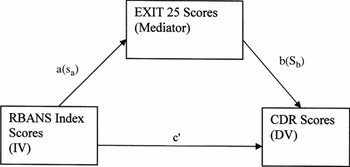
Regression models were created to formally test the mediating impact of EXIT25 scores on the link between RBANS Index scores and CDR SB scores. The criteria for a variable to be confirmed as a mediator are as follows: (1) there is a significant relationship between the independent variable (IV) and the dependent variable (DV), (2) there is a significant relationship between the IV and the mediator, (3) the mediator still predicts the DV after controlling for the IV, and (4) the relationship between the IV and DV is reduced when the mediator is in the equation (Tabachnick and Fidell, Reference Tabachnick and Fidell2001). Significance of mediation was tested using the Sobel test (Sobel, Reference Sobel and Leinhart1982) using the following procedures. Regression models were first run to determine if there was a significant link between RBANS indices (IV) and CDR SB scores (DV). Next, regression analyses were run using the IV (RBANS Index scores) and EXIT25 scores (mediator) as the dependent variable, which provided a (raw, unstandardized, regression coefficient for the association between the IV and the mediator), and sa (standard error of a). Next, regression models were conducted with the IVs (RBANS indices) and mediator (EXIT25 scores) entered into the model with CDR-SB scores as the DV, which provided b (raw coefficient of association between the mediator and the DV when the IV is also entered into the equation) and sb (standard error of b) (see Figure 1).
Mediational impact of EXIT25 scores on the link between RBANS Index scores and CDR Sum of Boxes scores.

Results
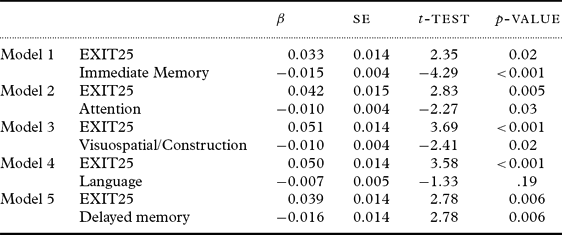
In the first step of the meditational analyses all RBANS indices (IV) were found to be significantly related with CDR SB scores (DV): Immediate Memory, B = −0.018, standard error (SE) = 0.004, t = −5.64, p < 0.001; Visuospatial/Construction B = −0.013, SE = 0.004, t = −3.12, p = 0.002; Language B = −0.013, SE = 0.005, t = −2.33, p = 0.02; Attention B = −0.015, SE = 0.004, t = −3.70, p < 0.001; Delayed Memory B = −0.019, SE = 0.004, t = −5.11, p < 0.001. Next, all RBANS indices (IV) were found to be significantly associated with EXIT25 scores (mediator): Immediate Memory B = −1.749, SE = 0.272, t = −6.44, p < 0.001; Visuospatial/Construction B = −0.830, SE = 0.265, t = −3.13, p = 0.002; Language B = −1.066, SE = 0.207, t = −5.14, p < 0.001; Attention B = −2.123, SE = 0.297, t = −7.15, p < 0.001; Delayed Memory B = −1.337, SE = 0.253, t = −5.29, p < 0.001. In step 3, EXIT25 scores were significantly related to CDR scores with all RBANS indices entered into the model (Table 1). As can be seen from Table 1, all RBANS indices, with the exception of Language, continued to be significantly related to CDR SB scores with EXIT25 scores (and education) entered into the model. These results indicate complete mediation of the Language index and partial mediation of all other indices; see Table 2 for results of Sobel tests for significance of mediation (step 4).
Regression models with EXIT25 (mediator) scores and RBANS Indices (IV) predicting CDR SB (DV) scores
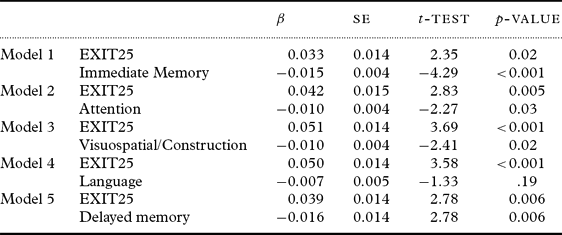
Note: Education was entered as covariate for all models.
Mediating impact of EXIT scores on the link between RBANS Index scores and CDR-SB scores

In order to determine if our findings were moderated by age and education, we re-ran the analyses separating the sample by years of education (≤10 versus > 10) and age in years (<65 versus ≥ 65). The findings were largely unchanged, with a few exceptions. When looking by age categories, RBANS Visuospatial Index scores were not significantly related to CDR scores (p > 0.05) among those less than 65 years of age or EXIT25 (p > 0.05) scores among those aged 65 years and above. Language Index scores were not significantly related to CDR scores (p > 0.05) among those under 65 or EXIT25 scores (p > 0.05) among those 65 or older. When looking by education categories, RBANS Visuospatial Index scores were not significantly related to CDR scores (p > 0.05) among those with ten or fewer years of education or EXIT25 scores (p > 0.05) among those with more than ten years of education. Lastly, Delayed Memory scores were not significantly related to EXIT25 (p > 0.05) scores among those with more than 10 years of education. Therefore, mediation was not possible with any of these particular follow-up models.
Discussion
Executive functioning is of primary importance to nearly all human neuropsychological functioning and, as the current results demonstrate, they mediate the link between other neuropsychological domains and daily functioning abilities. These results hold importance for many reasons.
First, they point to the fact that neuropsychological assessments without assessment of executive functioning (screening or comprehensive assessments) will yield only a partial view of the clinical picture, particularly when questions regarding ability to sustain independent living and/or decision-making capacity are at hand.
Another important aspect of the current study is the choice of assessment battery. The RBANS is a recently developed, well-validated neuropsychological instrument that has excellent diagnostic accuracy in identifying dementia (Duff et al., Reference Duff, Humphreys, O'Bryant, Mold, Scheffer and Sutker2008). The RBANS is rapidly being adopted in clinical and research settings (particularly geriatric) owing to its brevity combined with good psychometric properties that allows for optimization of time. While recent work has also demonstrated a significant link between RBANS scores and activities of daily living (Freilich and Hyer, Reference Freilich and Hyer2007; Hobson et al., Reference Hobson, Hall, Humphreys-Clark, Schrimsher and O'Bryant2010), this battery only minimally assesses the executive functioning domain (i.e. coding and verbal fluency). In dementia evaluations a common question that arises is the ability of the patient to maintain his/her ADLs independently; however, informants are not always available or amenable to questioning. The current results suggest that supplementation of RBANS administrations with the EXIT25 will add very valuable information to the clinical examination without addition of significant time requirements (approximately 10 minutes).
When we divided up the sample by age (<65 versus ≥65 years) and education (≤10 versus >10 years) our findings were largely unchanged; however, there were noteworthy differences. The RBANS Visuospatial Index score was not significantly related to functional status among those <65 or with 10 or fewer years of education. The Language Index was also not related to functional status among those 65 years or younger. The current sample size is insufficient to examine the potential causes for this change; however, it is possible that there was not sufficient variability in these two scores (RBANS indices and CDR) for a relationship to be observed. Regardless, we will investigate this further as the Project FRONTIER sample size continues to grow.
Finally, the current study offers valuable information for rural practitioners. Even though nearly 20% of the U.S. population resides in rural locales (U.S. Census Bureau, 2004), there is minimal research-based information available related to best practice guidelines among this segment of the population, and urban-based studies may not be applicable (Upper Midwest Rural Health Research Center, 2009). Therefore, the current findings offer rural healthcare providers with an option for a brief yet valid assessment battery to use with their elder patients. As with prior clinic-based studies, the RBANS is significantly related to functional status in a community-based setting of rural adults and elders, and supplementation with the EXIT25 offers important additional information that will assist in generating a better clinical picture. The current study provides the first formal demonstration of the mediating impact of executive functioning on the link between other cognitive domains and functional status.
Conflict of interest
None.
Description of authors' roles
S. E. O'Bryant designed the study, data collection, and participated in preparation of the paper. J. Falkowski participated in preparation of the paper. V. Hobson and L. Johnson participated in data analysis and preparation of the paper. J. Hall assisted in study design and preparation of the paper. G. W. Schrimsher assisted in study design, collection of data, and preparation of the paper. O. Win participated in data collection and preparation of the paper. B. Ngo participated in data collection and preparation of the paper. A. Dentino participated in study design, data collection, and preparation of the paper.
Acknowledgments
The authors would like to thank the entire research team, and especially the people of Cochran County and Parmer County as well as the respective Community Advisory Boards. We thank Cochran County Memorial Hospital, Parmer Medical Center, the Parmer County Rural Health Clinic and their staff for their assistance and provision of office space. This work would not have been possible without the assistance of our community recruiters Joel Torango, Bennie O'Brien, and Rosemary McCallum.