Childhood maltreatment has profound negative effects on emotional, social, and behavioral functioning (Alink, Cicchetti, Kim, & Rogosch, Reference Alink, Cicchetti, Kim and Rogosch2012; McCrory, De Brito, & Viding, Reference McCrory, De Brito and Viding2011). For example, individuals with adverse childhood experiences are more likely to have physical and mental health problems later in life, including alcoholism, drug abuse, and suicide attempt (Felitti, Reference Felitti2002; Norman et al., Reference Norman, Byambaa, De, Butchart, Scott and Vos2012). Childhood maltreatment has been shown to place individuals at risk for developing psychopathology in childhood or adulthood, including posttraumatic stress disorder (PTSD; Scott, Smith, & Ellis, Reference Scott, Smith and Ellis2010), borderline personality disorder (Zanarini et al., Reference Zanarini, Frankenburg, Reich, Marino, Lewis and Williams2000), depression (Anda et al., Reference Anda, Whitfield, Felitti, Chapman, Edwards and Dube2002), and schizophrenia (Read, van Os, Morrison, & Ross, Reference Read, van Os, Morrison and Ross2005). This may be at least partially attributable to the enduring adverse effects of early life stress on brain development, in particular the hippocampus (Bernard, Lind, & Dozier, Reference Bernard, Lind, Dozier, Korbin and Krugman2014; McCrory et al., Reference McCrory, De Brito and Viding2011; Sapolsky, Uno, Rebert, & Finch, Reference Sapolsky, Uno, Rebert and Finch1990). In the current paper, we present an empirical study on the association of childhood maltreatment with hippocampal volume, and we present a meta-analysis to test whether the association between childhood maltreatment and reductions in hippocampal volume is replicable across studies, and is dependent on sensitive age periods.
The hippocampus, a brain region that plays an important role in learning and memory, is suggested to be one of the most stress-sensitive structures in the brain. Research has shown that the hippocampus is involved in modulating the responsiveness of the hypothalamic–pituitary–adrenal (HPA) axis to stress (Bernard et al., Reference Bernard, Lind, Dozier, Korbin and Krugman2014). The hypothalamus releases corticotrophin-releasing hormone and arginine vasopressin in response to stress, which in turn leads to the secretion of adrenocorticotrophic hormone and increased release of cortisol. Inhibitory feedback of cortisol that binds to glucocorticoid receptors in the hippocampus, hypothalamus, and the pituitary ensures that the system returns to homeostasis (Gunnar & Fisher, Reference Gunnar and Fisher2006). However, early life adversity reduces the number of hippocampal neurons, inhibits neurogenesis, and leads to abnormalities in synaptic pruning (Sapolsky, Krey, & McEwen, Reference Sapolsky, Krey and McEwen1985; Sapolsky et al., Reference Sapolsky, Uno, Rebert and Finch1990). These hippocampal damages result in impaired glucocorticoid-mediated feedback control of the HPA axis, which leads to hyper- or hyporesponsiveness to mild stressors (McCrory et al., Reference McCrory, De Brito and Viding2011). For example, Heim et al. (Reference Heim, Newport, Wagner, Wilcox, Miller and Nemeroff2002) showed that maltreated women exhibited an increased adrenocorticotrophic hormone response during the Trier Social Stress Test. In addition, it has been shown that children who have experienced physical and sexual abuse exhibit elevated cortisol levels (Cicchetti & Rogosch, Reference Cicchetti and Rogosch2001b). Other studies indicate that children who have experienced maltreatment tend to exhibit low morning cortisol levels and a pattern of low cortisol production over the day (Gunnar & Vazquez, Reference Gunnar and Vazquez2001). In addition, maltreated individuals show lower cortisol reactivity to stressors, such as the Trier Social Stress Test (Carpenter, Shattuck, Tyra, Geracioti, & Price, Reference Carpenter, Shattuck, Tyrka, Geracioti and Price2011; Elzinga et al., Reference Elzinga, Roelofs, Tollenaar, Bakvis, van Pelt and Spinhoven2008), indicating that maltreatment can also result in hyporesponsiveness of the HPA axis.
Studies have found that adults with a history of childhood maltreatment show a reduction in hippocampal volume. Stein, Koverola, Hanna, Torchia, and McClarty (Reference Stein, Koverola, Hanna, Torchia and McClarty1997) and Carballedo et al. (Reference Carballedo, Lisiecka, Fagan, Saleh, Ferguson and Connolly2012) reported a lower hippocampal volume in individuals with experiences of childhood emotional abuse. In addition, Bremner et al. (Reference Bremner, Randall, Vermetten, Staib, Bronen and Mazure1997) found a reduction in hippocampal volume in individuals with PTSD related to childhood physical and sexual abuse. In contrast, other studies failed to find differences in hippocampal volume (Lenze, Xiong, & Sheline, Reference Lenze, Xiong and Sheline2008) or reported opposite effects, with increased hippocampal volume in individuals with maltreatment experiences (De Bellis et al., Reference De Bellis, Keshavan, Clark, Casey, Giedd and Boring1999). Although a large number of structural neuroimaging studies on the neurobiological effects of childhood maltreatment have been conducted in the past decade (for a narrative review, see Teicher & Samson, Reference Teicher and Samson2013), the exact association between childhood maltreatment and hippocampal volume remains unclear. One meta-analysis has been conducted on the effects of early life stress on hippocampal volume (Woon & Hedges, Reference Woon and Hedges2008), showing that adults with maltreatment-related PTSD had reduced bilateral hippocampal volume. However, it is unknown whether these neuroimaging findings are specific to PTSD, because recent studies found hippocampal volume reductions in individuals with a history of childhood maltreatment but without PTSD (Dannlowski et al., Reference Dannlowski, Stuhrmann, Beutelmann, Zwanzger, Lenzen and Grotegerd2012; Teicher, Anderson, & Polcari, Reference Teicher, Anderson and Polcari2012).
Woon and Hedges (Reference Woon and Hedges2008) did not find meta-analytic evidence for a reduction in hippocampal volume in children with maltreatment-related PTSD. Studies on the neurobiological effects of maltreatment in children without PTSD also fail to find significant abnormalities in hippocampal volume. For example, Tottenham et al. (Reference Tottenham, Hare, Quinn, McCarry, Nurse and Gilhooly2010) did not find a reduction in hippocampal volume in children who were raised in orphanages compared with a group of children raised in their biological families. Thus, the effects of childhood maltreatment on hippocampal development may be delayed and may not appear immediately after exposure (Teicher & Samson, Reference Teicher and Samson2013). This is consistent with animal studies indicating that early life stress has protracted effects on the hippocampus that occur long after the stressor has been removed (Andersen & Teicher, Reference Andersen and Teicher2004). Early adversity may not cause immediate hippocampal damage, but it seems to set in motion a series of adverse events that lead to the progressive loss of hippocampal synapses.
Moreover, little is known about influences of the timing of maltreatment on abnormal hippocampal development. Although it has been suggested that stress-sensitive brain regions have their own unique sensitive period to the effects of maltreatment and early life stress (Teicher, Tomoda, & Andersen, Reference Teicher, Tomoda and Andersen2006), few studies on the neurobiological effects of maltreatment take this timing issue into account. Andersen et al. (Reference Andersen, Tomada, Vincow, Valente, Polcari and Teicher2008) examined the relation between age at exposure to sexual abuse and abnormalities in brain structure and found evidence for discrete regional periods sensitive to the effects of maltreatment. The hippocampus was found to be maximally susceptible to the effects of sexual abuse that occurred between ages 3 and 5 years and ages 11 and 13 years. In contrast, when women were exposed to abuse at ages 9 and 10, the corpus callosum, but not the hippocampus, was affected. Further, abnormalities in the frontal cortex were observed when abuse was reported during ages 14–16. In line with these findings, Rao et al. (Reference Rao, Betancourt, Giannetta, Brodsky, Korczykowski and Avants2010) also found evidence for an early hippocampal sensitive period. Hippocampal volume loss during adolescence was associated with lack of parental nurturance at age 4 years old, but not with lack of parental nurturance at age 8. Additional support for these findings comes from animal studies that indicate that synaptic density in the hippocampus is susceptible to early stress, whereas the prefrontal cortex is sensitive to peripubertal stress (Andersen & Teicher, Reference Andersen and Teicher2004, Reference Andersen and Teicher2008).
In addition to timing, the changes in brain development after early life stress may be dependent on the severity of the abusive experience. For example, Cicchetti and Rogosch (Reference Cicchetti and Rogosch2001a) found divergent patterns of neuroendocrine activity in children exposed to multiple abuse types (sexual, physical, and emotional abuse) compared with children with experiences of only physical abuse. Children with experiences of multiple maltreatment types had elevated morning cortisol levels, whereas children with only physical abuse experiences tended to have decreased morning cortisol levels compared to nonmaltreated children. The combination of multiple types of abuse may be most severe, leading to profound neurobiological changes.
In sum, the neurobiological effects of maltreatment may be dependent on the time after exposure, the timing of the maltreatment, and the type and severity of maltreatment. It is time to take quantitative stock of the influences of childhood maltreatment on hippocampal volume and the moderating factors that might influence the direction and degree of hippocampal damage. In the current paper, we present two studies addressing the association between hippocampal volume and childhood abuse. The first study examines the effects of maltreatment experiences reported during the Adult Attachment Interview (AAI) on hippocampal volume in female twin pairs. In line with previous studies, we expect that experiences of child maltreatment are associated with a reduction in hippocampal volume. In the second study, we present meta-analytic evidence for reduced hippocampal volume in individuals who experienced child maltreatment. In addition, we explore the moderating influence of time after exposure to the abuse, the timing of the abuse, and the severity of abuse. We expect that the association of child maltreatment with hippocampal volume is stronger in adults compared to children, and we expect stronger associations when the maltreatment occurred early in childhood and when individuals experienced multiple types of maltreatment.
Study 1
Method
Participants
Participants were selected from a larger study investigating caregiving responses and physiological reactivity to infant crying (Out, Pieper, Bakermans-Kranenburg, & van IJzendoorn, Reference Out, Pieper, Bakermans-Kranenburg and van IJzendoorn2010). The original sample consisted of 50 male and 134 female adult twin pairs. A group of 44 right-handed women, 21 from monozygotic twin pairs and 23 from dizygotic twin pairs, were selected to participate in a functional magnetic resonance imaging (fMRI) study investigating the influence of oxytocin administration on neural responses to infant crying and laughing (Riem et al., Reference Riem, Bakermans-Kranenburg, Pieper, Tops, Boksem and Vermeiren2011, Reference Riem, van IJzendoorn, Tops, Boksem, Rombouts and Bakermans-Kranenburg2012). Zygosity was determined on the basis of a zygosity questionnaire (Magnus, Berg, & Nance, Reference Magnus, Berg and Nance1983) and additional genetic analysis of six polymorphisms. Twin siblings of 10 participants did not participate because of MRI contraindications or other exclusion criteria, resulting in a sample of 34 participants from twin pairs (9 monozygotic, 8 dizygotic) and 10 participants without a twin sibling. Participants were screened for hearing impairments, MRI contraindications, pregnancy, psychiatric or neurological disorders, and alcohol and drug use, and they did not have children of their own. At the time of MRI data acquisition the mean age of the participants was 29.05 years (SD = 7.48, range = 22–49). Permission for this study was obtained from the ethics committee of the Leiden University Medical Center; all participants gave informed consent.
Procedure
Participants were invited to the lab for two waves of data collection. In the first session, the AAI was administered in a quiet room. In the second session, MRI data acquisition was performed. After the MRI procedure was explained to them, participants were instructed to comfortably position themselves on the scanner bed. Cushions were placed between the head coil and the participant in order to prevent head movement. Anatomical scans were acquired before an fMRI paradigm in which neural responses to infant crying and laughter were measured (Riem et al., Reference Riem, Bakermans-Kranenburg, Pieper, Tops, Boksem and Vermeiren2011, Reference Riem, van IJzendoorn, Tops, Boksem, Rombouts and Bakermans-Kranenburg2012).
Measures
AAI
Attachment representations and experiences of maltreatment were coded using the AAI, an hour-long semistructured interview in which participants are required to reflect upon their attachment-related experiences (Bakermans-Kranenburg & van IJzendoorn, Reference Bakermans-Kranenburg and van IJzendoorn1993; Crowell et al., Reference Crowell, Waters, Treboux, O'Connor, Colon-Downs and Feider1996; Hesse, Reference Hesse, Cassidy and Shaver2008; Main, Hesse, & Goldwyn, Reference Main, Hesse and Goldwyn2008; Sagi et al., Reference Sagi, van IJzendoorn, Scharf, Koren-Karie, Joels and Mayseless1994). The AAI is considered to be the gold standard for assessing individuals' current state of mind with respect to attachment (Hesse, Reference Hesse, Cassidy and Shaver2008). Participants are asked to describe their relationships with attachment figures, to give specific examples to support these descriptions, and to evaluate their memories of attachment-related events from their current perspective. In addition, questions regarding experiences of childhood abuse are asked, for example, whether caregivers were ever threatening with the participant or whether the participant has memories of parental abusive behavior. In addition, if participants report abuse, they are asked to indicate how old they were at the time of the abusive experience. Interviews were audiorecorded, transcribed verbatim, and scored according to the standard AAI classification system (Main et al., Reference Main, Hesse and Goldwyn2008). Coding yields one of three main adult attachment classifications: secure–autonomous, insecure–dismissing, or insecure–preoccupied. An additional classification, unresolved, is assigned when an interview shows signs of unresolved trauma or loss, for example, when individuals show lapses in monitoring of reasoning (for a detailed description of the classifications, see Hesse, Reference Hesse, Cassidy and Shaver2008). In the current study, we focus on the continuous scores for unresolved trauma and loss, which were assigned using a 9-point rating scale (Hesse, Reference Hesse, Cassidy and Shaver2008) by two raters who were trained to be reliable to the coding standards of the Berkeley laboratory of Mary Main and Erik Hesse. For one participant, it was not possible to assign a score for unresolved trauma or loss because some AAI questions were missing due to problems with audiorecording.
Experiences of abuse
In addition, abuse experiences described during the AAI were coded with an adapted version of the Modified Maltreatment Classification System (MMCS; English & the LONGSCAN Investigators, Reference English1997). The MMCS is a modification of the Maltreatment Classification System developed by Barnett, Manly, and Cicchetti (Reference Barnett, Manly, Cicchetti, Cicchetti and Toth1993). Six subtypes of childhood maltreatment are included in the MMCS: physical abuse, physical neglect, sexual abuse, emotional maltreatment, moral–legal/educational maltreatment, and drugs and/or alcohol use by the caregiver. The severity of each experience of maltreatment that was described during the interview and fit the criteria for one of the categories, was coded using a rating scale ranging from 1 (low) to 5 (high; English, Bangdiwala, & Runyan, Reference English, Bangdiwala and Runyan2005). A maltreatment score of 1 was assigned when drugs and/or alcohol use by the parents was reported, and a maltreatment score of 0 was assigned to participants who did not report any experience of maltreatment.
The interviews were coded by six independent coders. Mean interrater reliability, based on a reliability assessment of 10 AAIs, was good for physical abuse (intraclass correlation [ICC] = 0.82), sexual abuse (ICC = 0.96), and emotional maltreatment (ICC = 0.82), and moderate for physical neglect (ICC = 0.54). A maltreatment severity score was calculated for each participant by selecting the highest severity score across maltreatment subtypes and adding one point when the participants had experienced more than one subtype of maltreatment.
Posttraumatic Diagnostic Scale (PDS)
The first 12 items of the PDS (Foa, Reference Foa1995), a self-report measure of PTSD symptoms, were administered in order to measure experiences of traumatic events, that is, serious accidents, natural disasters, sexual assaults by stranger, sexual assaults by nonstrangers, nonsexual assaults by strangers, sexual assaults by nonstrangers, military combat, imprisonments, torture, and life-threatening illness. Scores were summed and indicated the number of traumatic events experienced by the participant.
MRI data acquisition and analysis
Scanning was performed with a standard whole-head coil on a 3-T Philips Achieva MRI system (Philips Medical Systems, Best, The Netherlands) in the Leiden University Medical Center. A T1-weighted anatomical scan was acquired (flip angle = 8°, 140 slices, voxel size 0.875 × 0.875 × 1.2 mm). In accordance with Leiden University Medical Center policy, all anatomical scans were examined by a radiologist from the radiology department. No anomalous findings were reported.
Volumes of the left and right hippocampus were assessed using FIRST, part of FSL (FMRIB's Software Library, http://www.FMRIb.ox.ac.uk/fsl; Smith et al., Reference Smith, Jenkinson, Woolrich, Beckmann, Behrens and Johansen-Berg2004). Hippocampal volumes were extracted after affine registration to standard space. Registrations and segmentations were visually inspected, and no errors were observed. Volumes of the left and right hippocampus were then measured with fslstats. Brain tissue volume, normalized for subject head size, was estimated with SIENAX (Smith, De Stefano, Jenkinson, & Matthews, Reference Smith, De Stefano, Jenkinson and Matthews2001; Smith et al., Reference Smith, Zhang, Jenkinson, Chen, Matthews and Federico2002). Brain and skull images were extracted from the single whole-head input data (Smith, Reference Smith2002). The brain image was then affine registered to MNI152 space (Jenkinson, Bannister, Brady, & Smith, Reference Jenkinson, Bannister, Brady and Smith2002; Jenkinson & Smith, Reference Jenkinson and Smith2001), after which tissue-type segmentation with partial volume estimation was carried out in order to calculate total brain volume (Zhang, Brady, & Smith, Reference Zhang, Brady and Smith2001). Volumes of the left and right hippocampus (mm3) and total brain volume (mm3) were included in the statistical analyses.
Statistical analyses
We employed multilevel regression models to analyze volumes of the left and right hippocampus and the association with unresolved loss and trauma, traumatic experiences as assessed by the PDS, and experiences of childhood maltreatment as derived from the AAI. The choice for multilevel analysis was based on the hierarchical structure of the data; the individual measurements of the hippocampal volumes and traumatic experiences are nested within twin pairs in part of the sample. Therefore, a model with two levels was specified: a twin level and a person level. Unresolved trauma and loss, maltreatment scores, and PDS scores were log transformed because of skewed distributions, and all predictors were centered around their mean. Multilevel regression models were fitted using MLwiN version 2.27 (Rasbash, Charlton, Browne, Healy, & Cameron, Reference Rasbash, Charlton, Browne, Healy and Cameron2005). Fixed regression coefficients were estimated by maximum likelihood and tested using two-tailed z tests. Likelihood ratio tests were used to evaluate the variance of the random intercepts as well as overall model improvement.
A sequence of nested models was tested for the left and right hippocampal volume separately. An intercept-only model was used as a reference model. This model decomposes the variance in hippocampal volume into two levels (the twin and the person level). In the second model, age at participation and whole-brain volume were entered in order to examine the effects of these background variables on hippocampal volume. In the final model, childhood maltreatment, PDS scores, and unresolved trauma and loss were included as predictors of hippocampal volume.
Results
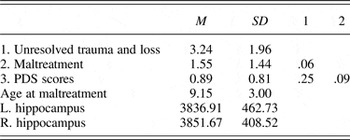
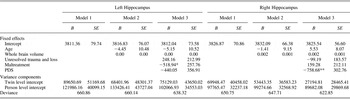
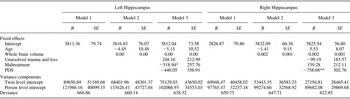
Table 1 presents descriptive data for maltreatment scores, unresolved trauma and loss, PDS scores, age at maltreatment, and left and right hippocampal volume. Correlations among maltreatment scores, unresolved trauma and loss, and PDS scores were not significant (p > .11). The results of the intercept-only model (Model 1), the model with age and whole-brain volume (Model 2), and the model with unresolved trauma and loss, maltreatment scores, and PDS scores (Model 3) are displayed in Table 2. The ICC was 89,650.69/(89,650.69 + 121,986.16) = 0.42 for the left hippocampus and 69,948.47/(69,948.47 + 97,765.47) = 0.42 for the right hippocampus, supporting our choice for multilevel analyses.
Means and standard deviations and correlations of unresolved trauma and loss, maltreatment, PDS scores, age at maltreatment (years), and left and right hippocampus (mm3)

Effects of unresolved trauma and loss, maltreatment, and PDS scores on left and right hippocampal volume
*p < .05. **p < .01.
For the left hippocampus, the addition of age and whole-brain volume (Model 2) to the intercept-only model (Model 1) did not yield a significantly improved model, χ2 (2) = 0.72, p = .70. Age and whole-brain volume were not significantly associated with left hippocampal volume (age: z = –0.42, p = .67, whole-brain volume: z = 1.00, p = .32). However, the addition of unresolved trauma and loss, maltreatment, and PDS scores resulted in an improved fit, χ2 (3) = 21.82, p < .001. Maltreatment was significantly related to left hippocampal volume (z = –2.01, p = .04), indicating that participants with higher maltreatment scores had smaller left hippocampal volumes compared to participants with lower maltreatment scores. PDS scores and unresolved trauma and loss were not significantly associated with left hippocampal volume (PDS: z = –1.23, p = .22, unresolved trauma and loss: z = 1.17, p = .24).
For the right hippocampus, the inclusion of age and whole-brain volume (Model 2) did not result in an improved fit compared with the intercept-only model, χ2 (2) = 3.03, p = .21. Age was not significantly related with right hippocampal volume (z = –0.15, p = .88). However, there was a marginally significant and positive relation between whole-brain volume and right hippocampal volume (z = 2.00, p = .05). Again, the addition of unresolved trauma and loss, maltreatment, and PDS scores (see Table 2, Model 3) resulted in an improved fit in comparison with Model 2, χ2 (3) = 24.87, p < .001. Right hippocampal volume was not significantly related to maltreatment (z = 0.75, p = .45) or unresolved trauma and loss (z = –0.45, p = .59). However, there was a significant negative relation between PDS scores and right hippocampal volume (z = –2.51, p = .01), indicating that participants with more traumatic experiences had smaller right hippocampal volumes compared to participants with no traumatic experiences.
Furthermore, age at time of maltreatment (coded with the MMCS) was significantly related to right and left hippocampal volume (left: r = –.58, p < .01; right: r = –.73, p < .001), controlling for age at time of MRI acquisition and whole-brain volume. Participants with maltreatment experiences at relatively older ages had smaller hippocampal volumes than participants who experienced maltreatment during early childhood. Correlations between age at time of maltreatment and hippocampal volume were still significant after the exclusion of participants with maltreatment experiences at ages older than 12 years (left: r = –.51, p = .04; right: r = –.60, p = .01).
Discussion
We found evidence for a reduction of hippocampal volume in individuals with experiences of childhood maltreatment and in individuals with other traumatic events. This is consistent with previous studies showing that individuals with a history of childhood maltreatment or with maltreatment-related PTSD have smaller hippocampal volumes (Teicher & Samson, Reference Teicher and Samson2013; Woon & Hedges, Reference Woon and Hedges2008).
It is interesting that the experiences of childhood reported during the AAI were related to a reduction in left hippocampal volume, whereas exposure to traumatic events as measured with the PDS was related to a reduction in right hippocampal volume. Previous studies on the relation between childhood maltreatment and hippocampal volume also found more pronounced left-sided effects. For example, women with a history of childhood sexual abuse have been shown to have smaller left-sided hippocampal volumes but not right-sided hippocampal volumes (Stein et al., Reference Stein, Koverola, Hanna, Torchia and McClarty1997). In addition, Frodl, Reinhold, Koutsouleris, Reiser, and Meisenzahl (Reference Frodl, Reinhold, Koutsouleris, Reiser and Meisenzahl2010) showed that the effects of emotional neglect are more pronounced on the left hippocampus compared with the right hippocampus. In contrast, a decrease in only right-sided hippocampal volume has been found when rats had been exposed to increased corticosterone for three weeks (Zach, Mrzilkova, Rezacova, Stuchlik, & Vales, Reference Zach, Mrzilkova, Rezacova, Stuchlik and Vales2010).
These findings indicate that stress can induce laterality changes in the hippocampus, possibly because of neuroanatomical and neurochemical asymmetries in the hippocampus (Zach et al., Reference Zach, Mrzilkova, Rezacova, Stuchlik and Vales2010). Woon and Hedges (Reference Woon and Hedges2008) found meta-analytic evidence for effects of early stress on lateralization. Hippocampal asymmetry was found in healthy adults, but not in adults with maltreatment-related PTSD. Similarly, some studies indicate that the response of the prefrontal cortex to stress is also lateralized. The left prefrontal cortex seems to be involved in the processing of mildly stressful experiences, whereas the right prefrontal cortex is activated during severe stress (Sullivan, Reference Sullivan2004). Different types of stressful experiences may thus have distinct effects on neural structures, which might explain why we found experiences of maltreatment were related to left hippocampal volume, whereas other traumatic events measured with the PDS affected right hippocampal volume.
No associations between unresolved trauma and hippocampal volume were found. This is in line with previous studies indicating that adult attachment representations and retrospective reports of early abuse and other traumatic experiences are distinct constructs (Waters, Hamilton, & Weinfield, Reference Waters, Hamilton and Weinfield2000; Weinfield, Sroufe, & Egeland, Reference Weinfield, Sroufe and Egeland2000). Early caregiving experiences and adult attachment representations are only modestly related because experiences in subsequent social relationships and attachment-related life events influence how individuals represent past and present attachment experiences. Although attachment representations can be stable over the life span and can be linked to experiences during childhood (Murphy et al., Reference Murphy, Steele, Dube, Bate, Bonuck and Meissner2014), they are also open to change (Waters, Merrick, Treboux, Crowell, & Albersheim, Reference Waters, Merrick, Treboux, Crowell and Albersheim2000). In particular, the unresolved AAI classification has modest stability over time (Bakermans-Kranenburg & van IJzendoorn, Reference Bakermans-Kranenburg and van IJzendoorn1993; Benoit & Parker, Reference Benoit and Parker1994; Crowell, Treboux, & Waters, Reference Crowell, Treboux and Waters2002). Therefore, systematic differences in hippocampal volume are unlikely to be found in individuals with unresolved versus not unresolved classifications in nonclinical samples.
To our surprise, we found a negative relation between age at maltreatment and hippocampal volume. Individuals who experienced maltreatment at older ages had larger reductions in hippocampal volume compared with individuals who experienced maltreatment during early childhood. This is in contrast with the suggestion that the hippocampus has heightened sensitivity to early experiences of abuse (Teicher & Samson, Reference Teicher and Samson2013). For example, Rao et al. (Reference Rao, Betancourt, Giannetta, Brodsky, Korczykowski and Avants2010) found that parental caregiving at 4 years old was related to decreased hippocampal volume, but not at age 8. However, it should be noted that in this study hippocampal volume was measured at age 14. This might be too early to detect hippocampal abnormalities because the effects of childhood stress on the hippocampus may be delayed and have been shown to become more visible during the transition from puberty to adulthood (Andersen & Teicher, Reference Andersen and Teicher2004).
One limitation of the current study is the use of retrospective assessment of maltreatment. Previous research has shown that abused individuals may provide false negative reports (Fergusson, Horwood, & Woodward, Reference Fergusson, Horwood and Woodward2000), indicating that the effects of maltreatment may be underestimated in the current study. Furthermore, the small sample in the current study does not allow for differentiation between effects of specific types of maltreatment. Because previous research has shown that changes in brain development after early life stress are dependent on the type and diversity of abusive experience, future empirical studies and meta-analyses should investigate the relation between hippocampal changes and type of maltreatment.
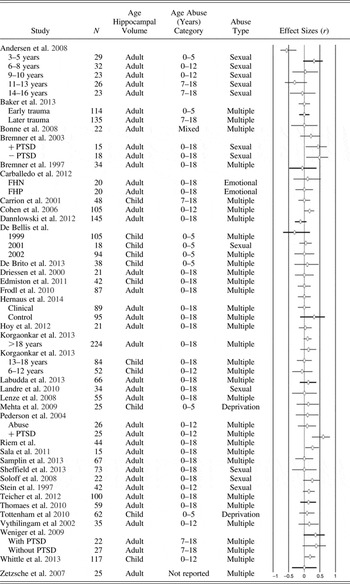
Study 2
Method
We included all pertinent studies from Teicher and Samson's (Reference Teicher and Samson2013) review, and systematically searched the databases Web of Science with the keywords hippocamp*, volume, and abuse or maltreatment to retrieve studies published in 2013 or 2014. We finished the search in March 2014. The selected studies (k = 49, N = 2,720) are presented in Table 3. The findings of these experiments are reviewed below and combined in a meta-analysis to compute the overall effect size across the studies. The Comprehensive Meta-Analysis program (Borenstein, Hedges, Higgins, & Rothstein, Reference Borenstein, Hedges, Higgins and Rothstein2009) was used to transform the results of the individual studies into the common metric of correlations and to combine effect sizes. Heterogeneity across sets of outcomes was assessed using the Q-statistic. Because some of our data sets were heterogeneous in their effect sizes, and because random effects models are more conservative than fixed-effects parameters in such cases, combined effect sizes and confidence intervals from random effects models are presented.
Overview of the studies included in the meta-analysis

We tested whether the distribution of these effect sizes showed any publication bias favoring the publication of studies with larger associations in smaller samples with the “trim and fill” method (Duval & Tweedie, Reference Duval and Tweedie2000). Using this method, a funnel plot is constructed of each study's effect size against the sample size or the standard error (usually plotted as 1/SE, or precision). It is expected that this plot has the shape of a funnel, because studies with smaller sample sizes and larger standard errors have increasingly large variation in estimates of their effect size as random variation becomes increasingly influential, whereas studies with larger sample sizes have smaller variation in effect sizes (Duval & Tweedie, Reference Duval and Tweedie2000; Sutton, Duval, Tweedie, Abrams, & Jones, Reference Sutton, Duval, Tweedie, Abrams and Jones2000). The plots would be expected to be shaped like a funnel if no data censoring is present. We used Egger's test to examine funnel plot asymmetry. Because smaller nonsignificant studies are less likely to be published (the “file-drawer” problem; Mullen, Reference Mullen1989), studies in the bottom left-hand corner of the plot are often omitted (Sutton et al., Reference Sutton, Duval, Tweedie, Abrams and Jones2000). The studies considered to be symmetrically unmatched can then be trimmed, that is, their missing counterparts can be imputed or “filled” as mirror images of the trimmed outcomes, allowing for the computation of an adjusted overall effect size and confidence interval (Gilbody, Song, Eastwood, & Sutton, Reference Gilbody, Song, Eastwood and Sutton2000; Sutton et al., Reference Sutton, Duval, Tweedie, Abrams and Jones2000).
We explored the moderating influence of age at MRI data acquisition (child or adult), age at the time of maltreatment (0–5, 0–12, 7–18, or 0–18 years), and the co-occurrence of abuse (sexual abuse, emotional abuse, institutional deprivation, and multiple abuse types) on the effects of maltreatment experiences on hippocampal volume. The influence of these moderators on the variation in combined effect sizes was tested with the Q contrast statistic in a random effects model (Borenstein et al., Reference Borenstein, Hedges, Higgins and Rothstein2009). A significant Q contrast value indicates that the difference in effect size between subsets of studies is significant.
Results
Narrative review
Early childhood: Age category 0–5 years
De Bellis et al. (Reference De Bellis, Keshavan, Clark, Casey, Giedd and Boring1999) examined hippocampal volumes in children with PTSD related to multiple types of maltreatment during early childhood and did not find a decrease in hippocampal volume in maltreated children compared to healthy children. Furthermore, Mehta et al. (Reference Mehta, Golembo, Nosarti, Colvert, Mota and Williams2009) examined hippocampal abnormalities in children who had experienced severe early institutionalized deprivation in Romania between the ages of 6 months and 3 years and did not find smaller hippocampal volumes. Consistent with these findings, Tottenham et al. (Reference Tottenham, Hare, Quinn, McCarry, Nurse and Gilhooly2010) failed to find a significant reduction in hippocampal volume in children who had experienced orphanage care. There was no significant difference in hippocampal volume between adults reporting maltreatment during early childhood (1 month–7 years) and adults without experiences of maltreatment in the study by Baker et al. (Reference Baker, Williams, Korgaonkar, Cohen, Heaps and Paul2013). Similarly, De Brito et al. (Reference De Brito, Viding, Sebastian, Kelly, Mechelli and Maris2013) reported no significant reduction in hippocampal volume in children who had experienced early childhood maltreatment. However, Andersen et al. (Reference Andersen, Tomada, Vincow, Valente, Polcari and Teicher2008) did find a significant relation between maltreatment during early childhood (between ages 3 and 5 years old) and hippocampal volume. Adults who had experienced sexual abuse during early childhood had significantly smaller hippocampal volumes.
Early and middle childhood: Age category 0–12 years
Stein et al. (Reference Stein, Koverola, Hanna, Torchia and McClarty1997) found that women who reported sexual victimization in childhood (before age 14) had significantly reduced left hippocampal volume compared to a control group. Similarly, Vythilingam et al. (Reference Vythilingam, Heim, Newport, Miller, Anderson and Bronen2002) showed that depressed women with a history of severe physical and/or sexual abuse before their first menstrual period had smaller left hippocampal volumes compared to depressed women without a history of abuse and compared to healthy subjects. In line with these findings, Whittle et al. (Reference Whittle, Dennison, Vijayakumar, Simmons, Yucel and Lubman2013) found that experiences of multiple types of maltreatment before age 12 years were related to smaller left hippocampal volume in a sample of children (mean age = 13 years).
However, four studies failed to find a significant association. Korgaonkar et al. (Reference Korgaonkar, Antees, Williams, Gatt, Bryant and Cohen2013) reported no significant reduction in hippocampal volume in a sample of children (6–12 years) reporting experiences of multiple types of abuse. In addition, Cohen et al. (Reference Cohen, Grieve, Hoth, Paul, Sweet and Tate2006) examined the relation between hippocampal abnormalities in adulthood and the experience of multiple traumatic events before age 12, such as severe family conflict, emotional abuse, physical abuse, and/or sexual abuse. No significant effect of traumatic events on hippocampal volume was found. Pederson et al. (Reference Pederson, Maurer, Kaminski, Zander, Peters and Stokes-Crowe2004) found no differences in hippocampal volumes between women with PTSD related to experiences of emotional, physical, and/or sexual abuse before puberty, women who were abused but without PTSD, and women in a healthy control group. Furthermore, Andersen et al. (Reference Andersen, Tomada, Vincow, Valente, Polcari and Teicher2008) did not find a significant reduction in hippocampal volume in women reporting sexual abuse during ages 6 to 8 years and 9 to10 years.
Late childhood and adolescence: Age categories 7–18 years
Weniger, Lange, Sachsse, and Irle (Reference Weniger, Lange, Sachsse and Irle2009) examined hippocampal size in women with borderline personality disorder (BPD), women with BPD and PTSD, and a control group. All BPD women had been exposed to neglect, physical, and/or sexual abuse during ages 7–18 years. They found that women with BPD and PTSD and women with only BPD had a significant reduction in hippocampal volume compared to the control group. There was no significant difference in hippocampal volume between BPD patients with and without PTSD. Further, Andersen et al. (Reference Andersen, Tomada, Vincow, Valente, Polcari and Teicher2008) investigated hippocampal volumes in women reporting sexual abuse during ages 11 to 13 and ages 14 to 16. Sexual abuse during age 11 to13 years predicted smaller hippocampal volume, but there was no significant effect of abuse reported at ages 14 to 16. Baker et al. (Reference Baker, Williams, Korgaonkar, Cohen, Heaps and Paul2013) also investigated the effects of multiple types of maltreatment during late childhood/adolescence (ages 8–17 years) on hippocampal volume in adulthood. No significant relation between maltreatment and hippocampal volume was found. Further, Carrion et al. (Reference Carrion, Weems, Eliez, Patwardhan, Brown and Ray2001) examined hippocampal volume in children with PTSD symptoms and a history of traumatic experiences. Children with traumatic experiences did not have significantly smaller hippocampal volumes than did control subjects.
Childhood and adolescence: Age category 0–18 years
Other studies investigated the relation between hippocampal volume and the effects of experiences of maltreatment during childhood and adolescence, that is, during the first 18 years, without differentiating age periods within this broad range. Bremner et al. (Reference Bremner, Randall, Vermetten, Staib, Bronen and Mazure1997) measured hippocampal volumes in adults with experiences of prolonged exposure to physical, sexual, and/or emotional abuse during childhood and adolescence (before age 18 years). They found that adults with a history of maltreatment had significantly smaller left hippocampal volumes compared to healthy control subjects. In a later study, Bremner et al. (Reference Bremner, Vythilingam, Vermetten, Southwick, McGlashan and Nazeer2003) examined hippocampal volumes in women with PTSD and experiences of sexual abuse before age 18, women with a history of sexual abuse without PTSD, and a comparison group. Women with abuse and PTSD had a significant reduction in hippocampal volume compared to women with abuse but without PTSD and compared to the comparison group. Furthermore, Thomaes et al. (Reference Thomaes, Dorrepaal, Draijer, de Ruiter, van Balkom and Smit2010) found that women with PTSD related to abuse (before age 16 years) had significantly smaller right hippocampal volumes compared to a comparison group. However, Korgaonkar et al. (Reference Korgaonkar, Antees, Williams, Gatt, Bryant and Cohen2013) did not find a significant reduction in hippocampal volume in a sample of adolescents (13–18 years) reporting experiences of abuse with the Early Life Stress Questionnaire (Cohen et al., Reference Cohen, Grieve, Hoth, Paul, Sweet and Tate2006).
Additional support for effects of maltreatment during childhood and adolescence on hippocampal volume comes from studies using self-report questionnaires that assess experiences of maltreatment before age 18, such as the Childhood Trauma Questionnaire (CTQ; Bernstein et al. Reference Bernstein, Stein, Newcomb, Walker, Pogge and Ahluvalia2003). Carballedo et al. (Reference Carballedo, Lisiecka, Fagan, Saleh, Ferguson and Connolly2012) found that experiences of childhood emotional abuse as assessed with the CTQ correlated negatively with hippocampal volume in adults at risk for depression. No relation between childhood emotional abuse and hippocampal volume was found for individuals who were not at risk for depression. Edmiston et al. (Reference Edmiston, Wang, Mazure, Guiney, Sinha and Mayes2011) did not find a significant effect of total CTQ score on hippocampal volume, but reported a significant negative relation between the CTQ emotional neglect subscale and hippocampal volume in a sample of adolescents. Further, Dannlowski et al. (Reference Dannlowski, Stuhrmann, Beutelmann, Zwanzger, Lenzen and Grotegerd2012) found that childhood maltreatment as measured with the CTQ was related to a reduction in right hippocampal volume in adults. Similarly, Driessen et al. (Reference Driessen, Herrmann, Stahl, Zwaan, Meier and Hill2000) reported that CTQ scores were negatively related to hippocampal volume in a sample consisting of adults with BPD and healthy controls, although the effect of abuse was not significant when the analyses were performed separately for BPD patients and controls. Sala et al. (Reference Sala, Caverzasi, Lazzaretti, Morandotti, De Vidovich and Marraffini2011) also found that BPD patients with a history of maltreatment had smaller hippocampal volumes compared to BPD patients without maltreatment experiences. In addition, Samplin, Ikuta, Malhotra, Szeszko, and Derosse (Reference Samplin, Ikuta, Malhotra, Szeszko and Derosse2013) found reduced hippocampal volume in adults reporting abuse or neglect on the CTQ. Consistent with these findings, Teicher et al. (Reference Teicher, Anderson and Polcari2012) showed that CTQ scores were related to volume reductions in several subfields of the hippocampus. In addition, Hoy et al. (Reference Hoy, Barrett, Shannon, Campbell, Watson and Rushe2012) examined hippocampal volume in individuals with psychosis and found that traumatic experiences (before age 18 years) reported on the Traumatic Experiences Checklist (Nijenhuis, Van der Hart, & Kruger, Reference Nijenhuis, Van der Hart and Kruger2002) were related to a reduction in hippocampal volume. Maltreatment experiences were measured with the Childhood Abuse Scale (Soloff, Lynch, & Kelly, Reference Soloff, Lynch and Kelly2002), which measures maltreatment experiences during childhood and adolescence.
In contrast, Hernaus et al. (Reference Hernaus, van Winkel, Gronenschild, Habets, Kenis and Marcelis2014) did not find a significant relation between childhood trauma as measured with the CTQ and hippocampal volume in patients with psychotic disorder and healthy control subjects. Labudda et al. (Reference Labudda, Kreisel, Beblo, Mertens, Kurlandchikov and Bien2013) also failed to find a significant relation between hippocampal volume in women with BPD and adverse childhood experiences as assessed with the CTQ. There was also no significant reduction in hippocampal volume in psychotic disorder patients with a history of childhood sexual abuse (measured with the CTQ) in the study by Sheffield, Williams, Woodward, and Heckers (Reference Sheffield, Williams, Woodward and Heckers2013). Further, Lenze et al (Reference Lenze, Xiong and Sheline2008) did not find a significant effect of multiple types of abuse (Bifulco, Brown, & Harris, Reference Bifulco, Brown and Harris1994) on hippocampal volume in a sample consisting of depressed women and psychiatrically healthy women. Korgaonkar et al. (Reference Korgaonkar, Antees, Williams, Gatt, Bryant and Cohen2013) did not report significant reductions in hippocampal volumes in adults with different types of traumatic experiences before age 18 years. In addition, Soloff, Nutche, Goradia, and Diwadkar (Reference Soloff, Nutche, Goradia and Diwadkar2008) did not find a significant difference in hippocampal volume between women with BPD and experiences of sexual abuse during childhood and women with BPD but without experiences of sexual abuse. There were also no significant hippocampal abnormalities in women with PTSD related to sexual abuse during late childhood/adolescence in the study by Landre et al. (Reference Landre, Destrieux, Baudry, Barantin, Cottier and Martineau2010). Further, Frodl et al. (Reference Frodl, Reinhold, Koutsouleris, Reiser and Meisenzahl2010) found smaller hippocampal white matter in depressed patients reporting emotional neglect before age 18 years, but did not find a significant reduction in hippocampal gray matter.
Meta-analysis
The total combined effect size for the association between maltreatment experiences and hippocampal volume was Pearson r = .08 (95% confidence interval [CI] = 0.03, 0.12, p < .01, k = 49, N = 2,720) and the set of outcomes was homogeneous (Q = 60.75, p = .10). The direction of the effect size supported our hypothesis that more maltreatment experiences compared to less or no such experiences were associated with smaller hippocampal volumes. According to the funnel plot, trim-and-fill, and Eggers test (p = .53), no publication bias could be detected. The fail-safe number for this combined effect size was k = 134, which is smaller than Rosenthal's (1991) criterion of 5k + 10.
One study without information on age at the time of maltreatment and one study with mixed age at maltreatment categories were excluded from the moderator analysis of age at maltreatment. The combined effect size of maltreatment experiences at 0–5 years on the hippocampus was not significant (r = –.06, 95% CI = –0.16, 0.04; p = .27, k = 8, N = 485). However, the combined effect size of maltreatment experiences at ages 0–12 years amounted to r = .14 (95% CI = 0.04, 0.24; p < .01, k = 9, N = 457). No significant combined effect size was found when maltreatment occurred at ages 7–18 years (r = .04, 95% CI = –0.10, 0.17; p = .60, k = 6 N = 281), but at ages 0–18 a significant effect was found with r = .11 (95% CI = 0.05, 0.17; p < .01, k = 24, N = 1,450). The contrast between the combined effect sizes (excluding the diffuse 0–18 category) was significant, Q (3) = 9.81 p = .02, showing stronger effects of maltreatment for individuals with maltreatment experiences at ages 0–12 years. The combined effect sizes of each of the age categories were homogeneous.
The combined effect size of maltreatment experiences on children's hippocampal volume amounted to a nonsignificant effect (r = .03, 95% CI = –0.06, 0.12; p < .47, k = 11, N = 685) and the combined effect size of maltreatment experiences on adults' hippocampal volume was significant (r = .09, 95% CI = 0.04, 0.14; p < .01, k = 38, N = 2,035). However, the contrast between the combined effect sizes of the group consisting of children and the group consisting of adults was not significant, Q (1) = 1.17, p = .28, indicating that the effect of maltreatment experiences on hippocampal volume were not significantly more pronounced in adults compared to children. The combined effect sizes of these groups were homogeneous.
The combined effect size of multiple maltreatment experiences was r = .09 (95% CI = 0.04, 0.14; p < .01, k = 33, N = 2,238), the combined effect size of solely sexual abuse amounted to r = .02 (95% CI = –0.10, 0.14; p = .71, k = 12, N = 355), the combined effect size of solely emotional abuse was r = .03 (95% CI = –0.32, -.36; p = .98, k = 2, N = 40), and the combined effect size of deprivation only was r = .06 (95% CI = –0.18, 0.30; p = .60, k = 2, N = 87). The contrast between the combined effect sizes of multiple maltreatment types and sexual abuse was not significant, Q (1) = 0.91 p = .34. The combined effect size of the group consisting of multiple maltreatment experiences was heterogeneous, whereas the combined effect sizes of groups consisting of only sexual maltreatment, emotional maltreatment, and deprivation were homogeneous.
General Discussion
The association of childhood maltreatment with hippocampal volume was examined in an empirical study and a meta-analysis, taking into account the moderating influence of timing of the maltreatment, age at neuroimaging, and severity of maltreatment. In the empirical study, we found a reduction of hippocampal volume as a function of childhood maltreatment. In addition, we found that individuals who reported having experienced maltreatment at older ages had larger reductions in hippocampal volume compared to individuals who reported maltreatment in early childhood. In line with the empirical study, our meta-analysis confirmed that experiences of childhood maltreatment are associated with a reduction in hippocampal volume and that the associations with maltreatment are more pronounced when the maltreatment occurred in middle childhood compared to early or late childhood and adolescence.
Research has shown that individuals with a history of childhood maltreatment are more likely to suffer psychiatric disorders, in particular depression, PTSD, and anxiety disorders (Teicher & Samson, Reference Teicher and Samson2013). Reductions in hippocampal volume might be the neurobiological mechanism underlying the association between childhood maltreatment and psychopathology. Early life adversity damages the hippocampus due to increased secretion of glucocorticoids (Sapolsky et al., Reference Sapolsky, Krey and McEwen1985, Reference Sapolsky, Uno, Rebert and Finch1990). These hippocampal damages may result in dysregulated stress reactivity, because the hippocampus plays a major role in modulating the responsiveness of the HPA axis to stress (Bernard et al., Reference Bernard, Lind, Dozier, Korbin and Krugman2014; McCrory, De Brito, & Viding, Reference McCrory, De Brito and Viding2010). This may explain the dysregulated stress responses that have been observed in children and adults with experiences of maltreatment (Carpenter et al., Reference Carpenter, Shattuck, Tyrka, Geracioti and Price2011; Elzinga et al., Reference Elzinga, Roelofs, Tollenaar, Bakvis, van Pelt and Spinhoven2008; Heim et al., Reference Heim, Newport, Wagner, Wilcox, Miller and Nemeroff2002).
Studies in rats have shown that early life stress can lead to methylation of the glucocorticoid receptor (GR) gene, which results in reduced GR expression, mainly in the hippocampus (Weaver et al., Reference Weaver, Cervoni, Champagne, D'Alessio, Sharma and Seckl2004). This has been replicated in an elegant study in humans, investigating brain tissue of men who committed suicide and did or did not have childhood abuse experiences and men who died in an accident (McGowan et al., Reference McGowan, Sasaki, D'Alessio, Dymov, Labonte and Szyf2009). Results were consistent with those from animal research in that more methylation of the GR receptor gene and fewer GR receptors in the hippocampus were found in abused individuals. This process may be partially responsible for the hippocampal volume reductions in maltreated individuals.
In the current meta-analysis, we found that the effects of maltreatment were more pronounced in individuals with maltreatment experiences at ages 0 to 12 years compared to individuals with maltreatment experiences at ages 0 to 5 years, ages 7 to 18 years, and before age 18 years. This indicates that the association between maltreatment and hippocampal volume reduction is stronger when the maltreatment occurred in middle childhood, which is not consistent with the suggestion the hippocampus has a relatively early sensitive period (Andersen et al., Reference Andersen, Tomada, Vincow, Valente, Polcari and Teicher2008; Rao et al., Reference Rao, Betancourt, Giannetta, Brodsky, Korczykowski and Avants2010). There may be at least three possible explanations for the stronger association between hippocampal volume reduction and maltreatment during middle childhood: a stress-hyporesponsive infancy period, childhood amnesia, and persistence of maltreatment across time.
A stress-hyporesponsive period may buffer the neurobiological effects of maltreatment in infancy. Studies with rats have shown that stressors during the stress-hyporesponsive period (Postnatal Day 4–14) induce little reactivity of the HPA axis (De Kloet, Rosenfeld, Van Eekelen, Sutano, & Levine, Reference De Kloet, Rosenfeld, Van Eekelen, Sutanto and Levine1988; Sapolsky & Meaney, Reference Sapolsky and Meaney1986). This hyporesponsive period may have evolved to protect the developing brain from the negative effects of elevated glucocorticoids (Sapolsky & Meaney, Reference Sapolsky and Meaney1986). A comparable period might emerge in human children at the end of the first year of life (Gunnar & Fisher, Reference Gunnar and Fisher2006). For example, there is diminished responsiveness of the HPA axis to stressors such as physical examinations around 3 months of age (Larson, White, Cochran, Donzella, & Gunnar, Reference Larson, White, Cochran, Donzella and Gunnar1998) and by 1 year infants do not show cortisol increases to stressors that typically provoke behavioral distress (Gunnar & Fisher, Reference Gunnar and Fisher2006). Large intraindividual variability in basal cortisol seems to be a typical characteristic of infants in the second half of the first year of life (De Weerth & van Geert, Reference De Weerth and van Geert2002). Thus, the effects of early childhood maltreatment on hippocampal development might be partly buffered by this hyporesponsive period in which HPA-axis functioning still has to stabilize.
Childhood amnesia may be another explanation for the finding that hippocampal reductions are larger when maltreatment occurred during middle childhood than during early childhood. There is little recall for events that occur before the age of 3–4 years (Rubin, Reference Rubin2000). Young children can recall events correctly, but this recall is feeble and as children grow older, they tend to forget early experiences; the age of the earliest memory shifts upward (Peterson, Warren, & Short, Reference Peterson, Warren and Short2011). Autobiographical memory of children might be shaped like an exponential function implying a constant half-life of retrieval of past events. Memories may get lost or distorted even in the long run, which would be an explanation for the so-called childhood amnesia (Bauer, Burch, Scholin, & Guler, Reference Bauer, Burch, Scholin and Guler2007). As a result, self-reported maltreatment experiences may not reliably cover the early childhood period, which might explain nonsignificant findings in this age group.
Persistence of maltreatment is another explanation. The longer duration of the maltreatment might explain why the neurobiological effects of maltreatment are stronger when maltreatment occurred at ages 0–12 years, rather than at ages 0–5 years. Individuals with a history of maltreatment at ages 0–12 years may have been exposed to abusive experiences for a longer period of time than were individuals with maltreatment experiences in early childhood because physical or emotional maltreatment may often not be restricted to a single incident but instead might continue to trouble the child over a large time span. Such persistent and chronic abuse may result in more profound neurobiological changes. Future studies should examine the effects of duration of exposure to maltreatment in order to clarify the effects of early adversity on brain development.
We did not find a significant combined effect size of maltreatment experiences on children's hippocampal volume, whereas maltreatment experiences were associated with adults' hippocampal volume. Although the contrast between these combined effect sizes was not significant, the difference between children and adults is consistent with the suggestion that the effects of childhood maltreatment on hippocampal development may be delayed (Teicher & Samson, Reference Teicher and Samson2013). Research with rats has shown that early maternal separation reduces synaptic overproduction and pruning in the hippocampus prior to puberty, with enduring effects of maternal separation for at least 80 days after cessation of the stressor (Andersen & Teicher, Reference Andersen and Teicher2004). Thus, effects of hippocampal changes do not appear immediately after exposure to childhood maltreatment, but are likely to emerge during the transition between puberty and adolescence.
In addition to time after exposure to maltreatment, our meta-analysis shows that changes in hippocampal volume are dependent on the severity of the maltreatment. We found that, in particular, the combination of multiple types of abuse affects hippocampal volume. No significant influences on hippocampal volume were found for experiences of solely sexual abuse, emotional abuse, or institutionalized deprivation. Although the contrast between the effect sizes was not significant, these results seem to indicate that the combination of multiple types of abuse is most severe, leading to profound hippocampal changes.
An important question is whether hippocampal changes related to childhood maltreatment are reversible. Some studies indicate that pharmacotherapy can reduce hippocampal abnormalities in individuals diagnosed with PTSD (Thomaes et al., Reference Thomaes, Dorrepaal, Draijer, Jansma, Veltman and van Balkom2014). For example, Vermetten, Vythilingam, Southwick, Charney, and Bremner (Reference Vermetten, Vythilingam, Southwick, Charney and Bremner2003) showed that long-term treatment with selective serotonin reuptake inhibitors reversed stress-induced hippocampal atrophy and improved memory in patients with PTSD related to child abuse and other traumas, indicating that antidepressants promote hippocampal neurogenesis. Phenytoin, an anticonvulsant used in the treatment of epilepsy, has been shown to increase hippocampal volume in adults with PTSD related to a variety of traumas (Bremner et al., Reference Bremner, Mletzko, Welter, Quinn, Williams and Brummer2005). Another study showed that psychotherapy does not increase hippocampal volume in patients with PTSD (Lindauer et al., Reference Lindauer, Vlieger, Jalink, Olff, Carlier and Majoie2005). However, it should be noted that these neuroimaging findings are specific to PTSD. It is unknown whether pharmacotherapy or psychotherapy reverses hippocampal changes in individuals with a history of childhood maltreatment but without PTSD.
A recent meta-analysis showed that depressed individuals with a history of maltreatment benefit less from treatment compared to depressed individuals who were not maltreated (Nanni, Uher, & Danese, Reference Nanni, Uher and Danese2012). Moreover, maltreated individuals with depressive, anxiety, and substance use disorders differ from patients without a history of maltreatment in terms of age at onset, symptom severity, and comorbidity, indicating that individuals with childhood maltreatment may constitute a clinically and neurobiologically distinct subtype (Teicher & Samson, Reference Teicher and Samson2013). Treatment of these disorders may be improved by differentiating between patients with and without maltreatment and by considering alternative treatments for individuals with experiences of childhood maltreatment (Nanni et al., Reference Nanni, Uher and Danese2012; Teicher & Samson, Reference Teicher and Samson2013).
Some limitations of the current studies should be noted. For instance, not all studies included in the meta-analysis specifically assessed the age at which maltreatment occurred. The use of self-report questionnaires such as the CTQ, which assesses abuse before age 18 years, resulted in broad age categories and made it difficult to draw conclusions on the effects of abuse in smaller time windows or more specific phases of development. A combination of prospective and retrospective measures may provide the most accurate view on maltreatment experiences (Shaffer, Huston, & Egeland, Reference Shaffer, Huston and Egeland2008). Future studies examining neurobiological changes after maltreatment should measure age at exposure to maltreatment in order to gain more insight into the sensitive periods in the effects of childhood maltreatment on brain development. The Maltreatment Classification System (Barnett et al., Reference Barnett, Manly, Cicchetti, Cicchetti and Toth1993) would be a suitable instrument for this type of research, because it assesses type(s), severity, and frequency of maltreatment as well as the developmental periods in which it occurred. Furthermore, we did not find evidence for an early hippocampal sensitive period, which is in contrast to translational studies indicating that hippocampal synaptic density is particularly sensitive to early stress (Andersen & Teicher, Reference Andersen and Teicher2004). Recent research provides evidence for a new developmental subtype of PTSD in children younger than 6 years of age (Scheeringa, Myers, Putnam, & Zeanah, Reference Scheeringa, Myers, Putnam and Zeanah2012), possibly indicating that the stress system is differently affected by abuse during early and middle childhood. Future animal studies may shed more light on sensitive periods in the development and functioning of the hippocampus by examining the effects of stress at different phases of development. In addition, the small number of studies examining effects of sexual abuse and institutionalized deprivation precluded investigating the associations of the specific type of abuse with hippocampal development. Moreover, several studies included in the meta-analysis involved patients diagnosed with psychiatric disorders, including PTSD and BPD. However, evidence is accumulating that the structural changes in the hippocampus are specific to child abuse.
In conclusion, in the current paper, we present empirical and meta-analytic evidence for the association between childhood maltreatment and reductions in hippocampal volume. In addition, we found that the neurobiological effects of maltreatment are most profound when maltreatment was reported to have occurred in middle childhood, rather than in early childhood or adolescence. Thus, our results point to a hippocampal sensitive period in middle childhood. Reduced hippocampal volume might result in dysregulated responses to stress and may thus be one of the neurobiological mechanisms underlying the association between childhood maltreatment and psychopathology. Available evidence on humans is still insufficient, however, to answer the crucial question of whether hippocampal abnormalities emerge after maltreatment and tip the balance into the direction of psychopathology, or whether atypical hippocampal development causes greater vulnerability to adverse childhood experiences leading to the development of psychopathology. In the disabling cycle of abuse, hippocampal volume may play the roles of cause, effect, and mediator similar to the role of the hippocampus in the feedback system that regulates cortisol levels in the human body and brain.