Background
According to the 2015 Global Adult Tobacco Survey (GATS), 45.3% of adult men use tobacco in Viet Nam, one of the highest rates of tobacco use in the world (GATS Viet Nam 2015). Smoking rates among women are less than 2%. Among current male smokers, 83% smoke cigarettes, 26% smoke waterpipes and less than 1% used smokeless tobacco (GATS Viet Nam 2010).
There is strong evidence of an association between waterpipe use and severe adverse health effects which include pulmonary disease, lung cancer, coronary heart disease and adverse birth outcomes (Akl, Jawad, Lam, Obeid, & Irani, Reference Akl, Jawad, Lam, Obeid and Irani2013; El-Zaatari, Chami, & Zaatari, Reference El-Zaatari, Chami and Zaatari2015). Despite these dangers, there is a widely held belief that using a waterpipe is a less harmful way of smoking tobacco (Afifi et al., Reference Afifi, Khalil, Fouad, Hammal, Jarallah and Farhat2013; Berg et al., Reference Berg, Stratton, Schauer, Lewis, Wang and Windle2015; Heinz et al., Reference Heinz, Giedgowd, Crane, Veilleux, Conrad and Braun2013; Primack et al., Reference Primack, Sidani, Agarwal, Shadel, Donny and Eissenberg2008). Data from the GATS suggests that Vietnamese hold similar beliefs (Minh et al., Reference Minh An, Van Minh, Huong, Bao Giang, Thanh Xuan and Thi Hai2013).
Waterpipe use continues to grow globally creating a need for research that elucidates factors that can guide prevention and treatment efforts. A recent systematic review of studies examining patterns of waterpipe use in the Middle East and US noted that there is a strong social dimension associated with waterpipe use (Akl, Jawad, Lam, Obeid, & Irani, Reference Akl, Jawad, Lam, Obeid and Irani2013). Waterpipe use occurs primarily in public gatherings and in places like cafes and at home with family and friends (Akl, Jawad, Lam, Obeid, & Irani, Reference Akl, Jawad, Lam, Obeid and Irani2013; Akl et al., Reference Akl, Ward, Bteddini, Khaliel, Alexander and Lotfi2015; Erbaydar, Bilir, & Yildiz, Reference Erbaydar, Bilir and Yildiz2010; Ghafouri et al., Reference Ghafouri, Hirsch, Heydari, Morello, Kuo and Singh2011; Griffiths, Harmon, & Gilly, Reference Griffiths, Harmon and Gilly2011; Israel, El-Setouhy, Gadalla, Aoun el, & Mohamed, Reference Israel, El-Setouhy, Gadalla, Aoun el, Mikhail and Mohamed2003; Roskin & Aveyard, Reference Roskin and Aveyard2009). Most of the studies in this review were conducted with students and youth. Only a few studies to date have focused on adult waterpipe users resulting in gaps in knowledge about how social context influences patterns of waterpipe use among adults (Morton et al., Reference Morton, Song, Fouad, Awa, Abou El Naga and Zhao2014; Shelley et al., Reference Shelley, Kumar, Lee, Nguyen, Nguyen and VanDevanter2017; Smith-Simone, Maziak, Ward, & Eissenberg, Reference Smith-Simone, Maziak, Ward and Eissenberg2008).
In contrast, there is an extensive literature on how social and cognitive factors influence cigarette use (Cialdini & Trost, Reference Cialdini, Trost, Gilbert, Fiske and Lindzey1998; Sheeran & Orbell, Reference Sheeran and Orbell1999). For example, self-efficacy beliefs, indicated by a person's confidence in his or her ability to perform and sustain a certain behaviour, are an important determinant of health behaviour change (Bandura, Reference Bandura1977, Reference Bandura1986; DiClemente, Reference DiClemente1986; Spek et al., Reference Spek, Lemmens, Chatrou, van Kempen, Pouwer and Pop2013). The concept of self-efficacy is especially important for tobacco cessation. Numerous studies have demonstrated that high self-efficacy to quit smoking is significantly associated with a greater likelihood of achieving smoking abstinence (Baldwin et al., Reference Baldwin, Rothman, Hertel, Linde, Jeffery and Finch2006) and lower rates of relapse after a quit attempt (Condiotte & Lichtenstein, Reference Condiotte and Lichtenstein1981). Finally, studies have demonstrated an association between social contextual influences and self-efficacy for quitting cigarettes (Christakis & Fowler, Reference Christakis and Fowler2008; de Vries, Dijkstra, & Kuhlman, Reference de Vries, Dijkstra and Kuhlman1988). There is a lack of equivalent research on factors that may influence self-efficacy among adult waterpipe users. More specifically, we are not aware of any studies that have examined the relationship between social influences, such as norms emerging from significant relationships, and self-efficacy for quitting waterpipe use.
The present study addresses current gaps in the literature by analysing: (1) how norms may influence self-efficacy to quit waterpipe smoking, and (2) whether these norms are differentially influential for different social relationships.
Materials and Methods
The current study is a part of a larger cluster–randomized controlled trial comparing the effectiveness of two strategies for implementing tobacco use treatment guidelines in 26 community health centres (CHCs) in the Thai Nguyen Province of Viet Nam. CHCs were randomized in three waves into one of two study arms: training, a clinical reminder system to prompt screening and cessation assistance, and a tool kit that included patient and clinician educational materials (ARM 1) versus ARM 1 plus referral to a village health worker (VHW) for three in person sessions of standardised smoking cessation counselling (ARM 2). The details of the intervention are described in a previous publication (Shelley, VanDevanter, Cleland, Nguyen, & Nguyen, Reference Shelley, VanDevanter, Cleland, Nguyen and Nguyen2015).
This analysis included tobacco users who had a visit during the intervention period in one of the four ARM 2 study sites enrolled in wave 1, and those who were 18 years or older and received a referral to a VHW for additional counselling (n = 473). Of those 473 patients, 214 met eligibility criteria, which included being male, having smoked waterpipes only or waterpipes and cigarettes (i.e., dual users) in the past 30 days, and completed a baseline survey prior to receiving VHW counselling. This analysis also excludes two female tobacco users. The small number of female participants is consistent with the low tobacco use rates among women in Viet Nam (GATS Viet Nam 2015). Patients were included regardless of their interest in quitting waterpipe use.
The Theory of Planned Behavior (TPB) (Ajzen, Reference Ajzen1991) informed this analysis that explored the association between perceived norms related to waterpipe use and self-efficacy to quit, two key constructs of TPB that are hypothesised to influence intentions to quit and cessation.
Measures
Dependent Variable
Self-efficacy to quit smoking was measured using a 10-point Likert scale with the following question: ‘How confident are you that you can quit smoking waterpipes completely if you wanted to?’ Responses ranged from ‘not confident at all’ (1) to ‘very confident’ (10). Single-item self-efficacy measures have been effectively used in several studies including among Asian populations (Wang, Borland, & Whelan., Reference Wang, Borland and Whelan2005) and have been found to be positively correlated with a well-established 20-item measure of self-efficacy and to consistently predict relapse to substance use after controlling for other predictors of relapse (Hoeppner, Kelly, Urbanoski, & Slaymaker, Reference Hoeppner, Kelly, Urbanoski and Slaymaker2011).
Independent Variables
Important and/or significant social relationships were identified through discussions with the research team in Viet Nam before including them in the instrument. Based on these conversations, significant relationships were identified as parents, children, spouse, siblings, relatives, in-laws, friends and co-workers. Through extensive discussions with field study staff we learned that in the rural Vietnamese context, many friends also work together as co-workers, hence our decision to have a composite variable for friends and co-workers. Also, spouse, parent and child were grouped together as immediate family, and in-law, sibling and relative/extended family were grouped together as extended family.
Two norms were assessed which include injunctive norms and descriptive norms. Injunctive (also called proscriptive or subjective) norms are what significant others say you should do. Injunctive norms can be explained as social acceptability of a behaviour (e.g., ‘my parents think I should quit smoking’) (Ajzen, Reference Ajzen1991, p. 188). Descriptive norms are what significant others are doing and whether they mind that the participant smokes (Cialdini & Trost, Reference Cialdini, Trost, Gilbert, Fiske and Lindzey1998).
Injunctive Norms. Injunctive norms were assessed using the question: ‘Which of these listed relationships/associations encourage you to quit smoking?’
Descriptive Norms: To collect information on perceived descriptive norms we used the following questions: Who on this list is also a smoker? And who on this list does not mind that you smoke?
The response categories were the same for injunctive and descriptive norm questions and included spouse, parent/s, child/ren, sibling/s, relative, in-laws, friend/neighbour, and co-worker. In total, we analysed nine independent variables assessing the three norms (encouraged to quit, smoker, does not mind that participant smokes) among the three types of relationships (immediate family, extended family and friends/co-workers).
Covariates
Demographic variables included age, name of commune (similar to village), occupation (full-time, part-time, retired, disabled, and other), and education (primary school, secondary school, high school, vocational school, college and graduate school). Frequency of waterpipe use was assessed as the number of times per day waterpipe was smoked. Categories included 1–10, 11–20 and ≥21 times per day. Those who smoked cigarettes in addition to waterpipe (Yes/No) were identified based on responses to the following item: ‘Do you smoke cigarettes some days, every day or not at all?’ Previous attempts to quit waterpipe smoking were measured with a single question: ‘When was the last time you stopped smoking waterpipes for 24 hours or longer because you were trying to quit?’ Responses included never, within the last month, within the last year and more than 1 year ago. Household smoking policy was measured with a single question: ‘Some households have rules about when and where people may smoke. Which statement best describes the rules about smoking inside your home?’ The response categories for this question were as follows: (1) smoking is allowed anywhere; (2) smoking is allowed in some places and at sometimes; (3) smoking is allowed everywhere inside the home (GATS Survey, 2010).
Analysis
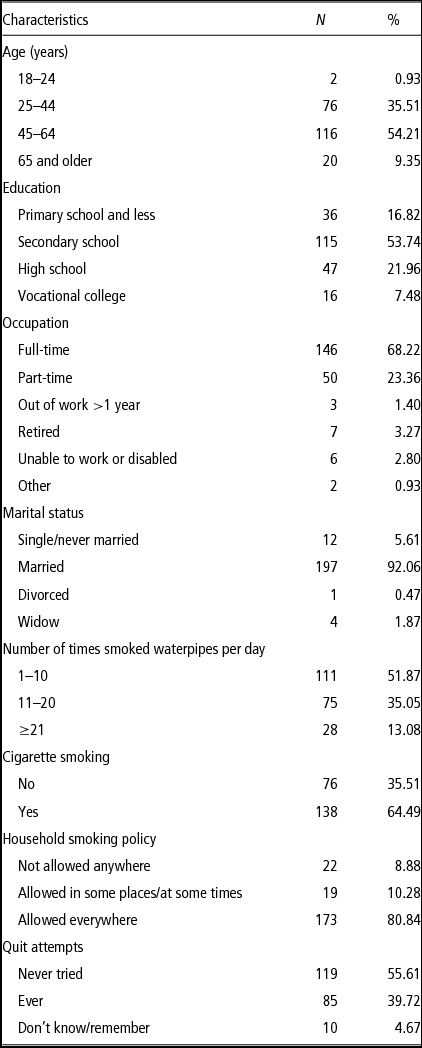
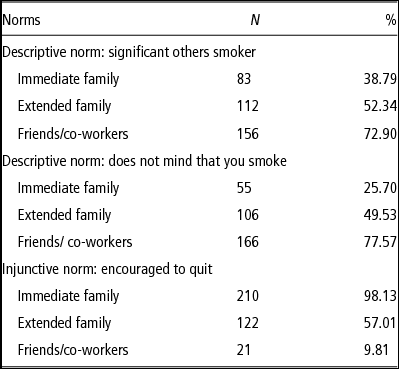
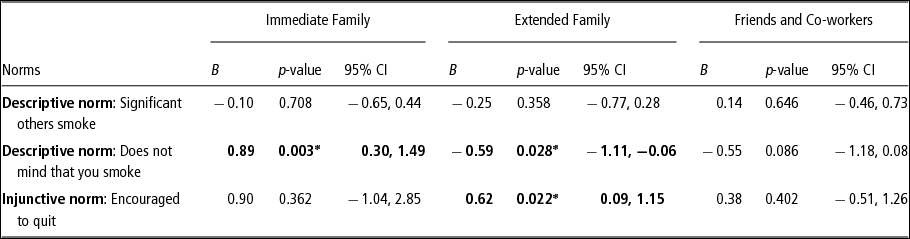
We used descriptive statistics to characterize the sample (Table 1) and the prevalence of perceived smoking related injunctive and descriptive norms among participants’ different relations (Table 2). Bivariate analysis was used to assess the unadjusted relationship between each of the social norms and self-efficacy to quit waterpipe smoking (Table 3). Finally, we created hierarchical regression models (HRM), for each of the three types of social relationships and each question related to injunctive and descriptive norms (i.e., 9 norm variables). We adjusted for commune, age, education, occupation, whether smoking was allowed in the home, frequency of waterpipe use, whether they also smoked cigarettes, and previous quit attempts. Regardless of the associations found in the bivariate analysis, we fit an HRM for each of the nine norms variables in order to examine both unadjusted associations and associations adjusted for covariates. All tests of statistical significance were two tailed, and p < .05 was considered significant. We conducted analyses using the R statistical computing environment (R Core Team, 2017).
Characteristics of waterpipe smokers (N = 214)

Frequency of descriptive and injunctive norms (N = 214)

Bivariate analyses of the association between smoking-related descriptive and injunctive norms of immediate family, extended family and friends/ co-workers and participants’ self-efficacy to quit waterpipe use

* = p < .05.
Results
Table 1 shows the characteristics of study participants. Most study participants were middle-aged and older, had a secondary school education, were employed full time, married, smoked water pipes 1–10 times daily (53%), and had never tried to quit waterpipe use. There were 138 dual users.
Table 2 presents the prevalence of the perceived descriptive and injunctive norms among the social relations of participants. Immediate (39%) and extended family (52%) were less likely to be smokers than friends/co-workers (73%). Participants reported that immediate and extended family members were less likely to not mind participants smoking (25.7% and 49.5%) than friends/coworkers (73%). Encouragement to quit was more likely among immediate (98%) and extended family (57%) than friends/co-workers (10%).
In the bivariate analysis (Table 3), immediate family not minding the participant's smoking was associated with greater self-efficacy to quit. However, extended family not minding the participant's smoking was associated with less confidence in quitting. Also, encouragement to quit from extended family was associated with greater confidence in quitting.
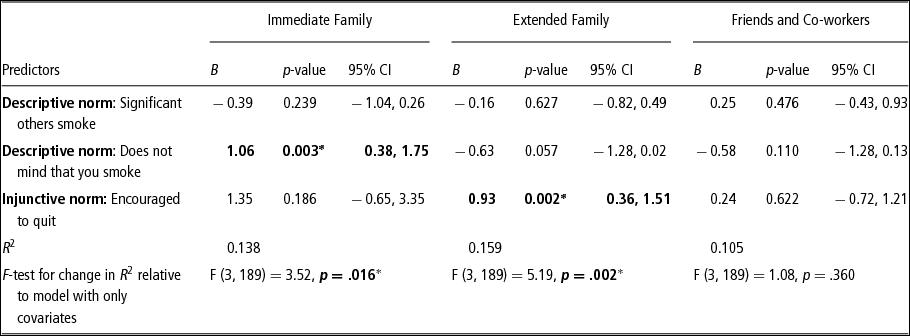
Table 4 presents the results of the HRM. Covariates alone accounted for approximately 9% of the variance in self-efficacy to quit: R 2 = .090, F (21, 192) = 0.90, p = .591. Immediate family not minding the participant's smoking was associated with greater self-efficacy to quit (B = 1.06, p = 0.003). Encouragement to quit from extended family was positively associated with self-efficacy to quit (B = 0.93, p = 0.002). Norms among friends/co-workers were not associated with self-efficacy.
Hierarchical regression model: association between smoking-related descriptive and injunctive norms of immediate family, extended family and friends/co-workers and self-efficacy of the index participant to quit waterpipe use

The model with only covariates accounted for approximately 9% of the variance in self-efficacy to quit (R 2 = 0.090, F (21, 192) = 0.90, p = .591).
* = p < .05.
Discussion
To our knowledge, this is the first study to examine how smoking-related norms among different types of social relationships are related to the self-efficacy to quit waterpipe smoking and the first study to explore the social dynamics of waterpipe smoking among adult male waterpipe smokers. This study provides some evidence that norms behave differently for different social relationships in their association with self-efficacy to quit waterpipe smoking.
Results from the descriptive analysis showed that family members, particularly immediate family were more likely to encourage smokers to quit compared with friends/coworkers which seems consistent with the finding that coworkers were also more likely to smoke. However, controlling for covariates, we found no association between the descriptive norm of significant others being smokers and participants’ self-efficacy to quit waterpipe smoking. This finding may be explained by the wide acceptance of smoking as a norm in the rural Viet Nam (Morrow, Hoang, & Trinh, Reference Morrow, Hoang and Trinh2002) where self-efficacy may not be influenced by active smoking among friends and family. In addition, others not minding that participants smoked allowed was not consistently associated with self-efficacy to quit. Social norms about smoking and attitudes toward smoking, such as acceptability as a product of interaction with members within the social network who smoke, may reinforce this behaviour (Homish, & Leonard, Reference Homish and Leonard2008). Additionally, there is research showing that tobacco use can assist in maintaining and reinforcing social relationships and kinship bonds which may create barriers to quitting (Berkman, Glass, Brissette, & Seeman, Reference Berkman, Glass, Brissette and Seeman2000; Johnston & Thomas, Reference Johnston and Thomas2008).
Similarly, although we found a positive relationship between encouragement to quit waterpipe use by extended family members (injunctive norm) and participants’ self-efficacy to quit, the regression model showed no association between immediate family and coworkers’ encouragement and self-efficacy. Extant studies have shown the importance of perceived injunctive norms in predicting tobacco use–related attitudes and behaviours (Robin and Johnson, 1996; Zaleski & Aloise-Young, Reference Zaleski and Aloise‐Young2013). Moreover, social networks and social support frequently overlap and are positively associated with health behaviours, including tobacco cessation (Lindstrom, Hanson, Östergren, & Berglund, Reference Lindström, Hanson, Östergren and Berglund2000; Mermelstein, Cohen, Lichtenstein, Baer, & Kamarck, Reference Mermelstein, Cohen, Lichtenstein, Baer and Kamarck1986). Although not consistent across family members, our results suggest that in this cultural context support and encouragement from family may be resonating more with the participants than that offered by non-family members (Latkin & Knowlton, Reference Latkin and Knowlton2015). The core societal value of the Asian society is ‘collectivist’ rather than ‘individualist’ (Burgess et al., Reference Burgess, Mock, Schillo, Saul, Phan and Chhith2014; Kim et al., Reference Kim, Kim, Fang, Kwon, Shelley and Ziedonis2015; Oyserman, Coon, & Kemmelmeier, Reference Oyserman, Coon and Kemmelmeier2002; Pokhrel, Little, & Herzog, 2014; Triandis, Reference Triandis1996) where family is considered to be the strongest social unit and a source of identity and support. Hence, the participants may be more influenced by family encouragement to quit leading to greater confidence to quit waterpipe use compared with similar encouragement from friends and coworkers.
Although not the focus of this analysis, we found that the frequency of us was high with almost half of the sample using a waterpipe more than 11 times per day. This is much higher than reported in a paper comparing waterpipe use among 13 low-middle income countries, which included Viet Nam (Morton et al., Reference Morton, Song, Fouad, Awa, Abou El Naga and Zhao2014). This may be related to the type of waterpipe used, which varies across regions globally. In Viet Nam and other Asian countries smokers use a ‘bong’ waterpipe that is made of bamboo and differs greatly from the traditional Arabic waterpipe (Maziak, Ward, Afifi Soweid, & Eissenberg, Reference Maziak, Ward, Afifi Soweid and Eissenberg2004; WHO Study Group on Tobacco Product Regulation, 2017). Unfortunately, the GATS and other tobacco use surveys have not reported on the specific type of waterpipe apparatus used when assessing patterns of use. Therefore, there is a lack of data on how this variation may influence frequency of use. Future surveys should address this gap in the literature by asking respondents to specify the type of waterpipe used.
Finally, we found that the waterpipe smokers in our study consisted primarily of older and less educated males. This is consistent with studies in Viet Nam but contrary to previous studies conducted in other countries which have found that waterpipe smoking tends to cluster among young age groups and the educated (Jenkins et al., Reference Jenkins, Dai, Van Kinh, Hoang and Bales1997; Maziak et al., Reference Maziak, Taleb, Bahelah, Islam, Jaber, Auf and Salloum2014; Xuan le et al., 2013; WHO, 2005). The demographic characteristics of users is important to track as it will affect how governments respond to this growing threat to public health.
Limitations
There are several potential limitations. First, this study was conducted in CHCs in only one district in Viet Nam, hence further studies are required to increase the generalizability of the findings of this study to overall rural Vietnamese male adult smoking population. Second, the questions were translated from English into Vietnamese by bi-lingual trained interviewers. Despite the fluency of the interviewers, there is the risk of losing ‘conceptual equivalence’ (Mangen, Reference Mangen1999; Van de Vijver & Tanzer, Reference Van de Vijver and Tanzer2004). Third, there may be other factors that affect self-efficacy to quit smoking apart from social norms, and these could lead to an artificial relationship between social norms and self-efficacy to quit smoking. Fourth, this study only focused on the smoking behaviour of people with social ties to the participants. To get a more accurate understanding of the role of descriptive norms, it will be important to study the non-smoking norms of significant others. Fifth, a social network analysis of tobacco use would have provided information on social network structure, network density, social network position, peer selection, peer influence and tobacco use for the participants in the present study. Finally, our data are from a cross sectional survey, which limits attributions about the direction of causality between social norms and the outcome of self-efficacy to quit smoking, although the hypotheses of this study was based on theoretical grounds.
Conclusion
Despite the limitations, the present study has important implications for future research. This paper suggests a need to further explore the social network factors underlying waterpipe smoking dependence and cessation. Studying the role of social norms at different levels of social ties for waterpipe longitudinally would validate the current findings and significantly advance the research on socio-cultural determinants of self-efficacy for tobacco cessation. The findings of this study suggest that it may be important to identify both support and risk networks preceding tobacco-cessation interventions and the development of social network-cantered tobacco control interventions while continuing to develop other policy measures to address the normalization of waterpipe use. Considering the universal importance of social influence on tobacco use, these findings have important implications for leveraging cultural and social norms for cessation and prevention efforts for adult waterpipe smokers globally.
Financial Support
This research was supported by a grant from the National Cancer Institute (1R01CA175329-01A1).
Conflict of Interest
All authors declare that they have no conflict of interest.
Ethical Standards
The authors assert that all procedures contributing to this work comply with the ethical standards of the relevant national and institutional committees on human experimentation and with the Helsinki Declaration of 1975, as revised in 2008.