Introduction
Mango (Mangifera indica L.) is a tropical fruit crop belonging to the family Anacardiaceae native from Southeast Asia. In Europe, commercial production is concentrated in Southern Spain (Andalusia), either in open fields or under protected structures. There are few commercial varieties of mango in Spain, cv. ‘Osteen’ being the most important one. This variety is the most produced in this area because it is reliable and offers a high yield. Some varieties of mango are self-compatible, but pollen transfer to the stigma of the flower by pollinators is still needed to achieve a satisfactory fruit set (Popenoe, Reference Popenoe1917; Singh, Reference Singh1954; Free and Williams, Reference Free and Williams1976).
When blooming, mango terminal and subterminal panicles bear from a few to several hundred flowers with a variable proportion of male and hermaphrodite flowers. Mango flowers are small, ranging from 5 to 10 mm in diameter, with white, red, pink or yellow petals depending on flower age and variety (Free, Reference Free1993; Sousa et al., Reference Sousa, Pigozzo and Viana2010). The hermaphrodite flowers present four or five stamens, of which only one or two are fertile (Mukherjee, Reference Mukherjee and Litz1997), and a nectary shaped as a fleshy disk surrounding the ovary (McGregor, Reference McGregor1976). Although male flowers lack the pistil, both types of flowers offer pollen and nectar as rewards.
Under greenhouses, mango production often faces pollination deficits because wild pollinators cannot gain access to trees so easily. Unfortunately, managed pollinators commonly used in greenhouses, such as honeybees and bumblebees, are not effective in mango, because its flowers not being very attractive to them (Popenoe, Reference Popenoe1917; Usman et al., Reference Usman, Bilquees and Jaskani2001). Furthermore, bees are not able to collect enough pollen and nectar for mass foraging due to the small quantity of the floral rewards in mango (Free and Williams, Reference Free and Williams1976; Du Toit and Swart, Reference Du Toit and Swart1993; Sung et al., Reference Sung, Lin, Chang, Cheng and Chen2006).
In order to improve mango production under protected conditions, alternative solutions based on flies are now being developed. Previous studies have demonstrated that dipterans are the main group of insects visiting mango flowers. Among them, blowflies (Calliphoridae) and hoverflies (Syrphidae) are the most frequent, suggesting these flies could help enhance mango pollination and eventually increase yields (Galán-Saúco et al., Reference Galán-Saúco, Galván, Hernández Conde and Navarro1997; Sharma et al., Reference Sharma, Abbas, Shukia and Sharma1998; Dag and Gazit, Reference Dag and Gazit2000; Usha et al., Reference Usha, Srivastava and Goswami2014; Saeed et al., Reference Saeed, Naqqash, Jaleel, Saeed and Ghouri2016; Alqarni et al., Reference Alqarni, Ahmed, Hannan, Ghose and Munshi2017; Rajan and Reddy, Reference Rajan and Reddy2019). Several authors have reported hoverflies foraging on mango flowers, and highlighted the presence of eristaline species such as Eristalis tenax (Linneo, 1758), Eristalinus aeneus (Scopoli, 1763), Eristalinus arvorum (Fabricius, 1787), Eristalinus hervebazini (Klocker, 1924) and Eristalinus taeniops (Wiedemann, 1818) (Anderson et al., Reference Anderson, Sedgley, Short and Allwood1982; Dag and Gazit, Reference Dag and Gazit2000; Sung et al., Reference Sung, Lin, Chang, Cheng and Chen2006; Fajardo et al., Reference Fajardo, Medina, Opina and Cervancia2008; Usha et al., Reference Usha, Srivastava and Goswami2014; Kumar et al., Reference Kumar, Joshi, Nath, Singh and Mansotra2016; Reddy and Sreedevi, Reference Reddy and Sreedevi2016; Alqarmi et al., Reference Alqarni, Ahmed, Hannan, Ghose and Munshi2017; Vishwakarma and Singh, Reference Vishwakarma and Singh2017; Chauhan et al., Reference Chauhan, Chandra and Gupta2018; Mohsen, Reference Mohsen2019).
As a first step to evaluate the potential of hoverflies for mango pollination, we studied the activity and foraging behaviour of the eristaline hoverfly E. aeneus in mango cultivated under plastic cover. Eristalinus aeneus is a cosmopolitan species belonging to the Eristalini tribe. Like other species of this tribe, adults visit flowers mainly to feed on pollen and nectar, necessary for reproduction and energy. The larvae are saprophagous and feed on microbes involved in the decay of mainly plant-based material. They are known as ‘rat-tailed maggot’ because they possess an elongated breathing tube at the end of the body that allows them to breathe while remaining underwater. They are usually found in liquid media with a large amount of organic matter such as coastal lagoons, ponds, slow-moving rivers, streams and irrigation ditches, animal dung and in sewage farms (Rotheray and Gilbert, Reference Rotheray and Gilbert2011; Speight, Reference Speight2011).
According to Speight (Reference Speight2011), this species has a homogeneous distribution in continental Europe, and can be found in anthropophilic areas in Southern Europe, while in Northern Europe its distribution is limited to coastal sites. The activity period of E. aeneus in Southern Europe extends from the end of March to October, with a peak in summer, and overwintering as adults (Marcos-García, Reference Marcos-García1985; Pérez-Bañón, Reference Pérez-Bañon2000; Speight, Reference Speight2011).
Understanding E. aeneus foraging behaviour under protected cultivation, along with the performance of efficacy trials, could allow the evaluation of its potential use as a managed pollinator in protected mango crops grown in countries where Eristalinae hoverflies are present. In this research, we studied the activity of E. aeneus and described its foraging behaviour and floral visits at different moments of the day, analysing floral and resources preferences (hermaphrodite vs. male flower, and nectar vs. pollen) for both male and female individuals in a protected plot of mango cv. ‘Osteen’ grown in Southern Spain.
Material and methods
The experiment was carried out in 2019 in the Cajamar Experimental Station (El Ejido, Almería, Spain), in an Inacral greenhouse covered with a three-layer non-photoselective polyethylene plastic. Before bloom, a cultivated area of 126 m2 was isolated with a white insectproof net (6 × 6 threads per cm2), enclosing six rows of 4-year-old cv. ‘Osteen’ trees. As pollinator, we used E. aeneus because this species tolerates high temperatures, and it was found to be the most abundant according to preliminary sampling carried in the study area in different mango varieties and other subtropical crops. After tree isolation, on 19th March, a single release consisting of the introduction of 3780 pupae of E. aeneus (Goldfly®, Polyfly, Spain) provided a density of approximately 30 individuals per m2. Preliminary trials comparing different densities indicated that this number of insects per m2 is adequate. After adult emergence finished, the pupae were sorted and counted to determine the emergence rate (95%). The sex ratio was determined from a group of pupae of the same population that were monitored in the laboratory with a 50:50 proportion (unpublished data). Observations started on 25th March and consisted of recording the daily activity of the hoverflies, foraging behaviour and visits to the inflorescences during full bloom, three times per week during three consecutive weeks. The observation period spanned from 07:00 to 19:00 h (UTC + 1).
Daily activity of E. aeneus on mango
To determine the flight activity of E. aeneus, observations were made always from the same point in a quadrant of 1 m2 located between the same two mango trees. Five minute observations were made starting at 7:00, then 8:00, 10:00, 12:00, 14:00, 16:00, 17:00, 18:00 and 19:00 h. We recorded the number of individuals in flight at those times, as well as the start and end time to establish the duration of the monitored activity.
Temperature (°C) and relative humidity (%) were registered every 30 min by a datalogger (Inkbird IBS-TH1 Plus). Light intensity records (klux) were made using a hand digital luxmeter (Mastech MS6612) immediately after completion of the observations, and the average of 20 measurements taken in different locations was then calculated.
Foraging behaviour of E. aeneus on mango
To evaluate the hoverfly activity, six randomly selected individuals were tracked for 5 min during two different observation periods: in the mornings from 9:30 to 10:30 h and in the afternoons from 15:15 to 16:15 h. After the observations, we classified E. aeneus activities as follows: walking around panicles or leaves; grooming pollen grains attached to their body (legs, thorax, wings, head and proboscis); flying (hovering or flying in any direction); resting statically; and foraging when the syrphid flies extended their proboscis and came into contact with the anthers or the nectariferous disc of the flowers during no less than 2 s. The duration of each activity was recorded. The time spent grooming, walking, flying and feeding was considered active time, i.e. creating an opportunity for pollen transport, while resting was determined as a period of inactivity. During foraging, the number and duration of floral visits made by each individual were recorded, making a distinction between the sex of the flower (male vs. hermaphrodite) and the type of resource collected.
Inflorescence mango visits
Five panicles randomly selected from different trees were observed each day for 5 min during the morning (8:30–9:30 h), midday (12:30–13:30 h) and afternoon (16:30–17:30 h). We recorded the number of E. aeneus visiting the panicles, the duration of the visits, the part of the panicle visited (basal, middle or apical portion) and the sex of the insect that made the visit. The panicle visitation rate was calculated as the number of visits per panicle per 5 min.
Data analyses
Data analyses were performed using R Statistical Software (R-Core Team, Vienna, Austria, version 4.0.2). Diurnal activity of E. aeneus was evaluated using a Linear Mixed-Effects Model (LMM) with the ‘lme4’ and the ‘lmerTest’ packages (Bates et al., Reference Bates, Mächler, Bolker and Walker2015; Kuznetsova et al., Reference Kuznetsova, Brockhoff and Christensen2017). The number of flies on flight was square-root transformed and included as the response variable. The time of the day was included as a fixed effect and the date of observation as a random effect. The conditional R 2 (R 2c) was calculated as a metric of model quality with ‘MuMIn’ package (Barton, Reference Barton2020). The effects of abiotic variables on the activity of E. aeneus were evaluated over two distinct periods: from mornings to afternoons (7:00–14:00 h) and from afternoons to evenings (14:00–19:00 h). The selection of these periods was based upon the overall patterns of flight activity previously observed. A generalized linear mixed-effect model (GLMM) with ‘MASS’ package (Venables and Ripley, Reference Venables and Ripley2002) was used, since the response variables have a negative binomial distribution (‘glm.nb’ function). The variables included in the model were temperature, light intensity and relative humidity. The final model was selected by comparing the Akaike Information Criterion (AICc) with the values of the full model. To ensure no violation of the normality and homoscedasticity assumption of the residuals, all models were graphically inspected with quantile-quantile plots (Q-Q plots) and histogram graphics.
To compare the time spent for every activity throughout the day and during each period of the day, Kruskal–Wallis and χ2 tests were performed. Floral visits were also analysed with Goodness-of-fit, Kruskal–Wallis and χ2 tests to determinate possible floral preferences (male vs. hermaphrodite), duration of floral visits and type of rewards collected (pollen vs. nectar).
Finally, Kruskal–Wallis test was used to determine whether differences in the number and duration of panicle visits by E. aeneus existed, comparing mornings, middays and afternoons. The χ2 tests were also used to determine differences between panicle visit rates and duration of the visits, according to the section of the panicle. The proportion of female and male flies visiting each mango panicle was compared using a one-sample proportions test.
Results
Daily activity of E. aeneus on mango
Flight activity of E. aeneus was positively correlated with the time of the day (F 5,43 = 37.204, P < 0.001, R 2c = 0.78). This hoverfly showed a bimodal daily activity pattern with two peaks of flight activity, and substantial variations in the number of individuals in flight throughout the day (fig. 1). The activity started early in the morning (between 7:00 and 8:00 h) and decreased after midday. The first peak of activity occurred at 10:00 h with an average of 27 individuals per m2 in flight (SE = 2.98). A clear decrease in E. aeneus activity was observed during the hottest hours of the day (14:00 h) (fig. 1). In the afternoon, the activity increased again to a certain extent, reaching a second peak around 16:00 h with an average of 15 individuals per m2 in flight (SE = 1.43). The activity of the majority of syrphid flies stopped between 18:00 and 19:00 h (fig. 1). Eristalinus aeneus flies were active for approximately 11 h throughout the day. The maximum number of syrphids per m2 observed was 39 and the minimum zero.
Boxplots representing the ranges of individuals per m2 of Eristalinus aeneus on flight related to the time of the day.

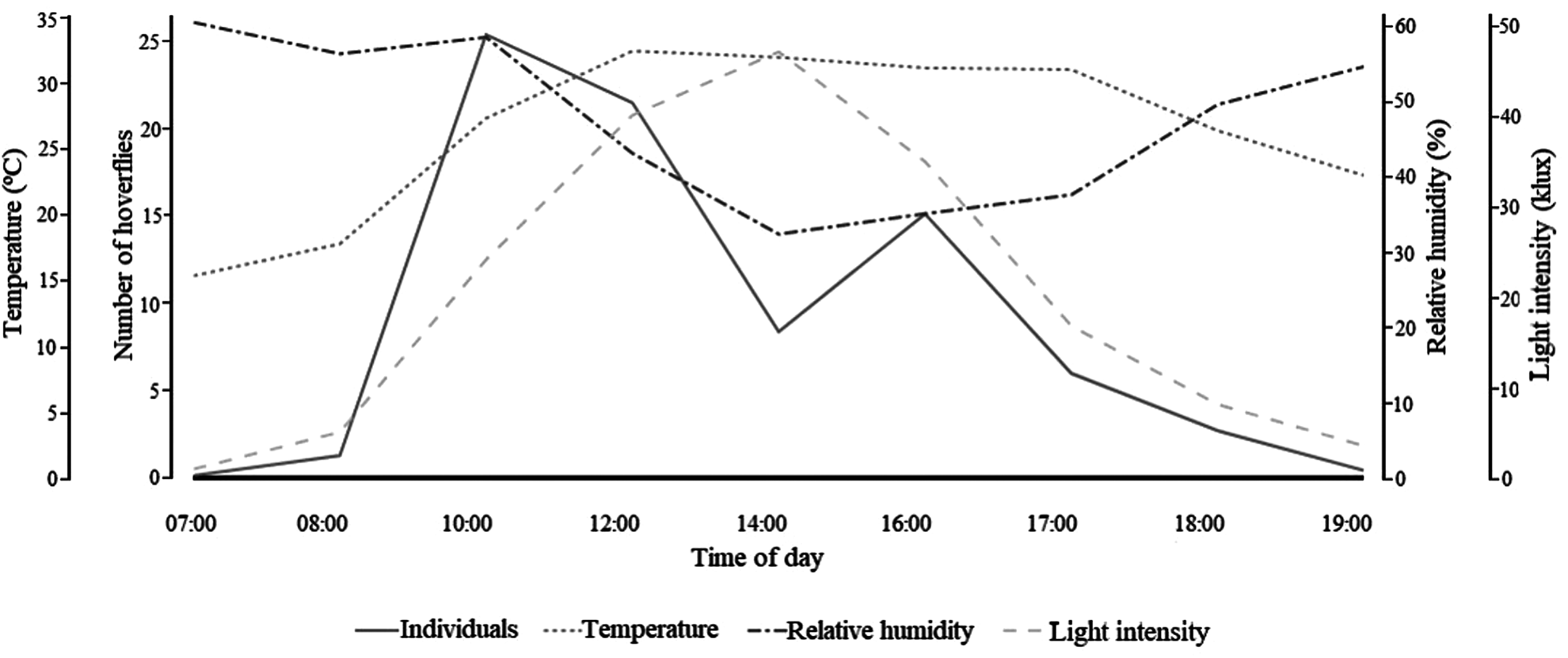
The activity of E. aeneus and environmental variables changed as the day progressed and they were correlated (fig. 2). Light intensity showed a unimodal pattern with a peak of 47.22 klux in the early afternoon (14:00 h). Temperature increased steadily from 15.3°C in the morning to 32.3°C at midday, remaining high until mid-afternoon (17:00 h) after which it decreased to 22.9°C. Humidity conditions varied inversely to light intensity and temperature, reaching a minimum value of 32.4% at 14:00 h. The drop in E. aeneus activity observed in early afternoon (14:00 h) coincided with the peak in temperature and light intensity, as well as with the lower values of relative humidity. Eristalinus aeneus continued to be active, with a minimum of ten individuals per m2 in high ranges of temperature, light intensity and humidity: 17.78–37.36°C; 8.20–57.41 klux and 18.98–88.77%, respectively.
Number of hoverflies in relation to environmental variables for each time of the day during the observation period.

The effects of the environmental factors on the bimodal activity pattern of E. aeneus seemed different depending on the time of the day. The significant variables for both periods are shown in table 1. The model for the first period (7:00–14:00 h) shows that the activity of the flies was significantly associated with temperature and light intensity. However, for the second part of the day (14:00–19:00 h), the significant variables were light intensity and relative humidity. Light intensity was the most important variable influencing the overall activity of E. aeneus throughout the day (table 1).
GLMM model of E. aeneus activity during two periods of the day and interactions with environmental factors

Foraging behaviour of E. aeneus on mango flowers
Most of the syrphid flies activities we observed took place around mango trees. Different interactions were detected among individuals, such as territorial aggressions between males or males hovering around females seeking to copulate with them. During midday hours, the hoverflies sought shelter among the flowers of the panicles or under the mango leaves. Moreover, gregarious groups were observed during the moments of inactivity in the course of sunset.
The time spent by each individual for the different activities is presented in fig. 3. A total of 80 individuals were observed, 40 during the morning and 40 during the afternoon; 4355 records were registered, 2918 of them were flies visiting flowers, 723 flights, 426 resting, 195 walking and only 93 were records of grooming. The percentage of time the syrphids spent in these activities was significantly different than an expected equal distribution, showing a bias towards feeding (χ2 = 240.020, df = 4, P < 0.001). The percentage of active time during the day was 83% while only 17% was resting (fig. 3).
Time spent (%) in each activity by E. aeneus during observations.

The syrphid flies were active most of their time, both in the mornings and in the afternoons (85.91 vs. 82.30%). The time assigned to the different tasks was similar along the day (χ2 = 1.533, df = 4, P = 0.821). Foraging and flying took slightly longer in the mornings, while walking, grooming and resting lasted longer in the afternoons (morning vs. afternoon: 68.32 vs. 64.57% foraging; 9.90 vs. 6.98% flying; 14.09 vs. 17.70% resting; 2.55 vs. 3.69% walking; and 5.14 vs. 7.06% grooming).
Regarding the main activity in terms of facilitating potential mango pollination, foraging of E. aeneus occurred in both hermaphrodite and male flowers, feeding on pollen as well as on nectar in both types of flowers. Foraging movements were clearly detected and constituted the most recurrent activity for all individuals. When E. aeneus was observed foraging, we noticed several extensions of the proboscis in each type of flower, around the five nectary discs. The majority of proboscis extensions were directed towards the fertile anther, ignoring the four atrophied anthers lacking pollen. Also, when feeding, E. aeneus made visits in all directions on the panicle, on different panicles of the same tree or different trees. The number of flowers visited during the observations was on average 36.46 ± 13.92 flowers per 5 min. Hermaphrodite flowers appeared to attract more visits than male flowers (53.87 vs. 46.13%). Since male flowers are by far more abundant in the inflorescence of this cultivar (85 vs. 15% for male and hermaphrodite flowers, respectively) (unpublished data), a strong preference for hermaphrodite flowers is deduced (χ2 = 3458.300, df = 1, P < 0.001).
The pattern of floral visits on hermaphrodite and male flowers remained unchanged throughout the day (χ2 = 0.159, df = 1, P = 0.691). Eristalinus aeneus made an average of 38.45 ± 15.47 visits per 5 min during the morning, with a comparatively higher rate on hermaphrodite flowers (21.52 ± 8.87 flowers) than on male flowers (16.93 ± 11.96 flowers). In the afternoon, the average number of flowers visited by E. aeneus was 34.26 ± 11.81 visits per 5 min, with 17.58 ± 8.29 visits to hermaphrodite flowers, and 16.68 ± 10.89 to male flowers. With regard to duration, the time spent was similar in both types of flowers (5.66 vs. 5.49 s, for hermaphrodite and male flowers, respectively) (χ2 = 3.116, df = 1, P = 0.08). The duration of the visits was not affected by the time of the day or by the sex of the flower (χ2 = 0.005, df = 1, P = 0.944), although it was slightly longer in the afternoons than in the mornings (hermaphrodite flowers: 5.77 vs. 5.58 s; male flowers: 5.76 vs. 5.25 s).
Major differences in the type of rewards taken from the different kinds of flowers were found and are presented in fig. 4, being nectar the most sought-after resource in both male and hermaphrodite flowers (91.9 vs. 8.1%, for nectar and pollen, respectively) (χ2 = 34.525, df = 1, P < 0.001). On the contrary, the time spent feeding on pollen was longer than the time consumed seeking nectar (6.44 and 5.51 s per flowers, respectively) (χ2 = 5.659, df = 1, P = 0.017).
Floral reward (%) taken on each type of flower by E. aeneus.

The foraging pattern did not change between mornings (nectar: 90.8%; pollen: 9.2%) and afternoons (nectar: 94.6%; pollen: 5.41%) (χ2 = 1.043, df = 1, P = 0.307), and the preference for nectar always remained more pronounced. The time E. aeneus dedicated to feeding on pollen and nectar was similar during the mornings and afternoons (χ2 = 0.016, df = 1, P = 0.901). However, nectar feeding took longer during the afternoons (5.73 vs. 5.32 s). On the contrary, slightly longer pollen feeding time was observed in the mornings (6.50 vs. 6.32 s).
With regard to the behaviour of female and male individuals of the syrphid population, we observed some differences between sexes. On one hand, females and males behaved differently in terms of time spent on each activity. On the other hand, the behaviour of both sexes somewhat changed throughout the day (Sánchez et al., in prep.). Nonetheless, in all cases, the most common and lasting activity for both sexes was foraging.
Inflorescences mango visits
During monitoring, a total of 335 visits of E. aeneus over 110 mango panicles were registered in 5 min observations. Visitation rate was 3.03 ± 1.56 visits per panicle per 5 min, with a minimum of 1 visit and a maximum of 8 visits per 5 min, being 2 visits per panicle the most frequent rate. The duration of the inflorescence visits ranged from 2 to 300 s, with an average of 133.79 ± 102.29 s. It is important to mention that the duration of some visits exceeded the time limit established for the observations (300 s). Therefore, the real duration of those visits was not established.
The time of the day had no significant effect on the number and duration of the visits received by mango panicles. The number of visits was, however, slightly higher in the morning followed by middays and afternoons (3.49, 2.85 and 2.77 panicles per 5 min, respectively) (χ2 = 3.819, df = 2, P = 0.148). Regarding the duration of the visits, they were a little longer in the afternoons, followed by middays and mornings (140.32, 132.00 and 129.75 s per panicle, respectively) (χ2 = 1.460, df = 2, P = 0.482) (fig. 5).
Boxplots representing the ranges of the visitation rate (left) and duration of visits in mango panicles (right) during each day period. Five minutes observations.

The number and duration of the visits made by E. aeneus were different depending on the portion of the panicle. Thus, the number of visits to the apex was significantly higher compared to the middle and basal portions (1.72, 0.92 and 0.42 visits per panicle portion per 5 min, respectively) (χ2 = 69.141, df = 2, P < 0.001). Conversely, the duration of the visits followed an opposite trend and was significantly longer in the basal portion followed by the middle and apical portions (169.40, 142.49 and 120.54 s per panicle zone, respectively) (χ2 = 8.879, df = 2, P = 0.012) (fig. 6).
Boxplots representing the ranges of the visitation rate (left) and duration (right) of hoverflies to the different portions of mango panicles. Five minutes observations.

Finally, we observed significant differences in the number and duration of the visits depending on the sex of the hoverflies. Males were more frequent visitors than females (59.10 vs. 40.90% visits) (χ2 = 11.107, df = 1, P < 0.001), although the duration of females' visits was longer (χ2 = 43.950, df = 1, P < 0.001) (fig. 7).
Boxplots representing the ranges of the visitation rate (left) and duration of visits (right) to mango panicles by females vs. males of E. aeneus. Five minutes observations.

Discussion
Eristalinus aeneus aptitude as pollinator of mango
The potential of an insect species as an effective pollinator is primarily determined, among other factors, by its foraging behaviour (Rader et al., Reference Rader, Howlett, Cunningham, Westcott, Newstrom-Lloyd, Walker, Teulon and Edwards2009; Ne'eman et al., Reference Ne'eman, Jürgens, Newstrom-Lloyd, Potts and Dafni2010). Unfortunately, detailed information about the behaviour of hoverflies is scarce and mostly limited to aphidophagous species (Wratten et al., Reference Wratten, White, Bowie, Berry and Weigmann1995; Soleyman-Nezhadiyan and Laughlin, Reference Soleyman-Nezhadiyan and Laughlin1998; Emtia and Ohno, Reference Emtia and Ohno2018; Rodriguez-Gasol et al., Reference Rodríguez-Gasol, Avilla, Alegre and Alins2019; Pekas et al., Reference Pekas, De Craecker, Boonen, Wäckers and Moerkens2020). Therefore, there is a clear gap in the knowledge of the aptitude of dipterans as pollinators, especially when confined within protected cultivation structures. Our study provides, for the first time, solid information about the activity and foraging behaviour of the hoverfly E. aeneus in mango crops under the challenging environmental conditions imposed by plastic greenhouses.
Contrary to what de Siqueira et al. (Reference de Siqueira, Kiill, Martins, Lemos, Monteiro and Feitoza2008) proposed for other dipterans, E. aeneus visits both types of flowers, although we have detected a preference for hermaphrodite flowers and for nectar as a reward (fig. 4). This is in line with observations carried out in Australia and Philippines (Anderson et al., Reference Anderson, Sedgley, Short and Allwood1982; Fajardo et al., Reference Fajardo, Medina, Opina and Cervancia2008), even though several authors reported that dipterans only feed on nectar, while bees and bumblebees reportedly feed on both pollen and nectar (Dag and Gazit, Reference Dag and Gazit2000; Sung et al., Reference Sung, Lin, Chang, Cheng and Chen2006; de Siqueira et al., Reference de Siqueira, Kiill, Martins, Lemos, Monteiro and Feitoza2008; Souza and Halak, Reference Souza and Halak2009; Vasanthakumar et al., Reference Vasanthakumar, Aruna and Srinivasan2018; Usha and Srivastava, Reference Usha and Srivastava2018).
Since the mango panicles contain hundreds of flowers, and the tree has numerous panicles, a high visitation rate and efficient floral visits are important to achieve successful pollen transfer. In our study, E. aeneus carried out a high number of visits to mango flowers (7.2 visits per min), similar to Apis cerana and Apis mellifera (7.3 and 8.9 visits per min, respectively) in open field (Dag and Gazit, Reference Dag and Gazit2000; Deuri et al., Reference Deuri, Rahman, Gogoi, Borah and Bathari2018). The available information on visits of wild dipterans is difficult to compare because it is highly variable and, in many cases, insects are not identified at species level. For instance, Dag and Gazit (Reference Dag and Gazit2000) reported a low activity for E. aeneus (2.1 visits per min) and higher visits rate for Calliphoridae and Sarcophagidae (9.7 and 13.6 visits per min, respectively), while Huda et al. (Reference Huda, Salmah, Hassan, Hamdan and Razak2015) recorded different visits rate for Sarcophaga, Stomorhina and Chrysomya (3.1, 4.2 and 7.0 visits per min, respectively).
Moreover, frequent visits to different panicles were also confirmed. We found that the rate of visits to the inflorescences by E. aeneus (36 visits per h) (fig. 6) was much higher than with other dipteran or hymenopteran pollinators in open field such as Chrysomya, Apis indica and Tetragonula (5.9, 6.4 and 11.5 visits per h, respectively) (Munj et al., Reference Munj, Zote, Raut and Salvi2017).
The time E. aeneus spent visiting flowers for nectar and pollen foraging was 5.5 and 6.4 s, respectively. These results are in line with the records of other pollinators. According to different studies, the duration of flower visits performed by wild dipterans such as Chrysomya, Sarcophaga, Stomorhina and Musca domestica varied from 5 to 33.1 s whereas hymenopteran records indicated floral visits lasting between 2 and 8 s (Sung et al., Reference Sung, Lin, Chang, Cheng and Chen2006; Souza and Halak, Reference Souza and Halak2009; Kumar et al., Reference Kumar, Baskaran, Sundaravadivelan, Kuberan and Anburaj2012).
In our experiment, most E. aeneus were observed landing in the most external and apical portions of the panicles (fig. 6). Easier access to the apex of the panicle explains this pattern. After landing, we observed that the syrphids hovered over terminal flowers across different ramifications of the panicle, and hopped on to another panicle branch, as this is the case with other pollinators (Fajardo et al., Reference Fajardo, Medina, Opina and Cervancia2008). This pattern also explains the proportionally higher number of visits to hermaphrodite flowers reported here, since it is common to see a greater number of this type of flowers in the apex of the panicle (Singh, Reference Singh1954; Sukhvibul et al., Reference Sukhvibul, Whiley, Smith, Hetherington and Vithanage1999). Meanwhile, when visiting flowers in the basal portion of the inflorescence, the syrphids took more time for each visit. Indeed, hovering to these zones is more difficult, which results in less frequent interactions between individuals. Thyselius et al. (Reference Thyselius, Gonzalez-Bellido, Wardill and Nordström2018) found that Eristalis hoverflies activate a scape response (leaving the flower) when approached by another insect, therefore in the basal portion of the panicle with less competitors, hoverflies remain longer exploiting the food resources.
With regard to the behaviour of E. aeneus, we observed five main activities: foraging, resting, flying, grooming and walking. According to Gilbert (Reference Gilbert1985), syrphids of the tribe Eristalini dedicate more time to foraging (between 73.7 and 84.5% depending on the species), compared to other syrphids. In our study, E. aeneus spent an average of 67% of its time foraging, followed by the times spent resting and flying (fig. 3). We also observed territorial fights between males and copulations with females. Other studies have reported territoriality in other species of the Eristalini tribe (Wellington and Fitzpatrick, Reference Wellington and Fitzpatrick1981), but such behaviour had never been observed before for E. aeneus.
Different authors have confirmed the capacity to transport pollen of eristaline syrphids in mango (Jiron and Hedström, Reference Jiron and Hedstrom1985; Huda et al., Reference Huda, Salmah, Hassan, Hamdan and Razak2015; Usha and Srivastava, Reference Usha and Srivastava2018). We observed that when foraging on the flowers, the body of the hoverflies, mainly the thorax and abdomen sections, came into contact with the fertile anther of the flower. This contact is what typically enables the transport of pollen as it is observed with other pollinators in mango (Anderson et al., Reference Anderson, Sedgley, Short and Allwood1982; Fajardo et al., Reference Fajardo, Medina, Opina and Cervancia2008; de Siqueira et al., Reference de Siqueira, Kiill, Martins, Lemos, Monteiro and Feitoza2008; Huda et al., Reference Huda, Salmah, Hassan, Hamdan and Razak2015).
Environment and food availability effects on E. aeneus behaviour
Pollinator behaviour throughout the day can be affected by environmental factors and food resource availability (Szabo, Reference Szabo1980; Sihag and Abrol, Reference Sihag and Abrol1986; Comba, Reference Comba1999; Innouye et al., Reference Innouye, Larson, Ssymank and Kevan2015). In our study, E. aeneus remained active for approximately 11 hours a day, as observed in open field plantations (Souza and Halak, Reference Souza and Halak2009). We observed that the activity followed a bimodal pattern, and although this species tolerates high temperatures, its activity is reduced at midday, as it is the case with other dipterans (Willmer, Reference Willmer1983; Gilbert, Reference Gilbert1985; Herrera, Reference Herrera1990; Ssymank, Reference Ssymank1991, Reference Ssymank2001). During the morning, the most important environmental variables influencing the flying activity of E. aeneus were temperature and light intensity, while light intensity and relative humidity appeared to be the most important variables during the second part of the day. Deuri et al. (Reference Deuri, Rahman, Gogoi, Borah and Bathari2018) observed that the activity of dipterans in mango was negatively associated with temperature and positively associated with relative humidity on cloudy or sunny days. In the case of bees of the genus Apis, several studies have shown positive correlations with light intensity and temperature, but negative with humidity (Szabo, Reference Szabo1980; Sihag and Abrol, Reference Sihag and Abrol1986; Deuri et al., Reference Deuri, Rahman, Gogoi, Borah and Bathari2018).
The bimodal activity observed in E. aeneus appears to be common in other syrphids (Herrera, Reference Herrera1990) but differs from hymenopterans and other dipterans observed in open field mangoes that show only a morning peak (Anderson et al., Reference Anderson, Sedgley, Short and Allwood1982; Sung et al., Reference Sung, Lin, Chang, Cheng and Chen2006; Fajardo et al., Reference Fajardo, Medina, Opina and Cervancia2008; Souza and Halak, Reference Souza and Halak2009; Kumar et al., Reference Kumar, Baskaran, Sundaravadivelan, Kuberan and Anburaj2012; Vishwakarma and Singh, Reference Vishwakarma and Singh2017; Deuri et al., Reference Deuri, Rahman, Gogoi, Borah and Bathari2018). These patterns also seem to be related to pollen availability and nectar secretion which vary throughout the day due to changes in temperature and humidity (Corbet et al., Reference Corbet, Willmer, Beament, Unwin and Prŷs-Jones1979). Pollen availability in mango is at its highest early in the morning when the anther dehiscence begins (Mallik, Reference Mallik1957; Singh, Reference Singh1960), then it gradually decreases as the day progresses (Mukherjee, Reference Mukherjee1953; de Siqueira et al., Reference de Siqueira, Kiill, Martins, Lemos, Monteiro and Feitoza2008; Souza and Halak, Reference Souza and Halak2009; Bally et al., Reference Bally, Lu, Johnson, Jain and Priyadarshan2009). On the other hand, nectar is equally available throughout the day (de Siqueira et al., Reference de Siqueira, Kiill, Martins, Lemos, Monteiro and Feitoza2008; Souza and Halak, Reference Souza and Halak2009). Therefore, hymenopterans that are more specialized in pollen foraging are more active in the mornings, whilst E. aeneus, which mainly forages nectar, remain active for a longer period, making frequent floral visits even in the afternoons.
The use of managed pollinators in protected crops presupposes their readiness to adapt to the extreme conditions of greenhouses, such as high temperatures and low humidity. Some authors describe how these extreme environmental conditions could reduce the activity, foraging and survival of bees and bumblebees (Heinrich, Reference Heinrich1974, Reference Heinrich1980; Gaye et al., Reference Gaye, Maurer and Seywerd1991; Sabara and Winston, Reference Sabara and Winston2003; Kwon and Saeed, Reference Kwon and Saeed2003; Hedtke et al., Reference Hedtke, Jensen, Jensen and Genersch2011; Morimoto et al., Reference Morimoto, Kojima, Toki, Komeda, Yoshiyama, Kimura, Nirasawa and Kadowaki2011; Abrol, Reference Abrol2012; Simon-Delso et al., Reference Simon-Delso, Martin, Bruneau, Minsart, Mouret and Hautier2014). In our experiment, E. aeneus kept a significant activity level over a wide range of temperatures, light intensity and humidity conditions. Ongoing studies on its pollination efficiency, resulting fruit set and fruit quality seek to establish suitable protocols for the management of E. aeneus as a pollinator of protected mango and other subtropical crops.
Acknowledgements
This study is part of a PhD project supported by the Ministry of Innovation and Science of Spain that co-financed the contract to M. Sánchez (DI-17-09575: Predoctoral grant for research training in companies ‘Industrial Doctorates’).
Conflict of interest
One author is employed by the company. Another author owns shares and is on the Board of the company.