Educators are at the heart of educational reforms, such as the introduction of mental health promotion initiatives into early childhood education and care (ECEC) settings. However, if educators have not had the opportunity to gain appropriate knowledge and expertise, new initiatives may be poorly implemented, and may consequently struggle to achieve desired outcomes. Good quality implementation of educational reforms requires educators to engage in high quality professional learning.
Professional education was part of the KidsMatter Early Childhood (KMEC) mental health promotion initiative in 111 ECEC services across Australia during 2010 and 2011. This article reports an analysis of the ECEC educators’ perspectives about the impact of that professional education on their knowledge and practices.
Three current directions set the context for this article. The first is the increasing introduction, over the past 5 to 10 years, of mental health promotion initiatives into educational settings. The second is reform in the ECEC sector, evidenced by policy statements such as the Early Years Workforce Strategy, the National Quality Framework for Early Childhood Education and Care, the National Partnership for Early Childhood Education, the National Partnership for Indigenous Early Childhood Development and the Early Years Learning Framework (EYLF; Standing Council on School Education and Early Childhood [SCSEEC], 2012). And the third direction regards how best to provide high quality professional education that enables educators to implement reforms. These three issues are addressed in turn in the following section.
Mental Health Promotion in Educational Settings
In Australia, substantial resources have been allocated to mental health promotion in secondary schools (MindMatters, 2010) and primary schools (KidsMatter, 2012). This is consistent with international perspectives. For example, the World Health Organization (WHO, 2011) advocates for mental health promotion activities in schools; and in the United States, the proposal for the Academic, Social, and Emotional Learning Act of 2013 [HR 1875] seeks to embed social and emotional education in schools (Collaborative for Academic, Social, and Emotional Learning [CASEL], 2013). As the importance of learning and education in the early childhood years (from birth to 5 years of age) has attracted increased attention, mental health promotion has been extended to ECEC settings (KMEC, 2012).
Such initiatives have led to improved mental health outcomes for children. For example, in a meta-analysis of 213 universal social and emotional learning programs in schools, Durlak, Weissberg, Dymnicki, Taylor and Schellinger (Reference Durlak, Weissberg, Dymnicki, Taylor and Schellinger2011) showed that compared to controls, participants demonstrated significantly improved social and emotional skills, attitudes, behaviour and academic performance. Similarly, Weare and Nind's (Reference Weare and Nind2011) review demonstrated that well-prescribed interventions for mental health promotion in schools could have positive outcomes. Recently, the evaluations of the Australian KidsMatter Primary and KidsMatter Early Childhood initiatives both reported improved mental health outcomes for children (Slee et al., Reference Slee, Lawson, Russell, Askell-Williams, Dix, Owens and Spears2009; Slee et al., Reference Slee, Murray-Harvey, Dix, Skrzypiec, Askell-Williams, Lawson and Krieg2012).
However, one issue that has emerged has been that some teachers and educators have felt uncertain about their abilities to engage with mental health promotion (Askell-Williams, Lawson, & Slee, Reference Askell-Williams, Lawson and Slee2009). Also, staff from different professional groups may have different perspectives about who is responsible for mental health promotion in educational settings (Rowling, Reference Rowling2007). However, as Askell-Williams and Lawson (Reference Askell-Williams, Lawson and Shute2011) pointed out, different types of professional staff engage with different levels of mental health promotion and prevention of difficulties. At the universal level, school teachers and ECEC educators typically deal with initiatives such as whole school approaches, modelling desired behaviours, explicit teaching, daily interaction with children and initiating referral processes. At the targeted level, staff such as specialist teachers and educators, social workers, psychologists, counsellors and other health professionals typically work with students who are identified as having known precursors to difficulties. And at the indicated level, counsellors, psychologists, psychiatrists and other health professionals work with children who are evidencing difficulties. When considered from a levels-of-intervention perspective, it is clear that all professional staff involved in educational settings have complementary roles in mental health promotion and prevention of difficulties. It is therefore important that the various types of professional staff have a general appreciation of the nature and extent of each other's knowledge, expertise and contexts of influence, and of how their own domain of specialised knowledge can assist and complement that of their professional colleagues.
ECEC Sector Reform
The Early Years Workforce Strategy (SCSEEC, 2012) set out a vision to build and support the capabilities of the ECEC profession and identified key areas that pinpoint the importance of professionally educated and qualified ECEC staff. Similarly, the Productivity Commission (2011) noted the need to ‘Ensure mental health and wellbeing competencies and responsive teaching practices are included in early childhood qualifications and develop options for incorporating these competencies where they do not exist’ (p. 15). These workforce reforms stand alongside other far-reaching reforms to the ECEC curricula that are embedded within the broader national quality framework requirements.
Professional Learning
Staff in ECEC settings hold a range of qualifications, from none through to certificates, diplomas, bachelor's degrees and, in a few cases, postgraduate degrees. As Richardson (Reference Richardson and Sikula1996) has pointed out, educators’ perspectives and practices, especially early in their professional careers, tend to be strongly informed by their interpretations of their own experiences as students. It may be that staff who have had limited opportunities for professional education hold conceptions of ECEC that no longer align with contemporary models of education and care.
However, not much is known about ECEC educators’ professional learning. Therefore, in order to establish a basis from which to examine potential issues and understand concepts in ECEC educators’ professional learning, we turn to the school-based professional learning literature.
Little (Reference Little1993) reviewed philosophies and designs for school teachers’ professional education. She drew attention to issues such as technical training versus teacher-led inquiry; organisational structures that permit time to investigate, reflect and discuss; recognition of existing personal, social and political contexts; emotional investments in teaching; and financial and human costs. In an extended program of work, Desimone and colleagues (e.g., Desimone, Reference Desimone2009; Desimone, Porter, Garet, Yoon, & Birman, Reference Desimone, Porter, Garet, Yoon and Birman2002) proposed a framework containing five core features that define the quality of teacher professional education, namely: (a) focus on content knowledge; (b) opportunities for active learning; (c) coherence with other learning activities; (d) the duration of the activity; and (e) collective participation of teachers from the same school, grade or subject. Meiers and Ingvarson's (Reference Meiers and Ingvarson2005) extensive review also summarised that professional education programs had the most impact if they emphasised content, active learning and collective participation.
However, Opfer and Pedder (Reference Opfer and Pedder2011) argued that many previous investigations had resulted from simplistic conceptualisations of teacher professional learning. Using terminology consistent with Bronfenbrenner's (Reference Bronfenbrenner1979) and Bronfenbrenner and Morris's (Reference Bronfenbrenner, Morris, Damon and Lerner1998) ecological model, Opfer and Pedder argued that investigations into teachers’ professional learning need to accommodate the interacting, nonlinear influences of micro, meso and macro system components. They proposed that although there appears to be consensus about the essential characteristics of professional education programs (e.g., Desimone's core features), the huge variety of complex systems in which teachers live and work has not been adequately accounted for, despite being a key concern of many writers (e.g., see Boud & Molloy, Reference Boud and Molloy2013). This draws attention to the interactions between professional learning and applications of that learning to practice within specific environments.
Professional Learning That Leads to Changes in Professional Practices
Dall'Alba and Sandberg (Reference Dall'Alba and Sandberg2006) argued that professional learning requires more than a transfer of knowledge (from professional trainer/facilitator to staff): it requires ‘promoting development of professional ways-of-being that can deal with the complexities, ambiguities, and dynamic change inherent in professional practice’ (p. 401). In particular, changes in educators’ declarative knowledge (Anderson, Reference Anderson1996), or espoused knowledge (Argyris & Schön, Reference Argyris and Schön1974; Schön, Reference Schön1988), may not lead to changes in their practices, due to a range of personal or system influences (such as the personal cost of expending effort, or fear of retribution).
Therefore, as Dall'Alba and Sandberg (Reference Dall'Alba and Sandberg2006) pointed out, a considerable challenge exists to design professional education programs that both call into question, and extend the quality of participants’ knowledge of, and knowledge in, practice — that is, to create sufficient cognitive disequilibrium to provoke staff to engage in new thinking that demands changes in practices (Cobb, Wood, & Yackel, Reference Cobb, Wood, Yackel, Davis, Maher and Noddings1990).
Research Questions
In summary, while there is a broad consensus that high quality professional education needs to address core components such as those proposed by Desimone (Reference Desimone2009), attention to these core components is not sufficient for effective professional education programs. Effective professional learning needs to be contextually grounded and should provide evidence of observable changes in participants’ professional behaviours. Thus, the questions that guided the research reported in this article were:
1. What are ECEC educators’ accounts of demonstrable changes in their professional knowledge and practices linked to their KidsMatter professional learning?
2. What are ECEC educators’ perspectives about the affordances and constraints of the KidsMatter professional education?
The significance of this research is twofold: it provides feedback on the observable impact of a specifically designed program of professional education, and it contributes to more detailed knowledge about what constitutes effective professional education in early childhood settings.
Method
For the present study we used selected data from Slee et al.'s (Reference Slee, Murray-Harvey, Dix, Skrzypiec, Askell-Williams, Lawson and Krieg2012) KidsMatter Early Childhood Evaluation, including the staff questionnaires, staff feedback on professional development sessions, and staff photo-story interviews.
Desimone (Reference Desimone2009) argued that published literature is biased against self-reports of teachers’ knowledge growth, based upon assumptions that self-reports are less valid and reliable than observations and surveys. However, as argued by Kaplan (Reference Kaplan1964), all methods of data collection are subject to interpretation, and all analyses need to guard against bias. Desimone found correlations between observational and self-report data, and between surveys and self-report data, when the focal points of the different types of data collection were matched. She concluded that self-reports have the potential to be extremely valuable sources of data about people's beliefs, knowledge and actions. Furthermore, the collection of rich data from participants’ perspectives is an important early step in research in areas about which little is known (Nuthall, Reference Nuthall, Biddle, Good and Goodson1997), which is certainly the case for professional learning in the ECEC sector. We agree with Desimone and Nuthall that participants’ self-reports have the potential to provide rich data that can assist our understanding of learning processes in educational settings.
Ethics
Ethics approvals for this study were received from our university's Social and Behavioural Research Ethics Committee and from each participating ECEC service, including informed consent to report textual and photographic data.
The KidsMatter ECEC Professional Learning
A major component of KidsMatter was to provide professional education programs to ECEC educators in 111 services across Australia over the two years of the initial KidsMatter trial. The programs were designed by the KidsMatter Early Childhood consortium, with delivery supported by trained facilitators. This model of delivery is similar to the phased approach to professional education described by Borko (Reference Borko2004), in which, following intensive efficacy trials, the processes of delivering professional education are devolved to local facilitators across multiple sites.
The KidsMatter Early Childhood model of increasing protective factors and reducing risk factors was structured around four components, namely: (1) creating a sense of community; (2) developing children's social and emotional skills; (3) working with parents and carers; and (4) helping children experiencing mental health difficulties. Each of the four components was supported by 3 hours of facilitated professional education, conducted either as a single session or delivered over more than one session. The four components were introduced one-by-one over the four successive 6-month periods of the program roll-out.
Participants
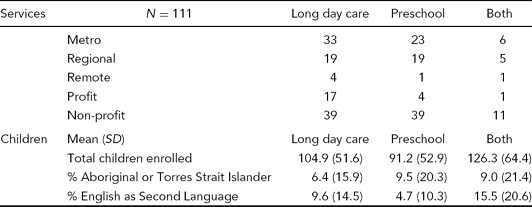
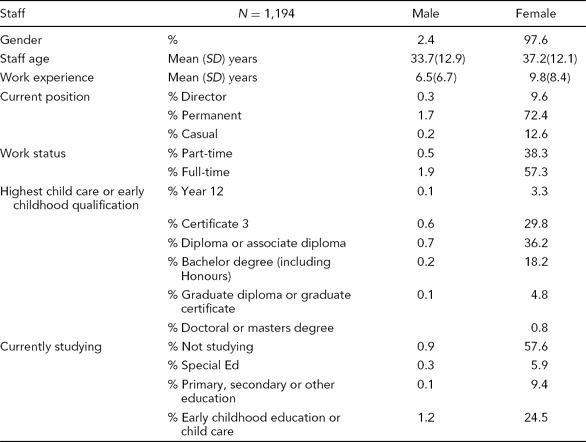
Table 1 provides demographic information about the participating 111 ECEC services, including geographical location, type, and numbers and characteristics of children. Table 2 provides information about the 1,194 staff participants, notably that most were female; most had an average age in the mid-30s; approximately three-quarters were permanently employed; approximately two-thirds were employed full-time; and the majority held certificate or diploma qualifications.
Characteristics of ECEC Services

Characteristics of Participating Staff
Types of Data
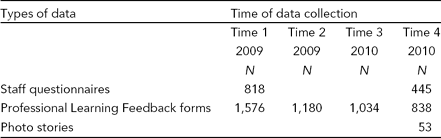
The selected quantitative and qualitative data, summarised in Table 3, included: (1) questionnaires completed at two time points, (2) feedback about the professional education sessions, and (3) photo stories from educators in 10 purposefully selected ECEC services.
Types, Times and Quantities of Collected Data
Staff questionnaire
As noted above, for the present study we sourced data from the KidsMatter Early Childhood evaluation reported by Slee et al. (Reference Slee, Murray-Harvey, Dix, Skrzypiec, Askell-Williams, Lawson and Krieg2012). To enable quantitative analyses, we used staff's responses to purpose designed questionnaire items about professional learning, and knowledge and self-efficacy for promoting children's mental health. The questionnaire items about professional learning were designed to gain explicit feedback on staff's experiences with the KidsMatter initiative. The items about staff knowledge and self-efficacy were designed following a review of extant literature about the quality of teachers’ knowledge (in this case, applied to educators in the ECEC sector; Fenstermacher & Richardson, Reference Fenstermacher and Richardson2005; Shulman, Reference Shulman1986b, Reference Shulman2000), the importance of self-efficacy for undertaking professional practice (Bandura, Reference Bandura1997; Grossman, Reference Grossman and Anderson1995; Skaalvik & Skaalvik, Reference Skaalvik and Skaalvik2007), and recommended areas for intervention within a systemic model of mental health promotion that recognises the influences of personal, social and environmental factors on mental health (Graetz et al., Reference Graetz, Littlefield, Trinder, Dobia, Souter, Champion and Cummins2008). An overview of the three areas of questionnaire items is as follows:
1. Professional learning: This factor consisted of staff's ratings of the impact of the KMEC professional education on eight items about staff knowledge and actions, such as ‘The KMEC professional learning improved the ways that I interact with children’.
2. Knowledge: This factor included seven items related to staff knowledge about supporting the development of children's social and emotional skills, identifying and responding to children experiencing mental health difficulties, and accessing pathways for children experiencing difficulties.
3. Self-efficacy: This factor included seven items about participants’ self-efficacy to foster a sense of belonging in others, provide effective support to parents, and identify early signs of social and emotional difficulties in children.
The questionnaire items required responses on 7-point Likert scales, with anchor points such as poor to excellent, or never to often.
Professional learning feedback
The KidsMatter facilitators administered feedback forms at the completion of every professional education session. Eight items included both multiple-choice and open-response options.
Photo stories
Ten ECEC services were purposefully selected to represent sites that were demographically and geographically diverse, and also that appeared to be going well, and not so well, with the KMEC initiative. Staff at the 10 services were invited to take photographs that depicted their experiences during the implementation of KidsMatter. The researchers then discussed the meanings lying behind the photos with the staff who took the photos. The researchers did not pose a standard question that related to professional learning, but varied the interview prompts to talk about professional learning in a way that would maintain flow in the discussion. Examples of prompts that were used were: ‘So, you've done all the professional learning for KidsMatter — how did you experience that?’ ‘You mentioned that you enjoyed the PD [professional development], what did you find most valuable from those PDs?’ and, ‘Through the personal journey that you've had, the professional learning has been part of that, is there anything that you would like to tell us?’
Discussions were recorded and transcribed, and excerpts that directly targeted staff's professional learning experiences were extracted from the transcripts and placed into a text database specifically related to professional learning. (We excluded staff members’ statements and feedback that were not directly related to their KidsMatter professional learning.) The transcribed Professional Development Feedback sheets were also added to the text database. The five core features proposed by Desimone (Reference Desimone2009) provided an initial framework for the thematic analysis, supplemented by themes that emerged from the data. Two researchers independently conducted several readings of the transcripts in the database and subsequently discussed the allocation of text to coding themes. This iterative reading and discussion process continued until agreement about the codes was reached.
Results
In this section we address the research questions about ECEC educators’ perspectives about demonstrable changes in their professional knowledge and practices, and their perspectives about the affordances and constraints of the KidsMatter professional education.
Professional learning
Approximately three-quarters of staff (76%) indicated that by the end of KidsMatter, their knowledge, attitudes and actions relating to building positive mental health in ECEC settings had improved as a result of their professional learning.
Knowledge
With respect to specific questions, such as knowledge about ‘how children's social and emotional skills develop’, and ‘how collaborative partnerships with parents are developed’, at Time 1, 32–58% (an average of 43%) of staff selected scores 6 or 7 on the Likert scales, indicating that they considered their knowledge to be excellent. By Time 4 (the final questionnaire), between 55% and 73% (an average of 66%) of staff selected scores 6 or 7.
Self-efficacy
Staff reported relatively high levels of self-efficacy for their abilities to engage with a range of components for children's mental health promotion. At Time 1, in answer to statements such as ‘I can help young children to recognise and manage their emotions’, 88% of staff reported high self-efficacy, increasing to 94% by Time 4.
Photo stories and feedback forms
We adopted the structure provided by Desimone's (Reference Desimone2009) framework of five core features of professional learning to thematically code participants’ responses. In the next section, from the very large database of transcribed photo stories and feedback sheets, we provide exemplars that illustrate key themes that emerged. In particular, we focus on photo-stories where staff indicated clear changes in their professional practices. These indicators of change are highlighted in bold text.
Focus on Content Knowledge
A focus on content knowledge has been a key feature of teacher knowledge frameworks (e.g., Shulman, Reference Shulman and Wittrock1986a, Reference Shulman1986b, Reference Shulman1987, Reference Shulman2000), with Darling-Hammond and colleagues (Darling-Hammond, Reference Darling-Hammond2006; Darling-Hammond & Ball, Reference Darling-Hammond and Ball1998; Darling-Hammond, Wei, Andre, Richardson, & Orphanos, Reference Darling-Hammond, Wei, Andre, Richardson and Orphanos2009) emphasising that knowledge of children, their ideas and their ways of thinking is crucial. Desimone (Reference Desimone2009) argued that content knowledge is probably the most influential component that paves the way for the other features of professional learning.
Participants’ comments relating to content knowledge suggest that professional learning was experienced in a variety of ways, including: (1) acquiring new knowledge about mental health; (2) applying that new knowledge; (3) drawing on the knowledge to reflect on practice; and (4) changing practice in light of knowledge. Staff also provided comments about contextual issues related to their learning in ECEC settings.
Acquiring new knowledge
It's made me a bit more aware of children at this age, there could be mental health issues. . .You think: ‘Oh well, later on they'll grow out of it’ or ‘They'll be right’ but it's like, no, now we've got to do something about it at this age before it gets bigger. And it's made me actually pick up one child who's suffering pretty bad anxiety issues and stuff at the moment and I've got her into the school's psych[ologist] and got things happening to her and it's good because before I probably would have just swept through and gone “OK, she'll be right, we'll send her on to Year 1 and she'll be fine”. (ST1S3)
Application in and out of classroom
Figure 1 was accompanied by the following story from an ECEC educator who explained how the photo represented their work with children and parents to ensure that each child found a point of connection at the ECEC service:
A vehicle for inclusion.
From an outsider point of view, it [ Figure 1 ] might look like some very tattered box joined together, but to us and a few children that spent time and effort in building it, it's a very special item that I think sums up what KidsMatter meant to me personally and to the family. . .Through working together with the child's parent (Component 3), we found out what is his interest at home. He was very interested in lawn mower and anything to do with gardening. Mum was very supportive and helped up through the process of making this lawn mower. She brought cardboard boxes, ribbons and things from home. Every day that he came in, it became the highlight of his day: the making of his lawn mower. Since then, he started opening up so much more to us, telling us about his day at home, what is the next project that he wants to do. (ST7FE3)
I learnt a lot. Doing the KidsMatter course it's given me another way of looking at things. Like, I look at it as a mum and then I sit back and look at it from what the KidsMatter course has taught me. Normally I would just look at a child and go ‘Something's wrong’, whereas now with that bit of knowledge behind me I can go back and have a look and go over it again without jumping to conclusions. I think more about things. Before that I would just make a judgement or be suspicious. It's been good for me too — even at home I'm doing it. Not reacting straight away. I sit back and try and work it out. (ST2FE)
Figure 2 was accompanied by the following story from the participating ECEC educator who explained how the photo represented a new approach to problem-solving in their ECEC service.
Problem-solving cards.
I went to the (professional development) day and her. . .stuff was all about positive behaviour support. And as part of that day, she showed us so many resources and so much stuff, but she gave us two websites and the problem-solving kit was part of one of the websites and so, we just put, we printed out the cards, laminated them, put them in a bag and then we got them a timer in there; we also have super-friends tags in that bag, too. So when the children come across a problem, we talk about getting the problem solver kit. Of course, we introduced it first and talked about all the different things and how you can deal with different problems. (ST5FD)
Re-evaluate/change current practices
Say, for instance, a child throws a tantrum in the supermarket and people look and go, ‘Oh dear, that child's behaviour is not OK’. In actual fact, if you look and if you are able to empathise and put yourself in that child's shoes, you don't really know what's going on for that child. Something might have just happened, they might not be feeling well. I think it's just that empathy. Rather than judging the behaviour, actually going ‘Well, you know, there could be all these reasons for this’, so I'll actually be nurturing and see how maybe that changes the behaviour. I think everybody's been more aware of that. I know I have, and it works. (ST3FD)
Knowledge of children and their characteristics
It's made me look deeper at children and perhaps wonderingwhy, where they've come from, why they behave like they do. Particularly this other little boy who gives off this really sort of gruff exterior and really, he is this sweet little boy deep down underneath. KidsMatter has been great in so many ways. It's just made me realise about your caring communities and just creating this safe place to help children grow, so then they're able to go out and feel good about themselves, and able to handle situations. (ST4FE4)
Early intervention
We always knew the basics. . .maybe showing signs of higher anxiety levels, being a little bit withdrawn, a little bit emotional. Prior to KidsMatter, we thought those indicators could be, just something that they're just going through and it's part of maybe a stage they are going through. We now, as educators, look at it a little bit differently and know that they're really important factors that could play a huge role later on with their overall mental wellbeing and it's really important that we target it early. (ST6SP1)
KidsMatter has helped me see that when I have a child who is, doesn't fit the mould — is that the best way to put it? — is outside the square, you know, that I do now know and have a little bit of confidence to approach the parent in a way of saying: ‘Look, I've noticed this, how do you feel about it? It might be opportune at this time before they begin school to seek some help from these agencies.’ And that has been something that I put down to KidsMatter. (ST1S5)
Prior knowledge and site contexts
I've always had an interest in mental health, whether it be with children or adults, so I thought it was a really, really good thing that you guys were doing to educate people about it, ‘cause I think it's something that's forgotten, and it was good for me to learn more in the area that I'm working in. . .opening up my knowledge a bit more to it . . . (ST6S4)
On cultural knowledge: training (has) to be appropriate for the areas that people were working in. . .I think cultural education is really important. (ST2S1)
When I read it [PL materials], it's all mainstream stuff. So I have to switch to, turn to the other way. . .I automatically think about the Aboriginal, Indigenous kids, that's what I think. But it's OK, I can relate to it. (ST2S6)
A selection of comments from the professional learning feedback forms also illustrates the diverse contexts of the 111 ECEC sites and the different needs of their staff:
Individualising the KMEC curriculum (for staff), in particular, to check what information may have already been covered in participants’ previous education (e.g., Certificate 3) or years of experience, so as to avoid duplication.
Most child care staff have basic education, basic EC training and many with ESL. They are not in a place where they are going to set up meetings and talk to parents about their child's mental health!
Recognise prior knowledge and skills of the individual sites.
More prior knowledge of the course to be undertaken before the professional learning.
Providing more information about available community services, to assist with referrals and sourcing information.
More multicultural things.
Translation and/or explanation of technical and jargonistic terms.
Opportunities for Active Learning
The second feature of Desimone's (Reference Desimone2009) professional learning framework focuses on opportunities for active learning, in which learners cognitively engage with constructing their own understandings (Bransford, Brown, & Cocking, Reference Bransford, Brown and Cocking2000). Two main themes emerged from staff's perspectives — namely, practical approaches and opportunities for personalised face-to-face discussions, as shown in the following extracts.
Reflective practice
I think the main thing that I got out of it was that I'm using reflective practice more. . .sometimes I'll get home at the end of the day and I'll remember maybe an issue like children getting along. And I'll think, maybe I could have dealt with that in a different way or I could have stopped and been a bit more focused on what was happening. (ST4S3)
Time to talk
I think the opportunity to sit down as a team in the PD was really valuable, because we all get busy, we all run around and we all get caught up doing our own things, and having someone lead it and some of the best things were when we could sit down. . .and share lots of ideas, and you can pick out ones that you want to do and. . .the chance to make a bit of an action plan. . .(ST1S1)
Figure 3 was accompanied by the following story from an ECEC educator who explained how the photo represented their work with families to express diversity and acceptance.
A family tree.
It's not just a family tree of the children and their families, it's also a family tree of their animals. The idea came from getting to know the parents in the KidsMatter process. I thought it was a great way to get to know the parents and get to know their life at home, as well. We had got together as a room and we had discussed that we needed something for the kids to feel a part of the room and to show that not everyone's the same and not everyone has the same backgrounds, or that at home, it's not the same: just to get them aware of differences in families and differences in life. (ST7FE2)
Coherence with Other Learning Activities
The third core feature of Desimone's (Reference Desimone2009)professional learning framework focuses on coherence with other learning activities. Constructive alignment between learning objectives and learning activities is essential for successful learning outcomes (Biggs, Reference Biggs1999). This includes working from what learners already know and can do (Bransford et al., Reference Bransford, Brown and Cocking2000).
Staff's responses indicated that a wide variety of individual learning needs and the diverse circumstances of services could make coherence difficult to achieve. Importantly, some staff did report that KMEC fitted well with other frameworks and programs being used in services.
As part of the unit on relationships, we did look through and looked at the outcomes in the early years learning framework and looked at where we'd go with, how we'd go with observations of them actually working in the playground and working in friendships. And that relates very strongly to some of the things we did in the KidsMatter, you know, professional learning; so I would say yes, all of that stuff that has been developed this year does relate very closely to the KidsMatter program and is part of what we're doing. But everything, to me, just fits together so nicely: KidsMatter, the school values program, the early years learning framework — everything just slots in and so, it's all part of what we do. (ST5S2)
The Duration of the Activity
The fourth feature of Desimone's (Reference Desimone2009) professional learning framework focuses on the duration of the activity. Staff indicated that they valued the professional learning opportunities provided by KMEC and wanted time to engage in discussions. But many staff struggled with long sessions delivered at the end of a working day. Our overall analysis indicated that participants felt that the time available for professional learning was insufficient, and that more opportunities for appropriately scheduled professional education would be welcomed, as captured in the following extracts.
Time and cost
Good, but I think that it was a bit rushed, because we did it after work or stuff like that. We only had a short period of time and I think that lessons should probably be a bit longer and to get a full understanding of topics. (ST2S3)
Suggestions from staff, contained in the professional learning feedback forms that related to issues of time and cost, included:
Incorporating professional learning as part of the day's work (not after).
Devote a larger block of time, such as a full professional day.
Have shorter sessions, with breaks.
More time for questions and examples.
More follow-up sessions.
Collective Participation of Staff From the Same Service
The fifth feature of Desimone's (Reference Desimone2009) professional learning framework focuses on the collective participation of staff. The professional learning literature (e.g., see Meiers & Ingvarson, Reference Meiers and Ingvarson2005) identifies staff relationships as a key requirement for generating a professional community, which is an essential component of professional education that mediates staff learning and practice. The following quotes are indicative of staff comments on the improved relationships and connections among staff that flowed from opportunities for more staff discussions.
Definitely. . .even like staff-wise, we've all become a lot closer. We talk to each other a lot more. If we have a problem, we can seek help from other people. If we're having a bad day or something, we can find a friend — it's not just a workmate, it's a friend. Say, ‘Can you come and help out for a while?’. . .we all pull together and help each other out. (ST4S11)
The biggest part that we've got out of KidsMatter, from my perspective, is I think to develop the staff to have more skills with each other, and that area has developed a lot. . .staff communication and awareness of how another person might be feeling. (ST4S2)
However, not all staff views about professional learning opportunities were positive. In one service, the view was expressed that the additional demands imposed by new expectations that staff would engage with professional education had led to the loss of staff.
Staff training in Components 1 and 2. This led to staff distress and departure. These changes did not support children's mental health and wellbeing. (ST5S7)
The following is a selection of suggestions from staff that relate to context-specific opportunities for improving collective participation.
Time and ‘space’ need to be built into the working day so educators can meet together and engage with each other around their practice.
Include some strategies or time for us as a team to come up with some strategies.
Provide time for staff to focus on areas of strength and areas that need improvement.
Discussion
In the study reported in this article we investigated demonstrable changes in ECEC educators’ professional knowledge and practices, and their perspectives about the affordances and constraints of the KidsMatter professional education. Overall, the questionnaire data illustrates improved staff knowledge and efficacy in the field of mental health promotion. However, this data also suggests that one-third to one-half of staff felt that their knowledge could not be scored at 6 or 7, indicating room for further improvement. This highlights that while relatively short-term professional learning opportunities can provide the initial impetus for improving staff knowledge, they must be accompanied by ongoing opportunities for knowledge acquisition, knowledge generation, and translation of knowledge into practice. A fruitful area for further research would be to examine the longer-term effects of this foundational professional learning.
The broad range of qualitative responses emerging from the photo stories (of which only a small selection of the most illustrative are reported in this paper due to space constraints) provide first-person accounts of the impacts of the KidsMatter professional learning on staff's actions in the five components of Desimone's (Reference Desimone2009) framework. In particular, staff taking the time to reflect upon the underlying causes of children's observable behaviour, leading to improved staff–child interactions, is an important outcome. Other outcomes included improved staff–staff and staff–parent communications.
The ECEC educators’ responses also highlight contextual affordances and constraints of delivering professional learning to early childhood and care contexts. Inevitably, staffing timetables and costs will directly impact upon the scheduling of professional learning in both the for-profit and not-for-profit early childhood education sectors. Staff provided many suggestions for improvement (some contradicting each other), which clearly reflect the needs of differing site contexts and a large variety of personal and professional backgrounds.
It must be noted that expectations and opportunities for ongoing professional learning in many early childhood settings, such as long day care services, have traditionally not been regarded as fundamental aspects of early childhood educators’ roles. Thus, the structures of many early childhood services do not have timetabled spaces for formal professional education. Therefore, during the period of the KMEC initiative, professional learning was undertaken by most early childhood educators in their unpaid time, and depended on their personal commitment and availability. This is unlike the situation in the school sector, in which professional learning is structured into the work life of teachers, such as being programmed to occur on student-free days, combined with staff meetings, or given time off in lieu, and recognised and documented in formal ways.
Limitations
This study was conducted with a sample of ECEC services that volunteered to be part of the KMEC trial and was therefore not a random sample. Thus, while our findings provide a lens for viewing similar situations, they may not apply to conditions at other sites. Furthermore, we selected a particular conceptual framework (Desimone, Reference Desimone2009) to interpret our data. Other researchers using other frameworks might draw alternative conclusions from our data.
Implications for Practice
The necessity for professional learning in relatively unfamiliar domains of knowledge such as mental health promotion suggests that expert guidance is needed to facilitate that learning. It was clear from educators’ reports that they relied on the input and support of the KidsMatter facilitators to reflect on and implement changes to their practices. In light of resource constraints for ongoing, face-to-face, facilitated professional learning by program developers such as KidsMatter, ECEC services may, and arguably will, need access to informed professionals, such as psychologists and counsellors, whose work connects them to ECEC services, in order to provide ongoing professional conversations and directions to support mental health promotion in educational settings. Such support from, and interaction with, related professional staff is particularly important given that mental health promotion is a relatively new area, and professional learning itself is a relatively new undertaking for many ECEC staff. Furthermore, the interaction between ECEC staff and other professions such as counsellors and psychologists is a two-way street. The more that each profession can appreciate about the nature, opportunities and constraints of each other's practices, the better will be the synergies of practice between the various professional groups. The present article about ECEC staff's professional education, knowledge and efficacy is potentially useful to inform the perspectives of other professional groups, such as counsellors, psychologists and guidance officers who collaborate with ECEC staff with a view to mental health promotion in educational settings.
Consideration must also to be given to the contextual and cultural influences that need to be taken into account in order to deliver effective professional learning. From the diversity of staff views that we were able to access (including urban, remote and regional Australian ECEC services) it was evident that a ‘one size fits all’ approach to mental health professional learning would not be effective in the long term. Culture acts to shape conceptualisations about child development and frames people's beliefs about mental health strengths and difficulties. Therefore, ECEC services may need local guidance and support to adapt mainstream professional learning content and delivery in light of the cultural beliefs and practices of staff and the communities with whom they work.
Conclusions
This study demonstrated that the KMEC professional learning contributed to self-reported gains in ECEC educators’ knowledge and understandings about mental health promotion, as well as to changes to their practices for supporting children's social, emotional and mental health needs. For professional learning to further contribute to mental health promotion in ECEC settings, it will need to be ongoing, supported by complementary professional staff, considered to be a core component of the ECEC educators’ role, located as an integral part of workplace practice, and culturally and contextually situated.
The participating staff members’ accounts of the impact of their professional learning on their daily practices are a valid, yet under-reported, source of information that can highlight to policy makers the practical outcomes of strong investments in professional education initiatives.
Declaration of Conflict of Interest
None.