1. Introduction and background
South Africa is a multilingual country in its legislation and its language practices. The Constitution of South Africa (RSA 1996) is perceived as a model of democracy in terms of its recognition of eleven official languages, nine of which are indigenous. Multiple languages are used interchangeably in daily interactions, enhanced by the influx of people from other parts of Africa. South African multilingualism is thus fluid and necessary for economic and community development. Most South Africans speak more than one language, and often three or more. However, the official business of the country is mostly carried out in English, and in smaller towns and provinces, in Afrikaans (PanSALB, 2001).
The multilingual nature of South African society makes the development and implementation of language policies complex, especially in education, where non-indigenous languages still play an important role. It also affects how the learning of additional languages is understood and interpreted, especially in an environment where multiple languages are used, and because of the interactions that are possible among the languages and the processes involved in learning them (Cenoz & Genesee, Reference Cenoz, Genesee, Cenoz and Genesee1998). This may include not only code-switching from one language to another, but also drawing simultaneously on several languages in order to communicate effectively in a given context – a phenomenon that is more common in the South African context (Heugh, Reference Heugh2015; Makalela, Reference Makalela2015, Reference Makalela2016; Probyn, Reference Probyn2015). This type of functional multilingualism has been termed ‘multicompetence’ by Cook and Wei (Reference Cook and Wei2016) who also question whether assessing a person's language proficiency according to a monolingual, purist norm is relevant in this context (see also Makoni & Pennycook, Reference Makoni and Pennycook2007; Garcia & Wei, Reference Garcia and Wei2014; Makoe & McKinney, Reference Makoe and McKinney2014). In South Africa, the process of acquiring and using several languages (or parts of several languages) simultaneously has only recently become a focus for research (Makalela, Reference Makalela2015, Reference Makalela2016; Probyn, Reference Probyn2015; Heugh, Reference Heugh2015) with increasing investigation into multiple language use in educational settings for epistemic access. The term ‘additional language learning’ thus needs to be examined against this complex linguistic tapestry and in terms of the language-in-education policies over time. The term ‘additional language’ is preferred to ‘second language’ because most South Africans are exposed to more than one language in the home and community in addition to, and often before, learning English.
The current article covers research on language and literacy acquisition and learning in primary education in the South African context from 2006 to 2018, although some well-known, seminal studies carried out prior to this have been included in order to illuminate more recent developments in the field. The studies selected for this review focus mainly on the learning of English as an additional language with some reference to studies involving the African languages and bilingual/multilingual learning/teaching models. The focus is on primary school where the HL is used as the LoLT, and where additional languages are first introduced to learners, either as FAL or second additional language (SAL) (DBE, 2011a). Furthermore, the FAL often becomes the LoLT from Grade 4. This is the level at which much of the research has been undertaken, as it is the point at which the switch takes place between learning through the HL from Grades 1 to 3 and learning through an FAL in subsequent grades in cases where the HL is not the LoLT (Desai, Reference Desai2016; Klapwijk & Van der Walt, Reference Klapwijk and Van der Walt2016). More recent research has also examined learning and literacy in the HL as the foundation for any further language learning or learning of other subjects. Such research will be included in this paper. Studies at secondary level that depict trends in the field are also considered, including those that address the complexities surrounding additional language learning in the South African context such as literacy, academic literacy, languages of learning and teaching, code-switching and translanguaging (Garcia & Wei, Reference Garcia and Wei2014). Research on the learning of African languages as additional languages is scarce, especially at school level. There are two reasons for this. Prior to 1996, teacher education focused on preparing teachers for the teaching of subject content in English or Afrikaans, which were the dominant LoLTs. Secondly, learners could study an African language only up to Grade 10 (and not to Grade 12 or matric which is the final school-leaving examination), which had a detrimental effect on their selection by learners (Mkhize & Balfour, Reference Mkhize and Balfour2017). Many of the studies on language and literacy learning in South Africa are small scale, do not include control groups, and do not report effect sizes or control for intervening variables. However, small-scale qualitative studies, taken collectively, can add contextual support to the empirical results of large-scale studies, thereby contributing to an understanding of trends in additional language learning.
Elimination criteria for this review included articles focusing on the teaching of other European or foreign African languages as there were too few of these. Attitude surveys which did not focus on any aspect of additional language learning were excluded. Small-scale research studies where the methodologies were not clearly explained or richly contextualised were also excluded. The review covered South African and international journals focusing on applied linguistics, linguistics, language education and languages as well as research theses, books, reports, government databases and research projects. A literature survey template was developed for each article or report in which the focus of the research, conceptual framework, theoretical underpinnings, sample size, research methodology, research instruments, findings, impact and contribution were summarised. Data from the templates were then analysed, collated and synthesised for the review.
This article is contextualised within the following policy framework: the Language in Education Policy (LiEP) (DoE, 1997) in terms of section 3(4)(m) of the National Education Policy Act, 1996 (DoE No. 27 of 1996a); the Norms and Standards Regarding Language Policy published in terms of section 6(1) of the South African Schools Act, 1996 (DoE No. 84 of 1996b); the Draft Policy for the Incremental Introduction of African Languages in South African Schools (DBE, 2013); the Curriculum Assessment Policy Statements (CAPS) (DBE, 2011a); the National Protocol for Assessment Grades R–12 (DBE, 2011b); the Annual National Assessments (ANAs) (DBE, 2014); and the National Education Evaluation and Development Unit National Report (NEEDU, 2012).
The article begins with an examination of language policy developments from 1996 (post-apartheid) to the present, particularly in relation to language-in-education policies and how these have been interpreted at curriculum level especially for the teaching of HLs, FALs and the LoLT. The article then moves to a consideration of learner performance in various international and systemic assessments in order to lay a foundation for a deeper examination of the evidence produced by large-scale studies of the causes underlying this performance. The state of language learning and teaching in South African primary school classrooms is then discussed, moving from traditional rote-type teaching methods to more fluid uses of learners’ multiple repertoires. The section on literacy investigates the link between low socioeconomic status (SES) and low literacy levels which is further complicated by the LoLT. This leads to the final section on teacher training and various interventions that have been put in place to uplift this sector, both large and small scale.
2. Language legislation
Higher education and schooling are the two broad areas in education in which language features prominently as a factor in terms of governance, access, medium of instruction, success and inclusion. However, for the purposes of this article only legislation for schooling will be discussed. The starting point in any framing of these areas is the Constitution (RSA, 1996) and its commitment, in Provision 6, to provide for all official languages: Sepedi, Sesotho, Setswana, Siswati, Tshivenda, Xitsonga, Afrikaans, English, isiNdebele, isiXhosa and isiZulu, in order to elevate their status and promote their use, given their diminished use and status under apartheid.
2.1 Language policies
The government appointed the Pan South African Language Board (RSA, 1995) to give effect to language development and promotion in South Africa, including all the official languages, the Khoi, Nama and San languages, sign language and promotion and respect for all languages commonly used by communities in South Africa. Schools had to develop language policies which were responsive to the communities they served by taking account of the languages spoken in the region.
If the Constitution (RSA, 1996) allows individuals the freedom to exercise their rights in any language, and to choose the language they wish as the medium of their own or their children's education, then the South African Schools Act (No. 84, 1996) (DoE, 1996b) delegates the exercise of such rights to school governing bodies and parents to determine the medium of instruction for a particular school. In terms of the Act, schools also have the right to define the language policy for the school on the basis of the languages, or language, used in the community. Further legislation pertaining to language, known as the Norms and Standards Regarding Language Policy (as contained in the South African Schools Act, section 6(1) 1996) (DoE, 1996b), is worth noting here because it provides an indication of how language features in terms of medium of instruction and the learning of additional languages. It confirms the commitment to multilingualism as part of the transformation project:
6(1) Subject to any law dealing with language in education and the Constitutional rights of learners, in determining the language policy of the school, the governing body must stipulate how the school will promote multilingualism through using more than one language of learning and teaching, and/or by offering additional languages as fully-fledged subjects, and/or applying special immersion or language maintenance programmes, or through other means approved by the head of the provincial education department…
The Norms and Standards document thus makes provision for the adoption of additive multilingualism in schools to cater for the multilingual needs of the learners. In 1997 the LiEP (DoE, 1997) was enacted with more specific reference to schools’ governing bodies in relation to language and admissions policies (Government Notice No. 383, Vol. 17997). The LiEP (DoE, 1997, p. 1) makes reference to research which demonstrates ‘that, under appropriate conditions, most learners benefit cognitively and emotionally from the type of structured bilingual education found in dual-medium (also known as two-way immersion) programmes’. This came to be known as mother-tongue based bilingual education (MTBBE) (Alexander, Reference Alexander2005). The policy further promoted ‘a more fluid relationship between languages and culture than is generally understood in the Eurocentric model which we have inherited in South Africa’ (DoE, 1997, p. 1). Heugh (Reference Heugh2015, p. 281) problematises the various meanings of bilingual/multilingual education, pointing out that there appear to be ‘mismatches’ between policies and practices borrowed from northern contexts and the multilingual realities of southern contexts. The tension arises from perceptions of languages as ‘bounded entities’ which is considered a northern perspective (Makoni & Pennycook, Reference Makoni and Pennycook2007; Makoe & McKinney, Reference Makoe and McKinney2014), and the more fluid, flexible use of languages in African multilingual settings (Makalela, Reference Makalela2015, Reference Makalela2016). The latter perspective speaks to the provision, in the LiEP, for both vertical and horizontal understandings of multilingualism. This will be discussed in greater detail in a later section. Whichever route is followed, the underlying principle is that HLs should be promoted and that additional languages ought to be acquired in order to facilitate common communication.
In terms of the LiEP, the language of instruction in a school can only be an official language. While English-speaking learners and most Afrikaans-speaking learners learn through the medium of their HL throughout schooling, and also take it as a subject, African language speakers in Grades 1, 2 and 3 are taught in their HL and then switch to a different medium of instruction (usually English) from Grade 4, with HL, FAL and SAL offered as subjects. Most African parents choose English education for their children out of necessity because it is highly resourced (Heugh, Reference Heugh2013) and is perceived as the language of progress and access to higher education and social mobility (Plüddemann, Reference Plüddemann2015). In Afrikaans medium schools, the FAL is English. In schools servicing a predominantly English HL population, the FAL is mostly Afrikaans. Opportunities to learn an African language as an additional language in these schools have thus been limited, partly through the lack of political will to implement the LiEP and the fact that curriculum documentation was left open to various interpretations (Heugh, Reference Heugh2013). The learning of African languages in schools has thus been as HLs although this may change soon with the introduction of three languages in primary school: one as a HL and the other two as additional languages, either FAL or SAL, at least one of them being an African language for ALL learners (DBE, 2013).
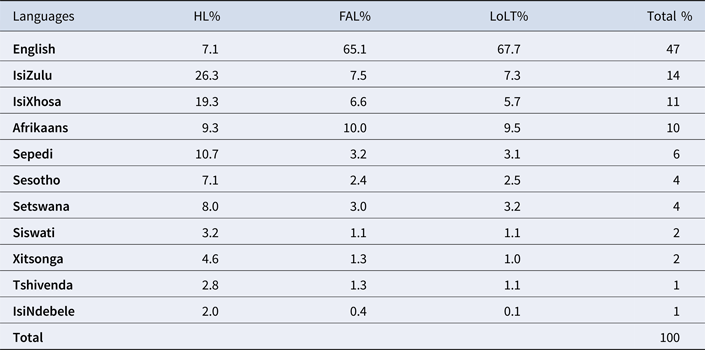
The following table shows the 2011 percentages of learners studying the official languages as HL or FAL (there were no figures for SAL) and the number of learners using the various languages as LoLTs. These data were the most recent figures obtainable from the Annual School Survey (2011) on the Department of Basic Education's website (DBE, 2011c). One could surmise that the current, relative distribution of the languages would probably not be very different from these figures.
From Table 1 we can see that the most widely spoken HL in South Africa is isiZulu (26.3%), followed by isiXhosa (19.3%), Sepedi (10.7%), Afrikaans (9.3%), Setswana (8.0%), Sesotho and English (7.1%), Xitsonga (4.6%), Siswati (3.2%) and Tshivenda (2.8%). Languages learned as FAL are English (65.1%), followed by Afrikaans (10%), isiZulu (7.5%) and isiXhosa (6.6%). The remaining languages were all below 5%. The most revealing set of figures are for the LoLT, with English by far the most preferred at 67.7%, followed by Afrikaans (9.5%), isiZulu (7.3%) and isiXhosa (5.7%). It is clear that the trend is towards English, both as the preferred FAL and as the LoLT. The 10% of learners taking Afrikaans as FAL are probably English mother-tongue speakers with even smaller percentages taking isiZulu and isiXhosa. Among these learners may also be speakers of other African languages.
Percentage of learners with HL, FAL and LoLT – 2011

Source: DBE 2011 Annual School Survey
So the picture is one of English dominance in education with the African languages becoming increasingly marginalised which is contrary to the idea of additive multilingualism promoted in the LiEP. A study by Taylor and von Fintel (Reference Taylor and von Fintel2016) evaluated the impact of English versus HL instruction in Grades 1, 2 and 3 on English proficiency in Grades 4, 5 and 6. The study analysed longitudinal data from a combination of several data sets between 2007 and 2012 for the entire population of South African schools. The researchers used a ‘fixed effects’ model to take advantage of within-school variation in the language of instruction in these grades caused by changes in the language of instruction at specific schools. Their final sample consisted of 827,745 pupils from 9,180 primary schools. Their findings showed that three years of English instruction as opposed to HL instruction in the first three grades was associated with ‘a negative effect on English performance in Grades 4, 5 and 6 of approximately 17% of a standard deviation in test scores’ (Taylor & von Fintel, Reference Taylor and von Fintel2016, p. 77), and that this estimation may be interpreted causally. There thus seems to be consensus from research that improved teaching of the African languages is essential for creating a stronger foundation upon which to build literacy in general, and oral language skills in English. This, in turn, will create a stronger foundation upon which to build academic literacy in English.
The Section 2.2 introduces the curriculum which pertains to the learning and teaching of languages and literacy, specifically for the Foundation Phase (FP) (Grades R–3) and intermediate phase (IP) (Grades 4–6). This will provide a reference point for a critical discussion of the systemic assessments, evaluation projects and selected research in the field.
2.2 The National Curriculum and language teaching
In 2011, the DBE released the CAPS (DBE, 2011a) together with the National Protocol for Assessment Grades R–12 (DBE, 2011b) as a means of addressing the poor performance of learners on the international benchmarking tests such as the Progress in International Reading Literacy Study (PIRLS) 2011 (Howie et al., Reference Howie, Venter, Van Staden, Zimmerman, Long, du Toit and Archer2008; Howie, van Staden, Dowse, Tshele, & Zimmermann, Reference Howie, van Staden, Dowse, Tshele and Zimmerman2012; Spaull, Reference Spaull2013), Southern and Eastern Africa Consortium for Monitoring Educational Quality (SACMEQ) III 2007 (Hungi et al., Reference Hungi, Makuwa, Ross, Saito, Dolata, Capelle and Villiers2010) and the national systemic tests, the ANAs (Spaull, Reference Spaull2013; DBE, 2014). The CAPS has a common framework for all the official languages – at HL and FAL/SAL levels. The curricula for languages other than English were ‘versioned’ from English (Heugh, Reference Heugh2013) with negative consequences for the teaching of decoding and phonics in the African languages in particular (De Vos, Van der Merwe, & Van der Mescht, Reference De Vos, Van der Merwe and Van der Mescht2014). This will be discussed in more detail later.
Underpinning the CAPS is a theoretical orientation towards ‘additive bilingualism’ and the transfer of language and literacy skills from the HL to the FAL. A strong oral foundation is also advocated for learning the FAL but this requires adequate exposure to the language as well as adequate resources (Fleisch, Reference Fleisch2008). Building the oral skills is viewed as a foundation for learning to read and write. The CAPS expects ‘a high level of competence’ (DBE, 2011a, p. 8) in English FAL by the end of Grade 3, in order for learners to be able to use the language as a LoLT from Grade 4. This will be achieved by taking advantage of learners’ literacy skills in their HL so activities designed to enhance language learning are duplicated for both languages.
The CAPS document explains the methodology behind additional language teaching clearly and explicitly in an attempt to provide structure and guidance for teachers. These methodological principles include a focus on communicative skills based on the principles of first language acquisition where children are frequently exposed to contextualised language in their environment. This, of course, assumes that there is adequate exposure to the FAL in the learners’ environment which is often not the case, especially in remote, rural areas. The emphasis in the early stages is therefore on receptive skills and understanding mainly through stories and classroom instructions, where activities are coupled with language learning akin to the Total Physical Response approach (Asher, Reference Asher1969). Productive language is encouraged in much the same way, through staged and scaffolded activities that require appropriate responses from learners, initially through actions and then through verbal responses. From Grade 1, listening and speaking skills are emphasised in the FP for FAL, but reading and writing are supposed to be introduced in Grades 2 and 3 in order to prepare learners for a switch to the FAL as LoLT in Grade 4 where they will be using the language for learning. The CAPS document also suggests that vocabulary development should take place bilingually using both HL and FAL for familiar objects found in the environment. For English FAL, Grade 3 learners should have learned between 1,500 and 2,500 words.
An explicit focus on language use and structure begins in Grade 3 but there is very little guidance for the teacher on how to teach grammar per se. Instead, teachers are encouraged to teach language structure via the texts selected for teaching reading and during writing activities. For the teaching of reading in the FP (Grades 1–3) which would normally be in the HL, CAPS specifies the teaching of decoding skills such as phonemic awareness, phonics and word recognition, and also specifies reading methods such as shared, group-guided, paired and individual oral reading and comprehension exercises. For teaching reading in the FAL offered as a subject from Grade 2, a bilingual approach is used whereby teachers are encouraged to build on the reading strategies that learners have presumably been taught for reading in their HL. CAPS specifies that word recognition accuracy should be between 90 and 95% for reading in the HL (DBE, 2011a, p. 56). While such accuracy might work for English, it may well be more complex for the agglutinating African languages (Land, Reference Land2015). A study by Spaull, Van der Berg, Wills, Gustafsson, and Kotze (Reference Spaull, van der Berg, Wills, Gustafsson and Kotze2016) shows that accuracy and speed in isiZulu, Sesotho sa Leboa or Northern Sotho and Xitsonga are good predictors of reading comprehension. Although benchmarks may differ for different languages, the principle of decoding accuracy remains consistent across languages. The morpho-syntactic and phonemic structures of these languages could influence both word recognition and decoding processes (De Vos, Van der Merwe, & Van der Mescht, Reference De Vos, Van der Merwe and Van der Mescht2014). More research is thus needed on reading processes in African languages in order to inform the curriculum and reading pedagogy. The work of the Primary Teacher Education Working Group on reading and reading research in African languages (Pretorius, Reference Pretorius2017, Reference Pretorius2018) is one response to this need and will be discussed in the section on literacy.
In terms of CAPS, writing in the FAL should normally begin in Grade 2 and should be supported gradually, moving from simple activities such as sentence completion to writing simple stories. A text-based approach is advocated, where different text genres are introduced, i.e. narratives in the early grades with the gradual introduction of recounts, procedural texts and information reports from Grade 3. Again, writing activities in the FAL in the early grades are supposed to build on those learned for writing in the HL. By Grade 3, learners are expected to write a personal recount and a set of instructions in the FAL. The teaching of writing makes use of a genre approach and is strongly supported with writing frames. This approach resonates with the Writing to read: Reading to learn approach advocated by Rose (Reference Rose, Muller, Morais and Davies2004), and Rose and Martin (Reference Rose and Martin2012). For the SAL, learners in Grades 4–6 concentrate on developing their aural and oral skills. From Grades 7 to 10 they gradually concentrate more on literacy by building on their knowledge of both HL and FAL. Although the CAPS requirements for the various language skills are explicit, this is not necessarily what takes place in classrooms.
From the IP (Grades 4–6), learners are expected to build on their higher order skills in comprehension, an aspect of cognitive academic language skills (CALP) (Cummins, Reference Cummins, Street and Hornberger2008) which is already encouraged by the CAPS in the FP for both HL and FAL. They are thus expected to collect and synthesise information, to listen critically and read texts, in order to evaluate them and to negotiate meaning. It is suggested that spoken and written language be carefully modelled and supported by vocabulary learning and the use of sentence frames. The further development of reading skills will be oriented towards reading across the curriculum therefore there is a strong focus on reading different genres and text types, including literary and non-literary texts. CAPS also stipulates that vocabulary development depends on the amount of reading learners engage in and strategies for effective teaching of reading are also suggested.
Dampier (Reference Dampier2014, p. 37) critiques the lack of a clearly defined theory of how language is acquired in the CAPS document, arguing that ‘the pedagogic process of introducing the first additional language has not been interrogated thoroughly at a theoretical level’ with serious expectations of learners and teachers to achieve proficiency in the FAL by building on their ‘already developed skills’ in the HL. For Dampier, this impedes the attainment of equity in education and epistemic access in situations where HL development has been poor. Large-scale studies to be discussed below have found that teachers struggle to implement the curriculum in the manner specified by the guidelines (DBE, 2015; Taylor, Van der Berg, & Mabogoane, Reference Taylor, Van der Berg and Mabogoane2013). Taylor (Reference Taylor2017) reported that officials do not seem to be accountable for lack of school functionality, an issue to which we will return in the section below.
3. Learner performance in language and literacy assessments in South African schools
South Africa participates in international evaluations and systemic assessments of language and literacy which provide evidence for policy, curriculum and teacher education inputs. The test results show that the majority of pupils in South Africa are seriously underperforming relative to the curriculum and to other developing countries. As a result, a number of large-scale evaluation studies were carried out at provincial and national levels in order to pinpoint the causes for poor learner language and literacy achievement.
3.1 International assessments
The two main international tests of educational achievement for developing countries in which South Africa participates are the PIRLS (2011) and the SACMEQ (Hungi et al., Reference Hungi, Makuwa, Ross, Saito, Dolata, Capelle and Villiers2010). These assessments show progress over time, in literacy and maths, of successive cohorts of pupils for Grades 4 and 6 respectively. The PIRLS assesses reading literacy with a focus on comprehension including information retrieval, inferencing, interpretation and evaluation. It also assesses the learner's ability to acquire and use information and assess literary events using expository and narrative text genres (Van Staden & Zimmerman, Reference Van Staden, Zimmerman, Scherman, Bosker and Howie2017).
In 2006, the first cohort of Grade 4 and (for South Africa) Grade 5 learners participated in the PIRLS. All official languages were used in the test. The average achievement of both grades was well below the international benchmark of 500, with Grade 4 learners averaging 253 and Grade 5 learners, 302 (Howie et al., Reference Howie, Venter, Van Staden, Zimmerman, Long, du Toit and Archer2008). In 2011, South African learners again participated in the PIRLS assessments but this time the prePIRLS was used for the Grade 4 learners. This test is much simpler than the PIRLS in terms of grammar, texts and comprehension skills required (Mullis, Martin, Foy, & Drucker, Reference Mullis, Martin, Foy and Drucker2012). Results showed little improvement over time. Almost a third (29%) of Grade 4 learners failed to reach the low international benchmark, which indicates that basic reading skills had not yet been mastered. They fail when it comes to more complex cognitive functions such as inference, analysis and synthesis of information (Mullis et al., Reference Mullis, Martin, Foy and Drucker2012). This indicates where the challenges lie in the South African education system at FP level.
In 2016, the PIRLS international assessment of literacy achievement was again conducted and South African learners came last out of 50 nations. It was also reported that 78% of South African learners cannot read for meaning (Howie et al., Reference Howie, Combrinck, Tshele, Roux, McLeod Palane and Mokoena2017). However, for the lowest performing African languages in the PIRLS 2011 study, there was an improvement in performance in PIRLS 2016 which offers some hope for the future. Nevertheless, the implications are that South African learners cannot read well enough to access texts in other subjects.
South African learners also achieved well below the benchmark and showed no improvement in Grade 6 literacy scores over a seven-year period between SACMEQ II(2000) and SACMEQ III (2007) (Spaull, Reference Spaull2013). Scores revealed that 27% of South African Grade 6 learners could not read a short, simple text for meaning. Achievement scores also varied by province, with learners in poor, rural provinces such as Limpopo considered illiterate (49%) whereas in better-resourced provinces such as the Western Cape, only 5% were considered illiterate. SACMEQ III(2007) also tested Grade 6 teachers on their content knowledge in literacy and maths with poor results. The top 5% of learners achieved higher scores than the bottom 20% of teachers (Spaull, Reference Spaull2013). Poor teacher knowledge will be discussed in more detail under the section on teacher education and training.
3.2 National systemic assessments
The ANAs were introduced in order to put in place a quality assurance mechanism. They are standardised tests for Grades 1–6 and Grade 9. The literacy component for the FP (Grades R–3) covers various aspects of early or emergent reading skills such as decoding, comprehension, vocabulary development and fluency (DBE, 2011a). Although the ANA tests attempt to cover both decoding and comprehension, they fail to provide benchmarked norms or standards against which to measure reading speed or vocabulary knowledge (Taylor, Reference Taylor2017). This is essential for teachers to be able to measure children's progress in literacy development in both the HLs and FALs. Furthermore, reading with comprehension is left unmonitored in schools (Taylor et al., Reference Taylor, Van der Berg and Mabogoane2013). The 2011 tests were externally verified by the Human Sciences Research Council (HSRC) but not the 2012 tests, which showed unrealistic increases in scores for the FP – 49% for Grade 3 literacy (Spaull, Reference Spaull2013). The latter tests had been marked by teachers in the schools with low levels of rigour in the process which means that the results were highly unreliable. It is thus difficult to monitor trends over time through these tests and their scores have to be read with extreme caution. The ANA scores for the NEEDU (Taylor et al., Reference Taylor, Van der Berg and Mabogoane2013) sample consisting of both monograde and multi-grade schools were 35.4% for HL and 38.4% for FAL. The most recent ANA assessment results (DBE, 2014) showed a sharp decrease in literacy scores from Grades 6 to 9 for both the HL (decrease by 15%) and FAL (decrease by 11%) (Table 2). There have been no official national assessments since 2014 due to pressure from the unions.
National average ANA scores in percentages for language and literacy in 2014

Source: DBE 2014
3.3 Evaluation studies
A number of large-scale evaluation studies have taken place since 2008, prompted by the poor achievement of South African learners in both national and international tests. Most studies evaluate the quality of learning and teaching in schools, mostly at primary and intermediate levels, focusing mainly on literacy and mathematics. Literacy findings from these studies will be discussed in Section 4. Findings on issues arising from the broader educational context which impact learner and teacher performance will be presented here. The studies include the National School Effectiveness Study (Taylor et al., Reference Taylor, Van der Berg and Mabogoane2013); the Evaluation of Literacy Teaching in Primary Schools in Limpopo Province (Reeves, Prinsloo, & Heugh, Reference Reeves, Heugh and Prinsloo2008); the Report of the NEEDU (2012) and the Implementation Evaluation of the National Curriculum Statement Grade R to 12 focusing on the CAPS (Taylor, Reference Taylor2017).
The research of the NEEDU of the DBE on multi-grade schools at IP level (Taylor et al., Reference Taylor, Van der Berg and Mabogoane2013) found that teachers did not differentiate among different learner age groups and levels in 59% of their classes. Learners received the same materials and exercises regardless of age or level. What was more disturbing was that in 83% of classes, no individual reading was observed and in 90% no independent writing was observed. The average written comprehension achievement was 20.7%.
In relation to pedagogy, Hoadley (Reference Hoadley2012, Reference Hoadley2016) conducted a review of the research literature on learning and teaching in the FP in South Africa in order to pinpoint possible causes of learners’ underperformance. The Research on Socio-Economic Policy Unit at the University of Stellenbosch has produced a number of research papers since 2015 dealing with educational issues that need addressing urgently in South Africa (Van Broekhuizen, Reference Van Broekhuizen2015; Spaull, Reference Spaull2016; Van der Berg, Reference Van Der Berg2016; Wills, Reference Wills2016). The issues raised by the findings from these studies include poor school management, absenteeism for sick leave, and bad time-keeping, which takes away time on task (NEEDU, 2012); excessive class sizes at primary level (Reeves et al., Reference Reeves, Heugh and Prinsloo2008; Spaull, Reference Spaull2016); slow pace of teaching (Hoadley, Reference Hoadley2016; Taylor et al., Reference Taylor, Van der Berg and Mabogoane2013)); poor home environments for establishing a foundation for later learning (Reeves et al., Reference Reeves, Heugh and Prinsloo2008); lack of parental involvement (Reeves et al., Reference Reeves, Heugh and Prinsloo2008; Taylor et al., Reference Taylor, Van der Berg and Mabogoane2013); very few specialised practitioners at Early Childhood Development level to prepare learners for formal learning (Reeves et al., Reference Reeves, Heugh and Prinsloo2008); delayed introduction of the additional language (FAL) as subject in spite of the LiEP, and inadequate teacher content and pedagogical knowledge (Reeves et al., Reference Reeves, Heugh and Prinsloo2008; NEEDU, 2012; Taylor et al., Reference Taylor, Van der Berg and Mabogoane2013).
It seems, then, that South Africa's performance in international and national tests is strongly predicted by socioeconomic factors as revealed by the large-scale evaluation studies. When English is the language of instruction, learner outcomes are poor for learners from poor socioeconomic backgrounds, whether urban or rural (Macdonald, Reference Macdonald1990; Christie, Reference Christie2008; Fleisch, Reference Fleisch2008). This may not be entirely due to language problems but also to poor teaching methodologies (Jordaan, Reference Jordaan2011; Hoadley, Reference Hoadley2012, Reference Hoadley2016).
4. Language learning and teaching
The predecessor to the current curriculum (CAPS) was outcomes-based education (OBE), which was based on constructivist principles that encouraged learners to be independent, active, inquiring and critical. Teachers were expected to facilitate learners in making decisions, strategising and initiating learning (Heugh, Reference Heugh2009). Such an approach might work with teachers and learners from well-resourced backgrounds, strong pre-school foundations, literate and well-educated families and fairly high levels of literacy in the LoLT, none of which pertained to the group of teachers and learners in question. There was thus a tension between constructivist ideas (Heugh, Reference Heugh2009), and the focus on performance and predetermined learning outcomes based on positivist, behaviourist principles rather than on the processes essential for language learning (Balfour, Reference Balfour2007). Teachers who were trained within the framework of the OBE curriculum seem to have adopted the behaviourist principles in their pedagogies, such as drilling, rote learning, repetition and memorisation with collective chorusing (Macdonald, Reference Macdonald1990; Wildsmith, Reference Wildsmith1992; Taylor & Vinjevold, Reference Taylor and Vinjevold1999; Hoadley, Reference Hoadley2012) while ignoring the more constructivist principles which would lead to greater learner engagement with content and materials (Hoadley, Reference Hoadley2012, Reference Hoadley2016).
Hoadley (Reference Hoadley2012, Reference Hoadley2016) found surprising consistency across small-scale studies that she reviewed on language learning and teaching in South African primary school classrooms. She identified very specific features of classroom practices which impact learning and reveal limitations to teachers’ knowledge base. These included very little learner engagement with books or print material, dominance of oral discourse, low levels of cognitive demand coupled with slow pace of delivery, very little individual reading or writing and weak forms of assessment. Factors associated with learning gains included greater curriculum coverage at appropriate pace; teacher adjustment to pupils’ ability; higher cognitive demand with a focus on reading and writing and appropriate assessment.
English language teaching methodologies suggested in the CAPS document (DBE, 2011a) such as communicative language teaching or text-based approaches that are imported from better-resourced, western contexts, may not be the most appropriate methods for teaching English in low income contexts. For this reason, teachers may resort to code-switching to facilitate understanding. Recent research has shown that the use of code-switching by South African teachers that is grounded in the social circumstances in which it occurs ‘constitutes a purposeful and productive teaching strategy’ (King & Chetty, Reference King and Chetty2014, p. 41). The authors conclude that code-switching needs to be understood in bounded linguistic contexts of interaction between teacher and learners for a given purpose. Code-switching is used for both management of the classroom and for explanatory purposes where the content is complex and concepts may not be immediately accessible to learners through English (Setati, Adler, Reed, & Bapoo, Reference Setati, Adler, Reed and Bapoo2002). However, issues arising from the use of code-switching include the exclusion of learners in diverse, multilingual classrooms who do not share those languages, the argument that code-switching does not serve to build either the L1 or the L2 (Jordaan, Reference Jordaan2011), and the reported ‘stigma’ attached to code-switching which is keenly felt by teachers who often deny the practice (Probyn, Reference Probyn2009).
The perception of language as pure and bounded (Makoni & Pennycook, Reference Makoni and Pennycook2007; Makoe & McKinney, Reference Makoe and McKinney2014; Makalela, Reference Makalela2015, Reference Makalela2016) is what influences teachers’ sometimes guilty attitudes towards their use of code-switching in the classroom (Probyn, Reference Probyn2009), while at the same time preventing them from putting their learners’ multilingual repertoires to productive use in the classroom. The latter would open up affordances for new multilingual pedagogies which may well be more appropriate in South African classrooms, as they engage learners linguistically, emotionally and cognitively (Makalela, Reference Makalela2015, Reference Makalela2016). Makalela (Reference Makalela2016, p. 193) terms the multiple use of languages in the classroom as ‘Ubuntu translanguaging pedagogy’ which involves input in one language with responses in multiple languages; contrasting phonological elements across languages; building vocabulary and syntax in more than one language simultaneously; process writing in different languages; reading input and writing output contrasts; and finally developing multilingual literacies. Makalela argues that multilingual learners are already involved in linguistic contrasts as their languages co-exist in their mental lexicon so making these explicit is natural. Findings from other studies show the benefits of translanguaging, especially social benefits and identity affirmation (Makalela, Reference Makalela2015; Guzula, McKinney, & Tyler, Reference Guzula, McKinney and Tyler2016; Mkhize, Reference Mkhize2016); epistemological access (Heugh, Reference Heugh2015; Probyn, Reference Probyn2015) and cognitive facilitation through cross-lingual reading in cognate languages (Sefotho & Makalela, Reference Sefotho and Makalela2017). Many of these studies, however, are small scale with criterion variables not necessarily controlled or assessed. Nevertheless, the studies report positive attitudes towards the use of translanguaging by both learners and teachers.
A major challenge to the translanguaging movement in South Africa is the linguistic diversity of learners in many schools. Not all learners share the same languages, and in many cases, neither do the teachers. The exploratory discourse engendered by the use of multiple languages is often constrained by the need to cover the curriculum and misunderstood for the role it serves in acting as a building block for the discourse of the discipline (Guzula et al., Reference Guzula, McKinney and Tyler2016).
The teaching of African languages to non-African language speakers is not without challenges either. In relation to the learning of the African languages as FALs, a number of small-scale studies have been included which focus on learners’, parents’ and teachers’ attitudes towards the offering of an African language (mainly isiZulu) as FAL in independent schools. They offer crucial insights into the challenges affecting the learning and teaching of African languages at school level as they reveal a complex interplay of issues concerning language and power, the perceived status of the African language in relation to English, language teaching methodologies and course content.
Bengu's (Reference Bengu2015) study explored the attitudes of Grade 10 learners towards isiZulu as FAL. Although attitudes were generally positive, underlying issues focused on the intersectionality of language and culture, African languages and cultural capital and on variations in the content and methodologies used for the HL as opposed to the FAL course for isiZulu, with the former perceived as having more status and more substantial and authentic (real isiZulu) content. Further research brought to light the need for greater support from the various departments of education at both national and provincial levels. Although principals, parents, teachers and pupils showed positive attitudes towards the offering of isiZulu as FAL, they were concerned about the shortage of professionally trained teachers and teaching resources (textbooks and other materials) in the African languages (Govindsamy, Reference Govindsamy2008). Mthembu's (Reference Mthembu2008) study investigated whether public primary schools were offering isiZulu as a subject in alignment with the LiEP (1997) in terms of promoting official languages, and whether they were receiving any support from government in this endeavour. Similar challenges to those found in Bengu's and Govindsamy's study came to light, and the study reiterated the call for the professionalisation of African language teachers in order that they use methodologies which would enhance the learners’ communicative competence in the language.
5. Literacy
Whereas the evaluation studies cited above focused on factors affecting learner achievement in the broader educational context, a later wave of studies on the link between low SES and low levels of literacy have gone deeper in order to examine the relationship between learners, teachers and resources.
Although the focus of the CAPS is clearly on early or emergent reading skills, results from the evaluation report (Taylor, Reference Taylor2017, p. 39) show the average reading comprehension scores (in English) of FP learners to be 4.14 out of 20 across a sample of 214 schools and 4,709 learners. Clearly, reading skills are not being taught effectively at this level. Hoadley (Reference Hoadley2016) makes the point that poor literacy teaching, especially in low SES contexts where a print-rich environment is lacking, may be a stronger contributor to poor learner performance levels than the LoLT. South African learners’ poor performance in literacy in both English and the HLs (NEEDU, 2012; Howie et al., Reference Howie, van Staden, Dowse, Tshele and Zimmerman2012) points to the need to provide more resources and create norms and standards for different aspects of reading in the African languages, particularly with reference to reading speeds and vocabulary development, both of which are correlated with reading fluency (Pretorius & Mokhwesana, Reference Pretorius and Mokhwesana2009; NEEDU, 2012; Land, Reference Land2015; Wilsenach, Reference Wilsenach2015). Wilsenach (Reference Wilsenach2015) makes the point that, in South Africa, insufficient vocabulary knowledge is compounded by an unfamiliar language of instruction, i.e. English. In such cases, vocabulary may be insufficiently developed in either HL or LoLT to support the development of literacy. What follows is a discussion of the research that has been carried out on English and various African languages at both primary and intermediate levels.
The National School Effectiveness Study (NSES) was a panel study that tracked 8,383 learners from a sample of 268 schools starting in Grade 3 in 2007 until Grade 5 in 2009 (Taylor, et al. Reference Taylor, Van der Berg and Mabogoane2013). The study focused on the development of understanding in mathematics and literacy in English through a year-end assessment over the three-year period. Research methods included interviews and direct observations. In schools where there was a clearly designed curriculum, the achievement of the learners was, generally, better than in schools where such evidence could not be found. Furthermore, in those schools where learners were engaged in extended writing exercises (longer than at the level of the paragraph), the achievement in English was higher than in schools where no such exercises were undertaken. In the latter it was found that very little writing of an analytical nature was undertaken, even in the schools in which extended writing development of children had occurred. The NSES concluded that writing-across-the-curriculum approaches were critical to the success of children in reading and writing development for the three-year period and that subject-content knowledge of teachers had an impact on the levels of success achieved by their learners in the year-end assessments. These findings suggest that literacy development in the content area was a critical aspect of interventions for learner improvement but depended on the quality of teacher training.
The Evaluation of Literacy Teaching in Primary Schools in Limpopo Province (Reeves et al., Reference Reeves, Heugh and Prinsloo2008) was an empirical project linking learner literacy achievements to other variables such as literacy practices, teacher expertise, quality of materials and resources, and quality of teacher education courses. The study used interviews and classroom observation instruments as the main methods of data collection over a four-week period. The sample included twenty primary schools from five districts. The study found that teachers had poor knowledge of how to teach language or literacy effectively in any language, and concluded that successful additional language learning (FAL) depended on the adequate development of language and literacy in the HL for a minimum of six years and that, for the FAL to replace the HL as LoLT, it needs to be taught as a subject for at least six years. When learners are bilingual and biliterate in both the HL and the FAL, then a switch to English as sole LoLT would be possible.
Pretorius’ well-known research on literacy at primary level in both English and the African languages underscores the importance of HL development as a foundation for learning an additional language and becoming literate in it (Pretorius & Mampuru, Reference Pretorius and Mampuru2007; Pretorius & Mokhwesana, Reference Pretorius and Mokhwesana2009; Pretorius & Lephalala, Reference Pretorius and Lephalala2011; Pretorius, Reference Pretorius2014). Her work highlights the fact that learners’ literacy scores are just as low for their home (African) languages as well as for the FAL. In the first three grades of the FP, learners learn the mechanics of reading, i.e. they learn to decode the language which is normally an African language. It is during this phase that children's oral language proficiency has an effect on how well they learn to read (Pretorius, Reference Pretorius2014). At Grade 4, however, they encounter (a) English as the language of instruction, and (b) other subject areas which are more cognitively demanding but which are now taught through English. They now have to learn to read in English and read for meaning at the same time when they have had little instruction in learning English as an additional language. Pretorius points out that it is in Grade 4 where learners’ literacy skills become increasingly academic in nature as written language becomes more complex and abstract. If they have not developed such skills in the FAL or LoLT by this time, they fall by the wayside.
There is very little quantitative research on oral reading fluency (ORF) for learners of English as FAL. The relationship between ORF and reading comprehension is mostly based on reading in the HL. The norms for English are thus based on HL reading data which are not appropriate for children reading in English as FAL (Pretorius & Spaull, Reference Pretorius and Spaull2016). The results of a large-scale evaluation study (Taylor et al., Reference Taylor, Van der Berg and Mabogoane2013; Draper & Spaull, Reference Draper and Spaull2015) in rural schools in South Africa in 2013 were analysed from a multivariate perspective with a focus on the strength of the relationship between ORF and comprehension in English for Grade 5 rural learners. Findings showed that the 1772 learners scored an average of 23% on the silent reading test which was at Grade 4 level. The ORF assessment was equally poor at 46 words correct per minute (wcpm) on a narrative text at Grade 4 level. From a cumulative density function of ORF scores, it was found that approximately 40% of the learners were reading at less than 40 wcpm and 11% could not read at all after five years of schooling. Poor ORF skills index basic reading skills which are practically non-existent in the large majority of the FP and IP learner population in South Africa. Pretorius and Spaull (Reference Pretorius and Spaull2016) conclude that systematic reading is not being taught in South African primary schools.
However, it is necessary to ask which aspects of systematic reading are not being taught. A related question is what causes lack of access to bottom-up decoding and encoding strategies? A study of the patterns and prevalence of monosyllabic three-letter-word spelling errors made by English FAL learners (Fleisch, Pather, & Motilal, Reference Fleisch, Pather and Motilal2017) brought to light misspellings of vowels in monosyllabic words and a high prevalence of errors which the researchers classified as pre-grapho-phonemic. Results showed that over two thirds of Grade 4 learners in the sample had not mastered the spelling of words benchmarked for Grade 2 learners. The authors surmise that such errors could be caused by limited and incomplete phonemic teaching and dialectal problems. The study was a secondary analysis of data drawn from learner literacy tests that formed part of a randomised control trial (RCT) using a random sample of 2,663 learners in the pre-test and 2543 learners in the post-test from 100 schools in one province.
An important part of learning to read is the development of vocabulary. Wilsenach (Reference Wilsenach2015) conducted a study on the relationship between receptive vocabulary and early literacy skills in emergent bilingual Northern Sotho-English children in order to ascertain whether vocabulary levels can predict difficulties in the acquisition of early literacy skills. The study tested the receptive vocabulary of one hundred learners divided into two groups, English and Northern Sotho, by means of the Peabody Picture Vocabulary test which is an untimed oral test of receptive vocabulary designed for Standard American English and is intended to provide an estimate of verbal ability and scholastic aptitude (Dunn & Dunn, Reference Dunn and Dunn2007). Learners’ knowledge of phoneme–grapheme correspondences was tested by means of matching letter cards with spoken sounds, and writing was assessed by the learners writing their names. The study found that receptive vocabulary knowledge co-occurs with the acquisition of early literacy skills and that English receptive vocabulary ‘significantly predicted the outcome of ALL literacy skills’. The better performance of the group that had English as a LoLT was unexpected given the assumption that early literacy in the HL is best.
It is possible that the structure of English, which is disjunctive (as opposed to conjunctive or agglutinating) and has shorter words, facilitates phonemic awareness and other subskills. Land's (Reference Land2015) research found that isiZulu is indeed read at a much slower pace by competent adult readers than equivalent texts in English, which she put down to the agglutinative nature of the African language. This is supported by the analysis of reading in English based on eye movements by Van Rooy and Pretorius (Reference Van Rooy and Pretorius2013), who found that three different groups of isiZulu early graders (strong, average and weak readers) showed similar eye movements when reading isiZulu but showed marked differences in reading rates, types of eye movements and duration of fixations when reading English.
Although CAPS specifies age-appropriate vocabulary size for the HLs for Grade 1 (children are expected to learn to spell 10 words per week taken from phonics lessons in Term 2 and should write as many as 6–8 sentences by the end of the year), the total amount of vocabulary to be mastered in the HL by the end of each grade is not specified. Instead, CAPS describes the kinds of early reading skills that learners should be engaging in and that ‘word recognition accuracy’ should be between 90% and 95% (DBE, 2011a, p. 56). At Grade 1 level, learners should be building up a sight vocabulary from incidental reading programmes (no direct focus on vocabulary), high frequency word lists and graded reading schemes. They should also begin to build personal dictionaries from initial letters of words. While this may work for English, it may well be more complex for the African languages whose structure includes a noun class and agreement system where a prefix marks agreement with the noun. Such prefixes would then become the ‘initial letter’ of the words in the personal dictionary, thus creating a vocabulary for a particular noun class but not necessarily teaching different letters and their corresponding sounds (Wildsmith-Cromarty, Reference Wildsmith-Cromarty2003). Guidelines for teaching the African languages in the CAPS documents were ‘versioned’ from English, and literacy acquisition in the indigenous languages seems to have been overlooked, given the poor performance of learners in their HLs in the PIRLS (2011). In addition, there is very little reading or vocabulary research in African languages and no reading norms or benchmarks (Taylor et al., Reference Taylor, Van der Berg and Mabogoane2013).
De Vos et al. (Reference De Vos, Van der Merwe and Van der Mescht2014) propose a research programme for language-specific pedagogies, underpinned by linguistic, psycholinguistic and applied linguistic theory. They argue that the African languages are structurally and typologically different to English or Afrikaans and thus require a different pedagogic approach. They critique the CAPS isiXhosa HL document that was versioned from English because it shows little consideration of language-specific structures, such as phonic sequences which use longer, multisyllabic words incorporating blends, digraphs, trigraphs and quadgraphs, which are complex consonants representing a single phoneme, as opposed to the shorter words and simpler graphemes in English. CAPS also requires that consonants and consonant clusters are taught together and completed by the end of Grade 1. This may be appropriate for English, but isiXhosa has blends like ng and tsh which occur frequently and need to be learned early in Grade 1, and also consonant sequences like ntshw and ngqw which need to be learned gradually (De Vos et al., Reference De Vos, Van der Merwe and Van der Mescht2014, p. 3). The authors point out that very little research has been done on micro-approaches to texts such as morphological, syntactic and phonological awareness. There is also little research carried out on word recognition and cross-orthography comparisons. Probert and De Vos (Reference Probert and De Vos2016) focused on word recognition strategies and the effect of differences in transparency between two different orthographies on word recognition in bilingual learners (isiXhosa/English). They examined the transfer of word recognition strategies from the HL (isiXhosa) to the FAL (English) of 47 Grade 4 isiXhosa HL learners, using isolated word and pseudo word reading tasks in both languages. They found that learners who are literate in a transparent orthography are able to transfer decoding skills more easily than learners who are literate in an opaque orthography. Transfer, however, was mostly limited to sublexical decoding skills and not to whole word recognition.
In relation to writing development, CAPS recommends that extended writing be taught through a combination of process and text/genre-based approaches. In a study of the teaching and assessment of narrative writing in English FAL, Akinyeye and Plüddemann (Reference Akinyeye and Pluddemann2016) found little evidence of a scaffolded approach to the teaching and assessment of writing, which points to teachers’ lack of understanding of the requirements for writing for meaning. However, an intervention using a systemic functional linguistics (SFL) genre-based pedagogy involving 72 Grade 6 learners and 2 teachers in a low SES context in the Western Cape seemed to enhance epistemic access to the specialised discourses of the various disciplines (Kerfoot & Van Heerden, Reference Kerfoot and Van Heerden2015). The study analysed the learners’ writing development in the information genre and found that significant gains occurred in staging, lexis and key linguistic features. The explicit focus on textual and linguistic features provided by an SFL genre-based pedagogy facilitated learner control of the writing process. Interventions providing explicit scaffolding thus need to be included.
6. Teacher training
It is clear from the evaluation studies discussed earlier that there is a need to build capacity in teacher training institutions for adequately preparing teachers to teach both HLs and additional languages effectively, especially the mechanics of reading and writing. Teachers once trained at specialised teacher training colleges are now trained at universities. In 2002, the erstwhile colleges of education either closed down or became merged with the universities as faculties of education. This reduced the number of hours that students spent on their practicums developing pedagogic experience. It also meant that initial teacher education (ITE) was now in the hands of university lecturers. What follows is a brief survey of courses on offer for initial teacher training, followed by a study evaluating such courses.
6.1 Courses on offer at tertiary institutions
The following course descriptions have been generalised from a perusal of the information on nine university websites. Most universities offer the following basic qualifications with a focus on language and language teaching for teachers in initial training: Bachelor of Education (B.Ed.) (four years) with specialisations in languages, literacy and FAL (English, African languages or Afrikaans) and at least two years of basic communication and academic literacy courses in English (the LoLT); Postgraduate Certificate in Education (PGCE) (one year) with similar language specialisations to the B.Ed.; a postgraduate diploma (PGDip) which is normally a part time course over two years with specialisations in higher education or educational technology, and postgraduate degrees such as the M.Ed. and Ph.D. which tend to offer applied language and literacy courses at a deeper level of specialisation.
Elective courses (offered at only some universities) may include a focus on emergent literacy, English as FAL, literacy at work, English as LoLT and academic literacy. Such courses help teachers understand their learners’ language difficulties better. However, they are not core courses and are usually offered at postgraduate level which means that most teachers would not be exposed to them. Very few if any courses actually teach teachers to teach reading using an evidence-based approach (Deacon Reference Deacon2016). The study of the individual languages that are to be taught either as HLs or additional languages generally includes courses on linguistics, language and literature with a focus on communicative and text-based approaches to language learning.
The Initial Teacher Education Research Project (ITERP) (Deacon, Reference Deacon2016) investigated university ITE courses for the intermediate schooling phase in order to examine the extent to which they were preparing teachers for the workplace. Apart from the data on the initial preparation of student teachers, the study also gathered data on the early work experiences of new teacher graduates, and on new teacher placement, distribution and reception in schools over a period of four years from 2012 to 2015. The first research question focused on the development of content knowledge, pedagogic skills, practicum support and professional identity, and the second focused on the implementation of this knowledge. Five public universities with strong ITE programmes were selected for examination. Collectively, these universities graduated 7,437 (54.3%) of a total of 13,708 new teachers in 2012 (DHET, 2013, p. 4). The methodology included surveys of final year students and new graduates, case studies of the selected universities, documentary analysis of courses, interviews with lecturers and new graduates, focus group discussions with newly qualified IP teachers, and assessments of their subject and pedagogical content knowledge. Findings revealed that although emphasis was placed on equipping new teachers with sound subject-content knowledge, the ITE programmes showed little conceptual coherence, especially the language and literacy modules for primary school level (Deacon, Reference Deacon2016). Student teachers expected to be using English as LoLT had very little exposure to it (1 in 7 teachers).
Of critical importance to literacy teaching was the finding that teaching practice assessment instruments focused more on general pedagogical knowledge rather than pedagogical content knowledge (PCK) for teaching a particular subject such as literacy. None of the selected university courses were teaching new IP teachers how to teach reading and writing in any language, compounded by the absence of children's literature. They were not preparing student teachers adequately for teaching through English as LoLT (Reed, Reference Reed2014) or for dealing with multiple HLs in the classroom (Deacon, Reference Deacon2016). It would seem then that teachers are starting their careers with a weak knowledge base of their subject, and limited proficiency in the LoLT (English). The ITERP found that applicants were admitted to ITE programmes with low levels of literacy and numeracy and no evidence of their interest in educating young children (Deacon, Reference Deacon2016, p. 11).
The influence of limited teacher language proficiency (in FAL) on learners’ language and reading acquisition has been investigated by Nel and Muller (Reference Nel and Muller2010), Nel and Swanepoel (Reference Nel and Swanepoel2010) and Hugo and Nieman (Reference Hugo and Nieman2010). Nel and Muller's study was an impact evaluation and involved a sample (n = 199) of student teachers enrolled for the Advanced Certificate in Education. The data was drawn from both a survey and Portfolios of Evidence (POEs) and showed that the errors located in the student teachers’ POEs reappeared in their learners’ workbooks. Nel and Swanepoel's (Reference Nel and Swanepoel2010) study drew on the same data from Nel and Muller's (Reference Nel and Muller2010) study but focused more on the type of linguistic and discourse errors that were transferred to the learners from the teachers. Findings from Hugo and Nieman's (Reference Hugo and Nieman2010) study identified phonetic and phonemic difficulties in English and a lack of vocabulary on the part of teachers that transfer to their learners. Based on their findings, they argue for a revision of language methodology courses and the upgrading of student teachers’ cognitive academic language skills.
If teachers have a poor knowledge base then they would find it challenging to analyse, interpret and use the information from the systemic tests, i.e. ANAs which were initially developed in order to facilitate continuous improvement. Based on the test information, they would need to link the assessment items to knowledge and skills and adjust their pedagogy accordingly. Then they need to design interventions to address areas of weakness, which requires a ‘high level of expertise’ (Herholdt & Henning, Reference Herholdt and Henning2014, p. 5). The authors found that teachers struggled to interpret the learners’ levels of understanding and formulate teaching strategies to address weak areas. What became apparent was the need for the development of teachers’ PCK and the adoption of a more developmental rather than a compliance-based approach (Spaull, Van der Berg, Wills, Gustafsson, & Kotze, Reference Spaull, van der Berg, Wills, Gustafsson and Kotze2016).
The problems that apply to the learning and teaching of English as FAL also apply to the learning and teaching of African languages as FALs. Turner (Reference Turner2015, Reference Turner, Kaschula and Wolff2016) found that adequately trained isiZulu FAL teachers in KwaZulu-Natal schools were scarce and that there had been no isiZulu FAL methods courses offered at one of the country's largest universities for teacher education and training in the past few years. Schools resort to using teachers trained to teach isiZulu as HL or who simply have isiZulu as HL themselves (Turner, Reference Turner2015). Greater professionalisation of teachers in this subject would comply with the LiEP (DoE, 1997) and help raise the status of the African languages.
6.2 Interventions
In order to address poor language and literacy achievement in South African schools, the DBE, in 2015, initiated a collaborative, large-scale impact evaluation project named the Early Grade Reading Study (Taylor, Cilliers, Prinsloo, Fleisch, & Reddy, Reference Taylor, Cilliers, Prinsloo, Fleisch and Reddy2017). The aim was to build evidence about what works to improve the learning and teaching of African languages. The project compares the cost-effectiveness of three intervention models to improve reading outcomes in learners’ HLs, in this case, Setswana. The sample comprised 230 low SES schools in the North West Province. Using a RCT design, each intervention was implemented in a separate group of 50 schools with the remaining 80 schools acting as control group. These were supplemented by in-depth case studies and classroom observations. The interventions included (1) a structured learning programme with centralised training which provided teachers with lesson plans aligned to the CAPS, quality reading materials and workshop training twice a year; (2) a structured learning programme and on-site coaching with a reading expert and lesson plans and materials similar to (1) but also providing continuous coaching support and small cluster training sessions; and (3) parental intervention in the form of weekly parent meetings to give them the knowledge and skills to engage more deeply with their children's literacy development. Learners were exposed to their particular intervention for the entire FP as the project spanned three years.
Findings after two years revealed that although the structured training intervention had moderately positive effects on learners’ performance in the literacy subtests, the coaching intervention registered statistically significant positive effects on all HL measures of literacy. Learners exposed to the coaching intervention were 40% of a year's learning ahead of pupils in schools that had received no interventions. The parental intervention had a small effect on phonological awareness which could have been due to the emphasis on this in meetings with parents. The most important findings were the increase in pupils’ book reading (graded readers) in the coaching and training schools – larger in the coaching teachers’ classes – and greater individual attention given to learners through group-guided reading in the coaching and training schools. There is thus a need to train teachers on how to interact with resources.
A number of other interventions, mainly experimental, have aimed at empowering teachers to improve their practices by giving them ready-made, accessible tools to use immediately in the classroom. These include the use of story-based, language enrichment programmes (Ntuli & Pretorius, Reference Ntuli and Pretorius2005; Nel & Theron, Reference Nel and Theron2008); strategy instruction through a blended learning approach (Klapwijk & Du Toit, Reference Klapwijk and Du Toit2009); and the use of dual-medium programmes to help support African teachers in teaching initial literacy in the children's mother tongue (Mashiya, Reference Mashiya2010; Plüddemann, Nomlomo, & Jabe, Reference Plüddemann, Nomlomo and Jabe2010; Mbatha Reference Mbatha2014) and to help non-African teachers cope in diverse multilingual classrooms (Evans, Reference Evans2011). The interventions by Nel and Theron (Reference Nel and Theron2008) and Ntuli and Pretorius (Reference Ntuli and Pretorius2005) supported language and literacy teaching by providing well-structured language experiences, interactive pedagogy, language development through frequent language exposure and the inclusion of age and culturally appropriate stories. The study by Klapwijk and Du Toit (Reference Klapwijk and Du Toit2009) focused on reading strategy instruction involving a blended learning approach and using both technology and more traditional teaching methods to facilitate reading comprehension for Grade 6 learners at two schools in the Western Cape. The study was an attempt to respond to the critique of the traditional teacher-led–learner response type of pedagogy which leads to passive learning. The blended approach used computer-based teaching methods which gave learners greater agency in improving reading comprehension when combined with strategy instruction. Eight years later, this type of strategy has been ear-marked by the Gauteng region's department of education in order to allow learners to utilise their strengths with regard to digital literacy and as a strategy to move teachers away from ‘chalk and talk’ and textbook reliant teaching. The department also considers this strategy as a way to upskill teachers in the use of technology in their teaching (GDE Lekgotla, 2017).
The studies by Mashiya (Reference Mashiya2010), Mbatha (Reference Mbatha2014), and Plüddeman et al. (Reference Plüddemann, Nomlomo and Jabe2010) focused on the use of an African language as complementary language of instruction in teacher training courses for the FP. All three studies found that although students enjoyed the freedom of expression afforded them by engaging with content in their HL, they struggled to write academically through the medium of an African language. This is partly due to their having been schooled through either English or a ‘bilingual’ model with substantial code-switching. The implications of this for using the African languages as LoLT and for teaching them as FALs are important. An interesting intervention using both English and an African language as complementary languages of instruction was the creation of a bilingual degree at a university in the Limpopo province (Ramani, Kekana, Modiba, & Joseph, Reference Ramani, Kekana, Modiba and Joseph2007). The aim of this study was to demonstrate that the African languages are sufficiently developed to be used for modern academic discourse in institutions of learning and can be developed further through their use in the academic domain. Ramani et al. (Reference Ramani, Kekana, Modiba and Joseph2007) provided evidence that terminology development for key disciplinary concepts can be created collaboratively through translation, transliteration and the use of the language as medium of instruction. Through the dual-medium degree in Sesotho sa Leboa (Sepedi) and English, students became professional biliterate bilinguals confident in the use of both languages in high status domains.
Evans (Reference Evans2011) designed and implemented a seven-week course in an African language for pre-service teacher trainees in order to give them the linguistic skills to manage diverse, multilingual classrooms. Over a five-year period, a total of 2,253 student teachers had completed the module successfully with less than 5% repeat rate. Feedback drawn from both qualitative and quantitative data was positive.
In terms of resources for language teaching, a study by Taljard (Reference Taljard2012) explores the possibilities offered by corpus-based based language teaching for the teaching of African languages which could be useful for initial teacher training courses. The rationale for the study was the inadequacy of materials in the teaching of Sesotho sa Leboa (Northern Sesotho) and also of current pedagogy, largely based on structural models of grammatical descriptions with little attention paid to frequency of use, authentic language and the communicative value of grammatical structures. Information gleaned from the corpus could provide the teacher with guidance on the selection and sequencing of vocabulary. A module in Sesotho sa Leboa for first year students was created using Wordsmith Tools Version 5. The study describes in detail the use of the Wordsmith tools and the concordance to locate and select patterns to include in the course. It also problematises issues of vocabulary selection and presentation, including ways of presenting collocational information. In spite of such design challenges the study concludes with an affirmation of the potential of such tools for language teaching.
Finally, a Concept Note for teaching reading and writing in the FP has been developed by a team of academics (Pretorius, Jackson, McKay, Murray, & Spaull, Reference Pretorius, Jackson, McKay, Murray and Spaull2016) from various South African universities. The Concept Note provides a detailed outline of a possible online teacher training course for teachers and subject advisers in order to provide systematic training in the teaching of reading. The course content would be evidence-based and would represent an ‘ideal’ course which was contextually sensitive to the South African educational context.
7. Conclusion
This article has examined the ‘state of play’ of language education in South Africa at primary school level, with reference to the legislation, the broader educational context and the instructional realities of classrooms. This has provided the framework for a consideration of learner performance in both language and literacy learning, and where the challenges lie, especially regarding the preparation of teachers for their specialisations in both FP and IP.
Over the past decade, the emphasis for research has been on reading in both the African languages and English as the foundation for learning (Pretorius, Reference Pretorius2014; Pretorius et al., Reference Pretorius, Jackson, McKay, Murray and Spaull2016; Pretorius, Reference Pretorius2018), language of instruction issues (Heugh, Reference Heugh2009, Reference Heugh2013; Kaschula & Wolff, Reference Kaschula and Wolff2016a), language teaching methodologies (Hoadley, Reference Hoadley2016; Makalela, Reference Makalela2015, Reference Makalela2016) and teacher training (Plüddemann, Reference Plüddemann2015; Taylor et al., Reference Taylor, Cilliers, Prinsloo, Fleisch and Reddy2017). There has been a pre-occupation with what Kaschula and Wolff (Reference Kaschula, Wolff, Kaschula and Wolff2016b, p. 5) term a ‘monolingual exoglossic strategy’ which cannot work because (1) the ex-colonial language is not the HL of the vast majority of the population but is, in reality, a ‘foreign’ language; (2) the majority of teachers, especially in the under-resourced schools, are not L1 speakers of the LoLT and neither do they have adequate competence in it sufficient to facilitate deep understanding and learning of concepts for their pupils; and (3) the use of the HL for instruction usually stops at the end of Grade 3 after which there is a switch to a foreign language.
Taking the above into consideration, it seems that the most workable model for South African education would be MTBBE as originally advocated by Alexander (Reference Alexander2005). The model could also acknowledge the multilingual repertoires of learners as reported by Makalela (Reference Makalela2015, Reference Makalela2016), Sefotho and Makalela (Reference Sefotho and Makalela2017), Mkhize (Reference Mkhize2016) and Probyn (Reference Probyn2015). This is a promising move towards a relevant pedagogy for African learners as such strategies appear to allow for deeper learning on the part of African language students. Findings from the studies on translanguaging are certainly interesting and point to promising pedagogies but their empirical base is currently too small to influence policy decisions. However, the translanguaging model appears to engage learners’ identities and emotions in ways that monoglossic pedagogic models cannot (Makoe & McKinney, Reference Makoe and McKinney2014; Guzula et al., Reference Guzula, McKinney and Tyler2016).
For South African education, what is now required is quality language teaching and training in the African languages so that teachers may effectively facilitate learning for their learners linguistically; quality additional language teaching for learners in order for them to be able to successfully access the languages of instruction; well-developed materials and resources and the development of reading norms and standards (Taylor, Reference Taylor2011; Hoadley, Reference Hoadley2016; Hoadley & Galant, Reference Hoadley and Galant2016). African language departments in South African universities need to be revitalised and tasked with the development of the language and literacy materials for the FP in the nine official African languages. Further research needs to be conducted into the development of indigenous African language teaching models since those used in schools are imported from Western-based second language teaching models. As the National Schools Effectiveness Study (Taylor, Reference Taylor2011), the research emanating from NEEDU (NEEDU 2012), the Early Grade Reading Studies (Taylor et al., Reference Taylor, Cilliers, Prinsloo, Fleisch and Reddy2017) and the Primary Teacher Education Project (Pretorius et al., Reference Pretorius, Jackson, McKay, Murray and Spaull2016) have demonstrated, attention needs to be devoted to creating teacher education courses, both for initial and in-service teacher education and training, that focus on teaching reading specifically at primary level. This needs to be coupled with a principled basis for determining professional competence in additional language teaching, both in terms of content knowledge and PCK and professional conduct in the workplace. What the large-scale, empirical studies have done is to galvanise researchers and government officials towards addressing these problems in earnest as they now have empirical evidence of the state of education of the nation. Drawing on the findings from both large-scale and smaller-scale studies, the South African government needs to put policies into effect, with adequate resources for all the languages.
Acknowledgements
The authors would like to acknowledge, with gratitude, the helpful comments and suggestions from our reviewers. These contributed greatly to the final product.
Rosemary Wildsmith-Cromarty holds an M.A. in Applied Linguistics from the University of Essex and a Ph.D. from the Institute of Education, University of London. She has been a Visiting Scholar at SOAS, University of London, University of Guadalahara, Mexico, Wilfred Laurier University, Ontario, Canada and Dalian Maritime University, China. She headed the School of Language, Literature and Linguistics at the University of KwaZulu-Natal from 2004 to 2011. She currently holds the Research chair for Early Childhood Development and Education at North-West University. She has served on provincial and national language bodies and is on the Editorial Board for Language Teaching: Surveys and Studies. She was co-editor for the journals Southern African Linguistics and Applied Language Studies from 2009 to 2012. Her publications focus on multilingualism, language acquisition, language teaching and language policy. She is currently interested in language education and cognitive development and how learners navigate their developmental path in linguistically complex learning environments.
Robert J. Balfour is Professor and Deputy Vice Chancellor Teaching and Learning at North-West University. He was previously Dean of Education Sciences at North-West University (Potchefstroom Campus), has worked at the University of KwaZulu-Natal and was formerly Registrar at St Augustine College of South Africa. He has held fellowships at the Institute of Commonwealth Studies (University of London), Clare Hall (Cambridge University), the Institute of Education (University College, London). He teaches courses in Applied Language Studies and specialises in language policy design and research. His latest publication Education in South Africa: Crisis and change was published by Cambridge University Press in 2015. In literary cultural studies his book Culture, Capital and Representation was published by Palgrave in 2010 to critical acclaim. Balfour holds degrees from the University of Rhodes, Natal, and Cambridge respectively, and is a published writer, poet, and also an exhibited painter.