

The United States is going through a period of renewed and continued attention to questions of racial justice. The concern that police officers direct undue scrutiny to minority groups has prompted state and local governments and media organizations to seek out and engage with data on police–citizen encounters, particularly traffic stops, in order to verify or discount claims of racially disparate policing. Using such data, many studies have shown that there is a consistent pattern across agencies and across the nation: the driver's race strongly affects the outcome (Baumgartner, Epp, and Shoub Reference Baumgartner, Epp and Shoub2018; Baumgartner et al. Reference Baumgartner, Christiani, Epp, Roach and Shoub2017; Epp, Maynard-Moody, and Haider-Markel Reference Epp, Maynard-Moody and Haider-Markel2014; Gelman, Fagan, and Kiss Reference Gelman, Fagan and Kiss2007; Peffley and Hurwitz Reference Peffley and Hurwitz2010; Pierson et al. Reference Pierson, Simoiu, Overgoor, Corbett-Davies, Jenson, Shoemaker, Ramachandran, Barghouty, Phillips, Shroff and Goel2020). Nevertheless, some argue these disparities are not due to the race of the driver, but instead to other factors that merely correlate with race (Engel, Calnon, and Bernard Reference Engel, Calnon and Bernard2002; Roh and Robinson Reference Roh and Robinson2009). In this paper, we seek to evaluate whether an officer's decision to search a vehicle can be explained by the race of the driver, even after contextual factors are taken into account. Research highlighted elsewhere in this volume, including Ash, Fagan, and Harris (Reference Ash, Fagan and Harrisforthcoming); Rocha et al. (Reference Rocha, Maltby, Jones and Vannetteforthcoming); and Weaver, Prowse, and Piston (Reference Weaver, Prowse and Piston2020), contextualize our analysis and give further reason to be concerned about these characteristics of policing: they may be driven by a racialized practice of financial extraction, and they may have numerous downstream consequences for political behavior of the different groups involved.
We look at three types of explanations for searches following a traffic stop. These are: (1) the context of the stop itself (e.g., the “stop purpose” and time of day); (2) the characteristics of the police department whose officer conducted the stop (e.g., race of the police chief and relevant policies); and (3) the characteristics of the municipality within which the stop occurred (e.g., the proportion of the population living in poverty and crime rate). If poverty, unemployment, or other factors fully determine the racial disparities we observe, we would conclude that systemic factors drive the outcomes. If the race of the driver remains significant even after these controls, then both systemic and individual factors must both be seen as important contributors to the wide racial disparities that we and others have documented (see, e.g., Baumgartner et al. Reference Baumgartner, Christiani, Epp, Roach and Shoub2017).
Our study is based on almost 6 million traffic stops across 90 police departments in IL and NC. These two states mandate comprehensive data collection for all police agencies, which we supplemented with further contextual data relating to the city and the police department, as described below. Several key takeaways emerge from our analysis. First, theoretically meaningful contextual factors do have explanatory power; much of the observed disparity is indeed related to poverty, crime rates, and other contextual factors. However, these connections are not always consistent across states or alternative model specifications. Second, leadership matters: with a black police chief at the helm, consent searches are less likely, for drivers of all races. This finding suggests black leadership leads to a decline in these high discretion searches, which often produce racial disparities.
Finally, and most crucially, even when these factors are taken into account, the race of the driver remains a significant predictor of a search across both states and across different search types. Black male drivers are two to three times more likely to experience a search than white males, even when controlling for other predictors of search. Latino male drivers are also much more likely to be searched. Thus, racial disparities in traffic stop searches cannot be “explained away.” We also note much lower racial disparities among female drivers, and sometimes lower search rates among minority males who are neither black nor Latino. These results buttress widespread complaints about differential policing by race, and document the powerful place of race in explaining social outcomes in the United States, even after controlling for various factors associated with geographic variability. They also clarify the high degree of targeting only of certain minorities: black and Latino men.
The Puzzle
Widespread racial disparities in the outcomes of citizen encounters with the police are not the question here; rather, we question the cause. Many have suggested that it is unfair to blame the police for 400 years of American history. Following from slavery, educational disadvantage, employment discrimination, housing segregation, and poverty and health disparities, there is no question that black and white Americans have different experiences, and different behaviors and attitudes follow from these (see Banks Reference Banks2003; Banks, Eberhardt, and Ross Reference Banks, Eberhardt and Ross2006; Blackmon Reference Blackmon2008; Gilliam and Iyengar Reference Gilliam and Iyengar2000; Gilliam, Valentino, and Beckmann Reference Gilliam, Valentino and Beckmann2002; Glaser Reference Glaser2015; Goff and Kahn Reference Goff and Kahn2012; Harris Reference Harris2002a; Reference Harris2002b; O'Connel Reference O'Connell2012; Lerman and Weaver Reference Lerman and Weaver2014a; Oshinsky Reference Oshinsky1996). This perspective emphasizes that the police respond to behaviors, and those behaviors may well be driven by factors associated with race, given our nation's history. Put another way, perhaps the police exhibit no racial bias, but their actions show racial difference because history has generated the conditions for different levels of criminal behavior by race or for the use of differential police tactics in areas where more black drivers coincidently live or drive through. If this perspective is correct, then statistical controls for factors beyond race should make any apparent racial difference disappear.
Two other perspectives suggest perhaps the situation is otherwise. One, following from history and common media portrayals, many Americans, police included, associate minorities, particularly young men of color, with crime (see Eberhardt Reference Eberhardt2019; Gilliam and Iyengar Reference Gilliam and Iyengar2000; Gilliam, Valentino, and Beckmann Reference Gilliam, Valentino and Beckmann2002). Another is that institutional practice, cultural norms, and professional socialization within the world of policing generate disparate patterns of interaction with citizens of different racial backgrounds (see, e.g., Glaser Reference Glaser2015; Goffman Reference Goffman2014). Fagan and Geller (Reference Fagan and Geller2015) in particular have recently argued that police often make use of a racialized “script” in structuring their encounters with citizens. Looking at highly routinized “stop and frisk” pedestrian stops, they argue that the police use highly racialized and widely shared “memes of suspicion,” narratives that explain the justification for the momentary detention and investigation of an individual. In particular, they rely on the concept of identifying, by sight, a person who fits the profile of a “criminal suspect” based on such factors as location, dress, age, gender, and attitude. Not only are these factors highly subjective, the authors note, but the same characteristics presented by a white individual may not be deemed suspicious but might be for a black person. If policing is driven by these “memes of suspicion,” then controlling for contextual factors will not make the race effect disappear.
Finally, our study focuses on whether or not a search follows a traffic stop. Epp, Maynard-Moody, and Haider-Markel (Reference Epp, Maynard-Moody and Haider-Markel2014) have clearly shown powerful racial differences in the likelihood that black and white drivers will be subjected to a “pretextual” traffic stop. Given that the average driving speed is often over the speed limit and anyone not speeding could be viewed as “obstructing traffic” at the discretion of the officer, drivers are in a uniquely vulnerable position with regards to police investigations. The many elements of the vehicle and traffic codes provide ample opportunity for a police officer to investigate virtually any driver. Their study leaves little doubt that black and white Americans have vastly different experiences with traffic stops, nor that black drivers know when their traffic stop was warranted by a legitimate traffic safety concern and when it was a pretext for an unwelcome investigation (see Epp, Maynard-Moody, and Haider-Markel Reference Epp, Maynard-Moody and Haider-Markel2014; Meares, Tyler, and Gardener Reference Meares, Tyler and Gardener2016). Our focus here is slightly different: We analyze the odds of search following a stop, and we use the racial disparities revealed in these rates as our key indicator of racial difference in policing.
Racial Disparities in Policing
We briefly review the relevant literature on traffic stops, focusing on three levels that may influence decision-making: the characteristics of (1) the driver and stop itself, (2) the police agency, and (3) the municipality. This perspective on race, place, and context allows us to see if race still matters, after these other elements are accounted for. Finally, we discuss how these possible explanations apply to the specific case of searches following a traffic stop.
The Traffic Stop
During the 1980s and 1990s, police departments came to rely on a high-contact policing strategy that sought to maximize encounters between police officers and citizens. The idea was to deploy these tactics to send a message to criminals that the local police force was active and, through frequent searches of motorists and pedestrians, to locate as much contraband as possible (Tyler, Jackson, and Mentovich Reference Tyler, Jackson and Mentovich2015; Wilson and Kelling Reference Wilson and Kelling1982). Consequently, officers were called upon to be as active as possible during their patrol, deciding rapidly, perhaps from only a momentary glimpse of a motorist, if a car should be stopped and its occupants investigated (Epp, Maynard-Moody, and Haider-Markel Reference Epp, Maynard-Moody and Haider-Markel2014; Remsberg Reference Remsberg1995).
This type of low-information decision-making can amplify existing biases, both explicit and implicit. In such ambiguous and uncertain situations, officers may rely on widespread stereotypes about who fits a criminal profile, as stereotypes are often used as heuristics when full information is not available (Fiske Reference Fiske1993). Even if these stereotypes are not held by the individual officer, they are often codified into the agency's practice as police are trained to operate on notions of “suspicion,” which are often race- and neighborhood-dependent (Epp, Maynard-Moody, and Haider-Markel Reference Epp, Maynard-Moody and Haider-Markel2014; Fagan and Geller Reference Fagan and Geller2015). Thus, even officers who are racial minorities are not necessarily immune to such biases. Such “high-contact” strategies also often involved sending officers to “high crime areas” where they might encounter more drivers of color, a systemic, not implicit, source of potential disparities in outcomes.
The “typical” criminal profile in the United States is of a dark-skinned minority male (Gillian and Iyengar Reference Gilliam and Iyengar2000; Welch Reference Welch2007). Scholarship has shown that individuals fitting this profile tend to appear more dangerous to law enforcement than their white or female counterparts, and there is evidence that officers interact more aggressively with members of these groups (Correll and Keesee Reference Correll and Keesee2009; Correll et al. Reference Correll, Park, Judd and Wittenbrink2002; Reference Correll, Park, Judd, Wittenbrink and Sadler2007; Glaser Reference Glaser2015; Voigt et al. Reference Voigt, Camp, Prabhakaran, Hamilton, Hetey, Griffiths, Jurgens, Jurafsky and Eberhardt2017). Thus, we have strong theoretical reasons based on widely shared physiological processes to anticipate an intersection of race and gender effects in policing. Note that our focus on traffic stops isolates police targeting of possible criminal behaviors (drug trafficking and violent crime) where males are more likely to appear suspicious than females. Thus, we expect the racial disparities to be more strongly evident among males than among females. This leads to our first hypothesis: (H1) Black and Latino male drivers are more likely to be searched than their white or female counterparts.
Beyond the race and gender of the driver, at the level of the individual stop, a variety of contextual elements may make an officer more or less likely to carry out a search (Baumgartner, Epp, and Shoub Reference Baumgartner, Epp and Shoub2018). Chief among these external factors is the reason the stop was made in the first place. A driver who appears to be intoxicated will likely experience a more intrusive police response than a driver who forgot to fasten their seat belt or whose car was going too fast while descending a hill. Including the purpose of the stop in our analyses will capture this effect. Further, the time of day that the stop occurred may affect how suspicious an officer perceives the driver (Fagan and Geller Reference Fagan and Geller2015). Drivers who are on the road on the weekend or late at night may immediately stoke more suspicion in the officer, divorced from their race or gender. Searches during the morning rush hour are correspondingly low.
The Police Agency
Different police departments may have different informal norms or standard protocols, and these may affect search rates. Of course, a central figure is the chief of police. Some have argued that officer “predispositions” are resistant to change regardless of leadership directives (Brehm and Gates Reference Brehm and Gates1999) or that substantial principal-agent problems limit attempts to constrain officers' behavior (see Miller Reference Miller2005 for an overview). On the other hand, police chiefs do have substantial influence over the way their department operates through policy directives and informing (informal) norms—with regard to hiring, firing, policing styles, and tactics (Cohen Marks and Stout Reference Cohen Marks and Stout2011; Rainguet and Dodge Reference Rainguet and Dodge2001). So, it seems plausible that characteristics of the chief would influence how officers under their leadership operate—either through explicit, official policies or through an implicit construction of departmental norms.
While police chiefs are not elected political representatives, they are typically appointed by the city council, mayor, and/or the city manager (depending on the form of local government). Given the highly public nature of the position, police chiefs can be considered key players in local politics (Cohen Marks and Stout Reference Cohen Marks and Stout2011). As such, it may be that, similar to political offices, the descriptive characteristics of the police chief matter in affecting outcomes. For example, we know from previous scholarship that having elected officials that share the racial identity of their constituents (descriptive representation) can lead to better policy outcomes for minority groups (Clark Reference Clark2019; Sances and You Reference Sances and You2017; Sharp Reference Sharp2014), though this relationship may depend on the coalition that is formed and the electoral position (mayor or city council) that is examined (Browning, Rogers Marshall, and Tabb Reference Browning, Rogers Marshall and Tabb1984; Saltzstein Reference Saltzstein1989; Sonenschein Reference Sonenshein1993). Black politicians are more likely to listen and respond to black constituents (Broockman Reference Broockman2013), encourage black voter turnout (Whitby Reference Whitby2007), and bring attention to the concerns of black constituents (Canon Reference Canon1999; Grose Reference Grose2011). In the case of policing, it may be that black police chiefs are less inclined to pursue high-contact policing strategies, since these are understood to have disproportionate effects on black and Latino community members. Following this logic, we introduce our second hypothesis: H2: Police agencies with black chiefs will have lower rates of search following traffic stops than agencies with white chiefs.
Note that we expect a black chief to affect search rates overall, not only search rates of black or Latino drivers. This is because chiefs can set the tone and affect institutional procedures for their departments more easily than they can direct their officers to target one racial group over another. In other work where the race of individual officers was available, Baumgartner et al. (Reference Baumgartner, Bell, Beyer, Boldrin, Doyle, Govan, Halpert, Hicks, Kyriadoudes, Lee, Leger, McAdon, Michalak, Murphy, Neal, O'Malley, Payne, Spirstein, Stanley and Thacker2020) found that officers who are racial minorities had lower rates of search overall, but similar likelihoods of targeting black and Latino drivers. Officers (and chiefs) of all racial backgrounds may harbor the same vision of the “criminal profile” but leaders may direct a department to be more or less assertive in using the traffic code to conduct criminal investigations. De-emphasizing traffic stops as an investigatory tool is certainly within the chief's purview, so we expect agencies with black chiefs to have a lower rate of search for drivers of all types.
In addition to the race of the police chief, previous studies have found that specific departmental policies matter. Mummolo (Reference Mummolo2018) finds that police officers are responsive to directives. A sudden policy change requiring officers to provide in-depth justifications for any stops of criminal suspects led to an increase in the rate at which these stops produced evidence. In his interviews with officers, it became clear that they viewed this policy change as likely to lead to increased scrutiny, and modified their behavior accordingly. Others (Baumgartner, Epp, and Shoub Reference Baumgartner, Epp and Shoub2018; Epp and Erhardt Reference Epp and Erhardt2020) similarly find evidence that a shift requiring written rather than verbal consent when asking to conduct a consent search following a traffic stop in a number of cities in NC led to a dramatic decrease in the number of consent searches conducted. Given these findings, and that one of the states studied is NC, we include an indicator for whether or not the jurisdiction in a given year required written consent forms to conduct a search.
The Composition of the Municipality
The place where a stop takes place is an important determinant of police behavior (Fagan and Geller Reference Fagan and Geller2015; Smith Reference Smith1986). Social disorganization theory highlights how certain conditions, such as a transient population with fragile social networks, poverty, and low education rates, combine to create the right conditions for crime (Sampson and Grove Reference Sampson and Groves1989; Kurbin and Witzer Reference Kubrin and Weitzer2003). Disadvantaged neighborhoods may have a harder time procuring prompt municipal services, including police protections (Sampson and Bartusch Reference Sampson and Bartusch1998). But over-policing can also be a problem. The logic behind the “broken windows” approach is to concentrate officers in neighborhoods with higher rates of violent crime. This place-based policing strategy renders some residents more “suspicious” simply by virtue of their address (Alexander Reference Alexander2010; Burch Reference Burch2013; Lerman and Weaver Reference Lerman and Weaver2014a; Sampson and Loeffler Reference Sampson and Loeffler2010; Reference Lerman and Weaver2014b). In the United States, the prevalence of each circumstance is, on average, correlated with race.
Another possibility is that law enforcement will target minority communities explicitly out of a perceived racial threat. White residents of a municipality may view minorities as a threatening, either physically or economically. To mitigate the perceived threat, minority neighborhoods may be subject to heightened social controls in the form of police scrutiny (Blalock Reference Blalock1967; Dollar Reference Dollar2014; Stults and Baumer Reference Stults and Baumer2007). As minority populations grow, so too does the punitiveness of the local police force (King and Wheelock Reference King and Wheelock2007). Others have noted the conditional importance of place, depending on the pedestrian or motorist in question. A black motorist in a predominately white neighborhood may appear to be a “fish out of water” (or vice versa) and attract police attention (Novak and Chamlin Reference Novak and Chamlin2008).
In order to account for some of the location-based explanations of police scrutiny, we control for as many municipal characteristics as possible, including explicitly racial factors (such as the racial composition of the community) as well as factors that merely correlate with race (such as poverty). Demographically, we control for the proportion of the population that is a non-White and the proportion that is foreign-born. To approximate the level of transience of a population, we include a measure for the percent of municipal residents who recently moved into a new home. Accounting for poverty-based rather than race-based explanations, we include measures for the percent of the population that lives below the poverty line and for the level of educational attainment. Finally, we include the crime rate. If police are merely searching black drivers because they tend to live in places that are more prone to crime, we should capture that effect by controlling for the crime rate. Our goal is to incorporate controls for contextual factors potentially associated with police decision-making but unrelated to the race and gender of the driver of any particular car.
Elements of a Traffic Stop
Each of the explanations and hypotheses discussed in the previous section could apply to many different types of policing. Here we focus on just one: traffic stops. Traffic stops are the most common way individuals directly engage with the police, which makes understanding their dynamics very important. They are used to both enhance traffic safety and pursue criminal investigations. Moreover, traffic stops provide officers with many points at which they must make decisions. The first of these is whether or not to stop a particular vehicle. Unfortunately, studying this specific decision is prohibitively difficult: for the type of study conducted here, researchers would need information on the individual drivers that pass through the same area or reliable estimates of the driving (i.e., not simply the residential) population. It would also be preferable to have information about how motorists are actually driving, as this might justify the traffic stop. Because of the difficulties in establishing these “baselines,” we follow the lead of others and focus on the outcome of the stop, given that it occurred.
Having made a stop, an officer makes several related decisions based on the behavior of the driver, information gleaned from a search of the driver's license and tag information, and other considerations. The officer may take no action at all, issue a warning, give a citation (ticket), or arrest the driver. In addition to these actions, the officer may search the driver or the vehicle; that is our focus here. Searches may be mandated by law (e.g., if the stop followed from a warrant for the driver to be arrested in which case a search is standard procedure), or they may be discretionary. Discretionary searches may be based on “probable cause” or “consent.” Probable cause searches follow the officer's observation of contraband or suspicious activity; consent searches follow an officer's request for a driver's permission to conduct a search. We focus on discretionary searches here, as these reflect clear cases where the officer evaluates the suspicious nature of the driver. Fagan and Geller (Reference Fagan and Geller2015) note that the typical NY police officer deciding to stop and frisk an individual observes that person for just a minute or two, on average. Thus, the decision that the individual merits investigation is quick, similar to an officer's decision to conduct a search following a traffic stop. With such little information available, officers may rely on “scripts,” “memes,” or stereotypes to guide their behaviors. Note that such heuristics may be based on widely shared institutional or cultural norms, not necessarily the result of a specific racial attitude held by an individual.
Data and Measures
We test the hypotheses presented above using micro-level data on traffic stops made by municipal police departments from two states: IL (2008–2011) and NC (2002–2016). We focus on stops made by municipal police departments because this allows us to incorporate covariates concerning the context of the stop, limit the focus to agencies with clear jurisdictional bounds, and ensure a common manner by which the police chief is put in place (i.e., by appointment). By focusing on municipal police departments, we exclude stops made by state troopers who operate throughout the state and county sheriffs who are typically elected and operate in unincorporated areas of counties (i.e., non-municipal areas). Our study is limited to IL and NC because they are the only two states that make reliable micro-level data publicly available spanning numerous municipal police departments within the state.Footnote 1
In each state, the mandate to collect and make public traffic stop data originates in laws that were first passed during the initial conversation surrounding “driving while black” in the late 1990s and early 2000s. IL passed and signed into law Public Act 93-0209, which mandated the initial statewide study of traffic stops in the state. It was then extended through July 1, 2019 with Public Act 98-0686 (Baumgartner et al. Reference Baumgartner, Christiani, Epp, Roach and Shoub2017). In response to concerns of racially biased policing raised within the legislature and by the public, NC initially passed Senate Bill 76 into law in 1999, which mandated the State Highway Patrol to collect traffic stop statistics. This was then expanded to include most county Sherriff's offices and municipal police departments beginning in 2002. For more information on NC, see Baumgartner, Epp, and Shoub (Reference Baumgartner, Epp and Shoub2018). In neither case does it appear that the existence of publicly available micro-level traffic stop data materially affects how officers or departments in IL and NC approach or carry out traffic stops as compared to those in other states. First, there is not a regular, well-publicized analysis of the data in either state. Second, as compared to states and municipalities that make only aggregate data available, agencies in IL and NC search motorists at similar rates and show similar levels of racial disparities in outcomes (Baumgartner et al. Reference Baumgartner, Christiani, Epp, Roach and Shoub2017). As a result, the existence of the datasets and collection efforts does not appear to affect police conduct during traffic stops.
Due to the limited availability of the data, we are necessarily using a non-random sample of traffic stops from the United States, which may influence the results. IL and NC are not representative of the broader country: they are two of the most populous states in the nation and one contains one of the largest cities in the nation. On the other hand, neither state is in the top nor bottom 10 states with respect to GDP per capita, the share of population that is non-White, or crime rates. Additionally, they provide regional variation, one being from the Midwest and one the South. Furthermore, we are interested in a process that takes place at the sub-state level. Due to this, these two states make for excellent case studies. Each provides a variety of contexts (i.e., urban and rural, large and small municipalities) and variation in the demographic composition of the citizens in different cities. Finally, we have not a sample, but a census of every traffic stop in these two states for the period studied. Thus, while not strictly representative of the United States, our focus on IL and NC provides us with a robust opportunity to evaluate our hypotheses.
The Dependent Variable: Whether a Driver is Subjected to a Discretionary Search
We focus on searches rather than other traffic stop outcomes because searches are directly tied to the concept of suspicion, and officers make decisions about who to search with a great deal of discretion (Epp, Maynard-Moody, and Haider-Markel Reference Epp, Maynard-Moody and Haider-Markel2014; Glaser, Spencer, and Charbonneau Reference Glaser, Spencer and Charbonneau2014). Note that we exclude mandatory searches. An example of a mandatory search would be one that follows the issuance of a warrant or following the decision to arrest an individual; incident-to-arrest searches are standard practice for officer safety, not discretionary. In NC, we exclude warrant, protective frisk, and incident-to-arrest searches. In IL, we exclude searches in the context of a custodial arrest, drug-dog alert searches, and incident-to-arrest searches.
This leaves two general types of searches: consent and probable cause. Probable cause searches are those that occur when the officer has reasonable suspicion that something illegal is in the car or on the driver. In these cases, officers need to justify why the search is taking place, such as alcohol being visible, but have the legal right to conduct a search. In the absence of probable cause, but where officers seek nonetheless to conduct a search, they may ask for “consent.” Citizens may refuse to give consent, but given the power dynamic in these situations, most comply with the request. Both types of search are highly discretionary for the officer.
We model consent and probable cause searches separately in the analysis that follows. IL did not record search type before 2008, which explains why IL data are restricted to the period after 2008, and the last available year of data is 2011, which is the end of the time series. NC mandated that search-type information to be included for the entire period of data collection from 2002 through 2016. Note that data are restricted to drivers, because information on passengers is inconsistently recorded. We exclude checkpoint stops in NC for the same reason: drivers passing through a checkpoint with no action are not recorded. Table 1 summarizes the data we use and demonstrates there is variation between the states: NC has a higher search rate than IL.
Traffic stops, searches, and search rates, by state

Primary Driver-Level Independent Variables: Race and Gender
Our first hypothesis centers on how the driver's race and gender relate to relative degrees of suspicion, which in turn make it more or less likely that a driver is searched. Many studies have shown that how officers, and average citizens, interact with individuals is a result of stereotypes associated with the intersection of characteristics—especially as it connects to black men (Baumgartner, Epp, and Shoub Reference Baumgartner, Epp and Shoub2018; Baumgartner, Bayard, Epp, and Shoub Reference Baumgartner, Christiani, Epp, Roach and Shoub2017; Christiani Reference Christiani2020; Fagan et al. Reference Fagan, Geller, Davies and West2010). Specifically, we hypothesize that black and Latino males are most likely to experience searches. To operationalize this, we generate a series of dichotomous variables based on the intersection of the driver's race and gender.
For both states, gender–race is a categorical variable identifying the following groups: non-Latina white female, non-Latino black male, non-Latina black female, Latino male, Latina female, non-Latino other race male, and non-Latina other race female. The “other race” categories include those of Native American or Asian descent or from other racial groups. The excluded group is white male, which is the modal category for both states. A summary of the number of stops, searches, and search rates for each group by state is shown in Table 2.
Number of stops and searches, by state, race-gender and search type

Figure 1 presents a visualization of the data in Table 2. The figure clearly shows significant variation across race–gender groups in each state.
Search rates, by race–gender group and state

Across the board, men are searched at higher rates than their female counterparts. Additionally, black and Latino men in both states are searched at higher rates than their white male counterparts. Further, this figure highlights that while searches are relatively rare events, the rates at which different groups are searched are highly variable. Female drivers often see rates of search below 1%, but black males see rates above 4 or 6%.
Primary Agency-Level Independent Variable: Race of the Police Chief
As discussed above, we expect that black police chiefs will instruct their officers to engage in fewer discretionary searches. We include dichotomous indicators for police chief race: white, black, and Latino/a, with white as the excluded category in the regressions below. In IL, four departments had a black police chief for at least one year during the period of study and in NC 12 departments did.
To visualize how drivers' search rates vary by the race of the police chief, we calculate search rates for those agencies that had a white and a black chief during the time period examined. We exclude agencies that instituted major changes to their consent search procedures. This ensures that we are only comparing chiefs operating in similar situations, which produce more meaningful comparisons. Figure 2 shows these comparisons by police chief race, separately for each state.
Search rates, by race of police chief and search type. (a) IL. (b) NC

Figure 2 demonstrates that the relationship between chief race and search rates are mixed in the bivariate case. For consent searches, black chiefs are associated with lower rates of search in both states. With regards to probable cause searches, however, black chiefs are associated with lower rates in IL, but higher ones in NC. We will return to this comparison in a multivariate treatment below.
Control Variables
In addition to the two primary independent variables of interest, we include a number of controls both at the level of the stop and at the level of the agency and municipality. First, associated with the traffic stop, we include: driver age, day of the week, hour of the day (available only in NC), vehicle age (available only in IL),Footnote 2 and “stop purpose.” In each state, speeding stops are the modal stop purpose; for a complete list of stop types for each state, see the online Appendix.
In NC, we also include a variable for whether a high disparity officer conducted the traffic stop. We define a high disparity officer as one who searches either black or Latino drivers at twice or more the rate that he or she searches white drivers, while also searching at or above the average rate for their department. This variable is not included in the IL regression, because there are no officer identifiers. The high disparity officer measure allows us to understand existing policing patterns beyond those attributable to “bad apple” officers. Previous research has shown the importance of this, as approximately one-third are identified as high-disparity officers (Baumgartner, Epp, and Shoub Reference Baumgartner, Epp and Shoub2018; Baumgartner, Christiani, Epp, Roach, and Shoub Reference Baumgartner, Christiani, Epp, Roach and Shoub2017; Epp, Maynard-Moody, and Haider-Markel Reference Epp, Maynard-Moody and Haider-Markel2014).
These variables represent the most complete picture of the context of the specific stop that we can estimate, given the data collected in each state; we exclude no element of the traffic stop that the state-sponsored databases include. However, it is not and could never be fully comprehensive. We do not know, for example, whether there were passengers in the car, who those passengers were, the precise location (e.g., street address) of the stop, the demeanor of the driver and passengers, or the race, gender, or years of experience of the officer. Nevertheless, these variables represent the fullest picture of what occurred based on the available data.
We supplement the stop-based data collection by adding a variety of contextual factors relating to the agency and the municipality. In NC, we control for whether the police department mandates a written form for consent searches. This policy has typically been introduced as a result of pressure from the public, local interest groups, and/or the local city council aimed at limiting officer discretion and altering practices perceived as arbitrary (Baumgartner, Epp, and Shoub Reference Baumgartner, Epp and Shoub2018). As it dramatically reduces consent searches, one of our dependent variables, it is an important control factor. (We are not aware of any agencies in IL mandating written consent forms.)
Lastly, we control for four aspects of community composition that may be linked to police behavior: socio-economic composition, racial and ethnic diversity, prevalence of crime, and degree of urbanization (Fagan and Davies Reference Fagan and Davies2000; MacDonald, Fagan, and Geller Reference MacDonald, Fagan and Geller2016; Smith Reference Smith1986). Each variable is constructed from a combination of the Census, American Community Survey (ACS), and the FBI's Universal Crime Reports.
To control for socio-economic factors, we include the percentage of the population that is living below the poverty line; is newly renting or owning a home in the area (housing turnover); and has less than a high school degree. To control for the racial and ethnic demographics of the neighborhood, we include the percentage of the population that is black, foreign born. To control for crime levels, we include the overall crime rates from the FBI's universal crime reports. While there is no universally acknowledged definition and measure of degree of urbanization, a common theme across definitions is that the population size of a municipality is correlated with the degree of urbanization. As a result, we include the logged population size as a proxy variable for the degree of urbanization. To account for remaining variation between agencies/cities, we include agency fixed effects.Footnote 3 Finally, we include fixed effects for years, because there are changes that occur over time in each state and nationally that are otherwise unaccounted for. (See our appendices for extensive robustness tests based on alternative measurements where available.)
Analysis
For each state, we estimate a logistic regression predicting whether a given traffic stop will lead to a consent or a probable cause search. Each regression includes our primary independent variables of interest—race–gender of driver and the race of police chief—and the control variables previously described.Footnote 4 Table 3 presents the results of these regressions.
Logistic regression explaining search, by state and search type

Note: *p < 0.05. Coefficients shown in table with standard errors in parentheses underneath.
Recall the first hypothesis concerning the race–gender of the driver: Black and Latino male drivers are more likely to be searched than their white or female counterparts. Support for this hypothesis would consist of positive and statistically significant coefficients associated with being a black or Latino male across all six models and both states, indicating that black and Latino males are more likely to be searched than white men. We indeed observe this across all models, lending support to the key hypothesis that motivates this research. The comparison between black and Latino men and their female counterparts can also be examined. The coefficients on the variables for black and Latina females are negative and statistically significant across all six models, which indicates support for the second part of this hypothesis.
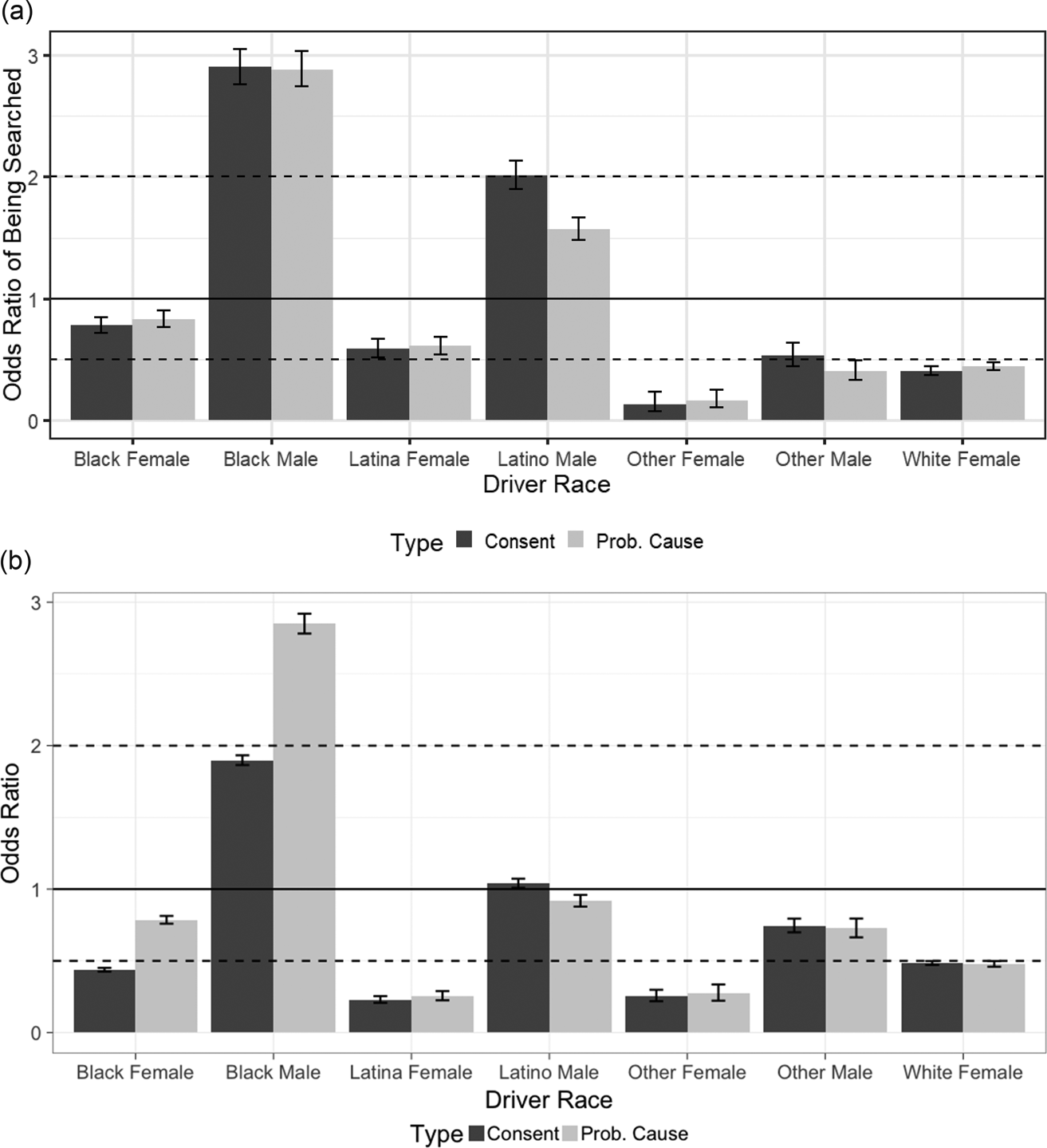
To evaluate the substantive significance, we can examine the increase or decrease in the odds of being searched (the odds ratio) for each race–gender group compared to a white male driver being stopped. These are presented in Figure 3, with subfigure (a) for IL and subfigure (b) for NC. Equal odds are indicated by the solid horizontal line.
Odds-ratios of being searched, by race–gender of the driver. (a) IL. (b) NC

The figure demonstrates that in both IL and NC, black male drivers are more than twice as likely to be searched as white male drivers (in IL, they are almost three times as likely). Conversely, white women are about half as likely to be searched as their male counterparts in both states. Interestingly, the relative odds of Latino men experiencing a search compared to white men differs drastically between the two states. In IL, Latinos are almost twice as likely to experience a search, while in NC, they see approximately equal odds to white men. These results demonstrate that the race and gender of the driver are robust predictors of the likelihood of a search occurring. So, we find both statistical and substantive support for our first hypothesis.
Next, we turn to an evaluation of our second hypothesis, which concerns the race of an agency's police chief. First, we evaluate the relationship between police chiefs and the probability of a driver being searched in that jurisdiction. A negative and statistically significant coefficient associated with the presence of a black chief would constitute support for our hypothesis.
Figure 4 plots the relative odds of a driver being searched if stopped where the local agency is headed by a black or Latino police chief relative to a white chief.
Odds-ratios of being searched, by search type and race of the police chief. (a) IL. (b) NC

In IL, stops made by officers belonging to agencies headed by a black and Latino chief are less likely to result in searches, almost regardless of search type (the exception is Latino chiefs in the case of consent searches, which is not statistically significantly different). Under black chiefs, officers are about approximately 25% less likely to search drivers than if they operate in jurisdictions overseen by white chiefs—across all types of searches. Officers under Latino chiefs are approximately 30% less likely to perform probable cause searches than those under white chiefs. In NC, the story is less clear. In jurisdictions headed by black police chiefs, consent searches are less likely to occur, while probable cause searches are more likely. Consent searches take place when there is no compelling legal reason why an officer should conduct a search, which is why they require a motorist's consent. As such, they are the search type where officer discretion is the highest and therefore the most likely to be scaled back by police chiefs interested in promoting a less high-contact style of policing.
Finally, we can evaluate what our models tell us about the relationship between our control variables. First, in NC, if a written consent policy is in place, drivers are less likely to be searched. Second, findings with respect to many of the municipal-level variables reinforce what previous studies have found: first, on average across the regressions, as the percentage of citizens with less than a high school diploma increases, the probability of search increases; second, as the percentage of the population living below poverty increases, the probability of search increases; and third, as the crime rate increases, the probability of search increases. The stop control variables support what previous studies have shown: those driving older cars are more likely to be searched in IL; those stopped by high disparity officers are more likely to be searched in NC; and those who are older are less likely to be searched in either state (shown in the Appendix). Results are mixed or inconsistent regarding the several of the demographic control variables: population size, proportion recently moved, proportion foreign born, and proportion black.
As with any statistical test on observational data, a concern is that the particular model specification and measures used may influence the results. To address this, we run three sets of robustness checks. First, we adopt two alternate modeling strategies to test whether this impacts our findings: (1) instead of separately modeling each search type, we jointly model them using multinomial regression (Table D1); and (2) we run regressions on subsets of the data based on stop purpose to test whether stop purposes induce entirely different processes and alter the results (Tables D2 and D3). In the first case, the results remain substantively and statistically the same. In the second, some variation is seen with regards to chief race but not driver race and gender. In NC, chiefs of color seem linked to lower rates of consent searches following safety stops, while in IL, chiefs of color seem linked to lower rates of consent searches (and probable cause searches) following investigatory stops.
Then, in the last two robustness checks, we examine whether the results change when alternative measures are used. We test whether our decision to create an indicator variable that jointly captures driver race and gender rather than interacting two indicator variables—(1) race and (2) gender—alters the results. In this case, the statistical results are the same. However, one can more clearly see that drivers of color regardless of gender are, on average, searched at higher rates than white drivers (Table E1). Finally, we tested whether using alternate measures for the municipal context variables alters the results: (1) measuring crime using the component parts of the overall crime rate (Tables E2 and E3), (2) measuring the economic context with percent unemployed rather than percent living below the poverty line (Table E4), and (3) measuring local diversity with (a) a reverse Herfindahl index or (b) the percent foreign born and percent not-white (Tables E5 and E6). Overall, the results remain the same. However, conflicting results across states with regards to municipal characteristics remain.
In summary, black and Latino men are much more likely to experience a search than any other race–gender group, and the importance of race persists despite multiple control variables measuring such things as the crime rate, poverty, demographics, and other factors that affect police behavior. Additionally, we find conditional support for the importance of the descriptive characteristics of the head of the police department. In IL, at least, the presence of a black police chief leads to a decline in searches of all types. In NC, a black chief leads to a decline in consent searches.
Discussion
The relevant laws mandating the collection of traffic stops statistics were uniformly motivated by concerns about the possibility of racial disparities (see Baumgartner, Epp, and Shoub Reference Baumgartner, Epp and Shoub2018, chapter 2). It makes sense then to employ these data for their intended purpose, which is what we do here. Looking at more than 5 million traffic stops in the two states that provide the most extensive data, we have asked a simple question: Are black and Latino male drivers searched at higher rates than white male drivers, and do these disparities remain after we control for potentially spurious or legally relevant factors that might explain them? The answer is that disparities are large and robust, even after controlling statistically for every variable made available. Few agencies are racially neutral in the odds of searching black, Latino, and white drivers after a routine traffic stop, and their greater rates of searching black or Latino drivers cannot be explained by “extraneous” factors, at least not any factors which are systematically collected by law enforcement officers or available through such sources as the U.S. Census or the FBI's crime reports. Indeed, we go well beyond previous studies to look at factors such as poverty and crime rates. These contextual factors are indeed strong predictors of higher rates of discretionary search. Systemic factors clearly matter. However, and crucially, the identity of the driver remains a powerful predictor even when these contextual factors are included in the model.
Substantively, our conclusions are very troubling. In its review of the Ferguson, MO, Police Department, the U.S. Department of Justice discovered that black drivers were 75% more likely to be searched after a traffic stop than white drivers. In this analysis covering millions of stops in many agencies across two states, the average disparity is much higher for black men. Black men are 123% more likely to experience a discretionary search in NC, all else equal, and 194% more likely to experience such a search in IL, all else equal. This disparity is not explained by individual, departmental, or municipal characteristics. It is solely explained by the race of the driver stopped.
Despite the disconcerting role that the race of the driver consistently plays in structuring individuals' interactions with the police, our analysis does contribute something slightly more hopeful: black leadership of the police department may work to combat these effects. In IL, the presence of a black police chief led to a decline in all types of discretionary searches. In NC, this presence led to a decline in consent searches, which, due to their highly discretionary nature, are thought to be a major driver of racial disparities in traffic stops. So, despite the persistence of such disparities, there is some indication in this study that representation may be a way forward in ameliorating such targeting. Of course, this finding should be subjected to confirmation and further study, particularly since a small proportion of agencies had black or Latino chiefs.
Here, we have given no insights into what is generating these racial disparities, except to document that nothing in the current data collection protocols used by most police agencies explains them away. If there are other factors absent from our datasets that might explain away these racial differences, then police departments should start collecting that data to better understand the dynamics at play and to help improve the relationship between the police and the communities they serve. Existing datasets, which are extensive, point to large, widespread, and statistically robust, racial disparities. If they cannot be accounted for by contextual factors, then they must be confronted and accepted for what they are.
Supplementary material
To view supplementary material for this article, please visit https://doi.org/10.1017/rep.2020.8