Introduction
Allergic rhinitis is the most frequent chronic, atopic disease with an increasing prevalence and one that affects 10–20 per cent of the world population.Reference Salib, Drake-Lee and Howarth1, Reference Brozek, Bousquet, Baena-Cagnani, Bonini, Canonica and Casale2 The differential diagnosis is made after a detailed clinical history, which includes the typical symptoms of allergic rhinitis, is taken and a physical examination and diagnostic tests are carried out.Reference Kurt, Metintas, Basyigit, Bulut, Coskun and Dabak3 Copious amounts of serous nasal discharge, nasal congestion, sneezing and nose/throat itching are the four major symptoms of allergic rhinitis. Besides these main symptoms, post-nasal drip, eye itching/watering, headache and hyposmia are the symptoms encountered less frequently.Reference Angier, Willington, Scadding, Holmes and Walker4
Skin tests have been used frequently in the diagnosis of allergic rhinitis to demonstrate the immunoglobulin E (IgE)-mediated allergic response in the skin. They are the most frequently used tests for the diagnosis of an allergy.Reference Bousquet, Khaltaev, Cruz, Denburg, Fokkens and Togias5 Allergens applied during a skin test crosslink the specific IgE antibodies that are bound to the mast cell receptors and cause the release of mediators, such as histamine, in allergic patients.Reference Gendo and Larson6 After 15–30 minutes, vasodilation, itching due to increased capillary permeability, erythema and induration occur due to the early response of the allergic reaction. The skin prick test is the most frequently used skin test as it demonstrates an allergic response to a specific allergen; it is evaluated by measuring skin induration and erythema.Reference Bousquet, Khaltaev, Cruz, Denburg, Fokkens and Togias5
Allergic rhinitis is normally classified as either seasonal or perennial. Classically, the symptoms of seasonal allergic rhinitis are claimed to develop in response to outdoor allergens, such as grass and tree pollen, while perennial allergic rhinitis is due to indoor allergens, such as moulds and house dust mites.Reference Young, Finn and Kim7
Since some allergic patients are symptomatic to perennial allergens for short periods, pollination periods are different in different countries and allergic inflammation goes on even in the absence of symptoms, it was thought that the classical classification of allergic rhinitis was not sufficient for daily practical use. Therefore, in 2001, the Allergic Rhinitis and its Impact on Asthma group, in collaboration with the World Health Organization, reclassified allergic rhinitis. According to this classification, allergic rhinitis patients are categorised into two groups: intermittent and persistent. Patients who have symptoms for less than 4 days a week or less than four weeks in a year are classified into the intermittent group while patients who have allergic rhinitis symptoms for more than 4 days a week or more than four weeks in a year are classified into the persistent group. In addition, patients are categorised into ‘mild’ or ‘moderate to severe’ groups. In the mild group, sleep, work and the social activities of patients are not affected by the disease. In the moderate to severe group, all of these parameters are affected.Reference Bousquet, Van Cauwenberge and Khaltaev8, Reference Ebert and Pillsbury9
In the literature published in English, only a few studies have compared the Allergic Rhinitis and its Impact on Asthma classification with the symptoms of allergic rhinitis and the skin prick test results. In our study, we aimed to investigate such a relationship.
Materials and methods
This retrospective study analysed the records of 268 patients with allergic rhinitis who were diagnosed and treated at the otorhinolaryngology clinic of the Ankara Numune Education and Research Hospital, Turkey, between 2005 and 2010. All patients had the symptoms of allergic rhinitis and were allergic to at least one allergen in our skin prick test battery. The study was approved by the Scientific Research Review Committee of the Ankara Numune Education and Research Hospital.
Age, gender, symptoms, symptom severity and duration, the event that triggered the symptoms, family history, previous surgeries, smoking status, allergen positivity and degree of positivity in the skin prick test, and the classification of the patient according to the Allergic Rhinitis and its Impact on Asthma classification were collected retrospectively from the patients’ files and reviewed.
Patients’ symptoms were grouped as ENT, eye and chest symptoms. The ENT symptoms included nasal discharge, nasal congestion, nose/throat itching, sneezing, post-nasal drip, headache and hyposmia. The eye symptoms included eye itching/watering and swelling of the eyelids. The chest symptoms included coughing, dyspnoea and wheezing. The symptoms were graded using a 5-point scale: 0 – no symptoms; 1 – mild symptoms; 2 – moderate symptoms; 3 – severe symptoms; 4 – extremely severe symptoms.
The Allergic Rhinitis and its Impact on Asthma classification of patients was as follows: group 1– mild intermittent group; group 2 – moderate to severe intermittent group; group 3 – mild persistent group; group 4 – moderate to severe persistent group. The groups were compared for age, gender, symptoms, symptom severity and duration, the event that triggered the symptoms, family history, previous surgeries, smoking status, allergen positivity and the degree of positivity in the skin prick test.
Analysis of the data was performed using SPSS for Windows version 11.5 (IBM Corporation, Armonk, New York, USA). One-way analysis of variance was used to analyse the intergroup comparison of continuous variables. The Kruskal–Wallis test was used for ordinal variables; a value of p < 0.05 was regarded as being statistically significant.
Results
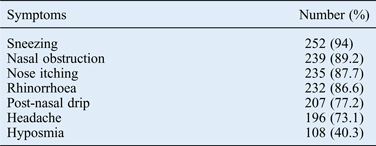
The cohort of 268 patients comprised 155 females (57.8 per cent) and 113 males (42.2 per cent). The patients’ ages ranged between 15 and 77 years with a mean of 30.68 ± 10.65 years. Sneezing was the most commonly reported ENT symptom. The frequencies of ENT symptoms are presented in Table I.
Frequencies of ENT symptoms

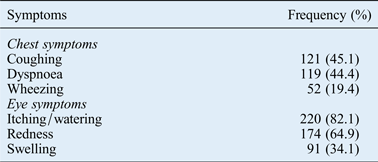
When patients were analysed for other symptoms, the most frequent symptom among the chest symptoms was coughing (121; 45.1 per cent), with eye itching/watering as the most common symptom among the eye symptoms (220; 82.1 per cent). The frequencies of chest and eye symptoms are presented in Table II.
Frequencies of chest and eye symptoms
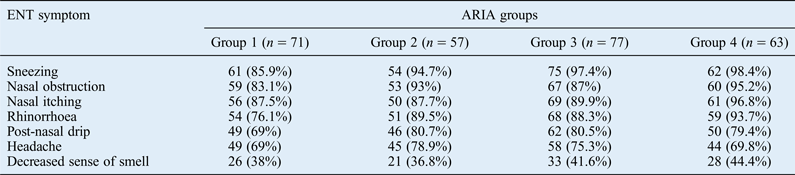
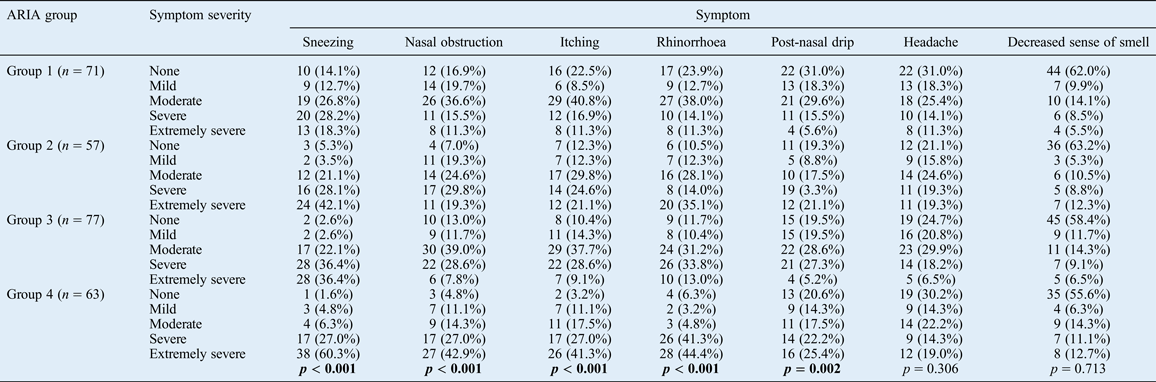
The grouping of patients according to the Allergic Rhinitis and its Impact on Asthma classification yielded the following: 71 (26.49 per cent) patients in group 1, 57 (21.26 per cent) in group 2, 77 (28.73 per cent) in group 3 and 63 (23.51 per cent) in group 4. Gender distribution between the groups was similar. The mean age of groups 3 and 4 was significantly lower than that of group 1. The frequencies of ENT symptoms in the Allergic Rhinitis and its Impact on Asthma groups are presented in Table III.
Frequencies of ENT symptoms in the ARIA groups
ARIA = Allergic Rhinitis and its Impact on Asthma
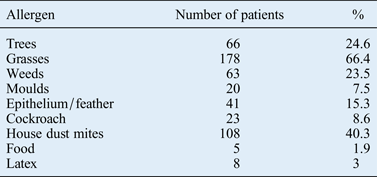
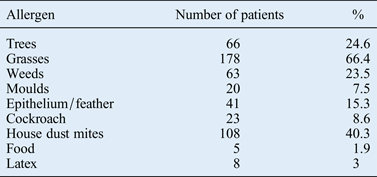
Analysis of the skin prick test results showed that the most frequent allergens were grass pollen followed by house dust mites (Table IV).
Distribution of allergens as determined by skin prick test positivity
There were statistically significant differences among the Allergic Rhinitis and its Impact on Asthma groups with regard to sneezing, nasal obstruction, rhinorrhoea and post-nasal drip. The severity of ENT symptoms increased as the group number increased (i.e. mildest in group 1 and most severe in group 4) (Table V).
Distribution of ENT symptoms in the ARIA groups
ARIA = Allergic Rhinitis and its Impact on Asthma; p < 0.05 statistically significant
The most frequent chest symptom was coughing and the least frequent one was wheezing. Among the chest symptoms, only the severity of wheezing was significantly different between groups 2 and 4. Eye itching/watering was the most frequent symptom among the eye symptoms, while eye swelling was the least frequent one. All eye symptoms were most frequently observed in group 4. The severity of eye itching, watering and redness increased from group 1 through to group 4 (i.e. mildest in group 1 and most severe in group 4).
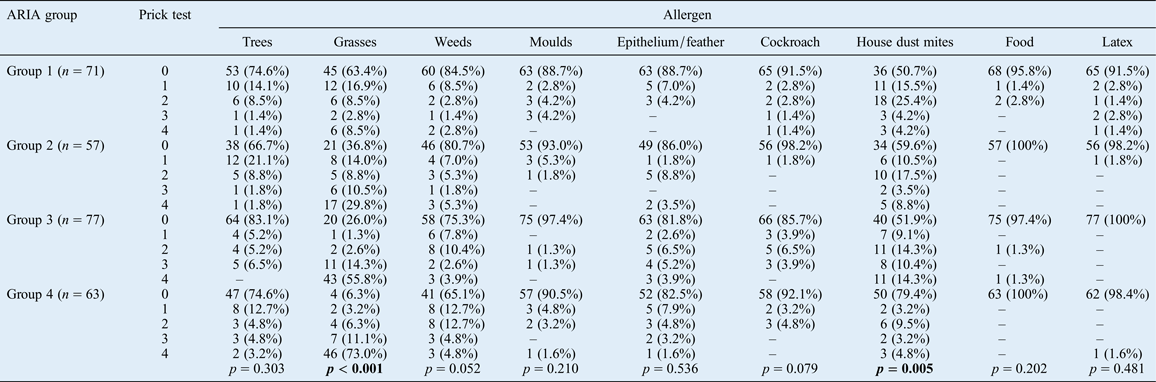
The correlations between the degree of positivity of the skin prick test (+1, +2, +3 or +4) and the Allergic Rhinitis and its Impact on Asthma groups were investigated. For grass pollen, a positivity of +4 was more frequent in groups 3 and 4 when compared to groups 1 and 2, and patients who did not have a grass pollen allergy were more frequently found in groups 1 and 2. House dust mite allergy was significantly more frequent in group 4 when compared to groups 1 and 2. The distribution of allergens and the degree of their positivity in the Allergic Rhinitis and its Impact on Asthma groups are presented in Table VI.
Distribution of the severity of allergen positivity according to the skin prick test results
ARIA = Allergic Rhinitis and its Impact on Asthma; – = not recorded; p < 0.05 statistically significant
Discussion
Anastassakis et al. in a study of 623 allergic patients, found nasal discharge in 91.3 per cent, nasal obstruction in 91 per cent and sneezing in 85.7 per cent.Reference Anastassakis, Chatzimichail, Androulakis, Charisoulis, Riga and Eleftheriadou10 In a different study, Mohammadi et al. found nasal discharge in 77.7 per cent, nasal obstruction in 68.4 per cent, sneezing in 67 per cent, nasal itching in 57.8 per cent and a decreased sense of smell in 21.7 per cent of their patients.Reference Mohammadi, Gharagozlou and Movahedi11 In our study, sneezing was the most frequent symptom and seen in 252 of 268 patients (94 per cent). Nasal obstruction (89.2 per cent) and itching (87.7 per cent) followed this symptom.
The frequency of allergens varies according to geographical region. Holopainen et al. reported that house dust mites (44 per cent) were the most common allergens followed by tree and grass pollen (30–40 per cent) in Nordic countries.Reference Holopainen, Salo, Tarkiainen and Malmberg12 However, Yasan et al. found that grass pollen was the most common allergen (70.5 per cent) in Turkey, followed by weeds (45.9 per cent), house dust mites (35 per cent) and tree pollen (25.2 per cent).Reference Yasan, Aynali, Akkuş, Doğru, Özkan and Şahín13 Antonicelli et al. reported that grass pollen (57.6 per cent), house dust mites (47.2 per cent) and Parietaria officinalis (41.3 per cent) were the most frequently encountered allergens in Italy.Reference Antonicelli, Micucci, Voltolini, Feliziani, Senna and Di Blasi14 In our study, grass pollen (66.4 per cent), house dust mites (40.3 per cent), tree pollen (24.6 per cent) and weeds (23.5 per cent) were the most common allergens.
Asha'ari et al. investigated the correlation of symptoms with the Allergic Rhinitis and its Impact on Asthma groups and found nasal/ocular itching and sneezing most frequently in patients with intermittent allergic rhinitis.Reference Asha'ari, Yusof, Ismail and Che Hussin15 Similarly, Popovic-Grle et al. demonstrated that nasal discharge and sneezing were more frequent in the intermittent group and nasal obstruction in the persistent group.Reference Popovic-Grle, Vrbica, Jankovic and Klaric16 However, nasal discharge, obstruction, itching and sneezing were significantly more severe in the moderate to severe persistent group. There were no differences between the mild persistent and moderate to severe intermittent groups with regard to nasal discharge, obstruction, itching or sneezing. There was no difference between the mild persistent and mild intermittent groups for the severity of nasal obstruction; however, a statistically significant difference was noted between the mild intermittent and moderate to severe intermittent groups. The mild persistent group had significantly less severe post-nasal drip. Unlike other studies, we found that nasal discharge, obstruction, itching and sneezing were significantly more severe in the moderate to severe persistent group. On the other hand, the severity of nasal discharge, obstruction, itching and sneezing was not found to be different between the moderate to severe intermittent and mild persistent groups.
Popovic-Grle et al. found coughing in 40 per cent of the intermittent group and in 52 per cent of the persistent group, wheezing in 30 per cent of the intermittent group and in 25 per cent of the persistent group, and dyspnoea in 39 per cent of the intermittent group and in 49 per cent of the persistent group.Reference Popovic-Grle, Vrbica, Jankovic and Klaric16 Mohammadi et al. determined the wheezing prevalence as 39.8 per cent and 34.2 per cent in the intermittent and persistent groups, respectively.Reference Mohammadi, Gharagozlou and Movahedi11 There were no differences between the groups for coughing and dyspnoea in our study; however, wheezing was seen in 11 (15.5 per cent) patients in the mild intermittent group, 7 (12.3 per cent) patients in the moderate to severe intermittent group, 15 (19.5 per cent) patients in the mild persistent group and 21 (33.3 per cent) patients in the moderate to severe persistent group. With regard to wheezing, there was a statistically significant difference between the moderate to severe persistent group and the intermittent groups.
Lee et al. found conjunctivitis in 60.6 per cent of the mild intermittent group, 77.2 per cent of the moderate to severe intermittent group, 65.4 per cent of the mild persistent group and 80.3 per cent of the moderate to severe persistent group, and stated that it was significantly more frequent in the moderate to severe groups compared to the mild intermittent groups.Reference Lee, Jang, Lee, Kim, Chu and Kim17 Popovic-Grle et al. found eye irritation in 49 per cent of the intermittent group and 25 per cent of the persistent group, respectively, and stated that they were more frequent in the former.Reference Popovic-Grle, Vrbica, Jankovic and Klaric16 Bauchau and Durham analysed the frequency and severity of conjunctivitis and found that it was significantly more frequent in the persistent group compared to the intermittent group.Reference Bauchau and Durham18
Our study showed eye itching/watering in 50 (70.5 per cent), 44 (77.2 per cent), 66 (85.7 per cent) and 60 (95.2 per cent) patients in the mild intermittent, moderate to severe intermittent, mild persistent and moderate to severe persistent groups, respectively. These values were 45 (63.4 per cent), 34 (59.6 per cent), 51 (66.2 per cent) and 51 (81 per cent), respectively, for eye redness and 22 (30 per cent), 19 (33.3 per cent), 24 (31.2 per cent) and 27 (42.9 per cent), respectively, for eye swelling. There was no difference between the groups for eye swelling; however, eye itching/watering and redness were significantly more frequent in the moderate to severe intermittent group. Although in contrast with the study by Popovic-Grle et al. our results are similar to those of other studies.Reference Popovic-Grle, Vrbica, Jankovic and Klaric16–Reference Bauchau and Durham18 It was noted that eye symptoms were more frequent and severe when symptom duration was long and quality of life was adversely affected.
Lee et al. investigated the relationship between the Allergic Rhinitis and its Impact on Asthma classification and skin test positivity, and did not find a difference between the groups for the studied allergens.Reference Lee, Jang, Lee, Kim, Chu and Kim17 Similarly, Mohammadi et al. did not find any difference between the intermittent and persistent groups for skin prick test positivity.Reference Mohammadi, Gharagozlou and Movahedi11 Bauchau and Durham found grass pollen sensitisation more frequently in the persistent rhinitis group while mite sensitisation was more frequent in the intermittent rhinitis group.Reference Bauchau and Durham18 Our study demonstrated a significant difference between the Allergic Rhinitis and its Impact on Asthma groups for grass pollen and house dust mite allergens. ‘Seasonal’ grass pollen allergens were significantly more frequent in the moderate to severe persistent group while ‘perennial’ house dust mite allergens were more frequent in the mild persistent and mild intermittent groups when compared to the moderate to severe persistent group. In addition, the degree of positivity for grass pollen was higher in the persistent group compared to the intermittent group. The mild intermittent, moderate to severe intermittent and mild persistent groups were not different with regard to the degree of positivity to mite allergens while the degree of positivity was less pronounced in the moderate to severe persistent group compared to the mild persistent and mild intermittent groups.
• Our study has shown that the seasonal/perennial classification of allergic rhinitis, which is based on causative allergens, does not reflect either the duration or severity of symptoms
• The Allergic Rhinitis and its Impact on Asthma classification takes into consideration symptom duration and quality of life in addition to allergen exposure and is thus a useful classification for allergic rhinitis
Unlike other studies, we found grass pollen allergy to be more frequent in the moderate to severe intermittent group and house dust mite allergy more frequent in the mild intermittent and mild persistent groups. These results are in agreement with the results of the study by Bauchau and Durham, which measured serum-specific IgE antibodies.Reference Bauchau and Durham18