When a teacher or politician tells you that we no longer exist, you can tell them you know it's not true, because you have seen us dance.
—Chief Tony Cerda, Costanoan Rumsen Carmel Tribe (Ohlone)In 2008, six Ohlone elders asked Mary Jean Robertson, the Cherokee co-director of the Ohlone Profiles Project, and me to engage in four cycles of ceremonies at Ohlone sacred sites in San Francisco. They wanted to dance where they could reconnect with their ancestors in ceremony, and with their ancestors' guidance make their lives more visible in San Francisco. We were talking at Ann Marie Sayers' place, “Indian Canyon,” with its remote waterfall that had been a ceremonial gathering place for Ohlone long after central California had been colonized. Up until the 1920s, Ann Marie's ancestors had hosted Ohlone escapees from the Missions and the Rancherias. Indian Canyon is the only parcel of Ohlone Territory (Bay Area and central California coast) that has never been taken from Ohlone hands. As its chair, Ann Marie has been a visible Ohlone leader who would come to San Francisco to bless new buildings, parks, murals, and exhibits, and would always offer a gracious, though poignant “welcome to Ohlone Territory” in her blessing. At our meeting in 2008 she framed the request for the group: “Ohlone people can sing, dance, and pray in the remote hills near Hollister, the mud flats and marshes east of San Jose, and the industrial areas of west Oakland, but if we do not appear in San Francisco, we will remain invisible.”
In the 1980s I lived in a collective house with San Francisco–based choreographers and performance artists Keith Hennessy and Jess Curtis, I helped with the site specific work of Sara Shelton Mann's Contraband, and I volunteered protecting native species in the canyons at San Bruno Mountain, a mountain visible from my bedroom window. There, I had met a local hero, the San Bruno Mountain Man, who taught me to see unmarked Ohlone village sites alongside the highway on the way to the airport, and ancient outdoor kitchens among the rocks along the tiny stream in one of the mountain canyons. The Mountain Man, David Schooley, also taught me that there were living Ohlone I could meet. Their culture was not recognized or protected, he said, but because they had lived among the lupine that host the larvae of an “endangered” butterfly species, since 1973, their ancient sites on San Bruno Mountain were protected by a kind of coincidence, alongside the lupine. In 1992, after returning from a gathering of people in Guatemala to “Celebrate 500 Years of Resistance to Colonization,” I brought Rosemary Cambra, Chair of the Muwekma Ohlone, and nine other Native Americans and supporters to a village site on San Bruno Mountain's edge, outside the protected area, threatened with high rise development. That was the first time I called a gathering to support Ohlone culture. It didn't go well. Rosemary didn't have free time to accept another threatened site on her to-do list. The Sioux, Cherokee, and Lakota I had assembled from San Francisco couldn't help because they wanted Ohlone leadership. The whites, with our can-do optimism, were irritating and naive about what we could accomplish. The Mountain man recited an Ohlone poem, “I am dancing. On the edge of the world I am dancing,” and Rosemary interrupted, asked him to stop, and threatened to leave. (Ten years later, David Schooley and Patrick Orozco succeeded in bringing the village site under the park's protection.)
The next time I saw Rosemary was in 1996 when she agreed to introduce the Santee Sioux author and leader John Trudell, whom I was presenting to read his poetry at the Unitarian Universalist Society. Rosemary wanted to welcome the poet to Ohlone Territory. Trudell's radio broadcasts during the Red Power Movement's Occupation of Alcatraz Island had brought him respect across Native America as well as among many white supporters. During his 90 minute talk at the society, a talk we later published and titled “We All Come from Tribes,” John spoke about the history of war and mental disease that had plagued Europeans for centuries in Europe before any Europeans ventured to the Americas. He said that if the descendents of Europe wanted to support Indigenous people we might start by traveling to our ancestral lands in Europe and learning what happened in our own history, to our own ancestors. He offered that “we all come from tribes” (Ohlone Profiles N.d.b), and that our differences were the result of the history of our people's since that tribal life we had in common. I traveled to Scotland three times after that, looking back to the only traceable past I have. Relatives there showed me where the forest fires that the British set had burned and spread for five years, clearing our ancestors out of the forests onto the beach, where they waited behind wind breaks made of rocks for boats to carry them to Nova Scotia. They also showed me the ancient Island of Iona, where all the Chiefs from the highlands are buried, where the ornate carved stone grave markers hearken to the more ancient, 3,000- to -11,000-year-old stone monuments placed on top of all the hills in the region.
These three trips to my clan's territory were some of the journey that led me to Indian Canyon in 2008. When Ann Marie asked for a deeper vision connecting me to Ohlone sacred sites. I shared how, in 1969, as a teenage runaway, I had heard voices singing inside the sounds of a stream in a forest, and how I had thought those watery voices were listening for human voices to sing back to them. I told Ann Marie I wanted to hear Ohlone sing next to the waters of San Francisco, where their ancestors were buried, just as I had heard my clan's songs on Iona, songs that are among the oldest known songs of Europe, made to accompany dead Chiefs as they were carried across the highlands and out to the island of Iona, and buried.
After that meeting at Indian Canyon, and with support of those who were there, my friend Mary Jean Robertson and I began to co-direct a small arts project called Ohlone Profiles that has since produced 18 Ohlone events in San Francisco: week-long clan initiation ceremonies, four-day dances around spirit fires, sweat lodges, and cultural presentations across many of San Francisco's great stages.
A turning point in Ohlone visibility came during the three events co-produced with the San Francisco Ethnic Dance Festival during their 2011 five-week season. The first event had the Rumsen Ohlone dance underneath the rotunda at City Hall, and the interim (faux) mayor welcomed them back to their homeland and asked if he could “join one of their little lodges,” and Rumsen Costanoan Ohlone Chief Tony Cerda, always on cue, invited the mayor to sweat. In the second event, the Rumsen's “Humaya” (hummingbird) dancers graced the Yerba Buena Center for the Arts, whose name recalls a native plant used for tea that still thrives on San Bruno Mountain. The Humaya dancers opened and closed the five-week-long festival that presented over 40 Indigenous groups from around the world, including Bali, Cambodia, Zimbabwe, Norway, Central Asia, and Peru—peoples who now find themselves relocated to Ohlone Territory and for the first time had the opportunity to meet, sing, and pray with the original people of their new home.
The week before the final performance, we staged the first California Native dance festival in San Francisco's modern history, on a lawn at 4th and Mission, adjacent to the architectural curtain of water that falls over the Moscone Center, and is surrounded by high rises. The lawn has a unique design. It is made of six inches of soil over a mesh of Styrofoam and gravel, over a plastic and tar-based pad, over cement, over the ceiling of a convention center. Our spirit fire burned at the center of the dance arena over the vast convention center. The permit had taken six months and six draft drawings to obtain, but Chief Cerda had always said that he knew they couldn't stop the dances: “Since 1978, when the American Indian Religious Freedom Act passed, the government can no longer stop us from praying. The dance and fire are sacred.”
The first chance I had to support Chief Tony Cerda and the Rumsen Ohlone make a ceremony was in 2010 at the opening of the Eco-Center Classroom at Heron's Head Park. Our community partner, Literacy for Environmental Justice (LEJ), had been building a stand-alone classroom there for more than a decade and it was finally to be unveiled. The new building sat atop the ridge of a small spit stretching out into San Francisco Bay. Its roof was a garden of native plants. Inside, the captured rain water and waste water were mixed in three vats, progressively cleaned by bacteria, and finally spilled into a marsh whose ancient Tule plants provide the finishing cleanse. Ohlone lived in and near Tule marshes, and built houses, boats, skirts, almost everything out of the reed. Beyond the classroom, just outside the window, the shoreline marsh restored by LEJ hosts murrelets, egrets, heron, plovers, and a rare avocet. LEJ had built a classroom that was off the power grid, off the water and sewage system, off the edge. The Eco Center's classroom would tell the story of recovering nature, with a garden on the roof. Now, they promised it would become the first place where Ohlone would be truly welcome in San Francisco.
I introduced Chief Cerda to Malik Looper, the director of LEJ, several months before the eco classroom's opening. Malik told Tony that after it opened he would give him the keys. Malik wanted their dancing ceremony to bless the opening of LEJ's more than ten-year building process, an undertaking whose vision had driven them so hard that LEJ was near collapse. Malik said that the Ohlone could sleep in the eco-center during the opening, build a fire beside the trail, and dance the central clan ceremony on the upland late into the night. As the opening day approached, money shortages, late contractors, and conflicting jurisdictions (Port Authority, City of San Francisco, County of San Francisco, Parks and Recreation, the Building Department), all converged while the harried LEJ staff pressed on.
The first Ohlone participant, Daniel Spinningwind, arrived on Thursday. He set the fire that would burn for four days and offered salmon, honey, and berries to the flames. He sang and prayed and made a small hut on top of a mat rug. It took most of the next day for complaint calls to authorities to rise to the office of the Supervisor of the San Francisco Port Authority. Monique Moyer, in an onsite visit, ultimately decided it was okay for the Ohlone to have their fire, tent, and ceremony. (Malik, in a fit of frustration with permits, had decided to fly under the bureaucratic radar until we emerged in plain sight the day before the ceremony.) By nightfall of day two, over fifty Ohlone were in the parking lot. They had brought sleeping bags, food, and cookout gear, but Malik had told Tony they could stay in the eco-classroom as they hadn't brought tents. Malik's staff, charged with completing the building before the opening on Sunday, had told the electricians they could work 24 hour shifts in order to complete their work in time. Where would the Ohlone sleep?
Spinningwind's 20-year-old son, Russell, had gotten some hard alcohol and expressed centuries of frustration: “Why do they always lie to us? Why do they promise to share with us and then take it back? Why do we have no place to stay?” Tony was stroking his hair and holding his head in his lap, “They aren't mean. They just don't know what they are saying. They don't know what it means to us.”
The next night we all joined the dance outside, the first ceremony of our cycle. The fire lit sky brightened our bodies and its smoke, aided by the winged dancers, carried our sickness to the creator.
It's been five years and eighteen major events since that first ceremony. Our work has settled into producing two major events: one mainly internal, focused on Ohlone people meeting and sharing with each other, and the other focused on bringing tribal groups together for an outdoor dance festival. California tribal groups call it a Big Time Gathering. The form of the Big Time has developed over the last fifty years. According to David Smith, a dance captain from the Manchester Point Arena Pomo, few of the dancers could afford to travel even up until the 1980s. Most danced on their own reservations for their own tribal members. A few people, like David, the mentee of the renowned Essie Parish, “the last California sucking doctor,” would travel from one reservation to another teaching songs and dances, inspiring and renewing interest, and establishing new dance groups. After the 1980s, some of the tribal dance leaders started to get enough money to pay for gas and expenses, so they could host groups from neighboring tribes. A tradition of family groups hosting each other emerged, and a few of the annual gatherings gained reputations where twenty or more groups would dance day and night. Later, some of the casino tribes began to host Big Times and afforded the expenses for many dance groups. Today there are dozens of Big Times throughout the summer and fall.
Powwows, the closest thing most North Americans might compare to a California-style Big Time Gathering, gained visibility after World War II. Powwows grew out of tribal warrior societies as public honor dances for returning Native American WWII veterans. The Powwow has become the signature intertribal form of Native American dance. California gatherings are tiny by contrast. Unlike powwows, they are non-competitive, they are almost always rural, in parks or reservations, and in practice they are almost exclusively attended by California Natives. The Big Times grew with the influence of the Civil Rights–era Red Power movement as ways to uplift belonging with pride and community affirmation. Each of the Big Times engages unique combinations of family and tribal network, tribal cultural committees, tribal officials, civic or town committees, and park service staff. But in every case the main action is to gather to express pride by dancing for other Natives and celebrate cultural renewal.
Ohlone Profiles' first Big Time took place in 2011 in downtown San Francisco as part of the Ethnic Dance Festival. The following year we began hosting our own gatherings in Golden Gate National Park. Our largest gathering was in 2013, when seven tribal groups came to our camp in San Francisco for two days. The dance arena is the centerpiece of these gatherings, surrounded by booths of art and craftwork, tables for organizing support for issues, and food booths.
When we began to spread the invitation to a Big Time Gathering in San Francisco and described how our funding came through the SF Arts Commission, it was a new kind of request. It did not come from a park or tribally based organization, but from a city-based initiative to restore Ohlone culture and teach its residents about Ohlone cultural survival. As far as I know, no urban municipality in the U.S. honors its original people. There are intertribal centers in some cities, especially cities that the federal government's relocation policy chose as urban end points for relocation, such as Minneapolis and Seattle. The exception is Sante Fe, where an Indigenous tribal nation represents its own culture in an urban environment. Nationwide the pattern remains that the city is a site of relocation, genocide, and exclusion. Well before California statehood, San Francisco adopted the Mexican government's Rancheria boundaries as the dominant land ownership pattern, granting huge tracts that later transferred to banker and developer estates. The Ohlone exclusion from the land continues in an ongoing line back to the colonial era's pre-Mexican Mission and Presidio.
San Francisco and Oakland, like Minneapolis and Seattle, had been an end point for tribal relocation. Twenty thousand Native Americans were officially relocated off reservations to San Francisco and Oakland in the 1950s. Those relocated Natives have accomplished many things, including becoming the urban center of the Red Power movement, a victory that educated thousands of people in the Bay Area about First Nation histories and federal Tribal Termination Policy. But it was not until 2007 that the San Francisco Human Rights Commission and the SF Arts Commission called for a policy of Ohlone inclusion. Ann Marie Sayers was among those who had made the arguments convincing (Ohlone Profiles N.d.a).
During our four cycles of ceremonies 2011–2014, we partnered with the largest Ohlone group. The Costanoan Rumsen Carmel Tribe's Humaya Singers and Dancers often brought 50 artists to the outdoor dance arena and to the stages of the city's theaters. Chief Cerda and I had many strategic talks and found lots of common ground. The government decreed all Ohlone tribes terminated in the 1920s and by the early 1930s no groups were recognized. The federal government never anticipated any renewal or rebirth. It never foresaw that Native self-awareness would survive through modernity or undergo the renaissance we are celebrating since Alcatraz. As Ann Marie often says, “Today is the best day to be a Native American since contact with Europe.”
There are nine Ohlone groups appealing to the federal government for “re-recognition.” There are over 400 tribal applicants in the re-recognition process and they are reviewed at the rate of 1.2 per year. As things have been going, it's unlikely that any of the Ohlone applicants will be re-recognized. Powerful leaders like Tony Cerda are able to get hundreds of Ohlone descendents to volunteer to come together to celebrate their culture and 50 or more to dance. But the group's legitimacy is denied by the government. Their village site is near Carmel. They share ancestors who fled the San Francisco Mission in 1834. There are other Ohlone groups with people from villages in Fremont, Carmel, and Vallejo. Tony and I wanted the city's recognition of Ohlone cultural life to provide an institutional pull that might gather a broad group of Ohlone leaders together.
Chief Cerda often says near the end of the one of his group's educational feather dance sets, “When a teacher or politician tells you that we no longer exist, you can tell them you know it's not true, because you have seen us dance.”
The roots of Tony's ceremonial practice go back to meeting with the Pajara Valley Ohlone leader Partick Orozco in the 1990s. Patrick's cultural work began with a song he learned as a child from his grandmother. Later, he learned dozens more from wax cylinder recordings a great cousin had made with the anthropologist J. P. Harrington. Patrick learned more songs from tribal people in the Santa Cruz area. In 1976, a developer was going to destroy a burial site where some of Patrick's ancestors and many other Ohlone were buried. He felt fortunate to meet AIM members who had been on Alcatraz and with them organized a protest of the development and desecration. During the protests he learned more songs, and they succeeded in protecting the burials. He still cares for them today, 40 years later.
About ten years later, in the mid 1980s, Patrick met and began working with Chemo Candelaria. Chemo brought Lakota, Apache, Chumash, and Ute songs with him. Patrick and Chemo began to engage in their own ceremonies and traveled to attend and learn from other tribal groups. It was in 1995 that Tony Cerda met Patrick at a meeting in Washington, DC, and within a week after that meeting Tony came to visit Patrick in his home in Watsonville. Tony soon began engaging in his own ceremonies in the Pomona area. In 2003 Tony brought the ceremonies he had been developing to San Francisco, including a crossover ceremony at the Mission Dolores to help their ancestors finally rest and other ceremonies at the Presidio, both were historic sites where Ohlone had been housed by the first colonization, and pre-historic sites where Ohlone villages had been. As far as I know, this is how the city regained its Indigenous ceremonial dance culture.
On Hiroshima Day, every year since 2010, the Ohlone Profiles Project has engaged in a ceremony adjacent to the Hunter's Point Naval base, where atomic bombs were loaded onto ships in 1945 to be dropped on Hiroshima and Nagasaki. The nearby shore also contains 16 known ancient village sites. During our first four years, we engaged invitation-only ceremonies with Tony. In 2015, for an entire week, we begin two new relationships. We brought Ohlone, Pomo, and Miwok dancers to the LEJ native plant nursery so we could restore portions of a small hill at Sunrise Point in Candlestick Park with native plants from the nursery. We also collaborated during the week with Yup'ik choreographer Emily Johnson who was in San Francisco to present a performance, SHORE: Yelamu, at the LEJ nursery, in Candlestick Park, in the ODC Theater, and in the mural covered alleys of the Mission neighborhood that are ODC's neighbors.
On August 8, 2015, Hiroshima Day, our final gathering, we danced on the shore at Candlestick Point, a blessing for the plants, for the 16 village sites, with the Navy's now closed radiological experimentation laboratory on the horizon, a beach shoreline in the foreground, within the gentle protected cove where a campground will be built and where all of the collaborators are planning to sing and pray in the years to come.
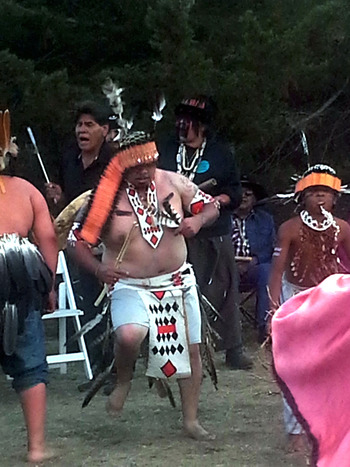
Before relating the specific dances and blessings that culminated our week of dancing and planting that Hiroshima Day, I want to bring out a story about one dancer who joined us that week, Raul Garcia, a Miwok man who had recently concluded nine years of incarceration in California's prisons and 11 months in a recovery clinic, volunteered to tend the fire at our weeklong camp. Photo 1 shows his picture, dancing with us.
Left to right: David Smith, Raul Garcia, Bernedette Smith, Lloyd Rodriquez, and Joe Joe, at Candlestick State Park. Photo credit: Neil MacLean.

One feature of these dances is that they are made and practiced almost entirely for other Native Americans. It is awkward to share this photo, and I wonder how it is seen. Yet my native friends know that for their worldview to survive they have to influence and radically transform settler agreements about property and how we move through it. Only forty years ago, in 1978, the American Indian Religious Freedom Act removed the prohibition of Indigenous dances. This was the first time they had been practiced in this park, or in the area of the sixteen ancient villages, since contact, and this was the first time Raul had been able to rejoin his tribal family. It's as if it's the dances themselves that have been freed.
Raul had to stay at my place for a few weeks recently but made a quick path to getting his own. His search for sustaining work hit a wall when his nine-year-old felony conviction records caused him to be dismissed. Raul is 26. I want to understand how Raul's dancing crosses lines he's prohibited from crossing in any other context—lines sharply defined in the violent practice of the police and the military. I want his picture here to help us understand tribal dance and its interaction with laws, borders, discipline, and punishment.
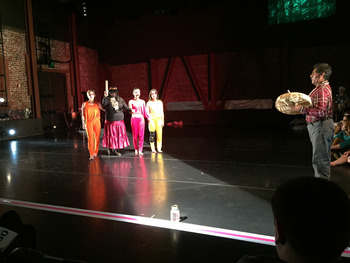
Three days prior, on Wednesday night, as part of Emily Johnson's SHORE: Yelamu, the Miwok and Pomo dance captains Richard Raguda and David Smith brought their singers and dancers into ODC's 200-seat theaters for a night of trading songs and dances with Emily's dancers. Not sure what to expect, and having just come from a day of restoring native plants to Candlestick Park's shoreline, the Miwok and Pomo hadn't brought their drums. But they dove into it, and using the theater's tympani and their clappers, they rocked the house. When it was over, Richard, a dance leader for 20 years, told me he had never been inside a place like that before, an indoor theater made for dancing. Picture a tribal dance director who for twenty years has danced all over northern California, and for the first time had just seen the inside of a theater (Photo 2).
(Left to right) Krista Langberg, Bernedette Smith, Aretha Aoki, Emily Johnson, and David Smith, at ODC Theater. Photo credit: Jacqueline Shea Murphy.

By the time Saturday came around, the four groups had told stories in public, around the campfire, and had danced in a theater and planted Tule, Yerba Buena, and even the nearly extinct and San Francisco–specific, Islais Cherry tree. ODC was scheduled to produce its final performance of SHORE but it conflicted with our culminating ceremony on Hiroshima Day at Candlestick, so ODC cancelled its show when Emily decided to join us in the park.
I was stunned that Hiroshima Day at how everyone came through: Emily Johnson, her band of contemporary dancers, Point Arena Pomo, Central Valley Miwok, and Pajara Valley Ohlone, as well as the city's inter tribal Indigenous dance group Dancing Earth and the Pomo-led world beat music group Audiopharmacy, whose artists and staff came out.
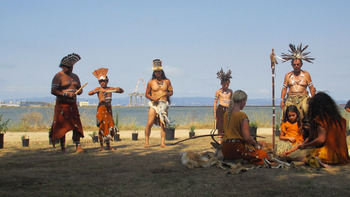
Patrick set the blessing, setting the center spirit pole, surrounded it with bear, coyote, raccoon, and deer skins. He led his group in six songs each introduced by stories about his life and the history of his people (Photo 3).
Pajara Valley Ohlone, Patrick Orozco. Photo Credit: Ana Montenegro, Candlestick Point State Park, Naval Base in background.

Raguda aka Razzle Dazzle talked with me throughout the day and helped improvise a flexible plan and aligned exactly with the visions Mary Jane and I had asked for: dancing and sharing all afternoon until sunset. For Patrick and some of the other dancers, there was pressure to rush, for everything to end before dinner. Instead, we expanded everything and gave everyone time, precious, beach side dancing time, with the Navy's submarine base on the distant shore.
Mary Jean welcomed and introduced all the participants as they entered the arena: SHORE, Miwok, Pomo, Ohlone, followed by Anthony Kahlil and Noxium (aka Brother Nature), from Literacy for Environmental Justice. Anthony and Noxium, the permaculturalists on LEJ's staff, took the center to tell us about the future of the park, the fighting chance for the people of the neighborhood in Hunter's Point to have a park, and to share their vision of Native plants being cultivated by school kids from Hunter's Point. He explained how we, a group of predominantly California tribal people, had planted nearly a thousand native plants that week including Islais Cherry trees, sedge, tule, monkey flower. They gifted rattles to dancers who had shown keen focus. They described the campground they are going to build beneath the mound we had filled with new native ancestral plants.
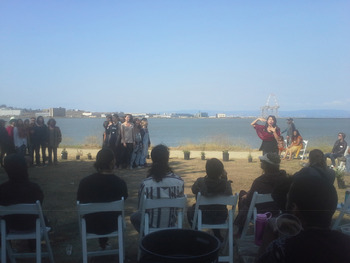
Then Emily's choir sung the Whale Song from SHORE, and then Emily performed a solo dance in relation to her choir: with them, against them, without them, and for them (Photo 4).
Emily Johnson with the large cast from Shore: Yelemu, at Candlestick Point State Park with Hunter's Point Naval Base in background. Photo credit: Julia Bither.

Then Mary Jean spoke about Hunter's Point, which is used as the city's waste basket, and Candlestick, the City's walled sports showcase, and Hiroshima whose destruction was sealed when Navy ships carrying atomic bombs left the shipyard in plain sight, and the California Native American genocide, made worse and worse because of its ongoing invisibility, and the 16 Ohlone village sites within the development area surrounding the park, and how the Ohlone were ignored and excluded during the planning, and then she offered this prayer: “I forgive you and I love you, I forgive you and I love you, I forgive you and I love you, I forgive you and I love you.”
Then it was Mike Little Bear's turn, our glorious chef. His 120 pieces of smoked chicken, his potato salad, his radish sprouts, and heirloom tomatoes, and backyard fresh basil, and the double chocolate cookies and lemonade and tea that the dancers brought and we shared. And we talked during and after the meal. And we looked at the horizon.
Then Razzle and David brought their groups out. I don't know how to describe what happened next. He Razzle Dazzled us. We entered another time. The dancers all took turns showing off. The singers yowled and praised, and laughed. For a short while it seemed as if all of the distinct cultures showed up: Ohlone, settler, city, navy, and park. Among the outcomes, two young Miwok women who had been with Razzle for more than ten years sang for the first time because they had had time all week beside the fire to sing with Natalie and Bernedette, two Pomo powerhouse voices. One of the Miwok singers asked me if I could help them bring a choir for Emily's performance next year. Emily had already offered this so now we are planning for it.
I wish I had space to relate some of the other stories of the Ohlone presence in the city. For example, how in a contest for the future of a museum at Crissy Field, the tribe defeated Star Wars billionaire George Lucas. (LucasFilms had just been purchased by the Walt Disney Company.) The proposal was to build a vanity museum featuring Lucas's movie characters and his odd collection of Americana featuring Norman Rockwell paintings. Lucas seeded the deal during the final weeks with a proposal to build an Indiana Jones Archeological Discovery Trail and theme park outside the museum in the Presidio Trust's park. At the public meeting, the Ohlone testimony was more than a little embarrassing for the Disney proposal's supporters. It was quietly tabled by the Trust's board.
The tribe has also worked with the veterans who hold in trust a memorial building across the street from City Hall. Veterans from all the wars and most of the local posts came out to the honor the tribe. Vets from the Legionnaire posts of the Korean war, the Vietnam war, the post of the GLBT-led Don't Ask Don't Tell organizing of the 1990s (who currently lead the entire Veteran's building), and the Iraq Vets Against the War all came to honor the Ohlone. (The only post missing was the 9/11 Heroes of the Future.) It seemed that they all wanted to do what they could to correct the dishonor that the city and country had perpetrated in its founding mis-treatment of the Ohlone.
When I think about the broad question of cultural survival I sometimes remember the radical honesty of Sara Shelton Mann's site specific performances with Contraband. That honesty developed from their collective dances and high impact contact improvisations. When I think of current Ohlone dance culture in relation to settler society, I can see it as if bodies of culture are colliding. What happens when a culture is impacted by the weight of an invader? How does it respond to the impact? If the fantasy of the invader is that it has subsumed and now controls the native, how does the Indigenous culture improvise new ways to rise up, transforming its previous practices, and find expression in one short set performance? Tribal groups from San Francisco, like most American cities, have been absent for a long time. It took the Indians of All Tribes movement on Alcatraz, supported by a relocated tribal community, to open social, then political and cultural, and then legal space, over a 40 year time span. Now these movements have cleared space in the San Francisco Human Rights and Arts Commissions for the Ohlone to return. Ohlone, Pomo, Miwok, and Chumash dancers have spent decades of their lives impelled by pride that reached a crest in the occupation, to create the space on the reservations and at the gatherings where their imaginations have restored, created and remembered a dance culture that sustains tribal life and that may now appear in the big city.