INTRODUCTION
A major feature of the response to trauma seen in patients with post-traumatic stress disorder (PTSD) is hypervigilance: an increased attentional bias to environmental cues associated with threat (e.g. Foa et al. Reference Foa, Feske, Murdock, Kozak and McCarthy1991; Freeman & Beck, Reference Freeman and Beck2000). Cognitive models of PTSD have suggested that this bias reinforces the preoccupation with the trauma (Foa et al. Reference Foa, Feske, Murdock, Kozak and McCarthy1991; Coles & Heimberg, Reference Coles and Heimberg2002). Such attentional biases are orthogonal to other forms of emotion/cognition interference. For example, anxiety is thought to result in intrusive thoughts that compete for working-memory resources according to the processing efficiency theory (Eysenck, Reference Eysenck1992; Eysenck & Calvo, Reference Eysenck and Calvo1992).
The current paper considers three main issues: first, the conceptualization of attentional bias from the perspective of cognitive neuroscience. Considerable recent functional magnetic resonance imaging (fMRI) work has examined emotional attention (Pessoa & Ungerleider, Reference Pessoa and Ungerleider2004; Vuilleumier et al. Reference Vuilleumier, Schwartz, Duhoux, Dolan and Driver2005; Blair et al. Reference Blair, Smith, Mitchell, Morton, Vythilingam, Pessoa, Fridberg, Zametkin, Sturman, Nelson, Drevets, Pine, Martin and Blair2007), demonstrating that emotional attention involves amygdala priming of temporal cortex representations (Pessoa & Ungerleider, Reference Pessoa and Ungerleider2004; Mitchell et al. Reference Mitchell, Richell, Leonard and Blair2006). If PTSD is characterized by increased amygdala responsiveness, as has been suggested (e.g. Rauch et al. Reference Rauch, Shin and Wright2003; McNally, Reference McNally2006), then the attentional bias might result from priming of emotional representations by the ‘hyper’-responsive amygdala. This makes two clear predictions: (1) increased activation of emotional representations should mean increased interference by emotional distracters in patients with PTSD. The emotional representations should compete more strongly with task-relevant representations causing greater disruption of task performance (cf. Desimone & Duncan, Reference Desimone and Duncan1995). Preliminary data suggest that this is the case (Williams et al. Reference Williams, Mathews and MacLeod1996; Dubner & Motta, Reference Dubner and Motta1999; Buckley et al. Reference Buckley, Blanchard and Neill2000; McNally, Reference McNally2006; Bar-Haim et al. Reference Bar-Haim, Lamy, Pergamin, Bakermans-Kranenburg and van IJzendoorn2007). (2) Increased activation of emotional representations in patients with PTSD should facilitate task performance when emotional representations govern task performance. This second prediction has received far less attention.
An alternative view of attentional bias emphasizes ‘top-down’ influences on attention (see Desimone & Duncan, Reference Desimone and Duncan1995). Within the Desimone & Duncan (Reference Desimone and Duncan1995) conceptualization of attention, representations can ‘win’ competition (i.e. be attended to) due either to bottom-up mechanisms (e.g. due to visual salience) or to top-down priming by executive systems. There have been suggestions that PTSD involves top-down regulatory system dysfunction (e.g. Rauch et al. Reference Rauch, Shin and Wright2003; McNally, Reference McNally2006). On this basis, the attentional bias might result from inadequate priming of task-relevant representations such that emotional distracters cause excessive interference. This conceptualization thus also predicts increased interference in PTSD from emotional distracters. However, it does not predict increased facilitation of task performance in PTSD if the emotional representations govern task performance.
The second issue is whether increased attention to emotional stimuli in PTSD occurs only for threat stimuli (McNally et al. Reference McNally, Kaspi, Riemann and Zeitlin1990; Foa et al. Reference Foa, Feske, Murdock, Kozak and McCarthy1991; Bryant & Harvey, Reference Bryant and Harvey1995) or for emotional stimuli more generally; that is, to positive stimuli (Martin et al. Reference Martin, Williams and Clark1991; Cassiday et al. Reference Cassiday, McNally and Zeitlin1992; Paunovic et al. Reference Paunovic, Lundh and Ost2002). The third issue is whether the attentional bias seen in PTSD also occurs in individuals who have experienced significant trauma even though they are currently not symptomatic for PTSD (trauma controls). Freeman & Beck (Reference Freeman and Beck2000) reported threat-related attentional biases for sexual abuse victims whether they were symptomatic or not. By contrast, other studies have indicated that attentional biases for threat are only seen in trauma victims who are symptomatic for PTSD (Foa et al. Reference Foa, Feske, Murdock, Kozak and McCarthy1991; Cassiday et al. Reference Cassiday, McNally and Zeitlin1992; Bryant & Harvey, Reference Bryant and Harvey1995).
A methodological point relates to the second and third issues. One problem inherent in many previous investigations of attentional bias is that the emotional stimuli have not induced attentional biases in the comparison population. Indeed, a recent review suggested that healthy individuals do not typically show emotional attentional biases (Bar-Haim et al. Reference Bar-Haim, Lamy, Pergamin, Bakermans-Kranenburg and van IJzendoorn2007). This is problematic because if, for example, healthy participants do not show attentional biases for negative and positive distracters, we cannot determine whether a selective attentional bias shown by patients with PTSD is selective or only a reflection of the increased emotionality of the negative stimuli (albeit at a level undetectable in healthy participants).
In the current study, we investigated the performance of patients with PTSD, trauma controls, and healthy comparison individuals on the affective Stroop task (aST; Blair et al. Reference Blair, Smith, Mitchell, Morton, Vythilingam, Pessoa, Fridberg, Zametkin, Sturman, Nelson, Drevets, Pine, Martin and Blair2007) and the emotional lexical decision task (eLDT; Nakic et al. Reference Nakic, Smith, Busis, Vythilingam and Blair2006), tasks where healthy participants show clear emotional biases. In the aST, participants are presented sequentially with two numerical displays and asked to determine which contains the greater numerosity (the number of stimuli present). Subjects are slower to perform this task and its variants (Mitchell et al. Reference Mitchell, Richell, Leonard and Blair2006) when the numerical displays are bracketed by emotional rather than neutral distracters (Blair et al. Reference Blair, Smith, Mitchell, Morton, Vythilingam, Pessoa, Fridberg, Zametkin, Sturman, Nelson, Drevets, Pine, Martin and Blair2007).
In the eLDT, participants are instructed to judge if a briefly presented letter string is a word or a non-word. Healthy volunteers are significantly faster/more accurate to recognize as words emotional letter strings (e.g. ‘murder’), relative to non-emotional letter strings (e.g. ‘table’) (Graves et al. Reference Graves, Landis and Goodglass1981; Strauss, Reference Strauss1983; Williamson et al. Reference Williamson, Harpur and Hare1991; Lorenz & Newman, Reference Lorenz and Newman2002; Nakic et al. Reference Nakic, Smith, Busis, Vythilingam and Blair2006). They also recognize high-frequency words (e.g. ‘contract’) faster and more accurately than low-frequency words (e.g. ‘caste’) (Morton, Reference Morton1968; Gernsbacher, Reference Gernsbacher1984).
Lexical decisions are thought to be based on the familiarity of the semantic patterns activated by the words (Atkinson & Juola, Reference Atkinson, Juola and Kornblum1973; Balota & Chumbley, Reference Balota and Chumbley1984; Plaut & Booth, Reference Plaut and Booth2000). We have argued that lexical decisions are faster for emotional relative to neutral words because the semantic representations of emotional words both activate and receive reciprocal feedback from basic motivational systems (Nakic et al. Reference Nakic, Smith, Busis, Vythilingam and Blair2006). Such feedback would increase the speed and strength of the activation of the semantic representations of the emotional words. Importantly, in the eLDT, top-down regulation of the emotional response is not seen (Kuchinke et al. Reference Kuchinke, Jacobs, Grubich, Vo, Conrad and Herrmann2005; Nakic et al. Reference Nakic, Smith, Busis, Vythilingam and Blair2006).
In short, we investigated the performance of patients with PTSD, trauma controls, and healthy comparison individuals on two tasks where healthy participants show clear emotional biases. In one task, the aST (Blair et al. Reference Blair, Smith, Mitchell, Morton, Vythilingam, Pessoa, Fridberg, Zametkin, Sturman, Nelson, Drevets, Pine, Martin and Blair2007), the emotional stimuli act as distracters and interfere with task performance. If PTSD is associated with either increased emotional responsiveness or reduced top-down attentional regulation, patients with the disorder should show increased interference on the task. Moreover, as both positive and negative distracters lead to interference on this task and its variants (Mitchell et al. Reference Mitchell, Richell, Leonard and Blair2006; Blair et al. Reference Blair, Smith, Mitchell, Morton, Vythilingam, Pessoa, Fridberg, Zametkin, Sturman, Nelson, Drevets, Pine, Martin and Blair2007), we can determine whether patients with PTSD show selectively increased interference for only negative distracters or a more general emotionality effect. In the second task, the eLDT (Nakic et al. Reference Nakic, Smith, Busis, Vythilingam and Blair2006), the emotional component of the stimulus facilitates task performance. Here there is no need for, or indication of, top-down attentional suppression. If PTSD is associated with increased emotional responsiveness, patients with the disorder should show increased facilitation on the task (although their reaction times across all conditions might be slower than comparison individuals; see Eysenck, Reference Eysenck1992). However, if PTSD is only associated with reduced top-down attentional regulation, then patients with the disorder should not show increased facilitation on this task.
METHOD
Participants
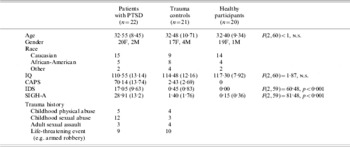
A total of 22 patients with PTSD, 21 trauma controls and 20 non-traumatized healthy participants participated in the study. These groups did not differ significantly in age, gender distribution, race or IQ (Table 1). The participants were recruited from the Mood and Anxiety Disorder Program Clinic at the National Institute of Mental Health (NIMH) and NIMH Institutional Review Board (IRB)-approved fliers and advertisements placed in the local media. Healthy participants were recruited from the pool of healthy participants interested in participating in research at the NIMH available through the National Institutes of Health (NIH). All the patients were free of medication for at least 2 weeks prior to testing (6 weeks if they were on fluoxetine).
Participant characteristics

PTSD, Post-traumatic stress disorder; F, female; M, male; n.s., not significant; IQ, intelligence quotient; CAPS, Clinician-Administered PTSD Scale; IDS, Inventory of Depressive Symptoms; SIGH-A, Structured Interview Guide for the Hamilton Anxiety Rating Scale.
Standard deviation (s.d.) in parentheses.
Participants in the patient group had to meet the DSM-IV (1994) criteria for PTSD based on the Structural Clinical Interview for DSM-IV Axis I disorders (SCID; First et al. Reference First, Spitzer, Gibbon and Williams1997). Participants with PTSD were included if the severity of the PTSD as measured by the Clinician-Administered PTSD Scale (CAPS; Blake et al. Reference Blake, Weathers, Nagy, Kaloupek, Kiaumnizer and Charney1990, Reference Blake, Weathers, Nagy, Kaloupek, Gusman, Charney and Keane1995) was ⩾50. Participants were considered trauma controls if they had experienced significant trauma but did not meet criteria for PTSD (either current or lifetime). Their CAPS score was ⩽15. Healthy controls did not have a current history of psychiatric illnesses according to the SCID (for full details see Table 1). All eligible participants were in good physical health as confirmed by a complete physical examination. Participants provided written informed consent for participation in the study.
The participants with PTSD showed significantly greater depression, as indexed by the Inventory of Depressive Symptoms (IDS; Rush et al. Reference Rush, Giles, Schlesser, Fulton, Weissenburger and Burns1986), and anxiety, as indexed by the Structured Interview Guide for the Hamilton Anxiety Rating Scale (SIGH-A; Shear et al. Reference Shear, Vander Bilt, Rucci, Endicott, Lydiard, Otto, Pollack, Chandler, Williams, Ali and Frank2001), than the trauma controls and healthy individuals (see Table 1). Co-morbid diagnoses for the patients with PTSD included current major depressive disorder (MDD) (n=3), past MDD (n=7), current social phobia (n=2), current phobia (n=3), current panic disorder (n=1) and alcohol/substance abuse in complete remission (n=2). One of the trauma controls had a past history of post-partum depression. None of the healthy participants had a history of present or past psychiatric disorders.
The affective Stroop task (aST; Blair et al. Reference Blair, Smith, Mitchell, Morton, Vythilingam, Pessoa, Fridberg, Zametkin, Sturman, Nelson, Drevets, Pine, Martin and Blair2007)
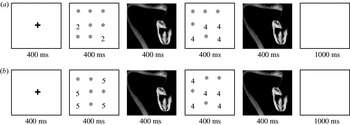
This task was adapted from a Number Stroop task developed by Pansky & Algom (Reference Pansky and Algom2002). In the original Number Stroop task, participants are presented sequentially with two numerical displays, consisting of two, three, four or five 1s, 2s, 3s, 4s, 5s or 6s randomly presented within a nine-point grid of * symbols (see Fig. 1). The subject must determine which numerical display contains the greater numerosity. If there were more numbers in the first numerical display (50% of task trials), they responded by pressing a button with their left hand (more numbers in the second numerical display implied a right-hand response). Participants did not receive feedback on their performance.
Example trial sequences from the affective Stroop task (aST). (a) Negative congruent trial; (b) negative incongruent trial.

The Stroop element of the task is based on the competition between the numerosity and number-reading information. On congruent trials, the Arabic numeral distracter information was consistent with the numerosity information; that is, the second (greater numerosity) display also contained Arabic numerals of larger value than the first display (e.g. two 2s and four 4s) (see Fig. 1a). On incongruent trials, the Arabic numeral distracter information was inconsistent with the numerosity information; that is, the second (greater numerosity) display contained numerals of smaller value than the first display (e.g. four 5s and five 4s) (see Fig. 1b). There were three different levels of incongruent trials according to the numerical distance between the numerosity and Arabic numeral information. Incongruent trials with a distance of 1 (two 3s and three 2s) are significantly more difficult than incongruent trials with a distance of 3 (two 5s and five 2s).
The aST modifies this Number Stroop task by having positive, negative or neutral images temporally bracket the numerical displays such that the trial consists of four, very rapid (400 ms each) consecutive displays (e.g. four 5s→picture of snake→five 4s→picture of snake) (see Fig. 1). The emotional stimuli consisted of 40 positive, 40 negative (primarily threat related), and 40 neutral pictures selected from the International Affective Picture System (IAPS; Lang & Greenwald, Reference Lang and Greenwald1988). The normative mean [±standard error (s.e.)] valence and arousal values on a nine-point scale were respectively 2·71±0·11 and 5·85±0·11 for negative pictures, 7·30±0·11 and 5·01±0·10 for positive pictures, and 4·96±0·07 and 2·78±0·08 for neutral pictures.
Overall, each participant was presented with 480 trials (160 positive, 160 negative and 160 neutral). Within each of the 160 trials, for each valence, 40 were congruent, 40 were incongruent distance 1, 40 were incongruent distance 2 and 40 were incongruent distance 3. Trials were randomized across participants.
The aST differs from emotional Stroop tasks (Williams et al. Reference Williams, Mathews and MacLeod1996; Bar-Haim et al. Reference Bar-Haim, Lamy, Pergamin, Bakermans-Kranenburg and van IJzendoorn2007) in that the emotional distracter and the target stimulus are never present simultaneously. We believe that this is why the affective Stroop variants, unlike emotional Stroop variants (see Williams et al. Reference Williams, Mathews and MacLeod1996; Bar-Haim et al. Reference Bar-Haim, Lamy, Pergamin, Bakermans-Kranenburg and van IJzendoorn2007), show consistent emotional interference effects in healthy individuals (Mitchell et al. Reference Mitchell, Richell, Leonard and Blair2006; Blair et al. Reference Blair, Smith, Mitchell, Morton, Vythilingam, Pessoa, Fridberg, Zametkin, Sturman, Nelson, Drevets, Pine, Martin and Blair2007). Following the arguments of Desimone & Duncan (Reference Desimone and Duncan1995), the emotional distracter competes for attention only with the residual representations of the previously displayed target stimulus. On account of these design differences with emotional Stroop paradigms, the task was named the aST (Blair et al. Reference Blair, Smith, Mitchell, Morton, Vythilingam, Pessoa, Fridberg, Zametkin, Sturman, Nelson, Drevets, Pine, Martin and Blair2007).
The emotional lexical decision task (eLDT; Nakic et al. Reference Nakic, Smith, Busis, Vythilingam and Blair2006)
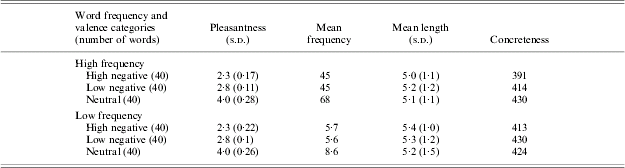
The stimuli were 240 nouns selected from the MRC Psycholinguistic Database (www.psy.uwa.edu.au/mrcdatabase/uwa_mrc.htm; see Table 2 for description of stimuli). ‘Non-words’ were created by changing one letter within each of the target stimuli to produce 240 pronounceable non-words. We chose to use pronounceable non-words because, as has been noted (Binder et al. Reference Binder, McKiernan, Parsons, Westbury, Possing, Kaufman and Buchanan2003), lexical decisions can be based upon orthographic familiarity if the non-words contain relatively uncommon letter combinations. If, on the contrary, the non-words are closely matched to words, lexical decisions are likely to be based on semantic processing (Balota & Chumbley, Reference Balota and Chumbley1984; Plaut & Booth, Reference Plaut and Booth2000; Binder et al. Reference Binder, McKiernan, Parsons, Westbury, Possing, Kaufman and Buchanan2003). As our hypotheses examined the role of emotional responding in the modulation of semantic representations, our non-words were pronounceable and produced by changing one letter in each of the 240 target words.
Characteristics of the word stimuliFootnote a

s.d., Standard deviation.
a Word frequency is expressed in number of occurrences per million words.
Pleasantness ratings were taken from Toglia & Battig (Reference Toglia and Battig1978).
Stimuli were presented sequentially in uppercase letters (black against white background) for durations of 300 ms. Each word was preceded by a fixation cross of 200-ms duration and followed by a blank period of 2500 ms. Presentation was carried out by a computer-controlled projection system (Macintosh G4, Apple Computer, Cupertino, CA, USA). Participants were instructed to decide if the letter string was a word or a non-word, and to indicate their responses by button response, with responses and reaction times recorded using SuperLab software (Cedrus Corp., San Pedro, CA, USA). Trial order was randomized across participants. Button assignment was counterbalanced across the participants.
Procedure
Each participant was tested individually in a quiet interview room. Following written consent, each participant was presented with the two tasks as part of a larger neuropsychological test battery. The tasks were presented in a random order. Not all participants received both tasks due to time constraints. Participants received financial compensation for taking part in the study.
RESULTS
Table 1 shows that the groups significantly differed on self-reported depression (IDS) and anxiety (SIGH-A). For this reason, the analyses presented below were initially conducted as analyses of covariance (ANCOVAs) with IDS and SIGH-A scores as covariates. However, in all cases there were no significant effects of either covariate on task performance (either as main effects or interactions with other parameters). The data were thus reanalyzed with analyses of variance (ANOVAs).
The aST
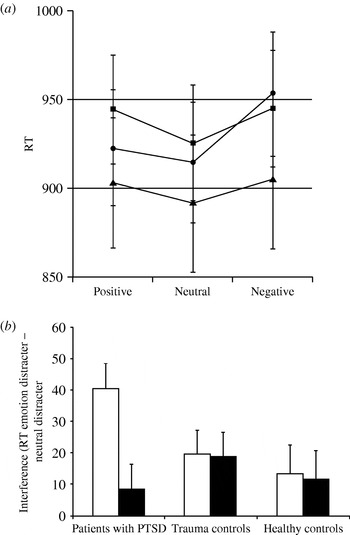
A 3 (Group: patients with PTSD, trauma controls and healthy controls) by 3 (Emotion: negative, positive, neutral) by 4 (Distance: distance 1, distance 2, distance 3 and congruent) ANOVA was conducted on the real-time (RT) data. This revealed no main effect for group [F(1, 49)<1, n.s., ηp2=0·02] but significant main effects for both emotion [F(2, 98)=12·63, p<0·001, ηp2=0·21] and distance [F(3, 147)=17·01, p<0·001, ηp2=0·26]. Participants were slower to perform the task in the presence of emotional rather than neutral distracters: mean RT (negative)=934·41, s.e.=20·80; mean RT (positive)=923·39, s.e.=19·32; mean RT (neutral)=910·47, s.e.=20·35; negative>neutral [F(1, 51)=26·45, p<0·001, ηp2=0·34; positive>neutral [F(1, 51)=7·92, p<0·01, ηp2=0·13]. In addition, the participants' performance was significantly modulated by numerical distance between the target and distracter [mean RT (distance 1)=923·68, s.e.=19·67; mean RT (distance 2)=944·31, s.e.=19·27; mean RT (distance 3)=924·01, s.e.=20·42; mean RT (congruent)=899·01, s.e.=21·94]. Although there was no significant group by distance interaction [F(6, 147)=1·31, n.s., ηp2=0·05], we did find the predicted group by emotion interaction [F(4, 98)=2·49, p<0·05, ηp2=0·09] (see Fig. 2a). Follow up ANOVAs were performed to investigate this interaction, examining interference by negative and positive affect separately, across groups. These revealed that the patients with PTSD showed significantly greater interference by negative affect than healthy comparison individuals [F(1, 30)=4·88, p<0·05, ηp2=0·14] and a trend for this effect with respect to trauma controls [F(1, 36)=3·33, p<0·1, ηp2=0·09]. However, the trauma controls did not show significantly greater facilitation by negative affect than the healthy comparison individuals [F(1, 32)<1, n.s., ηp2=0·01]. By contrast, while the participants showed significant interference by positive affect [F(1, 49)=7·21, p<0·01], there was no interaction with group [F(2, 49)=0·47, n.s.] (see Fig. 2b).
(a) Reaction time (RT) (– ● –, patients with PTSD; – ■ –, trauma controls; – ▲ –, healthy controls), and (b) interference data (■, negative distracters; □, positive distracters) from the affective Stroop task (aST).

A second 3 (Group: patients with PTSD, trauma controls and healthy controls) by 3 (Emotion: negative, positive, neutral) by 4 (Distance: distance 1, distance 2, distance 3 and congruent) ANOVA was conducted on the error data. This revealed only one significant main effect for distance [F(3, 147)=5·99, p<0·005, ηp2=0·11]. There were no other significant main effects or interactions.
The eLDT
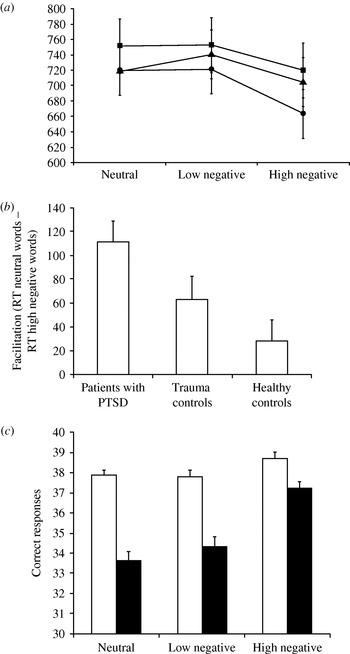
A 3 (Group: patients with PTSD, trauma controls and healthy controls) by 3 (Emotion: high negative, low negative, neutral) by 2 (Frequency: high and low) ANOVA was conducted on the RT data. This revealed no main effect for group [F(2, 53)<1, n.s.] but significant main effects for both emotion [F(2, 106)=45·29, p<0·001, ηp2=0·46] and frequency [F(1, 53)=172·47, p<0·001, ηp2=0·77]; participants were faster to recognize letter strings as words if they were more negative in valence [mean RT(high negative)=696·01, s.e.=18·99; mean RT(neutral)=729·87, s.e.=18·89] and of higher frequency [mean RT(high frequency)=679·93, s.e.=17·66; mean RT(low frequency)=762·78, s.e.=20·35].
Importantly, there was also a significant group by emotion interaction [F(4, 106)=4·03, p<0·005, ηp2=0·13] (see Fig. 3a). Follow-up ANOVAs were performed to investigate this interaction, examining facilitation of performance by negative affect, across groups. These revealed that the patients with PTSD showed significantly greater facilitation by negative affect than healthy comparison individuals [F(1, 38)=11·36, p<0·005, ηp2=0·23] and a trend to this effect with respect to trauma controls [F(1, 34)=3·10, p<0·1, ηp2=0·08]. However, the trauma controls did not show significantly greater facilitation by negative affect than the healthy comparison individuals [F(1, 34)=2·26, p<0·15, ηp2=0·06; mean facilitation (patients with PTSD)=111·52, s.e.=17·08; mean facilitation (trauma controls)=63·08, s.e.=19·10; mean facilitation (healthy comparison individuals)=28·57, s.e.=17·08] (see Fig. 3b). There was no significant group by frequency interaction [F(2, 53)=1·65, n.s., ηp2=0·06] or group by emotion by frequency interaction [F(4, 106)=1·30, n.s., ηp2=0·13].
(a) Reaction time (RT) (– ● –, patients with PTSD; – ■ –, trauma controls; – ▲ –, healthy controls), and (b) facilitation data from the emotional lexical decision task (eLDT); (c) the emotion by frequency interaction (□, high frequency; ■, low frequency) seen in the number of correct responses.

A second 3 (Group: patients with PTSD, trauma controls and healthy controls) by 3 (Emotion: high negative, low negative, neutral) by 2 (Frequency: high and low) ANOVA was conducted on the correct responses. This revealed no main effect for group [F(2, 53)<1, n.s.] but significant main effects for both emotion [F(2, 106)=58·63, p<0·001, ηp2=0·53] and frequency [F(1, 53)=110·08, p<0·001, ηp2=0·68]; participants more accurately recognized letter strings as words if they were more negative in valence [mean error rate (highly negative)=35·78, s.e.=0·27; mean error rate (neutral)=37·98, s.e.=0·27] and of higher frequency [mean error rate (high frequency)=35·07, s.e.=0·37; mean error rate (low frequency)=38·14, s.e.=0·25]. There was also a significant emotion by frequency interaction [F(2, 106)=21·59, p<0·001, ηp2=0·29]. As can be seen in Fig. 3c, frequency has a far greater impact on accuracy for neutral rather than highly emotional words. There was no significant group by emotion [F(4, 106)<1, n.s., ηp2=0·03], group by frequency [F(2, 53)=1·86, p<0·2, ηp2=0·07] or group by emotion by frequency interaction [F(4, 106)<1, n.s., ηp2=0·02].
DISCUSSION
The current study examined three main issues: emotional attention in PTSD; whether patients with PTSD show heightened sensitivity only for threatening stimuli or also for positive stimuli; and whether individuals who have experienced trauma but not PTSD also show heightened sensitivity for emotional stimuli. Two tasks were used: the aST (Blair et al. Reference Blair, Smith, Mitchell, Morton, Vythilingam, Pessoa, Fridberg, Zametkin, Sturman, Nelson, Drevets, Pine, Martin and Blair2007) and the eLDT (Nakic et al. Reference Nakic, Smith, Busis, Vythilingam and Blair2006). In the first, the emotional stimuli interfered with task performance. On this task, the patients with PTSD showed increased interference for negative but not positive distracters relative to both the trauma and healthy controls. In the second, the eLDT (Nakic et al. Reference Nakic, Smith, Busis, Vythilingam and Blair2006), the emotional component of the stimuli facilitated task performance. On this task, the patients with PTSD showed increased facilitation in response to highly negative stimuli relative to both the trauma and healthy controls.
With regard to the specificity of emotional sensitivity, the current data are consistent with suggestions that increased emotional attention is seen in PTSD only for threat-based information (e.g. Foa et al. Reference Foa, Feske, Murdock, Kozak and McCarthy1991) rather than other emotional stimuli (Martin et al. Reference Martin, Williams and Clark1991). In line with some researchers (McNally et al. Reference McNally, Kaspi, Riemann and Zeitlin1990; Foa et al. Reference Foa, Feske, Murdock, Kozak and McCarthy1991; Bryant & Harvey, Reference Bryant and Harvey1995), we saw increased interference in the patients with PTSD for negative but not positive emotional distracters, although all participants, irrespective of diagnosis or trauma exposure, did show significant interference by positive affect. This suggests that the impact of the trauma may generalize in PTSD to other threat stimuli, as is evidenced by patients' increased responses to fearful expressions – a stimulus not usually part of the original trauma (Rauch et al. Reference Rauch, Whalen, Shin, McInerney, Macklin, Lasko, Orr and Pitman2000; Armony et al. Reference Armony, Corbo, Clement and Brunet2005). However, the impact of trauma does not generalize to positive stimuli.
With respect to whether only patients with PTSD or also trauma controls show heightened sensitivity for threat stimuli, the current data indicated that the results were specific for patients with PTSD (Foa et al. Reference Foa, Feske, Murdock, Kozak and McCarthy1991; Cassiday et al. Reference Cassiday, McNally and Zeitlin1992; Bryant & Harvey, Reference Bryant and Harvey1995). On the aST, the patients with PTSD showed increased interference by negative distracters relative to both trauma (though this was only a trend) and healthy comparison individuals (who did not differ from one another). On the eLDT, the patients with PTSD showed increased facilitation by negative information relative to both trauma (though this was only a trend) and healthy comparison individuals (who again did not differ from one another).
Of course, the group differences between the patients with PTSD and healthy comparison individuals were, for both tasks, considerably greater than the group differences between the patients with PTSD and the trauma controls. This may indicate that at least some trauma controls show increased sensitivity for negative emotional material (see Freeman & Beck, Reference Freeman and Beck2000). Indeed, 35% of the trauma controls showed interference by negative distracters on the aST that was greater than the mean for patients with PTSD (as opposed to 20% of healthy comparison individuals). Similarly, 25% of the trauma controls showed facilitation by negative emotion on the eLDT that was greater than the mean for patients with PTSD (as opposed to 5% of healthy comparison individuals).
With respect to the emotional attentional bias in PTSD, we considered two conceptualizations in the introduction. The first was based on a specific cognitive neuroscience model of emotional attention (Pessoa & Ungerleider, Reference Pessoa and Ungerleider2004; Blair et al. Reference Blair, Mitchell and Blair2005; Mitchell et al. Reference Mitchell, Richell, Leonard and Blair2006). From a neuroscience perspective, this model stresses a role for the amygdala in priming representations of emotional information in temporal cortex. This should occur whether the emotional stimulus is an emotional image (aST) or an emotional word (eLDT). Within this conceptualization, the emotional attentional bias seen in PTSD is a consequence of increased emotional responsiveness (Rauch et al. Reference Rauch, Shin and Wright2003; McNally, Reference McNally2006) and thus greater reciprocal priming of emotional stimuli representations. This predicts increased interference if an emotional stimulus representation competes with a stimulus representation necessary for task performance. This was seen here in the aST data and is in line with previous work (McNally et al. Reference McNally, Kaspi, Riemann and Zeitlin1990; Foa et al. Reference Foa, Feske, Murdock, Kozak and McCarthy1991; Bryant & Harvey, Reference Bryant and Harvey1995). It also predicts increased facilitation if the stimulus representation necessary for task performance is emotional. This was shown here in the data from the eLDT. In short, the current data are compatible with the suggestion that increased emotional attention in patients with PTSD reflects increased emotional responding to threat information in this group.
A second way of considering the emotional attentional bias reflects consideration of top-down influences on attention (see Desimone & Duncan, Reference Desimone and Duncan1995). Considerable recent work has suggested frontal lobe pathology in PTSD (e.g. Rauch et al. Reference Rauch, Shin and Wright2003; McNally, Reference McNally2006). Given current understandings of frontal lobe function, this work indirectly implicates dysfunctional top-down influences in PTSD, leading to the prediction of increased interference in PTSD on the aST. However, top-down attentional systems are likely to regulate both negative and positive distracters (see Blair et al. Reference Blair, Smith, Mitchell, Morton, Vythilingam, Pessoa, Fridberg, Zametkin, Sturman, Nelson, Drevets, Pine, Martin and Blair2007). Yet the patients with PTSD showed no increased inference from positive distracters on the aST. Moreover, analysis of the eLDT reveals no top-down attentional regulatory role in the processing of emotional information (Nakic et al. Reference Nakic, Smith, Busis, Vythilingam and Blair2006); here, the emotional component facilitates rather than interferes with task performance. Yet the patients with PTSD showed increased facilitation by highly negative words relative to the healthy individuals and the trauma controls. This suggests that while there may be dysfunctional top-down regulatory systems linked to the emergence of PTSD, such dysfunction cannot solely account for PTSD, which involves emotional over-responsiveness despite intact top-down control. Indeed, it is even possible that the increased emotional response may disrupt the operation of some of the frontal regulatory systems.
Several caveats should be mentioned. First, almost all study participants were female; the results may not extend to males with PTSD. Second, the tasks were selected to test a hypothesis regarding hypervigilance in PTSD. However, work is necessary to show whether the anomalous processing seen here relates to hypervigilance seen clinically. Third, the hypothesis developed here made predictions regarding the neural systems subserving the behavioral performance. These remain to be tested with fMRI.
Compared to healthy participants, patients with PTSD showed increased interference for negative but not positive distracters on the aST and significantly enhanced performance on the eLDT. These findings are compatible with suggestions that increased responsiveness of basic threat systems subsequent to the trauma primes emotional representations that can either interfere with task relevant representations (aST) or facilitate performance if they are relevant for task performance (eLDT). Future imaging work will test the neural level predictions of this position for PTSD.
ACKNOWLEDGMENTS
This research was supported by the Intramural Research Program of the NIH:NIMH.
DECLARATION OF INTEREST
None.