Implications
The negative impact on digestibility, growth performance and feed conversion of high-fibre diets in growing pigs was confirmed in the current study. However, it may still be economically feasible for resource-poor small-scale pig farmers to use available and cheap ingredients with high-fibre content, particularly if this is used in indigenous breeds, such as the Mong Cai, rather than in exotic breeds, as the former appears to be better adapted to low-quality feeds owing to a larger gastrointestinal tract (in terms of diameter), resulting in longer mean retention time of digesta and higher digestibility.
Introduction
In Vietnam, feed ingredients common in pig diets, particularly at small-holder farm level, derive primarily from the vegetable foods and agro-industry co-products, such as sweet potato vines, water spinach, rice bran, tofu residue, cassava residue (CR) and brewer's grain (BG). These feed ingredients are readily available, cheap and well accepted by pigs (Dung et al., Reference Dung, Manh and Udén2002; Len et al., Reference Len, Lindberg and Ogle2007, Reference Len, Hong, Lindberg and Ogle2009a and Reference Len, Ngoc, Ogle and Lindberg2009b). However, the high-fibre content may be a constraint for feed intake, and may impair performance and feed utilization. In addition to fibre level, factors such as solubility and the degree of lignification (Bach Knudsen, Reference Bach Knudsen1997) of the fibre fraction may be of importance for its utilization.
In the current study, we used CR, which is high in soluble non-starch polysaccharides (S-NSP), and BG, which is high in insoluble NSP (I-NSP) as fibrous dietary ingredient sources (Ngoc et al., Reference Ngoc, Len and Lindberg2012). These differences between fibre sources were expected to affect the physical properties of gut digesta and as a consequence also the digestibility (Bach Knudsen and Jørgensen, Reference Bach Knudsen and Jørgensen2001). Fibrous ingredient sources characterized by a high concentration of S-NSP may increase digesta retention time (Glitsø et al., Reference Glitsø, Brunsgaard, Højsgaard, Sandström and Bach Knudsen1998; Le Goff et al., Reference Le Goff, Van Milgen and Noblet2002), because of swelling and high water-binding capacity (Bach Knudsen and Jørgensen, Reference Bach Knudsen and Jørgensen2001), resulting in an enhanced nutrient utilization.
In Vietnam, the rearing of exotic pig breeds such as the Landrace, Yorkshire and Duroc has developed rapidly, especially in the urban areas, to meet the demand of consumers for both quantity and quality of meat. However, pure-bred Mong Cai (MC) sows are still commonly mated with boars of an exotic breed, usually Yorkshire or Landrace, using artificial insemination, and the offsprings are fattened in small-scale semi-intensive or intensive systems. Earlier studies have shown that the MC breed digests high-fibre diets better than exotic breeds (Borin et al., Reference Borin, Lindberg and Ogle2005; Len et al., Reference Len, Hong, Lindberg and Ogle2009a and Reference Len, Ngoc, Ogle and Lindberg2009b). Consequently, different breeds probably have different responses to diets in terms of nutrient digestibility and growth performance. The different response between breeds could be related to the development of the digestive capacity (Len et al., Reference Len, Hong, Lindberg and Ogle2009a) and the composition of diets, especially dietary fibre (DF) level and fibre sources (Freire et al., Reference Freire, Dias, Cunha and Aumaitre2003; Borin et al., Reference Borin, Lindberg and Ogle2005; Len et al., Reference Len, Hong, Lindberg and Ogle2009a and Reference Len, Ngoc, Ogle and Lindberg2009b).
The aim of the present study was to investigate the influence of fibre level and fibre source on digestibility, gastrointestinal tract (GIT) development, total tract mean retention time (MRT) and growth performance of indigenous (MC) and exotic (Landrace × Yorkshire, LY) pigs.
Material and methods
Location
The experiment was carried out at the Centre of Animal Feed Testing and Conservation, National Institute of Animal Sciences (NIAS), Hanoi, Vietnam. The experiment was approved by the Animal Science Committee of NIAS.
Experimental feeds
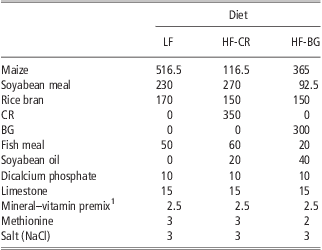
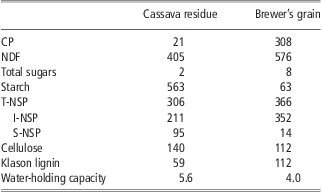
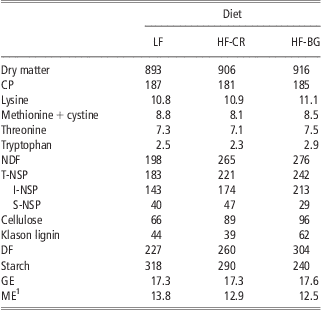
The diets were based on maize, rice bran, soyabean meal, fish meal and soyabean oil, and CR or BG as fibrous ingredient sources in the high-fibre diets (HF; Table 1). A low-fibre diet (LF), containing around 200 g NDF/kg dry matter (DM), was formulated without CR and BG as feed ingredients. The chemical composition of CR and BG is shown in Table 2. The HF diets (HF-CR and HF-BG) were formulated to contain around 270 g NDF/kg DM. All diets were formulated to be equal in metabolizable energy (ME), CP, essential amino acids, minerals and vitamins, and to meet requirements for growing/finishing pigs according to National Research Council (NRC, 1998) (Table 3). Celite (Celite 545, Titan Biotech, India) was included in the diets (as top-dressing, 30 g/kg diet, as-fed basis) as a source of acid insoluble ash (AIA), which was used as an indigestible marker for determination of the digestibility of the dietary components.
Ingredient composition (g/kg, air-dry basis) of the experimental diets
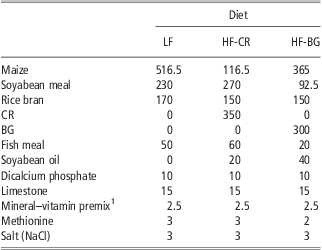
LF = low-fibre diet; HF-CR = high-fibre diet containing cassava residue; HF-BG = high-fibre diet containing brewer's grain.
1Content per kg on air-dry basis: vitamin A, 2000 IU; vitamin D3, 400 IU; vitamin E, 12.5 mg; vitamin K, 3 mg; vitamin B1, 2.5 mg; vitamin B12, 100 IU; Ca, 0.275 g; Cu, 27.5 mg; Fe, 25 mg; Zn, 37 mg; Co, 0.5 mg; Iodine, 0.38 mg; Se, 0.11 mg.
Chemical composition (g/kg dry matter) and water-holding capacity (kg water/kg dry matter) of cassava residue and brewer's grain
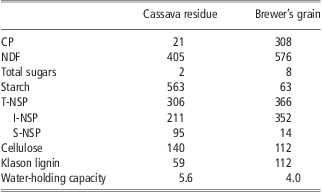
T-NSP = total non-starch polysaccharides; I-NSP = insoluble non-starch polysaccharides; S-NSP = soluble non-starch polysaccharides.
Data from Ngoc et al. (Reference Ngoc, Len and Lindberg2012).
Dry matter content (g/kg), analysed chemical composition (g/kg dry matter) and energy content (MJ/kg dry matter) of the experimental diets
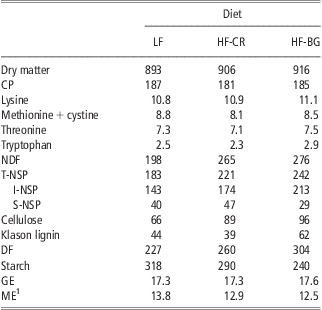
LF = low-fibre diet; HF-CR = high-fibre diet containing cassava residue; HF-BG = high-fibre diet containing brewer's grain; T-NSP = total non-starch polysaccharides; I-NSP = insoluble non-starch polysaccharides; S-NSP =soluble non-starch polysaccharides; DF = dietary fibre; GE = gross energy; ME = metabolisable energy.
1Calculated based on Composition and Nutritive Value of Animal Feeds in Vietnam (Chinh et al., Reference Chinh, Oanh, Ha, Viet, Khang, Tinh, Binh and Tao2001).
Feed ingredients were stored in plastic bags to avoid moisture entering before mixing the diets. The diets were mixed every 7 days and put into plastic bags in order to maintain the quality of the feed and avoid mould. The diet was offered in mash form.
Experimental design
A total of 36 pigs (18 MC and 18 LY) were used in this experiment. The MC pigs were bought from the MC Farm in Quang Ninh province, and the LY pigs from the Pig Research Centre in Hanoi. They were 60 days old, and the initial BW (IBW) of the MC pigs was 9.5 ± 0.4 kg and of the LY pigs 16.5 ± 0.4 kg. Before the experiment started, all animals were vaccinated against Hog cholera, pasteurellosis, pneumonia and paratyphoid. The pigs were kept individually in concrete floored pens (1.8 m × 0.8 m), fully covered with wooden slats, in an open-sided house. The pens and the troughs were cleaned every day. The animals had free access to feed and water.
The experiment was structured according to a completely randomized 2 × 3 factorial design, with two breeds (MC and LY) and three diets (LF, HF-CR and HF-BG). The animals were selected from six litters (three litters for MC and three litters for LY), with an equal number of males and females and were distributed equally among the treatments. Each treatment consisted of six pens, with one pig per pen as a replicate. The length of the experiment was 27 days.
Measurements and data collection
On day 20 of the experiment, digesta retention time of liquid and solids were estimated on four selected pigs in each treatment. The pigs were simultaneously given a single dose in the morning meal of chromium (Cr) mordanted NDF (500 mg) from rice bran as a solid marker and Co-EDTA (500 mg) as liquid marker, respectively. The Cr-mordanted rice bran and Co-EDTA were prepared according to Udén et al. (Reference Udén, Colucci and Van Soest1980). The rice bran was milled before the mordanting and had a Cr content of 40 g/kg. Faecal samples were collected three times per day during 3 days, at 4, 8, 16, 24, 32, 40, 48, 56 and 72 h, after giving the liquid and solid markers.
During the last 5 days of the experiment, collection of faeces (∼0.2 kg per pig and day) was carried out in the morning from individual pigs. All collected faeces were stored at −4°C, and then at the end of the study, the total faeces of each pig was pooled, mixed and sampled for analysis.
At the end of experiment, pigs were fed the last meal at 0500 h. After a 4-h fasting period, the pigs were injected with Thiopental (20 mg/kg BW), exsanguinated and immediately eviscerated. The GIT was removed and segmented into stomach, small intestine, caecum and colon plus rectum. The removal of GIT started from the anus using scissors to remove each segment in turn (rectum, colon, caecum, small intestine and stomach).
Segments of full and empty digestive tract were weighed to calculate digesta weight, and the length of each segmented section of intestine was recorded. Digesta was collected from ileum (about 100 cm of small intestine before the ileo-caecal ostium) and immediately transferred to plastic jars, frozen at −20°C and kept frozen until preparation for analysis.
Chemical analysis
All samples were dried at 60°C and ground through a 1 mm sieve before analysis. DM (967.03), CP (984.13), AIA (942.05) and ash (942.05) were analysed according to the standard Association of Official Analytical Chemist (AOAC) methods (AOAC, 1990), and CP content was calculated as nitrogen × 6.25. The NDF content was determined by the method of Van Soest et al. (Reference Van Soest, Robertson and Lewis1991). Amino acids were determined by HPLC using an ion exchange column (Amino Quant, 1990). Starch was analysed by an enzymatic method (Larsson and Bengtsson, Reference Larsson and Bengtsson1983). Gross energy (GE) was determined with a bomb calorimeter (Model: C2000 Basic – IKA Werke GmbH & Co. KG, Staufen, Germany). Chromium and cobalt were analysed by atomic absorption spectrophotometry after digesting the samples overnight at 80°C in 20 ml of 4 M HNO3 (Udén and Sutton, Reference Udén and Sutton1994).
Total, soluble and insoluble NSP and their constituent sugars were determined as alditol acetates by gas chromatography (Model: Agilent 6890N, Agilent Technologies Inc., Santa Clara, CA, USA) for neutral sugars, and by a colorimetric method for uronic acids using a modification of the Uppsala method (Theander et al., Reference Theander, Aman, Westerlund, Andersson and Pettersson1995), as described by Bach Knudsen (Reference Bach Knudsen1997). Klason lignin was determined as the 12 M H2SO4 insoluble residue. Total DF is the sum of Klason lignin and total NSP (T-NSP).
Content of different fibre fractions were calculated as follows:
 $${ & {\rm{Cellulose}}\,{\rm{ = }}\,{\rm{NSP}}\,{\rm{glucose}}\,{\rm{(12}}\,{\rm{mol/l}}\,{{{\rm{H}}}_{\rm{2}}}{\rm{S}}{{{\rm{O}}}_{\rm{4}}}{\rm{) }} \cr & \quad- {\rm{NSP}}\,{\rm{glucose}}\,{\rm{(2}}\,{\rm{mol/l}}\,{{{\rm{H}}}_{\rm{2}}}{\rm{S}}{{{\rm{O}}}_{\rm{4}}}{\rm{) }} \cr & {\rm{Total}}\,{\rm{non - cellulosic}}\,{\rm{polysaccharides}}\,{\rm{(T {\hbox-} NCP)}} \cr & \quad\,{\rm{ = }}\,{\rm{rhamnose}}\,{\rm{ + }}\,{\rm{fucose}}\,{\rm{ + }}\,{\rm{arabinose}}\,{\rm{ + }}\,{\rm{xylose}}\,{\rm{ + }}\,{\rm{mannose}} \cr & \quad\,{\rm{ + }}\,{\rm{galactose}}\,{\rm{ + }}\,{\rm{glucose}}\,{\rm{ + }}\,{\rm{uronic}}\,{\rm{acids}} \cr & {\rm{T {\hbox-} NSP}}\,{\rm{ = }}\,{\rm{T {\hbox-} NCP}}\,{\rm{ + }}\,{\rm{cellulose}} \cr & {\rm{Soluble}}\,{\rm{NCP}}\,{\rm{(S {\hbox-} NCP)}}\,{\rm{ = }}\,{\rm{T {\hbox -} NCP}} - {\rm{I {\hbox-} NCP}} $$
Data calculations
The total tract MRT of liquid and solids were calculated according to Thielemans et al. (Reference Thielemans, Francois, Bodart and Thewis1978):
 $${\rm{MRT}}\,{\rm{ = }}\,\mathop{\sum}\limits_{i\,{\rm{ = }}\,{\rm{1}}}^n {{{t}_i}{{C}_i}\rDelta {{t}_i}/\mathop{\sum}\limits_{i\,{\rm{ = }}\,{\rm{1}}}^n {{{C}_i}\rDelta {{t}_i}} } $$
where ti is the time elapsed (h) since dosage of marker to the mid-point in the i th collection interval, Ci is the concentration of marker (>0) excreted in the i th sample, at time ti over a time interval Δti.
The digestibility of the diets at each sampling site was calculated using the indicator technique (Sauer et al., Reference Sauer, Fan, Mosenthin and Drochner2000) according to the equation:
 $${\rm{CA}}{{{\rm{D}}}_{\rm{D}}}\,{\rm{ = }}\,{\rm{(1}} - {\rm{(D}}{{{\rm{C}}}_{\rm{F}}}\times {\rm{AI}}{{{\rm{A}}}_{\rm{D}}}{\rm{/D}}{{{\rm{C}}}_{\rm{D}}}\times {\rm{AI}}{{{\rm{A}}}_{\rm{F}}}{\rm{))}}\times {\rm{100}}$$
where CADD is the coefficient of apparent digestibility of dietary components in the assay diet; DCF is the dietary component concentration in ileal digesta or faeces (g/kg DM); AIAD is the AIA concentration in the assay diet (g/kg DM); DCD is the dietary component concentration in the assay diet (g/kg DM); and AIAF is the AIA concentration in ileal digesta or faeces (g/kg DM).
Statistical analysis
The data were analysed as a 2 × 3 factorial completely randomized design with diet, breed and interaction (diet by breed) as factors using the GLM procedure of Minitab Software, version 13.31 (Minitab, 2000). Treatment means that showed significant differences at the probability level of P < 0.05 were compared using Tukey's pairwise comparison procedure.
There was no interaction between diet and breed for any of the parameters studied; therefore, the following model was used to analyse treatment effects on digestibility and MRT:
 $${{Y}_{ijk}}\,{\rm{ = }}\,\mu \,{\rm{ + }}\,{{D}_i}\,{\rm{ + }}\,{{B}_j}\,{\rm{ + }}\,{{e}_{ijk}}$$
where: Yij = digestibility and MRT, μ = overall mean, Di = effect of diet i, Bj = effect of breed j, and eijk = random error.
The following model, including IBW as covariate, was used to analyse treatment effects on feed intake, final BW, average daily gain (ADG), feed conversion ratio (FCR) and GIT weight, length and content:
 $${{Y}_{ijk}}\,{\rm{ = }}\mu \,{\rm{ + }}\,{{D}_i}\,{\rm{ + }}\,{{B}_j}\,{\rm{ + }}\,b{{X}_{ijk}}{\rm{(}}{{B}_j}{\rm{)}}\,{\rm{ + }}\,{{e}_{ijk}}$$
where: Yij = feed intake, final BW, ADG, FCR, and GIT weight, length and content, μ = overall mean, Di = effect of diet i, Bj = effect of breed j, b = regression of IBW within breed, Xijk = IBW at start of experiment and eijk = random error.
The impact of fibre level in the diet on the MRT of solids and on digestibility, respectively, was analysed using a GLM with breed and fibre level as factors, and fibre level as covariate.
Results
Performance and MRT
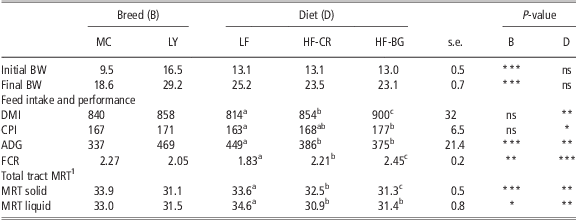
The daily dry matter intake (DMI) and CP intake (CPI) were similar (P > 0.05) between MC and LY pigs (Table 4). The ADG was lower (P < 0.001) and the FCR was higher (P < 0.01) for MC pigs than for LY pigs.
Effects of dietary fibre source on daily feed intake (g/day, dry matter basis), performance and retention time (h) in MC and LY pigs – least square means and s.e.m.
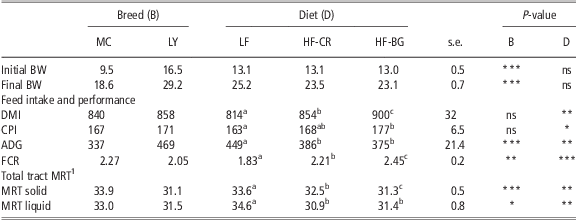
MC = Mong Cai; LY = Landrace × Yorkshire; standard error of mean = s.e.m.; LF = low-fibre diet; HF-CR = high-fibre diet containing cassava residue; HF-BG = high-fibre diet containing brewer's grain; DMI = dry matter intake; CPI = crude protein intake; ADG = average daily gain (g); FCR = feed conversion ratio (kg feed/kg gain, as dry matter basis); MRT = mean retention time; ns = non-significant.
1Total tract MRT was calculated by using chromium and cobalt markers as solid and liquid markers.
For diets, means with different letters within a row are significantly different (P < 0.05).
*P < 0.05; **P < 0.01; ***P < 0.001.
Pigs fed diet LF had lowest daily DMI (P < 0.01) and CPI (P < 0.05), followed by the pigs fed diet HF-CR and diet HF-BG (Table 4). The ADG was higher (P < 0.01) and the FCR lower (P < 0.001) in pigs fed diet LF than in pigs fed diets HF-CR and HF-BG.
The MRT of solid (P < 0.001) and liquid (P < 0.05) markers were higher in MC than LY pigs (Table 4). Pigs fed diet LF had the highest MRT for solids and liquid (P < 0.001). For solids, this was followed in descending order by the MRT for pigs fed diet HF-CR and diet HF-BG (P < 0.01), whereas the MRT for liquid was comparable between diets HF-CR and HF-BG.
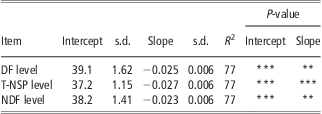
Across MC and LY pigs, there was a linear decrease (P < 0.01) in the MRT with increasing NDF, DF and T-NSP level in the diet (Table 5).
Impact of fibre level in the diet (g/kg dry matter) on the total tract mean retention time of solids (h)
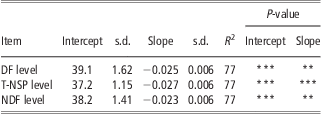
DF = dietary fibre; T-NSP = total non-starch polysaccharides.
**P < 0.01; ***P < 0.001.
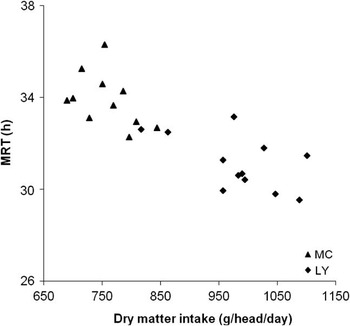
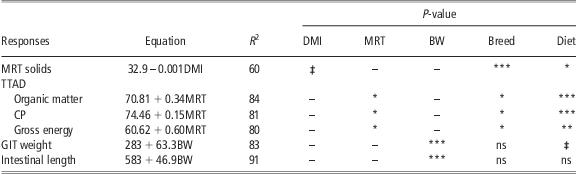
Across MC and LY pigs, the MRT of solids was linearly related to DMI (g/day; R 2 = 0.60; Table 9 and Figure 1).
The relationship between total tract mean retention time (MRT) and dry matter intake across Mong Cai (MC) and Landrace × Yorkshire (LY) pigs. For data sources and statistics, see Table 9.

Ileal and total tract apparent digestibility
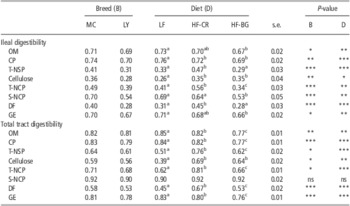
The coefficients of ileal (CIAD) and total tract (CTTAD) apparent digestibility of nutrients and fibre fractions are shown in Table 6. The CIAD and CTTAD of dietary components differed between breeds (P < 0.05), with the exception of the CTTAD of soluble non-cellulosic polysaccharides (S-NCP; P > 0.05). Generally, MC pigs showed greater digestibility than LY pigs. There were no interactions in the CIAD and CTTAD of dietary components between diet and breed (P > 0.05).
Effects of dietary fibre source on ileal and total tract coefficients of apparent digestibility in MC and LY pigs – least square means and s.e.m.

MC = Mong Cai; LY = Landrace × Yorkshire; standard error of mean = s.e.m.; LF = low-fibre diet; HF-CR = high-fibre diet containing cassava residue; HF-BG = high-fibre diet containing brewer's grain; OM = organic matter; T-NSP = total non-starch polysaccharides; T-NCP = total non-cellulosic polysaccharides; S-NCP = soluble non-cellulosic polysaccharides; DF = dietary fibre; GE = gross energy; ns = non-significant.
For diets, means with different letters within a row are significantly different (P < 0.05).
*P < 0.05; **P < 0.01; ***P < 0.001.
Fibre level and fibre source affected the CIAD and CTTAD of dietary components (P < 0.05), except for the CTTAD of S-NCP (P > 0.05). Increased fibre level (diets HF-CR and HF-BG) resulted in decreased CIAD and CTTAD (P < 0.05) of organic matter (OM), CP and GE. The lowest CIAD and CTTAD of OM, CP and GE were found for diet HF-BG.
The CIAD of T-NSP and DF was similar in diets LF and HF-BG (P > 0.05), whereas it was greater in diet HF-CR (P < 0.05). The CIAD of S-NCP did not differ (P > 0.05) between diets LF and HF-CR, whereas it was lower in diet HF-BG (P < 0.05). The highest CIAD of total non-cellulosic polysaccharides (T-NCP) was observed for diet HF-CR, followed in descending order by diet LF and diet HF-BG (P < 0.05). The CIAD of cellulose was greater in diets HF-CR and HF-BG than in diet LF (P < 0.05).
The CTTAD of T-NSP, T-NCP and DF differed between diets (P < 0.05), and was lowest in diet LF followed in increasing order by diet HF-BG and diet HF-CR (Table 6). The CTTAD of cellulose was greater (P < 0.05) in diets HF-CR and HF-BG than in diet LF.
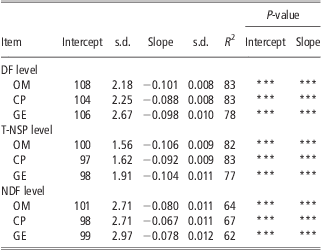
Across MC and LY pigs, there was a linear decrease (P < 0.001) in the CTTAD of OM, CP and GE, with increasing NDF, DF and T-NSP level in the diet (Table 7).
Impact of fibre level in the diet (g/kg dry matter) on the total tract apparent digestibility of OM, CP and GE
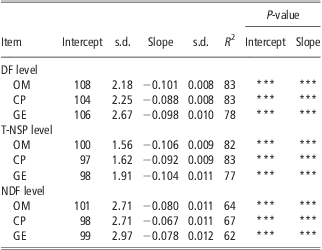
OM = organic matter; GE = gross energy; DF = dietary fibre; T-NSP = total non-starch polysaccharides.
***P < 0.001.
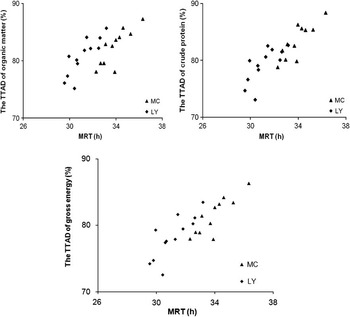
There was a linear relation (P < 0.05) between the MRT of solids and the CTTAD of OM, CP and GE (Table 9 and Figure 2).
The relationship between total tract mean retention time (MRT) and the total tract apparent digestibility (TTAD) of dietary components across Mong Cai (MC) and Landrace × Yorkshire (LY) pigs. For data sources and statistics, see Table 9.

Gastrointestinal tract development
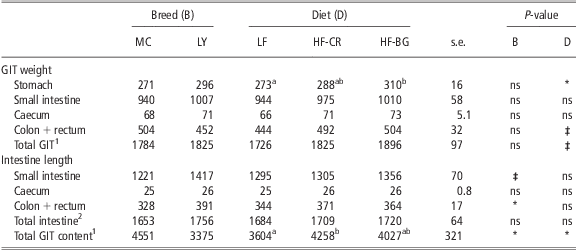
Breed had no impact on the weight of the individual segments and whole gut (sum of all segments) (P > 0.05; Table 8). The diet had an impact on the weight of stomach, colon + rectum and whole GIT (P < 0.05 or P < 0.1).
Effects of dietary fibre source on GIT weight (g) and length (cm) and the weight of GIT content (g wet weight) in MC and LY pigs – least square means and s.e.m.
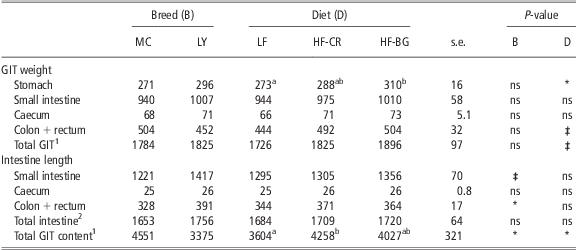
GIT = gastrointestinal tract; MC = Mong Cai; LY = Landrace × Yorkshire; standard error of mean = s.e.m.; LF = low-fibre diet; HF-CR = high-fibre diet containing cassava residue; HF-BG = high-fibre diet containing brewer's grain; ns = non-significant.
1Total GIT weight or content included weight or content of stomach, small intestine, caecum and colon + rectum.
2Length of total intestine included length of small intestine, caecum and colon + rectum.
For diets, means with different letters within a row are significantly different (P < 0.05).
‡P < 0.1; *P < 0.05.
The length of colon + rectum and small intestine were greater for LY than for MC pigs (P < 0.05 or P < 0.1), whereas the length of caecum and total intestine (small intestine, caecum and colon + rectum) did not differ between (P > 0.05) LY and MC pigs (Table 8). The length of individual segments and total intestine was unaffected by diet (P > 0.05).
Gut content was higher for MC pigs than for LY pigs (P < 0.05; Table 8). The pigs fed diet HF-CR had greater gut content than the pigs fed diet LF (P < 0.01), whereas the pigs fed diet HF-BG had similar gut content with the pigs fed diets HF-CR and LF (P > 0.05)
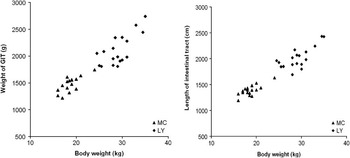
BW had an impact on gut weight and length (P < 0.001), with a linear increase of gut weight and length with increasing BW (Table 9 and Figure 3).
Results of General Linear Models relating the MRT to DMI (g/day), the TTAD to the MRT and GIT weight and intestinal length to BW, using breed and diet as cofactors
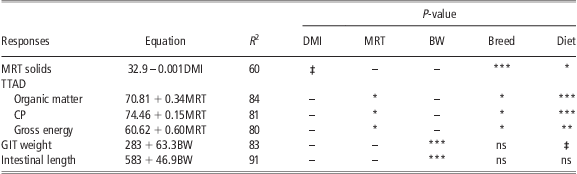
MRT = mean retention time; DMI = dry matter intake; TTAD = total tract apparent digestibility; GIT = gastrointestinal tract.
‡P < 0.1; *P < 0.05; **P < 0.01; ***P < 0.001.
The relationship between BW and the weight (g) of the gastrointestinal tract (GIT) and length (cm) of the intestinal tract across Mong Cai (MC) and Landrace × Yorkshire (LY) pigs. For data sources and statistics, see Table 9.

Discussion
The most striking finding in the current study was the high impact (R 2 = 0.80 to 0.84) of digesta MRT on the total tract apparent digestibility (TTAD) of OM, CP and GE across diets. Similarly, Kim et al. (Reference Kim, Lindemann, Cromwell, Balfagon and Agudelo2007) showed that the TTAD of DM in weanling, growing and finishing pigs was positively correlated with the passage rate of digesta, indicating the importance of MRT as a potential independent variable in digestibility assessments.
Earlier studies (Castle and Castle, Reference Castle and Castle1957; Stanogias and Pearce, Reference Stanogias and Pearce1985) reported that feed intake had an impact on MRT, with higher feed consumption resulting in faster passage of digesta. This could be confirmed in the present study. Moreover, the shorter MRT of liquid and solids on diets HF-CR and HF-BG than on diet LF can be explained by the higher fibre intake (Wilfart et al., Reference Wilfart, Montagne, Simmins, Noblet and van Milgen2007) and the resulting increase in DMI. The decrease in MRT of solids was linearly related to the increase in dietary content of DF, T-NSP and NDF (Table 5). In addition, the longer MRT of solids on diet HF-CR than on diet HF-BG could also be explained by a lower DMI and indicate that solubility of NSP may have an effect on the MRT. In addition to fibre solubility, the MRT will be affected by other physical characteristics of the diet such as viscosity, water-holding capacity and lignification (Stanogias and Pearce, Reference Stanogias and Pearce1985; Glitsø et al., Reference Glitsø, Brunsgaard, Højsgaard, Sandström and Bach Knudsen1998; Freire et al., Reference Freire, Guerreiroa, Cunhaa and Aumaitre2000; Le Goff et al., Reference Le Goff, Van Milgen and Noblet2002). Insoluble fibre has a direct physical effect in the hindgut because of its bulking effect, and will stimulate propulsive colonic motility and shorten the MRT (Le Goff et al., Reference Le Goff, Van Milgen and Noblet2002). In contrast, soluble fibre may lengthen the MRT of digesta owing to its effect on viscosity and water-holding capacity (Freire et al., Reference Freire, Guerreiroa, Cunhaa and Aumaitre2000; Le Goff et al., Reference Le Goff, Van Milgen and Noblet2002).
Pigs fed the HF diets in the current study compensated a lower dietary content of ME by consuming more DM than on diet LF. In contrast, Len et al. (Reference Len, Hong, Lindberg and Ogle2009a) found no difference in DMI of pigs fed low- and high-fibre diets on the basis of rice bran, sweet potato vines and CR. The lower DMI on diet HF-CR compared with diet HF-BG could be related to the higher water-holding capacity of CR as compared with BG (Ngoc et al., Reference Ngoc, Len and Lindberg2012). The water-holding capacity of a feedstuff is related to its bulking properties and will affect the feed intake capacity (Kyriazakis and Emmans, Reference Kyriazakis and Emmans1995). The high-fibre diets had a negative impact on ADG and FCR, and the higher DMI on the HF diets could not fully compensate for the lower energy and nutrient availability.
In agreement with previous studies (Högberg and Lindberg, Reference Högberg and Lindberg2004 and Reference Högberg and Lindberg2006; Serena et al., Reference Serena, Jørgensen and Bach Knudsen2008), source and level of DF had a pronounced effect on the site of OM, CP and GE digestion. Furthermore, the digestibility of OM, CP and GE at ileum followed the same pattern as shown for the total tract. The CIAD and CTTAD of OM, CP and GE was reduced with an increase in dietary fibre level, in agreement with other studies (Högberg and Lindberg, Reference Högberg and Lindberg2004 and Reference Högberg and Lindberg2006; Len et al., Reference Len, Hong, Lindberg and Ogle2009a and Reference Len, Ngoc, Ogle and Lindberg2009b). Moreover, the CTTAD of OM, CP and GE was improved with an increase in the solubility of the DF fraction, in agreement with others (Bach Knudsen and Jørgensen, Reference Bach Knudsen and Jørgensen2001; Högberg and Lindberg, Reference Högberg and Lindberg2004 and Reference Högberg and Lindberg2006). The insoluble and more lignified DF in diet HF-BG compared with diets HF-CR and LF restricts the microbial degradation of nutrients in the large intestine (Bach Knudsen and Hansen, Reference Bach Knudsen and Hansen1991). However, the different solubility properties of the diets HF-CR and HF-BG did not have any effects on the CIAD of OM, CP and GE. Possibly, the difference in soluble DF between diets HF-CR and HF-BG (29 v. 47 g/kg DM) was too small to have an effect on the CIAD.
The decrease in TTAD of OM, CP and GE was linearly related to the dietary content of DF, T-NSP and NDF (Table 7). This was in accordance with results from other studies where fibrous feed ingredients have been included in the diet (Högberg and Lindberg, Reference Högberg and Lindberg2004; Len et al., Reference Len, Lindberg and Ogle2007).
The extent of ileal digestion of DF fractions was in the range reported from earlier digestibility experiments with growing pigs (Bach Knudsen and Jørgensen, Reference Bach Knudsen and Jørgensen2001). In the current study, the digestion pattern of the DF components between diets was different at the ileum and in the total tract. Thus, at the ileum, T-NSP, T-NCP and DF were more extensively digested on the diet HF-CR than on the diets HF-BG and LF, while values for diet LF (except for T-NCP) were similar to diet HF-BG. This could be related to the higher content of soluble NSP in diet HF-CR than on diets LF and HF-BG (Table 3), and indicated that both type and level of DF was of importance for the digestion of the fibre fractions in the total tract. Soluble fibres are more readily digested than insoluble fibres before the hindgut of the pig (Bach Knudsen and Jørgensen, Reference Bach Knudsen and Jørgensen2001; Högberg and Lindberg, Reference Högberg and Lindberg2004; Serena et al., Reference Serena, Jørgensen and Bach Knudsen2008), while the increase in digestibility of fibre components with higher DF content could be due to adaptation of the gut microflora to the high-fibre diets (Högberg and Lindberg, Reference Högberg and Lindberg2004).
In the present study, increased fibre level in the diet resulted in greater weight of the GIT (except for small intestine and caecum), in agreement with others (Freire et al., Reference Freire, Guerreiroa, Cunhaa and Aumaitre2000 and Reference Freire, Dias, Cunha and Aumaitre2003; Len et al., Reference Len, Hong, Lindberg and Ogle2009a), whereas the length of the GIT was unaffected by diet. However, there were no differences in the weight of the GIT between the diets HF-CR and HF-BG, which could be due to the small difference in soluble fibre content between the HF diets. In contrast, earlier studies have shown that fibre source and its specific properties may be of importance for gut development (Freire et al., Reference Freire, Guerreiroa, Cunhaa and Aumaitre2000; Len et al., Reference Len, Hong, Lindberg and Ogle2009a).
Although the daily intakes of DM and CP were not different between MC and LY pigs, LY pigs had higher growth rate and better feed conversion than MC pigs, which is in line with earlier reports (Borin et al., Reference Borin, Lindberg and Ogle2005; Len et al., Reference Len, Lindberg and Ogle2007). This could be explained by greater growth potential of LY pigs owing to long-term breeding for improved performance traits. Nitrogen retention of growing MC pigs was shown to be lower than in growing LY pigs (Borin et al., Reference Borin, Lindberg and Ogle2005; Len et al., Reference Len, Lindberg and Ogle2007.
The digestion of dietary components and fibre fractions was higher in MC pigs than in LY pigs. This supports the contention that indigenous pig breeds may have a higher capacity to digest fibre than exotic pig breeds genetically improved to support high growth performance (Borin et al., Reference Borin, Lindberg and Ogle2005; Len et al., Reference Len, Lindberg and Ogle2007, Reference Len, Hong, Lindberg and Ogle2009a and Reference Len, Ngoc, Ogle and Lindberg2009b). The main explanation to the improved digestibility in the MC pigs in the current study was a longer MRT of digesta. This should have contributed to a more efficient digestion due to longer contact between digesta, digestive enzymes and absorptive surfaces (Guixin et al., Reference Guixin, Verstegen and Bosch1995), and between digesta and the gut microbiota (Freire et al., Reference Freire, Guerreiroa, Cunhaa and Aumaitre2000). The longer MRT in MC pigs could be explained by a larger GIT (in terms of diameter), reflected in more gut content, as compared with the LY pigs. In accordance, Morales et al. (Reference Morales, Perez, Martin-Orue, Fondevila and Gasa2002) reported that Iberian pigs had lower gut content compared with Landrace pigs, resulting in shorter transit time of digesta. Earlier studies on indigenous and exotic pig breeds support the contention of greater length of the GIT in the indigenous pigs (Freire et al., Reference Freire, Peiniau, Cunha, Almeida and Aumaitre1998; Len et al., Reference Len, Hong, Lindberg and Ogle2009a).
Conclusion
An increased fibre content in the diet decreased in the digestibility of nutrients and the MRT of digesta, and increased gut weight (except for small intestine and caecum). Moreover, the results indicate a possible impact of fibre properties (such as solubility) on digestibility of dietary components and MRT of digesta. MC pigs had a greater gut content and a longer MRT of digesta compared with LY pigs, resulting in higher digestibility of dietary components. However, the digesta MRT appeared to be the major factor influencing the digestibility of dietary components, across diets and pig breeds.
Acknowledgements
This study was financed by Sida-SAREC (Swedish International Development Cooperation Agency – Department for Research Cooperation), through the regional MEKARN programme and the Swedish University of Agricultural Sciences. The authors would like to thank the researchers at the Department of Animal Nutrition and Forage and staff of the Centre of Animal Feed Testing and Conservation of the National Institute of Animal Science for their help in carrying out the study.