





Introduction
Herbicides remain one of the most widely used methods for managing weeds in agriculture. However, the evolution of herbicide resistance, increasing concerns about environmental impacts, and growing regulatory and societal pressure to reduce synthetic pesticide use have stimulated interest in more sustainable production systems and alternative weed management strategies (European Commission 2020; Gerhards et al. Reference Gerhards, Spaeth, Özcan, Zimmermann, Schönleber, Bahrs, Schwaderer and Sturm2026; Schappert et al. Reference Schappert, Schumacher and Gerhards2019). As a potential solution to these challenges, Zimmermann et al. (Reference Zimmermann, Claß-Mahler, Cossel, Lewandowski, Weik, Spiller, Nitzko, Lippert, Krimly, Pergner, Zörb, Wimmer, Dier, Schurr and Pagel2021) introduced the mineral ecological cropping system (MECS), which applies plant protection methods without the use of synthetic chemical pesticides (Saile et al. Reference Saile, Spaeth, Schwarz, Bahrs, Claß-Mahler and Gerhards2023). Similar to earlier weed management options, MECS aims to replace synthetic pesticides with preventive and smart alternative plant protection methods. However, mineral nitrogen was included in MECS to increase productivity, whereas it is not included in organic farming systems (Riemens et al. Reference Riemens, Sønderskov, Moonen, Storkey and Kudsk2022). Consequently, MECS has emerged as a promising alternative production system that aims to reduce environmental risks while maintaining productivity. Because MECS does not rely on herbicides, effective weed control may become more difficult. Therefore, effective fertilization strategies may play an important role in weed management in MECS. Nevertheless, it remains unclear whether mineral nitrogen in these pesticide-free systems supports crop competitiveness or favors weed growth.
Competition between crops and weeds for available resources plays a central role in weed interference in agricultural systems (DiTomaso Reference DiTomaso1995). Weeds have been found to possess comparable or better biological, physiological, and chemical traits for using nitrogen for biomass production than crop plants (Lindsey et al. Reference Lindsey, Warncke, Steinke and Everman2013; Saile et al. Reference Saile, Spaeth, Schwarz, Bahrs, Claß-Mahler and Gerhards2023). However, several studies have reported contrasting findings (Berquer et al. Reference Berquer, Bretagnolle, Martin and Gaba2023; Gantoli et al. Reference Gantoli, Rueda Ayala and Gerhards2013), suggesting that crops can better suppress weeds when they receive sufficient fertilizer. Those contrasting results may be explained by different ecological conditions, specific crop species, the composition and quantities of weed species, fertilizer type, application rate, timing, and methods, along with other related factors (Little et al. Reference Little, DiTommaso, Westbrook, Ketterings and Mohler2021).
Nitrogen is the most essential nutrient that can be strategically applied to mitigate the negative effects of weeds because it plays a key role in promoting the optimal growth and competitiveness of cultivated plants (Agostinetto et al. Reference Agostinetto, Tarouco, Langaro, Gomes and Vargas2017). However, in certain cases, the use of nitrogen fertilizer may stimulate the proliferation of weeds more than the growth of crop plants (Blackshaw et al. Reference Blackshaw, Brandt, Janzen, Entz, Grant and Derksen2003; Lindsey et al. Reference Lindsey, Warncke, Steinke and Everman2013). Hence, these findings emphasize the significance of nitrogen fertilization in agricultural ecosystems, particularly in balancing competition between crops and weeds (DiTomaso Reference DiTomaso1995).
Fertilization and weed management are critical practices for achieving sustainable corn cultivation. Nevertheless, corn is very sensitive to both nutrient limitations and weed competition (Gołębiowska and Kieloch Reference Gołębiowska and Kieloch2016). Weeds can quickly take up nitrogen during their early growth stages, which can lead to substantial yield reductions in corn. This crop is highly susceptible to weed-crop competition, especially during its early development (Nelson et al. Reference Nelson, Nash and Dudenhoeffer2013), when the crop canopy is not yet fully established and its ability to intercept light and suppress competing vegetation is limited. Therefore, weed competition is one of the key factors leading to reduced corn production.
Spring barley and other summer cereals are known to face severe competition for nitrogen with weeds (Satorre and Snaydon Reference Satorre and Snaydon1992). Some reports indicate that each gram of dry matter produced by weeds can significantly decrease crop yield (Kaur et al. Reference Kaur, Kaur and Chauhan2018). Consequently, the extent of yield reduction is directly correlated with weed density and the duration of their competition with crops, with potential grain yield losses reaching up to 50%. These yield losses can be further exacerbated under conditions of nitrogen deficiency in the soil (Önen et al. Reference Önen, Özgöz and Özer2012).
Despite the increasing interest in pesticide-free production systems, limited research has explored how mineral fertilizers used in MECS influence weed-crop competition (Saile et al. Reference Saile, Spaeth, Schwarz, Bahrs, Claß-Mahler and Gerhards2023). This study aimed to evaluate weed-crop competition in corn and spring barley within the MECS. The competitiveness of a dicotyledon weed, common lambsquarters, a major weed in corn production systems in Germany (Saile et al. Reference Saile, Spaeth, Schwarz, Bahrs, Claß-Mahler and Gerhards2023); and a monocotyledon weed, barnyardgrass, a globally important weed that causes significant economic damage in agricultural areas (Lehoczky Reference Lehoczky2002), was investigated for nitrogen accumulation in competition with corn. Additionally, the study investigated the response of blackgrass, a growing concern for farmers in southwestern Germany (Gerhards et al. Reference Gerhards, Messelhäuser and Sievernich2022), and common chickweed, a dominant weed with considerable competition potential in spring barley fields (Saile et al. Reference Saile, Spaeth, Schwarz, Bahrs, Claß-Mahler and Gerhards2023), to different nitrogen doses at two defined weed densities.
The objective of this study was to determine how increased nitrogen availability influences the competitive balance between crops and weeds in MECS and whether the applied fertilizer primarily benefits crops or competing weeds.
Materials and Methods
Experimental Site and Design
Four pot studies (two with corn and two with spring barley) were conducted in a greenhouse at the Institute of Phytomedicine, University of Hohenheim (Stuttgart, Germany; 48.71°N, 9.20°E) during 2023. The study focused on corn (ZEMA), a significant crop in the region, alongside its two dominant weed species, common lambsquarters (CHAL7) and barnyardgrass (ECCR). Additionally, spring barley (HOVU) and its two prevalent weeds, blackgrass (ALMY) and common chickweed (STME2) were included. The experiment was designed according to a randomized complete block design with four replications and was conducted twice. Temperature and sunshine duration for each experimental period were derived from daily records, and standard deviations were calculated from these values. Mean temperature was 16.89 ± 3.73 C in Experiment 1 and 20.24 ± 3.47 C in Experiment 2. Mean daily sunshine duration was 8.94 ± 4.60 h and 7.58 ± 3.58 h for Experiment 1 and Experiment 2, respectively.
Experimental Procedures
The crop:weed combinations and nitrogen doses used in the ZEMA and HOVU competition experiments are summarized in Table 1. The nitrogen doses were based on local recommendations for corn and spring barley, where 1N corresponded to 210 and 140 kg N ha⁻1, respectively. Ammonium nitrate (NH4NO3) with 27% N content was used for nitrogen fertilization in solid form.
Crop:weed ratios and nitrogen doses applied in the competition experiments. a

Table 1. Long description
A table with four rows and six columns summarizing crop-weed combinations and nitrogen doses in competition experiments. The columns are labeled Crop, Weed, Crop:weed ratios, and Nitrogen doses with sub-columns 0N, ½N, 1N, and 2N. The row labels are ZEAMX CHEAL, ZEAMX ECHCG, HORVS ALOMY, and HORVS STME. The Crop:weed ratios are given in plants per pot. The nitrogen doses are given in grams per pot. Row 1: ZEAMX CHEAL, 1:0, 1:2, 1:5, 0:1, 0, 1.115, 2.230, 4.460. Row 2: ZEAMX ECHCG, 1:0, 1:2, 1:5, 0:1, 0, 1.115, 2.230, 4.460. Row 3: HORVS ALOMY, 1:0, 1:5, 1:15, 0:1, 0, 0.598, 1.197, 2.394. Row 4: HORVS STME, 1:0, 1:5, 1:15, 0:1, 0, 0.598, 1.197, 2.394.
a Abbreviations: ALMY, blackgrass (Alopecurus myosuroides Huds.); CHAL7, common lambsquarters (Chenopodium album L.); ECCR, barnyardgrass (Echinochloa crus-galli (L.) P. Beauv.; HOVU, spring barley (Hordeum vulgare L.); STME2, common chickweed (Stellaria media (L.) Vill.; ZEMA, corn (Zea mays L.).
b Field-equivalent nitrogen doses corresponding to the grams per pot (g pot−1) doses were 0, 105, 210, and 420 kg N ha−1 for corn and 0, 70, 140, and 280 kg N ha−1 for spring barley.
Prior to planting, seeds were subjected to a germination test. Mechanical scarification was used to break dormancy in common lambsquarters. Crop and weed seeds were planted in standard Mitscherlich pots (20 cm diameter × 18.5 cm depth; approximately 6 kg soil capacity), which were considered to provide adequate rooting volume for both crop and weed species throughout the experimental period. Pots were filled with a mixture of ½ humus, ¼ loam, and ¼ sand. The first trial commenced on May 4, 2023, followed by the second trial on July 6, 2023. To ensure uniform emergence, approximately twice the required number of both crop and weed seeds were initially sown, and excess seedlings were removed once the target number had germinated according to the treatment plan. Crop plants were positioned in the center of each pot, whereas weed plants were distributed uniformly around the crop plants.
Nitrogen was applied in three split doses to minimize the risk of leaching due to irrigation and to reflect common fertilizer application practices used in agricultural production. The first dose (10%) was applied at planting, the second (50%) at the 2- to 4-leaf stage of corn, and the final dose (40%) at the 6- to 8-leaf stage. For spring barley, nitrogen was applied similarly: 10% at sowing, 50% during tillering stage, and 40% during the stem elongation stage. To eliminate the influence of irrigation on plant competition, the field capacity moisture content of pots was determined before the experiment. Pots were irrigated when soil moisture dropped to 60% to 70% of field capacity, which was monitored by weighing the pots and adjusted using predetermined values (Camoglu Reference Camoglu2013).
Assessments
The experiments were terminated 7 wk after planting. Dried weights (grams per pot; g pot−1) and root and shoot lengths (cm) of both crops and weeds were recorded. After harvest, roots of both crops and weeds were carefully washed to remove any soil residue and then dried for accurate measurement. Root length was measured from the stem base to the tip of the longest root using a measuring ruler and expressed as the mean value per pot. Shoot length was measured from the soil surface to the tip of the top leaf afterward, and shoots were chopped and weighed. Samples were then placed in labelled paper bags and dried in an oven at 80 C for 48 h. Once fully dried, the root and shoot dry weights were determined using a precision digital scale. Additionally, no significant correlation was found between nitrogen dose, weed density, and corn root length data. Therefore, this dataset did not contribute meaningful insights to the findings of the study and was excluded from the final evaluation.
To evaluate the crop–weed competitive balance, a weed/crop biomass ratio was calculated using shoot dry weights separately for each experiment and for every nitrogen dose × weed density combination. This ratio was defined as follows:
 $$Biomass\;ratio = Weed\;shoot\;dry\;weight/Crop\;shoot\;dry\;weight$$
Only data obtained from mixed planting pots were used in the calculations. The biomass ratio approach is consistent with studies that evaluate crop–weed competitiveness through relative comparisons of weed and crop biomass in mixtures under different nitrogen doses (Blackshaw and Brandt Reference Blackshaw and Brandt2008). An increase in this ratio indicates that the competitive advantage of the weed over the crop is strengthened, whereas a decrease indicates that the competitive balance shifts in favor of the crop. For each ratio, means and standard errors (SE) were calculated and presented for each species × weed density combination.
Statistical Analysis
The statistical analyses were performed using Minitab software (v.21; Minitab LLC, State College, PA). Since the experiments were conducted twice, an analysis of variance (P < 0.05) and a Levene test for homogeneity of variances were applied. Significant differences between the two experiments led to separate analyses for each experiment. Response surface methodology (RSM) was applied to evaluate the effects of weed density and nitrogen dose on crop and weed traits, including linear and second-order terms. Model significance and fit were assessed using ANOVA, R 2 values, and lack of fit tests. To improve model accuracy, one to four outliers were removed from most investigated parameters based on the data distribution and standardized residuals. These removals were applied selectively across traits such as shoot dry weight, root dry weight, root length, and shoot length in both ZEMA and HOVU. Contour plots were generated to visualize the RSM results, with total and partial R 2 values and P-values for each factor and their interaction. Additionally, descriptive statistics (means ± SE) were presented in Supplementary Tables S1 to S8 for both crop and weed growth traits.
Results and Discussion
Competition Between Corn and Common Lambsquarters
Corn biomass increased with higher nitrogen doses when no common lambsquarters competition was present (0 CHAL7 pot−1), with the highest values recorded under the 2N + 0 CHAL7 pot−1 treatment. However, as common lambsquarters density increased, the positive effect of nitrogen on corn growth diminished. In this context, common lambsquarters density appeared to have a stronger influence on corn performance than nitrogen dose alone, particularly at higher weed densities, as supported by partial R 2 analysis (e.g., root dry weight in Experiment 1: CHAL7 density = 73.7%, nitrogen dose = 11.2%; Figure 1). Corn root dry weight and shoot development declined progressively with increasing common lambsquarters density across all nitrogen doses (Table S1), indicating intensified competitive pressure from common lambsquarters under higher nitrogen availability. Overall, higher common lambsquarters density largely constrained the capacity of corn to benefit from additional nitrogen, as reflected in the contour plots (Figure 1; Supplementary Tables S1 and S2).
Contour plots representing the effect of different nitrogen doses (N) and common lambsquarters (Chenopodium album L.; CHAL7) densities on the growth traits of corn (Zea mays L.; ZEMA). Each plot is accompanied by P-values and partial R 2 values for nitrogen, CHAL7, and their interaction (N × CHAL7), along with the total model R 2 (1N = recommended nitrogen rate for ZEMA, 210 kg N ha−1).

Common lambsquarters appeared to benefit more from nitrogen than corn, likely due to its increasing competitiveness from germination onward. Several earlier studies (Blackshaw et al. Reference Blackshaw, Brandt, Janzen, Entz, Grant and Derksen2003; Lindsey et al. Reference Lindsey, Warncke, Steinke and Everman2013) support this finding. For example, Lehoczky and Reisinger (Reference Lehoczky and Reisinger2003) found that weeds, especially common lambsquarters, can extract five times more nutrients than corn during its early stages of development. Higher nitrogen doses promoted the root and shoot development of common lambsquarters (Supplementary Table S2), indicating a favorable impact of nitrogen levels on its growth. This competitive advantage helps explain why common lambsquarters may cause high yield losses, even under conventional fertilization, since it emerges earlier and can quickly reach high biomass. Nitrogen fertilization, in particular, has been reported as a key factor influencing common lambsquarters growth and contributing to the weed seed bank (Blackshaw et al. Reference Blackshaw, Molnar and Janzen2004). Increasing nitrogen input alone will not mitigate common lambsquarters interference and may reinforce it under high weed density. Delayed control of common lambsquarters increases its competitiveness against corn, thereby severely hampering corn growth and productivity (Gołębiowska and Kieloch Reference Gołębiowska and Kieloch2016). Thus, optimized rather than higher nitrogen doses, together with early weed control, appears essential to reduce common lambsquarters interference.
Competition Between Corn and Barnyardgrass
Barnyardgrass competition negatively affected root and shoot development of corn (Figure 2). In both experiments, corn achieved the highest root and shoot dry weights when high nitrogen doses were combined with low weed densities, whereas a greater barnyardgrass density markedly reduced these responses. Under high barnyardgrass density and limited nitrogen availability, corn growth was strongly suppressed, indicating substantial competitive pressure. Increasing the nitrogen dose partly mitigated the negative effect of barnyardgrass on root growth, particularly at lower weed density, while shoot development remained more strongly constrained. A generally similar trend was observed in shoot length, with greater suppression occurring when barnyardgrass densities were higher (Figure 2, Supplementary Table S3). Previous studies confirm strong early competition between barnyardgrass and corn, causing substantial biomass reductions (Gołębiowska and Kieloch Reference Gołębiowska and Kieloch2016; Lehoczky Reference Lehoczky2002; Lehoczky and Borosne-Nagy Reference Lehoczky and Borosne-Nagy2002). One of the key factors behind this competition is the strong capacity of barnyardgrass to use soil nitrogen, especially at high weed densities (Holm et al. Reference Holm, Plucknett, Pancho and Herberger1991). At elevated densities, barnyardgrass exerts strong competitive pressure on corn growth, especially affecting shoot development, as is evident from the contour plots and consistent with the partial R 2 analysis (e.g., shoot dry weight in Experiment 2: barnyardgrass density = 95.0%, nitrogen dose = 51.2%; Figure 2).
Contour plots representing the effect of different nitrogen (N) doses and barnyardgrass [Echinochloa crus-galli (L.) P. Beauv.; ECCR] densities on the growth traits of corn (Zea mays L.; ZEMA). Each plot is accompanied by P-values and partial R 2 values for nitrogen, ECCR, and their interaction (N × ECCR), along with the total model R 2 (1N = recommended nitrogen rate for ZEMA, 210 kg N ha−1).

As the nitrogen doses increased, barnyardgrass responded by producing more biomass (Supplementary Table S4), indicating that the weed was able to benefit effectively from additional nitrogen. Earlier studies have shown that barnyardgrass is highly competitive for nitrogen during its vegetative growth stage, with higher nitrogen doses enhancing vegetative growth and seed production (Chauhan and Abugho Reference Chauhan and Abugho2013). Increasing the amount of nitrogen alone, however, will not improve corn competitiveness and may intensify weed pressure when weed density is high. Similarly, corn appears to be highly sensitive to barnyardgrass competition, particularly during the crop’s early growth stages. During the first 4 wk after emergence, yield losses may reach up to 30% due to barnyardgrass interference (Lehoczky and Borosne-Nagy Reference Lehoczky and Borosne-Nagy2002). Therefore, appropriate nitrogen doses, combined with early barnyardgrass control, appear to be essential for maintaining corn competitiveness.
Competition Between Spring Barley and Blackgrass
Increasing the blackgrass (ALMY) density had a negative effect on spring barley (Figure 3, Supplementary Table S5). In both experiments, higher nitrogen doses generally led to an increase in the root and shoot dry weights, and in shoot lengths, of spring barley at low blackgrass densities, including the 0 ALMY pot−1 treatments (Supplementary Table S5). However, when blackgrass densities were high (15 plants pot−1), the intensified crop–weed competition largely eliminated these positive effects, and the beneficial effect of nitrogen on spring barley was considerably diminished. Blackgrass exerts substantial competitive pressure on spring barley, particularly when blackgrass is dense, which reduces the effectiveness of nitrogen, as shown in the contour plots (Figure 3). Previous studies reported that barley’s ability to process nitrogen decreases under weed competition (Andreasen et al. Reference Andreasen, Litz and Streibig2006), which is consistent with the present findings.
Contour plots representing the effect of different nitrogen (N) doses and blackgrass (Alopecurus myosuroides Huds.; ALMY) densities on the growth traits of spring barley (Hordeum vulgare L.; HOVU). Each plot is accompanied by P-values and partial R 2 values for nitrogen, ALMY, and their interaction (N × ALMY), along with the total model R 2 (1N = recommended nitrogen rate for HOVU, 140 kg N ha−1).

Higher nitrogen doses altered the competitive balance between blackgrass and spring barley depending on weed density (Figure 3). This pattern reflects a density-dependent response surface, indicating that the effect of nitrogen on crop growth is not constant but varies with weed pressure. Blackgrass often germinates earlier than barley, which gives the weed an early resource advantage, leading to considerable reductions in barley yield (Ahmad et al. Reference Ahmad, Jabran, Moss and Chauhan2021). This background explains the present results in which higher nitrogen doses favored barley only when the blackgrass density was low, but it favored blackgrass when blackgrass infestations were dense. Increased nitrogen availability may intensify crop–weed competition when blackgrass density is high. Similarly, blackgrass has been shown to use nitrogen more effectively in the absence of interspecific competition (Chauvel et al. Reference Chauvel, Guillemin and Letouze2005), which is consistent with the response pattern observed in the current studies. These findings are further supported by the partial R 2 analysis, which highlights the dominant role of weed density and its interaction with nitrogen in determining crop response (e.g., shoot dry weight in Experiment 1: ALMY density = 76.8%, nitrogen dose × ALMY = 77.1%; Figure 3).
Blackgrass generally grows faster than cereals and produces substantial seed quantities (Koch and Rademacher Reference Koch and Rademacher1966). Therefore, enhancing barley competitiveness appears more important than increasing nitrogen doses alone. Delaying winter cereal planting and adjusting nitrogen timing have been proposed as effective approaches against blackgrass (Gerhards et al. Reference Gerhards, Messelhäuser and Sievernich2022), and various cultural practices may further contribute to its control (Zeller et al. Reference Zeller, Kaiser and Gerhards2018).
Competition Between Spring Barley and Common Chickweed
The contour plots indicate a clear interaction between nitrogen dose and chickweed (STME2) density, showing that the competitiveness of barley improved with increasing nitrogen doses, resulting in reduced weed competition (Figure 4). Under nitrogen deficiency conditions, chickweed was somewhat effective in competing with barley, potentially limiting the crop’s growth. A significant decrease in root dry weight and root length of barley was recorded at 15 STME2 pot−1 compared with 0 STME2 pot−1 under the 0N treatment. However, this difference largely disappeared following fertilizer application (½N, 1N, and 2N). Compared to the other weed species in this study, chickweed exhibited a weaker competitive ability under increasing nitrogen doses, which enabled barley to maintain its growth even in the presence of high weed densities (Figure 4, Supplementary Table S7).
Contour plots representing the effect of different nitrogen (N) doses and common chickweed (Stellaria media (L.) Vill.; STME2) densities on the growth traits of spring barley (Hordeum vulgare L.; HOVU). Each plot is accompanied by P-values and partial R 2 values for nitrogen, STME2, and their interaction (N × STME2), along with the total model R 2 (1N = recommended nitrogen rate for HOVU, 140 kg N ha−1).

Earlier studies reported that barley’s rapid early growth and tillering contribute to its dominance over competing species (Agostinetto et al. Reference Agostinetto, Tarouco, Langaro, Gomes and Vargas2017; Andreasen et al. Reference Andreasen, Litz and Streibig2006). The marked difference in seed size between barley and chickweed has also been proposed as a factor that influences early growth dynamics (Exley and Snaydon Reference Exley and Snaydon1992). Such characteristics may help to explain the present results in which barley was able to use applied nitrogen more effectively than chickweed. Similar responses were observed in wheat–chickweed competition, in which chickweed gained little benefit from additional nitrogen when it needed to compete with barley (Lehoczky et al. Reference Lehoczky, Kismanyoky and Kismanyoky2006). Moreover, the vertical growth habit and rapid tillering of barley allow earlier light capture compared with prostrate-growing chickweed, limiting chickweed responsiveness to increased nitrogen (Petr and Jan Reference Petr and Jan1991). Further studies are needed to specifically address the underlying mechanisms for this. Overall, appropriate nitrogen doses within the MECS system have the potential to reduce yield losses from chickweed by strengthening barley competitiveness.
Weed–Crop Biomass Ratios Under Nitrogen Doses
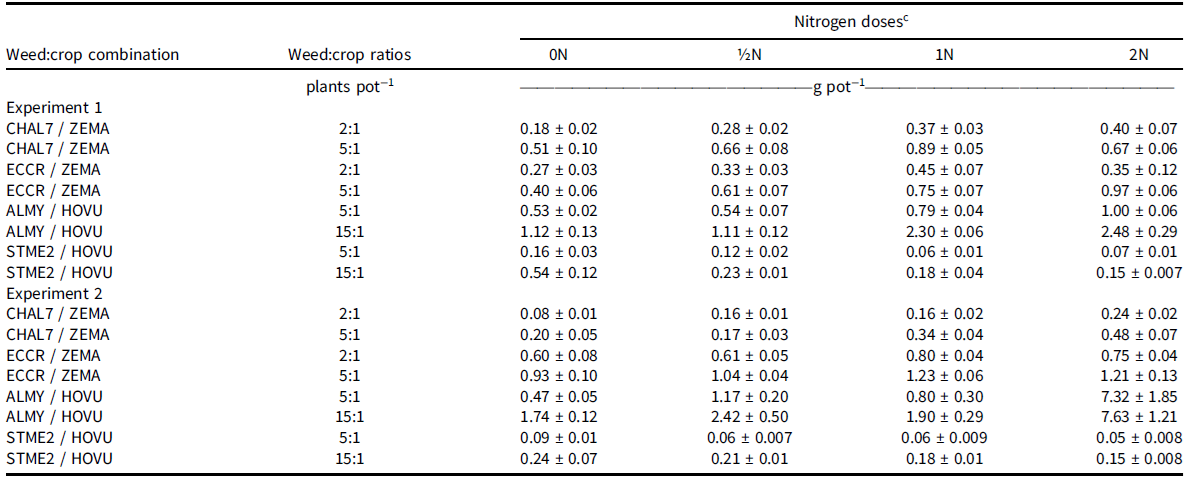
The effect of nitrogen application on crop–weed competition was evaluated using shoot dry weight-based weed-crop biomass ratios (Table 2). This allowed us to compare the competitive balance under different weed species and density level combinations. Responses to nitrogen application varied among weed species and density.

Table 2. Long description
A table showing weed and crop shoot dry weight ratios in response to nitrogen doses and weed densities. The table has 15 rows and 7 columns. Column headers are Weed:crop combination, Weed:crop ratios, and Nitrogen doses with sub-columns 0N, 1/2N, 1N, and 2N. Row labels include Experiment 1 and Experiment 2 with various weed and crop combinations and ratios. Each cell contains values representing the shoot dry weight ratios under different nitrogen doses. Notable trends include variations in shoot dry weight ratios across different weed species, densities, and nitrogen doses.
a Abbreviations: ALMY, blackgrass (Alopecurus myosuroides Huds.); CHAL7, common lambsquarters (Chenopodium album L.); ECCR, barnyardgrass (Echinochloa crus-galli (L.) P. Beauv.; HOVU, spring barley (Hordeum vulgare L.); STME2, common chickweed (Stellaria media (L.) Vill.; ZEMA, corn (Zea mays L.).
b Data are presented as mean ± standard error (SE).
c Field-equivalent nitrogen doses corresponding to the grams per pot (g pot−1) doses were 0, 105, 210, and 420 kg N ha−1 for corn and 0, 70, 140, and 280 kg N ha−1 for spring barley.
For lambsquarters, biomass ratios increased markedly with both increasing nitrogen dose and weed density. Particularly at 5 CHAL7 pot−1, ratios under 1N and 2N treatments were higher than those at 2 CHAL7 pot−1, indicating that nitrogen tended to favor lambsquarters over corn (Tables 2 and S2). For barnyardgrass, a moderate response was observed: at 2 ECCR pot−1 nitrogen caused only limited changes, whereas at 5 ECCR pot−1 more pronounced increases were recorded, particularly in Experiment 2. The competitive ability of barnyardgrass is strongly density-dependent and that, under high density, the weed benefited from additional nitrogen more than corn (Table 2 and Supplementary Table S4).
In the blackgrass–barley interaction, the effect of nitrogen became more evident under high weed density and high nitrogen doses. In Experiment 2, biomass ratios under the 2N treatment favored blackgrass over barley. This shift was limited at 5 ALMY pot−1 but pronounced at 15 ALMY pot−1, confirming that the nitrogen effect was strongly dependent on weed pressure (Table 2 and Supplementary Table S6). In the chickweed–barley interaction, a contrasting pattern was observed. Increasing nitrogen doses were associated with decreasing chickweed/barley ratios in both experiments, particularly at 15 STME2 pot−1. Higher nitrogen availability favored barley, because the crop used the additional nitrogen more effectively than the weed, and chickweed was a weaker competitor under fertilized conditions compared with the other weed species (Table 2 and Supplementary Table S8).
Overall, nitrogen application did not consistently favor the crop. In particular, higher ratios in the lambsquarters and blackgrass systems indicate a shift in competitive balance toward weeds, whereas the chickweed system favored the crop; Barnyardgrass exhibited an intermediate, density-dependent response. This pattern is consistent with that reported in previous studies showing that nitrogen availability can alter the crop–weed competitive balance depending on species and density (Blackshaw et al. Reference Blackshaw, Brandt, Janzen, Entz, Grant and Derksen2003; Chauhan and Abugho Reference Chauhan and Abugho2013).
Comparison of Competitive Abilities of Weeds Against Corn
Lambsquarters had a stronger negative effect on corn root dry weight than barnyardgrass across nitrogen doses (Supplementary Tables S2 and S4). Although barnyardgrass had a slightly stronger effect on corn shoot growth, no clear difference was detected between the two weeds in their impact on shoot development, indicating that lambsquarters was marginally more competitive when root growth was considered. Previous studies have also shown that weed species respond differently to nitrogen treatments and may affect distinct components of crop growth (Kaur et al. Reference Kaur, Kaur and Chauhan2018). Such species-specific differences may be associated with morphological features, particularly root structure, which can influence access to soil resources (Basaran Reference Basaran2022), and this could partly explain the stronger impact of lambsquarters on corn root development. In line with these observations, partial R 2 analysis (Figures 1 and 2) identified different dominant drivers of corn growth between weeds, with density prevailing in lambsquarters, whereas with barnyardgrass, nitrogen contributed more strongly to root traits and weed density to shoot traits, and species identity appeared to be more important than fertilizer level in determining the direction of competition.
In addition to species-specific responses, environmental conditions also influenced the observed interactions. These conditions differed between the experiments, with mean temperatures of 16.89 ± 3.73 C (Experiment 1) and 20.24 ± 3.47 C (Experiment 2). These differences may have contributed to the seasonal variation observed in corn–weed interactions; the cooler conditions in Experiment 1 may have favored weeds relative to corn, whereas temperatures more favorable for corn growth in Experiment 2 were associated with improved corn performance. Consequently, fluctuating temperature may influence competitive dynamics, although targeted studies are required to verify this effect (Patterson Reference Patterson1995).
Comparison of Competitive Abilities of Weeds Against Spring Barley
Blackgrass was more competitive against barley than chickweed, particularly under high weed density and elevated nitrogen supply. Additional nitrogen favored barley in the presence of chickweed, whereas under blackgrass competition the same nitrogen levels shifted the advantage toward the weed at high density, indicating a weed-specific response of barley to nitrogen. Partial R 2 analysis (Figures 3 and 4) supported this pattern by showing different dominant drivers in the two systems, with nitrogen dose prevailing in the barley–chickweed system, whereas weed density and the nitrogen × weed density interaction dominated in the barley–blackgrass system. This difference is consistent with results reported in previous studies that chickweed gains little benefit from nitrogen under cereal competition (Lehoczky et al. Reference Lehoczky, Kismanyoky and Kismanyoky2006) and its prostrate growth limits resource capture (Petr and Jan Reference Petr and Jan1991), whereas blackgrass often emerges earlier and utilizes nitrogen effectively under competitive conditions (Ahmad et al. Reference Ahmad, Jabran, Moss and Chauhan2021; Chauvel et al. Reference Chauvel, Guillemin and Letouze2005).
Effective weed management is crucial for corn and spring barley production in MECS. Rather than increasing the total nitrogen dose alone, nitrogen fertilization strategies should be adapted to weed species and infestation level. Previous studies reported that surface-applied nitrogen can stimulate weeds more than subsurface placement (Basaran Reference Basaran2022; Blackshaw et al. Reference Blackshaw, Molnar and Janzen2004), and that split nitrogen applications enhance cereal competitiveness (Dhima and Eleftherohorinos Reference Dhima and Eleftherohorinos2001). Therefore, further research on fertilizer systems (dose, timing, method, and formulation) is needed to optimize crop–weed relationships in MECS under different infestation scenarios. In conclusion, weeds in MECS may be more effectively managed by enhancing crop competitiveness through species-specific nitrogen fertilization strategies.
Practical Implications
Crop–weed competition in mineral ecological cropping system is strongly influenced by weed species, weed density, and nitrogen doses. Increasing nitrogen input does not consistently improve crop performance and may favor weed growth instead of the crop. In corn systems, common lambsquarters and barnyardgrass benefited more from an increased nitrogen supply, particularly under high weed density, which can intensify yield losses. In contrast, in spring barley, responses were species-specific: blackgrass became more competitive under higher nitrogen and density, whereas spring barley maintained a competitive advantage over chickweed, even at elevated nitrogen levels. Uniform fertilization strategies are not suitable for all crop–weed situations. Instead, nitrogen doses should be adjusted according to the dominant weed species and infestation level. Future research on fertilizer timing, placement, application methods, and formulation may provide additional opportunities for improving weed management in MECS. Overall, effective weed management in MECS requires appropriate nitrogen doses rather than increasing nitrogen input. Adapting fertilization strategies to species-specific competition patterns can improve crop performance.
Supplementary material
The supplementary material for this article can be found at https://doi.org/10.1017/wet.2026.10142.
Acknowledgments
We are indebted to Oyebanji Alagbo and Matthias Schumacher for their technical support. Additionally, we thank Sandor Knecht, Jan Roggenbuck, Sebastian Hajek, Alexandra Heyn, Susanne Brüx, and Cathrin Brechlin for their help in data collection and plant harvesting.
Funding
The Article Processing Charge (APC) was funded by Bundesministerium für Bildung und Forschung (BMBF), grant number 031B0731A.
Competing Interests
The authors declare they have no conflicts of interest.




 Open access

