Implications
Market valuation techniques often fail to provide accurate economic weights for the construction of breeding goals, owing to market failures and the diverse particularities of sheep farming systems. In this paper, preferences are recorded and presented alongside estimates of the economic value of various sheep traits, based on non-market valuation (choice experiment) among Greek sheep farmers; the most preferred traits are revealed, their ‘true’ economic value is estimated, and the effects of farm and farmer-specific characteristics are investigated.
Introduction
The design and implementation of efficient breeding programmes in order to cover emerging and changing needs of sheep farmers constitutes a major challenge for animal scientists worldwide. The use of modern technologies provides new perspective to breeding programmes and permits the investigation of the inclusion of functional traits in the breeding goal. The expected final outcome from a breeding programme – that is, the production of animals with desirable characteristics under current and future environmental, economic and social circumstances – is summarized in the breeding goal. The breeding goal is predominantly of economic nature and commonly involves profit maximization and/or utility maximization. In the latter case, a breeding programme aims not only at ensuring additional income for farmers but also at the improvement of their overall satisfaction (‘utility’, Marshall, Reference Marshall1920). Rational-behaving consumers (in this case farmers, who are the consumers of the product of the breeding programme) will maximize their utility, that is, their overall satisfaction (Johansson, Reference Johansson1991), by seeking to obtain the most satisfaction possible from the product of the breeding programme. The breeding goal includes both production traits (e.g. milk and meat production), whose changes are reflected in increased outputs and functional traits (Fuerst-Waltl and Baumung, Reference Fuerst-Waltl and Baumung2009) (e.g. resistance to disease and adaptability), which affect the use of inputs and the operation of livestock farms in general (Barillet, Reference Barillet2007).
The breeding goal illustrates that the results of a breeding programme are affected by biological and economic factors, the latter being more volatile than the former, considering the globalized nature of the economy, including agricultural and livestock production. Economic weights reflect the value of one unit (marginal) change in each trait and can be used to determine the weighting each trait receives in the breeding goal. The systematic exclusion of some traits in favour of others is economically unsustainable, if it entails the loss of sheep attributes that contribute to the economic performance of farms – or of farming systems – indirectly, and environmentally unsustainable if it affects adversely the genetic diversity. For example, the intensive efforts of improving milk production brought about a loss in resistance to disease, as the latter was systematically ignored. Kogsey (Reference Kogsey2004) states that ‘intangible benefits’ are often disregarded in favour of ‘technical’ traits.
Economic weights are also expected to reflect the diversity of farmers’ preferences towards genetic material. Indeed, preferences are not static, but rather evolve over time. In addition, sheep farming systems are not uniform and particular sheep breeds are suitable for different systems. Some traits were neglected in past breeding programmes because market demand was not taken into account, which is driven by the diverse attitudes of farmers – the ‘potential consumers of genetically improved animals’ and the final beneficiaries of the breeding programme. Thus, a thorough understanding of the factors underlying the decision of a farmer to buy a production animal, including animal-, farmer-, farm- and site-specific characteristics, becomes crucial in the development of economic weights that provide the necessary direction for the breeding programmes (Amer, Reference Amer1994; Dekkers and Gibson, Reference Dekkers and Gibson1998; Byrne et al., Reference Byrne, Amer, Fennessy, Hansen and Wickham2012). Indeed, such accurate economic weights may inform all actors involved in sheep breeding (organizations, nucleus farms and sheep farmers) and contribute to a more effective distribution of funds for genetic improvement and breeding programmes.
The established methodology for the calculation of economic weights for sheep traits is based on techniques commonly applied in the field of agricultural production economics, such as partial budgeting, profit functions and linear programming (Tolone et al., Reference Tolone, Riggio, Maizon and Portolano2011; Lopes et al., Reference Lopes, Borjasa, da Silva, Facó, Lôbo, Fiorvantia and McManus2012). Bioeconomic models are also used to combine biological and economic data (Byrne et al., Reference Byrne, Amer, Fennessy, Cromie, Keady, Hanrahan, McHugh and Wickham2010; Gebre et al., Reference Gebre, Fuerst-Waltl, Wurzinger, Philipsson, Duguma, Mirkena, Haile and Sφlkner2012). These methods require data from real market transactions in order to produce undistorted estimations.
Nonetheless, the valuation of sheep traits is subject to restrictions that render market valuation techniques inadequate in providing reliable estimates of the true value of sheep traits and this is owing to several reasons. First, in many countries the niche sheep genetic material market is the cause of market failures. Market failures are present in cases of inefficient allocation of resources and of funds for the production of goods and the provision of services (Ingersent and Rayner, Reference Ingersent and Rayner1999). Niche markets of sheep genetic material are abundant, as there are many breeds available, with different characteristics that suit the needs of various types of sheep farmers. For example, in Greece, a recent study reported 25 Greek indigenous sheep breeds, most of them detected in small areas, under various statuses of endangerment (Mpizelis, Reference Mpizelis2013). The geographical dispersion of the niche markets and of relevant actors induces asymmetric information, which results in deviations from Pareto optimality, that is, an ideal state of allocation of resources, such that it is not possible to improve the state of an individual without at least one other individual to become worse off (Tietenberg and Lewis, Reference Tietenberg and Lewis2006). Such deviations ultimately lead to market failures. According to Stiglitz (Reference Stiglitz1989), information is a source of market failure if it is not properly capitalized by firms; in this sense, if farmer preferences are not properly communicated to research centres and breeders, the available genetic and financial resources will not be channelled towards the production of the animals that the market demands. In this case, market failures do not permit the estimation of the real values that society would attach to sheep traits, if their prices were to be formed at the cross-section of the supply and demand curves.
Another factor that constrains the efficiency of market valuation is the nature of functional sheep traits. Improvements in functional traits often have an impact on the overall operation of the farm without a definable measure of changes in costs or revenues, and therefore markets and market valuation techniques are not always appropriate in the valuation of functional traits. Furthermore, sheep farmers who lack education and specialized education on sheep farming, in particular, are not always able to understand the true impact of these traits. Even in cases where farmers are fully aware of the advantages of some functional traits, they may not find the animals endowed with them.
In order to overcome these problems, non-market valuation techniques have been used complementarily to market valuation, such as those predominantly used within marketing research and environmental economics (contingent valuation, conjoint analysis, choice experiments (CE)), also known as stated-preference valuation techniques (Amer, Reference Amer1994; Bateman et al., Reference Bateman, Carson, Day, Hanemann, Hanley, Hett, Jones-Le, Loomes, Mourato, Ozdemiroglu, Pearce, Sugden and Swanson2002). These methods are appropriate for the valuation of goods and services under market failures and asymmetric information. Their common characteristic is the formulation of a hypothetical market for a good or service and the elicitation of its members’ willingness to pay (Arrow et al., Reference Arrow, Solow, Portney, Learner, Radner and Schuman1993; Bateman et al., Reference Bateman, Carson, Day, Hanemann, Hanley, Hett, Jones-Le, Loomes, Mourato, Ozdemiroglu, Pearce, Sugden and Swanson2002). CE’s have been applied by numerous authors during the past few years to attach monetary values to non-marketed goods and services (Birol et al., Reference Birol, Karousakis and Koundouri2006). The method is based on Lancaster’s (Reference Lancaster1966) theory of consumer preference, according to which the total utility of goods and services can be derived from their components. Applications of such methods in the valuation of production animal traits propose participatory processes for farmers in the design of breeding programmes. Nielsen and Amer (Reference Nielsen and Amer2007) provide a methodological approach of CE for breeding programme design. Tano et al. (Reference Tano, Kamuanga, Faminow and Swallow2003) used a CE to evaluate indigenous bovine breeds in West Africa and found that disease resistance, fitness for traction and reproductive performance were the most important traits.
The purpose of this study is to provide insights as to the use of non-market valuation as an alternative to established methods in estimating economic weights of sheep traits. The study employs the CE approach, which allows for an examination of sheep farmer preferences and for the attribution of monetary values to goods and services that markets fail to evaluate.
Material and methods
The CE method
The most important task in the design of a CE is the choice of attributes that describe the good or service (Wolfova and Wolf, Reference Wolfova and Wolf2013) as well as the determination of levels for each attribute. In the experimental design, the researcher adds a monetary attribute corresponding to an amount that a respondent should pay in order to achieve the attribute levels they desire. The possible combinations of all attributes and levels are called alternatives, which are then organized in pairs, formulating the choice sets. Respondents are presented with a number of choice sets and in each one they are asked to indicate the alternative they prefer.
Experimental and questionnaire design
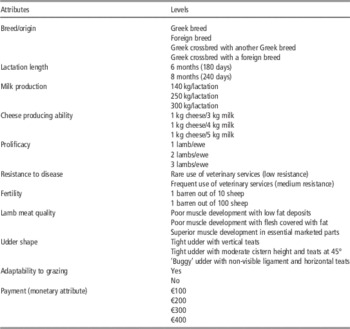
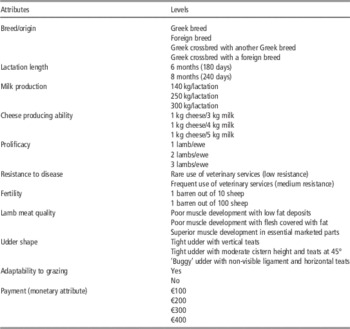
In all, 11 attributes of dairy ewes were included in the experimental design: five production traits, five functional traits and the monetary attribute. The choice of these attributes (described below) and of their corresponding levels (see Table 1) was based on the results of two focus-group surveys among sheep farmers in the study area (northern Greece), empirical evidence from the study area and relevant literature, which is presented in what follows, alongside the description of traits. It is stressed that the theoretical background of the method generally allows for attributes that are either qualitative or quantitative in nature (Adamowicz et al., Reference Adamowicz, Louviere and Swait1998). Attribute levels were determined carefully to account for the whole range of possible outcomes of each attribute, as described in what follows.
The attributes and their corresponding levels in the choice experiment
Breed/origin
In all, four levels were chosen: Greek breed, foreign breed, Greek crossbred with another Greek breed and Greek crossbred with a foreign breed. Crossbreds between Greek and foreign breeds were usual for Greece until mid-1970s (Zervas et al., Reference Zervas, Boyazoglu, Kalaissakis, Papadimitriou and Flamant1977; Fragkos, Reference Fragkos1988), while in later years Greek pure breeds (Chios, Lesvos and Karagkouniko) are promoted.
Lactation
The duration of lactation varies among sheep farms. Longer lactation does not necessarily mean increased net income because the additional expenses (human labour, feedstuffs) may not be counterbalanced by the extra milk production. Two levels were chosen: 6 months (180 days) and 8 months (240 days), corresponding to the average lactation length on extensive and semi-intensive farms in Greece, respectively (Lagka, Reference Lagka2005).
Milk production
Three levels were determined (140, 250 and 300 kg/year), which account for the mean milk yield in extensive, semi-intensive and intensive Greek farms, respectively (Chatziminaoglou, Reference Chatziminaoglou2001).
Cheese producing ability
This trait is of particular importance for sheep, as most of the milk production is directed to dairy industries for cheese making. For this reason, three levels were chosen for the experimental design, which were expressed as the quantity of milk most commonly required for the production of 1 kg of Greek ‘feta’ cheese: 1 kg cheese/3 kg milk, 1 kg cheese/4 kg milk, 1 kg cheese/5 kg milk.
Prolificacy
Prolificacy is very important for the economic performance of farms, as it determines lamb meat production, which constitutes the second most important economic activity of Greek sheep farms. Low prolificacy reduces meat production, but higher rates of prolificacy are linked to increased lamb mortality, still-birth and higher supervision labour requirements during the weaning period. In this study, prolificacy was expressed as the number of lambs per ewe lambed: one lamb/ewe, two lambs/ewe, three lambs/ewe.
Resistance to disease
This attribute included the whole range of diseases found in sheep farms. Resistance to disease affects the economic performance directly, through a decrease in veterinary expenses, and indirectly, through the improvement of farm management and product quality. The levels of resistance to disease were expressed according to the frequency of use of veterinary services – frequent or rare – which describe the two most popular answers among farmers in the focus groups.
Fertility
This attribute affects the annual milk production and labour requirements. Two extreme levels were chosen to account for the whole range of the attribute: 1 barren out of 10 sheep, 1 barren out of 100 sheep.
Lamb meat quality
Farmers are particularly interested in producing lambs that correspond to the preferences of Greek consumers, who predominantly ask for lamb meat with low fat deposits. Three levels were decided for this attribute, which complied with the standards set out by the Reg. EEC 1278/1994 and 2137/1992: poor muscle development with low fat deposits; poor muscle development with flesh covered with fat; superior muscle development in the essential marketed parts (hindquarter, back, shoulder) with less fat. The three levels corresponded to Categories A, B and C, respectively, of Annex 1 of Reg. EEC 2137/1992.
Udder shape
The levels of this trait were determined following the categorization of sheep udders by Rovai et al. (Reference Rovai, Thomas and Berger2004) based on teat position, the height of cisterns and the visibility of the suspensor ligament. In addition, Greek studies were taken under consideration to account for particularities of Greek breeds, such as the results reported by Abas et al. (Reference Abas, Sinapis, Roustemis, Hatziminaoglou, Banos and Pampoukidou2004) and Sinapis et al. (Reference Sinapis, Diamantopoulos, Abas and Vlachos2006, Reference Sinapis, Stergiadis, Abas and Katanos2008). Three different types of udder were finally chosen as three indicative levels of this attribute: tight udder with vertical teats; tight udder with moderate cistern height and teats at 45º; and ‘buggy’ udder with non-visible ligament and horizontal teats. Visual aids were used to facilitate respondents.
Adaptability to grazing
This attribute describes the adaptability of sheep to grazing in mountainous rangelands. Grazing is of vital importance for the Greek sheep farming sector because the country is endowed with many under-developed mountainous pasturelands (Chatziminaoglou, Reference Chatziminaoglou2001). The adaptability of sheep was introduced as a binary Yes/No choice in the experimental design.
Monetary attribute
Four levels were included, which were empirically decided following the prevailing market prices for the most common breeds and crossbreds in Greece.
The full-factorial design comprised 62 208 alternatives that were reduced to 25 choice sets with an orthogonal design algorithm in the R-package. Each choice set included three alternatives (A, B and C). A and B described a particular profile of an animal, each one with varying levels of the 10 attributes, which the farmer could ‘buy’ by paying the price indicated by the level of the monetary attribute. If the farmer did not want to ‘buy’ one of the two animals described by alternatives A and B, they would choose alternative C, meaning that they would not buy any animal and would not pay any amount of money.
Following the recommendations found in literature, the survey instrument was a carefully designed questionnaire (Arrow et al., Reference Arrow, Solow, Portney, Learner, Radner and Schuman1993; Bateman et al., Reference Bateman, Carson, Day, Hanemann, Hanley, Hett, Jones-Le, Loomes, Mourato, Ozdemiroglu, Pearce, Sugden and Swanson2002). Although a stated-preference questionnaire typically consists of three parts, in this study it was reduced to two parts. Farmers’ attitudes towards breeding programmes, their social and demographic characteristics and the main characteristics of their farm (type, site, management, productivity) were included in the first part, in order to reduce non-response to specific parts of the questionnaire or to specific questions, because of potential fatigue or loss of interest. In the second part of the questionnaire, the interviewee was presented with a hypothetical scenario, which entailed the establishment of a breeding programme through the foundation of a non-profit non-government organization (NGO), in charge of producing and selling certified sheep genetic material. Respondents were then asked whether they would be willing to buy sheep from such an NGO. This particular payment vehicle was chosen because respondents were expected to feel safer with a non-profit NGO in charge of channelling their money only towards genetic improvement rather than to profits of a private company. Furthermore, it was compatible with the circumstances and the decision-making process for real market transactions, as, in some cases, Greek farmers may resort to similar types of organizations to buy certified production animals. In the next step of the interview, the 25 choice sets were presented to respondents, who were asked to indicate their choice between the three alternatives.
Survey design and administration
The survey was conducted on a random sample of 78 farms situated in Macedonia, Northern Greece, which reared 20 964 sheep in total. The sampling frame included all the farms in the area that did not participate in the milk recording programme and were not registered in herdbooks, in order to investigate the preferences of farmers with no prior participation to breeding programmes, which would potentially be a source of bias. The enumerator visited respondents’ farms and conducted personal interviews with all of them. Care was taken to provide all respondents with the same level of information, which is an important prerequisite for stated-preference methods (Arrow et al., Reference Arrow, Solow, Portney, Learner, Radner and Schuman1993); if a part of the questionnaire was not fully understood, additional clarifications were provided. Choice sets were shown directly to respondents and the enumerator marked their choices on a separate answer sheet. The average duration of interviews was about 90 min. Farmers were willing to cooperate, in general, but some of them expressed fatigue after answering 15 to 20 choice sets.
The attributes were coded as continuous variables, if they were continuous by nature (lactation, milk production, milk composition, prolificacy, fertility, amount of payment), while qualitative variables were effects coded (breed/origin, resistance to disease, meat production, udder shape, adaptability). In effects coding, one level was chosen as a benchmark and the other ones were coded relative to that, then each of these levels was treated as a separate variable (Hensher et al., Reference Hensher, Rose and Greene2005). After the initial treatment of the data, the final data set comprised 1927 valid choices, which is considered a satisfactory sample size. Note that in CE studies, a sample can be considered satisfactory if each alternative is chosen at least by 50 respondents (Hensher et al., Reference Hensher, Rose and Greene2005).
Econometric analysis of the data
The econometric analysis of CE data in this study is based on random utility models where utility is distinguished in an observed (V ij ) and an unobserved (ε ij ) part.
 $$U_{{ij}} =V_{{ij}} {\plus}{\varepsilon}_{{ij}} $$
The econometric analysis of CE data within this study uses random parameter logit (RPL) models (Revelt and Train, Reference Revelt and Train1998; Birol et al., Reference Birol, Karousakis and Koundouri2006). In RPL models a separate linear utility function is introduced for each respondent and standard deviations (ηi ) are estimated for some parameters, which are treated as random; hence, utility from choosing an alternative is itself a random variable. The probability distribution function is formulated as follows, where the probability (P ij ) of respondent i choosing alternative j over all other k alternatives in choice set B equals the utility derived from this alternative over the utility derived from all alternatives. Z denotes a linear utility function and β’s the parameters to be estimated.
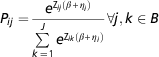 $$P_{{ij}} ={{e^{{{\rm Z}_{{ij}} (\beta {\plus}\eta _{i} )}} } \over {\mathop{\sum}\limits_{k\,=\,1}^J {e^{{{\rm Z}_{{ik}} (\beta {\plus}\eta _{i} )}} } }}\forall j,k\in B$$
RPL models account for preference heterogeneity, both observed and unobserved (see Birol et al., Reference Birol, Karousakis and Koundouri2006 for a discussion about preference heterogeneity); the former is captured in respondent-specific or other characteristics that are introduced as interaction terms with attributes (characteristic×attribute), and the latter in the estimated standard deviations. Formula (3) can be solved using the simulated maximum likelihood estimation method (MLE). The choice of random coefficients and distributional forms depends on the researcher, with a normal distribution most commonly applied (Revelt and Train, Reference Revelt and Train1998; Hensher et al., Reference Hensher, Rose and Greene2005).
The experimental design of CEs allows for the estimation of the marginal willingness to pay (MWTP) (Hanemann, Reference Hanemann1989) for each attribute using the MLE estimates, as the trade-off between income (captured in the monetary attribute) and a marginal change in the level of the attribute. The interpretation of marginality depends on the initial coding and the nature of each attribute. A marginal change for a continuous variable corresponds to a unit change (for instance 1%), while for qualitative attributes with effects coding MWTP is estimated for each level separately. For attributes with fixed coefficients in RPL models, trade-offs are estimated by means of formula (3):
 $${\rm MWTP}={\minus}{{\beta _{{{\rm attribute}}} {\plus}\beta _{1} S_{1} {\plus}...{\plus}\beta _{n} S_{n} } \over {\beta _{{{\rm payment}}} }}$$
where β 1 … β n are the coefficients of interaction terms S 1 … S n . MWTP for random coefficients in RPL models is also estimated using formula (4); however, in order to take into account the standard deviations, Hensher et al. (Reference Hensher, Rose and Greene2005) describe a technique that uses the population moments to simulate the unknown distribution of MWTP. This technique involves the estimation of a large number of random values for each of the random parameters, by taking random draws from a normal distribution whose mean and standard deviation equals those estimated by means of the MLE. For each draw, the MWTP is calculated (formula (4)) and the MWTP for the whole population is calculated as the mean of the individual values. Confidence intervals for MWTP are estimated using the bootstrapping technique of Krinsky and Robb (Reference Krinsky and Robb1986) for attributes with fixed parameters, and by using the aforementioned technique of population moments for random parameters (Hensher et al., Reference Hensher, Rose and Greene2005).
Results
The sampled farms were situated in the lowlands (74%), used old-type buildings and infrastructure (stables and sheds made from wood or metal) (70%), did not use milking machines (58%) and based animal nutrition on grazing (95%) at various degrees. According to their production systems, they were classified as extensive (53%) or semi-intensive (47%). The mean farm size was 272.2 sheep, with the rate of ewe replacement being close to 25%. Farmers were predominantly lowly educated (57% attended only primary school) and only 14% had attended some sort of educational programme on sheep farming. Most of the interviewed farmers lived permanently in the village where their farm was situated (79.5%). Pluriactive farmers accounted for only 12% of the total cohort, while the mean sample farmer had been engaged in the profession for 28.6 years.
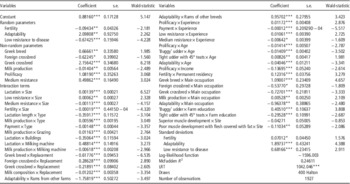
The results of the RPL model are reported in Table 2. The observed preference heterogeneity was captured in the interaction terms of attributes with various characteristics of farms and farmers, while unobserved heterogeneity was accounted for by the standard deviations of the three random parameters – fertility, adaptability and low resistance to disease. These parameters followed a normal distribution and were chosen after many tests of alternative specifications of the model. This means that there are crucial factors underlying farmers’ behaviour concerning these traits, which cannot be captured through the CE survey. The main findings from the RPL model are discussed in what follows.
Results of the random parameters logit model
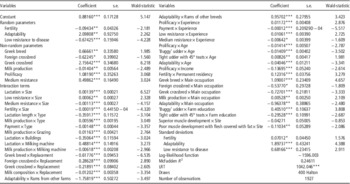
***Significant at the 99% level; **significant at the 95% level; *significant at the 90% level.
When it comes to farm-specific characteristics, farmers with larger flocks were interested in animals with longer lactation and higher fertility compared with farmers with smaller flocks. The former generally take advantage of the seasonality of mating and births, because out-of-season births increase labour requirements – more supervision labour is needed – and cause inefficiencies in the use of the available space thereby increasing production costs. High fertility rates would ensure that there will not be abortions or early embryonic losses, which would cause late season pregnancies for these animals, which, in turn, would entail off-season births. For the same reasons, farmers with larger flocks also preferred a longer lactation period; 1 or 2 months longer lactation would balance milk production losses from the reduction of off-season births by simultaneously improving the overall management of the farm.
Extensive farmers preferred animals with shorter lactation period because there was not enough available labour on the farm to accommodate milking throughout the year. These farmers seek higher milk production to a larger extent than semi-intensive farmers. Milk production was also important to farmers whose flocks grazed throughout the year and for which grazing covered a substantial part of their nutritional needs. Another interesting feature lies in the preferences of farmers who used modern infrastructure and milking machines, who were highly interested in animals with longer lactation period in order to use their buildings efficiently for a longer period throughout the year. In addition, the frequent replacement of ewes was linked to a preference for Greek breeds or crossbreds and for better cheese-making ability compared with farmers who replaced animals more rarely.
Lambs with poor muscle development with flesh covered with fat were preferred by highland sheep farmers, while in the lowlands farmers preferred animals with superior muscle development. This is owing to the fact that highland farmers are mainly focused on milk production and meat sales are only a supplementary activity; also, animals with heavier carcasses usually cannot adapt to the harsh mountainous environment. Lowland farmers, on the other hand, are able to develop systematic meat production activities, thereby selling heavier carcasses and gaining more income.
The characteristics of farmers were also important in predicting their behaviour. Older farmers seemed to prefer animals with higher adaptability to grazing and higher prolificacy. High levels of farming experience resulted in a preference towards low prolificacy and low resistance to disease. Farmers who were solely employed within the farm were more interested in crossbreds (either of Greek or of foreign origin), while pluriactive farmers placed more interest on milk production and less on adaptability to grazing. Education also seemed to play an important role, as farmers who attended educational programmes for sheep farming preferred animals with tight udder with moderate cistern height and teats at 45º.
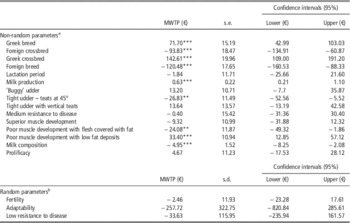
The RPL model estimates are used to estimate the MWTP for each attribute (Table 3). Note that the MWTP presented in Table 3 was estimated for the average farmer of the study area and reflect the preferences of the average farmer; the findings reported in the previous section concern the preferences of particular segments of the research population, thus highlighting the heterogenous preferences.
Marginal willingness to pay and confidence intervals
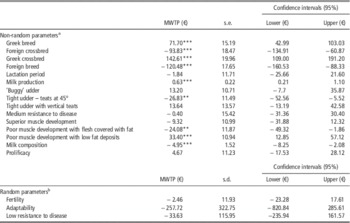
MWTP=marginal willingness to pay.
a MWTP is estimated with the Wald procedure of the econometric package LIMDEP NLOGIT 3.0 using formula (4). Confidence intervals were estimated with the bootstrapping technique of Krinsky and Robb (Reference Krinsky and Robb1986).
b MWTP and confidence intervals are estimated by simulating the population preferences using the population moments (10 000 replications) (Hensher et al., Reference Hensher, Rose and Greene2005). For MWTP formula (4) is used.
***Significant at the 99% level; **significant at the 95% level; *significant at the 90% level.
MWTP is positive for Greek breeds, as the average sheep farmer was willing to pay €71.70 for a purebred Greek ewe and €142.61 for a Greek crossbred. This finding reveals that Greek sheep farmers prefer Greek breeds, especially when some of their unwanted characteristics are improved through crossbreeding with other Greek breeds. In addition, farmers were willing to pay €0.63 per additional kg of milk per lactation. The most preferable meat production characteristic is poor muscle development with low fat deposits, as farmers were willing to pay €33.40, which are the carcasses with the highest demand in the Greek market (Zygoyiannis, 2006). When it comes to fertility, the value of an animal was reduced by €2.46 for a 1% increase in the ratio of barrens in the herd, which is interpreted as a 1% reduction in fertility.
When it comes to negative MWTP, the value of animals was reduced by €93.89 and €120.48 if they were Greek crossbreds with foreign breeds or foreign purebred animals, respectively. Furthermore, a tight udder with moderate cistern height and teats at 45° reduced the value of an animal by €26.83. Low resistance to disease was also a characteristic that reduced the value of animals as the average farmer would be willing to pay €33.63 less. Note that the standard deviation of this estimate was very high, which indicated that some farmers considered low resistance to disease as a desirable characteristic. This demonstrates the magnitude of preference heterogeneity among sheep farmers; the positive MWTP indicates that there is a segment of farmers who do not care about resistance to disease or that resistant animals lack other characteristics that farmers prefer. Lower adaptability to grazing reduced the value of an animal by €257.72. Here, the different aspirations of Greek farmers, with respect to their age and main occupation and the origin of the rams they use, were reflected in the broad confidence intervals and the standard deviation. Finally, the average farmer was willing to pay €4.95 less for an animal producing milk with a 1% higher cheese producing ability.
Discussion
Farmer preferences are determined by a broad range of farm-, farmer- and site-specific factors that vary over time. Heterogeneous preferences need to be better examined in the future, in order to provide more detailed information to breeders and to ameliorate the performance of the market, that is its ability to meet farmer demand. Breeding programmes failed in the past because they did not effectively account for farmer preferences, especially when it comes to functional traits. The successful design and implementation of a breeding goal should, in all cases, take functional traits into account, especially when there are niche markets and/or the market is spatially segmented.
Especially for Greece, the findings of this study illustrate that a bottom-up approach in the design of a sheep breeding programme is possible if MWTP estimates, such as those reported in this study, are included. The average Greek farmer prefers Greek sheep, especially crossbreds, which is the result of the strategy prevailing in the country for decades and also of heavy advertisement during the past few years (Papavasileiou, Reference Papavasileiou2013). Higher milk production clearly affects the value of animals positively but improved milk composition for cheese making is a negative characteristic. Bearing in mind that the findings of this study reflect farmers’ preferences, it seems that farmers consider the volume of milk production as ‘rival’ to milk composition owing to the fact that in Greece milk prices are not determined by the composition of milk (fat and protein); farmers are almost always rewarded according to the volume of their production and only a minimum acceptable fat composition is set. Hence, they think that increased fat would entail a loss in the volume of production, which would bring about a loss of income. As for meat production, a clear preference towards poor muscle development with low fat deposits is expressed, which is common for Greek consumers (Boutonnet, Reference Boutonnet1999; Zygoyiannis, Reference Zygoyiannis2006). In contrast, Omondi et al. (Reference Omondi, Baltenweck, Drucker, Obare and Zander2008) reported positive MWTP for fat deposition for sheep in Kenya. High resistance to diseases is desirable – also found by Omondi et al. (Reference Omondi, Baltenweck, Drucker, Obare and Zander2008) for sheep and by Roessler et al. (Reference Roessler, Drucker, Scarpa, Markemann, Lemke, Thuy and Zarate2008) for pigs – as well as fertility (also reported by Ouma and Abdulai, Reference Ouma and Abdulai2006 for cattle in Eastern Africa) and adaptability to grazing, but farmers’ preferences are heterogeneous, reflecting their varying aspirations.
The valuation with non-market techniques yielded estimates of the economic value of both production and functional traits. However, the CE method has been criticized for its inability to predict the real-life behaviour of farmers in real market transactions (Nielsen et al., Reference Nielsen, Olesen, Navrud and Kolastad2011) owing to its hypothetical nature. In order to mitigate the inherent disadvantages of market and non-market approaches and to examine the alternatives for the design of breeding programmes in a more coherent manner, stated-preference methods can be used complementarily to market valuation techniques.
Another future direction where this approach could be useful is the design of a selection index. The values of traits that were estimated with the CE should be reflected in the choice of breeding animals endowed with appropriate characteristics, approved by farmers (Gizaw et al., Reference Gizaw, Getachew, Tibbo, Haile and Dessie2011), and could also be used in the formation of desired gains weightings. Therefore, cooperation with farmers is essential in order to rapidly detect the most practical phenotypes of these attributes, which are easily understood by farmers. Of these, the morphology of the udder (Barillet, Reference Barillet2007), which affects milk composition and resistance to disease, constitutes a typical example. Nonetheless, it is only through the provision of information and farm education that farmers can fully understand traits and selection criteria. The final result of successful breeding strategies would be the establishment of permanent breeding associations, which would accommodate the preferences of all stakeholders and benefit from innovative techniques and advances in biotechnology.
Acknowledgement
During the process of the review of this paper, Dr Zaphiris Abas died in a tragic car accident on 28 December 2013. At that time he was initiating this same research for the whole country, which was annulated after the news of his loss. This paper is dedicated to his memory, as this research was one of his lifetime visions.