INTRODUCTION
The international conservation community has long depended on the biological sciences to inform policy and practice. As a result, most research and conservation management on threatened species has been ecologically focused (Mascia et al. Reference Mascia, Brosius, Dobson, Forbes, Horowitz, McKean and Turner2003). However, there is a growing realization that social factors are the primary determinants of conservation success. Human activities can lead to ‘biodiversity impacts’ where people may impact negatively on biodiversity or vice versa (Young et al. Reference Young, Marzano, White, McCracken, Redpath, Carss, Quine and Watt2010), and conservation interventions are the product of human decision-making processes, therefore changes in human behaviour are required if they are to succeed (Soulé Reference Soulé1985; Clark & Wallace Reference Clark and Wallace1998; Leiserowitz et al. Reference Leiserowitz, Kates and Parris2006; Schultz Reference Schultz2011). Threatening processes and species recovery occur within highly complex socio–political–ecological environments, and require a multidisciplinary approach to interpret them (Mascia et al. Reference Mascia, Brosius, Dobson, Forbes, Horowitz, McKean and Turner2003). Analysing biodiversity as part of an integrated social–ecological system can identify social, economic and governance factors that influence efforts to conserve biodiversity (Lockwood et al. Reference Lockwood, Mitchell, Moore and Clement2014).
At the core of biodiversity conservation is the value placed on the concept by society. Values – codes or standards that have some persistence through time or which organize systems of action that can be justified either morally, by reasoning or by aesthetic judgement (Kluckhohn Reference Kluckhohn, Parsons and Shils1962) – can be held at the level of individuals, groups, societies and cultures. Values sit within a cognitive hierarchy and are influenced by culture and society through world views and beliefs, and in turn they influence attitudes and behaviours (Cary et al. Reference Cary, Webb and Barr2002). Cultural values influence individual and group beliefs and are expressed in a culture's institutional arrangements and policies, norms and everyday practices (Schwartz Reference Schwartz2006).
Advocacy for particular species or conservation actions is prevalent within both the scientific and public sectors (Bowen-Jones & Entwistle Reference Bowen-Jones and Entwistle2002; Garnett et al. Reference Garnett, Crowley and Balmford2003; Weston et al. Reference Weston, Silcocks, Tzaros and Ingwerson2006; Chan Reference Chan2008). The focus of conservation efforts may be influenced by various factors, such as a geographic bias in research focus towards more populated areas, and a preoccupation with certain types of wildlife over others (Weston et al. Reference Weston, Silcocks, Tzaros and Ingwerson2006; Yarwood et al. Reference Yarwood, Weston and Garnett2014). Regardless of legislative responsibilities, human preferences can bias research and conservation effort towards taxa with higher social interest due to proximity and exposure (Ainsworth et al. Reference Ainsworth, Aslin, Weston and Garnett2015).
Social values, ideals and beliefs to which people individually and collectively aspire and desire to uphold (Jepson & Canney Reference Jepson and Canney2003) can sometimes then be reflected in relevant legislation. Thus, in Australia, not only does the Australian public value biodiversity in general, and threatened species in particular (Zander et al. Reference Zander, Ainsworth, Meyerhoff and Garnett2014), but this has sometimes been reflected in conservation legislation and policies, and expressed through Australia's membership of international conservation agreements (e.g., the Convention on Biological Diversity).
Australia's federal and state environmental legislation, statutes and policies lack clearly defined objectives with respect to minimizing species loss (McCarthy et al. Reference McCarthy, Thompson and Garnett2008) and provide no guidance on societal values involved. Such vagueness regarding whose values within society ought to be addressed in the context of biodiversity conservation has allowed short-term economic returns to gain priority over longer-term biodiversity protection (Godden & Peel Reference Godden and Peel2007; Allchin et al. Reference Allchin, Kirkpatrick and Kriwoken2013) and contestation over the most efficient way to invest conservation resources (Leiserowitz et al. Reference Leiserowitz, Kates and Parris2006; McDonald et al. Reference McDonald, Carwardine, Joseph, Klein, Rout, Watson, Garnett, McCarthy and Possingham2015).
Under current western conceptions of wildlife management as a ‘public good’, biodiversity conservation is primarily the responsibility of government as a function of public policy. In Australia, wildlife management and formal conservation are largely restricted to experts working within contemporary conservation policy and law as framed by the governments of various jurisdictions (Holmes Reference Holmes2013). These experts, however, operate in a contested social context. Rather than being integrated into all government policies and departments, responsibility for environmental protection is commonly spread across multiple departments, which may have mutually incompatible goals. Individual experts within these departments must respond not only to policy and legislation but also to external constituencies that may exploit legislative ambiguities or perceived inequities to apply political pressure.
For instance, government spending or restrictions associated with conservation activities may be more difficult to implement (Hunter & Rinner Reference Hunter and Rinner2004) where threatened species affect land use planning (Ballard Reference Ballard2005; Weston et al. Reference Weston, Miller, Lawson and Ehmke2012), cause damage to crops or infrastructure (Ballard Reference Ballard2005; Vertebrate Pests Committee 2007; Potts Reference Potts2009) or engender fear (Hytten & Burns Reference Hytten and Burns2007). Government officers may also receive pressure from environmentally concerned citizens (Tranter Reference Tranter2012) and environmental non-government organizations (ENGOs) advocating on behalf of threatened species (Weston et al. Reference Weston, Fendley, Jewell, Satchell and Tzaros2003).
Such contested social contexts can engender conservation conflicts, especially where stakeholders are excluded from or disadvantaged by conservation planning, or when conservation appears threatening due to historical factors (Redpath et al. Reference Redpath, Young, Evely, Adams, Sutherland, Whitehouse, Amar, Lambert, Linnell, Watt and Gutierrez2013).
There is a growing body of research attempting to understand what motivates people to engage in activities that harm or promote biodiversity conservation (Teel & Manfredo Reference Teel and Manfredo2009; Sandbrook et al. Reference Sandbrook, Adams, Büscher and Vira2013; Ainsworth et al. Reference Ainsworth, Aslin, Weston and Garnett2015). Here, we investigate how the values of key stakeholders are associated with conservation efforts for two closely-related threatened species with which they are involved. We aim to understand why one species has received high levels of local and institutional support while the other has had very little, despite both having the same conservation status and taxonomic distinctiveness, factors commonly thought to influence conservation investment (Restani & Marzluff Reference Restani and Marzluff2002; Garnett et al. Reference Garnett, Crowley and Balmford2003). Understanding the values of influential decision-makers for these threatened birds can help drive more effective conservation action in the future (Carlos et al. Reference Carlos, Gibson and Weston2014).
Biology and ecology
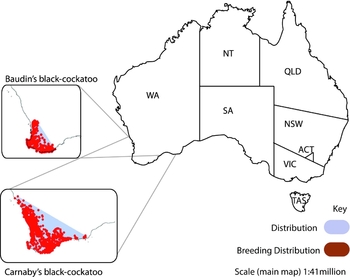
Baudin's (Calyptorhynchus baudinii) and Carnaby's black-cockatoo (C. latirostris) occur only in south-west Western Australia (WA). They are similar in appearance, partially sympatric and sometimes associate in foraging flocks but differ in their calls, breeding, foraging and nesting behaviour (Saunders Reference Saunders1974; Chapman Reference Chapman2008; DPaW 2013; Fig. 1).
Distributions of Baudin's (Calyptorhynchus baudinii) and Carnaby's black-cockatoos (C. latirostris). Red (dark) shading indicates main breeding range; grey (light) shading indicates main predicted non-breeding range (adapted with permission from Garnett et al. Reference Garnett, Szabo and Dutson2011).

Although identified as separate species in 1948 (Carnaby Reference Carnaby1948), subsequent biological and ecological studies confirmed them to be sympatric species in 1979 (Saunders Reference Saunders1979). Their most distinguishing feature is subtle differentiation in the upper mandible size (Saunders Reference Saunders1979), although there is negligible genetic differentiation between the long- and short-billed forms (White Reference White2011).
Many published accounts have not differentiated between the two species, but there has been more research on Carnaby's than Baudin's black-cockatoo (DoE 2014a , b ).
Conservation status and governance
Population estimates suggest there are 10 000–15 000 Baudin's and c. 40 000 Carnaby's black-cockatoos (Garnett et al. Reference Garnett, Szabo and Dutson2011).
Both species are listed as ‘rare or likely to become extinct’ under the WA Wildlife Conservation Act 1950 (WC Act), but under the Commonwealth Environment Protection and Biodiversity Conservation Act 1999 (EPBC Act) Baudin's black-cockatoo is listed as ‘vulnerable’ while Carnaby's black-cockatoo is ‘endangered’ (Chapman Reference Chapman2008; DPaW 2013).
Baudin's black-cockatoo conservation is managed under a combined (two species) recovery plan (Chapman Reference Chapman2008) implemented by the Forest Black Cockatoo Recovery Team (FBCRT). At the time we conducted interviews, the FBCRT comprised a formal group of 12 expert representatives from various organizations nominated to manage conservation efforts for Baudin's black-cockatoo and the Forest Red-tailed black-cockatoo (Calyptorhynchus banksii naso; Table 1). Although the Department of Agriculture and Food WA (DAFWA) had a place on the recovery team, no representative was attending meetings when the research was conducted, greatly reducing the opportunities for relevant DAFWA staff to be fully engaged with the process of conserving Baudin's black-cockatoo and suggesting that conservation of this threatened species was not considered a departmental priority.
Examples of major investments in the conservation of Baudin's and Carnaby's black-cockatoos (Weston et al. Reference Weston, Fendley, Jewell, Satchell and Tzaros2003; Chapman Reference Chapman2008; BirdLife Australia 2016; WA Museum Reference Museum2012; DPaW 2013; DoE 2014 a, b).

Major threats to the survival of Baudin's black-cockatoo across its range include illegal shooting, habitat loss and nest hollow shortage (Chapman Reference Chapman2008). WA fruit growers have long considered Baudin's black-cockatoo as the principal pest of apple crops (Chapman Reference Chapman2007, Reference Chapman2008; Johnstone & Kirkby Reference Johnstone and Kirkby2008) and orchardists were allowed to shoot the species from the 1950s to the 1980s. The Department of Parks and Wildlife WA (DPaW) continues to issue damage mitigation licenses allowing orchardists to ‘shoot to scare’, although the permanent netting of orchards is considered more effective (Chapman Reference Chapman2007, Reference Chapman2008).
Listing of Baudin's black-cockatoo as a ‘declared pest of agriculture’ under the Agriculture and Related Resources Protection Act 1976 allows a management program to be implemented across the taxon's range (Chapman Reference Chapman2008). Consequently, high priority management actions include promoting non-lethal means of mitigating fruit damage in orchards and eliminating illegal shooting (Chapman Reference Chapman2008).
Carnaby's black-cockatoo conservation is managed under a dedicated recovery plan (DPaW 2013) implemented by the Carnaby's Cockatoo Recovery Team (CCRT), consisting of 17 representatives when interviews were conducted (Table 1).
Major threats to the survival of Carnaby's black-cockatoo across its range include habitat loss, tree health, and mining and extraction activities (DPaW 2013). High priority management actions include mitigation of habitat loss, and maintenance of nesting, feeding and roosting habitat (DPaW 2013).
Social and economic considerations
The ranges of both species cross several of the most populous regions in WA, which are predicted to experience ongoing significant human population growth (DSD 2012). The area is experiencing rapid urban expansion, has extensive mining, construction and forestry, and the wheatbelt is one of the most important cropping areas in Australia (DSD 2012). Much of the region's diverse endemic biota has been cleared for agriculture (Coates & Atkins Reference Coates and Atkins2001; WWF Australia 2012). The apple industry is economically important at both state and national levels (Australian Bureau of Statistics 2007).
METHODS
Drawing from the discipline of social psychology, the theory of social constructionism and the human dimensions of wildlife research tradition, we used a qualitative multiple case study approach (Yin Reference Yin2003; Stake Reference Stake2006) to explore how social factors are associated with the conservation of Baudin's black-cockatoo and Carnaby's black-cockatoo: two almost identical threatened Australian bird species with contrasting levels of societal investment (e.g., funding, recovery plans and actions). We first gathered data on the biology and ecology, conservation status and governance, levels of conservation investment, social and economic considerations, and major stakeholders for the two taxa from the peer-reviewed scientific literature (Ainsworth Reference Ainsworth2014).
Then we examined the attitudes and motivations of 31 ‘key informants’ (‘informants’) in south-west WA, who we identified through a stakeholder analysis (e.g., advice from experts, published literature, institutional websites and personal knowledge) as being influential in relation to conserving the cockatoos. G.B.A. conducted 31 semi-structured, anonymous, qualitative interviews with these informants during October and November 2011 (Ainsworth Reference Ainsworth2014). More conservation practitioners were working on Carnaby's than Baudin's black-cockatoo with several working on both taxa (this represents a real difference in the number of interviewees available for each taxa). Informants were selectively sampled and their views are not intended to represent those of the general public or necessarily of all stakeholders therefore some findings may be generalized to similar taxa in similar contexts and some to threatened bird conservation more generally.
Informants represented the following: Baudin's black-cockatoo (6 informants): state government environmental departments (2), academics (1), ENGOs (1), scientific consultants (1), and volunteers (1); Carnaby's black-cockatoo (15 informants): state government environmental departments (4), academics (3), bird ENGOs (2), resource extraction industries (1), habitat restoration agencies (1), natural resource management agencies (1), scientific consultants (1), landholders (1) and volunteers (1); and both species (10 informants): state government environmental departments (3), academics (2), scientific organizations (2), Commonwealth government environmental departments (1), media (1) and wildlife rescue groups (1).
Nine of the 31 interviews were conducted with wildlife managers representing DPaW, reflecting this organization's high level of involvement in recovery efforts.
Interviews lasted approximately 1 hour, focused primarily on the species with which individual key informants had most experience (unless they were experienced with both), and sought to understand whether the values and attitudes held for the black-cockatoos are associated with the success of strategies to conserve them. Results from four key questions are presented (see questions 2.2, 2.3, 2.6 and 2.7 in Appendix S1). Interview questions revealed informants’ values and attitudes towards the two species, and those they perceived to be held by influential members of society. Direct questions regarding participant values were generally avoided (Satterfield Reference Satterfield2001) and the term ‘value’ was used minimally and always in a common language sense. Questions about people's opinions of the cockatoos and associated conservation efforts were asked in a way that was considered meaningful to participants and would enable subsequent qualitative content analysis (Minichiello et al. Reference Minichiello, Aroni and Hays2008).
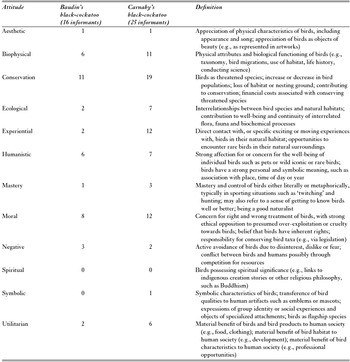
Interview transcripts were imported into NVivo. Individual coding nodes were created for each of the 12 categories defined in a new ‘avifaunal attitudes typology’, which was developed from existing wildlife attitude typologies to describe the different ways Australians value birds (Ainsworth Reference Ainsworth2014; Table 2). Attitude(s) expressed about the study species were classified by manually coding text under one or more nodes. As well as expressing their own attitudes, informants sometimes reported perceptions they believed were held by people other than themselves, for example, the public or particular sectors of society.
Total number of informants expressing each attitude about Baudin's and Carnaby's black-cockatoos in response to four interview questions, classified according to the avifaunal attitudes typology (n = 31; Baudin's black-cockatoo only: 6 informants; Carnaby's black-cockatoo only: 15; both species: 10).

RESULTS
Conservation effort
Carnaby's black-cockatoo has received significantly more conservation effort than Baudin's black-cockatoo, particularly in terms of the length of time since a recovery team was established, research conducted on its biology and ecology, and funding invested in recovery (Table 1).
The current distribution and habitat critical to Baudin's black-cockatoo survival are only known in general terms (Chapman Reference Chapman2008; Le Souëf et al. Reference Le Souëf, Stojanovic, Burbidge, Vitali, Heinsohn, Dawson and Warren2013), whereas, several research and conservation projects have been conducted on Carnaby's black-cockatoo, including habitat management, monitoring and captive breeding. Much of this research has been conducted by a single investigator, D. Saunders, beginning in 1968 (Saunders & Ingram Reference Saunders and Ingram1998; Saunders et al. Reference Saunders, Mawson and Dawson2014 a). In addition to the recovery team, three expert groups contribute to the conservation of this species.
Public involvement in conservation has also been greater for Carnaby's than Baudin's black-cockatoo, especially stakeholder involvement and public awareness. BirdLife Australia's (BLA) volunteers have long supported Carnaby's black-cockatoo recovery (Weston et al. Reference Weston, Fendley, Jewell, Satchell and Tzaros2003) and worked with natural resource management groups, DPaW and BirdLife WA to engage relevant sectors of the community and implement recovery actions (BirdLife Australia Reference Australia2016).
By contrast, the little research conducted on Baudin's black-cockatoo has been recent (Johnstone & Kirkby Reference Johnstone and Kirkby2008; Le Souëf et al. Reference Le Souëf, Stojanovic, Burbidge, Vitali, Heinsohn, Dawson and Warren2013), its recovery team manages two threatened species and the main management effort has been in promoting non-lethal means of mitigating fruit damage in orchards (Chapman Reference Chapman2008; Table 1).
Which values are held for each species?
Key findings from four interview questions are presented. Examples of primary attitudes expressed by informants, classified according to the avifaunal attitudes typology, are shown in brackets in alphabetical order. Table 2 compares the total number of informants expressing each type of attitude for either species.
Factors considered most important to the conservation of Baudin's and Carnaby's black-cockatoos
Informants perceived habitat loss and fragmentation to be the greatest threat to both species, and protecting habitat was a key conservation objective. However, little was said to be known, especially in the case of Baudin's black-cockatoo, about habitat use, preferred food or the habitat most important to each species’ survival. To conduct the research needed to obtain this kind of information was said to require substantial investment and application of rigorous methodology (conservation attitude).
Since both species are long-lived with low recruitment rates, key informants emphasized a need to gather data on species’ population size and dynamics to predict population viability (biophysical).
Some recovery team members described holding strong feelings about the species: they said the birds are easy to relate to and enrich people's lives; they are of historical significance in the area through the people after whom they are named; they have beautiful calls; and are admired for their specialized feeding techniques (aesthetic; biophysical; humanistic).
Baudin's black-cockatoo
Specific concerns about Baudin's black-cockatoo focused on projections for landscape change due to climate change, fire and various tree diseases. Two further processes were said to compound this problem: logging of habitat trees by the Forest Products Commission WA (FPCWA); and removal of habitat trees for strip-mining. It was said that DPaW was responsible for managing most Baudin's black-cockatoo habitat, but was neither adequately resourced for the task, nor supported in its implementation of management strategies by relevant government ministers and political processes (conservation; utilitarian).
Loss of habitat was thought to increase Baudin's black-cockatoo's reliance on supplementary food sources such as orchard fruits, and informants identified illegal shooting by orchardists as the second most important threat. For some informants, the threat posed by shooting was a ‘moral indictment’ of Australian society (conservation; moral; negative).
According to one informant, despite the fact that several non-lethal bird deterrent options exist, orchardists received no government support to manage these cockatoos: ‘I genuinely think farmers are wanting to be on side with all of this but they feel they're getting no help. . . the stress of the industry with the threat of other apples coming into Australia. . . cockies coming along is just a nail in the coffin. . .’ (Volunteer) (negative).
According to two key informants, some orchardists perceived the extent of damage caused to their crops by black-cockatoos to far exceed the actual financial cost incurred (Chapman Reference Chapman2007) (negative).
It was suggested that habitat loss and illegal shooting should be primarily addressed at a policy level. For habitat loss, better inter-governmental information exchange, particularly about the location and size of potential Baudin's black-cockatoo habitat and the extent of logging of existing habitat, must inform research priorities and more accurate threshold triggers for referral to the Commonwealth EPBC Act (conservation; moral; utilitarian).
Informants thought that helping government understand the effectiveness of netting orchards, so that appropriate strategies to support netting programs were implemented, and better enforcement, were paramount to abating illegal shooting. Several key informants suggested that public pressure on politicians could help achieve some of these goals (conservation; moral).
A small group of informants working with Baudin's black-cockatoo described the difficulty of finding vital resources to implement recovery actions in a timely way and identified conflicting values held by different WA state government agencies: ‘One of the real difficulties is recovery teams are usually driven by government departments, which makes it politically very difficult for them to do a lot. So, they have to get approval from ministers . . . It's hard because the forestry side of land management is run by the government as well as the conservation side so it's really a political issue. . . even to the point that one of the DEC (DPaW) people had written a really nice modelling paper looking at the shooting effects on Baudin's cockatoos but they can't get permission to publish it’ (Academic #1) (conservation; moral).
Carnaby's black-cockatoo
Because Carnaby's black-cockatoo inhabits both public and private land and is commonly seen in Perth, more people encountered it than Baudin's black-cockatoo. Thus, there were more opportunities for the community to participate in conserving Carnaby's black-cockatoo, especially landholders who can protect habitat remaining on their properties (conservation; experiential).
Carnaby's black-cockatoo was described as an ‘umbrella’ and ‘iconic’ species because of its important ecological role across a broad range of habitats. Informants said this combination of attributes made it particularly valuable since conserving the species necessarily implied conserving habitat, and the biodiversity therein, across the landscape (conservation; ecological; symbolic).
Several informants working with Carnaby's black-cockatoo described a heightened appreciation of the benefits of working with large networks and a wide range of stakeholders. However, some said that keeping everyone informed can be challenging, and not all stakeholders are perceived to have the species’ best interests at heart: ‘. . .because [Carnaby's black-cockatoo] were the one listed federal species they tended to be what the rallying cry came around. . . they've already de facto become the emblematic species for loss of bushland in the Perth area. So. . . the green opposition to development is epitomized in birds. . . a kind of negative flagship’ (Academic #2) (conservation; symbolic; utilitarian).
Perceived outlook for Baudin's and Carnaby's black-cockatoo conservation efforts
Baudin's black-cockatoo
On the whole, those working on Baudin's black-cockatoo were pessimistic about the species’ future prospects. Some expected the species’ numbers to decline in the next few decades and never recover. The main reason for this belief was the perception of a massive change in the species’ habitat from old growth nesting habitat to pole timber lacking cockatoo nest sites. Mining activities and inappropriate fire management were also blamed for reducing available nesting habitat: ‘I think the foresters. . . the big mining companies have got a lot to answer for. We had seven cockatoo nests in one area and they did a biodiversity management (assessment) there and we lost three of those nests’ (Consultant #2) (conservation; moral).
Informants felt that if illegal shooting and an aging population were added to the mix, then conservation failure was inevitable, but they also considered the lack of data on which to base decisions as highly disadvantageous, especially about the current population size and structure, as well as about breeding and feeding habitat (biophysical; conservation; ecological; moral).
Carnaby's black-cockatoo
Far greater optimism was shown for Carnaby's black-cockatoo's survival despite a general sense that threats will increase and populations shrink before they improve. Two informants commented that Carnaby's black-cockatoo may survive at the expense of Baudin's black-cockatoo by out-breeding or out-competing it (biophysical; conservation).
Many informants pointed to Carnaby's black-cockatoo's adaptability as their reason for optimism, citing its ability to exploit new food sources and places. The larger population of Carnaby's compared to that of Baudin's black-cockatoo was thought to stand it in good stead increasing its chance of long-term survival if no more habitat is lost. Although local population extinction was considered likely because of habitat loss (e.g., ongoing development planned for Perth and the Swan Coastal Plain, salinization in the wheatbelt), landscape scale restoration and long-term protection of viable habitats may enable survival of the species (biophysical; conservation; ecological; utilitarian).
It was thought that the conspicuousness of Carnaby's black-cockatoo in terms of its presence in the Perth metropolitan area, and the conservation attention it currently receives from BLA and other advocates, enhances its chances of being conserved successfully (conservation; experiential).
Two informants considered that political change might be needed to ensure its protection. However, there was also concern that newcomers to WA put less value on conserving the environment than longer term residents: ‘A decade ago (Perth) was just on the cusp of a boom, but there wasn't the huge population pressure and the new community who've come over here aren't fully appreciative of what was and what has already gone. So, there seems to be lots of birds because they fly over in big flocks. . . so, they're not threatened’ (Commonwealth Government informant) (conservation; experiential; utilitarian).
Informants expressed a range of emotions when asked what it would mean to them if conservation efforts for Carnaby's or Baudin's black-cockatoo failed. Those who felt disappointment or sadness tended to take some personal responsibility for the species and said they would be left wondering what they could have done differently. Those who described frustration or moral outrage mostly accused the government of failing to address the threats, particularly given the seemingly adequate funds available as a result of a booming economy. Two informants challenged human nature: ‘I think Carnaby's is probably the iconic species for almost all Western Australians because it is so unique. So, if we didn't get it right, WA would really have to look at itself long and hard. It's an absolutely essential charismatic species that needs as much input as possible’ (Academic #3) (aesthetic; conservation; humanistic; moral; symbolic).
Potential for the local community to influence conservation of Baudin's and Carnaby's black-cockatoos
Baudin's black-cockatoo
Because Baudin's black-cockatoo tends to inhabit forested areas with low human populations, the only community informants identified as having potential to make direct contributions to its conservation were the farming and fruit growing communities. Although many WA fruit-growers were said to agree that Baudin's black-cockatoo should be protected, local orchardists estimated they lose around 6% of their net income to fruit damage by the species, and spend a further 2% on damage control (Chapman Reference Chapman2007). While Carnaby's black-cockatoo has been associated with damage to canola crops, claims have been described as exaggerated (Jackson Reference Jackson2009) (conservation; ecological; experiential; moral; negative).
Beyond agricultural and horticultural interests, informants felt that limited awareness of Baudin's black-cockatoo or its plight precluded any significant contribution by others. They thought raising awareness and changing public perceptions about the birds would help, but the recovery team was said to have insufficient capacity to implement such strategies. Two informants raised the notion of an eco-branded program featuring orchardists who actively support Baudin's black-cockatoo conservation. One informant said DPaW had attempted this but suggested that a non-government group could manage it better due to fewer political constraints (conservation; experiential; humanistic; moral; utilitarian).
Carnaby's black-cockatoo
By contrast, informants identified many community sectors that could play a direct role in conserving Carnaby's black-cockatoo (e.g., government agencies, mining companies, volunteers and landholders).
Informants thought volunteers could assist through advocacy, by participating in BLA's monitoring programs or by identifying development proposals likely to affect habitat. Wheatbelt landholders in particular were identified as being able to restore cockatoo habitat, ultimately creating a better lifestyle for future farmers in the process. Tapping into the emotional connection people have for the land by encouraging them to experience nature for themselves was also recommended, for example through planting schemes at a backyard or community level, taking people into the bush or providing opportunities to interact with wildlife: ‘Take a shrieking, screaming cockatoo to an agricultural show. . . the kids and the mums and dads love them. . . One of the things we do in WA badly, probably in Australia too, is say: “Keep off! The bush is fragile.” You will never get people to appreciate the bush if they don't walk in it and love it’ (Habitat restoration manager) (conservation; ecological; experiential; humanistic; moral; utilitarian).
Conservation effort imbalance between the species
Carnaby's black-cockatoo has a higher public profile than Baudin's black-cockatoo, is the subject of more management planning and published studies and has more and a greater diversity of stakeholders involved in its recovery including more community involvement (Table 1).
Reasons suggested for this imbalance included, first, Saunders’ >40 years of research and passion for the species that provided the essential baseline data for Carnaby's black-cockatoo conservation (Saunders & Ingram Reference Saunders and Ingram1998, Saunders et al. Reference Saunders, Wintle, Mawson and Dawson2013, Reference Saunders, Mawson and Dawson2014a , Reference Saunders, Mawson and Dawson b ). Secondly, people could see Carnaby's more easily than Baudin's black-cockatoo because its breeding habitat is more accessible and it visits urban habitats. Thirdly, it was suggested that Carnaby's black-cockatoo's public profile and potential for recovery may evoke stronger emotional ties even though it may not be the more threatened of the two species: ‘I'm passionate about Carnaby's because I think we can probably make a difference. Baudin's are in far worse trouble; they're on the slide, they're gone. They're going to get shot into extinction, no doubt about that. . . and yet we seem to ignore it. But Carnaby's, because it's studied so well and so well-known and there's scientific proof that it's on a decline, it's just enabled it to happen. . . you get to know the bird, you get to like them’ (State Government informant) (biophysical; conservation; ecological; experiential; humanistic; mastery; moral).
From a community perspective, Carnaby's black-cockatoo was described as a species of interest to BLA because of what informants described as its ‘keystone’ status and the complex mix of stakeholders involved in its recovery. Informants said this had created an opportunity for BLA to implement its philosophy of engaging with different interest groups across south-west WA and beyond. The visibility and charismatic behaviour of Carnaby's black-cockatoo were said to have rendered it very popular and an ideal ‘flagship’ for community campaigns to prevent loss of habitat in inner city and wheatbelt areas (aesthetic, biophysical; conservation, ecological, experiential; humanistic; symbolic; utilitarian).
From a policy standpoint, the combination of Carnaby's black-cockatoo occurrence in the Perth metropolitan area and rapid urban expansion were described as providing a focal point for political pressure. Informants said it was highly significant that potential impacts on both Baudin's and Carnaby's black-cockatoo must be referred to the EPBC Act (DSEWPaC 2012). However, a lack of data regarding Baudin's black-cockatoo requirements and extent of available habitat made it difficult to calculate thresholds for triggering referrals (conservation; ecological; experiential; moral; utilitarian).
As a result, according to one informant, EPBC Act referrals for impacts on Carnaby's black-cockatoo from urban development are much more common than those for Baudin's black-cockatoo, so the former has a higher profile regarding community and developer awareness. Consequently, there were more communications to the Commonwealth Environment Minister and responses from DPaW. Informants explained how this process had resulted in a need for better policy and coordination regarding development of Carnaby's black-cockatoo habitat and the need to protect the species. Government funding has also been more forthcoming as a result, for example, some Commonwealth funds provided to DPaW to implement Carnaby's black-cockatoo recovery actions were used to initiate a habitat offset program in and around Perth (conservation; humanistic; moral; utilitarian).
Some informants thought that perhaps Baudin's black-cockatoo would receive greater conservation attention in the future. There was a perception among informants that the adaptability of Carnaby's black-cockatoo may have done more for its survival than any conservation effort, and some saw Carnaby's black-cockatoo as a ‘catch-all’ for those who might want to use it as a tool to protect interests other than those of just the cockatoo. Some of those who had helped promote Carnaby's black-cockatoo to its status as an iconic species felt that attention may now be better diverted to ‘more deserving’ species, such as Baudin's black-cockatoo (conservation; biophysical; humanistic; moral; symbolic; utilitarian).
DISCUSSION
Key informants identified the greatest threats to the survival of both Baudin's and Carnaby's black-cockatoos as habitat loss and fragmentation due to the impacts of climate change, fire and various tree diseases, as well as timber harvesting and land-clearing for mining. They therefore considered protecting habitat as a key conservation objective for both species, and research on the attributes of critical habitat was an immediate priority. Notwithstanding the similarities in these concerns, political and social factors strongly influenced what was actually being done to conserve each species.
Political factors
High-level decision-makers and influencers within government, ministerial offices and parliaments were perceived by informants as having most control over conservation decision-making processes, as well as those currently deemed by society to have appropriate expertise, such as biological scientists. Government-led decision-making was thought to limit the influence of non-government advocacy groups and give greater weight to the opinions of officials. Some government department officials (e.g., DAFWA, Department of Planning and Infrastructure WA (DPIWA), FPCWA) were thought to hold values incompatible with achieving conservation objectives for the cockatoos. Economically important development was described as being prioritized over threatened species protection, possibly because when this research was conducted WA had no threatened species law (ANEDO 2014). Thus, conservation conflict, primarily due to the conflicting interests and responsibilities held by various relevant WA government departments, was strongest for Baudin's black-cockatoo and seemed to constrain conservation effort more for that species.
There was a major disparity reported with respect to recovery teams’ efforts. Baudin's black-cockatoo recovery team had fewer members, representing a narrower range of stakeholder groups than the Carnaby's black-cockatoo team, and they were required to manage two species with fewer resources. Importantly, the DAFWA representative, who had closest ties to orchardists, was not attending Baudin's black-cockatoo recovery team meetings, suggesting both implicit political support for orchardists, since no advocacy was deemed necessary within the recovery team, and a lack of government interest in the team's efforts. Priority management actions for Baudin's black-cockatoo, therefore, mainly targeted orchard-related problems rather than promoting research on the species’ requirements. A lack of reliable data, specifically about current population size, structure and trends, and breeding and feeding habitat requirements, hindered recovery. This was exacerbated by alleged restrictions on publishing government research and a lack of political support for habitat protection.
Sociological factors
Our findings support the idea that conservation decisions, and concern about species conservation are specific to particular cultures and knowledge systems, times and places (Aslin & Bennett Reference Aslin and Bennett2000). Also that conservation decisions are influenced by how biodiversity impacts are characterized in a particular socio–economic context (Young et al. Reference Young, Marzano, White, McCracken, Redpath, Carss, Quine and Watt2010). Baudin's and Carnaby's black-cockatoos exist within very different human social contexts. Although diverse attitudes were expressed about both taxa by a range of community sectors, it appears the experiential attitudes expressed for Carnaby's black-cockatoos, as a result of existing in close proximity to humans, have engendered greater community interest and conservation action than they have for the Baudin's black-cockatoos few people see or recognize.
Where Carnaby's black-cockatoo was known to a large cross-section of society in Perth and the surrounding region across a diverse range of land tenures and was considered iconic by many informants and promoted as a flagship for landscape-scale habitat conservation, Baudin's black-cockatoo was known mainly to fruit-growers, many of whom disliked it.
The social construction of Baudin's black-cockatoo as a pest species, with a history of bounties and open shooting (Chapman Reference Chapman2007, Reference Chapman2008), seems to have been particularly damaging. If the estimate of illegal shooting by orchardists of 200–300 Baudin's black-cockatoo every year is correct (Chapman Reference Chapman2008), then this shooting could have serious effects on the persistence of the species; yet the public outcry seems to have been modest compared to the alarm expressed at the decline of Carnaby's black-cockatoo. The history of human interactions with the two species may have influenced the different reactions. Informants described how orchardists have been complaining about Baudin's black-cockatoo for decades whereas recent complaints by WA wheatbelt farmers that Carnaby's black-cockatoo are damaging canola crops seems not to have resonated with the public or the interviewees.
One possible explanation for these contrasting reactions is that the authorities are discriminating against Baudin's black-cockatoo, in what could be considered an example of speciesism (Ryder Reference Ryder2000) where individuals of one species are treated differently to another simply due to a person's perceptions of that species not because of objective criteria.
People engaged in conservation efforts for Baudin's black-cockatoo appear to be faced with challenges comparable to those faced by people trying to conserve grey-headed flying foxes (Pteropus poliocephalus) in New South Wales (Ballard Reference Ballard2005). In both cases, some sections of the community claim to be suffering significant economic damage or risk due to the presence and behaviour of the species concerned. Partly as a result of these claims being aired, the public holds conflicting perceptions about these species, conservation conflicts arise and support for these efforts may be undermined (Redpath et al. Reference Redpath, Young, Evely, Adams, Sutherland, Whitehouse, Amar, Lambert, Linnell, Watt and Gutierrez2013). If Baudin's black-cockatoo is to persist, there is clearly a need to address the conflicting values held for it, namely by minimizing the extent of negative perceptions about it and maximizing public awareness of its plight.
This study demonstrates that a variety of stakeholders with competing socio–political interests can influence threatened bird conservation decision-making processes and highlights the importance of understanding the value dynamics existing between different stakeholders. We argue that employing the social sciences to explain human behaviour could help wildlife managers devise conservation strategies that appeal to different stakeholder attitudes and values and lead to the broader community becoming more positively involved in conservation decision-making processes.
ACKNOWLEDGEMENTS
The authors thank all of the informants and other correspondents, as well as the anonymous reviewers for their improvements to this article and G. Ehmke (BirdLife Australia) for help with Fig. 1. Funding was provided by The Nature Conservancy Applied Conservation Award 2011, part of The Nature Conservancy's Ecological Science Program and made possible through a generous donation from The Thomas Foundation. G.B.A. was supported by a Charles Darwin University Faculty of Engineering, Health, Science and Environment travel grant and an Australian Government Australian Postgraduate Award scholarship.
Supplementary material
To view supplementary material for this article, please visit http://dx.doi.org/10.1017/S0376892916000126