





Introduction
The adoption of early-planted soybean [Glycine max (L.) Merr.], typically planted before mid-April, has increased because of its potential to produce greater grain yields than later-planted soybean in the U.S. Midwest (Egli and Cornelius Reference Egli and Cornelius2009; Hubbs and Irwin Reference Hubbs and Irwin2020; Rowntree et al., Reference Rowntree, Suhre, Weidenbenner, Wilson, Davis, Naeve, Casteel, Diers, Esker and Conley2014). However, previous studies have reported increased soybean injury and yield loss when residual herbicides such flumioxazin and sulfentrazone are applied under the cooler soil temperatures and greater rainfall typically associated with early planting (Niekamp et al. Reference Niekamp, Johnson and Smeda1999; Taylor-Lovell et al. Reference Taylor-Lovell, Wax and Nelson2001).
The period during which the residual herbicide concentration in the soil remains biologically effective is referred to as herbicide persistence (Curran Reference Curran2016). Soil temperature, moisture, pH, and organic matter are soil properties that influence the activity and diversity of soil microorganisms and persistence of residual herbicides (Curran Reference Curran2016; Schaal et al. Reference Schaal, Stirm and Newman1972). Among these factors, the soil microbial activity is considered a major factor responsible for the degradation of several residual herbicide chemical families used in annual crops (Kaufman Reference Kaufman and Guenzi1974). In general, soil microbial activity increases with rising soil temperature and moisture and is greater under constant temperatures than under fluctuating temperatures, resulting in shorter persistence of herbicides that are prone to microbial breakdown (Biederbeck and Campbell Reference Biederbeck and Campbell1973). Reduced herbicide persistence in coarse-textured soils can shorten residual weed control, increasing the risk of weed escapes, whereas slower dissipation in finer-textured soils can help maintain effective herbicide concentrations for extended control (Chudzik et al. Reference Chudzik, Arneson, DeWerff, Mobli, Mueller and Werle2026).
Chlorimuron-ethyl, flumioxazin, and pyroxasulfone are herbicides known to degrade more slowly under lower soil moisture and temperatures (Chen et al. Reference Chen, Han, Chen, Liu, Zhang and Hu2021; Fuesler et al. Reference Fuesler, Hanafey and Hanafey1990; Gaynor et al. Reference Gaynor, Mactavish, Edwards, Rhodes and Huston1997; Kaur et al. Reference Kaur, Kaur and Kaur2024). Chen et al. (Reference Chen, Han, Chen, Liu, Zhang and Hu2021) reported greater flumioxazin persistence in soil incubated at 15 C compared with soil incubated at 25 C and 35 C. Kaur et al. (Reference Kaur, Kaur and Kaur2024) observed a consistent increase in pyroxasulfone persistence as the temperature decreased from 45 C to 25 C. Additionally, Gaynor et al. (Reference Gaynor, Mactavish, Edwards, Rhodes and Huston1997) reported increased chlorimuron-ethyl persistence in soil when incubated at 5 C compared with 25 C.
Soil cation exchange capacity (CEC) indicates the number of negatively charged sites in the soil that enable herbicide sorption to the clay fraction and soil organic matter. Consequently, soils with higher CEC adsorb more residual herbicides than those with lower CEC, which typically have low organic matter content and coarser texture. The degree of sorption of each herbicide to soil colloids is inversely proportional to the rate at which the herbicide is degraded by soil microorganisms (Lehmann et al. Reference Lehmann, Miller, Fontaine, Laskowski, Hunter and Cordes1992).
Pyroxasulfone is a Group 15 (very-long-chain fatty-acid synthesis inhibitors) non-ionizable preemergence herbicide (Shaner Reference Shaner2014c). Pyroxasulfone exhibits soil-residual activity on both grass and broadleaf weed species while demonstrating selectivity to soybean, corn (Zea mays L.), and other crops (Mahoney et al. Reference Mahoney, Shropshire and Sikkema2014). Pyroxasulfone applied alone may not be sufficient for robust weed control; therefore, applications of pyroxasulfone with sulfentrazone, flumioxazin, saflufenacil, or metribuzin are recommended to improve broadleaf weed control (McNaughton et al. Reference McNaughton, Shropshire, Robinson and Sikkema2014; Olson et al. Reference Olson, Zollinger, Thompson, Peterson, Jenks, Moechnig and Stahlman2011). The reported half-life of pyroxasulfone in the field is 16 to 26 d, and microbial activity has been identified as the major factor contributing to its dissipation in soil (Tanetani et al. Reference Tanetani, Kaku, Kawai, Fujioka and Shimizu2009).
Flumioxazin is a Group 14 (protoporphyrinogen oxidase [PPO] inhibitor) non-ionizable preemergence herbicide from the N-phenyl imide chemical family, used in a wide range of crops, including soybean, corn, cotton (Gossypium hirsutum L.) (Shaner Reference Shaner2014b). Previous studies reported control of important broadleaf weeds and suppression of some annual grasses predominant in the U.S. Midwest (Askew et al. Reference Askew, Wilcut and Cranmer1999; Taylor-Lovell et al. Reference Taylor-Lovell, Wax and Nelson2001). The mode of action of flumioxazin is inhibition of PPO, leading to the accumulation of protoporphyrinogen IX which is subsequently converted to protoporphyrin IX (Proto IX). Proto IX generates oxygen radicals, which leads to plasma membrane disruption in the presence of light and plant death (Dayan and Duke Reference Dayan and Duke1996). Consequently, due to light requirement for the optimized efficacy of PPO-inhibiting herbicides used in preemergence applications, increased injury to weed seedlings is observed after emergence (Barker et al. Reference Barker, Pawlak, Duke, Beffa, Tranel, Wuerffel, Young, Porri, Liebl, Aponte, Findley, Betz, Lerchl, Culpepper, Bradley and Dayan2023). The reported half-life in the soil under field conditions is 11.9 to 17.5 d, with soil adsorption highly correlated with organic matter, and microbial activity as the primary factor of degradation (Alister et al. Reference Alister, Rojas, Gómez and Kogan2008; Ferrell et al. Reference Ferrell, Vencill, Xia and Grey2005). Crop injury is a concern when flumioxazin is used preemergence under conditions of high soil moisture and cold temperatures where the crop is not able to rapidly metabolize the herbicide (Taylor-Lovell et al. Reference Taylor-Lovell, Wax and Nelson2001).
Chlorimuron-ethyl is a Group 2 (acetolactate synthase–inhibiting) weak-acid sulfonylurea herbicide, used preemergence and postemergence for broadleaf weed control in soybean (Brown Reference Brown1990; Shaner, Reference Shaner2014a). Sulfonylurea herbicides dissipate in soil through chemical and biological mechanisms, whereas soil temperature, pH, and moisture influence their dissipation rate (Smith and Aubin Reference Smith and Aubin1992). Regardless of the influence of microbial activity on the persistence of chlorimuron-ethyl in soil, hydrolysis is the major degradation pathway (Fuesler et al. Reference Fuesler, Hanafey and Hanafey1990). Moreover, chlorimuron-ethyl persistence in soil is influenced by chemical hydrolysis in moist soil, where soil pH has a significant effect on the hydrolysis rate (Fuesler et al. Reference Fuesler, Hanafey and Hanafey1990; Gaynor et al. Reference Gaynor, Mactavish, Edwards, Rhodes and Huston1997). Hydrolysis of sulfonylurea herbicides such as chlorimuron-ethyl consists of the cleavage and rearrangement of the sulfonylurea linkage, which is susceptible to reaction in the presence of water, leading to increased chlorimuron-ethyl hydrolysis in soils with higher moisture content (Sarmah and Sabadie Reference Sarmah and Sabadie2002). Results from Gaynor et al. (Reference Gaynor, Mactavish, Edwards, Rhodes and Huston1997) demonstrated only a slight increase in chlorimuron-ethyl persistence in sterile soil compared with nonsterile soil, suggesting that microbial degradation has minimal effect on chlorimuron persistence in soil.
The increased adoption of early-planted soybean in the U.S. Midwest makes it necessary to investigate the persistence of commonly used residual herbicides under cooler conditions and assess their persistence in soils across different temperatures. Therefore, a greenhouse bioassay was conducted to evaluate the interaction between constant incubation temperature and soil properties on the persistence of flumioxazin and pyroxasulfone, using velvetleaf (Abutilon theophrasti Medik.) height, density, and biomass in herbicide-treated soil as response variables. Additionally, a field experiment was conducted to investigate the interaction between herbicide application timing and herbicide concentration on the persistence of flumioxazin, pyroxasulfone, and chlorimuron-ethyl in Indiana soils.
Materials and Methods
Controlled Environment Greenhouse Bioassay
Bioassays were conducted in a two-factor factorial for flumioxazin and pyroxasulfone herbicides with three soil incubation temperatures (factor 1) and three soils (factor 2) from different sites in Indiana, with four replications for each treatment combination and the experiment conducted twice. Soils from Wanatah [Tracy sandy loam 5.9 meq 100 g−1 CEC, 1.5% OM (organic matter), and pH 6.2], Lafayette (Drummer silt loam 9.5 meq 100 g−1 CEC, 2.5% OM, and pH 6.6), and Butlerville (Cobbsfork silt loam 6.4 meq 100 g−1 CEC, 1.6% OM, and pH 5.9) from the 0- to 20-cm-depth layer were air-dried for 7 to 14 d and passed through a 2.0-mm sieve. The 0- to 20-cm soil depth was selected based on the approximate rooting depth of soybean during the early growth stages. Soil properties from each site are described in Table 1. Soil aliquots weighing 1,500 g were placed in 3.8-L polyethylene bags and treated with 22.5 ml of herbicide solution, resulting in concentrations of 78 and 48 ppb (µg ai kg−1 of soil) for flumioxazin and pyroxasulfone, respectively. The amount of herbicide to be added to the herbicide solution was determined assuming that the herbicides would be concentrated in the top 7.5-cm layer of the soil in a broadcast field application (Camargo et al. Reference Camargo, Senseman, Haney, Guice and McCauley2012). The concentrations of flumioxazin and pyroxasulfone correspond to field applications of Valor EZ® and Zidua SC® delivering 51 g ai ha−1 and 31 g ai ha−1, respectively. A nontreated control was included in this study with an application of 22.5 ml of deionized water. The herbicide solution was applied to the soil using a spray bottle and then the bag was shaken by hand for 10 min to provide uniform incorporation of the herbicide. Moisture was maintained at the initial levels by weighing the bags and adding the required amount of distilled water weekly. Soil bags (including the nontreated control) were placed in a controlled environment chambers (BioChamber FXR, BioChamber, Winnipeg, Canada) set at 5.5, 15, and 27 C. Air was allowed to enter the soil bags through an 5-cm opening at the top while the soil was incubated in the dark.
Soil properties at the 0- to 20-cm layer depth at Wanatah, Lafayette, and Butlerville, IN.a

Table 1. Long description
The table presents soil properties from three sites in Indiana: Wanatah, Lafayette, and Butlerville. It has three rows and six columns. The columns are labeled Site, Soil type, pH, CEC, Sand, Silt, Clay, and OM. The row labels are the site names: Wanatah, Lafayette, and Butlerville. The values in the table are as follows: Row 1: Wanatah, Sandy loam, 6.2, 5.9 meq 100 g^-1, 58 percent, 28 percent, 14 percent, 1.5 percent. Row 2: Lafayette, Silt loam, 6.6, 9.5 meq 100 g^-1, 16 percent, 64 percent, 20 percent, 2.5 percent. Row 3: Butlerville, Silt loam, 5.9, 6.4 meq 100 g^-1, 18 percent, 72 percent, 10 percent, 1.6 percent.
a Abbreviations: CEC, cation exchange capacity; OM, organic matter.
After 30 d, soil samples were removed from the growth chambers and transferred to 10 by 10 cm pots, with each pot representing an experimental unit in which a bioassay was conducted. The soil in each bag was sufficient for two experimental units, requiring two bags per treatment to accommodate the four replications. Thirty A. theophrasti seeds were planted in each pot to evaluate the effects of flumioxazin and pyroxasulfone. Seeds were planted at a depth of 2.5 cm. Preliminary bioassays were conducted with oats (Avena sativa L.), giant foxtail (Setaria faberi Herrm.), crimson clover (Trifolium incarnatum L.), peas (Pisum sativum L.), green beans (Phaseolus vulgaris L.), and A. theophrasti. Among these species, A. theophrasti was the most suitable, as it was not completely controlled and exhibited moderate injury at the herbicide rates tested. Pots in the greenhouse were arranged in a randomized complete block design. Greenhouse conditions included a 16/8-h photoperiod, with natural light supplemented by 600-W high-pressure sodium lamps providing a photon flux density of 1,100 µmol m−2 s−1 during the day. Pots were subirrigated to field capacity to promote A. theophrasti germination, and soil moisture was maintained at field capacity through regular subirrigation. Plants were allowed to grow for 21 d in the greenhouse. Plant density and average height were recorded at 7 and 14 d after planting (DAP), and density, average height, and aboveground biomass were recorded at 21 DAP. To measure aboveground biomass, plants were cut at the surface of the soil, placed in paper bags, and then dried in a forced-air oven at 40 C for 7 d.
Flumioxazin and pyroxasulfone bioassay data were analyzed separately using generalized linear mixed models in R software (v. 4.2.1). Soil type, incubation temperature, measurement day, and their interactions were treated as fixed effects, with experimental run included as a fixed effect. Replication nested within run and experimental pot were included as random effects, with pot accounting for repeated measurements over time. Abutilon theophrasti density was analyzed using a negative-binomial distribution with a log link, whereas A. theophrasti height and aboveground biomass were analyzed using a Tweedie distribution with a log link. Model adequacy was assessed using simulated residual diagnostics. Estimated marginal means were obtained using the emmeans package and separated using Tukey-adjusted comparisons at P ≤ 0.05. Means are presented on the original response scale.
Field Study
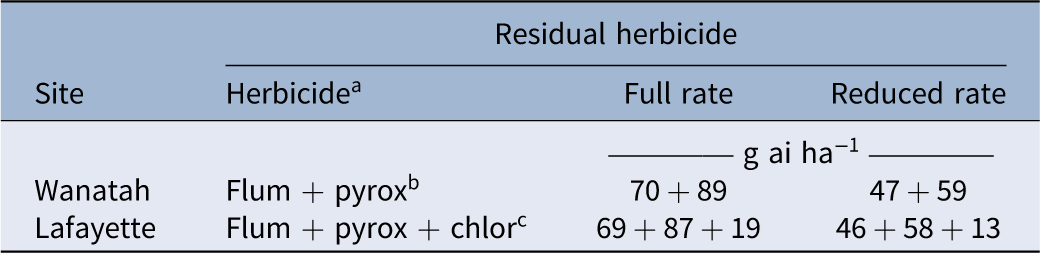
Field experiments were conducted in Indiana in 2024 and 2025 at two Purdue Agricultural Centers (PAC) located in Wanatah (Pinney PAC [PPAC], 41.44342°N, 86.92378°W) and Lafayette (Throckmorton PAC [TPAC], 40.37358°N, 86.90431°W), IN. The field experiments were conducted at the same field site from which the soil was collected for the controlled environment assay (Table 1). The experimental design was a two-way factorial comprising two soil-residual herbicide rates (factor 1) and four herbicide application timings corresponding to four soybean planting dates (factor 2). The two herbicide rates include full rate of residual herbicide (maximum labeled rate based on soil texture and organic matter) and reduced rate according label recommendation for each soil texture and organic matter. At Wanatah, residual herbicides included flumioxazin + pyroxasulfone (Fierce EZ®) applied at 70 + 89 and 47 + 59 g ai ha−1 for the full and reduced rates, respectively. At Lafayette, residual herbicide included flumioxazin + pyroxasulfone + chlorimuron-ethyl (Fierce XLT®) applied at 69 + 87 + 19 and 46 + 58 + 13 g ai ha−1 for the full and reduced rates, respectively. Herbicides were selected based on the effectiveness of their active ingredients for controlling the natural weed infestation at each site. Herbicide application timing corresponded to the soil-residual herbicide application at four soybean planting dates: early, early-mid, mid-late, and late. Herbicides and application rates are described in Table 2. At Lafayette, a split-plot design with soybean planting date as the main plot and rate of soil-residual herbicide randomized in each main plot was replicated four times for a total of 32 experimental units. At Wanatah, a randomized complete block design with four replications was used. Different experimental designs were used because the space allocated to this study differed among sites. Plots measured 6-m wide and 30-m long in Lafayette and 6-m wide and 91-m long in Wanatah. Planting date, precipitation, and average soil temperature at each planting date are described in Table 3.
Herbicides and application rates used at Wanatah and Lafayette, IN.

Table 2. Long description
A table comparing residual herbicide application rates at two sites. The table has two rows and three columns. The columns are labeled ‘Site’, ‘Herbicide’, ‘Full rate’, and ‘Reduced rate’. The row labels are ‘Wanatah’ and ‘Lafayette’. For Wanatah, the herbicide is ‘Flum + pyrox’ with full rate values of ‘70 + 89’ and reduced rate values of ‘47 + 59’. For Lafayette, the herbicide is ‘Flum + pyrox + chlor’ with full rate values of ‘69 + 87 + 19’ and reduced rate values of ‘46 + 58 + 13’. The units for the rates are ‘g ai ha^-1’.
a Abbreviations: flum, flumioxazin; pyrox, pyroxasulfone; chlor, chlorimuron-ethyl.
b Fierce EZ® was used as a premix herbicide source of flumioxazin + pyroxasulfone (Valent U.S.A. Corporation, Walnut Creek, CA, USA).
c Fierce XLT® was used as a premix herbicide source of flumioxazin + pyroxasulfone + chlorimuron-ethyl (Valent U.S.A. Corporation, Walnut Creek, CA, USA).
Accumulated precipitation from planting to 30 days after planting (DAP) and average soil temperature from planting to 10 DAP (0- to 10-cm soil depth) at Wanatah and Lafayette, IN, in 2024 and 2025.a

Table 3. Long description
A table comparing precipitation and soil temperature at different planting dates in Wanatah and Lafayette. The table has 12 rows and 7 columns. Column headers are Site-year, Planting date (calendar date), Planting date, 0-10 DAP, 11-30 DAP, 0-30 DAP, 0-30 DAP (30-yr avg.), and Avg. soil temp. 0-10 DAP. Row 1: Wanatah 2024, March 22, Early, 66, 58, 124, 88, 7. Row 2: Wanatah 2024, April 16, Early-mid, 33, 76, 109, 103, 12. Row 3: Wanatah 2024, May 02, Mid-late, 36, 38, 74, 106, 17. Row 4: Wanatah 2024, May 22, Late, 20, 8, 28, 120, 20. Row 5: Wanatah 2025, March 27, Early, 53, 10, 64, 92, 9. Row 6: Wanatah 2025, April 16, Early-mid, 13, 33, 46, 103, 14. Row 7: Wanatah 2025, May 09, Mid-late, 10, 76, 86, 110, 17. Row 8: Wanatah 2025, June 11, Late, 46, 64, 109, 120, 26. Row 9: Lafayette 2024, May 02, Early, 8, 66, 74, 105, 19. Row 10: Lafayette 2024, May 12, Early-mid, 15, 58, 74, 117, 20. Row 11: Lafayette 2024, May 31, Mid-late, 10, 28, 38, 122, 23. Row 12: Lafayette 2024, June 21, Late, 51, 127, 178, 126, 24. Row 13: Lafayette 2025, April 17, Early, 28, 15, 43, 113, 14. Row 14: Lafayette 2025, April 28, Early-mid, 13, 36, 48, 106, 16. Row 15: Lafayette 2025, May 19, Mid-late, 41, 104, 145, 111, 16. Row 16: Lafayette 2025, June 03, Late, 64, 102, 165, 123, 21.
a Abbreviations: avg., average; temp., temperature.
b Precipitation averages over 30 yr correspond to data from 1991 to 2020 obtained from the National Weather Service dataset.
Soil samples were taken at each soybean planting date, corresponding to day of herbicide application (0 DAP), at 30 d after herbicide application (30 DAP), and 1 wk before soybean harvest to quantify the concentration of residual herbicide in soil. Fifteen soil cores were randomly collected from a depth of 15 cm in each plot using a 2-cm-diameter soil probe. The soil cores were combined and homogenized to form one sample per plot and stored at −20 C until processing. Soil samples were thawed and passed through a 2-mm sieve, and an aliquot of approximately 50 g was placed in a 50-ml Falcon tube and stored at −20 C before analysis of herbicide concentration.
The concentration of the herbicides in the soil was determined following the QuEChERS (Quick-Easy-Cheap-Effective-Rugged-Safe) extraction method. Approximately 3 g of homogenized and sieved soil was weighed into 50-ml Falcon tubes. Each sample was extracted by adding 15 ml of deionized water, 15 ml of acetonitrile, and 10 µl of an internal standard mixture, followed by vortexing for 10 min (Vortex Genie 2, Scientific Industries, Bohemia, NY, USA). QuEChERS extraction salts (6 g of MgSO4 and 1.5 g of NaOAc) were then added, and the tubes were shaken and vortexed for 5 to 10 min before centrifugation at 2,200 rpm for 10 min (Geno/Grinder, SPEX Sample Prep, Metuchen, NJ, USA). A 12-ml aliquot of the supernatant was transferred to a 15-ml BondElut tube containing 400 mg of primary-secondary amine (PSA) and 1,200 mg of MgSO4, vortexed for 5 min, and centrifuged at 3,500 rpm for 5 min. The resulting supernatant was transferred to a 15-ml centrifuge tube and dried using a SpeedVac (SPD1030, Thermo Scientific, San Jose, CA, USA) overnight. Dried extracts were stored at −80 C until further analysis. For sample preparation, the dried pellets were reconstituted in 150 µl of 50% acetonitrile:water, vortexed until dissolved, and centrifuged at 4,000 rpm for 5 min. A 130-µl aliquot of the supernatant was transferred to 96-well plates on the day of instrumental analysis. All samples were analyzed in an Agilent 1290 Infinity II ultra-high performance liquid chromatography platform with a 6470 triple quadrupole mass spectrometry and EclipsePlus C18 RRHD 1.8 μm, 2.1 × 50 mm column (Agilent Technologies, Santa Clara, CA, USA) at the Bindley Bioscience Center at Purdue University. Recovery from untreated soil was 97%, 78%, and 83% for chlorimuron-ethyl, flumioxazin, and pyroxasulfone, respectively. Final herbicide concentrations were adjusted for percent recovery before data analysis.
Each herbicide was analyzed separately, with planting date, residual herbicide rate, and year treated as fixed effects, and replication as a random effect. Data were subjected to ANOVA using the mixed function in R software (v. 4.2.1). Assumptions of normality and homogeneity of variance were evaluated by visual assessment of residual plots. Herbicide concentration in soil data was square-root transformed. However, back-transformed mean values are presented. Treatment means were separated using Tukey’s honest significant difference (HSD) test at ≤0.05.
Results and Discussion
Controlled Environment Greenhouse Bioassay
Abutilon theophrasti density and height at 7, 14, and 21 DAP is shown in Figure 1, and growth after planting at Figure 2. Table 4 only represent interaction effect on the responsive variables at α = 0.05. The significant effects of incubation temperature, pooled across soils, on the response variables are shown in Table 5.
Effect of soil incubation temperature (5.5, 15, and 27 C) and soil type (Wanatah, Lafayette, and Butlerville) on Abutilon theophrasti density and height at 7, 14, and 21 d after planting in flumioxazin- or pyroxasulfone-treated soils.

Figure 1. Long description
The image contains multiple line graphs showing the effect of soil incubation temperature and soil type on Abutilon theophrasti density and height over time in flumioxazin- or pyroxasulfone-treated soils. The graphs are divided into two main sections: one for flumioxazin and one for pyroxasulfone, each further divided by soil type (Wanatah, Lafayette, and Butlerville). Each section contains two rows of graphs: the top row shows plant density (plants per pot) and the bottom row shows average plant height (centimeters). The x-axis for all graphs represents days after planting (7, 14, and 21 days). The y-axis for the top row graphs represents plant density (plants per pot), and the y-axis for the bottom row graphs represents average plant height (centimeters). Different colored lines represent different incubation temperatures: black for nontreated, blue for 7 degrees Celsius, green for 15 degrees Celsius, and red for 27 degrees Celsius. In the flumioxazin-treated soils, plant density generally decreases over time across all soil types and temperatures. In the pyroxasulfone-treated soils, plant density also decreases over time, with more pronounced effects at lower temperatures. Average plant height increases over time in both herbicide treatments, with the nontreated plants generally showing the greatest height increase. The trends indicate that both herbicides affect plant density and height, with the effects being more significant at lower incubation temperatures.
Comparison of incubation temperature (27, 15, and 5.5 C) and soils from Wanatah, Lafayette, and Butlerville, IN, on Abutilon theophrasti growth as a bioindicator of the persistence of flumioxazin and pyroxasulfone in soil 7, 14, and 21 d after A. theophrasti planting (DAP). NTC, nontreated.

Figure 2. Long description
The image contains one photo. The photo shows a grid of trays with plants, comparing the effects of different incubation temperatures and soil types on the growth of Abutilon theophrasti. The grid is divided into two main sections: one for flumioxazin and one for pyroxasulfone. Each section is further divided into columns representing different temperatures (NTC, 27 C, 15 C, and 5 C) and rows representing different soil types (Wanatah, Lafayette, and Butlerville). The photo captures the plant growth at three different time points: 7 days after planting (DAP), 14 DAP, and 21 DAP. Each tray shows varying levels of plant growth and health, indicating the persistence of the herbicides under different conditions.
Interaction effect of soil type and incubation temperature on Abutilon theophrasti height, density, and biomass in flumioxazin- and pyroxasulfone-treated soils.a,b

Table 4. Long description
The table presents data on the interaction effect of soil type and incubation temperature on Abutilon theophrasti height, density, and biomass in flumioxazin- and pyroxasulfone-treated soils. It has 10 rows and 11 columns. The columns are labeled as follows: Soil, Incubation temperature, Flumioxazin (with sub-columns for 7 DAP Height, 7 DAP Density, 14 DAP Density, 21 DAP Density, 21 DAP Biomass), and Pyroxasulfone (with sub-columns for 14 DAP Density, 21 DAP Density). The rows are labeled with different soil types (Wanatah, Lafayette, Butlerville) and incubation temperatures (NTC, 27, 15, 5). Each cell contains specific values for height, density, and biomass measurements. Notable trends include variations in plant height, density, and biomass across different soil types and incubation temperatures, with specific values indicating significant differences in plant growth responses.
a Abbreviations: DAP, days after planting; NTC, nontreated.
b Means followed by the same letter within the same column are not different at the α = 0.05 significance level according to Tukey’s honest significant difference (HSD).
c Soil properties Wanatah soil: CEC = 5.9, soil organic matter = 1.5%, and pH = 6.2.
d Soil properties Lafayette soil: CEC = 9.5, soil organic matter = 2.5%, and pH = 6.6.
e Soil properties Butlerville soil: CEC = 6.4, soil organic matter = 1.6%, and pH = 5.9.
Effect of soil incubation temperature on Abutilon theophrasti height, density, and biomass in flumioxazin- and pyroxasulfone-treated soils, pooled across soils.a,b

Table 5. Long description
The table presents data on the effects of different incubation temperatures on Abutilon theophrasti height, density, and biomass in soils treated with flumioxazin and pyroxasulfone. The table has 6 columns and 5 rows, including headers. The columns are labeled as follows: Incubation temperature, Flumioxazin (7 DAP Height, 7 DAP Density, 14 DAP Height, 14 DAP Density, 21 DAP Height, 21 DAP Density, 21 DAP Biomass), and Pyroxasulfone (7 DAP Height, 7 DAP Density, 14 DAP Height, 14 DAP Density, 21 DAP Height, 21 DAP Density, 21 DAP Biomass). The rows are labeled with different incubation temperatures: C, NTC, 27, 15, and 5. Each cell contains numerical values representing the measurements of height in centimeters, density in plants, and biomass in grams. The table shows variations in height, density, and biomass of Abutilon theophrasti at different days after planting (DAP) under different incubation temperatures.
a Abbreviations: DAP, days after planting; NTC, nontreated.
b Means followed by the same letter within the same column are not different at the α = 0.05 significance level according to Tukey’s honest significant difference (HSD).
Flumioxazin
Abutilon theophrasti height at 7 and 14 DAP, density at 7, 14, and 21 DAP, and biomass at 21 DAP were affected by the interaction between incubation temperature and soil type (Table 4). As indicated by A. theophrasti biomass at 21 DAP, flumioxazin was more persistent in the Lafayette soil and under colder incubation temperatures (Figure 1; Table 4). While A. theophrasti height at 21 DAP did not capture the interaction between soil type and incubation temperature on flumioxazin persistence, the biomass bioassay indicated greater flumioxazin persistence in Lafayette soil and under colder incubation temperatures (Figure 1; Table 5). The A. theophrasti height, density, and biomass responses are consistent with previous studies reporting that soils with higher organic matter and lower temperatures increase flumioxazin persistence (Alister et al. Reference Alister, Rojas, Gómez and Kogan2008; Chen et al. Reference Chen, Han, Chen, Liu, Zhang and Hu2021; Ferrell and Vencill Reference Ferrell and Vencill2003; Ferrell et al. Reference Ferrell, Vencill, Xia and Grey2005). These results suggest that A. theophrasti aboveground biomass is a more reliable bioindicator for evaluating flumioxazin persistence under different incubation temperatures.
Chen et al. (Reference Chen, Han, Chen, Liu, Zhang and Hu2021) reported that increased flumioxazin persistence in colder soils is likely due to reduced microbial degradation under low-temperature conditions, as microbial degradation is the primary mechanism involved in flumioxazin dissipation in soil (Biederbeck and Campbell Reference Biederbeck and Campbell1973; Ferrell and Vencill Reference Ferrell and Vencill2003). The strong sorption of flumioxazin to soil organic matter reduces its availability in the soil solution for microbial degradation under low soil moisture conditions, potentially resulting in increased persistence in the soil (Ferrell et al. Reference Ferrell, Vencill, Xia and Grey2005).
Pyroxasulfone
As indicated by A. theophrasti density at 21 DAP, pyroxasulfone persistence was lower in the Butlerville soil than in the Wanatah and Lafayette soils and decreased with increasing incubation temperature (Figure 2; Table 4). Abutilon theophrasti height at 14 DAP suggested increased pyroxasulfone persistence in colder soils, with no effect of soil properties, whereas pyroxasulfone persistence measured by biomass was not influenced by incubation temperature or soil type (Table 5). In contrast, A. theophrasti density at 21 DAP indicated lower persistence under warmer conditions and in Butlerville soil, consistent with Kaur et al. (Reference Kaur, Kaur and Kaur2024), who reported an effect of soil temperature on pyroxasulfone persistence in soil. These results suggest that A. theophrasti density at 21 DAP is a more reliable bioindicator for evaluating pyroxasulfone persistence in soils with differing chemical properties under varying incubation temperatures. These findings are supported by previous research reporting increased persistence in colder soils but are not consistent with Szmigielski et al. (Reference Szmigielski, Johnson and Schoenau2014), who reported that lower soil pH increased pyroxasulfone persistence. This suggests that soil temperature may be a more consistent variable than soil pH for indicating the effects of soil properties on pyroxasulfone persistence.
Lower A. theophrasti density at 21 DAP compared with 7 and 14 DAP may be attributed to compromised cuticular wax formation, which can also result in reduced drought tolerance due to increased transpiration (Batsale et al. Reference Batsale, Bahammou, Fouillen, Mongrand, Joubès and Domergue2021).
Bioassay results indicate that A. theophrasti biomass for flumioxazin and A. theophrasti density for pyroxasulfone were accurate assays for evaluating the interaction between soil incubation temperature and soil properties on herbicide persistence in soil.
Field Study
Across all site-years, planting date and residual herbicide rate did not interact on herbicide concentration in soil in any soil sampling time; however, each factor was significant when considered independently.
Chlorimuron-Ethyl
Chlorimuron-ethyl persistence was greater in colder soils under early planting conditions with lower accumulated precipitation after herbicide application than in warmer soils under late planting conditions with greater accumulated precipitation after application. In 2024 at 30 DAP, applying chlorimuron-ethyl at the early planting date resulted in 77% greater chlorimuron-ethyl concentration in soil compared with application at late planting date. In 2025, applying chlorimuron-ethyl at the early planting date resulted in 40%, 63%, and 83% greater chlorimuron-ethyl concentrations at 30 DAP than applying it at the early-mid, mid-late, and late planting dates, respectively. At Lafayette in 2024, the similar temperatures after herbicide application between planting dates suggest that the increased chlorimuron-ethyl persistence under early and early-mid planting was likely due to greater accumulated rainfall during the initial days after herbicide application under late planting, because chemical hydrolysis has a significant effect on chlorimuron-ethyl dissipation (Fuesler et al. Reference Fuesler, Hanafey and Hanafey1990; Tables 3 and 6). In 2025, lower temperatures occurred at early planting, and cumulative precipitation 30 d after application was greater for the mid-late and late planting dates than for the early planting. The combination of colder soil temperatures and lower accumulated rainfall during the 30-d interval after herbicide application under early planting resulted in greater chlorimuron-ethyl persistence in soil. These results corroborate previous research investigating the effects of temperature and moisture on chlorimuron-ethyl persistence in soil (Fuesler et al. Reference Fuesler, Hanafey and Hanafey1990; Gaynor et al. Reference Gaynor, Mactavish, Edwards, Rhodes and Huston1997; Walker Reference Walker1983). Despite the effect of planting date on chlorimuron-ethyl persistence at 30 d after planting, planting date had no effect on chlorimuron-ethyl concentration in the soil at soybean harvest (Table 6).
Concentration of flumioxazin and pyroxasulfone in soil (0- to 15-cm depth) from soybean planting date (0 d after planting [DAP]), 30 DAP, and soybean harvest under different planting dates in 2024 and 2025, at Lafayette and Wanatah, IN.

Table 6. Long description
The table presents data on the concentration of herbicides Chlorimuron-ethyl, Flumioxazin, and Pyroxasulfone in soil at two sites, Lafayette and Wanatah, over the years 2024 and 2025. The table has 14 rows and 10 columns. The columns are labeled as Site, Sample timing, Planting date, Chlorimuron-ethyl, Flumioxazin, Pyroxasulfone for both 2024 and 2025. The rows are labeled with different sample timings (0 DAP, 30 DAP, Harvest) and planting dates (Early, Early-mid, Mid-late, Late). The concentrations are measured in ng g^-1 soil. Notable trends include varying concentrations of herbicides based on planting dates and sample timings. For instance, in 2024 at Lafayette, early planting dates generally show higher concentrations of Chlorimuron-ethyl and Pyroxasulfone compared to later planting dates. Similar patterns are observed in 2025, with specific planting dates showing higher concentrations of herbicides. The data highlights the impact of planting dates and environmental conditions on herbicide persistence in soil.
Flumioxazin
Flumioxazin was less persistent in warmer soils with higher accumulated rainfall following herbicide application. At Wanatah in 2024, flumioxazin applied at the mid-late and late planting dates resulted in 70% and 35% less flumioxazin at 30 DAP, respectively, compared with flumioxazin application in the early planting date (Table 6). Despite colder soil temperatures after flumioxazin applications in the mid-late planting dates compared with the late planting date, accumulated precipitation after the mid-late planting date was higher, leading to increased flumioxazin in the soil solution for microbial breakdown (Ferrell et al. Reference Ferrell, Vencill, Xia and Grey2005). In 2025 at 30 DAP, applying flumioxazin at the early planting date resulted in 42%, 50%, and 42% greater flumioxazin concentration in soil compared with applications at early-mid, mid-late, and late planting dates, respectively (Table 6).
At Lafayette, the early planting dates had lower soil temperatures and accumulated rainfall compared with late planting dates, resulting in increased flumioxazin persistence under early planting dates (Ferrell and Vencill Reference Ferrell and Vencill2003; Sebastian et al. Reference Sebastian, Nissen, Westra, Shaner and Butters2016; Weber Reference Weber, Honeycutt and Schabacker1994; Table 6). Results from Nunes et al. (Reference Nunes, Arneson, Wallace, Gage, Miller, Lancaster, Mueller and Werle2023) show that precipitation after flumioxazin application is the most important variable influencing flumioxazin concentration in soil. Chudzik et al. (Reference Chudzik, Arneson, DeWerff, Mobli, Mueller and Werle2026) also demonstrated that preemergence applications of imazethapyr, S-metolachlor, and fomesafen exhibited greater persistence in soil when applied in April than when applied in May or June. Moreover, Chen et al. (Reference Chen, Han, Chen, Liu, Zhang and Hu2021) reported the fastest flumioxazin dissipation in soil under ponded (anaerobic) conditions, which implies greater persistence under drier soil conditions.
Pyroxasulfone
Pyroxasulfone was more persistent in colder soils with lower accumulated rainfall following herbicide application. At Wanatah in 2024, pyroxasulfone applied at the mid-late planting date resulted in 34% less herbicide at 30 DAP than when applied at the late planting date, likely due to lower accumulated rainfall following the mid-late planting date application. In 2025, the combination of colder soil temperatures and lower precipitation after early planting compared with early-mid planting resulted in 25% higher pyroxasulfone concentration in the soil at 30 DAP.
At Lafayette, lower soil temperatures and reduced precipitation under early planting resulted in increased pyroxasulfone persistence in the soil when applied at early soybean planting dates. In 2025, the combination of lower soil temperatures and reduced rainfall during pyroxasulfone application in early planting resulted in 26% and 31% lower pyroxasulfone concentrations in the soil at 30 DAP for the mid-late and late planting dates, respectively, compared with the early planting date. Under increased soil moisture and warmer soil temperatures, pyroxasulfone is degraded more rapidly by soil microorganisms, resulting in reduced persistence compared with pyroxasulfone in colder and drier soils (Kaur et al., Reference Kaur, Kaur and Kaur2025; Rao and Jessup Reference Rao, Jessup, Nelson, Elrick and Tanji1983).
Applying the residual herbicides chlorimuron-ethyl, flumioxazin, and pyroxasulfone in early-planted soybean increased their persistence in the soil because of colder soil temperatures and reduced rainfall after application. When precipitation at the later planting date was lower, flumioxazin and pyroxasulfone had similar or lower persistence compared with earlier planting timing.
The differences in rainfall accumulation following herbicide application among planting dates at Wanatah in 2024 resulted in greater flumioxazin and pyroxasulfone concentrations at soybean harvest under late planting, likely due to the shorter interval between herbicide application and soil sampling and the reduced accumulated rainfall (Table 6). At 30 DAP, chlorimuron-ethyl, flumioxazin, and pyroxasulfone concentrations in the soil were greater at full residual rates due to the higher initial application rates compared with the reduced-rate treatments (data not shown).
Field experiments demonstrated that, despite variable lower temperatures associated with earlier planting dates, flumioxazin and pyroxasulfone may persist for less time in soil than when applied at later planting dates under warmer soil conditions, likely due to increased cumulative rainfall following application. Additionally, herbicides such as chlorimuron-ethyl, for which chemical hydrolysis is the primary degradation pathway, depend more on soil water content than on soil temperature for persistence. However, under similar accumulated rainfall following different application timings, applications made at lower soil temperatures result in greater persistence in soil. These results indicate that applying residual herbicides in colder soils under early soybean planting does not necessarily increase herbicide persistence in soil.
The greenhouse bioassay and field study demonstrate that herbicide persistence is influenced by interacting environmental factors rather than soil temperature alone. The greenhouse study isolated the effects of soil type and temperature, showing that colder conditions generally increased flumioxazin and pyroxasulfone persistence and that soil properties modified these responses. The field study confirmed these trends under field conditions while demonstrating that rainfall following herbicide application can outweigh the effects of soil temperature by accelerating herbicide dissipation. Consequently, predicting herbicide persistence in early-planted soybean requires considering both soil properties and weather conditions after herbicide application rather than planting date alone.
For soybean growers adopting early planting, rainfall after herbicide application is more likely to result in visual injury symptoms than periods of lower soil temperatures following planting and application. In regions with similar rainfall regimes in late spring and early summer, growers may experience increased soybean injury from residual herbicides in early-planted soybean due to an extended herbicide uptake period under higher concentrations. Extended residual weed control may also occur if herbicide application in colder soils coincides with the germination period of target weed species.
Future research is needed to better understand whether uptake rates in germinated seeds and emerged seedlings vary under colder soil temperatures and whether herbicide concentration in soil influences uptake rate.
Acknowledgments
The authors also acknowledge the valuable contributions of graduate students, faculty, and staff at the Purdue University. The authors would like to thank Yu Han-Hallett for technical assistance with HPLC analysis.
Competing interests
The authors declare no conflicts of interest.






 Open access

